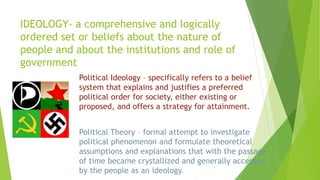
IDEOLOGY- a comprehensive and logically
ordered set or beliefs about the nature of
people and about the institutions and role of
government
Political Ideology – specifically refers to a belief
system that explains and justifies a preferred
political order for society, either existing or
proposed, and offers a strategy for attainment.
Political Theory – formal attempt to investigate
political phenomenon and formulate theoretical
assumptions and explanations that with the passage
of time became crystallized and generally accepted
by the people as an ideology.
CONSERVATISM
 Desires to maintain, or conserve, the existing order.
 Value the wisdom of the past and are generally opposed to
widespread reform and change .
 Emerged in the 19th century in reaction to the political and
social changes associated with the eras of the French
Revolution and the Industrial Revolution.
 Tendency to resort to moderate reform to preserve the
foundations of the established order.
 Religion, family, nationalism, Order, Tradition
 Maintenance of status quo.
 Edmund Burke, Joseph de Maistre – preserve power of the King
and aristocracy, etc.
Conservatism
 Belief in mans’ essential irrationality
 Need for sense of community
 Social hierarchy as inevitable
 High value placed on existing institutions
 Reliance on custom and tradition
 Religious (fundamentalism)
 Skeptical view of human nature
Liberalism
 A philosophy or movement that aims for the development of
individual freedom and expression.
 Believes in essential human goodness and human rationality
 People have the ability to recognize problems and solve them and
thus can achieve systematic improvement in the human condition.
 John Locke, Jean Jacques Rosseau
Classical Liberalism
 Stress on human rationality but also the importance of
individual property rights, natural rights, the need for
constitutional limitations on government, and freedom of
he individual from any kind of external restraint.
 Ideals of Age of Enlightenment. Prefect natural order thus
society no need for government interference.
 Adam Smith, David Ricardo
 Principles of Representative government, protection of
civil liberties, and laizzez Faire economics.
 But the industrial revolution bred inequality that brought
about questions that changed the doctrine of liberating
individuals based on historical realities.
Modern Liberalism
 Look at the state to prevent oppression and to advance
welfare of all individuals
 Government should have a responsibility in providing the
minimum conditions necessary for decent individual
existence.
 Welfare state (Scandinavian, post industrial countries)
 Environmentalism and Feminism
Feminism
 Patriarchal society thus it seeks to promote and improve
the political social economic position of women.
 Radical feminism – oppressive patriarchy is the root of the
most serious social problems more than class, ethnicity,
religion.
Environmentalism
 Concern for environmental conservation and
improvement of the state of the environment.
 Represented by the color green.
 Greenpeace, Haribon are example.
ANARCHISM
 No government
 Equality and justice are to be sought through the abolition of
the state and the substitution of free agreements between
individuals.
 Institutions corrupt individuals.
 Oppose
 Individual freedom and the denial of any authority, of the state.
 Mikhail Bakunin – attempted to orient the 1st Internatonal
toward anarchism but was defeated by Karl Marx
 Individualism
SOCIALISM
 An economic system in which property is held in common and not individually.
 Centralized economic / vital industries under government control
 Collective rule
 Wealth and power redistribution based on the total amount of work required
for production and an individual’s contribution to that workload.
 An intermediary step in moving from capitalism to communism. A transitional
stage on the road to communism
Forms
Social Democracy
Marxism-Leninism
COMMUNISM
 Political and Economic Philosophy
 Communist Manifesto 1848 – Marx-Engels “Abolition of private property”
 Proletariats (workers) main producer of wealth exploited by capitalist class.
 Revolution
 A specific stage of historical development that inevitably emerges from the
development of the productive forces that leads to a superabundance of
material wealth, allowing for distribution based on need and social relations
based on freely-associated individuals.
FASCISM
 State as an absolute
 Belief on a strongman leadership
 Race superiority – Aryan

Ideology

  • 2.
    IDEOLOGY- a comprehensiveand logically ordered set or beliefs about the nature of people and about the institutions and role of government Political Ideology – specifically refers to a belief system that explains and justifies a preferred political order for society, either existing or proposed, and offers a strategy for attainment. Political Theory – formal attempt to investigate political phenomenon and formulate theoretical assumptions and explanations that with the passage of time became crystallized and generally accepted by the people as an ideology.
  • 3.
    CONSERVATISM  Desires tomaintain, or conserve, the existing order.  Value the wisdom of the past and are generally opposed to widespread reform and change .  Emerged in the 19th century in reaction to the political and social changes associated with the eras of the French Revolution and the Industrial Revolution.  Tendency to resort to moderate reform to preserve the foundations of the established order.  Religion, family, nationalism, Order, Tradition  Maintenance of status quo.  Edmund Burke, Joseph de Maistre – preserve power of the King and aristocracy, etc.
  • 4.
    Conservatism  Belief inmans’ essential irrationality  Need for sense of community  Social hierarchy as inevitable  High value placed on existing institutions  Reliance on custom and tradition  Religious (fundamentalism)  Skeptical view of human nature
  • 5.
    Liberalism  A philosophyor movement that aims for the development of individual freedom and expression.  Believes in essential human goodness and human rationality  People have the ability to recognize problems and solve them and thus can achieve systematic improvement in the human condition.  John Locke, Jean Jacques Rosseau
  • 6.
    Classical Liberalism  Stresson human rationality but also the importance of individual property rights, natural rights, the need for constitutional limitations on government, and freedom of he individual from any kind of external restraint.  Ideals of Age of Enlightenment. Prefect natural order thus society no need for government interference.  Adam Smith, David Ricardo  Principles of Representative government, protection of civil liberties, and laizzez Faire economics.  But the industrial revolution bred inequality that brought about questions that changed the doctrine of liberating individuals based on historical realities.
  • 7.
    Modern Liberalism  Lookat the state to prevent oppression and to advance welfare of all individuals  Government should have a responsibility in providing the minimum conditions necessary for decent individual existence.  Welfare state (Scandinavian, post industrial countries)  Environmentalism and Feminism
  • 8.
    Feminism  Patriarchal societythus it seeks to promote and improve the political social economic position of women.  Radical feminism – oppressive patriarchy is the root of the most serious social problems more than class, ethnicity, religion.
  • 9.
    Environmentalism  Concern forenvironmental conservation and improvement of the state of the environment.  Represented by the color green.  Greenpeace, Haribon are example.
  • 10.
    ANARCHISM  No government Equality and justice are to be sought through the abolition of the state and the substitution of free agreements between individuals.  Institutions corrupt individuals.  Oppose  Individual freedom and the denial of any authority, of the state.  Mikhail Bakunin – attempted to orient the 1st Internatonal toward anarchism but was defeated by Karl Marx  Individualism
  • 11.
    SOCIALISM  An economicsystem in which property is held in common and not individually.  Centralized economic / vital industries under government control  Collective rule  Wealth and power redistribution based on the total amount of work required for production and an individual’s contribution to that workload.  An intermediary step in moving from capitalism to communism. A transitional stage on the road to communism Forms Social Democracy Marxism-Leninism
  • 12.
    COMMUNISM  Political andEconomic Philosophy  Communist Manifesto 1848 – Marx-Engels “Abolition of private property”  Proletariats (workers) main producer of wealth exploited by capitalist class.  Revolution  A specific stage of historical development that inevitably emerges from the development of the productive forces that leads to a superabundance of material wealth, allowing for distribution based on need and social relations based on freely-associated individuals.
  • 13.
    FASCISM  State asan absolute  Belief on a strongman leadership  Race superiority – Aryan