Non Viral Gene Transfer
Department of Pharmaceutical Sciences
R.T.M.N.U Nagpur - 440033
By Ashish Agrawal
Mpharm 1nd year 2018-2019
Gene Expression System
 Gene expression refers to a complex series of processes
in which the information encoded in a gene is used to
produce a functional product such as a protein that
dictates cell function.
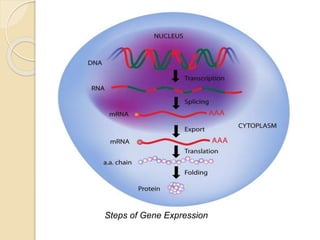
 It involves several different steps through which DNA is
converted to an RNA which in turn is converted into a
protein or in some cases an RNA, for example, genes
encoding the necessary information for transfer RNAs
and ribosomal RNAs (tRNAs and rRNAs).
Steps of Gene Expression
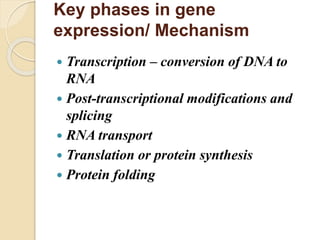
Key phases in gene
expression/ Mechanism
 Transcription – conversion of DNA to
RNA
 Post-transcriptional modifications and
splicing
 RNA transport
 Translation or protein synthesis
 Protein folding
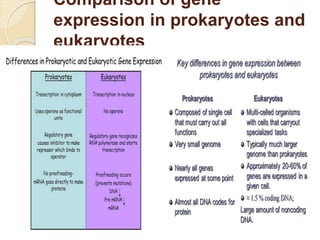
Comparison of gene
expression in prokaryotes and
eukaryotes
Gene Expression System
 An expression system refers to the factors that
work together to yield a particular gene product such as
a protein, ribozyme or RNA particle.
 The expression system is made up of a gene, which is
encoded by DNA, and the machinery needed to make
mRNA from the DNA and translate that into a protein.
 In this sense, every cell in the human body is an
expression system. However, the term usually refers to
gene expression in the laboratory.
 The way a virus replicates is a good example of how an
expression system may be used. The virus invades a host
cell and uses the cell’s machinery as a system to
generate viral gene products.
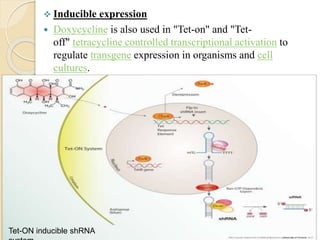
 Inducible expression
 Doxycycline is also used in "Tet-on" and "Tet-
off" tetracycline controlled transcriptional activation to
regulate transgene expression in organisms and cell
cultures.
Tet-ON inducible shRNA
 In nature
 In addition to these biological tools, certain naturally
observed configurations of DNA (genes, promoters,
enhancers, repressors) and the associated machinery itself
are referred to as an expression system.
 This term is normally used in the case where a gene or set of
genes is switched on under well defined conditions, for
example, the simple repressor switch expression system
in Lambda phage and the lac operator system in bacteria.
Several natural expression systems are directly used or
modified and used for artificial expression systems such as
the Tet-on and Tet-off expression system.
VECTOR AND ITS IDEAL
PROPERTIES:
 A Vector can be described as a
system fulfilling
 several functions
 1. Enabling delivery of genes to target
cells
 and their nucleus.
 2. Providing protection from gene
degradation.
 3. Ensuring gene transcription in the
cells.
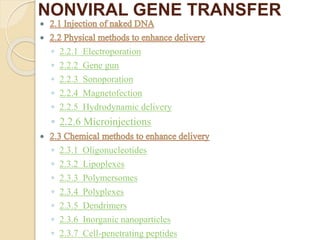
NONVIRAL GENE TRANSFER
◦ 2.2.1 Electroporation
◦ 2.2.2 Gene gun
◦ 2.2.3 Sonoporation
◦ 2.2.4 Magnetofection
◦ 2.2.5 Hydrodynamic delivery
◦ 2.2.6 Microinjections
◦ 2.3.1 Oligonucleotides
◦ 2.3.2 Lipoplexes
◦ 2.3.3 Polymersomes
◦ 2.3.4 Polyplexes
◦ 2.3.5 Dendrimers
◦ 2.3.6 Inorganic nanoparticles
◦ 2.3.7 Cell-penetrating peptides
Types of Nucleic acids
Non-viral vectors are generally used to transfer
following types of nucleic acids.
 Small DNA (Oligodeoxynucleotides) or related
molecules synthesized chemically.
 Large DNA molecules (Plasmid DNA: p DNA)
 RNA(Ribozymes, Si RNA, m RNA)
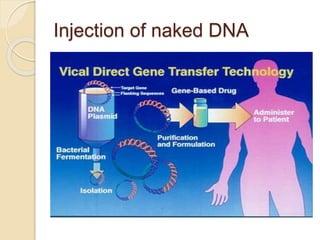
 simplest method of non-viral transfection
 Expression rate is very low as compared to other
methods.
 Cellular uptake of naked DNA is generally
inefficient.
 Only possible for certain tissues.
 Requires large amount of DNA.
 Different methods like Electroporation ,
Sonoporation and the use of a "gene gun", can be
used for direct injection of Naked DNA.
Injection of naked DNA
2.2.1 Electroporation
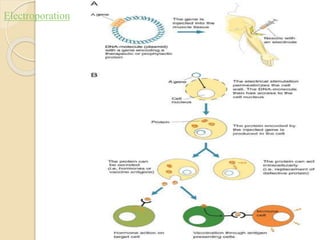
 It is a method that uses short pulses of high voltage to carry
DNA across the cell membrane and this shock causes
temporary formation of pores in the cell membrane, allowing
DNA molecules to pass through.
 It is Efficient and works across a broad range of cell types.
 Causes a high rate of cell death following electroporation has
limited its use, including clinical applications.
 More recently a newer method of electroporation, termed
electron-avalanche transfection, has been used in gene
therapy experiments. By using a high-voltage plasma
discharge, DNA was efficiently delivered following very short
(microsecond) pulses. Compared to electroporation, the
technique resulted in greatly increased efficiency and less
cellular damage.
Electroporation
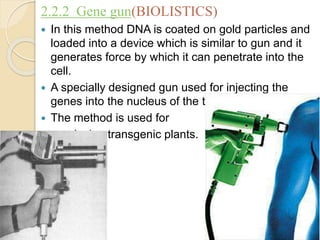
2.2.2 Gene gun(BIOLISTICS)
 In this method DNA is coated on gold particles and
loaded into a device which is similar to gun and it
generates force by which it can penetrate into the
cell.
 A specially designed gun used for injecting the
genes into the nucleus of the target cell.
 The method is used for
producing transgenic plants.
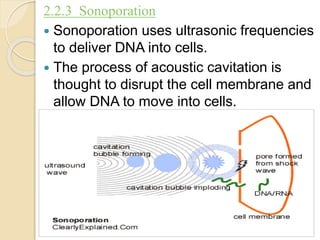
2.2.3 Sonoporation
 Sonoporation uses ultrasonic frequencies
to deliver DNA into cells.
 The process of acoustic cavitation is
thought to disrupt the cell membrane and
allow DNA to move into cells.
 Genetic material is incorporated within micro bubble
and administered into systemic circulation.
 This is followed by external application of
ultrasound.
 The ultrasound wave’s cavitate the micro bubble
within the microcirculation of target tissue, produces
bio effects that result in deposition of targeted
transfection of therapeutic gene.
 Micro bubbles are composed of gas filled core
[air/nitrogen/inert gas] with high molecular weight
such as per fluorocarbon or sulfur hexafluoride.
 The outer shell consists of biocompatible compounds
like lipids, proteins or synthetic biopolymers.
 Micro bubbles resemble red blood cells in
circulation (mean diameter of 2-4 μm).
 generally used in brain, cornea, kidney, peritoneal
cavity, and muscle and heart tissues.
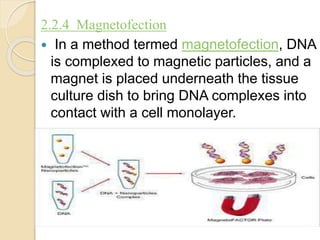
2.2.4 Magnetofection
 In a method termed magnetofection, DNA
is complexed to magnetic particles, and a
magnet is placed underneath the tissue
culture dish to bring DNA complexes into
contact with a cell monolayer.
 Electromagnets which are placed below
cell culture increases sedimentation of
complex and increases transfection
speed.
 In case of in vivo, the therapeutic gene-
magnetic particle complex is
administered intravenously. Using strong
high gradient external magnets, the
complex is captured and held at the
target.
 The genetic material is released by
enzymatic cleavage of cross linking
molecule, charge interaction or
2.2.5 Hydrodynamic delivery
 It is also called as Hydroporation
 . The technique uses hydrodynamic pressure to penetrate the
cell membrane.
 Hydrodynamic pressure is created by injecting large volume
of DNA solution in a fraction of time.
 This creates increased permeability of capillary endothelium
and forms pores in plasma membrane.
 The therapeutic gene of interest can reach the cell through
these pores and these membrane pores are closed later thus
keeping the genetic material inside the cell.
 This technique is most commonly used for gene therapy
research in hepatic cells
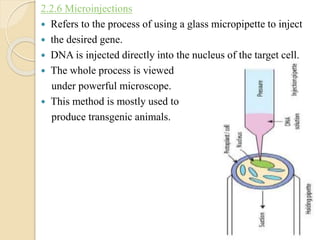
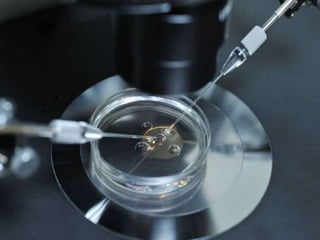
2.2.6 Microinjections
 Refers to the process of using a glass micropipette to inject
 the desired gene.
 DNA is injected directly into the nucleus of the target cell.
 The whole process is viewed
under powerful microscope.
 This method is mostly used to
produce transgenic animals.
2.3.1 Oligonucleotides
 To inactivate genes involved in disease process.
 Different approaches are used for Oligonucleotides based
Gene Therapy
1. Using antisense specific to the target gene which disrupts the
transcription of faulty genes.
2. By Using siRNA(small molecules of RNA) to signal the cell
to cleave specific sequences in the mRNA transcript of the
faulty genes which results in disruption of translation.
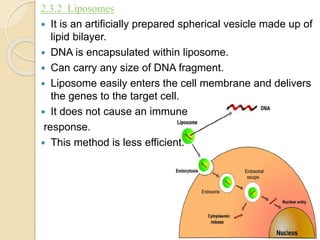
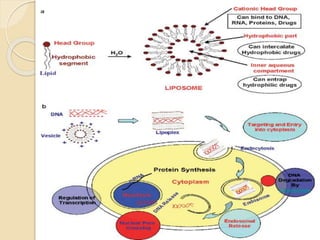
2.3.2 Liposomes
 It is an artificially prepared spherical vesicle made up of
lipid bilayer.
 DNA is encapsulated within liposome.
 Can carry any size of DNA fragment.
 Liposome easily enters the cell membrane and delivers
the genes to the target cell.
 It does not cause an immune
response.
 This method is less efficient.
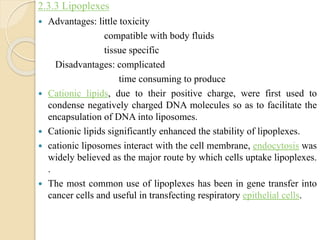
2.3.3 Lipoplexes
 Advantages: little toxicity
compatible with body fluids
tissue specific
Disadvantages: complicated
time consuming to produce
 Cationic lipids, due to their positive charge, were first used to
condense negatively charged DNA molecules so as to facilitate the
encapsulation of DNA into liposomes.
 Cationic lipids significantly enhanced the stability of lipoplexes.
 cationic liposomes interact with the cell membrane, endocytosis was
widely believed as the major route by which cells uptake lipoplexes.
.
 The most common use of lipoplexes has been in gene transfer into
cancer cells and useful in transfecting respiratory epithelial cells.
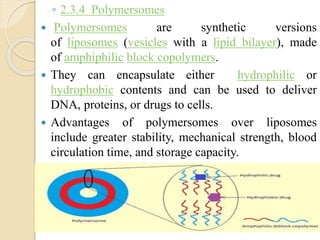
◦ 2.3.4 Polymersomes
 Polymersomes are synthetic versions
of liposomes (vesicles with a lipid bilayer), made
of amphiphilic block copolymers.
 They can encapsulate either hydrophilic or
hydrophobic contents and can be used to deliver
DNA, proteins, or drugs to cells.
 Advantages of polymersomes over liposomes
include greater stability, mechanical strength, blood
circulation time, and storage capacity.
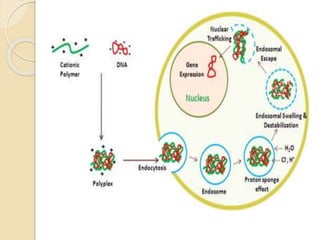
◦ 2.3.5 Polyplexes
 Complexes of polymers with DNA are called
polyplexes.
 Most polyplexes consist of cationic polymers and their
fabrication is based on self-assembly by ionic
interactions.
 Difference between polyplexes and lipoplexes is that
polyplexes cannot directly release their DNA load into
the cytoplasm.
 As a result, co-transfection with endosome-lytic agents
such as inactivated adenovirus was required to facilitate
nanoparticle escape from the endocytic vesicle made
during particle uptake.
 However, Polyethyleneimine and chitosan show proton
sponge effect, is disruption of endosomes and there is
no need of transfection by adenoviruses.
 Advantages: low toxicity,
high loading capacity,
ease of fabrication,
the ease of controlling the size, shape,
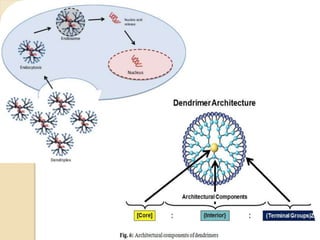
◦ 2.3.6 Dendrimers
 A dendrimer is a highly branched macromolecule with a
spherical shape.
 It is possible to construct a cationic dendrimer, i.e. one with a
positive surface charge.
 DNA or RNA with opposite charge binds with cationic
dendrimer.
 On reaching its destination the dendrimer-nucleic acid
complex is then taken into the cell via endocytosis.
 Limitations : the lack of ability to transfect some cell types,
the lack of robust active targeting capabilities,
incompatibility with animal models,
toxicity.
Production is slow and expensive process
 Adantages: offer robust covalent construction
extreme control over molecule structure and size.
◦ 2.3.7 Inorganic nanoparticles
 Inorganic nanoparticles, such as gold, silica, iron
oxide (ex. magnetofection) and calcium
phosphates have been shown to be capable of gene
delivery.
 Advantages: storage stability, low manufacturing
cost and time, low immunogenicity, and resistance to
microbial attack.
 Nanosized materials less than 100 nm have been
shown to efficiently trap the DNA or RNA and
allows its escape from the endosome without
degradation.
 Show improved in vitro transfection for attached
cell due to their increased density and preferential
location on the base of the culture dish.
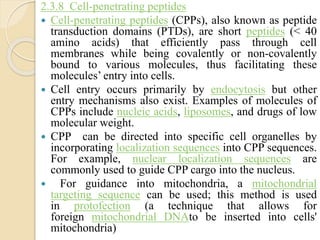
2.3.8 Cell-penetrating peptides
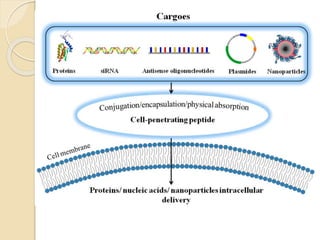
 Cell-penetrating peptides (CPPs), also known as peptide
transduction domains (PTDs), are short peptides (< 40
amino acids) that efficiently pass through cell
membranes while being covalently or non-covalently
bound to various molecules, thus facilitating these
molecules’ entry into cells.
 Cell entry occurs primarily by endocytosis but other
entry mechanisms also exist. Examples of molecules of
CPPs include nucleic acids, liposomes, and drugs of low
molecular weight.
 CPP can be directed into specific cell organelles by
incorporating localization sequences into CPP sequences.
For example, nuclear localization sequences are
commonly used to guide CPP cargo into the nucleus.
 For guidance into mitochondria, a mitochondrial
targeting sequence can be used; this method is used
in protofection (a technique that allows for
foreign mitochondrial DNAto be inserted into cells'
mitochondria)
Delivery methods Key Mechanism Tissue on which it is
effective
Advantage Disadvantage
Naked plasma/Plasmid
DNA[p DNA] –Direct
delivery
Endocytosis Muscle, skin, liver,
cardiac muscle and solid
tumour.
Safety. Simplicity. Low transfection
efficiency.
Gene Gun High pressure helium
stream
Ovarian cancer cell
line[invitro and in vivo
preclinical model]
Flexibility. Low
cytotoxicity. Good
efficiency.
Shallow penetration
Electroporation Enhancement of cell
membrane permeability
Skin, muscle. Good efficiency.
Repeatable.
Tissue damage.
Accessibility of electrodes
to internal organ are
limited.
Ultrasound + micro
bubble
Enhancement of cell
membrane permeability
Brain, cornea, kidney,
peritoneal cavity, muscle,
heart, vascular cells.
Safety. Flexibility. Low efficiency.
Magnetofection Pinocytosis and
endocytosis
primary cells and cells
difficult to transfect by
other methods[only
invitro]
Flexibility. Low
cytotoxicity.
Transient transfection.
Inorganic molecules Endocytosis Invitro Easy Production Storage
stability. Surface
functionalization.
Low efficiency
Lipoplexes[Lipid based] Endocytosis, DNA
condensation,
Airway epithelial cells,
endothelial cells,
hepatocytes, muscle cells.
Safety Low cytotoxicity Low to medium
efficiency Some results
immunogenicity.
Polyplexes and
Dendrimers
Endocytosis, DNA
condensation, protein
sponge effect
Lung, oral cavity. Low immunogenicity Fair
efficiency
Complement activation
Low efficiency
Cytotoxicity.
Refrences
 https://www.news-medical.net/life-sciences/Gene-Expression-An-
Overview.aspx
 https://www.news-medical.net/life-sciences/Gene-Expression-
Mechanism.aspx
 https://www.news-medical.net/life-sciences/Gene-Expression-
System.aspx
 https://en.wikipedia.org/wiki/Vectors_in_gene_therapy
 https://www.ncbi.nlm.nih.gov/pmc/articles/PMC4347098/
 Viral and nonviral delivery systems for gene delivery
Nouri Nayerossadat,1,2 Talebi Maedeh,1 and Palizban Abas Ali3
https://www.ncbi.nlm.nih.gov/pmc/articles/PMC3507026/

Non viral gene transfer

  • 1.
    Non Viral GeneTransfer Department of Pharmaceutical Sciences R.T.M.N.U Nagpur - 440033 By Ashish Agrawal Mpharm 1nd year 2018-2019
  • 2.
    Gene Expression System Gene expression refers to a complex series of processes in which the information encoded in a gene is used to produce a functional product such as a protein that dictates cell function.  It involves several different steps through which DNA is converted to an RNA which in turn is converted into a protein or in some cases an RNA, for example, genes encoding the necessary information for transfer RNAs and ribosomal RNAs (tRNAs and rRNAs).
  • 3.
    Steps of GeneExpression
  • 4.
    Key phases ingene expression/ Mechanism  Transcription – conversion of DNA to RNA  Post-transcriptional modifications and splicing  RNA transport  Translation or protein synthesis  Protein folding
  • 5.
    Comparison of gene expressionin prokaryotes and eukaryotes
  • 6.
    Gene Expression System An expression system refers to the factors that work together to yield a particular gene product such as a protein, ribozyme or RNA particle.  The expression system is made up of a gene, which is encoded by DNA, and the machinery needed to make mRNA from the DNA and translate that into a protein.  In this sense, every cell in the human body is an expression system. However, the term usually refers to gene expression in the laboratory.  The way a virus replicates is a good example of how an expression system may be used. The virus invades a host cell and uses the cell’s machinery as a system to generate viral gene products.
  • 7.
     Inducible expression Doxycycline is also used in "Tet-on" and "Tet- off" tetracycline controlled transcriptional activation to regulate transgene expression in organisms and cell cultures. Tet-ON inducible shRNA
  • 8.
     In nature In addition to these biological tools, certain naturally observed configurations of DNA (genes, promoters, enhancers, repressors) and the associated machinery itself are referred to as an expression system.  This term is normally used in the case where a gene or set of genes is switched on under well defined conditions, for example, the simple repressor switch expression system in Lambda phage and the lac operator system in bacteria. Several natural expression systems are directly used or modified and used for artificial expression systems such as the Tet-on and Tet-off expression system.
  • 9.
    VECTOR AND ITSIDEAL PROPERTIES:  A Vector can be described as a system fulfilling  several functions  1. Enabling delivery of genes to target cells  and their nucleus.  2. Providing protection from gene degradation.  3. Ensuring gene transcription in the cells.
  • 10.
    NONVIRAL GENE TRANSFER ◦2.2.1 Electroporation ◦ 2.2.2 Gene gun ◦ 2.2.3 Sonoporation ◦ 2.2.4 Magnetofection ◦ 2.2.5 Hydrodynamic delivery ◦ 2.2.6 Microinjections ◦ 2.3.1 Oligonucleotides ◦ 2.3.2 Lipoplexes ◦ 2.3.3 Polymersomes ◦ 2.3.4 Polyplexes ◦ 2.3.5 Dendrimers ◦ 2.3.6 Inorganic nanoparticles ◦ 2.3.7 Cell-penetrating peptides
  • 11.
    Types of Nucleicacids Non-viral vectors are generally used to transfer following types of nucleic acids.  Small DNA (Oligodeoxynucleotides) or related molecules synthesized chemically.  Large DNA molecules (Plasmid DNA: p DNA)  RNA(Ribozymes, Si RNA, m RNA)
  • 12.
     simplest methodof non-viral transfection  Expression rate is very low as compared to other methods.  Cellular uptake of naked DNA is generally inefficient.  Only possible for certain tissues.  Requires large amount of DNA.  Different methods like Electroporation , Sonoporation and the use of a "gene gun", can be used for direct injection of Naked DNA.
  • 13.
  • 14.
    2.2.1 Electroporation  Itis a method that uses short pulses of high voltage to carry DNA across the cell membrane and this shock causes temporary formation of pores in the cell membrane, allowing DNA molecules to pass through.  It is Efficient and works across a broad range of cell types.  Causes a high rate of cell death following electroporation has limited its use, including clinical applications.  More recently a newer method of electroporation, termed electron-avalanche transfection, has been used in gene therapy experiments. By using a high-voltage plasma discharge, DNA was efficiently delivered following very short (microsecond) pulses. Compared to electroporation, the technique resulted in greatly increased efficiency and less cellular damage.
  • 15.
  • 16.
    2.2.2 Gene gun(BIOLISTICS) In this method DNA is coated on gold particles and loaded into a device which is similar to gun and it generates force by which it can penetrate into the cell.  A specially designed gun used for injecting the genes into the nucleus of the target cell.  The method is used for producing transgenic plants.
  • 17.
    2.2.3 Sonoporation  Sonoporationuses ultrasonic frequencies to deliver DNA into cells.  The process of acoustic cavitation is thought to disrupt the cell membrane and allow DNA to move into cells.
  • 18.
     Genetic materialis incorporated within micro bubble and administered into systemic circulation.  This is followed by external application of ultrasound.  The ultrasound wave’s cavitate the micro bubble within the microcirculation of target tissue, produces bio effects that result in deposition of targeted transfection of therapeutic gene.  Micro bubbles are composed of gas filled core [air/nitrogen/inert gas] with high molecular weight such as per fluorocarbon or sulfur hexafluoride.  The outer shell consists of biocompatible compounds like lipids, proteins or synthetic biopolymers.  Micro bubbles resemble red blood cells in circulation (mean diameter of 2-4 μm).  generally used in brain, cornea, kidney, peritoneal cavity, and muscle and heart tissues.
  • 19.
    2.2.4 Magnetofection  Ina method termed magnetofection, DNA is complexed to magnetic particles, and a magnet is placed underneath the tissue culture dish to bring DNA complexes into contact with a cell monolayer.
  • 20.
     Electromagnets whichare placed below cell culture increases sedimentation of complex and increases transfection speed.  In case of in vivo, the therapeutic gene- magnetic particle complex is administered intravenously. Using strong high gradient external magnets, the complex is captured and held at the target.  The genetic material is released by enzymatic cleavage of cross linking molecule, charge interaction or
  • 21.
    2.2.5 Hydrodynamic delivery It is also called as Hydroporation  . The technique uses hydrodynamic pressure to penetrate the cell membrane.  Hydrodynamic pressure is created by injecting large volume of DNA solution in a fraction of time.  This creates increased permeability of capillary endothelium and forms pores in plasma membrane.  The therapeutic gene of interest can reach the cell through these pores and these membrane pores are closed later thus keeping the genetic material inside the cell.  This technique is most commonly used for gene therapy research in hepatic cells
  • 22.
    2.2.6 Microinjections  Refersto the process of using a glass micropipette to inject  the desired gene.  DNA is injected directly into the nucleus of the target cell.  The whole process is viewed under powerful microscope.  This method is mostly used to produce transgenic animals.
  • 24.
    2.3.1 Oligonucleotides  Toinactivate genes involved in disease process.  Different approaches are used for Oligonucleotides based Gene Therapy 1. Using antisense specific to the target gene which disrupts the transcription of faulty genes. 2. By Using siRNA(small molecules of RNA) to signal the cell to cleave specific sequences in the mRNA transcript of the faulty genes which results in disruption of translation.
  • 25.
    2.3.2 Liposomes  Itis an artificially prepared spherical vesicle made up of lipid bilayer.  DNA is encapsulated within liposome.  Can carry any size of DNA fragment.  Liposome easily enters the cell membrane and delivers the genes to the target cell.  It does not cause an immune response.  This method is less efficient.
  • 26.
    2.3.3 Lipoplexes  Advantages:little toxicity compatible with body fluids tissue specific Disadvantages: complicated time consuming to produce  Cationic lipids, due to their positive charge, were first used to condense negatively charged DNA molecules so as to facilitate the encapsulation of DNA into liposomes.  Cationic lipids significantly enhanced the stability of lipoplexes.  cationic liposomes interact with the cell membrane, endocytosis was widely believed as the major route by which cells uptake lipoplexes. .  The most common use of lipoplexes has been in gene transfer into cancer cells and useful in transfecting respiratory epithelial cells.
  • 28.
    ◦ 2.3.4 Polymersomes Polymersomes are synthetic versions of liposomes (vesicles with a lipid bilayer), made of amphiphilic block copolymers.  They can encapsulate either hydrophilic or hydrophobic contents and can be used to deliver DNA, proteins, or drugs to cells.  Advantages of polymersomes over liposomes include greater stability, mechanical strength, blood circulation time, and storage capacity.
  • 29.
    ◦ 2.3.5 Polyplexes Complexes of polymers with DNA are called polyplexes.  Most polyplexes consist of cationic polymers and their fabrication is based on self-assembly by ionic interactions.  Difference between polyplexes and lipoplexes is that polyplexes cannot directly release their DNA load into the cytoplasm.  As a result, co-transfection with endosome-lytic agents such as inactivated adenovirus was required to facilitate nanoparticle escape from the endocytic vesicle made during particle uptake.  However, Polyethyleneimine and chitosan show proton sponge effect, is disruption of endosomes and there is no need of transfection by adenoviruses.  Advantages: low toxicity, high loading capacity, ease of fabrication, the ease of controlling the size, shape,
  • 31.
    ◦ 2.3.6 Dendrimers A dendrimer is a highly branched macromolecule with a spherical shape.  It is possible to construct a cationic dendrimer, i.e. one with a positive surface charge.  DNA or RNA with opposite charge binds with cationic dendrimer.  On reaching its destination the dendrimer-nucleic acid complex is then taken into the cell via endocytosis.  Limitations : the lack of ability to transfect some cell types, the lack of robust active targeting capabilities, incompatibility with animal models, toxicity. Production is slow and expensive process  Adantages: offer robust covalent construction extreme control over molecule structure and size.
  • 33.
    ◦ 2.3.7 Inorganicnanoparticles  Inorganic nanoparticles, such as gold, silica, iron oxide (ex. magnetofection) and calcium phosphates have been shown to be capable of gene delivery.  Advantages: storage stability, low manufacturing cost and time, low immunogenicity, and resistance to microbial attack.  Nanosized materials less than 100 nm have been shown to efficiently trap the DNA or RNA and allows its escape from the endosome without degradation.  Show improved in vitro transfection for attached cell due to their increased density and preferential location on the base of the culture dish.
  • 34.
    2.3.8 Cell-penetrating peptides Cell-penetrating peptides (CPPs), also known as peptide transduction domains (PTDs), are short peptides (< 40 amino acids) that efficiently pass through cell membranes while being covalently or non-covalently bound to various molecules, thus facilitating these molecules’ entry into cells.  Cell entry occurs primarily by endocytosis but other entry mechanisms also exist. Examples of molecules of CPPs include nucleic acids, liposomes, and drugs of low molecular weight.  CPP can be directed into specific cell organelles by incorporating localization sequences into CPP sequences. For example, nuclear localization sequences are commonly used to guide CPP cargo into the nucleus.  For guidance into mitochondria, a mitochondrial targeting sequence can be used; this method is used in protofection (a technique that allows for foreign mitochondrial DNAto be inserted into cells' mitochondria)
  • 36.
    Delivery methods KeyMechanism Tissue on which it is effective Advantage Disadvantage Naked plasma/Plasmid DNA[p DNA] –Direct delivery Endocytosis Muscle, skin, liver, cardiac muscle and solid tumour. Safety. Simplicity. Low transfection efficiency. Gene Gun High pressure helium stream Ovarian cancer cell line[invitro and in vivo preclinical model] Flexibility. Low cytotoxicity. Good efficiency. Shallow penetration Electroporation Enhancement of cell membrane permeability Skin, muscle. Good efficiency. Repeatable. Tissue damage. Accessibility of electrodes to internal organ are limited. Ultrasound + micro bubble Enhancement of cell membrane permeability Brain, cornea, kidney, peritoneal cavity, muscle, heart, vascular cells. Safety. Flexibility. Low efficiency. Magnetofection Pinocytosis and endocytosis primary cells and cells difficult to transfect by other methods[only invitro] Flexibility. Low cytotoxicity. Transient transfection. Inorganic molecules Endocytosis Invitro Easy Production Storage stability. Surface functionalization. Low efficiency Lipoplexes[Lipid based] Endocytosis, DNA condensation, Airway epithelial cells, endothelial cells, hepatocytes, muscle cells. Safety Low cytotoxicity Low to medium efficiency Some results immunogenicity. Polyplexes and Dendrimers Endocytosis, DNA condensation, protein sponge effect Lung, oral cavity. Low immunogenicity Fair efficiency Complement activation Low efficiency Cytotoxicity.
  • 37.
    Refrences  https://www.news-medical.net/life-sciences/Gene-Expression-An- Overview.aspx  https://www.news-medical.net/life-sciences/Gene-Expression- Mechanism.aspx https://www.news-medical.net/life-sciences/Gene-Expression- System.aspx  https://en.wikipedia.org/wiki/Vectors_in_gene_therapy  https://www.ncbi.nlm.nih.gov/pmc/articles/PMC4347098/  Viral and nonviral delivery systems for gene delivery Nouri Nayerossadat,1,2 Talebi Maedeh,1 and Palizban Abas Ali3 https://www.ncbi.nlm.nih.gov/pmc/articles/PMC3507026/