Shift Left Testing
Traditional testing :
• A typical waterfall software development project would have seen
testing occur immediately prior to release into production. This
meant that when bugs or usability issues were inevitably found, the
release would be delayed until these were fixed.
What’s shift left testing?
• The easiest way to explain shift-left software testing is to think of the
development cycle as a line running from left to right.
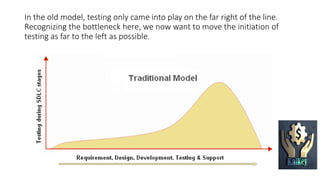
In the old model, testing only came into play on the far right of the line.
Recognizing the bottleneck here, we now want to move the initiation of
testing as far to the left as possible.
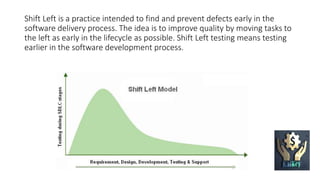
Shift Left is a practice intended to find and prevent defects early in the
software delivery process. The idea is to improve quality by moving tasks to
the left as early in the lifecycle as possible. Shift Left testing means testing
earlier in the software development process.
Why Shift Left?
• In the traditional software development model, requirements are kept
on the left side of the plan, and the delivery and testing requirements
on the right. The problem is that these practices can’t handle changing
expectations and requirements, resulting in negative outcomes for the
business such as:
• Increased costs
• Increased time to market
• Unexpected errors
Is Shift Left always appropriate?
• A Shift Left testing approach may not always be able to deliver optimal
performance and functioning in a real-world environment. In such
situations, a Shift Right testing strategy may help to:
 Enhance customer experience
 Provide scope for implementation of test automation
 Ensure better test coverage
• Shift Right initiates testing from the right, i.e., post-production. In this Shift
Right practice, you’ll test a completely built and functioning application to
ensure performance and usability traits. Reviews and feedbacks from
targeted users further help in enhancing the quality of the software.
How to move to Shift Left?
• Demand planning
Test analysts will engage with business and operational stakeholders,
providing a forward view of demand. Having this view enables you to—
ahead of time—plan and finalize:
 The budget
 Resourcing
 Test strategies
Static testing
• Static testing is carried out in the early cycles of the project, and
includes validation of requirements and design. The purpose of static
testing is to find defects early in the life cycle that could prove to be
very expensive to remove in the later phases of the project.
• Use appropriate checklists to verify and validate requirements and
design. Log defects into a defect management tool.
Benefits of a shift left approach
• There are several benefits that can be obtained by adopting a shift
left strategy. Here are some of the most important:
• Automation
• Increased delivery speed
• Increased satisfaction

Shift left

  • 1.
  • 2.
    Traditional testing : •A typical waterfall software development project would have seen testing occur immediately prior to release into production. This meant that when bugs or usability issues were inevitably found, the release would be delayed until these were fixed.
  • 3.
    What’s shift lefttesting? • The easiest way to explain shift-left software testing is to think of the development cycle as a line running from left to right.
  • 4.
    In the oldmodel, testing only came into play on the far right of the line. Recognizing the bottleneck here, we now want to move the initiation of testing as far to the left as possible.
  • 5.
    Shift Left isa practice intended to find and prevent defects early in the software delivery process. The idea is to improve quality by moving tasks to the left as early in the lifecycle as possible. Shift Left testing means testing earlier in the software development process.
  • 6.
    Why Shift Left? •In the traditional software development model, requirements are kept on the left side of the plan, and the delivery and testing requirements on the right. The problem is that these practices can’t handle changing expectations and requirements, resulting in negative outcomes for the business such as: • Increased costs • Increased time to market • Unexpected errors
  • 7.
    Is Shift Leftalways appropriate? • A Shift Left testing approach may not always be able to deliver optimal performance and functioning in a real-world environment. In such situations, a Shift Right testing strategy may help to:  Enhance customer experience  Provide scope for implementation of test automation  Ensure better test coverage • Shift Right initiates testing from the right, i.e., post-production. In this Shift Right practice, you’ll test a completely built and functioning application to ensure performance and usability traits. Reviews and feedbacks from targeted users further help in enhancing the quality of the software.
  • 8.
    How to moveto Shift Left? • Demand planning Test analysts will engage with business and operational stakeholders, providing a forward view of demand. Having this view enables you to— ahead of time—plan and finalize:  The budget  Resourcing  Test strategies
  • 9.
    Static testing • Statictesting is carried out in the early cycles of the project, and includes validation of requirements and design. The purpose of static testing is to find defects early in the life cycle that could prove to be very expensive to remove in the later phases of the project. • Use appropriate checklists to verify and validate requirements and design. Log defects into a defect management tool.
  • 10.
    Benefits of ashift left approach • There are several benefits that can be obtained by adopting a shift left strategy. Here are some of the most important: • Automation • Increased delivery speed • Increased satisfaction