Sense relation
Sense relation
• Sense is relation between forms and meanings.
• We get the meanings through comparison and
difference. We get proper meaning through a
comparison with other. If you describe the
meaning of word black than you will compare it
with white. If there is a girl then how we will
differentiate a girl from a boy.
Types of relations
• Hyponymy: It is a term used to describe the
relation of words like there is word dog and dog
is the hyponym of animal(hypernym).
• Super ordinate hyponymy: the main
character (hypernym) e.g animals, birds.
• Subordinate: another character from which
the main figure belongs.
Synonymy
• Synonymy is the state or phenomenon in which
the words that sound different but have same
meaning as another word.
• It does not change the truth value of sentence.
• Ex: king royal , buy purchase
• big large , small little
Antonymy
• It is a state in which words have the sense
relation which involve the opposite meaning.
• Words are totally opposite in this relation.
• Ex: big small , good bad , fast slow
• Gradable antonym: its name shows that
maybe divided into different grades like hot ,
very hot, more hot, to hot . They vary person to
person may for you its hot and cold for me.
Complementary antonym
• Complementary antonym are those for
which the assertion of one entails the negation of
the other vice versa. Ex: alive dead, right wrong,
right left.
• Relational antonym: They are pairs of words
that refer to a relationship from opposite point
of view. These antonyms depend upon each
other e.g buyer=seller , teacher=student
• Parent=child, above=below.
• Converses are sometime referred to as
complementary antonyms because an
“either/or” relationship is present between
theme. Ex: buy=sell, lend=borrow, east=west
• Antipode antonym: These antonyms are
situated on opposite direction of each other. Like
and left right, up and down.
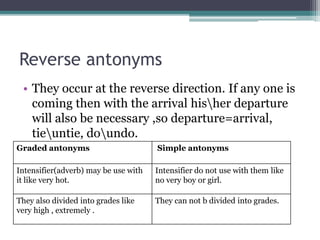
Reverse antonyms
• They occur at the reverse direction. If any one is
coming then with the arrival hisher departure
will also be necessary ,so departure=arrival,
tieuntie, doundo.
Graded antonyms Simple antonyms
Intensifier(adverb) may be use with
it like very hot.
Intensifier do not use with them like
no very boy or girl.
They also divided into grades like
very high , extremely .
They can not b divided into grades.
Homonymy
• Homonyms are two words that spelled the same
and sound the same but have different
meanings. E.g address to speak /location, band a
musical group/a ring, bat.
Homophones
• Homophones are words that sound alike. They
have same sound but different meaning and they
are often spelled differently. For example fate
and fete. Fate is an inevitable outcome but fete is
festival or party. Two/too.
Homographs
• Homographs are words that spelled the same.
They have same spelling but different meanings
and usually different pronunciation. For
example the word tear it means water from eye
and other means to rip paper into pieces. Other
examples: bow (to bend at waist)(a piece of
archery equipment), entrance (to hold one’s
attention) (a doorwar).
Polysemy
• Some words have more than one meanings or
sense. As above example of bank and get which
means understand, become. It is distinguished
from simple homonyms where words sound
alike but have different meaning. E.g book a
bound collection of pages and a text reproduced
and distributed,2) milk.
Meronym
• A meronym is a word that denote the part and
whole thing. For example apple is a meronym of
apple tree. This part to whole relationship is
called meronymy. Other example: like the word
finger and it is hyponym of hand so in this
example the word finger is the part and hand is
the whole.

Sense Relations

  • 1.
  • 2.
    Sense relation • Senseis relation between forms and meanings. • We get the meanings through comparison and difference. We get proper meaning through a comparison with other. If you describe the meaning of word black than you will compare it with white. If there is a girl then how we will differentiate a girl from a boy.
  • 3.
    Types of relations •Hyponymy: It is a term used to describe the relation of words like there is word dog and dog is the hyponym of animal(hypernym). • Super ordinate hyponymy: the main character (hypernym) e.g animals, birds. • Subordinate: another character from which the main figure belongs.
  • 4.
    Synonymy • Synonymy isthe state or phenomenon in which the words that sound different but have same meaning as another word. • It does not change the truth value of sentence. • Ex: king royal , buy purchase • big large , small little
  • 5.
    Antonymy • It isa state in which words have the sense relation which involve the opposite meaning. • Words are totally opposite in this relation. • Ex: big small , good bad , fast slow • Gradable antonym: its name shows that maybe divided into different grades like hot , very hot, more hot, to hot . They vary person to person may for you its hot and cold for me.
  • 6.
    Complementary antonym • Complementaryantonym are those for which the assertion of one entails the negation of the other vice versa. Ex: alive dead, right wrong, right left. • Relational antonym: They are pairs of words that refer to a relationship from opposite point of view. These antonyms depend upon each other e.g buyer=seller , teacher=student • Parent=child, above=below.
  • 7.
    • Converses aresometime referred to as complementary antonyms because an “either/or” relationship is present between theme. Ex: buy=sell, lend=borrow, east=west • Antipode antonym: These antonyms are situated on opposite direction of each other. Like and left right, up and down.
  • 8.
    Reverse antonyms • Theyoccur at the reverse direction. If any one is coming then with the arrival hisher departure will also be necessary ,so departure=arrival, tieuntie, doundo. Graded antonyms Simple antonyms Intensifier(adverb) may be use with it like very hot. Intensifier do not use with them like no very boy or girl. They also divided into grades like very high , extremely . They can not b divided into grades.
  • 9.
    Homonymy • Homonyms aretwo words that spelled the same and sound the same but have different meanings. E.g address to speak /location, band a musical group/a ring, bat.
  • 10.
    Homophones • Homophones arewords that sound alike. They have same sound but different meaning and they are often spelled differently. For example fate and fete. Fate is an inevitable outcome but fete is festival or party. Two/too.
  • 11.
    Homographs • Homographs arewords that spelled the same. They have same spelling but different meanings and usually different pronunciation. For example the word tear it means water from eye and other means to rip paper into pieces. Other examples: bow (to bend at waist)(a piece of archery equipment), entrance (to hold one’s attention) (a doorwar).
  • 12.
    Polysemy • Some wordshave more than one meanings or sense. As above example of bank and get which means understand, become. It is distinguished from simple homonyms where words sound alike but have different meaning. E.g book a bound collection of pages and a text reproduced and distributed,2) milk.
  • 13.
    Meronym • A meronymis a word that denote the part and whole thing. For example apple is a meronym of apple tree. This part to whole relationship is called meronymy. Other example: like the word finger and it is hyponym of hand so in this example the word finger is the part and hand is the whole.