Pragmatics:
Presented by: Hina Javaid
Roll # 100884006
Mapping:
Explicit vs implicit meaning
Presupposition and
entailment
Grice‟s theory
Cooperative principles
Grice‟s Maxims Implicature
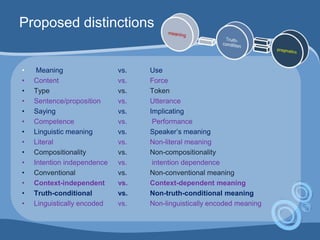
Proposed distinctions
• Meaning vs. Use
• Content vs. Force
• Type vs. Token
• Sentence/proposition vs. Utterance
• Saying vs. Implicating
• Competence vs. Performance
• Linguistic meaning vs. Speaker‟s meaning
• Literal vs. Non-literal meaning
• Compositionality vs. Non-compositionality
• Intention independence vs. intention dependence
• Conventional vs. Non-conventional meaning
• Context-independent vs. Context-dependent meaning
• Truth-conditional vs. Non-truth-conditional meaning
• Linguistically encoded vs. Non-linguistically encoded meaning
sentence conventional
meaning
disambiguation
reference
fixing, i.e., what is said
Explicit
meaning
(semantic
meaning)
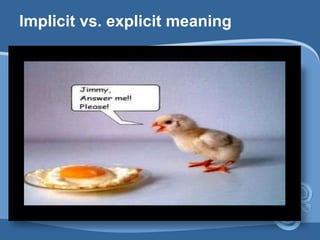
Implicit vs. explicit meaning
• Gricean view
• Explicit meaning:
– sentence's conventional meaning
– the meaning obtained by the combination of
• Implicit meaning:
– The remaining of utterance meaning, presuppositions and implicatures.
Pragmatics
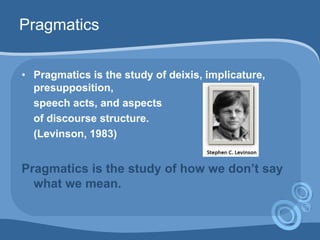
• Pragmatics is the study of deixis, implicature,
presupposition,
speech acts, and aspects
of discourse structure.
(Levinson, 1983)
Pragmatics is the study of how we don’t say
what we mean.
• Semantic context dependence
• Presupposition / Conventional implicature
• Conversational Implicature
• Speech Acts
• Textual cohesion and coherence
• Conversational structure (dialogue)
according to Levinson: Pragmatics. CUP
Pragmatics: Subareas
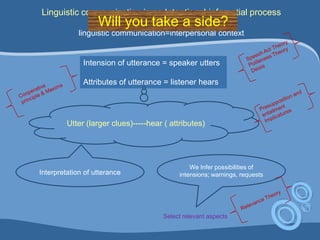
Linguistic communication is an Intentional-inferential process
linguistic communication=interpersonal context
Intension of utterance = speaker utters
Attributes of utterance = listener hears
Interpretation of utterance
We Infer possibilities of
intensions; warnings, requests
Utter (larger clues)-----hear ( attributes)
Select relevant aspects
Will you take a side?
Presuppositions and entailments
Two aspects of what is communicated but not said
• Gottlob Frege (1848-1925) noted presupposition in his book.
• Presupposition is what a speaker or writer assumes that the
receiver of the message already knows.
• In saying X, we presuppose Y.
• E.g. John doesn‟t write poetry anymore → John once wrote poetry.
• Speakers, not sentences, have presuppositions,
• symbolized as >> .
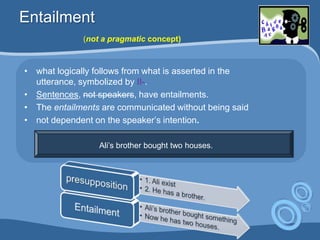
Entailment
(not a pragmatic concept)
• what logically follows from what is asserted in the
utterance, symbolized by II-.
• Sentences, not speakers, have entailments.
• The entailments are communicated without being said
• not dependent on the speaker‟s intention.
Ali‟s brother bought two houses.
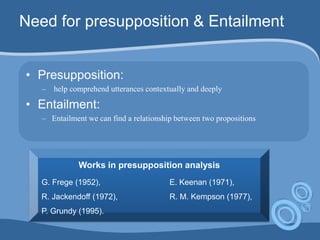
Need for presupposition & Entailment
• Presupposition:
– help comprehend utterances contextually and deeply
• Entailment:
– Entailment we can find a relationship between two propositions
Works in presupposition analysis
G. Frege (1952), E. Keenan (1971),
R. Jackendoff (1972), R. M. Kempson (1977),
P. Grundy (1995).
Grice‟s Pragmatic Theory &
Intentional-inferential approach
• Grice‟s pragmatic theory (Grice 1989), shows how
semantic theories can be greatly simplified where
judgements about meaning can be accounted for via
the mechanism of conversational implicature rather
than derived by entailment from conventional
meaning.
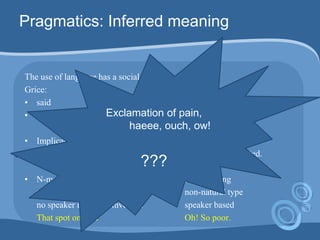
Pragmatics: Inferred meaning
The use of language has a social function
Grice:
• said (= truth-condition)
• implicated (= non-truth-condition)
• Implicature is calculated on the basis of what is said;
what is said provides input to what is implicated.
• N-meaning NN-meaning
natural type non-natural type
no speaker intension involved speaker based
That spot on skin Oh! So poor.
Exclamation of pain,
haeee, ouch, ow!
???
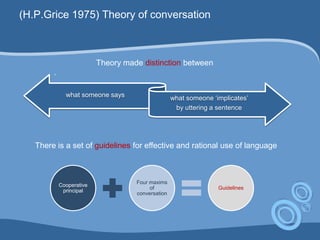
(H.P.Grice 1975) Theory of conversation
Theory made distinction between
.
what someone says what someone „implicates‟
by uttering a sentence
Cooperative
principal
Four maxims
of
conversation
Guidelines
There is a set of guidelines for effective and rational use of language
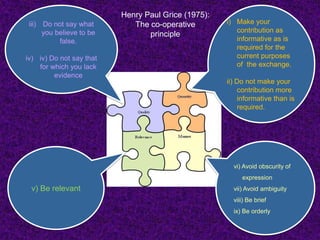
i) Make your
contribution as
informative as is
required for the
current purposes
of the exchange.
ii) Do not make your
contribution more
informative than is
required.
iii) Do not say what
you believe to be
false.
iv) iv) Do not say that
for which you lack
evidence
vi) Avoid obscurity of
expression
vii) Avoid ambiguity
viii) Be brief
ix) Be orderly
v) Be relevant
Henry Paul Grice (1975):
The co-operative
principle
Gricean maxims and cooperative
principle
• 2 Way cooperation:
1. speakers observe the cooperative principle
2. listeners assume that speakers are observing it
• The Cooperative Principle and the Grecian Maxims
are not specific to conversation but to interaction as a
whole.
Gricean maxims and cooperative
principle
• Flouting the maxims:
– Manipulated positively and negatively
– produce a negative pragmatic effect, as with sarcasm or
irony.
This allows for the possibility of implicatures, which are
meanings that are not explicitly conveyed in what is said, but
that can nonetheless be inferred.
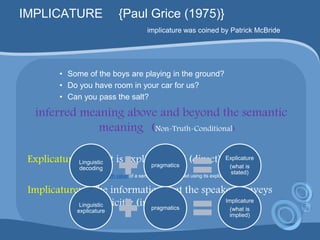
IMPLICATURE {Paul Grice (1975)}
implicature was coined by Patrick McBride
• Some of the boys are playing in the ground?
• Do you have room in your car for us?
• Can you pass the salt?
inferred meaning above and beyond the semantic
meaning (Non-Truth-Conditional)
Explicature: what is explicitly said (direct)
(The truth value of a sentence is determined using its explicature)
Implicature: The information that the speaker conveys
implicitly (indirect)
Linguistic
decoding
pragmatics
Explicature
(what is
stated)
Linguistic
explicature
pragmatics
Implicature
(what is
implied)
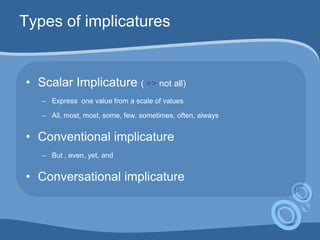
Types of implicatures
• Scalar Implicature ( +> not all)
– Express one value from a scale of values
– All, most, most, some, few, sometimes, often, always
• Conventional implicature
– But , even, yet, and
• Conversational implicature
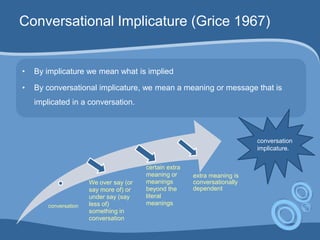
Conversational Implicature (Grice 1967)
• By implicature we mean what is implied
• By conversational implicature, we mean a meaning or message that is
implicated in a conversation.
conversation
We over say (or
say more of) or
under say (say
less of)
something in
conversation
certain extra
meaning or
meanings
beyond the
literal
meanings
extra meaning is
conversationally
dependent
conversation
implicature.
Example:
• Mary: „Did you manage to fix that leak?
• Jim: „I tried to.‟
Jim‟s utterance may implicate that Jim didn‟t fix it
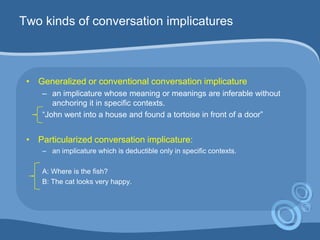
Two kinds of conversation implicatures
• Generalized or conventional conversation implicature
– an implicature whose meaning or meanings are inferable without
anchoring it in specific contexts.
“John went into a house and found a tortoise in front of a door”
• Particularized conversation implicature:
– an implicature which is deductible only in specific contexts.
A: Where is the fish?
B: The cat looks very happy.
Shumaila KiranNext presenter

Honey's presentaion

  • 1.
    Pragmatics: Presented by: HinaJavaid Roll # 100884006 Mapping: Explicit vs implicit meaning Presupposition and entailment Grice‟s theory Cooperative principles Grice‟s Maxims Implicature
  • 2.
    Proposed distinctions • Meaningvs. Use • Content vs. Force • Type vs. Token • Sentence/proposition vs. Utterance • Saying vs. Implicating • Competence vs. Performance • Linguistic meaning vs. Speaker‟s meaning • Literal vs. Non-literal meaning • Compositionality vs. Non-compositionality • Intention independence vs. intention dependence • Conventional vs. Non-conventional meaning • Context-independent vs. Context-dependent meaning • Truth-conditional vs. Non-truth-conditional meaning • Linguistically encoded vs. Non-linguistically encoded meaning
  • 4.
    sentence conventional meaning disambiguation reference fixing, i.e.,what is said Explicit meaning (semantic meaning) Implicit vs. explicit meaning • Gricean view • Explicit meaning: – sentence's conventional meaning – the meaning obtained by the combination of • Implicit meaning: – The remaining of utterance meaning, presuppositions and implicatures.
  • 5.
    Pragmatics • Pragmatics isthe study of deixis, implicature, presupposition, speech acts, and aspects of discourse structure. (Levinson, 1983) Pragmatics is the study of how we don’t say what we mean.
  • 6.
    • Semantic contextdependence • Presupposition / Conventional implicature • Conversational Implicature • Speech Acts • Textual cohesion and coherence • Conversational structure (dialogue) according to Levinson: Pragmatics. CUP Pragmatics: Subareas
  • 7.
    Linguistic communication isan Intentional-inferential process linguistic communication=interpersonal context Intension of utterance = speaker utters Attributes of utterance = listener hears Interpretation of utterance We Infer possibilities of intensions; warnings, requests Utter (larger clues)-----hear ( attributes) Select relevant aspects Will you take a side?
  • 8.
    Presuppositions and entailments Twoaspects of what is communicated but not said • Gottlob Frege (1848-1925) noted presupposition in his book. • Presupposition is what a speaker or writer assumes that the receiver of the message already knows. • In saying X, we presuppose Y. • E.g. John doesn‟t write poetry anymore → John once wrote poetry. • Speakers, not sentences, have presuppositions, • symbolized as >> .
  • 9.
    Entailment (not a pragmaticconcept) • what logically follows from what is asserted in the utterance, symbolized by II-. • Sentences, not speakers, have entailments. • The entailments are communicated without being said • not dependent on the speaker‟s intention. Ali‟s brother bought two houses.
  • 10.
    Need for presupposition& Entailment • Presupposition: – help comprehend utterances contextually and deeply • Entailment: – Entailment we can find a relationship between two propositions Works in presupposition analysis G. Frege (1952), E. Keenan (1971), R. Jackendoff (1972), R. M. Kempson (1977), P. Grundy (1995).
  • 11.
    Grice‟s Pragmatic Theory& Intentional-inferential approach • Grice‟s pragmatic theory (Grice 1989), shows how semantic theories can be greatly simplified where judgements about meaning can be accounted for via the mechanism of conversational implicature rather than derived by entailment from conventional meaning.
  • 12.
    Pragmatics: Inferred meaning Theuse of language has a social function Grice: • said (= truth-condition) • implicated (= non-truth-condition) • Implicature is calculated on the basis of what is said; what is said provides input to what is implicated. • N-meaning NN-meaning natural type non-natural type no speaker intension involved speaker based That spot on skin Oh! So poor. Exclamation of pain, haeee, ouch, ow! ???
  • 13.
    (H.P.Grice 1975) Theoryof conversation Theory made distinction between . what someone says what someone „implicates‟ by uttering a sentence Cooperative principal Four maxims of conversation Guidelines There is a set of guidelines for effective and rational use of language
  • 14.
    i) Make your contributionas informative as is required for the current purposes of the exchange. ii) Do not make your contribution more informative than is required. iii) Do not say what you believe to be false. iv) iv) Do not say that for which you lack evidence vi) Avoid obscurity of expression vii) Avoid ambiguity viii) Be brief ix) Be orderly v) Be relevant Henry Paul Grice (1975): The co-operative principle
  • 15.
    Gricean maxims andcooperative principle • 2 Way cooperation: 1. speakers observe the cooperative principle 2. listeners assume that speakers are observing it • The Cooperative Principle and the Grecian Maxims are not specific to conversation but to interaction as a whole.
  • 16.
    Gricean maxims andcooperative principle • Flouting the maxims: – Manipulated positively and negatively – produce a negative pragmatic effect, as with sarcasm or irony. This allows for the possibility of implicatures, which are meanings that are not explicitly conveyed in what is said, but that can nonetheless be inferred.
  • 17.
    IMPLICATURE {Paul Grice(1975)} implicature was coined by Patrick McBride • Some of the boys are playing in the ground? • Do you have room in your car for us? • Can you pass the salt? inferred meaning above and beyond the semantic meaning (Non-Truth-Conditional) Explicature: what is explicitly said (direct) (The truth value of a sentence is determined using its explicature) Implicature: The information that the speaker conveys implicitly (indirect) Linguistic decoding pragmatics Explicature (what is stated) Linguistic explicature pragmatics Implicature (what is implied)
  • 18.
    Types of implicatures •Scalar Implicature ( +> not all) – Express one value from a scale of values – All, most, most, some, few, sometimes, often, always • Conventional implicature – But , even, yet, and • Conversational implicature
  • 19.
    Conversational Implicature (Grice1967) • By implicature we mean what is implied • By conversational implicature, we mean a meaning or message that is implicated in a conversation. conversation We over say (or say more of) or under say (say less of) something in conversation certain extra meaning or meanings beyond the literal meanings extra meaning is conversationally dependent conversation implicature.
  • 20.
    Example: • Mary: „Didyou manage to fix that leak? • Jim: „I tried to.‟ Jim‟s utterance may implicate that Jim didn‟t fix it
  • 21.
    Two kinds ofconversation implicatures • Generalized or conventional conversation implicature – an implicature whose meaning or meanings are inferable without anchoring it in specific contexts. “John went into a house and found a tortoise in front of a door” • Particularized conversation implicature: – an implicature which is deductible only in specific contexts. A: Where is the fish? B: The cat looks very happy.
  • 23.

Editor's Notes

  • #3 The utterance is the token, the historical event with causes and consequences; the sentence is the type, the type of utterances of a sentence; an abstract entity. Meaning (character) would be a property of types; content, a property of tokens.
  • #10 Ordered EntailmentsTHE FOREGROUND ENTAILMENTIt-cleft construction/cleft sentences
  • #14 Theory was of language use
  • #19 Scalar: use of ‘some’ ‘all’