IN the NAME OF
THE MOST HIGH
Chapter 12
Word Meaning
“All my life I've looked
at words
as though I were seeing
them for the first time.”
Ernest Hemingway
Lexical
Relations
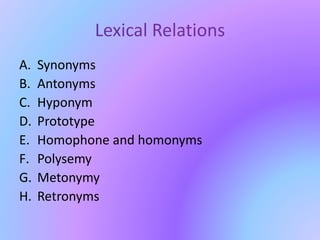
Lexical Relations
A. Synonyms
B. Antonyms
C. Hyponym
D. Prototype
E. Homophone and homonyms
F. Polysemy
G. Metonymy
H. Retronyms
A. Synonymy
Synonyms
Two or more words with very
closely related meaning.
e.g. answer/reply
B. Antonymy
Antonyms
Two words with opposite
meanings.
e.g. alive/dead
Different kinds of antonyms
1.Gradable antonyms
2. Non-gradable antonyms ( complementary
pairs)
3. Reversives (antiautonym)
4. Rational opposites
5. Autoantonyms
1. Gradable antonyms
 Those which can be used in comparative constructions.
e.g. big/small
 Also the negative of one member of a gradable pair
does not necessarily imply the other.
e.g. My car isn't old doesn’t necessarily mean My car is
new.
When one gradable antonym is marked ,the other is
unmarked.
The unmarked member is the one used in the question of
degree.
e.g. How high is the mountain?(not “How low is it?)
2. Non-gradable antonyms ( complementary pairs)
 Comparative constructions are not normally used. We don’t
say deader or more dead.
 The negative of one member of a non-gradable pair does
imply the other one.
e.g. My grandparents aren’t alive does indeed
mean my grandparents are dead.
single/marred, true/false, male/female
3. Reversives (antiautonym)
one member of this antonymous pair does
not necessarily describe the negative of the
other.
e.g. In undress/ dress ,undress doesn’t mean
not dress.
enter/exit, pack/unpack, lengthen/shorten
4. Rational opposites
Kinds of antonym which display symmetry
in their meaning.
e.g. give/ receive, buy/sell, teacher /pupil
5. Autoantonyms
Some words which are their own antonyms.
split apart
e.g. cleave
cling together
Note: Antonym pairs are pronounced the same
but spelled differently are similar to autoantonyms.
e.g. raise/raze
C. Hyponymy
When the meaning of one form is included in the
meaning of another word, the relationship is
described as hyponymy.
e.g. animal/dog
The specific term ,dog, is called hyponym, and the
general term ,animal, is called a superordinate.
Co-hyponyms : are two or more words that share
the same superordinate term.
e.g. dog, horse, cat
D. Prototype
The characteristic instance of a category is known
as the prototype.
e.g. The most characteristic instance of the
category ‘bird’ is the ‘robin’.
The concept of the prototype helps explain the
meaning of certain words, like bird, not in terms of
clearest features( e.g. ‘has feathers, wings ), but in
terms of resemblance to the clearest example.
E. Homophones and homonyms
• Homophones
Two or more words that have
the same pronunciation, but
different meanings.
e.g. flower/ flour, right/
write
Challenge Your Mind
Why is number Six
afraid?
Because7 ate9?
C. Homonyms
When one form (written or spoken) has two or
more unrelated meanings.
e.g. bank (of a river)- bank (financial
institution).
Note: All homonyms have lexical ambiguity.
G. Metonymy
A type of relationship between words, based simply
on a close connection in every experience.
That close connection can be based on a
 container-content relation( bottle/water,
can/juice)
A whole/part relation (car/wheels, house/roof)
Representative-symbol relation (king/crown, the
President/ the White house).
e.g. He drank the whole bottle.
filling up the car, boiling the kettle.
H. Retronyms
It is a term doesn't apply to the
individual words themselves, but
the combination.
e.g. whole milk, silent movie
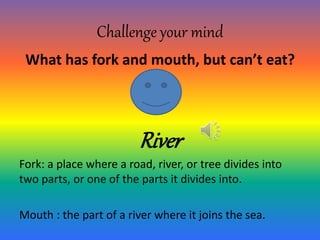
Challenge your mind
What has fork and mouth, but can’t eat?
River
Fork: a place where a road, river, or tree divides into
two parts, or one of the parts it divides into.
Mouth : the part of a river where it joins the sea.
Entailment
&
Hyponymy
Semantic aspects in lexicon and
lexical entries
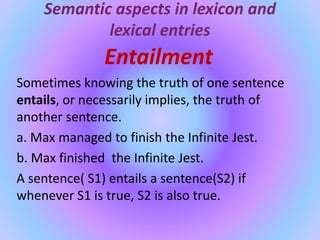
Entailment
Sometimes knowing the truth of one sentence
entails, or necessarily implies, the truth of
another sentence.
a. Max managed to finish the Infinite Jest.
b. Max finished the Infinite Jest.
A sentence( S1) entails a sentence(S2) if
whenever S1 is true, S2 is also true.
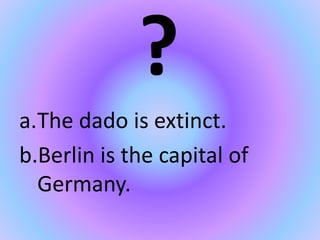
?
a.The dado is extinct.
b.Berlin is the capital of
Germany.
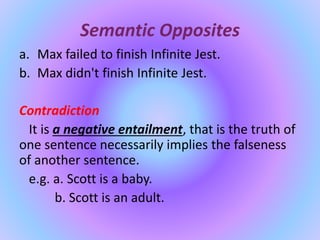
Semantic Opposites
a. Max failed to finish Infinite Jest.
b. Max didn't finish Infinite Jest.
Contradiction
It is a negative entailment, that is the truth of
one sentence necessarily implies the falseness
of another sentence.
e.g. a. Scott is a baby.
b. Scott is an adult.
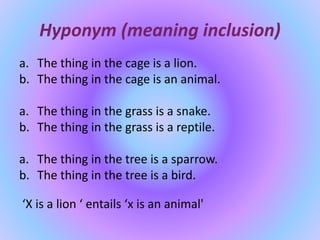
Hyponym (meaning inclusion)
a. The thing in the cage is a lion.
b. The thing in the cage is an animal.
a. The thing in the grass is a snake.
b. The thing in the grass is a reptile.
a. The thing in the tree is a sparrow.
b. The thing in the tree is a bird.
‘X is a lion ‘ entails ‘x is an animal'
Note: An important
property of hyponymy
is that it is a ‘one way’
relation.
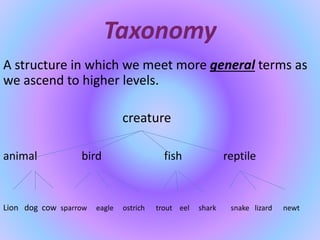
Taxonomy
A structure in which we meet more general terms as
we ascend to higher levels.
creature
animal bird fish reptile
Lion dog cow sparrow eagle ostrich trout eel shark snake lizard newt
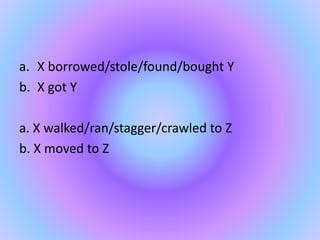
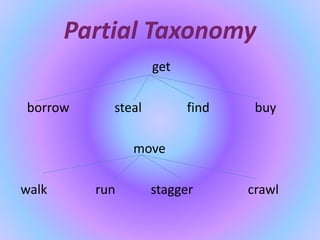
a. X borrowed/stole/found/bought Y
b. X got Y
a. X walked/ran/stagger/crawled to Z
b. X moved to Z
Partial Taxonomy
get
borrow steal find buy
move
walk run stagger crawl
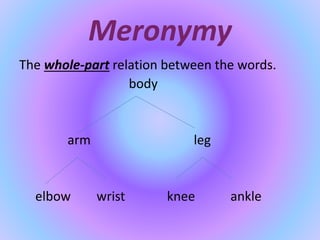
Meronymy
The whole-part relation between the words.
body
arm leg
elbow wrist knee ankle
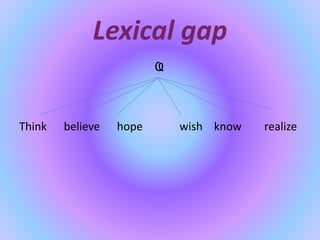
Lexical gap
Ҩ
Think believe hope wish know realize
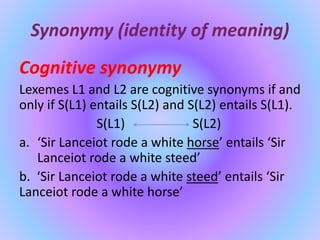
Synonymy (identity of meaning)
Cognitive synonymy
Lexemes L1 and L2 are cognitive synonyms if and
only if S(L1) entails S(L2) and S(L2) entails S(L1).
S(L1) S(L2)
a. ‘Sir Lanceiot rode a white horse’ entails ‘Sir
Lanceiot rode a white steed’
b. ‘Sir Lanceiot rode a white steed’ entails ‘Sir
Lanceiot rode a white horse’
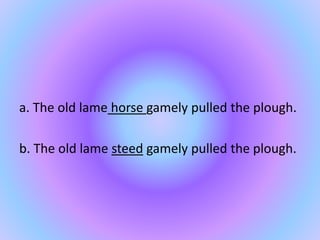
a. The old lame horse gamely pulled the plough.
b. The old lame steed gamely pulled the plough.
Meaning
Opposites
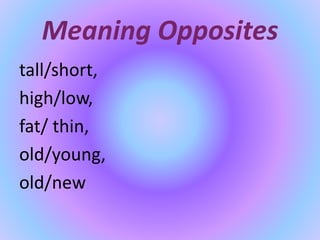
Meaning Opposites
tall/short,
high/low,
fat/ thin,
old/young,
old/new
Antonyms
Two words with opposite meanings.
a. ‘x is tall’ entails ‘X is not short’
b. ‘X is short’ entails ‘X is not tall’
Complementary(non-gradable
antonyms)
a. ‘The store is open’ entails’ the store is not
closed’
b. ‘the store is closed’ entails ‘the store is not
open’
a. ‘the store is not closed’ entails ‘the store is
open’
b. ‘the store is not open’ entails ‘the store is
closed’
Semantic
Features
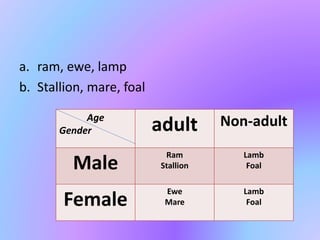
a. ram, ewe, lamp
b. Stallion, mare, foal
Age
Gender adult Non-adult
Male
Ram
Stallion
Lamb
Foal
Female
Ewe
Mare
Lamb
Foal
a. Ram – [male, adult, …]
b. Ewe – [female, adult,…]
c. Lamb - [non-adult,…]
a.Tall – [+Average, …]
b.Short – [-Average, …]
c. Wide – [+Average, …]
d.Narrow - [-Average, …]
Reptile – [F1,F2, …,Fn]
Snake – [F1,F2, …,Fn,fn+1,…,Fm]
Dictionaries
And Prototypes
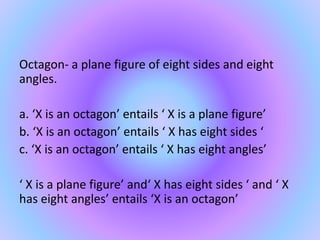
Octagon- a plane figure of eight sides and eight
angles.
a. ‘X is an octagon’ entails ‘ X is a plane figure’
b. ‘X is an octagon’ entails ‘ X has eight sides ‘
c. ‘X is an octagon’ entails ‘ X has eight angles’
‘ X is a plane figure’ and‘ X has eight sides ‘ and ‘ X
has eight angles’ entails ‘X is an octagon’
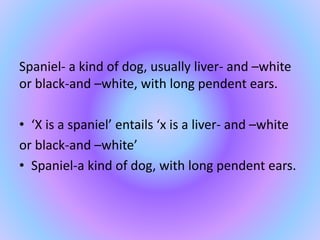
Spaniel- a kind of dog, usually liver- and –white
or black-and –white, with long pendent ears.
• ‘X is a spaniel’ entails ‘x is a liver- and –white
or black-and –white’
• Spaniel-a kind of dog, with long pendent ears.
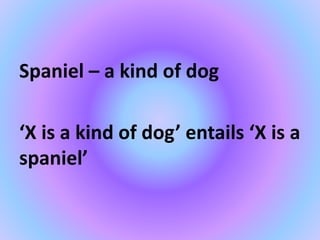
Spaniel – a kind of dog
‘X is a kind of dog’ entails ‘X is a
spaniel’
a. Strictly speaking, an ostrich is a bird.
b. ? Strictly speaking, a robin is a bird.
c. Technically, a whale is a mammal.
d. ? Strictly speaking, a trout is a fish.
The job of the linguist, like that of the biologist or
the botanist, is not to tell us how nature should
behave, or what its creations should look like, but
to describe those creations in all their messy glory
and try to figure out what they can teach us about
life, the world, and, especially in the case of
linguistics, the workings of the human mind.”
Arika Okrent
The
End

word meaning

  • 1.
    IN the NAMEOF THE MOST HIGH
  • 2.
  • 3.
    “All my lifeI've looked at words as though I were seeing them for the first time.” Ernest Hemingway
  • 4.
  • 5.
    Lexical Relations A. Synonyms B.Antonyms C. Hyponym D. Prototype E. Homophone and homonyms F. Polysemy G. Metonymy H. Retronyms
  • 6.
    A. Synonymy Synonyms Two ormore words with very closely related meaning. e.g. answer/reply
  • 7.
    B. Antonymy Antonyms Two wordswith opposite meanings. e.g. alive/dead
  • 8.
    Different kinds ofantonyms 1.Gradable antonyms 2. Non-gradable antonyms ( complementary pairs) 3. Reversives (antiautonym) 4. Rational opposites 5. Autoantonyms
  • 9.
    1. Gradable antonyms Those which can be used in comparative constructions. e.g. big/small  Also the negative of one member of a gradable pair does not necessarily imply the other. e.g. My car isn't old doesn’t necessarily mean My car is new. When one gradable antonym is marked ,the other is unmarked. The unmarked member is the one used in the question of degree. e.g. How high is the mountain?(not “How low is it?)
  • 10.
    2. Non-gradable antonyms( complementary pairs)  Comparative constructions are not normally used. We don’t say deader or more dead.  The negative of one member of a non-gradable pair does imply the other one. e.g. My grandparents aren’t alive does indeed mean my grandparents are dead. single/marred, true/false, male/female
  • 11.
    3. Reversives (antiautonym) onemember of this antonymous pair does not necessarily describe the negative of the other. e.g. In undress/ dress ,undress doesn’t mean not dress. enter/exit, pack/unpack, lengthen/shorten
  • 12.
    4. Rational opposites Kindsof antonym which display symmetry in their meaning. e.g. give/ receive, buy/sell, teacher /pupil
  • 13.
    5. Autoantonyms Some wordswhich are their own antonyms. split apart e.g. cleave cling together Note: Antonym pairs are pronounced the same but spelled differently are similar to autoantonyms. e.g. raise/raze
  • 14.
    C. Hyponymy When themeaning of one form is included in the meaning of another word, the relationship is described as hyponymy. e.g. animal/dog The specific term ,dog, is called hyponym, and the general term ,animal, is called a superordinate. Co-hyponyms : are two or more words that share the same superordinate term. e.g. dog, horse, cat
  • 15.
    D. Prototype The characteristicinstance of a category is known as the prototype. e.g. The most characteristic instance of the category ‘bird’ is the ‘robin’. The concept of the prototype helps explain the meaning of certain words, like bird, not in terms of clearest features( e.g. ‘has feathers, wings ), but in terms of resemblance to the clearest example.
  • 16.
    E. Homophones andhomonyms • Homophones Two or more words that have the same pronunciation, but different meanings. e.g. flower/ flour, right/ write
  • 17.
    Challenge Your Mind Whyis number Six afraid? Because7 ate9?
  • 18.
    C. Homonyms When oneform (written or spoken) has two or more unrelated meanings. e.g. bank (of a river)- bank (financial institution). Note: All homonyms have lexical ambiguity.
  • 19.
    G. Metonymy A typeof relationship between words, based simply on a close connection in every experience. That close connection can be based on a  container-content relation( bottle/water, can/juice) A whole/part relation (car/wheels, house/roof) Representative-symbol relation (king/crown, the President/ the White house). e.g. He drank the whole bottle. filling up the car, boiling the kettle.
  • 20.
    H. Retronyms It isa term doesn't apply to the individual words themselves, but the combination. e.g. whole milk, silent movie
  • 21.
    Challenge your mind Whathas fork and mouth, but can’t eat? River Fork: a place where a road, river, or tree divides into two parts, or one of the parts it divides into. Mouth : the part of a river where it joins the sea.
  • 22.
  • 23.
    Semantic aspects inlexicon and lexical entries Entailment Sometimes knowing the truth of one sentence entails, or necessarily implies, the truth of another sentence. a. Max managed to finish the Infinite Jest. b. Max finished the Infinite Jest. A sentence( S1) entails a sentence(S2) if whenever S1 is true, S2 is also true.
  • 24.
    ? a.The dado isextinct. b.Berlin is the capital of Germany.
  • 25.
    Semantic Opposites a. Maxfailed to finish Infinite Jest. b. Max didn't finish Infinite Jest. Contradiction It is a negative entailment, that is the truth of one sentence necessarily implies the falseness of another sentence. e.g. a. Scott is a baby. b. Scott is an adult.
  • 26.
    Hyponym (meaning inclusion) a.The thing in the cage is a lion. b. The thing in the cage is an animal. a. The thing in the grass is a snake. b. The thing in the grass is a reptile. a. The thing in the tree is a sparrow. b. The thing in the tree is a bird. ‘X is a lion ‘ entails ‘x is an animal'
  • 27.
    Note: An important propertyof hyponymy is that it is a ‘one way’ relation.
  • 28.
    Taxonomy A structure inwhich we meet more general terms as we ascend to higher levels. creature animal bird fish reptile Lion dog cow sparrow eagle ostrich trout eel shark snake lizard newt
  • 29.
    a. X borrowed/stole/found/boughtY b. X got Y a. X walked/ran/stagger/crawled to Z b. X moved to Z
  • 30.
    Partial Taxonomy get borrow stealfind buy move walk run stagger crawl
  • 31.
    Meronymy The whole-part relationbetween the words. body arm leg elbow wrist knee ankle
  • 32.
    Lexical gap Ҩ Think believehope wish know realize
  • 33.
    Synonymy (identity ofmeaning) Cognitive synonymy Lexemes L1 and L2 are cognitive synonyms if and only if S(L1) entails S(L2) and S(L2) entails S(L1). S(L1) S(L2) a. ‘Sir Lanceiot rode a white horse’ entails ‘Sir Lanceiot rode a white steed’ b. ‘Sir Lanceiot rode a white steed’ entails ‘Sir Lanceiot rode a white horse’
  • 34.
    a. The oldlame horse gamely pulled the plough. b. The old lame steed gamely pulled the plough.
  • 35.
  • 36.
  • 37.
    Antonyms Two words withopposite meanings. a. ‘x is tall’ entails ‘X is not short’ b. ‘X is short’ entails ‘X is not tall’
  • 38.
    Complementary(non-gradable antonyms) a. ‘The storeis open’ entails’ the store is not closed’ b. ‘the store is closed’ entails ‘the store is not open’ a. ‘the store is not closed’ entails ‘the store is open’ b. ‘the store is not open’ entails ‘the store is closed’
  • 39.
  • 40.
    a. ram, ewe,lamp b. Stallion, mare, foal Age Gender adult Non-adult Male Ram Stallion Lamb Foal Female Ewe Mare Lamb Foal
  • 41.
    a. Ram –[male, adult, …] b. Ewe – [female, adult,…] c. Lamb - [non-adult,…]
  • 42.
    a.Tall – [+Average,…] b.Short – [-Average, …] c. Wide – [+Average, …] d.Narrow - [-Average, …]
  • 43.
    Reptile – [F1,F2,…,Fn] Snake – [F1,F2, …,Fn,fn+1,…,Fm]
  • 44.
  • 45.
    Octagon- a planefigure of eight sides and eight angles. a. ‘X is an octagon’ entails ‘ X is a plane figure’ b. ‘X is an octagon’ entails ‘ X has eight sides ‘ c. ‘X is an octagon’ entails ‘ X has eight angles’ ‘ X is a plane figure’ and‘ X has eight sides ‘ and ‘ X has eight angles’ entails ‘X is an octagon’
  • 46.
    Spaniel- a kindof dog, usually liver- and –white or black-and –white, with long pendent ears. • ‘X is a spaniel’ entails ‘x is a liver- and –white or black-and –white’ • Spaniel-a kind of dog, with long pendent ears.
  • 47.
    Spaniel – akind of dog ‘X is a kind of dog’ entails ‘X is a spaniel’
  • 48.
    a. Strictly speaking,an ostrich is a bird. b. ? Strictly speaking, a robin is a bird. c. Technically, a whale is a mammal. d. ? Strictly speaking, a trout is a fish.
  • 49.
    The job ofthe linguist, like that of the biologist or the botanist, is not to tell us how nature should behave, or what its creations should look like, but to describe those creations in all their messy glory and try to figure out what they can teach us about life, the world, and, especially in the case of linguistics, the workings of the human mind.” Arika Okrent
  • 50.