Quantum Computing
The Why and How
Jonathan Baker
Argonne National Lab
7-29-2019
Outline for this Talk (Pt 1.)
1. Why Quantum Computing? What is the current state of quantum computing
and what are current challenges? What are algorithms is this paradigm is ideal
for?
2. What is different between quantum and classical information? What makes a
quantum computer that much different than a classical one?
3. How can we use a quantum computer to solve concrete problems? Can we do
better than classical computers at the same tasks?
Why Quantum Computing?
● Fundamentally change what is computable (in a reasonable amount of time)
○ The only known means to potentially scale computation exponentially with the number of
devices
○ We can do this by taking advantage of quantum mechanical phenomenon
● Solve currently intractable problems in chemistry, simulation, and optimization
● Moore’s Law is ending - quantum computing can act as a replacement in
some scientific domains to help continue scaling applications
● Insights in classical computing
○ Many classical algorithms are “quantum-inspired”, e.g. in chemistry physics or cryptography
○ Challenges classical algorithms to compete with quantum algorithms
3
Current State of Quantum Computing: NISQ
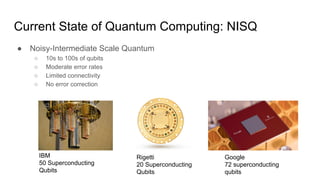
● Noisy-Intermediate Scale Quantum
○ 10s to 100s of qubits
○ Moderate error rates
○ Limited connectivity
○ No error correction
IBM
50 Superconducting
Qubits
Google
72 superconducting
qubits
Rigetti
20 Superconducting
Qubits
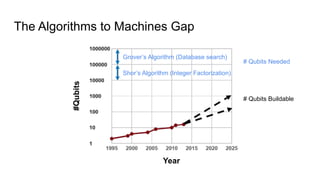
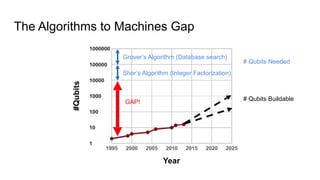
The Algorithms to Machines Gap
Year
#Qubits
Grover’s Algorithm (Database search)
Shor’s Algorithm (Integer Factorization)
# Qubits Needed
# Qubits Buildable
The Algorithms to Machines Gap
Year
#Qubits
GAP!
Grover’s Algorithm (Database search)
Shor’s Algorithm (Integer Factorization)
# Qubits Needed
# Qubits Buildable
The Algorithms to Machines Gap
Year
#Qubits
GAP!
Grover’s Algorithm (Database search)
Shor’s Algorithm (Integer Factorization)
# Qubits Needed
# Qubits Buildable
Q. Sim,
Q Chem,
QAOA
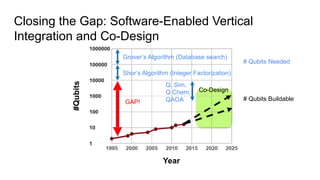
Closing the Gap: Software-Enabled Vertical
Integration and Co-Design
Year
#Qubits
GAP!
Grover’s Algorithm (Database search)
Shor’s Algorithm (Integer Factorization)
# Qubits Needed
# Qubits Buildable
Q. Sim,
Q Chem,
QAOA
Co-Design
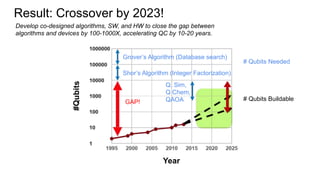
Result: Crossover by 2023!
Year
#Qubits
GAP!
Grover’s Algorithm (Database search)
Shor’s Algorithm (Integer Factorization)
# Qubits Needed
# Qubits Buildable
Q. Sim,
Q Chem,
QAOA
Develop co-designed algorithms, SW, and HW to close the gap between
algorithms and devices by 100-1000X, accelerating QC by 10-20 years.
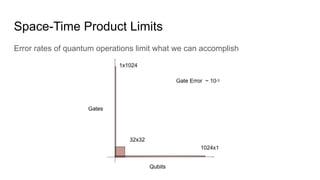
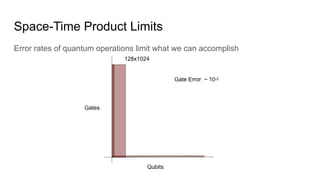
Space-Time Product Limits
Error rates of quantum operations limit what we can accomplish
Space-Time Product Limits
Error rates of quantum operations limit what we can accomplish
“Good” Quantum Algorithms
● Compact problem representation
○ Functions, small molecules, small graphs
● High complexity computation
● Compact solution
● Easily-verifiable solution
● Co-processing with classical supercomputers
● Can exploit a small number of quantum kernels
Introduction to the Basics
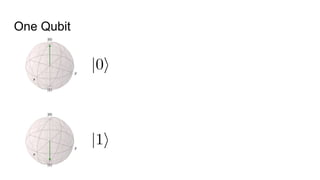
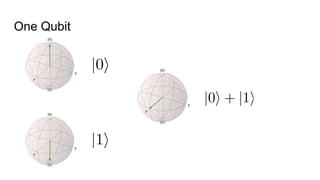
One Qubit
One Qubit
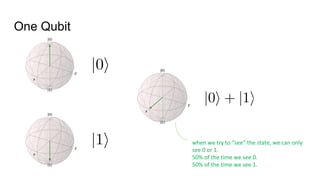
One Qubit
when we try to “see” the state, we can only
see 0 or 1.
50% of the time we see 0.
50% of the time we see 1.
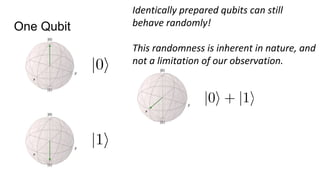
One Qubit
Identically prepared qubits can still
behave randomly!
This randomness is inherent in nature, and
not a limitation of our observation.
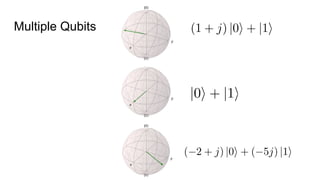
Multiple Qubits
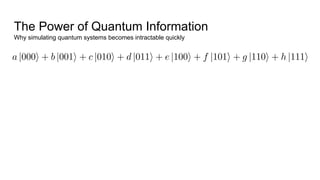
The Power of Quantum Information
Why simulating quantum systems becomes intractable quickly
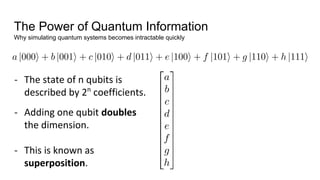
The Power of Quantum Information
Why simulating quantum systems becomes intractable quickly
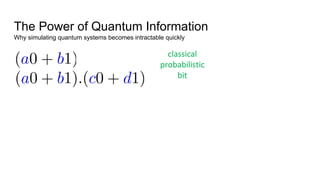
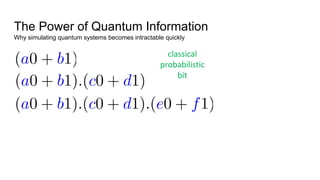
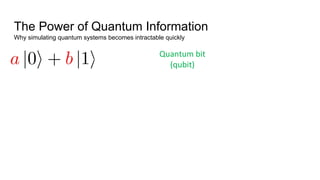
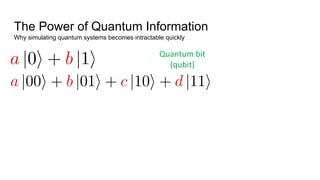
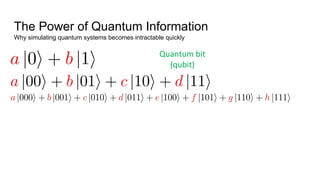
- The state of n qubits is
described by 2n
coefficients.
- Adding one qubit doubles
the dimension.
- This is known as
superposition.
The Power of Quantum Information
Why simulating quantum systems becomes intractable quickly
classical
probabilistic
bit
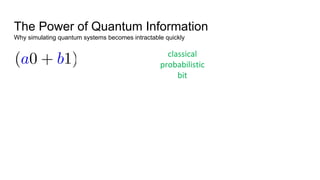
The Power of Quantum Information
Why simulating quantum systems becomes intractable quickly
classical
probabilistic
bit
The Power of Quantum Information
Why simulating quantum systems becomes intractable quickly
classical
probabilistic
bit
The Power of Quantum Information
Why simulating quantum systems becomes intractable quickly
classical
probabilistic
bit
The Power of Quantum Information
Why simulating quantum systems becomes intractable quickly
Quantum bit
(qubit)
The Power of Quantum Information
Why simulating quantum systems becomes intractable quickly
Quantum bit
(qubit)
The Power of Quantum Information
Why simulating quantum systems becomes intractable quickly
Quantum bit
(qubit)
The Power of Quantum Information
Why simulating quantum systems becomes intractable quickly
Quantum bit
(qubit)
The Power of Quantum Information
Why simulating quantum systems becomes intractable quickly
Quantum bit
(qubit)
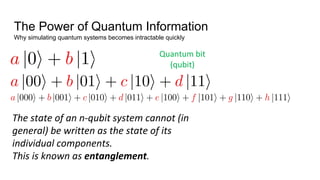
The state of an n-qubit system cannot (in
general) be written as the state of its
individual components.
This is known as entanglement.
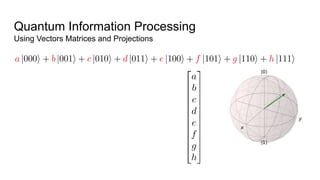
Quantum Information Processing
Using Vectors Matrices and Projections
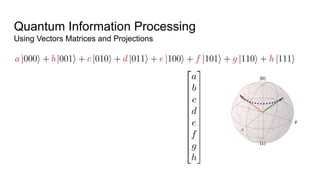
Quantum Information Processing
Using Vectors Matrices and Projections
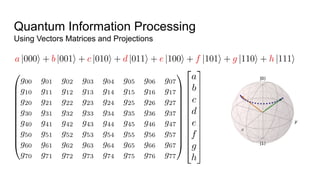
Quantum Information Processing
Using Vectors Matrices and Projections
Quantum Information Processing
Using Vectors Matrices and Projections
Quantum Information Processing
Using Vectors Matrices and Projections
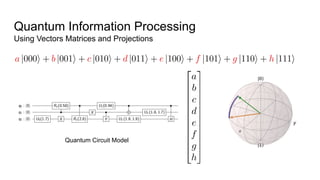
Quantum Circuit Model
Quantum Information Processing
Using Vectors Matrices and Projections
Important Result:
1-qubit & 2-qubit gates (i.e. local operations)
are sufficient for universal computation
[Barenco et al. 95].
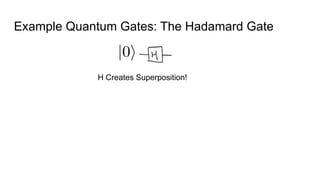
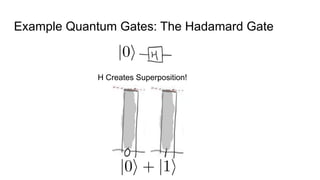
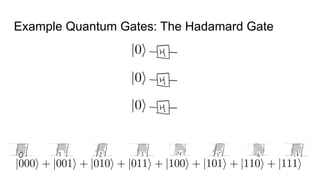
Example Quantum Gates: The Hadamard Gate
H Creates Superposition!
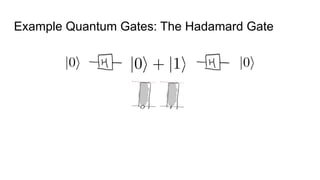
Example Quantum Gates: The Hadamard Gate
H Creates Superposition!
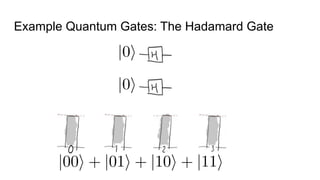
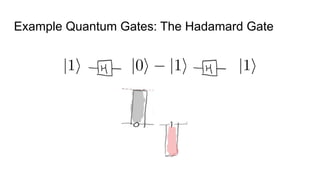
Example Quantum Gates: The Hadamard Gate
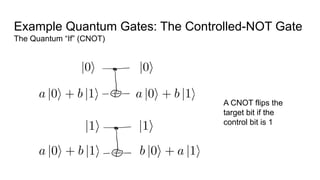
Example Quantum Gates: The Controlled-NOT Gate
The Quantum “If” (CNOT)
Example Quantum Gates: The Controlled-NOT Gate
The Quantum “If” (CNOT)
A CNOT flips the
target bit if the
control bit is 1
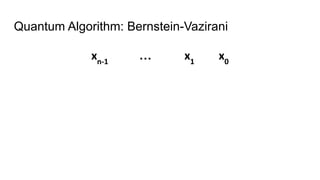
Quantum Algorithm: Bernstein-Vazirani
xn-1
… x1
x0
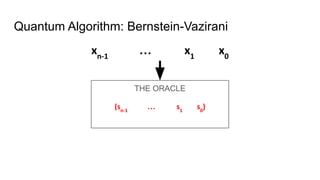
Quantum Algorithm: Bernstein-Vazirani
xn-1
… x1
x0
THE ORACLE
(sn-1
… s1
s0
)
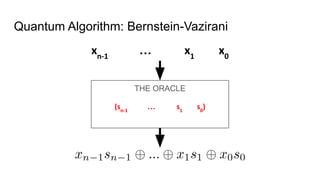
Quantum Algorithm: Bernstein-Vazirani
xn-1
… x1
x0
THE ORACLE
(sn-1
… s1
s0
)
Quantum Algorithm: Bernstein-Vazirani
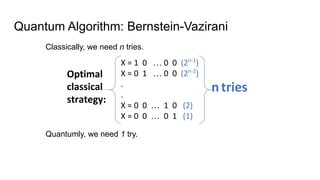
Classically, we need n tries.
Optimal
classical
strategy:
X = 1 0 … 0 0 (2n-1
)
X = 0 1 … 0 0 (2n-2
)
.
.
X = 0 0 … 1 0 (2)
X = 0 0 … 0 1 (1)
n tries
Quantumly, we need 1 try.
Quantum Algorithm: Bernstein-Vazirani
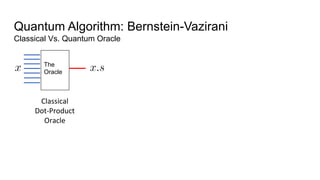
Classical Vs. Quantum Oracle
Classical
Dot-Product
Oracle
The
Oracle
Quantum Algorithm: Bernstein-Vazirani
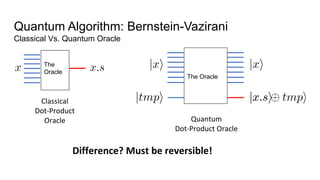
Classical Vs. Quantum Oracle
Classical
Dot-Product
Oracle
The
Oracle
Quantum
Dot-Product Oracle
Difference? Must be reversible!
The Oracle
Quantum Algorithm: Bernstein-Vazirani
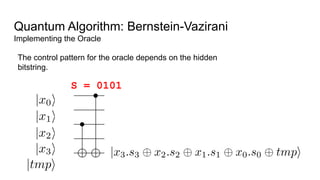
Implementing the Oracle
The control pattern for the oracle depends on the hidden
bitstring.
Quantum Algorithm: Bernstein-Vazirani
Implementing the Oracle
The control pattern for the oracle depends on the hidden
bitstring.
S = 0101
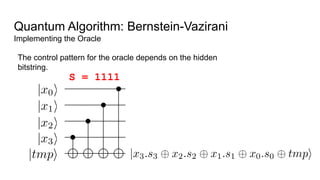
Quantum Algorithm: Bernstein-Vazirani
Implementing the Oracle
The control pattern for the oracle depends on the hidden
bitstring.
S = 1111
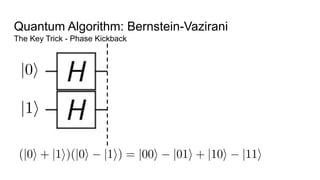
Quantum Algorithm: Bernstein-Vazirani
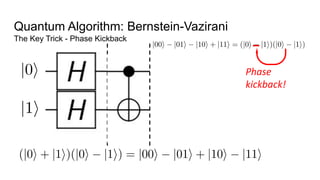
The Key Trick - Phase Kickback
Quantum Algorithm: Bernstein-Vazirani
The Key Trick - Phase Kickback
Quantum Algorithm: Bernstein-Vazirani
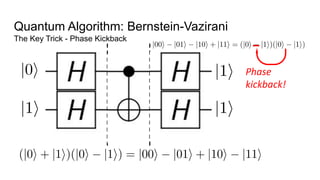
The Key Trick - Phase Kickback
Phase
kickback!
Quantum Algorithm: Bernstein-Vazirani
The Key Trick - Phase Kickback
Phase
kickback!
Quantum Algorithm: Bernstein-Vazirani
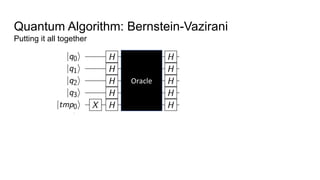
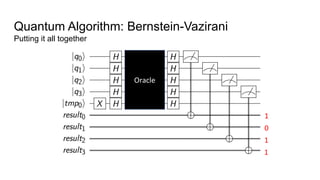
Putting it all together
Quantum Algorithm: Bernstein-Vazirani
Putting it all together
Oracle
Quantum Algorithm: Bernstein-Vazirani
Putting it all together
Oracle
1
0
1
1
Quantum Algorithm: Bernstein-Vazirani
Putting it all together
Oracle
1
0
1
1
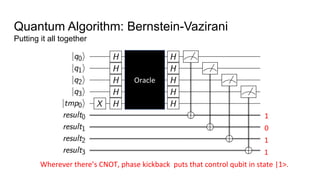
Wherever there’s CNOT, phase kickback puts that control qubit in state |1>.
Quantum Algorithm: Bernstein-Vazirani
Why did it work?
1. Classical oracles can only be queried with a single number at a time.
Quantum oracles can be queried in superposition.
2. We don’t just “try every answer simultaneously”. The problem had a
structure that we could exploit using qubits: encode information in
phases

Quantum Computing: The Why and How