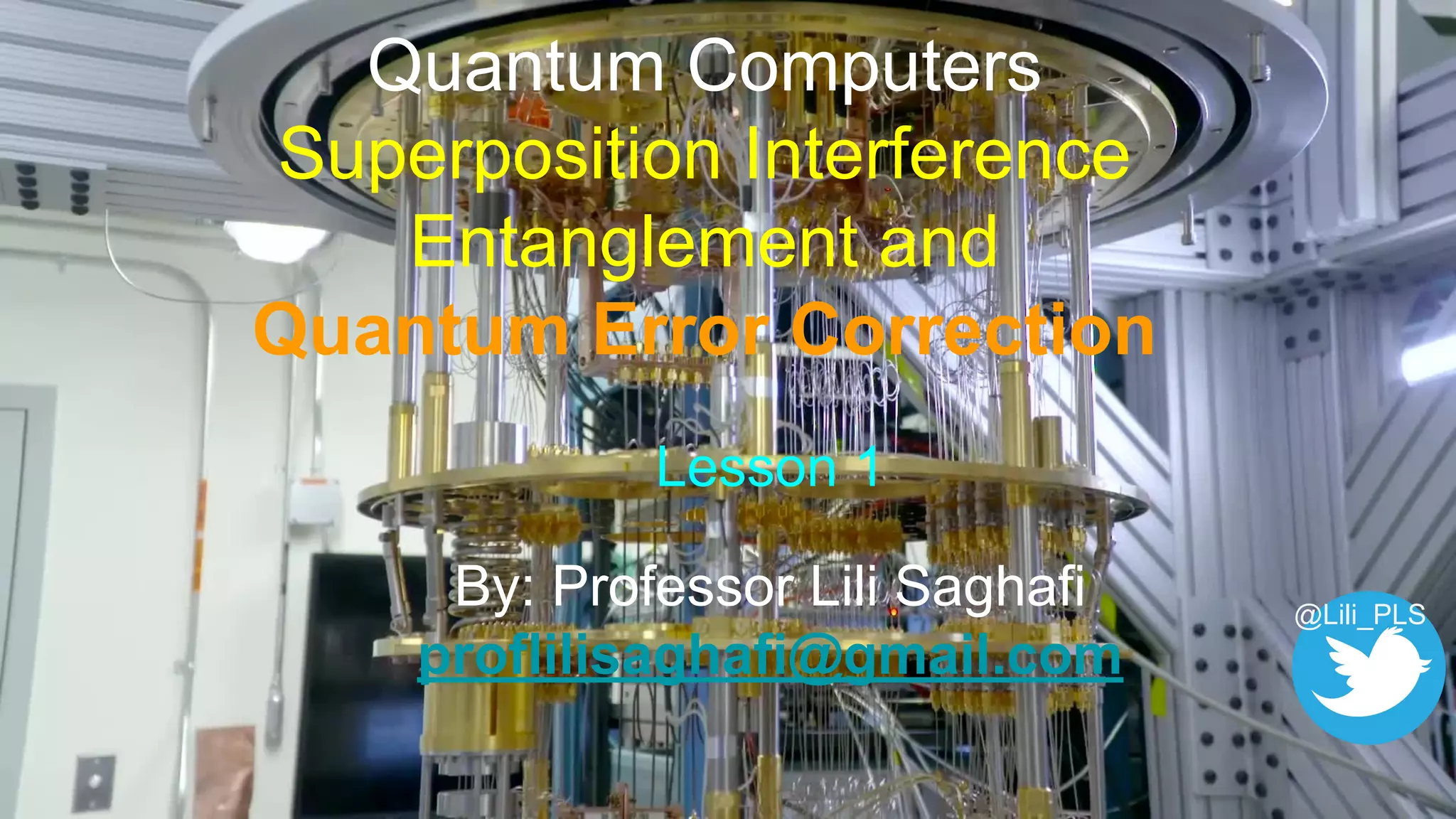
Quantum Computers
Superposition Interference
Entanglement and
Quantum Error Correction
Lesson 1
By: Professor Lili Saghafi
proflilisaghafi@gmail.com
@Lili_PLS
What is a quantum computer?
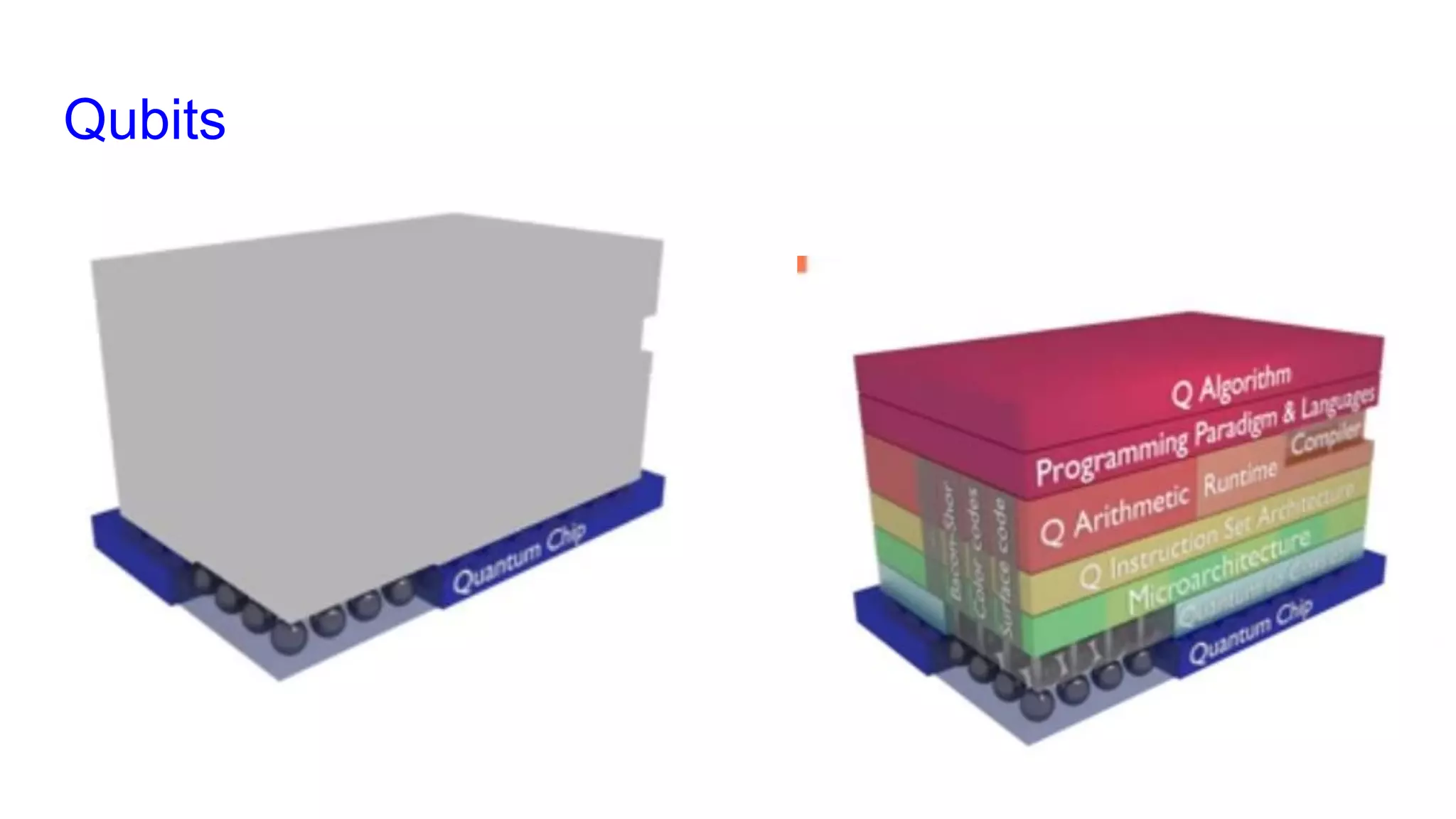
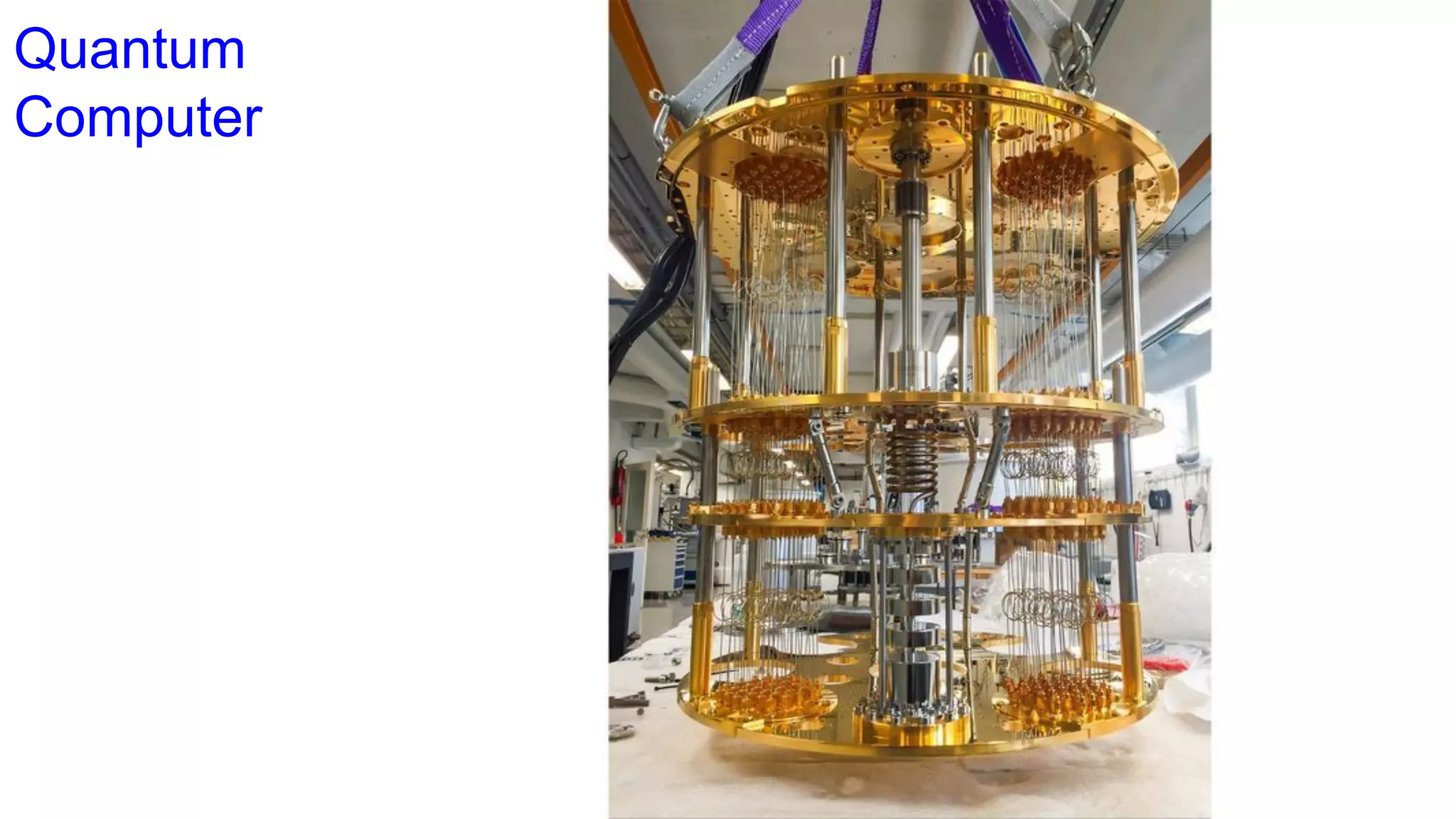
● A future quantum computer will contain many hardware
and software components.
● We can leverage of classical technology and construct a
framework to layout a real vision for a quantum computer.
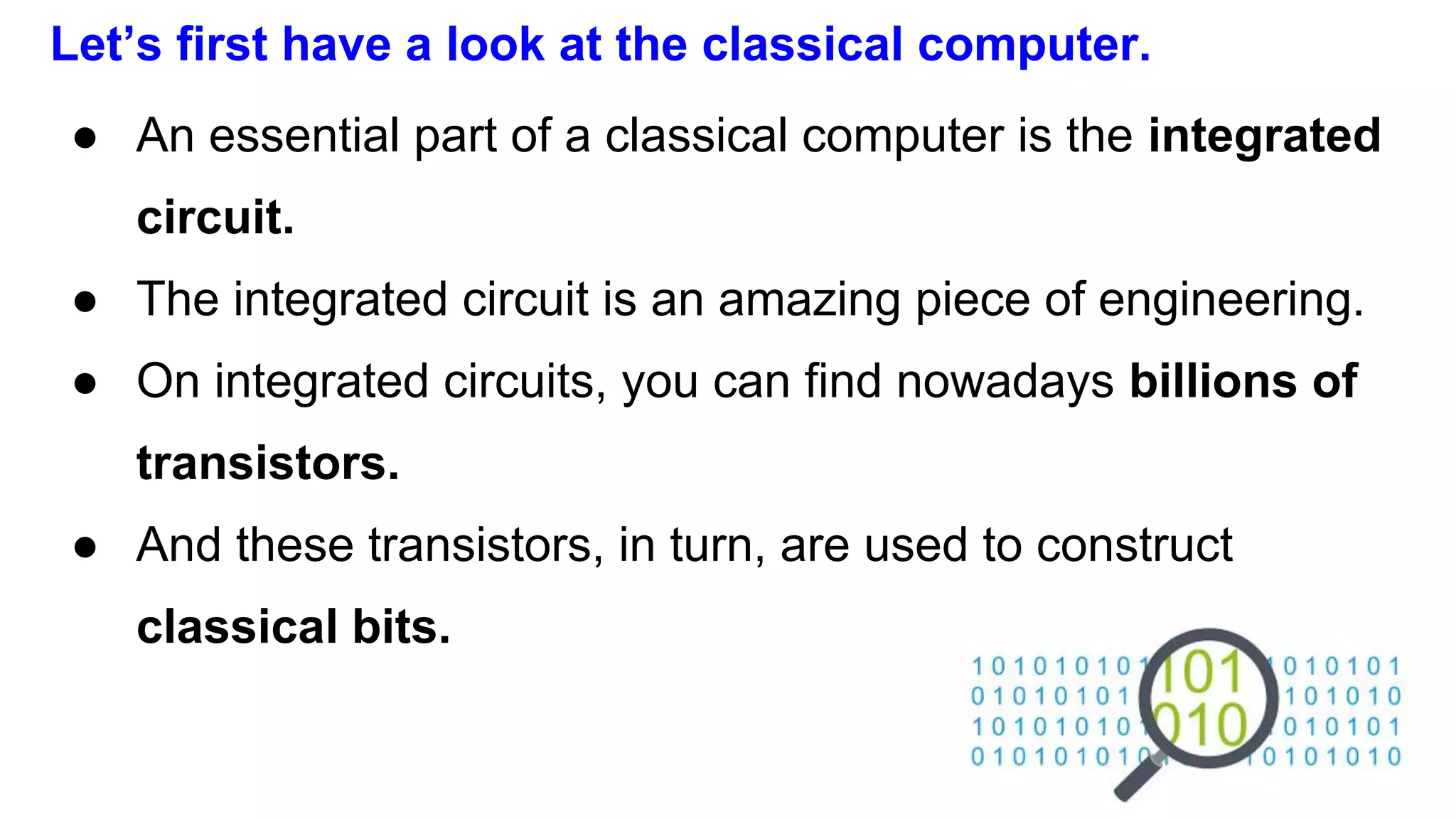
Let’s first have a look at the classical computer.
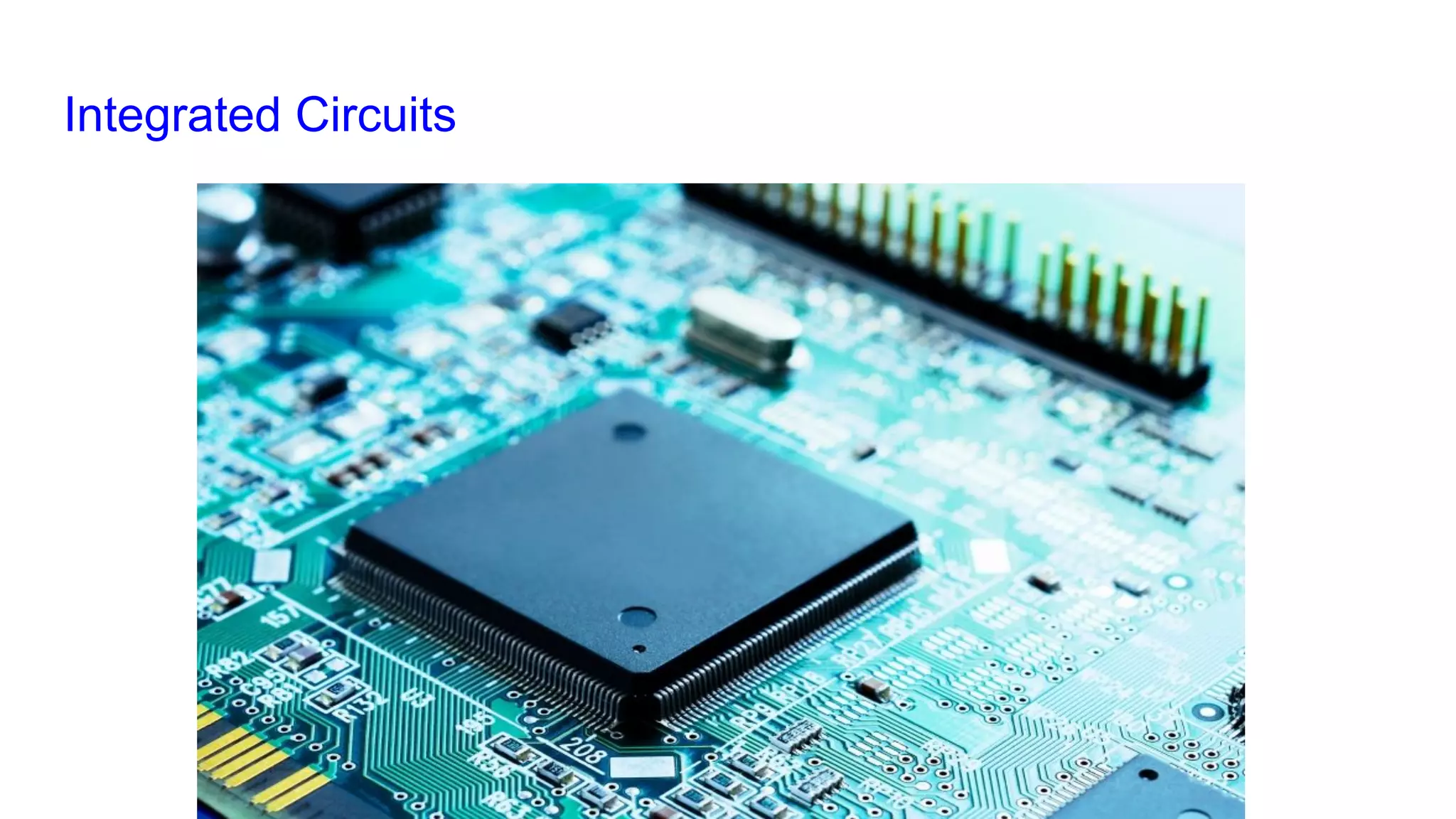
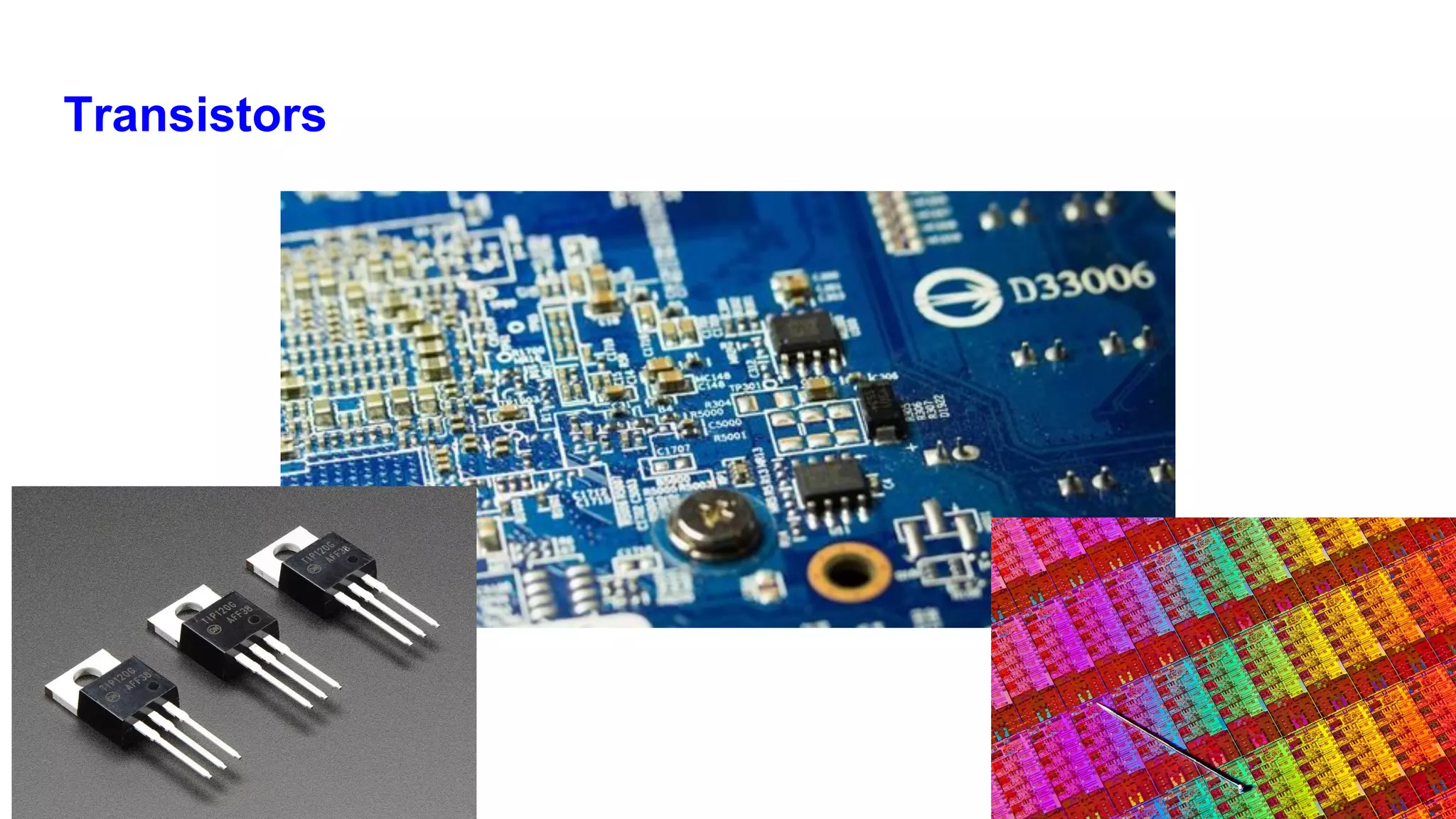
● An essential part of a classical computer is the integrated
circuit.
● The integrated circuit is an amazing piece of engineering.
● On integrated circuits, you can find nowadays billions of
transistors.
● And these transistors, in turn, are used to construct
classical bits.
Integrated Circuits
Transistors
…..Continue
● These bits can represent either a zero or a one, and we use these numbers to
perform calculations with a computer.
● We find integrated circuits virtually everywhere and they completely
changed our daily lives.
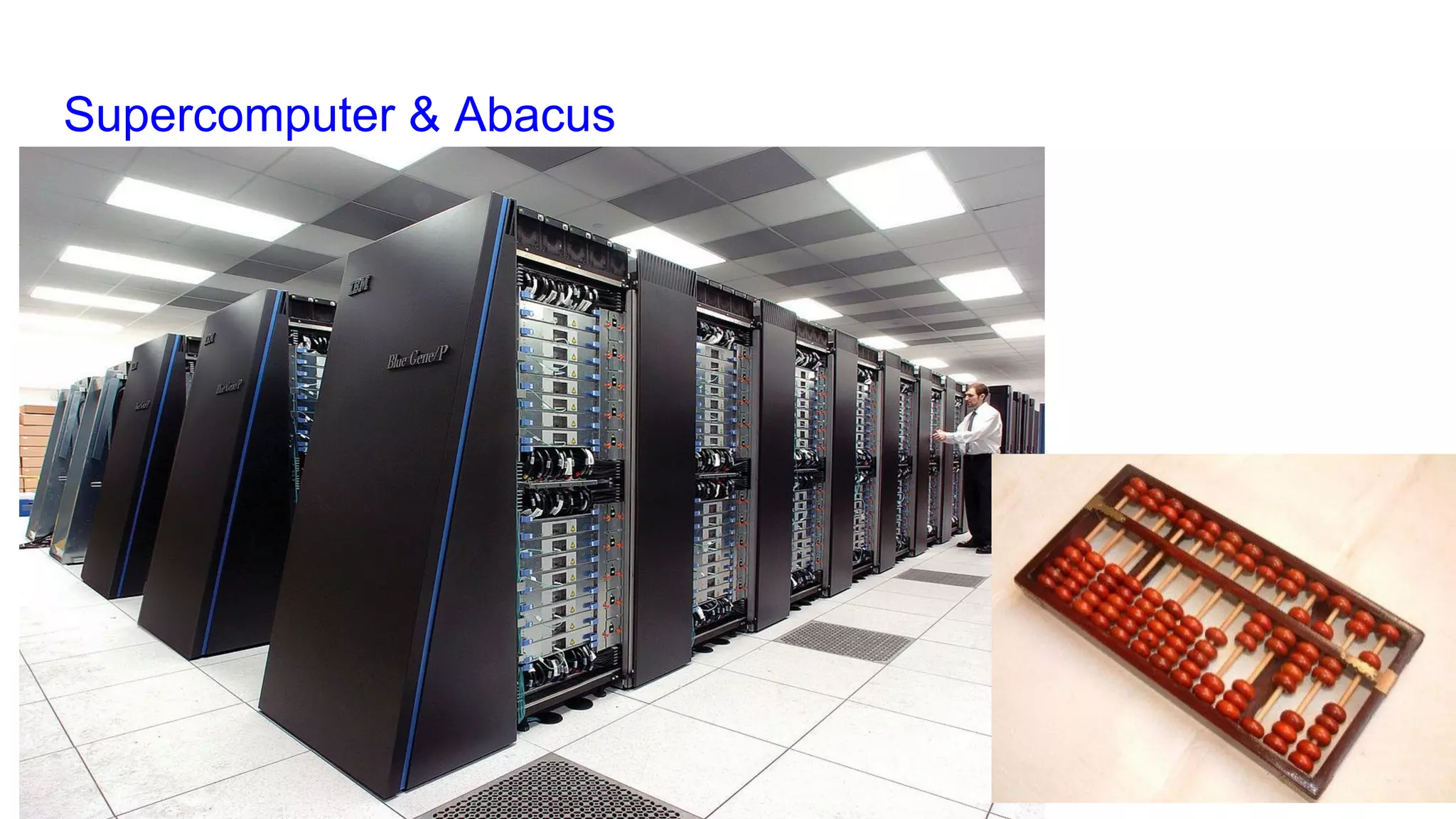
● while the modern supercomputer is much faster and much more accurate
than the abacus that was invented thousands of years ago, they are
bounded by the same physical principles.
● This century, we have the opportunity to develop something radically new,
and use quantum mechanics to build quantum computers.
Supercomputer & Abacus
Superposition, Interference and Entanglement
● Quantum mechanics can offer unique phenomena.
● Include superposition, interference and entanglement.
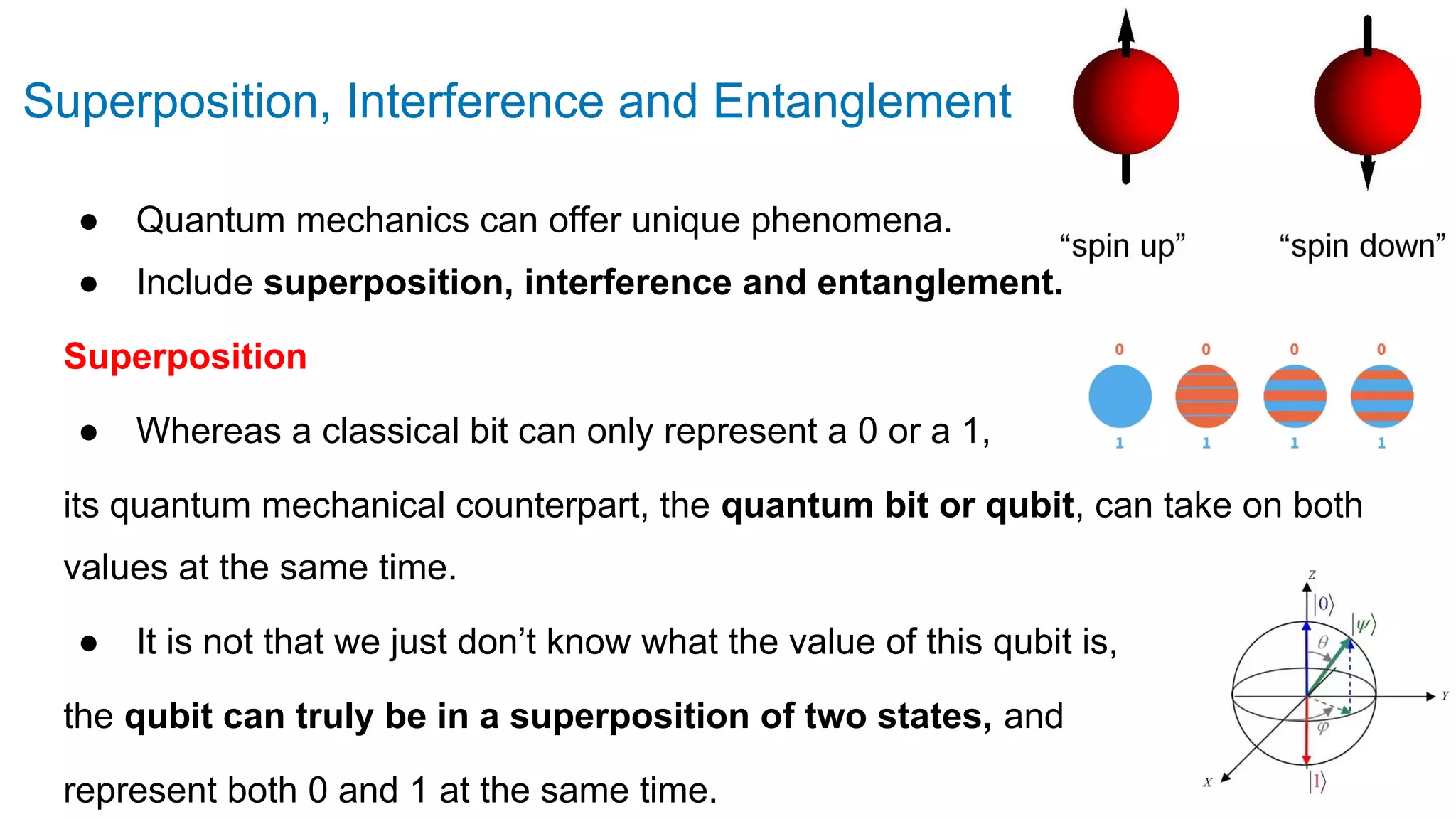
Superposition
● Whereas a classical bit can only represent a 0 or a 1,
its quantum mechanical counterpart, the quantum bit or qubit, can take on both
values at the same time.
● It is not that we just don’t know what the value of this qubit is,
the qubit can truly be in a superposition of two states, and
represent both 0 and 1 at the same time.
Superposition, Wikipedia
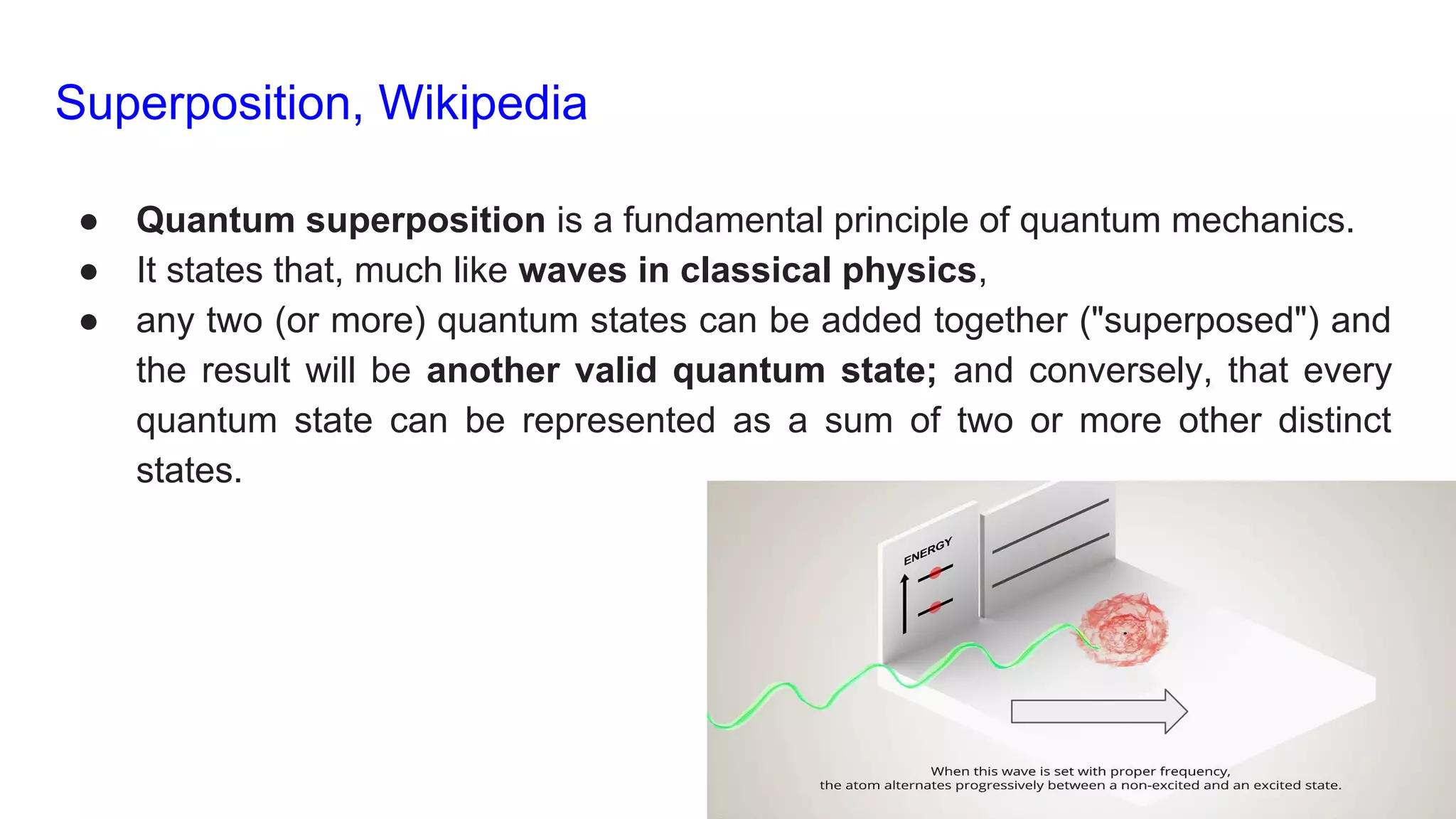
● Quantum superposition is a fundamental principle of quantum mechanics.
● It states that, much like waves in classical physics,
● any two (or more) quantum states can be added together ("superposed") and
the result will be another valid quantum state; and conversely, that every
quantum state can be represented as a sum of two or more other distinct
states.
Classical World
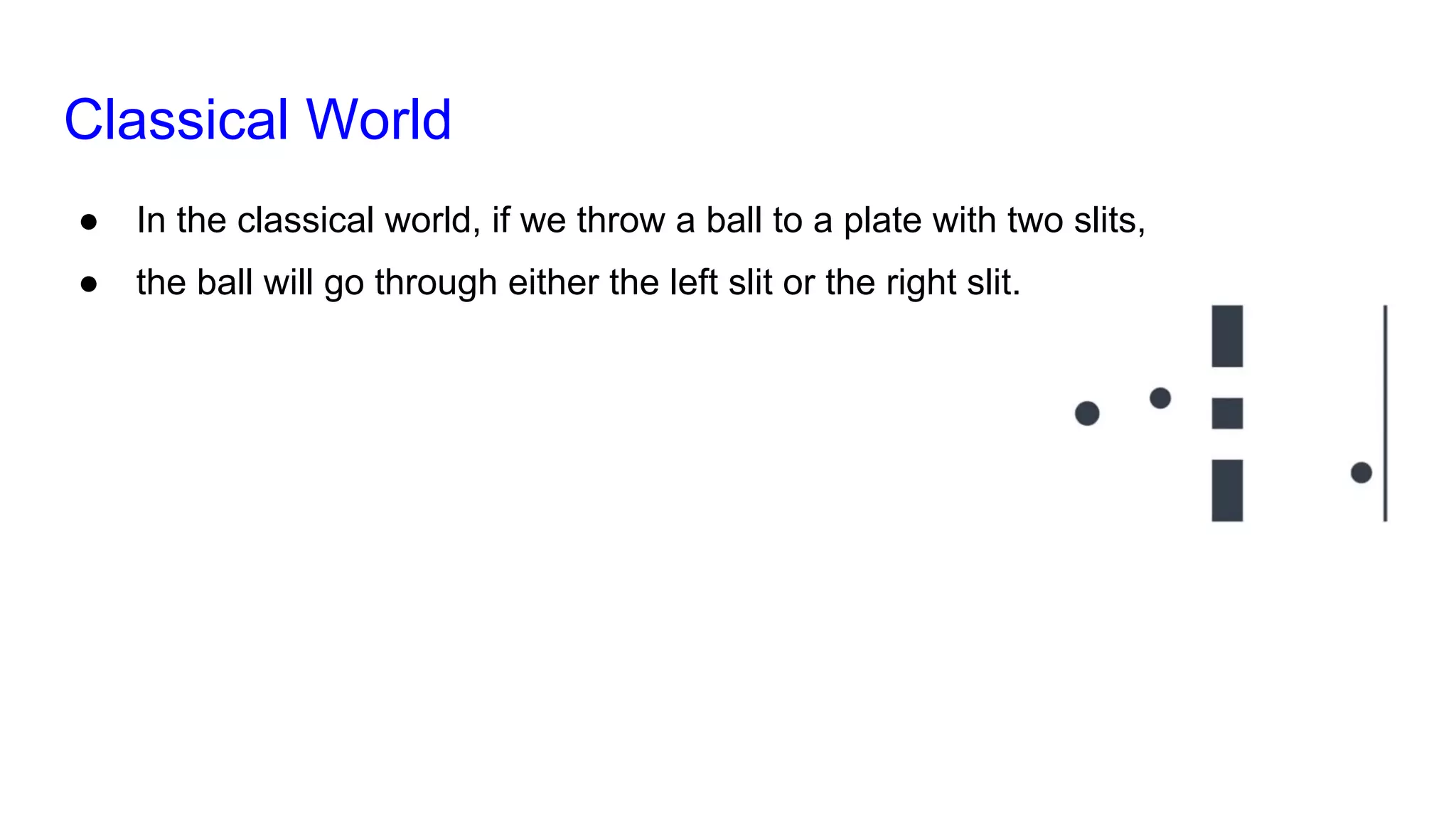
● In the classical world, if we throw a ball to a plate with two slits,
● the ball will go through either the left slit or the right slit.
Quantum world
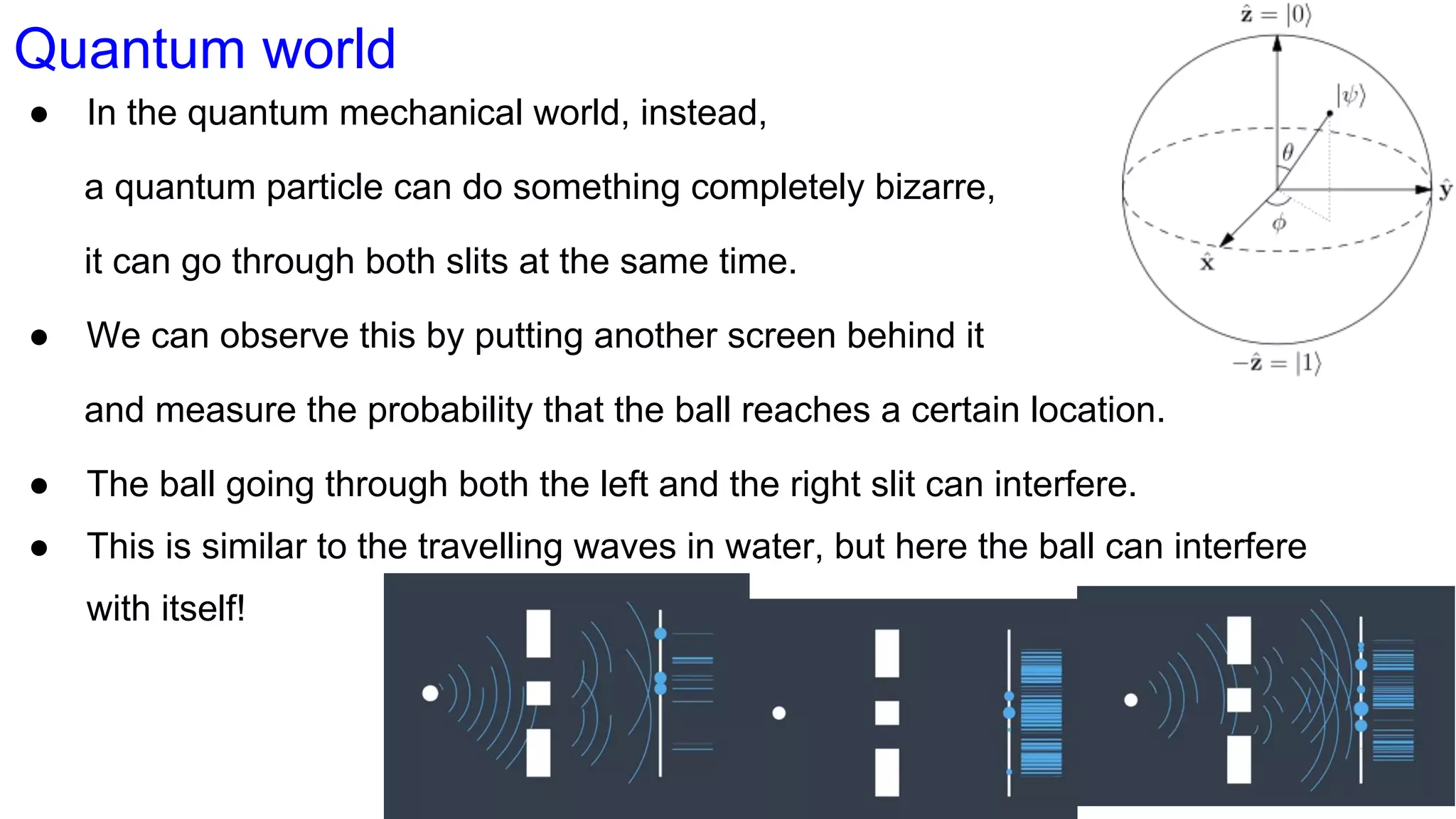
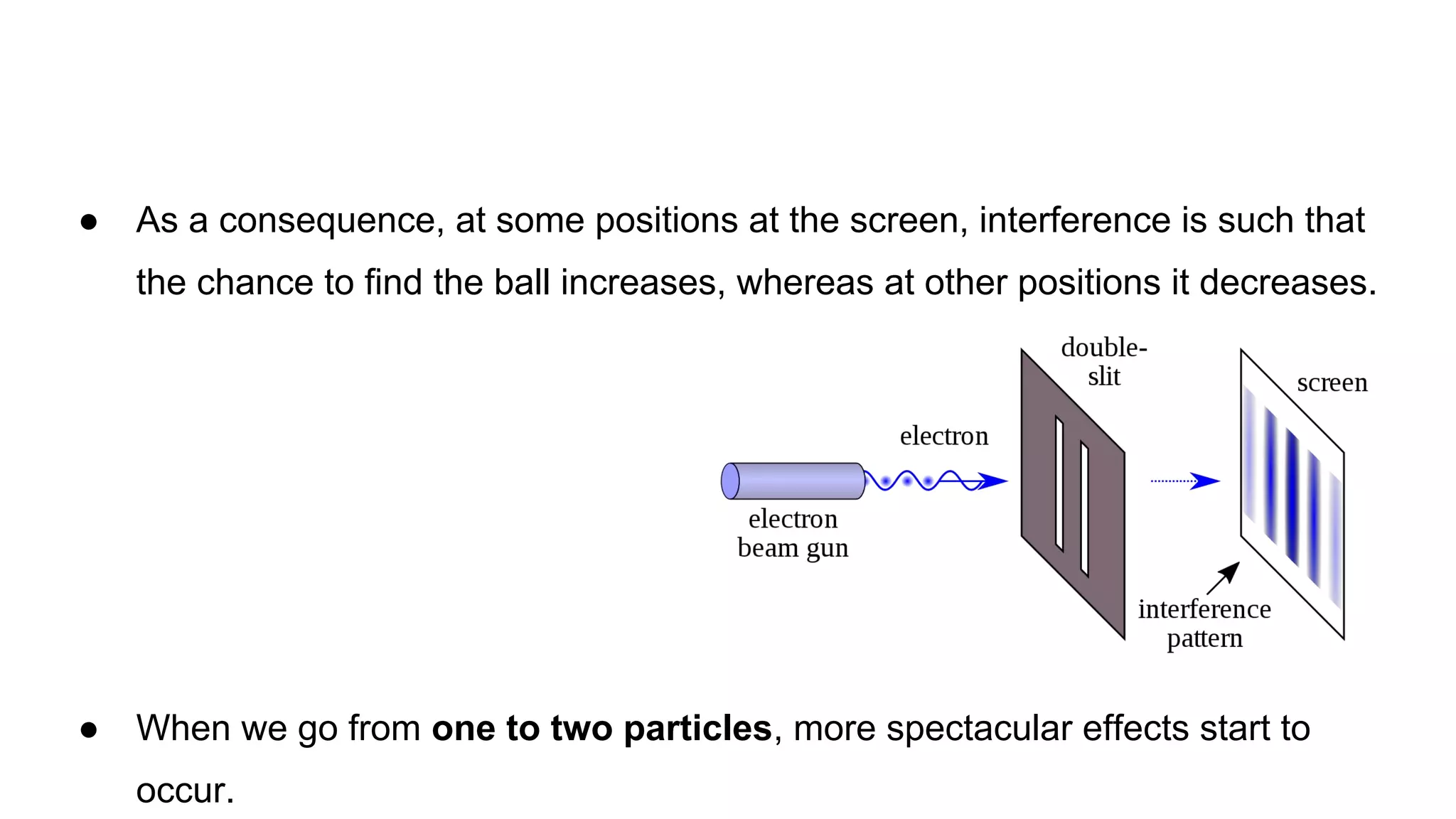
● In the quantum mechanical world, instead,
a quantum particle can do something completely bizarre,
it can go through both slits at the same time.
● We can observe this by putting another screen behind it
and measure the probability that the ball reaches a certain location.
● The ball going through both the left and the right slit can interfere.
● This is similar to the travelling waves in water, but here the ball can interfere
with itself!
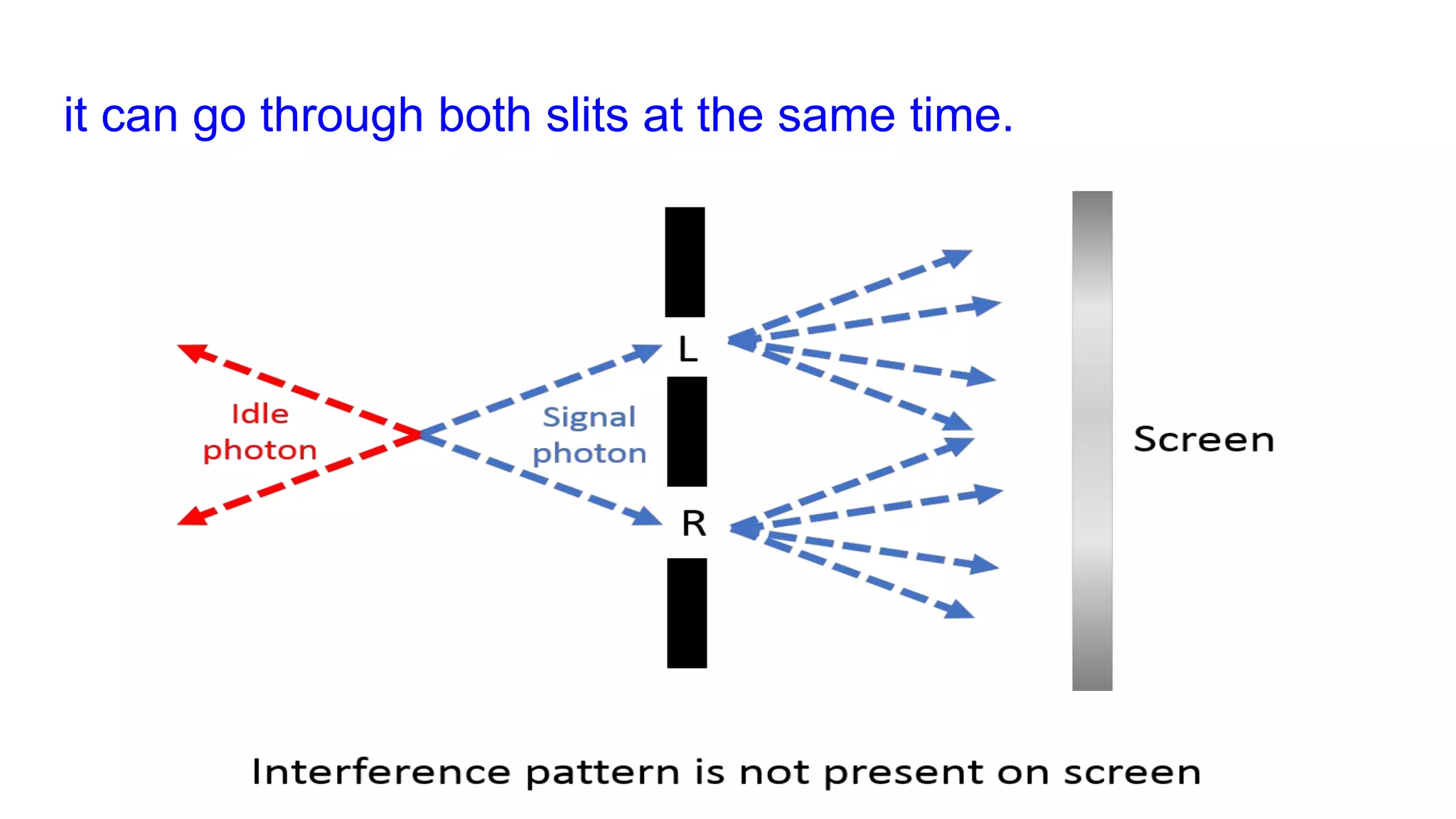
it can go through both slits at the same time.
● As a consequence, at some positions at the screen, interference is such that
the chance to find the ball increases, whereas at other positions it decreases.
● When we go from one to two particles, more spectacular effects start to
occur.
Entangled State
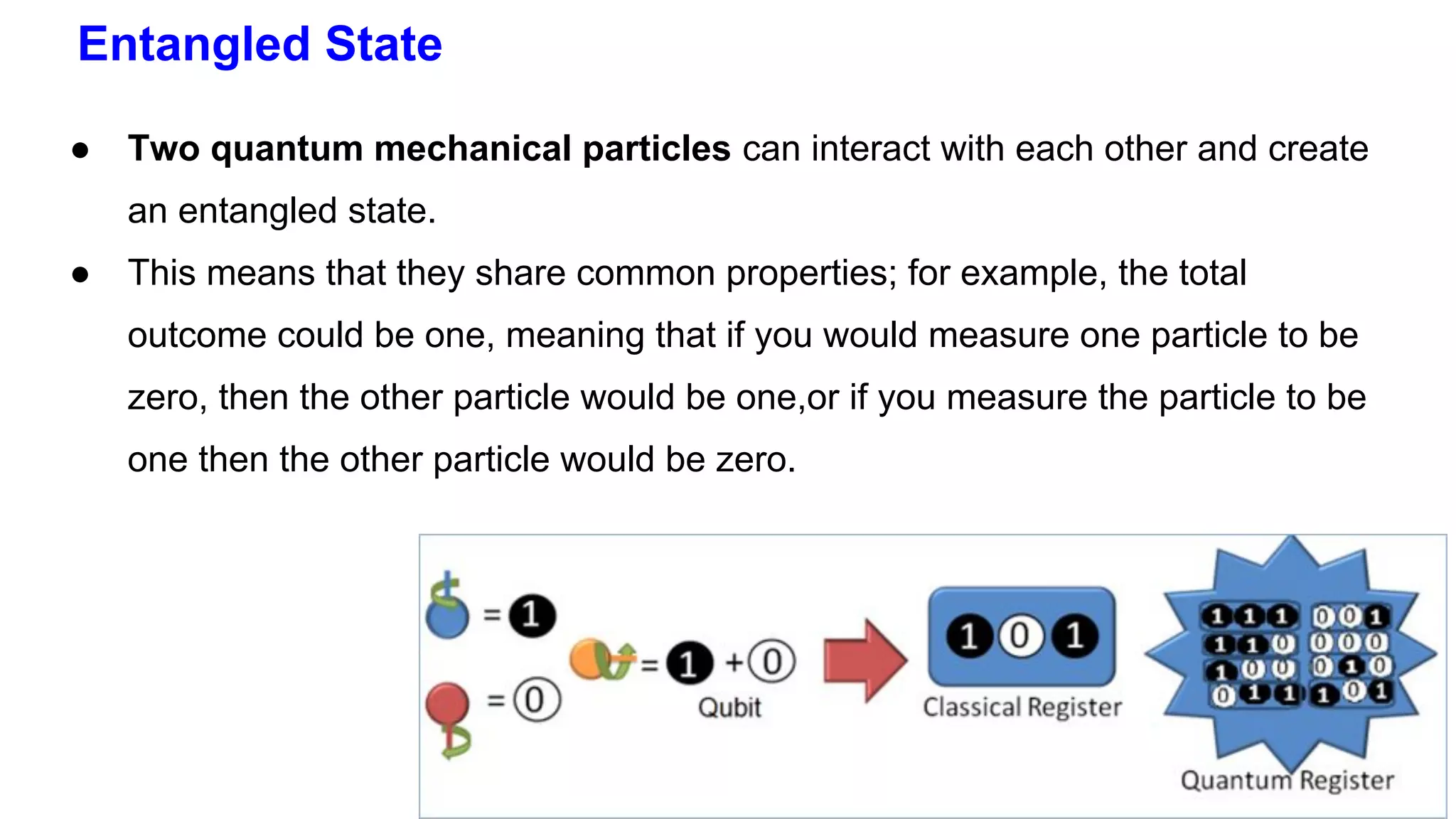
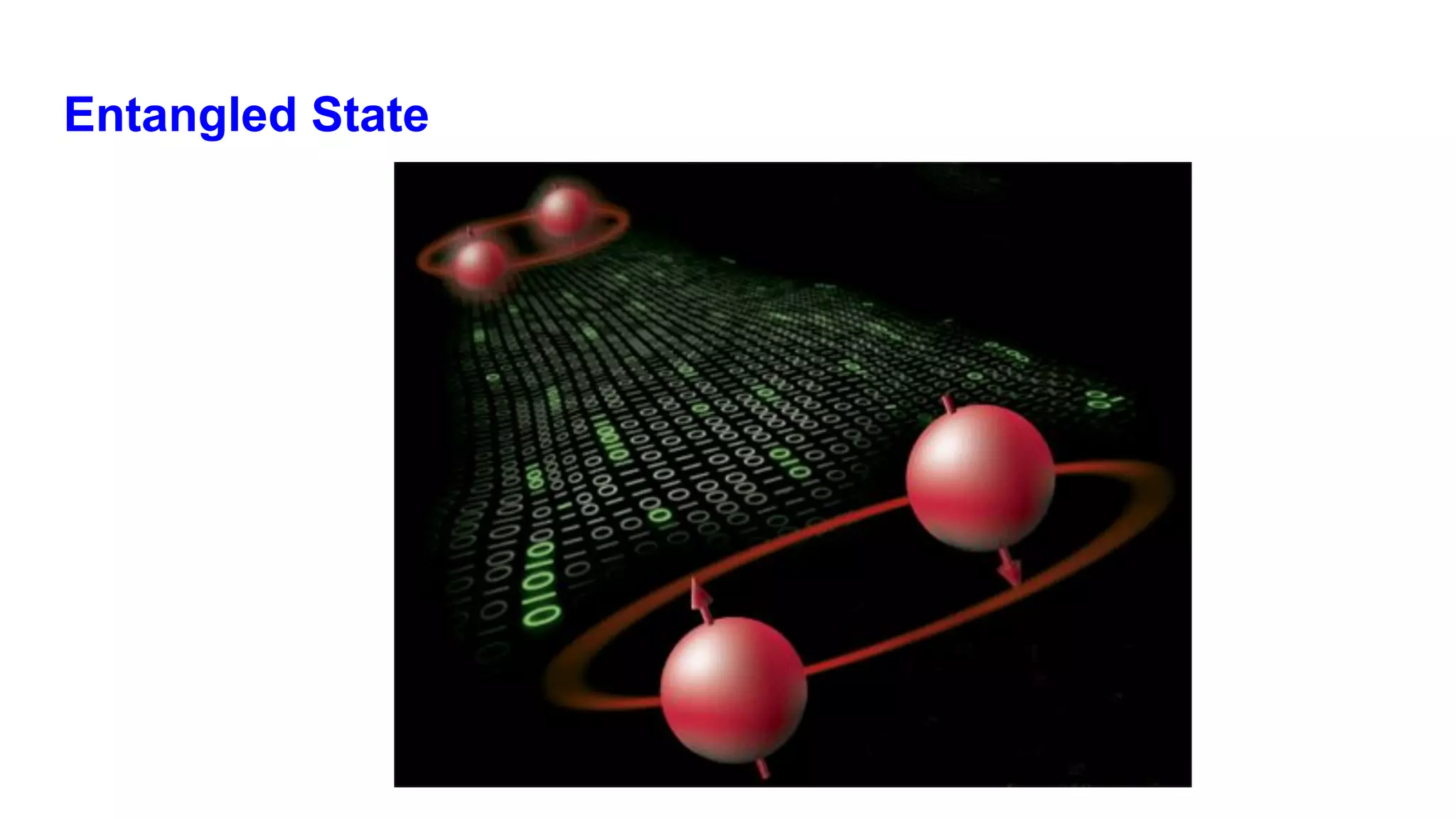
● Two quantum mechanical particles can interact with each other and create
an entangled state.
● This means that they share common properties; for example, the total
outcome could be one, meaning that if you would measure one particle to be
zero, then the other particle would be one,or if you measure the particle to be
one then the other particle would be zero.
Entangled State
Qubit
● The concepts of superposition, interference and entanglement that are behind
the real power of quantum computing.
● However in order to go beyond these concepts, we need to make use of it.
And create quantum particles that we can control very well for the
construction of a quantum computer.
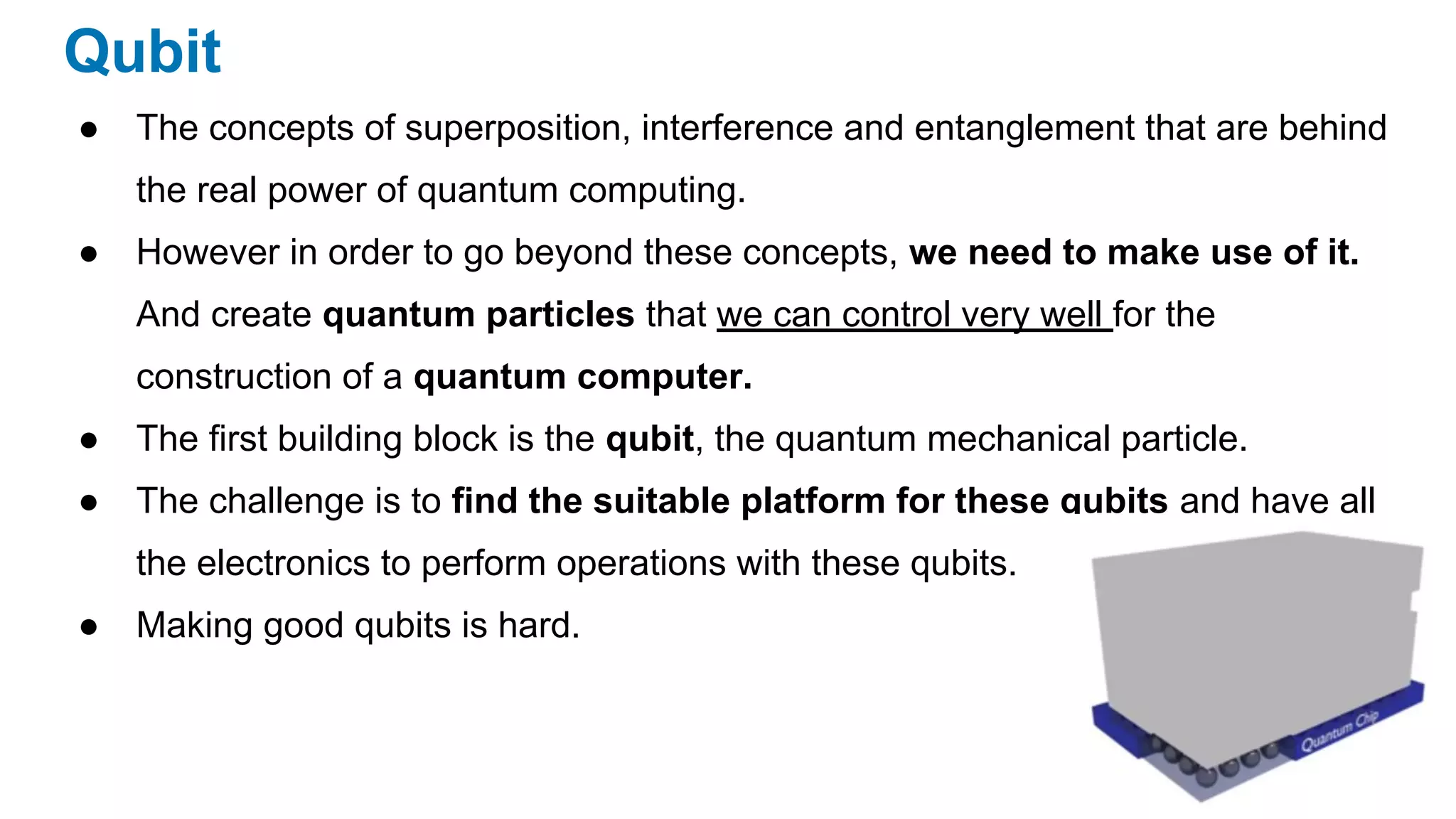
● The first building block is the qubit, the quantum mechanical particle.
● The challenge is to find the suitable platform for these qubits and have all
the electronics to perform operations with these qubits.
● Making good qubits is hard.
Qubits
We build these qubit systems in special fridges
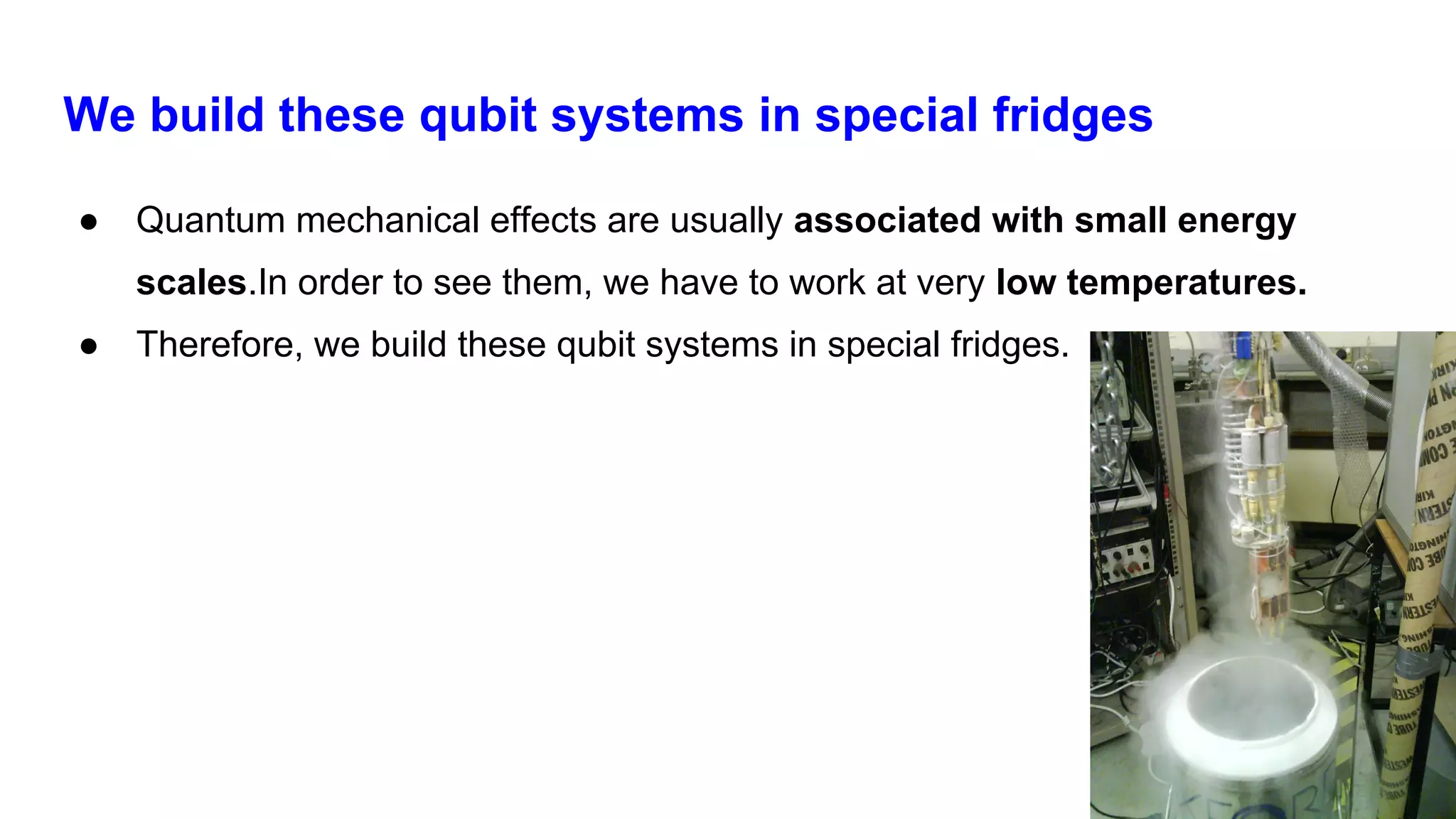
● Quantum mechanical effects are usually associated with small energy
scales.In order to see them, we have to work at very low temperatures.
● Therefore, we build these qubit systems in special fridges.
zero Kelvin
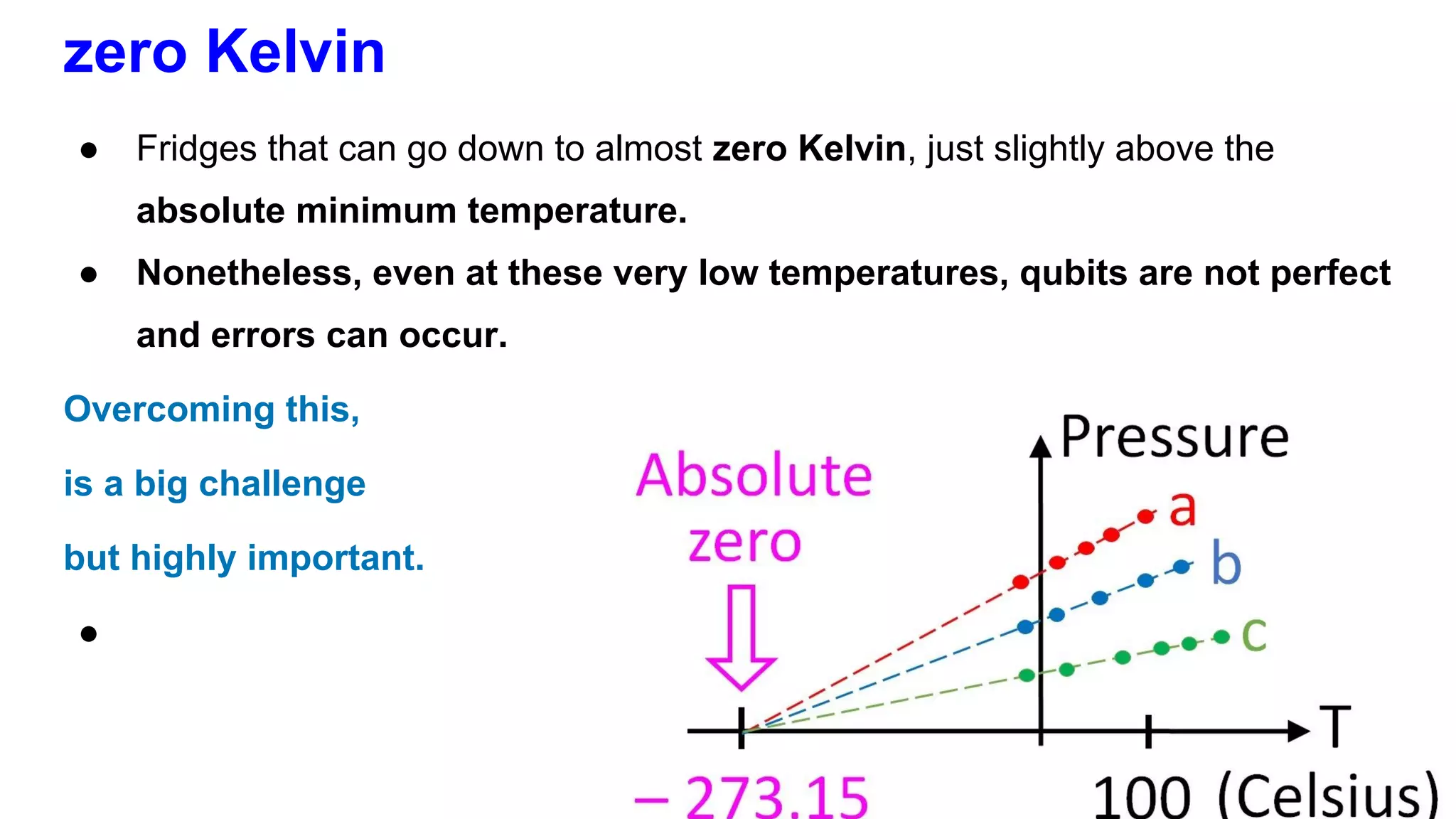
● Fridges that can go down to almost zero Kelvin, just slightly above the
absolute minimum temperature.
● Nonetheless, even at these very low temperatures, qubits are not perfect
and errors can occur.
Overcoming this,
is a big challenge
but highly important.
●
Quantum
Computer
Error correction techniques
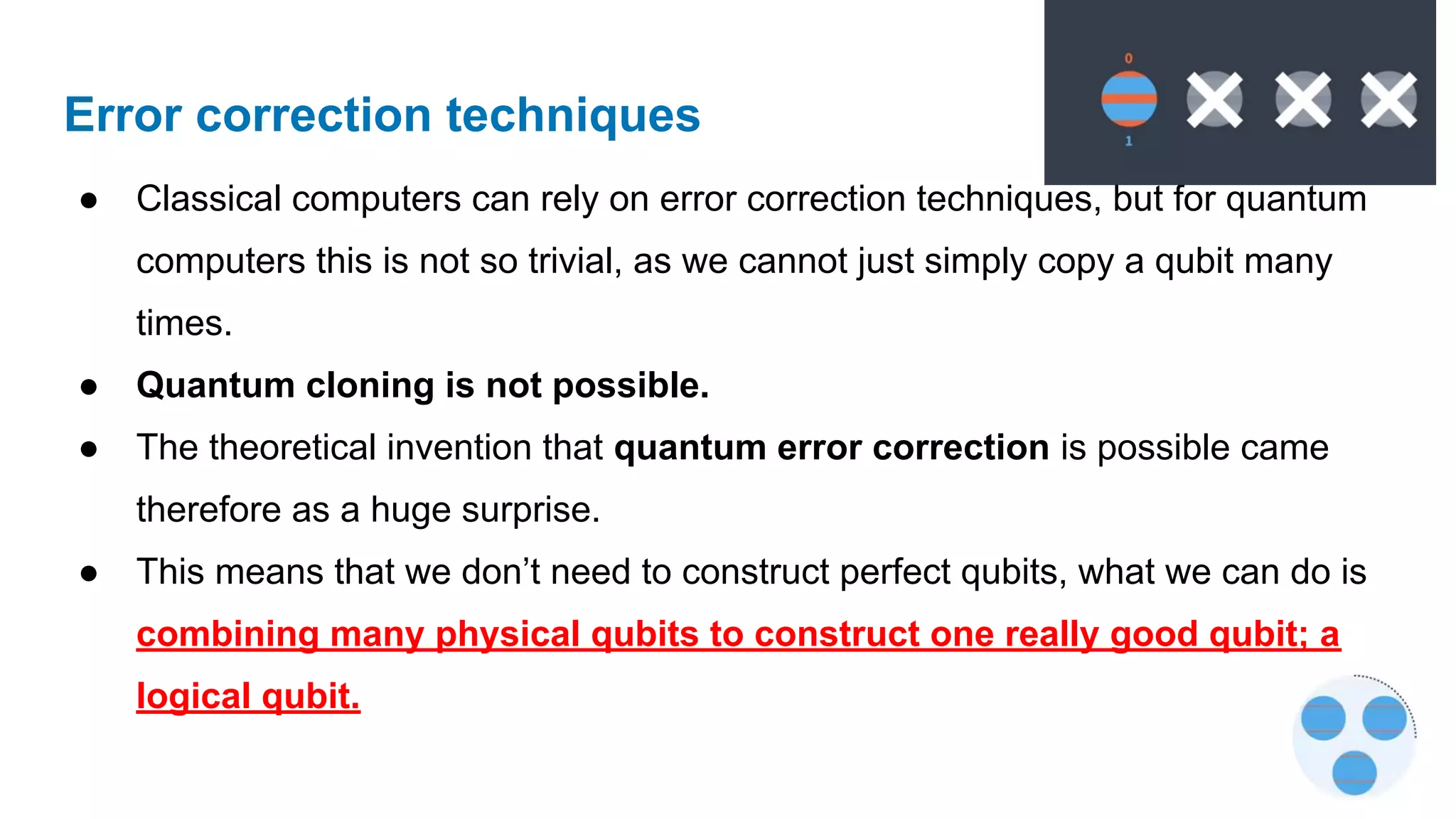
● Classical computers can rely on error correction techniques, but for quantum
computers this is not so trivial, as we cannot just simply copy a qubit many
times.
● Quantum cloning is not possible.
● The theoretical invention that quantum error correction is possible came
therefore as a huge surprise.
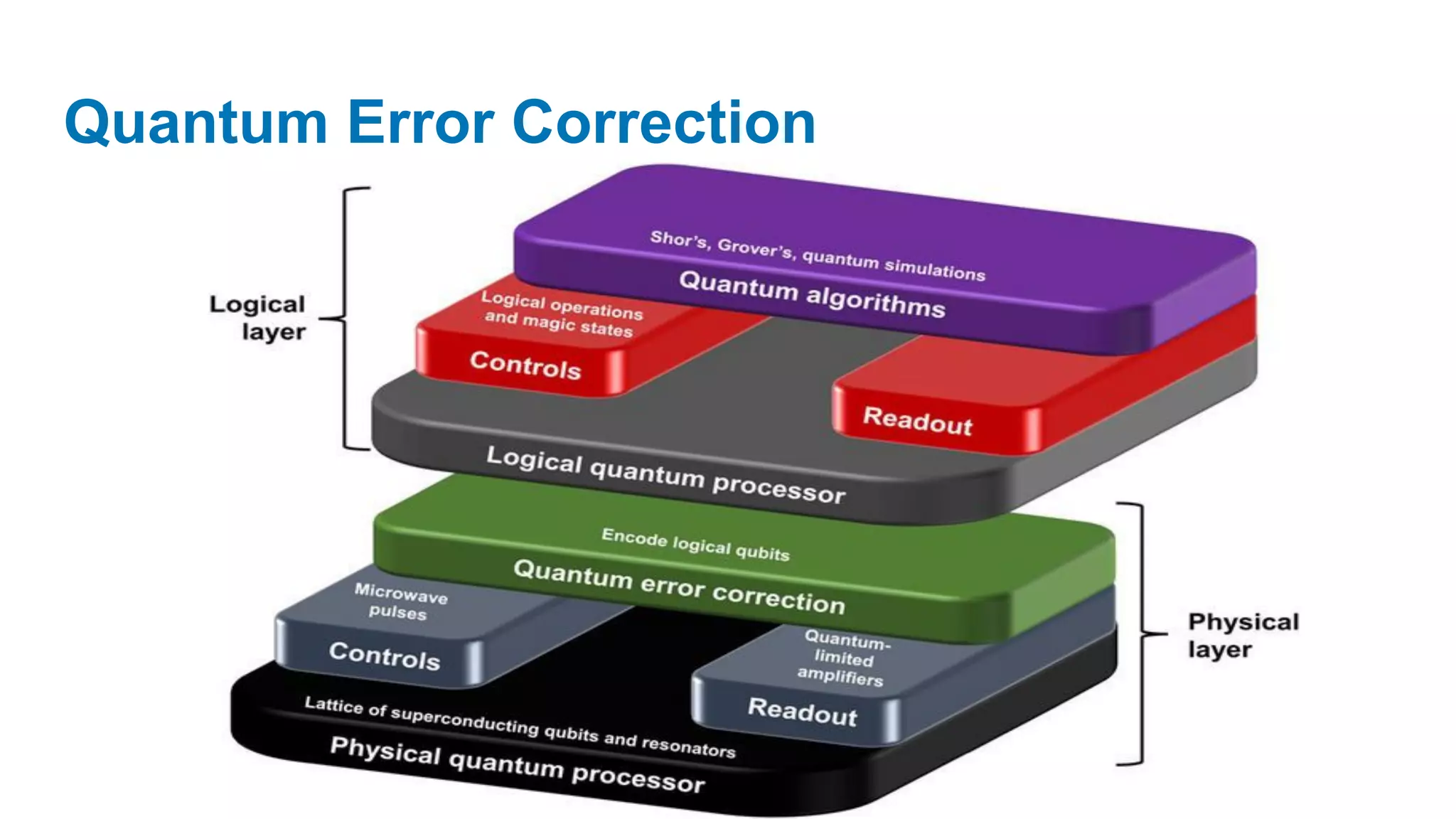
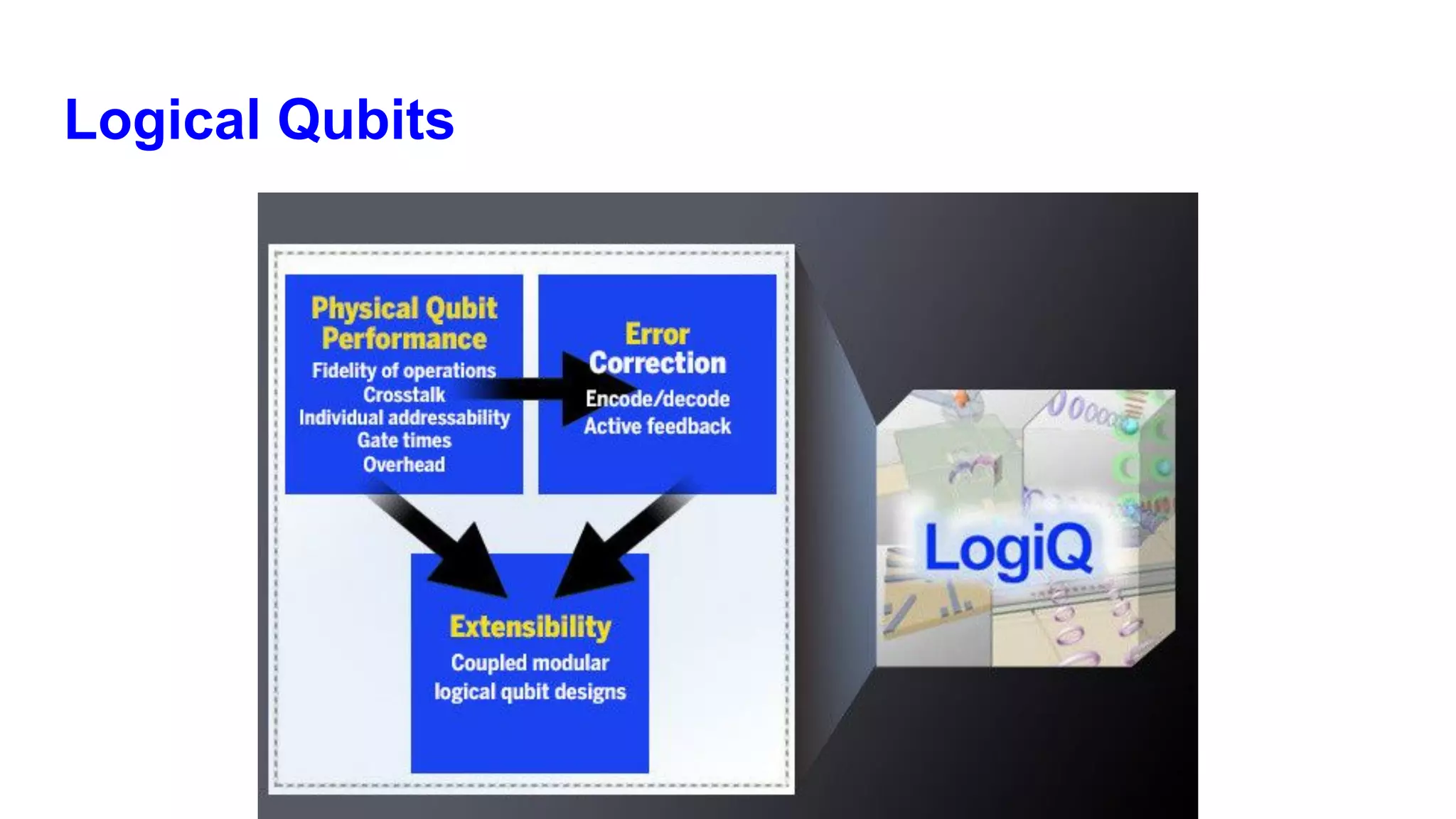
● This means that we don’t need to construct perfect qubits, what we can do is
combining many physical qubits to construct one really good qubit; a
logical qubit.
Quantum Error Correction
Logical Qubits
physical qubits to construct logical qubits
● We don’t need many logical qubits to build a powerful quantum computer,
since many quantum algorithms provide an exponential speedup as
compared to their classical counterpart.
● What we do need is many physical qubits to construct logical qubits, and
so a quantum computer may contain millions of qubits.
● What are the requirements to advance a system with a few qubits,
toward a quantum computer containing millions of qubits?
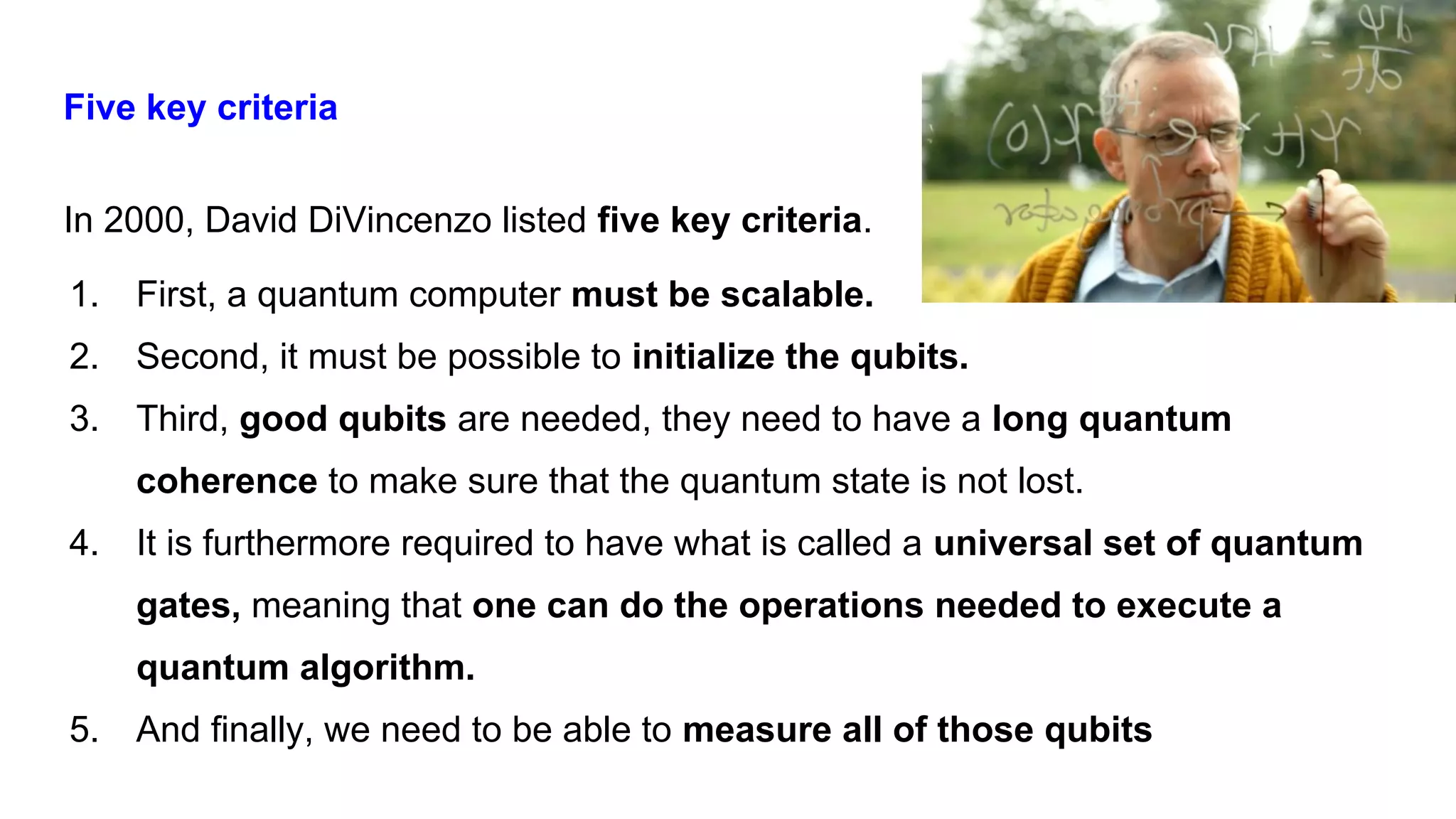
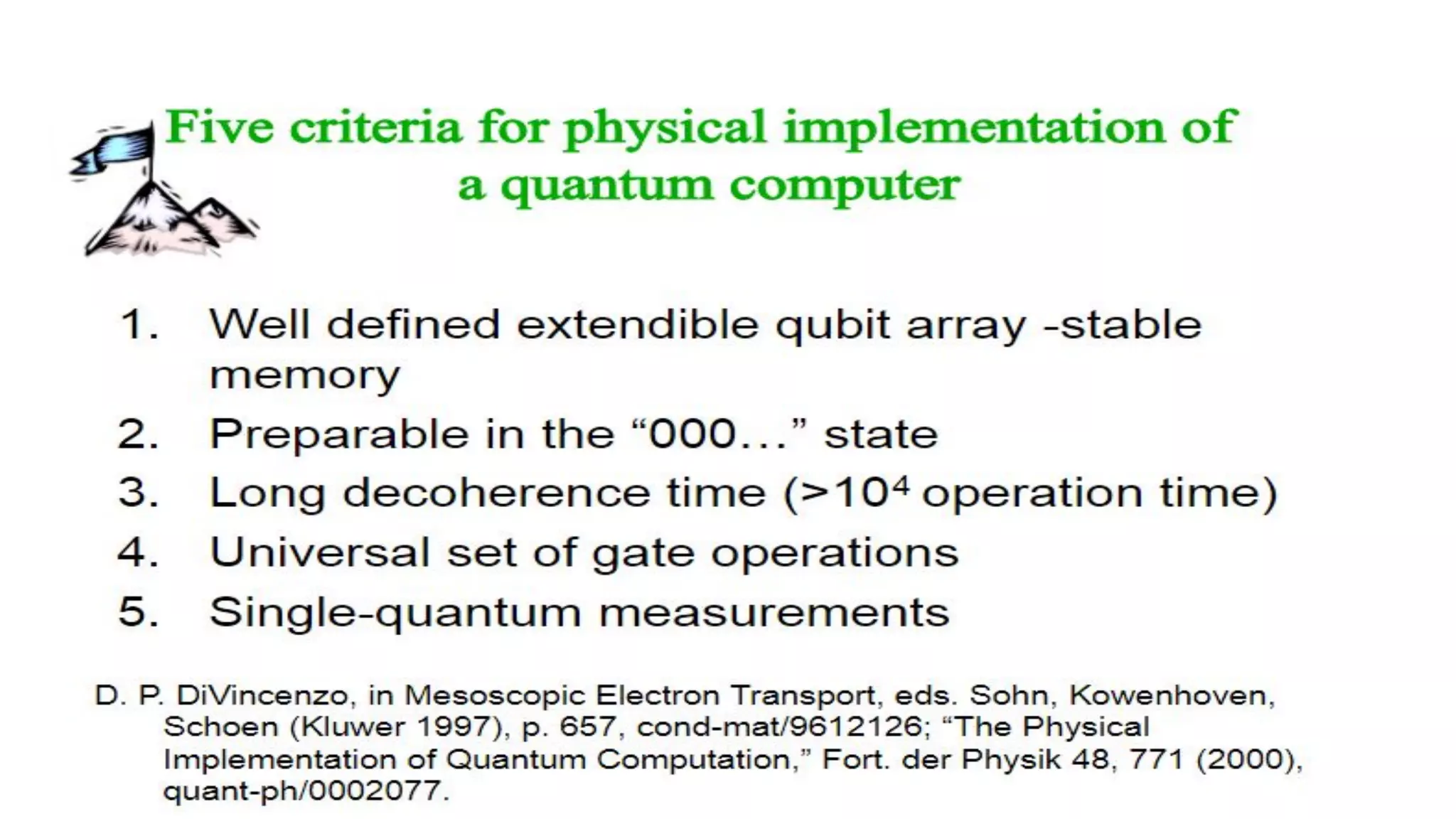
Five key criteria
In 2000, David DiVincenzo listed five key criteria.
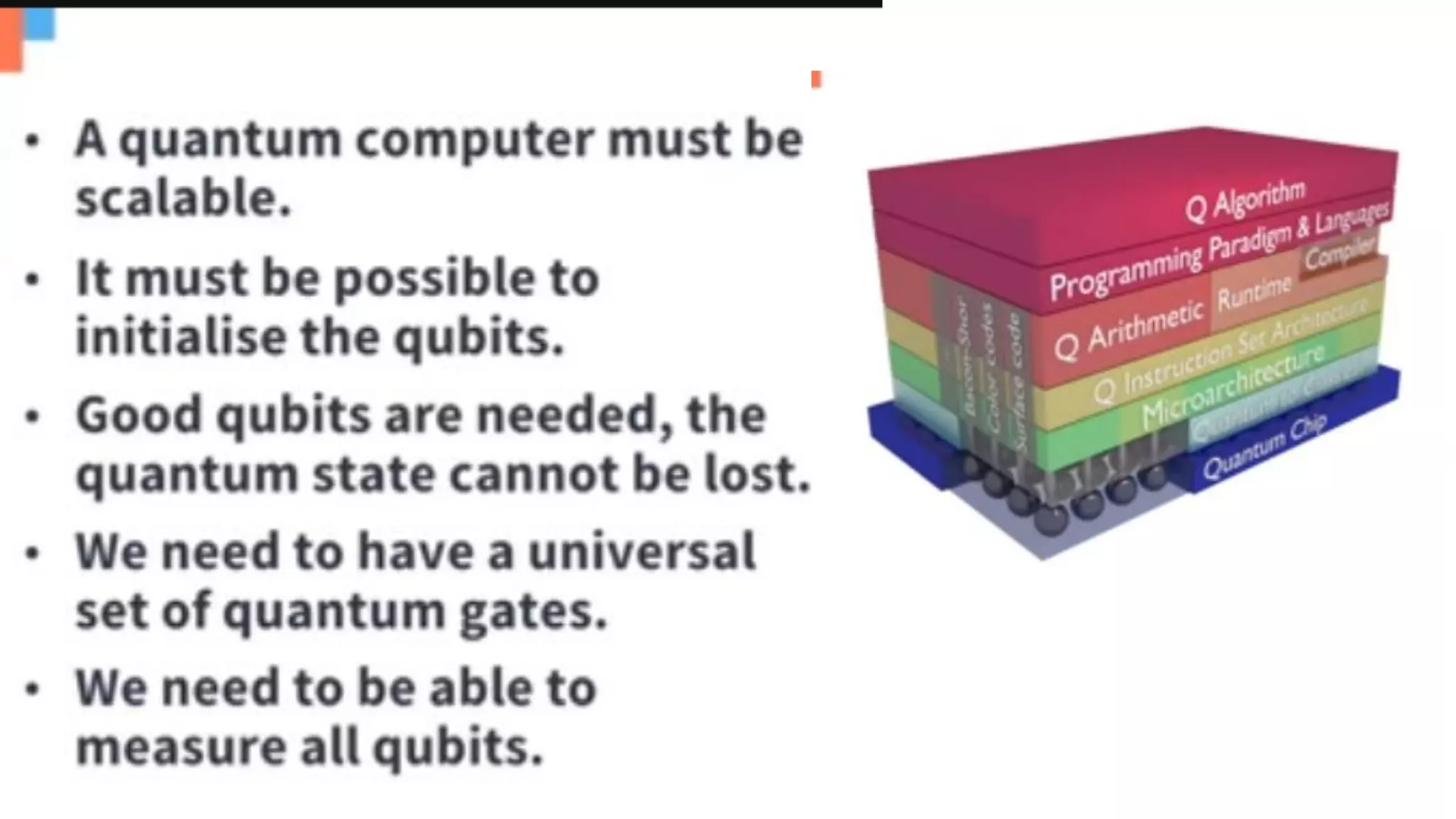
1. First, a quantum computer must be scalable.
2. Second, it must be possible to initialize the qubits.
3. Third, good qubits are needed, they need to have a long quantum
coherence to make sure that the quantum state is not lost.
4. It is furthermore required to have what is called a universal set of quantum
gates, meaning that one can do the operations needed to execute a
quantum algorithm.
5. And finally, we need to be able to measure all of those qubits
Quantum Computers
Superposition Interference
Entanglement and
Quantum Error Correction
Lesson 1
By: Professor Lili Saghafi
proflilisaghafi@gmail.com
@Lili_PLS

Quantum Computers_Superposition Interference Entanglement and Quantum Error Correction

  • 1.
    Quantum Computers Superposition Interference Entanglementand Quantum Error Correction Lesson 1 By: Professor Lili Saghafi proflilisaghafi@gmail.com @Lili_PLS
  • 2.
    What is aquantum computer? ● A future quantum computer will contain many hardware and software components. ● We can leverage of classical technology and construct a framework to layout a real vision for a quantum computer.
  • 3.
    Let’s first havea look at the classical computer. ● An essential part of a classical computer is the integrated circuit. ● The integrated circuit is an amazing piece of engineering. ● On integrated circuits, you can find nowadays billions of transistors. ● And these transistors, in turn, are used to construct classical bits.
  • 4.
  • 5.
  • 6.
    …..Continue ● These bitscan represent either a zero or a one, and we use these numbers to perform calculations with a computer. ● We find integrated circuits virtually everywhere and they completely changed our daily lives. ● while the modern supercomputer is much faster and much more accurate than the abacus that was invented thousands of years ago, they are bounded by the same physical principles. ● This century, we have the opportunity to develop something radically new, and use quantum mechanics to build quantum computers.
  • 7.
  • 8.
    Superposition, Interference andEntanglement ● Quantum mechanics can offer unique phenomena. ● Include superposition, interference and entanglement. Superposition ● Whereas a classical bit can only represent a 0 or a 1, its quantum mechanical counterpart, the quantum bit or qubit, can take on both values at the same time. ● It is not that we just don’t know what the value of this qubit is, the qubit can truly be in a superposition of two states, and represent both 0 and 1 at the same time.
  • 9.
    Superposition, Wikipedia ● Quantumsuperposition is a fundamental principle of quantum mechanics. ● It states that, much like waves in classical physics, ● any two (or more) quantum states can be added together ("superposed") and the result will be another valid quantum state; and conversely, that every quantum state can be represented as a sum of two or more other distinct states.
  • 10.
    Classical World ● Inthe classical world, if we throw a ball to a plate with two slits, ● the ball will go through either the left slit or the right slit.
  • 11.
    Quantum world ● Inthe quantum mechanical world, instead, a quantum particle can do something completely bizarre, it can go through both slits at the same time. ● We can observe this by putting another screen behind it and measure the probability that the ball reaches a certain location. ● The ball going through both the left and the right slit can interfere. ● This is similar to the travelling waves in water, but here the ball can interfere with itself!
  • 12.
    it can gothrough both slits at the same time.
  • 13.
    ● As aconsequence, at some positions at the screen, interference is such that the chance to find the ball increases, whereas at other positions it decreases. ● When we go from one to two particles, more spectacular effects start to occur.
  • 14.
    Entangled State ● Twoquantum mechanical particles can interact with each other and create an entangled state. ● This means that they share common properties; for example, the total outcome could be one, meaning that if you would measure one particle to be zero, then the other particle would be one,or if you measure the particle to be one then the other particle would be zero.
  • 15.
  • 16.
    Qubit ● The conceptsof superposition, interference and entanglement that are behind the real power of quantum computing. ● However in order to go beyond these concepts, we need to make use of it. And create quantum particles that we can control very well for the construction of a quantum computer. ● The first building block is the qubit, the quantum mechanical particle. ● The challenge is to find the suitable platform for these qubits and have all the electronics to perform operations with these qubits. ● Making good qubits is hard.
  • 17.
  • 18.
    We build thesequbit systems in special fridges ● Quantum mechanical effects are usually associated with small energy scales.In order to see them, we have to work at very low temperatures. ● Therefore, we build these qubit systems in special fridges.
  • 19.
    zero Kelvin ● Fridgesthat can go down to almost zero Kelvin, just slightly above the absolute minimum temperature. ● Nonetheless, even at these very low temperatures, qubits are not perfect and errors can occur. Overcoming this, is a big challenge but highly important. ●
  • 20.
  • 21.
    Error correction techniques ●Classical computers can rely on error correction techniques, but for quantum computers this is not so trivial, as we cannot just simply copy a qubit many times. ● Quantum cloning is not possible. ● The theoretical invention that quantum error correction is possible came therefore as a huge surprise. ● This means that we don’t need to construct perfect qubits, what we can do is combining many physical qubits to construct one really good qubit; a logical qubit.
  • 22.
  • 23.
  • 24.
    physical qubits toconstruct logical qubits ● We don’t need many logical qubits to build a powerful quantum computer, since many quantum algorithms provide an exponential speedup as compared to their classical counterpart. ● What we do need is many physical qubits to construct logical qubits, and so a quantum computer may contain millions of qubits. ● What are the requirements to advance a system with a few qubits, toward a quantum computer containing millions of qubits?
  • 25.
    Five key criteria In2000, David DiVincenzo listed five key criteria. 1. First, a quantum computer must be scalable. 2. Second, it must be possible to initialize the qubits. 3. Third, good qubits are needed, they need to have a long quantum coherence to make sure that the quantum state is not lost. 4. It is furthermore required to have what is called a universal set of quantum gates, meaning that one can do the operations needed to execute a quantum algorithm. 5. And finally, we need to be able to measure all of those qubits
  • 28.
    Quantum Computers Superposition Interference Entanglementand Quantum Error Correction Lesson 1 By: Professor Lili Saghafi proflilisaghafi@gmail.com @Lili_PLS