Dr. Andrés Gómez
Andres.gomez.tato@cesga.es
Jan. 2020
Quantum
Computing
Schedule
2
 Lecture 1: Introduction to Quantum
Computing.
 My First Quantum Program.
 Lecture 2: Programming Quantum
Algorithms
 My first Quantum Program with ProjectQ
 Lecture 3: Basic Quantum algorithms
 Lecture 4: Advanced algorithms
Lecture 1
 A brief history of QC and
needs. Types of quantum
computers.
 Basic concepts: qubit,
tensors, multiqubit,
quantum gates,
measurement, amplitudes
 My first quantum program.
 Quantum Circuits. Width,
Depth, Quantum Volume.
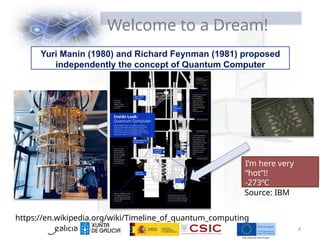
Welcome to a Dream!
Yuri Manin (1980) and Richard Feynman (1981) proposed
independently the concept of Quantum Computer
I’m here very
“hot”!!
-273ºC
4
Source: IBM
https://en.wikipedia.org/wiki/Timeline_of_quantum_computing
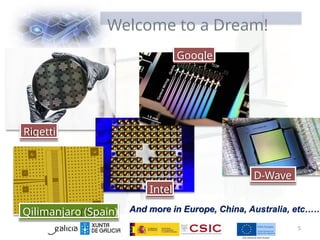
Welcome to a Dream!
Rigetti
Intel
Google
D-Wave
Qilimanjaro (Spain) And more in Europe, China, Australia, etc……
5
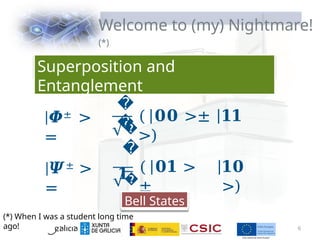
Welcome to (my) Nightmare!
(*)
|𝜱± >
=
�
� ( 𝟎𝟎 >± 𝟏𝟏
>)
|𝜳± >
=
�
�
𝟏
�
�
( 𝟎𝟏 >
±
𝟏𝟎
>)
Bell States
Superposition and
Entanglement
6
(*) When I was a student long time
ago!
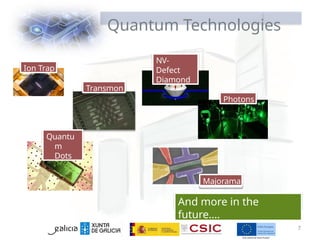
Quantum Technologies
Ion Trap
Transmon
NV-
Defect
Diamond
Photons
Quantu
m
Dots
And more in the
future….
Majorama
7
Quantum Technologies
Quantum Computer
 Quantum simulator [1]. Simulate a quantum system using another one,
maybe simpler, that can be controlled by the experimenter.
 Adiabatic Quantum Computer [2]. Prepares a known and easy
Hamiltonian and lets it evolve to solution.
 Topological Quantum Computer[4]. Uses topological properties.
 Continuous Variable Quantum Computer [5].
 Universal Quantum Computer [3].
1Reviewed in Georgescu, I. M., Ashhab, S., & Nori, F. (2014). Quantum simulation. Reviews of Modern Physics, 86(1), 153–
185. http://doi.org/10.1103/RevModPhys.86.153 arXiv:1308.6253
2 Reviewed in Albash, T., & Lidar, D. A. (2016). Adiabatic Quantum Computing. arxiv:1611.04471
3Proposed in Deutsch, D. (1985). http://doi.org/10.1098/rspa.1985.0070
and Deutsch, D. (1989). http://doi.org/10.1098/rspa.1989.0099
4 Lahtinen V., Pachos J.K.. SciPost Phys. 3, 021 (2017) arXiv:1705.04103
5 Lloyd S. & Braunstein, A.L. Phys.Rev.Lett. 82 (1999) 1784-1787.
arXiv:quant-ph/9810082 11
Adiabatic Quantum
Computer
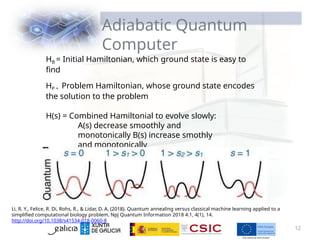
HB = Initial Hamiltonian, which ground state is easy to
find
HP = Problem Hamiltonian, whose ground state encodes
the solution to the problem
H(s) = Combined Hamiltonial to evolve slowly:
A(s) decrease smoothly and
monotonically B(s) increase smothly
and monotonically
H(s) = A(s)HB + B(s)HP
Li, R. Y., Felice, R. Di, Rohs, R., & Lidar, D. A. (2018). Quantum annealing versus classical machine learning applied to a
simplified computational biology problem. Npj Quantum Information 2018 4:1, 4(1), 14.
http://doi.org/10.1038/s41534-018-0060-8
12
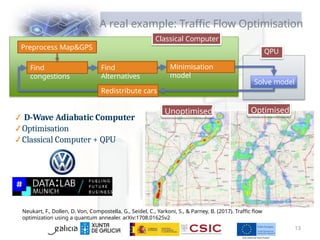
A real example: Traffic Flow Optimisation
Neukart, F., Dollen, D. Von, Compostella, G., Seidel, C., Yarkoni, S., & Parney, B. (2017). Traffic flow
optimization using a quantum annealer. arXiv:1708.01625v2
D-Wave Adiabatic Computer
Optimisation
Classical Computer + QPU
Unoptimised Optimised
Preprocess Map&GPS
Find
congestions
Find
Alternatives
Minimisation
model
Solve model
Redistribute cars
Classical Computer
QPU
13
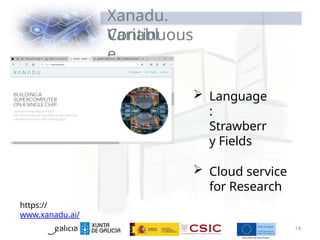
Xanadu.
Continuous
Variabl
e
https://
www.xanadu.ai/
14
 Language
:
Strawberr
y Fields
 Cloud service
for Research
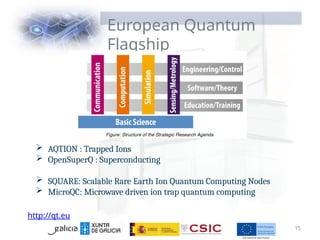
European Quantum
Flagship
 AQTION : Trapped Ions
 OpenSuperQ : Superconducting
 SQUARE: Scalable Rare Earth Ion Quantum Computing Nodes
 MicroQC: Microwave driven ion trap quantum computing
http://qt.eu
15
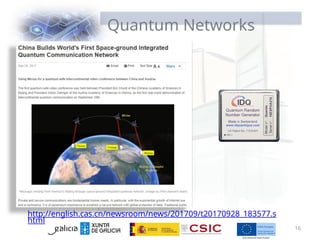
Quantum Networks
http://english.cas.cn/newsroom/news/201709/t20170928_183577.s
html
16
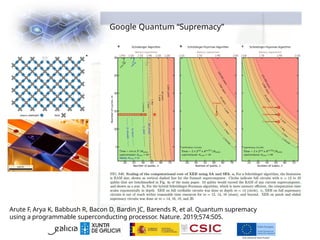
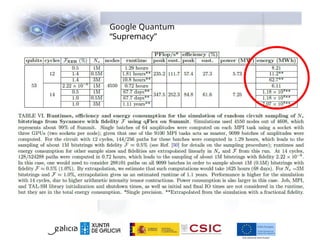
Google Quantum “Supremacy”
Arute F, Arya K, Babbush R, Bacon D, Bardin JC, Barends R, et al. Quantum supremacy
using a programmable superconducting processor. Nature. 2019;574:505.
Google Quantum
“Supremacy”
Lecture 1
 A brief history of QC and
needs. Types of quantum
computers.
 Basic concepts: qubit,
tensors, multiqubit, quantum
gates, measurement,
amplitudes
 My first quantum program.
 Quantum Circuits. Width,
Depth, Quantum Volume.
1. A scalable physical system with well characterized qubits.
2. The ability to initialize the state of the qubits to a simple fiducial
state, such as |000….000>
3. Long relevant decoherence times, much longer than the gate
operation time.
4. A “universal” set of quantum gates.
5. A qubit-specific measurement capability.
20
DiVincenzo’s Criteria
D. DiVincenzo (2000). “The Physical Implementation of Quantum Computation“,
arXiv:quant-ph/0002077
What do you need (today)?
21
Complex numbers
Matrix multiplication
Understand TENSOR products
Understand measurement and probabilities
Imagination
BIT, QUBIT AND
SUPERPOSITION
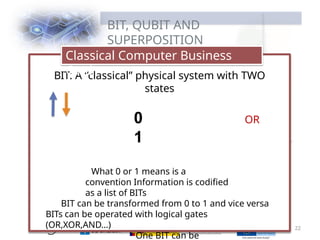
BIT: A “classical” physical system with TWO
states
0 OR
1
What 0 or 1 means is a
convention Information is codified
as a list of BITs
BIT can be transformed from 0 to 1 and vice versa
BITs can be operated with logical gates
(OR,XOR,AND…)
One BIT can be
Classical Computer Business
Card
22
BIT, QUBIT AND
SUPERPOSITION
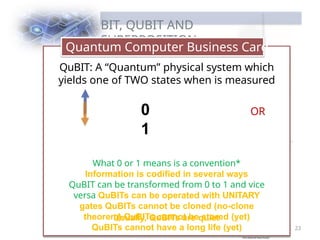
Quantum Computer Business Card
QuBIT: A “Quantum” physical system which
yields one of TWO states when is measured
0 OR
1
What 0 or 1 means is a convention*
Information is codified in several ways
QuBIT can be transformed from 0 to 1 and vice
versa QuBITs can be operated with UNITARY
gates QuBITs cannot be cloned (no-clone
theorem) QuBITs cannot be stored (yet)
QuBITs cannot have a long life (yet)
Usually, QuBITs are quiet
23
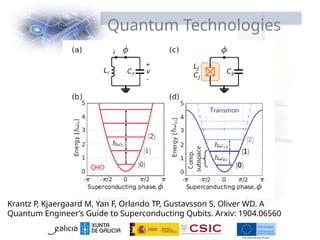
Quantum Technologies
Krantz P, Kjaergaard M, Yan F, Orlando TP, Gustavsson S, Oliver WD. A
Quantum Engineer’s Guide to Superconducting Qubits. Arxiv: 1904.06560
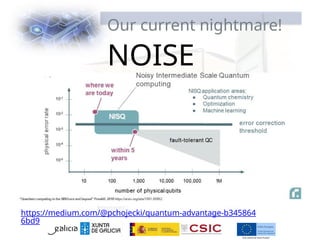
Our current nightmare!
NOISE
Noisy Intermediate-Scale Quantum” (NISQ)
https://medium.com/@pchojecki/quantum-advantage-b345864
6bd9
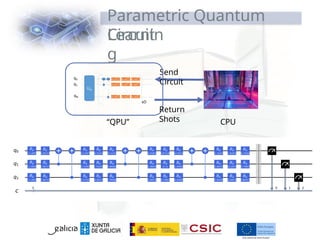
Send
Circuit
“QPU” CPU
Return
Shots
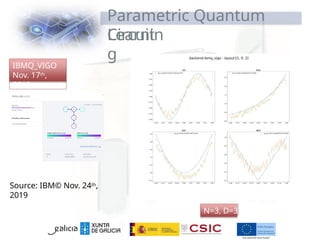
Parametric Quantum
Circuit
Learnin
g
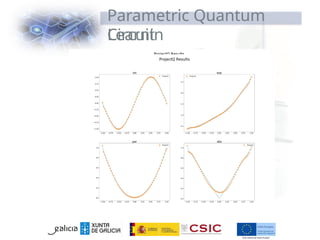
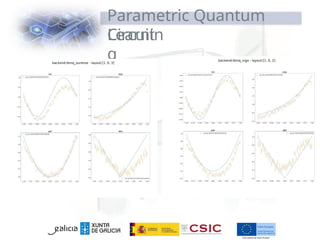
Parametric Quantum
Circuit
Learnin
g
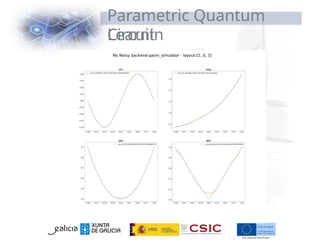
Parametric Quantum
Circuit
Learnin
g
Parametric Quantum
Circuit
Learnin
g
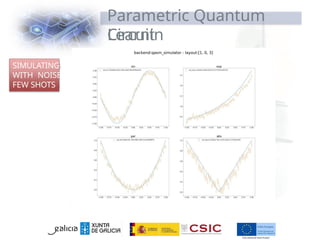
SIMULATING
WITH NOISE
FEW SHOTS
Parametric Quantum
Circuit
Learnin
g
N=3, D=3
IBMQ_VIGO
Nov. 17th,
2019
Source: IBM© Nov. 24th,
2019
Parametric Quantum
Circuit
Learnin
g
Algorithms with
shallow
circuit
s
• QVE: Quantum Variational Eigensolver:
https://arxiv.org/abs/1304.3061
• QAOA: Quantum Approximate Optimization Algorithm.
http://arxiv.org/abs/1411.4028
• Variational Quantum Factoring:
https://arxiv.org/abs/1808.08927
• Quantum Machine Learning:
• Quantum Support Vector Machine
• Quantum Principal Component Analysis
• Quantum Variational Autoencoder,
• Etc.
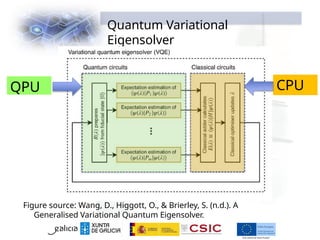
Quantum Variational
Eigensolver
Figure source: Wang, D., Higgott, O., & Brierley, S. (n.d.). A
Generalised Variational Quantum Eigensolver.
QPU CPU
www.inl.int
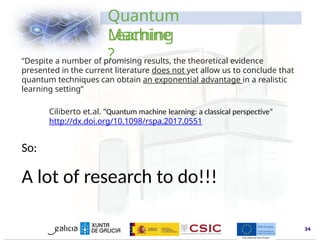
“Despite a number of promising results, the theoretical evidence
presented in the current literature does not yet allow us to conclude that
quantum techniques can obtain an exponential advantage in a realistic
learning setting”
Ciliberto et.al. “Quantum machine learning: a classical perspective”
http://dx.doi.org/10.1098/rspa.2017.0551
34
Quantum
Machine
Learning
?
So:
A lot of research to do!!!
www.inl.int
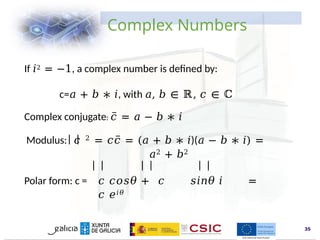
Complex Numbers
If 𝑖2 = −1, a complex number is defined by:
c=𝑎 + 𝑏 ∗ 𝑖, with 𝑎, 𝑏 ∈ ℝ, 𝑐 ∈ ℂ
Complex conjugate: 𝑐̅ = 𝑎 − 𝑏 ∗ 𝑖
Modulus: 𝑐 2 = 𝑐𝑐̅ = (𝑎 + 𝑏 ∗ 𝑖)(𝑎 − 𝑏 ∗ 𝑖) =
𝑎2 + 𝑏2
Polar form: c = 𝑐 𝑐𝑜𝑠𝜃 + 𝑐 𝑠𝑖𝑛𝜃 𝑖 =
𝑐 𝑒𝑖𝜃
35
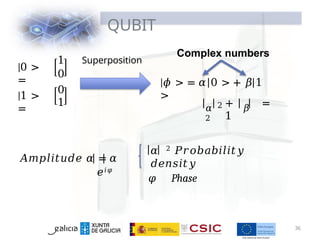
QUBIT
|0 >
=
|1 >
=
1 Superposition
0
0
1
|𝜙 > = 𝛼 0 > + 𝛽 1
>
Complex numbers
𝛼 2 𝛽
2
+ =
1
𝐴𝑚𝑝𝑙𝑖𝑡𝑢𝑑𝑒 𝛼 = 𝛼
𝑒𝑖𝜑
𝛼 2 𝑃𝑟𝑜𝑏𝑎𝑏𝑖𝑙𝑖𝑡𝑦
𝑑𝑒𝑛𝑠𝑖𝑡𝑦
𝜑 Phase
36
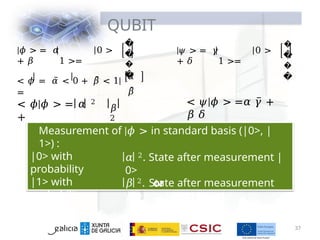
QUBIT
|𝜙 > = 𝛼 0 >
+ 𝛽 1 >=
�
�
�
�
Measurement of |𝜙 > in standard basis (|0>, |
1>) :
|0> with
probability
𝛼 2. State after measurement |
0>
or
|1> with
probability
𝛽 2. State after measurement
|1>
< 𝜙 = 𝛼̅ < 0 + 𝛽̅ < 1|
=
𝛼̅
𝛽̅
< 𝜙|𝜙 > = 𝛼 2
+
𝛽
2
|𝜓 > = 𝛾 0 >
+ 𝛿 1 >=
�
�
�
�
37
< 𝜓|𝜙 > =𝛼 𝛾̅ +
𝛽 𝛿
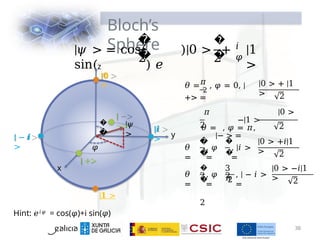
Bloch’s
Sphere
�
�
2
�
�
2
|𝜓 > = cos( )|0 > +
sin( ) 𝑒
𝑖
𝜑
|1
>
2
𝜋 |0 >
−|1 >
𝜃 = , 𝜑 = 𝜋,
|− > =
2
𝜃
=
�
�
2
, 𝜑
=
�
�
2
, |𝑖 >
=
|0 > +𝑖|1
>
𝜃
=
�
�
2
, 𝜑
=
3
𝜋
2
, | − 𝑖 >
=
2
|0 > −𝑖|1
> 2
𝜋
𝜃 =
2
, 𝜑 = 0, |
+> =
|0 > + |1
> 2
y
x
|𝜓
>
�
�
z
|𝟎
>
𝜑
| +>
|
−>
| − 𝒊
>
|𝒊
>
38
|𝟏 >
Hint: 𝑒𝑖𝜑 = cos(𝜑)+i sin(𝜑)
One-Qubit Transformations
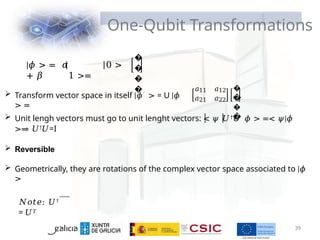
|𝜙 > = 𝛼 0 >
+ 𝛽 1 >=
�
�
�
�
 Transform vector space in itself |𝜙′ > = U |𝜙
> =
𝑎11
𝑎21
𝑎12
𝑎22
�
�
�
�
 Unit lengh vectors must go to unit lenght vectors: < 𝜓 𝑈†𝑈 𝜙 > =< 𝜓|𝜙
>⇒ 𝑈†𝑈=I
 Reversible
 Geometrically, they are rotations of the complex vector space associated to |𝜙
>
𝑁𝑜𝑡𝑒: 𝑈†
= 𝑈𝑇
39
One-Qubit Transformations
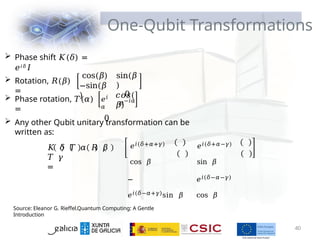
 Phase shift 𝐾(𝛿) =
𝑒𝑖𝛿𝐼
 Rotation, 𝑅(𝛽)
=
cos(𝛽)
−sin(𝛽
)
sin(𝛽
)
𝑐𝑜𝑠(
𝛽)
 Phase rotation, 𝑇(𝛼)
=
𝑒𝑖
𝛼
0
0
𝑒−𝑖𝛼
 Any other Qubit unitary transformation can be
written as:
𝐾 𝛿 𝑇 𝛼 𝑅 𝛽
𝑇 𝛾
=
𝑒𝑖(𝛿+𝛼+𝛾)
cos 𝛽
−
𝑒𝑖(𝛿−𝛼+𝛾)sin 𝛽
𝑒𝑖(𝛿+𝛼−𝛾)
sin 𝛽
𝑒𝑖(𝛿−𝛼−𝛾)
cos 𝛽
40
Source: Eleanor G. Rieffel.Quantum Computing: A Gentle
Introduction
One-Qubit Transformations
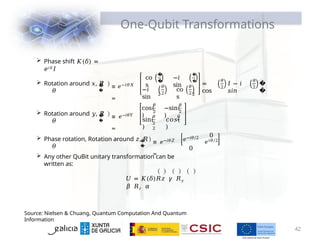
 Phase shift 𝐾(𝛿) =
𝑒𝑖𝛿𝐼
�
�
 Rotation around 𝑥, 𝑅
𝜃
≡ 𝑒−𝑖𝜃𝑋
=
co
s
�
�
2
−𝑖
sin
�
�
2
−𝑖
sin
𝜃
2
co
s
𝜃
2
=
cos
𝜃
2
𝐼 − 𝑖
𝑠𝑖𝑛
𝜃
2
�
�
�
�
 Rotation around 𝑦, 𝑅
𝜃
≡ 𝑒−𝑖𝜃𝑌
=
𝜃
cos(
)
𝜃
−sin(
)
2
𝜃
sin(
)
2
𝜃
2
2
𝑐𝑜𝑠(
)
�
�
 Phase rotation, Rotation around 𝑧, 𝑅
𝜃
≡ 𝑒−𝑖𝜃𝑍
=
𝑒−𝑖𝜃/2
0
0
𝑒𝑖𝜃/2
 Any other QuBit unitary transformation can be
written as:
𝑈 = 𝐾(𝛿)𝑅𝑧 𝛾 𝑅𝑦
𝛽 𝑅𝑧 𝛼
42
Source: Nielsen & Chuang, Quantum Computation And Quantum
Information
One-Qubit Transformations
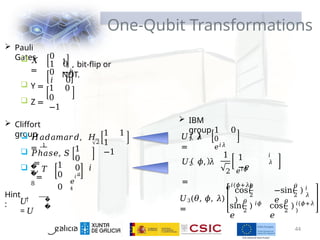
 Pauli
Gates 1
, bit-flip or
NOT.
 𝑋
=
 Y =
 Z =
0
1 0
0 −𝑖
𝑖 0
1 0
0
−1
 Cliffort
group
 𝐻𝑎𝑑𝑎𝑚𝑎𝑟𝑑, 𝐻
= 1
2
1 1
1
−1
 𝑃ℎ𝑎𝑠𝑒, 𝑆
=
1
0
0 𝑖
�
�
 , 𝑇
=
8
1
0
0
𝑖
𝜋
𝑒
4
Hint
:
†
𝑈
= 𝑈
�
�
𝑈1 𝜆
=
1 0
0
𝑒𝑖𝜆
𝑈2 𝜙, 𝜆
=
1 1
−𝑒
𝑖
𝜆
2 𝑒𝑖𝜙
𝑒𝑖(𝜙+𝜆)
𝑈3(𝜃, 𝜙, 𝜆)
=
𝜃
2
cos(
)
𝜃
2
−sin( )
𝑒
𝑖
𝜆
𝜃
2
sin( )
𝑒
𝑖𝜙 𝜃
44
2
cos( )
𝑒
𝑖(𝜙+𝜆
)
 IBM
group
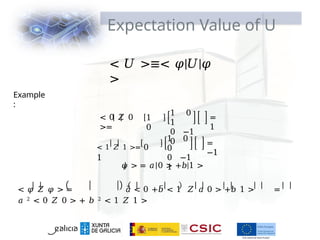
Expectation Value of U
< 𝑈 >≡< 𝜑|𝑈|𝜑
>
Example
:
< 0 𝑍 0
>=
1
0
1 0
1
0 −1
0
=
1
< 1 𝑍 1 >= 0
1
1 0
0
0 −1
1
=
−1
𝜑 > = 𝑎 0 > +𝑏|1 >
< 𝜑 𝑍 𝜑 > = 𝑎̅ < 0 +𝑏̅ < 1 𝑍 𝑎 0 > +𝑏 1 > =
𝑎 2 < 0 𝑍 0 > + 𝑏 2 < 1 𝑍 1 >
O P E N Q U I R K . H T
M L
Exercise with 1 QuBit
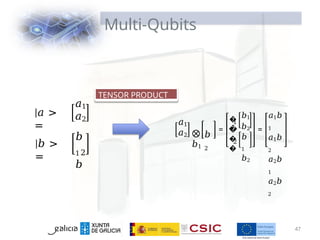
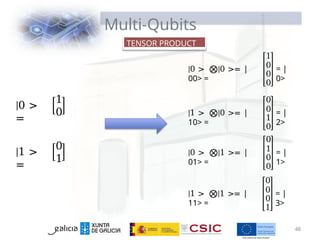
Multi-Qubits
|𝑎 >
=
|𝑏 >
=
𝑎1
𝑎2
𝑏
1
𝑏
2
TENSOR PRODUCT
𝑎1
𝑎2 ⨂
𝑏1
𝑏
2
=
�
�
1
�
�
2
𝑏1
𝑏2
𝑏
1
𝑏2
=
𝑎1𝑏
1
𝑎1𝑏
2
𝑎2𝑏
1
𝑎2𝑏
2
47
Multi-Qubits
|0 > ⨂|1 >= |
01> =
= |
1>
|0 > ⨂|0 >= |
00> =
1
0
0
0
= |
0>
|1 > ⨂|0 >= |
10> =
= |
2>
|1 > ⨂|1 >= |
11> =
0
0
1
0
0
1
0
0
0
0
0
1
= |
3>
TENSOR PRODUCT
|0 >
=
1
0
|1 >
=
0
1
48
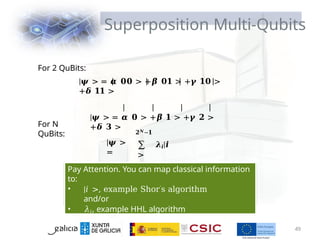
Superposition Multi-Qubits
For N
QuBits:
For 2 QuBits:
|𝝍 > = 𝜶 𝟎𝟎 > +𝜷 𝟎𝟏 > +𝜸 𝟏𝟎 >
+𝜹 𝟏𝟏 >
|𝝍 > = 𝜶 𝟎 > +𝜷 𝟏 > +𝜸 𝟐 >
+𝜹 𝟑 >
|𝝍 >
=
𝟐𝑵−𝟏
∑ 𝝀𝒊|𝒊
>
𝒊=𝟎
Pay Attention. You can map classical information
to:
• |𝑖 >, example Shor′s algorithm
and/or
• 𝜆𝑖, example HHL algorithm
49
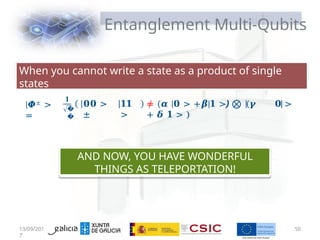
Entanglement Multi-Qubits
13/09/201
7
50
When you cannot write a state as a product of single
states
|𝜱± >
=
𝟏
�
�
𝟎𝟎 >
±
𝟏𝟏
>
≠ (𝜶 |𝟎 > +𝜷|𝟏 >) ⨂ (𝜸 𝟎 >
+ 𝜹 𝟏 > )
AND NOW, YOU HAVE WONDERFUL
THINGS AS TELEPORTATION!
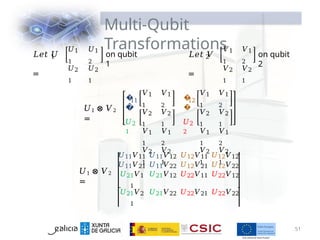
Multi-Qubit
Transformations
51
1
𝐿𝑒𝑡 𝑈
=
𝑈1
1
𝑈2
1
𝑈1
2
𝑈2
1
on qubit
1
2
𝐿𝑒𝑡 𝑉
=
𝑉1
1
𝑉2
1
𝑉1
2
𝑉2
1
on qubit
2
𝑈1 ⊗ 𝑉2
=
�
�
11 �
�
12
𝑈2
1
𝑉1
1
𝑉2
1
𝑉1
1
𝑉2
1
𝑉1
2
𝑉2
1
𝑉1
2
𝑉2
1
𝑈2
2
𝑉1
1
𝑉2
1
𝑉1
1
𝑉2
1
𝑉1
2
𝑉2
1
𝑉1
2
𝑉2
1
𝑈1 ⊗ 𝑉2
=
𝑈11𝑉11 𝑈11𝑉12 𝑈12𝑉11 𝑈12𝑉12
𝑈11𝑉21 𝑈11𝑉22 𝑈12𝑉21 𝑈12𝑉22
𝑈21𝑉1
1
𝑈21𝑉12 𝑈22𝑉11 𝑈22𝑉12
𝑈21𝑉2
1
𝑈21𝑉22 𝑈22𝑉21 𝑈22𝑉22
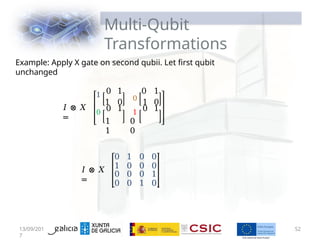
Multi-Qubit
Transformations
13/09/201
7
52
𝐼 ⊗ 𝑋
=
1 0 1 0 1
1 0
0
1 0
0
0 1 1
0 1
1 0
1 0
𝐼 ⊗ 𝑋
=
0 1 0 0
1 0 0 0
0 0 0 1
0 0 1 0
Example: Apply X gate on second qubii. Let first qubit
unchanged
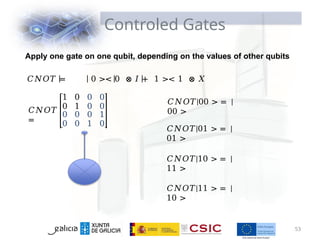
Controled Gates
𝐶𝑁𝑂𝑇
=
1 0 0 0
0 1 0 0
0 0 0 1
0 0 1 0
Apply one gate on one qubit, depending on the values of other qubits
𝐶𝑁𝑂𝑇 = 0 >< 0 ⊗ 𝐼 + 1 >< 1 ⊗ 𝑋
𝐶𝑁𝑂𝑇|00 > = |
00 >
𝐶𝑁𝑂𝑇|01 > = |
01 >
𝐶𝑁𝑂𝑇|10 > = |
11 >
𝐶𝑁𝑂𝑇|11 > = |
10 >
53
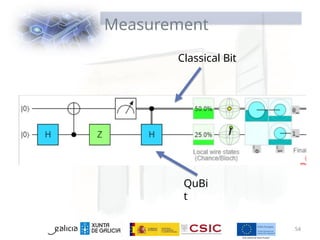
Measurement
Classical Bit
QuBi
t
54
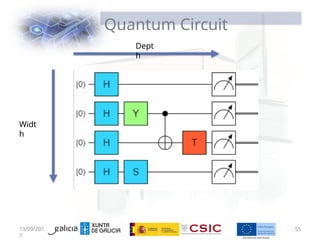
Quantum Circuit
Widt
h
13/09/201
7
55
Dept
h
O P E N Q U I R K . H T
M L
MY FIRST QUANTUM
PROGRAM:
Superdense Coding
My First Quantum Program
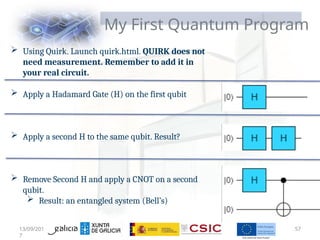
 Using Quirk. Launch quirk.html. QUIRK does not
need measurement. Remember to add it in
your real circuit.
 Apply a Hadamard Gate (H) on the first qubit
 Apply a second H to the same qubit. Result?
 Remove Second H and apply a CNOT on a second
qubit.
 Result: an entangled system (Bell’s)
13/09/201
7
57
Superdense Coding
58
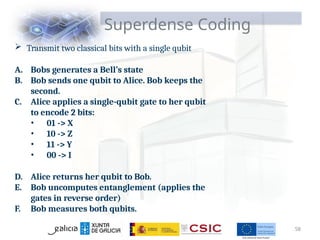
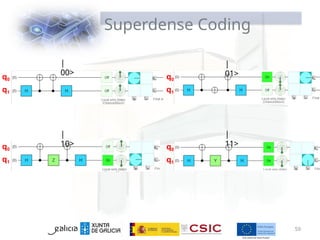
 Transmit two classical bits with a single qubit
A. Bobs generates a Bell’s state
B. Bob sends one qubit to Alice. Bob keeps the
second.
C. Alice applies a single-qubit gate to her qubit
to encode 2 bits:
• 01 -> X
• 10 -> Z
• 11 -> Y
• 00 -> I
D. Alice returns her qubit to Bob.
E. Bob uncomputes entanglement (applies the
gates in reverse order)
F. Bob measures both qubits.
Superdense Coding
|
00>
59
|
01>
|
10>
|
11>
q0
q1
q0
q1
q0
q1
q0
q1
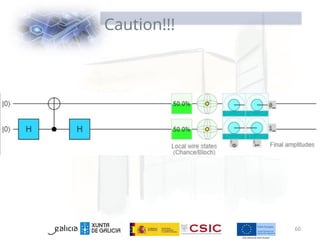
Caution!!!
60
C O N N E C T T O : H T T P S : / / Q U A N T U M - C O M P U T I N G . I
B M . C O M /
Exercise 2: IBM Quantum
Experience
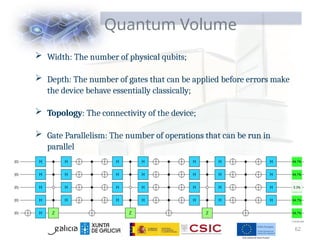
Quantum Volume
 Width: The number of physical qubits;
 Depth: The number of gates that can be applied before errors make
the device behave essentially classically;
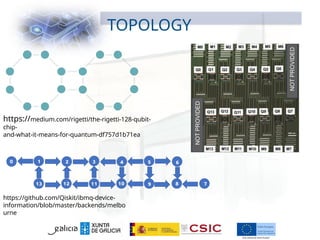
 Topology: The connectivity of the device;
 Gate Parallelism: The number of operations that can be run in
parallel
62
TOPOLOGY
https://medium.com/rigetti/the-rigetti-128-qubit-
chip-
and-what-it-means-for-quantum-df757d1b71ea
https://github.com/Qiskit/ibmq-device-
information/blob/master/backends/melbo
urne
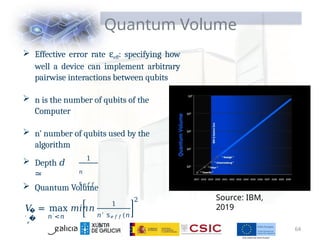
Quantum Volume
 Effective error rate εeff: specifying how
well a device can implement arbitrary
pairwise interactions between qubits
 n is the number of qubits of the
Computer
 n’ number of qubits used by the
algorithm
 Depth 𝑑
≃
1
𝑛
𝗌𝑒𝑓𝑓
 Quantum Volume
�
� 𝑛′<𝑛
𝑉 = max 𝑚𝑖𝑛𝑛
′,
1
𝑛′ 𝗌𝑒𝑓𝑓(𝑛
′)
2 Source: IBM,
2019
64
Classical
Resources
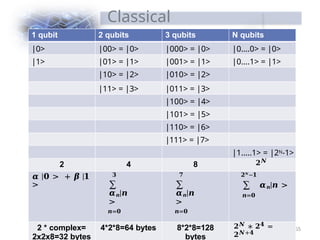
65
1 qubit 2 qubits 3 qubits N qubits
|0> |00> = |0> |000> = |0> |0….0> = |0>
|1> |01> = |1> |001> = |1> |0….1> = |1>
|10> = |2> |010> = |2>
|11> = |3> |011> = |3>
|100> = |4>
|101> = |5>
|110> = |6>
|111> = |7>
|1…..1> = |2N-1>
2 4 8 𝟐𝑵
𝜶 |𝟎 > + 𝜷 |𝟏
>
𝟑
∑
𝜶𝒏|𝒏
>
𝒏=𝟎
𝟕
∑
𝜶𝒏|𝒏
>
𝒏=𝟎
𝟐𝑵
−𝟏
∑ 𝜶𝒏|𝒏 >
𝒏=𝟎
2 * complex=
2x2x8=32 bytes
4*2*8=64 bytes 8*2*8=128
bytes
𝟐𝑵 ∗ 𝟐𝟒 =
𝟐𝑵+𝟒
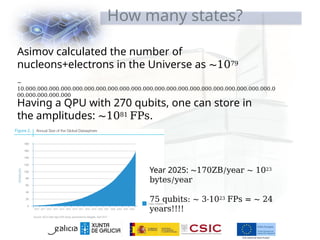
How many states?
Asimov calculated the number of
nucleons+electrons in the Universe as ∼1079
∼
10.000.000.000.000.000.000.000.000.000.000.000.000.000.000.000.000.000.000.000.000.000.0
00.000.000.000.000
Having a QPU with 270 qubits, one can store in
the amplitudes: ∼1081 FPs.
Year 2025: ∼170ZB/year ∼ 1023
bytes/year
75 qubits: ∼ 3·1023 FPs = ∼ 24
years!!!!
Classical
Resources
qubits RAM
1 32 bytes + memory for gates
2 64 bytes + memory for gates
3 128 bytes + memory for gates
4 256 bytes + memory for gates
8 4 kbytes + memory for gates
16 1 Mbytes + memory for gates
32 64 Gbytes + memory for gates
36 1TB + …..
38 4TB (Limit CESGA FT2 FAT node
….)
45 0,5PB [1]
64 512 ExaBytes!!!
THIS IS ONLY TRUE IF YOU NEED ALL POSSIBLE STATES!
[1] Häner, T., & Steiger, D. S. (2017). 0.5 Petabyte Simulation of a 45-Qubit Quantum Circuit. Arxiv:1704.01127
67
quantum computing presentation for professionals

quantum computing presentation for professionals

  • 1.
  • 2.
    Schedule 2  Lecture 1:Introduction to Quantum Computing.  My First Quantum Program.  Lecture 2: Programming Quantum Algorithms  My first Quantum Program with ProjectQ  Lecture 3: Basic Quantum algorithms  Lecture 4: Advanced algorithms
  • 3.
    Lecture 1  Abrief history of QC and needs. Types of quantum computers.  Basic concepts: qubit, tensors, multiqubit, quantum gates, measurement, amplitudes  My first quantum program.  Quantum Circuits. Width, Depth, Quantum Volume.
  • 4.
    Welcome to aDream! Yuri Manin (1980) and Richard Feynman (1981) proposed independently the concept of Quantum Computer I’m here very “hot”!! -273ºC 4 Source: IBM https://en.wikipedia.org/wiki/Timeline_of_quantum_computing
  • 5.
    Welcome to aDream! Rigetti Intel Google D-Wave Qilimanjaro (Spain) And more in Europe, China, Australia, etc…… 5
  • 6.
    Welcome to (my)Nightmare! (*) |𝜱± > = � � ( 𝟎𝟎 >± 𝟏𝟏 >) |𝜳± > = � � 𝟏 � � ( 𝟎𝟏 > ± 𝟏𝟎 >) Bell States Superposition and Entanglement 6 (*) When I was a student long time ago!
  • 7.
  • 8.
  • 11.
    Quantum Computer  Quantumsimulator [1]. Simulate a quantum system using another one, maybe simpler, that can be controlled by the experimenter.  Adiabatic Quantum Computer [2]. Prepares a known and easy Hamiltonian and lets it evolve to solution.  Topological Quantum Computer[4]. Uses topological properties.  Continuous Variable Quantum Computer [5].  Universal Quantum Computer [3]. 1Reviewed in Georgescu, I. M., Ashhab, S., & Nori, F. (2014). Quantum simulation. Reviews of Modern Physics, 86(1), 153– 185. http://doi.org/10.1103/RevModPhys.86.153 arXiv:1308.6253 2 Reviewed in Albash, T., & Lidar, D. A. (2016). Adiabatic Quantum Computing. arxiv:1611.04471 3Proposed in Deutsch, D. (1985). http://doi.org/10.1098/rspa.1985.0070 and Deutsch, D. (1989). http://doi.org/10.1098/rspa.1989.0099 4 Lahtinen V., Pachos J.K.. SciPost Phys. 3, 021 (2017) arXiv:1705.04103 5 Lloyd S. & Braunstein, A.L. Phys.Rev.Lett. 82 (1999) 1784-1787. arXiv:quant-ph/9810082 11
  • 12.
    Adiabatic Quantum Computer HB =Initial Hamiltonian, which ground state is easy to find HP = Problem Hamiltonian, whose ground state encodes the solution to the problem H(s) = Combined Hamiltonial to evolve slowly: A(s) decrease smoothly and monotonically B(s) increase smothly and monotonically H(s) = A(s)HB + B(s)HP Li, R. Y., Felice, R. Di, Rohs, R., & Lidar, D. A. (2018). Quantum annealing versus classical machine learning applied to a simplified computational biology problem. Npj Quantum Information 2018 4:1, 4(1), 14. http://doi.org/10.1038/s41534-018-0060-8 12
  • 13.
    A real example:Traffic Flow Optimisation Neukart, F., Dollen, D. Von, Compostella, G., Seidel, C., Yarkoni, S., & Parney, B. (2017). Traffic flow optimization using a quantum annealer. arXiv:1708.01625v2 D-Wave Adiabatic Computer Optimisation Classical Computer + QPU Unoptimised Optimised Preprocess Map&GPS Find congestions Find Alternatives Minimisation model Solve model Redistribute cars Classical Computer QPU 13
  • 14.
  • 15.
    European Quantum Flagship  AQTION: Trapped Ions  OpenSuperQ : Superconducting  SQUARE: Scalable Rare Earth Ion Quantum Computing Nodes  MicroQC: Microwave driven ion trap quantum computing http://qt.eu 15
  • 16.
  • 17.
    Google Quantum “Supremacy” AruteF, Arya K, Babbush R, Bacon D, Bardin JC, Barends R, et al. Quantum supremacy using a programmable superconducting processor. Nature. 2019;574:505.
  • 18.
  • 19.
    Lecture 1  Abrief history of QC and needs. Types of quantum computers.  Basic concepts: qubit, tensors, multiqubit, quantum gates, measurement, amplitudes  My first quantum program.  Quantum Circuits. Width, Depth, Quantum Volume.
  • 20.
    1. A scalablephysical system with well characterized qubits. 2. The ability to initialize the state of the qubits to a simple fiducial state, such as |000….000> 3. Long relevant decoherence times, much longer than the gate operation time. 4. A “universal” set of quantum gates. 5. A qubit-specific measurement capability. 20 DiVincenzo’s Criteria D. DiVincenzo (2000). “The Physical Implementation of Quantum Computation“, arXiv:quant-ph/0002077
  • 21.
    What do youneed (today)? 21 Complex numbers Matrix multiplication Understand TENSOR products Understand measurement and probabilities Imagination
  • 22.
    BIT, QUBIT AND SUPERPOSITION BIT:A “classical” physical system with TWO states 0 OR 1 What 0 or 1 means is a convention Information is codified as a list of BITs BIT can be transformed from 0 to 1 and vice versa BITs can be operated with logical gates (OR,XOR,AND…) One BIT can be Classical Computer Business Card 22
  • 23.
    BIT, QUBIT AND SUPERPOSITION QuantumComputer Business Card QuBIT: A “Quantum” physical system which yields one of TWO states when is measured 0 OR 1 What 0 or 1 means is a convention* Information is codified in several ways QuBIT can be transformed from 0 to 1 and vice versa QuBITs can be operated with UNITARY gates QuBITs cannot be cloned (no-clone theorem) QuBITs cannot be stored (yet) QuBITs cannot have a long life (yet) Usually, QuBITs are quiet 23
  • 24.
    Quantum Technologies Krantz P,Kjaergaard M, Yan F, Orlando TP, Gustavsson S, Oliver WD. A Quantum Engineer’s Guide to Superconducting Qubits. Arxiv: 1904.06560
  • 25.
    Our current nightmare! NOISE NoisyIntermediate-Scale Quantum” (NISQ) https://medium.com/@pchojecki/quantum-advantage-b345864 6bd9
  • 26.
  • 27.
  • 28.
  • 29.
  • 30.
    Parametric Quantum Circuit Learnin g N=3, D=3 IBMQ_VIGO Nov.17th, 2019 Source: IBM© Nov. 24th, 2019
  • 31.
  • 32.
    Algorithms with shallow circuit s • QVE:Quantum Variational Eigensolver: https://arxiv.org/abs/1304.3061 • QAOA: Quantum Approximate Optimization Algorithm. http://arxiv.org/abs/1411.4028 • Variational Quantum Factoring: https://arxiv.org/abs/1808.08927 • Quantum Machine Learning: • Quantum Support Vector Machine • Quantum Principal Component Analysis • Quantum Variational Autoencoder, • Etc.
  • 33.
    Quantum Variational Eigensolver Figure source:Wang, D., Higgott, O., & Brierley, S. (n.d.). A Generalised Variational Quantum Eigensolver. QPU CPU
  • 34.
    www.inl.int “Despite a numberof promising results, the theoretical evidence presented in the current literature does not yet allow us to conclude that quantum techniques can obtain an exponential advantage in a realistic learning setting” Ciliberto et.al. “Quantum machine learning: a classical perspective” http://dx.doi.org/10.1098/rspa.2017.0551 34 Quantum Machine Learning ? So: A lot of research to do!!!
  • 35.
    www.inl.int Complex Numbers If 𝑖2= −1, a complex number is defined by: c=𝑎 + 𝑏 ∗ 𝑖, with 𝑎, 𝑏 ∈ ℝ, 𝑐 ∈ ℂ Complex conjugate: 𝑐̅ = 𝑎 − 𝑏 ∗ 𝑖 Modulus: 𝑐 2 = 𝑐𝑐̅ = (𝑎 + 𝑏 ∗ 𝑖)(𝑎 − 𝑏 ∗ 𝑖) = 𝑎2 + 𝑏2 Polar form: c = 𝑐 𝑐𝑜𝑠𝜃 + 𝑐 𝑠𝑖𝑛𝜃 𝑖 = 𝑐 𝑒𝑖𝜃 35
  • 36.
    QUBIT |0 > = |1 > = 1Superposition 0 0 1 |𝜙 > = 𝛼 0 > + 𝛽 1 > Complex numbers 𝛼 2 𝛽 2 + = 1 𝐴𝑚𝑝𝑙𝑖𝑡𝑢𝑑𝑒 𝛼 = 𝛼 𝑒𝑖𝜑 𝛼 2 𝑃𝑟𝑜𝑏𝑎𝑏𝑖𝑙𝑖𝑡𝑦 𝑑𝑒𝑛𝑠𝑖𝑡𝑦 𝜑 Phase 36
  • 37.
    QUBIT |𝜙 > =𝛼 0 > + 𝛽 1 >= � � � � Measurement of |𝜙 > in standard basis (|0>, | 1>) : |0> with probability 𝛼 2. State after measurement | 0> or |1> with probability 𝛽 2. State after measurement |1> < 𝜙 = 𝛼̅ < 0 + 𝛽̅ < 1| = 𝛼̅ 𝛽̅ < 𝜙|𝜙 > = 𝛼 2 + 𝛽 2 |𝜓 > = 𝛾 0 > + 𝛿 1 >= � � � � 37 < 𝜓|𝜙 > =𝛼 𝛾̅ + 𝛽 𝛿
  • 38.
    Bloch’s Sphere � � 2 � � 2 |𝜓 > =cos( )|0 > + sin( ) 𝑒 𝑖 𝜑 |1 > 2 𝜋 |0 > −|1 > 𝜃 = , 𝜑 = 𝜋, |− > = 2 𝜃 = � � 2 , 𝜑 = � � 2 , |𝑖 > = |0 > +𝑖|1 > 𝜃 = � � 2 , 𝜑 = 3 𝜋 2 , | − 𝑖 > = 2 |0 > −𝑖|1 > 2 𝜋 𝜃 = 2 , 𝜑 = 0, | +> = |0 > + |1 > 2 y x |𝜓 > � � z |𝟎 > 𝜑 | +> | −> | − 𝒊 > |𝒊 > 38 |𝟏 > Hint: 𝑒𝑖𝜑 = cos(𝜑)+i sin(𝜑)
  • 39.
    One-Qubit Transformations |𝜙 >= 𝛼 0 > + 𝛽 1 >= � � � �  Transform vector space in itself |𝜙′ > = U |𝜙 > = 𝑎11 𝑎21 𝑎12 𝑎22 � � � �  Unit lengh vectors must go to unit lenght vectors: < 𝜓 𝑈†𝑈 𝜙 > =< 𝜓|𝜙 >⇒ 𝑈†𝑈=I  Reversible  Geometrically, they are rotations of the complex vector space associated to |𝜙 > 𝑁𝑜𝑡𝑒: 𝑈† = 𝑈𝑇 39
  • 40.
    One-Qubit Transformations  Phaseshift 𝐾(𝛿) = 𝑒𝑖𝛿𝐼  Rotation, 𝑅(𝛽) = cos(𝛽) −sin(𝛽 ) sin(𝛽 ) 𝑐𝑜𝑠( 𝛽)  Phase rotation, 𝑇(𝛼) = 𝑒𝑖 𝛼 0 0 𝑒−𝑖𝛼  Any other Qubit unitary transformation can be written as: 𝐾 𝛿 𝑇 𝛼 𝑅 𝛽 𝑇 𝛾 = 𝑒𝑖(𝛿+𝛼+𝛾) cos 𝛽 − 𝑒𝑖(𝛿−𝛼+𝛾)sin 𝛽 𝑒𝑖(𝛿+𝛼−𝛾) sin 𝛽 𝑒𝑖(𝛿−𝛼−𝛾) cos 𝛽 40 Source: Eleanor G. Rieffel.Quantum Computing: A Gentle Introduction
  • 41.
    One-Qubit Transformations  Phaseshift 𝐾(𝛿) = 𝑒𝑖𝛿𝐼 � �  Rotation around 𝑥, 𝑅 𝜃 ≡ 𝑒−𝑖𝜃𝑋 = co s � � 2 −𝑖 sin � � 2 −𝑖 sin 𝜃 2 co s 𝜃 2 = cos 𝜃 2 𝐼 − 𝑖 𝑠𝑖𝑛 𝜃 2 � � � �  Rotation around 𝑦, 𝑅 𝜃 ≡ 𝑒−𝑖𝜃𝑌 = 𝜃 cos( ) 𝜃 −sin( ) 2 𝜃 sin( ) 2 𝜃 2 2 𝑐𝑜𝑠( ) � �  Phase rotation, Rotation around 𝑧, 𝑅 𝜃 ≡ 𝑒−𝑖𝜃𝑍 = 𝑒−𝑖𝜃/2 0 0 𝑒𝑖𝜃/2  Any other QuBit unitary transformation can be written as: 𝑈 = 𝐾(𝛿)𝑅𝑧 𝛾 𝑅𝑦 𝛽 𝑅𝑧 𝛼 42 Source: Nielsen & Chuang, Quantum Computation And Quantum Information
  • 42.
    One-Qubit Transformations  Pauli Gates1 , bit-flip or NOT.  𝑋 =  Y =  Z = 0 1 0 0 −𝑖 𝑖 0 1 0 0 −1  Cliffort group  𝐻𝑎𝑑𝑎𝑚𝑎𝑟𝑑, 𝐻 = 1 2 1 1 1 −1  𝑃ℎ𝑎𝑠𝑒, 𝑆 = 1 0 0 𝑖 � �  , 𝑇 = 8 1 0 0 𝑖 𝜋 𝑒 4 Hint : † 𝑈 = 𝑈 � � 𝑈1 𝜆 = 1 0 0 𝑒𝑖𝜆 𝑈2 𝜙, 𝜆 = 1 1 −𝑒 𝑖 𝜆 2 𝑒𝑖𝜙 𝑒𝑖(𝜙+𝜆) 𝑈3(𝜃, 𝜙, 𝜆) = 𝜃 2 cos( ) 𝜃 2 −sin( ) 𝑒 𝑖 𝜆 𝜃 2 sin( ) 𝑒 𝑖𝜙 𝜃 44 2 cos( ) 𝑒 𝑖(𝜙+𝜆 )  IBM group
  • 43.
    Expectation Value ofU < 𝑈 >≡< 𝜑|𝑈|𝜑 > Example : < 0 𝑍 0 >= 1 0 1 0 1 0 −1 0 = 1 < 1 𝑍 1 >= 0 1 1 0 0 0 −1 1 = −1 𝜑 > = 𝑎 0 > +𝑏|1 > < 𝜑 𝑍 𝜑 > = 𝑎̅ < 0 +𝑏̅ < 1 𝑍 𝑎 0 > +𝑏 1 > = 𝑎 2 < 0 𝑍 0 > + 𝑏 2 < 1 𝑍 1 >
  • 44.
    O P EN Q U I R K . H T M L Exercise with 1 QuBit
  • 45.
    Multi-Qubits |𝑎 > = |𝑏 > = 𝑎1 𝑎2 𝑏 1 𝑏 2 TENSORPRODUCT 𝑎1 𝑎2 ⨂ 𝑏1 𝑏 2 = � � 1 � � 2 𝑏1 𝑏2 𝑏 1 𝑏2 = 𝑎1𝑏 1 𝑎1𝑏 2 𝑎2𝑏 1 𝑎2𝑏 2 47
  • 46.
    Multi-Qubits |0 > ⨂|1>= | 01> = = | 1> |0 > ⨂|0 >= | 00> = 1 0 0 0 = | 0> |1 > ⨂|0 >= | 10> = = | 2> |1 > ⨂|1 >= | 11> = 0 0 1 0 0 1 0 0 0 0 0 1 = | 3> TENSOR PRODUCT |0 > = 1 0 |1 > = 0 1 48
  • 47.
    Superposition Multi-Qubits For N QuBits: For2 QuBits: |𝝍 > = 𝜶 𝟎𝟎 > +𝜷 𝟎𝟏 > +𝜸 𝟏𝟎 > +𝜹 𝟏𝟏 > |𝝍 > = 𝜶 𝟎 > +𝜷 𝟏 > +𝜸 𝟐 > +𝜹 𝟑 > |𝝍 > = 𝟐𝑵−𝟏 ∑ 𝝀𝒊|𝒊 > 𝒊=𝟎 Pay Attention. You can map classical information to: • |𝑖 >, example Shor′s algorithm and/or • 𝜆𝑖, example HHL algorithm 49
  • 48.
    Entanglement Multi-Qubits 13/09/201 7 50 When youcannot write a state as a product of single states |𝜱± > = 𝟏 � � 𝟎𝟎 > ± 𝟏𝟏 > ≠ (𝜶 |𝟎 > +𝜷|𝟏 >) ⨂ (𝜸 𝟎 > + 𝜹 𝟏 > ) AND NOW, YOU HAVE WONDERFUL THINGS AS TELEPORTATION!
  • 49.
    Multi-Qubit Transformations 51 1 𝐿𝑒𝑡 𝑈 = 𝑈1 1 𝑈2 1 𝑈1 2 𝑈2 1 on qubit 1 2 𝐿𝑒𝑡𝑉 = 𝑉1 1 𝑉2 1 𝑉1 2 𝑉2 1 on qubit 2 𝑈1 ⊗ 𝑉2 = � � 11 � � 12 𝑈2 1 𝑉1 1 𝑉2 1 𝑉1 1 𝑉2 1 𝑉1 2 𝑉2 1 𝑉1 2 𝑉2 1 𝑈2 2 𝑉1 1 𝑉2 1 𝑉1 1 𝑉2 1 𝑉1 2 𝑉2 1 𝑉1 2 𝑉2 1 𝑈1 ⊗ 𝑉2 = 𝑈11𝑉11 𝑈11𝑉12 𝑈12𝑉11 𝑈12𝑉12 𝑈11𝑉21 𝑈11𝑉22 𝑈12𝑉21 𝑈12𝑉22 𝑈21𝑉1 1 𝑈21𝑉12 𝑈22𝑉11 𝑈22𝑉12 𝑈21𝑉2 1 𝑈21𝑉22 𝑈22𝑉21 𝑈22𝑉22
  • 50.
    Multi-Qubit Transformations 13/09/201 7 52 𝐼 ⊗ 𝑋 = 10 1 0 1 1 0 0 1 0 0 0 1 1 0 1 1 0 1 0 𝐼 ⊗ 𝑋 = 0 1 0 0 1 0 0 0 0 0 0 1 0 0 1 0 Example: Apply X gate on second qubii. Let first qubit unchanged
  • 51.
    Controled Gates 𝐶𝑁𝑂𝑇 = 1 00 0 0 1 0 0 0 0 0 1 0 0 1 0 Apply one gate on one qubit, depending on the values of other qubits 𝐶𝑁𝑂𝑇 = 0 >< 0 ⊗ 𝐼 + 1 >< 1 ⊗ 𝑋 𝐶𝑁𝑂𝑇|00 > = | 00 > 𝐶𝑁𝑂𝑇|01 > = | 01 > 𝐶𝑁𝑂𝑇|10 > = | 11 > 𝐶𝑁𝑂𝑇|11 > = | 10 > 53
  • 52.
  • 53.
  • 54.
    O P EN Q U I R K . H T M L MY FIRST QUANTUM PROGRAM: Superdense Coding
  • 55.
    My First QuantumProgram  Using Quirk. Launch quirk.html. QUIRK does not need measurement. Remember to add it in your real circuit.  Apply a Hadamard Gate (H) on the first qubit  Apply a second H to the same qubit. Result?  Remove Second H and apply a CNOT on a second qubit.  Result: an entangled system (Bell’s) 13/09/201 7 57
  • 56.
    Superdense Coding 58  Transmittwo classical bits with a single qubit A. Bobs generates a Bell’s state B. Bob sends one qubit to Alice. Bob keeps the second. C. Alice applies a single-qubit gate to her qubit to encode 2 bits: • 01 -> X • 10 -> Z • 11 -> Y • 00 -> I D. Alice returns her qubit to Bob. E. Bob uncomputes entanglement (applies the gates in reverse order) F. Bob measures both qubits.
  • 57.
  • 58.
  • 59.
    C O NN E C T T O : H T T P S : / / Q U A N T U M - C O M P U T I N G . I B M . C O M / Exercise 2: IBM Quantum Experience
  • 60.
    Quantum Volume  Width:The number of physical qubits;  Depth: The number of gates that can be applied before errors make the device behave essentially classically;  Topology: The connectivity of the device;  Gate Parallelism: The number of operations that can be run in parallel 62
  • 61.
  • 62.
    Quantum Volume  Effectiveerror rate εeff: specifying how well a device can implement arbitrary pairwise interactions between qubits  n is the number of qubits of the Computer  n’ number of qubits used by the algorithm  Depth 𝑑 ≃ 1 𝑛 𝗌𝑒𝑓𝑓  Quantum Volume � � 𝑛′<𝑛 𝑉 = max 𝑚𝑖𝑛𝑛 ′, 1 𝑛′ 𝗌𝑒𝑓𝑓(𝑛 ′) 2 Source: IBM, 2019 64
  • 63.
    Classical Resources 65 1 qubit 2qubits 3 qubits N qubits |0> |00> = |0> |000> = |0> |0….0> = |0> |1> |01> = |1> |001> = |1> |0….1> = |1> |10> = |2> |010> = |2> |11> = |3> |011> = |3> |100> = |4> |101> = |5> |110> = |6> |111> = |7> |1…..1> = |2N-1> 2 4 8 𝟐𝑵 𝜶 |𝟎 > + 𝜷 |𝟏 > 𝟑 ∑ 𝜶𝒏|𝒏 > 𝒏=𝟎 𝟕 ∑ 𝜶𝒏|𝒏 > 𝒏=𝟎 𝟐𝑵 −𝟏 ∑ 𝜶𝒏|𝒏 > 𝒏=𝟎 2 * complex= 2x2x8=32 bytes 4*2*8=64 bytes 8*2*8=128 bytes 𝟐𝑵 ∗ 𝟐𝟒 = 𝟐𝑵+𝟒
  • 64.
    How many states? Asimovcalculated the number of nucleons+electrons in the Universe as ∼1079 ∼ 10.000.000.000.000.000.000.000.000.000.000.000.000.000.000.000.000.000.000.000.000.000.0 00.000.000.000.000 Having a QPU with 270 qubits, one can store in the amplitudes: ∼1081 FPs. Year 2025: ∼170ZB/year ∼ 1023 bytes/year 75 qubits: ∼ 3·1023 FPs = ∼ 24 years!!!!
  • 65.
    Classical Resources qubits RAM 1 32bytes + memory for gates 2 64 bytes + memory for gates 3 128 bytes + memory for gates 4 256 bytes + memory for gates 8 4 kbytes + memory for gates 16 1 Mbytes + memory for gates 32 64 Gbytes + memory for gates 36 1TB + ….. 38 4TB (Limit CESGA FT2 FAT node ….) 45 0,5PB [1] 64 512 ExaBytes!!! THIS IS ONLY TRUE IF YOU NEED ALL POSSIBLE STATES! [1] Häner, T., & Steiger, D. S. (2017). 0.5 Petabyte Simulation of a 45-Qubit Quantum Circuit. Arxiv:1704.01127 67