Practice II: Didactics of ELT and Practicum at Primary School Level
Carolina Weigum
Lesson Plan N°5
15/09/2016
School N°246 “Quelulén”
Course: 2nd
Grade
Teacher: Nadina Rodriguez
Timetable fit: Thursdays from 16:00 to 16:50
Class description:
Students are between 7 and 8 years old. They are 19 students (12 girls and 7 boys). The class starts
after the break.
There is a boy, Franco, that is integrated and he is usually accompanied by his special needs
teacher. When his teacher is not with him, he can sometimes get a little nervous or demand more
attention than usual. Sometimes he screams or hits his desk when he wants something and the
teacher does not respond immediately. The teacher in charge of the English class, Nadina, told us
that we should not praise Franco directly because he does not like it and he may get violent.
There is a girl, Emilia, who pretends to be an animal and hides under the desk. Until now, she never
got to work in the English class. The teacher tried in many different ways and tones of voice to
convince her to work as the rest of her classmates but she does not pay attention. We (trainees) also
tried to sit next to her and help her participate, but she does not answer, she does not look at us in
the eyes and she pretends that we are not there. Finally, the teacher decided to ignore her for a
while. The teacher told us that she was going to try to speak with Emilia’s mother about her behavior
in class.
The rest of the group is very participative and they work very well.
Most of the time they speak in Spanish, but when they have to answer questions in English or
participate in an oral activity all together they do it well. When they have to work in pairs orally, they
need the constant help/guidance of the teacher to do it.
The students have been working with numbers, colors, school objects, weather and seasons.
Emilia and Franco worked very well last class! They were very enthusiastic about the activities and
they participated actively. 
Lesson aims:
As teachers we’ll try to…
 Focus on oral aspects (listening and speaking) considering learners’ ages to acquire language.
 Use multisensory approach to favor learners’ motivation and acquisition of language.
 Using games as a tool for learning as well as enjoying the class.
Objectives of the Lesson:
During the lesson students are expected to:
 Revise and activate the vocabulary related to clothes and colors: jacket, coat, trousers, shoes,
boots, socks, scarf, hat, jumper, gloves, skirt, T-shirt, shorts.
Practice II: Didactics of ELT and Practicum at Primary School Level
Carolina Weigum
 Describe clothes using adjectives: colors, big, small.
 Follow instructions: “Put on”, “Take off”.
Language:
Lexis: vocabulary about clothes, adjectives, colors.
Functions: describing clothes. Following instructions “Put on”, “Take off”.
Activities:
Routine:
“Yellow, red, green and blue. Hello teacher, how are you?”
Give each student a label with their name so as to know who is present and who is absent.
Write the date and the weather on the blackboard.
Warm up
Dress the cardboard girl/boy with clothes that match the weather. E.g.: If it is a sunny day on
Thursday, students will dress the boy with summer clothes: t-shirt, shorts.
With this warm up we will activate vocabulary about clothes, colors and adjectives (big, small).
Body of the class:
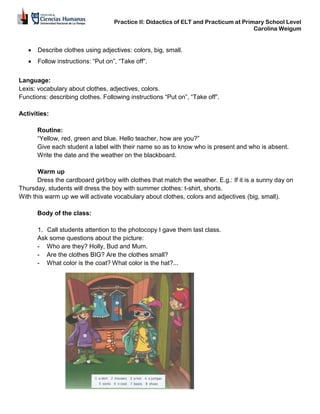
1. Call students attention to the photocopy I gave them last class.
Ask some questions about the picture:
- Who are they? Holly, Bud and Mum.
- Are the clothes BIG? Are the clothes small?
- What color is the coat? What color is the hat?...
Practice II: Didactics of ELT and Practicum at Primary School Level
Carolina Weigum
2. Listen to the song “Let’s dress up”. (CD 2 – track 4)
3. Listen to the song, sing and mime:
Put on your trousers, put on your jumper
Put on your socks, put on your boots.
Put on your skirt, put on your jumper
Put on your hat, put on your coat.
Call students attention to the clothes in the song and point them in the photocopy.
Who’s wearing boots? Holly or Bud?
Who’s wearing a coat? Holly or Bud?...
Closing activity:
4. Play BINGO with clothes of different colors: a blue t-shirt, a green t-shirt, etc…
With the help of the teacher all students can take a calling card so they can practice
vocabulary orally.

Lesson plan 5 weigum

  • 1.
    Practice II: Didacticsof ELT and Practicum at Primary School Level Carolina Weigum Lesson Plan N°5 15/09/2016 School N°246 “Quelulén” Course: 2nd Grade Teacher: Nadina Rodriguez Timetable fit: Thursdays from 16:00 to 16:50 Class description: Students are between 7 and 8 years old. They are 19 students (12 girls and 7 boys). The class starts after the break. There is a boy, Franco, that is integrated and he is usually accompanied by his special needs teacher. When his teacher is not with him, he can sometimes get a little nervous or demand more attention than usual. Sometimes he screams or hits his desk when he wants something and the teacher does not respond immediately. The teacher in charge of the English class, Nadina, told us that we should not praise Franco directly because he does not like it and he may get violent. There is a girl, Emilia, who pretends to be an animal and hides under the desk. Until now, she never got to work in the English class. The teacher tried in many different ways and tones of voice to convince her to work as the rest of her classmates but she does not pay attention. We (trainees) also tried to sit next to her and help her participate, but she does not answer, she does not look at us in the eyes and she pretends that we are not there. Finally, the teacher decided to ignore her for a while. The teacher told us that she was going to try to speak with Emilia’s mother about her behavior in class. The rest of the group is very participative and they work very well. Most of the time they speak in Spanish, but when they have to answer questions in English or participate in an oral activity all together they do it well. When they have to work in pairs orally, they need the constant help/guidance of the teacher to do it. The students have been working with numbers, colors, school objects, weather and seasons. Emilia and Franco worked very well last class! They were very enthusiastic about the activities and they participated actively.  Lesson aims: As teachers we’ll try to…  Focus on oral aspects (listening and speaking) considering learners’ ages to acquire language.  Use multisensory approach to favor learners’ motivation and acquisition of language.  Using games as a tool for learning as well as enjoying the class. Objectives of the Lesson: During the lesson students are expected to:  Revise and activate the vocabulary related to clothes and colors: jacket, coat, trousers, shoes, boots, socks, scarf, hat, jumper, gloves, skirt, T-shirt, shorts.
  • 2.
    Practice II: Didacticsof ELT and Practicum at Primary School Level Carolina Weigum  Describe clothes using adjectives: colors, big, small.  Follow instructions: “Put on”, “Take off”. Language: Lexis: vocabulary about clothes, adjectives, colors. Functions: describing clothes. Following instructions “Put on”, “Take off”. Activities: Routine: “Yellow, red, green and blue. Hello teacher, how are you?” Give each student a label with their name so as to know who is present and who is absent. Write the date and the weather on the blackboard. Warm up Dress the cardboard girl/boy with clothes that match the weather. E.g.: If it is a sunny day on Thursday, students will dress the boy with summer clothes: t-shirt, shorts. With this warm up we will activate vocabulary about clothes, colors and adjectives (big, small). Body of the class: 1. Call students attention to the photocopy I gave them last class. Ask some questions about the picture: - Who are they? Holly, Bud and Mum. - Are the clothes BIG? Are the clothes small? - What color is the coat? What color is the hat?...
  • 3.
    Practice II: Didacticsof ELT and Practicum at Primary School Level Carolina Weigum 2. Listen to the song “Let’s dress up”. (CD 2 – track 4) 3. Listen to the song, sing and mime: Put on your trousers, put on your jumper Put on your socks, put on your boots. Put on your skirt, put on your jumper Put on your hat, put on your coat. Call students attention to the clothes in the song and point them in the photocopy. Who’s wearing boots? Holly or Bud? Who’s wearing a coat? Holly or Bud?... Closing activity: 4. Play BINGO with clothes of different colors: a blue t-shirt, a green t-shirt, etc… With the help of the teacher all students can take a calling card so they can practice vocabulary orally.