1
IFDC LENGUASVIVAS
TALLER DE PRÁCTICA DOCENTE III
ALUMNOPRACTICANTE: MARIA INES TRECH
Período de Práctica: Escuela Primaria
Institución Educativa: Escuela Manuel Belgrano – DIPREGEP Nº 662
Dirección: Costa Y Lequerica – Coronel Dorrego, Provincia Bs Aires.
Sala / Grado / Año – sección: 5to año A
Cantidad de alumnos: 30 alumnos
Nivel lingüístico de los cursos: elemental
Tipo de Planificación: Diaria
Unidad Temática: “Las Ropas”
Clase N°: 5
Fecha: 03 de Agosto 2015
Hora: de 13.30 a 14.20 hs
Duración de la clase: 50 minutos
Fecha de primera entrega: 27 de Julio
Teaching points: Boots,dress,Hat, jeans,scarf,shorts,skirt,sweater,trainers,t-shirt
Aims:
Duringthislesson:
 Learnerswill be able to refertosome clothesitemsina meaningful context.
 Theywill be able todeveloptheirlisteningskillsthroughlistening toandwatchinga video.
 Learnerswill be able todeveloptheirwritingskillsbymatchingclothesitemsandtheirnames.
 Theywill be able todeveloptheirspeakingandwritingskillsby takingdecisionsin groupsand writinga
stanza for a song.
 Language focus:
FUNCTIONS LEXIS STUCTURES PRONUNCIATIO
N
REVISION Following
commands:
Look!
Listen!
Let’sread.
Colours:
black
blue
brown
green
orange
pink
purple
What’sthis?
It’sa …
It’san …
What are these?
Theyare …
Where are they?
/ae/ bat, black
/a:/ giraffe
2
red
white
yellow
Animals:Giraffe,
hummingbird,
mockingbird,
bat,
People:boys,
girls.
NEW What are they
wearing?
boots
dress
Hat
jeans
scarf
shorts
skirt
sweater
trainers
t-shirt
What isit wearing?
It iswearinga/ a …
What iss/he
wearing?
s/he iswearing …
/s/ boots,
shorts,trainers.
 Teaching Approach: Natural Approach, organized through the presentation, practice, and
procedure stages (PPP).
 Integration of skills: the four skills will be applied in this lesson. Listening to and watching a
video about clothes. Speaking about the clothes characters in the video are wearing. Reading and
listening to a song. Writing a stanza for a song, writing activity for homework.
 Material and resources: Computer - Projector - CD player, CD- .
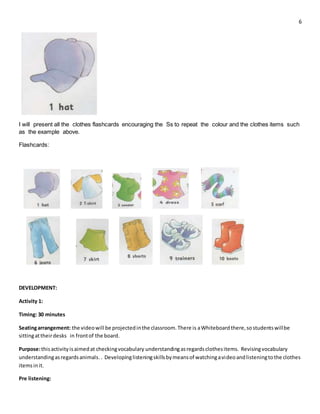
Clothes flashcards:
(Picturesadaptedfrom EnglishAdventures 1. Anne Worrall.Longman)
3
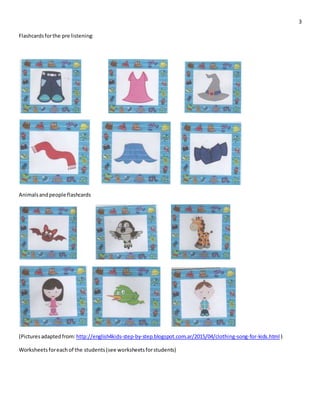
Flashcardsforthe pre listening:
Animalsandpeople flashcards
(Pictures adaptedfrom:http://english4kids-step-by-step.blogspot.com.ar/2015/04/clothing-song-for-kids.html )
Worksheetsforeach of the students(see worksheetsforstudents)
4
 Pedagogical use of the ICT inn class or at home: a video about the topic vocabulary for
clothes will be shown. https://www.youtube.com/watch?v=PzCXXuXvrU0
Clothes Song Lyrics/ script:
Who is wearing a scarf?) X3
can’t you see? It’s a giraffe.
Who is wearing a hat?) X3
it’s a funny brown bat.
Who is wearing a skirt?) X3
it’s a little hummingbird.
Who is wearing a shirt?) X 3
it is just a mockingbird.
Are you wearing a dress?
If you’re a girl, say: “Yes!”
Are you wearing corduroys?
Say: “Yes, we are!” if you are boys.
 Seating arrangement: the whole class facing the board. In pairs.
 Possible problems /difficulties and their solutions during the class: students may speak
in Spanish. I will demonstrate and make them repeat the correct form /word in English.
 Classroom management strategies:
In case there are students who are not paying attention, I will approach them and kindly suggest
trying to go back to work.
Fast finishers generally draw something because they are bored; if this is the case I will tell that
student to help me with other students.
If there are students who are reluctant to participate in class, I will approach to him/her try to
encourage participating by asking him/her myself a question. (There are very shy students).
In cases if misbehavior, I will ask kindly to please go back to work and not to do it again. If this
continues I will stop the class and explain the importance of working and behaving properly in L1.
 Potential problems students may have with the language: As it is mainly a vocabulary presentation
with flashcards and practice lesson, I think there will be no problems. Nonetheless, a possible one
would be distraction. In such a case, I will clap my hands so as to call their attention, as their teacher is
used to apply that method and it works perfectly because students are accustomed. So, in case Ss
don’t listen to me, I will change my voice tone and I will tell: "Are you listening? Are you listening?
Everyone! Everyone! If you are listening, if you are listening, look at me, look at me."
Assessment: What will be assessed and how. Understanding of the new items will be assessed by my
asking questions individually, for example new items will be assessed by asking: what is it wearing ……?
Observing students development during the different instances of the class. Comprehension of the new items
5
will be assessed through the correction of the written activities and homework. There will be oral sentences to
complete so that I get to know if SS understand the use of the structure for communicative purposes and if
they remember the new items,
WARM UP:
Timing: 5 minutes.
Purpose: To start the lesson, to get students into the mood for work, to establish rapport.
Routine: For this routine I will separate the classroom in two halves. Students will be sat at their desks. I
am going to play the tape twice, so the first time half of the class will sing the first two stanzas and the
other half will sing the last two stanzas of the song. Te second time roles will be inverted.
(Students have already sang this song the previous classes)
Transition: Ok children, we are going to sing the Hello song:
Hello! Hello!
How are you today?
I’m fine, I’m fine
And you how are you
(Adapted from: Singing Songs: The Teacher’s magazine: EDIBA)
Transition: Well done! Boys and girls! Excellent!
PRESENTATION
Timing 10 minutes.
Purpose: to revise the new clothes vocabulary items presented last class.
I will make students remember/ revise the vocabulary as regards clothes items by means of showing them the
flashcards with clothes images again. I will ask those questions such as: What’s this? What are they? They will
have to answer. First I will demonstrate like this:
Transitions: Last class I was cleaning my wardrobe and I found my clothes when I was 10. Lets’ have a
look at them: What is this?
Look! This is my blue hat.
6
I will present all the clothes flashcards encouraging the Ss to repeat the colour and the clothes items such
as the example above.
Flashcards:
DEVELOPMENT:
Activity 1:
Timing: 30 minutes
Seatingarrangement: the videowill be projectedinthe classroom.There is aWhiteboard there,sostudentswillbe
sittingattheirdesks in frontof the board.
Purpose:thisactivityisaimedat checkingvocabulary understandingasregardsclothesitems. Revisingvocabulary
understandingasregardsanimals. . Developinglisteningskillsbymeansof watchingavideoandlisteningtothe clothes
itemsinit.
Pre listening:
7
Timing: 8 minutes
I will tell the students thatduringthe winterholidaysI wenttothe zoo. There someone stole mysuitcase andsome
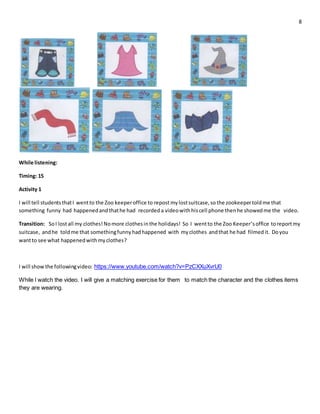
animalsandpeople were playingwith myclothes.I willshow themsome flashcardswiththe clothesin my suitcase and
the animalsandpeople thatwere there inthe zoo.
Transition: Duringthe winterholidaysIwentto the Zoo. And lookhere Ihave some photographsof the animalsIsaw
there at the zoo. Look, I saw a …
(Iwill showthe picturesof the animalsandthe people to the Ss encouragingthemtotell theirnamesinEnglish)
Animalsandpeople flashcards
BAT MOCKINGBIRD GIRAFFE
GIRL HUMMINGBIRD BOY
Afterthat I will tell the SS
Transition: Now,inthe zoo I hadmy suitcase withmy clothes, then whenIwentto buypopcorn someone a lost
my suitcase. Ihad these clothes. Look,Ihad a blue corduroys, and …
(Iwill showthe flashcardsone byone encouragingSsto tell the name of the clothes itemsand theircolours)
Clothesflashcards:
8
While listening:
Timing: 15
Activity 1
I will tell studentsthatI wentto the Zoo keeperoffice to repostmylostsuitcase,so the zookeepertoldme that
something funny had happenedandthathe had recorded a videowithhiscell phone thenhe showedme the video.
Transition: SoI lostall my clothes!Nomore clothesin the holidays! So I wentto the Zoo Keeper’soffice toreportmy
suitcase, andhe toldme that somethingfunnyhadhappened with myclothes andthat he had filmedit. Doyou
wantto see what happenedwithmyclothes?
I will show the followingvideo: https://www.youtube.com/watch?v=PzCXXuXvrU0
While l watch the video. I will give a matching exercise for them to match the character and the clothes items
they are wearing.
9
(Adaptedfrom:http://english4kids-step-by-step.blogspot.com.ar/2015/04/clothing-song-for-kids.html )
Once Students watched the video, I will ask them to tell me what happened with my clothes. (The animals
were wearing my clothes).
10
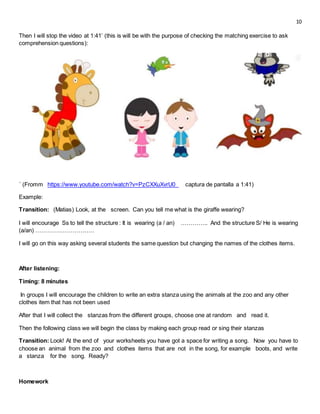
Then I will stop the video at 1:41’ (this is will be with the purpose of checking the matching exercise to ask
comprehension questions):
´ (Fromm https://www.youtube.com/watch?v=PzCXXuXvrU0_ captura de pantalla a 1:41)
Example:
Transition: (Matias) Look, at the screen. Can you tell me what is the giraffe wearing?
I will encourage Ss to tell the structure : It is wearing (a / an) ………….. And the structure S/ He is wearing
(a/an) …………………………
I will go on this way asking several students the same question but changing the names of the clothes items.
After listening:
Timing: 8 minutes
In groups I will encourage the children to write an extra stanza using the animals at the zoo and any other
clothes item that has not been used
After that I will collect the stanzas from the different groups, choose one at random and read it.
Then the following class we will begin the class by making each group read or sing their stanzas
Transition: Look! At the end of your worksheets you have got a space for writing a song. Now you have to
choose an animal from the zoo and clothes items that are not in the song, for example boots, and write
a stanza for the song. Ready?
Homework
11
Timing 2 minutes:
For homework I will give the students the following worksheet in order to complete the clothes items word
and match them with their corresponding image.
I will send parents a note:
Estimada familia: hemos estado trabajando con el tema “Las ropas”. Sus hijos llevan la siguiente
actividad para completar para la próxima clase.
Salads please, proofread your work before submission.
Miss Maria Ines.
(Adapted from: http://english4kids-step-by-step.blogspot.com.ar/2015/04/clothing-song-for-kids.html )
12
CLOSURE:
I will tell the students we only have two minutes to go so we should say goodbye to each other
I will invite the students to say goodbye, I will tell them goodbye.
The Bell rings.
Sources:
Anne Worrall. English Adventures 1. Longman.
Video: https://www.youtube.com/watch?v=PzCXXuXvrU0_
Activities worksheets adapted from: http://english4kids-step-by-step.blogspot.com.ar/2015/04/clothing-song-
for-kids.html )
STUDENT WORK SHEET: Name: …………………………………………………….
Vocabularyrevision
VideoVocabulary:
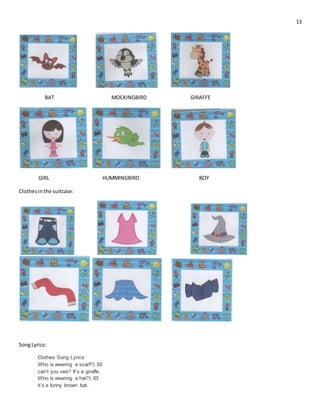
Animalsandpeople t the zoo:
13
BAT MOCKINGBIRD GIRAFFE
GIRL HUMMINGBIRD BOY
Clothesin the suitcase:
SongLyrics:
Clothes Song Lyrics:
Who is wearing a scarf?) X3
can’t you see? It’s a giraffe.
Who is wearing a hat?) X3
it’s a funny brown bat.
14
Who is wearing a skirt?) X3
it’s a little hummingbird.
Who is wearing a shirt?) X 3
it is just a mockingbird.
Are you wearing a dress?
If you’re a girl, say: “Yes!”
Are you wearing corduroys?
Say: “Yes, we are!” if you are boys.
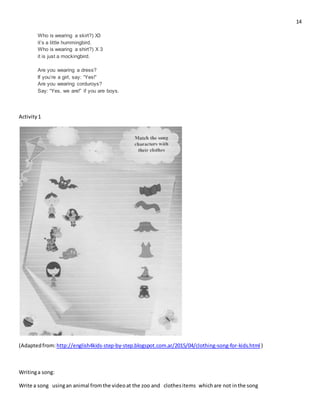
Activity1
(Adaptedfrom:http://english4kids-step-by-step.blogspot.com.ar/2015/04/clothing-song-for-kids.html )
Writinga song:
Write a song usingan animal fromthe videoat the zoo and clothesitems whichare not inthe song
15
Homework:
Estimada familia hemos estado trabajando con el tema: “Las ropas”, sus hijos llevan la siguiente
actividad para completar para la próxima clase.
Saludos
Miss Maria Ines.
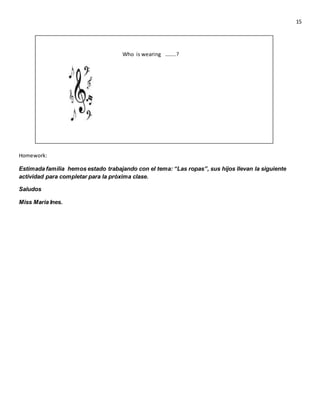
Who is wearing ……..?
16
(Adapted from: http://english4kids-step-by-step.blogspot.com.ar/2015/04/clothing-song-for-kids.html )
17
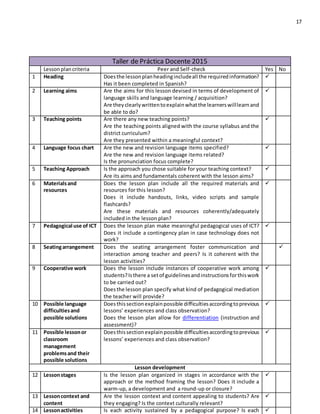
Taller de Práctica Docente 2015
Lessonplancriteria Peer and Self-check Yes No
1 Heading Doesthe lessonplanheadingincludeall the requiredinformation?
Has it been completed in Spanish?

2 Learning aims Are the aims for this lesson devised in terms of development of
language skills and language learning / acquisition?
Are theyclearlywrittentoexplainwhatthe learnerswilllearnand
be able to do?

3 Teaching points Are there any new teaching points?
Are the teaching points aligned with the course syllabus and the
district curriculum?
Are they presented within a meaningful context?

4 Language focus chart Are the new and revision language items specified?
Are the new and revision language items related?
Is the pronunciation focus complete?

5 Teaching Approach Is the approach you chose suitable for your teaching context?
Are its aims and fundamentals coherent with the lesson aims?

6 Materialsand
resources
Does the lesson plan include all the required materials and
resources for this lesson?
Does it include handouts, links, video scripts and sample
flashcards?
Are these materials and resources coherently/adequately
included in the lesson plan?

7 Pedagogical use of ICT Does the lesson plan make meaningful pedagogical uses of ICT?
Does it include a contingency plan in case technology does not
work?

8 Seatingarrangement Does the seating arrangement foster communication and
interaction among teacher and peers? Is it coherent with the
lesson activities?

9 Cooperative work Does the lesson include instances of cooperative work among
students?Isthere a setof guidelinesandinstructionsforthiswork
to be carried out?
Doesthe lesson plan specify what kind of pedagogical mediation
the teacher will provide?

10 Possible language
difficultiesand
possible solutions
Doesthissectionexplainpossible difficultiesaccordingtoprevious
lessons’ experiences and class observation?
Does the lesson plan allow for differentiation (instruction and
assessment)?

11 Possible lessonor
classroom
management
problemsand their
possible solutions
Doesthissection explainpossible difficultiesaccordingtoprevious
lessons’ experiences and class observation?

Lesson development
12 Lessonstages Is the lesson plan organized in stages in accordance with the
approach or the method framing the lesson? Does it include a
warm-up, a development and a round-up or closure?

13 Lessoncontext and
content
Are the lesson context and content appealing to students? Are
they engaging? Is the context culturally relevant?

14 Lessonactivities Is each activity sustained by a pedagogical purpose? Is each 
18
Lesson plan
component
Very Good
4
Good
3
Acceptable
2
Below Standard
1
Organization

Coherence and
sequencing 
Learning aims

activity related to a learning aim?
Do the activities allow for language exposure, exploration,
development of language awareness ?
15 Type of activities Is there a balance of activitiesthat range from controlled practice
to freer communicative practice?
Do they facilitate integration of skills?

16 Transitions Does the lesson plan show a coherent flow of activities clearly
interconnected? Are there any comments or indicators that link
each activity or stage with the next one?

17 Language of
instructions
Are instructions written in a simple manner? Is there a set of
strategies to accompany the instructions and aid learner
comprehension?

18 Teaching strategies Is instruction aided by any teaching strategies such as…
- Modeling
- Exemplifying
- Showing
- Pointing
- Explaining
- Paraphrasing
- Miming
- Others?

19 Direct speech Are all instructions and possible anticipated dialogues written in
direct speech?

20 Homework Does the lesson plan include any task to do at home? Is the task
engaging? Will students feel motivated to perform it? Will the
students be in direct contact with the language? Will they share
their work with the class?

21 Active learning:
Bloom’sTaxonomy
2001
Are many learning tasks addressing a higher level of Bloom’s
taxonomy?

22 Grammar,
Appearance,and
Language
Does the lesson plan effectively communicate to the intended
audience? Has it gone through proof-reading for grammar and
spelling mistakes?

Observations:
Excellentwork,Ma.Inés!The context,the materialsandthe activitiesfosterinteractionandmeaningful
language use.
Way to go!!!
Cecilia
19
Stages

Activities

Teaching strategies

Class. management
strategies 
Language accuracy

Observations Minimumscore:20 / 32
Score:29/32= 9

Tdp trech-5th-llesson-plan-primaria-class-5-9

  • 1.
    1 IFDC LENGUASVIVAS TALLER DEPRÁCTICA DOCENTE III ALUMNOPRACTICANTE: MARIA INES TRECH Período de Práctica: Escuela Primaria Institución Educativa: Escuela Manuel Belgrano – DIPREGEP Nº 662 Dirección: Costa Y Lequerica – Coronel Dorrego, Provincia Bs Aires. Sala / Grado / Año – sección: 5to año A Cantidad de alumnos: 30 alumnos Nivel lingüístico de los cursos: elemental Tipo de Planificación: Diaria Unidad Temática: “Las Ropas” Clase N°: 5 Fecha: 03 de Agosto 2015 Hora: de 13.30 a 14.20 hs Duración de la clase: 50 minutos Fecha de primera entrega: 27 de Julio Teaching points: Boots,dress,Hat, jeans,scarf,shorts,skirt,sweater,trainers,t-shirt Aims: Duringthislesson:  Learnerswill be able to refertosome clothesitemsina meaningful context.  Theywill be able todeveloptheirlisteningskillsthroughlistening toandwatchinga video.  Learnerswill be able todeveloptheirwritingskillsbymatchingclothesitemsandtheirnames.  Theywill be able todeveloptheirspeakingandwritingskillsby takingdecisionsin groupsand writinga stanza for a song.  Language focus: FUNCTIONS LEXIS STUCTURES PRONUNCIATIO N REVISION Following commands: Look! Listen! Let’sread. Colours: black blue brown green orange pink purple What’sthis? It’sa … It’san … What are these? Theyare … Where are they? /ae/ bat, black /a:/ giraffe
  • 2.
    2 red white yellow Animals:Giraffe, hummingbird, mockingbird, bat, People:boys, girls. NEW What arethey wearing? boots dress Hat jeans scarf shorts skirt sweater trainers t-shirt What isit wearing? It iswearinga/ a … What iss/he wearing? s/he iswearing … /s/ boots, shorts,trainers.  Teaching Approach: Natural Approach, organized through the presentation, practice, and procedure stages (PPP).  Integration of skills: the four skills will be applied in this lesson. Listening to and watching a video about clothes. Speaking about the clothes characters in the video are wearing. Reading and listening to a song. Writing a stanza for a song, writing activity for homework.  Material and resources: Computer - Projector - CD player, CD- . Clothes flashcards: (Picturesadaptedfrom EnglishAdventures 1. Anne Worrall.Longman)
  • 3.
    3 Flashcardsforthe pre listening: Animalsandpeopleflashcards (Pictures adaptedfrom:http://english4kids-step-by-step.blogspot.com.ar/2015/04/clothing-song-for-kids.html ) Worksheetsforeach of the students(see worksheetsforstudents)
  • 4.
    4  Pedagogical useof the ICT inn class or at home: a video about the topic vocabulary for clothes will be shown. https://www.youtube.com/watch?v=PzCXXuXvrU0 Clothes Song Lyrics/ script: Who is wearing a scarf?) X3 can’t you see? It’s a giraffe. Who is wearing a hat?) X3 it’s a funny brown bat. Who is wearing a skirt?) X3 it’s a little hummingbird. Who is wearing a shirt?) X 3 it is just a mockingbird. Are you wearing a dress? If you’re a girl, say: “Yes!” Are you wearing corduroys? Say: “Yes, we are!” if you are boys.  Seating arrangement: the whole class facing the board. In pairs.  Possible problems /difficulties and their solutions during the class: students may speak in Spanish. I will demonstrate and make them repeat the correct form /word in English.  Classroom management strategies: In case there are students who are not paying attention, I will approach them and kindly suggest trying to go back to work. Fast finishers generally draw something because they are bored; if this is the case I will tell that student to help me with other students. If there are students who are reluctant to participate in class, I will approach to him/her try to encourage participating by asking him/her myself a question. (There are very shy students). In cases if misbehavior, I will ask kindly to please go back to work and not to do it again. If this continues I will stop the class and explain the importance of working and behaving properly in L1.  Potential problems students may have with the language: As it is mainly a vocabulary presentation with flashcards and practice lesson, I think there will be no problems. Nonetheless, a possible one would be distraction. In such a case, I will clap my hands so as to call their attention, as their teacher is used to apply that method and it works perfectly because students are accustomed. So, in case Ss don’t listen to me, I will change my voice tone and I will tell: "Are you listening? Are you listening? Everyone! Everyone! If you are listening, if you are listening, look at me, look at me." Assessment: What will be assessed and how. Understanding of the new items will be assessed by my asking questions individually, for example new items will be assessed by asking: what is it wearing ……? Observing students development during the different instances of the class. Comprehension of the new items
  • 5.
    5 will be assessedthrough the correction of the written activities and homework. There will be oral sentences to complete so that I get to know if SS understand the use of the structure for communicative purposes and if they remember the new items, WARM UP: Timing: 5 minutes. Purpose: To start the lesson, to get students into the mood for work, to establish rapport. Routine: For this routine I will separate the classroom in two halves. Students will be sat at their desks. I am going to play the tape twice, so the first time half of the class will sing the first two stanzas and the other half will sing the last two stanzas of the song. Te second time roles will be inverted. (Students have already sang this song the previous classes) Transition: Ok children, we are going to sing the Hello song: Hello! Hello! How are you today? I’m fine, I’m fine And you how are you (Adapted from: Singing Songs: The Teacher’s magazine: EDIBA) Transition: Well done! Boys and girls! Excellent! PRESENTATION Timing 10 minutes. Purpose: to revise the new clothes vocabulary items presented last class. I will make students remember/ revise the vocabulary as regards clothes items by means of showing them the flashcards with clothes images again. I will ask those questions such as: What’s this? What are they? They will have to answer. First I will demonstrate like this: Transitions: Last class I was cleaning my wardrobe and I found my clothes when I was 10. Lets’ have a look at them: What is this? Look! This is my blue hat.
  • 6.
    6 I will presentall the clothes flashcards encouraging the Ss to repeat the colour and the clothes items such as the example above. Flashcards: DEVELOPMENT: Activity 1: Timing: 30 minutes Seatingarrangement: the videowill be projectedinthe classroom.There is aWhiteboard there,sostudentswillbe sittingattheirdesks in frontof the board. Purpose:thisactivityisaimedat checkingvocabulary understandingasregardsclothesitems. Revisingvocabulary understandingasregardsanimals. . Developinglisteningskillsbymeansof watchingavideoandlisteningtothe clothes itemsinit. Pre listening:
  • 7.
    7 Timing: 8 minutes Iwill tell the students thatduringthe winterholidaysI wenttothe zoo. There someone stole mysuitcase andsome animalsandpeople were playingwith myclothes.I willshow themsome flashcardswiththe clothesin my suitcase and the animalsandpeople thatwere there inthe zoo. Transition: Duringthe winterholidaysIwentto the Zoo. And lookhere Ihave some photographsof the animalsIsaw there at the zoo. Look, I saw a … (Iwill showthe picturesof the animalsandthe people to the Ss encouragingthemtotell theirnamesinEnglish) Animalsandpeople flashcards BAT MOCKINGBIRD GIRAFFE GIRL HUMMINGBIRD BOY Afterthat I will tell the SS Transition: Now,inthe zoo I hadmy suitcase withmy clothes, then whenIwentto buypopcorn someone a lost my suitcase. Ihad these clothes. Look,Ihad a blue corduroys, and … (Iwill showthe flashcardsone byone encouragingSsto tell the name of the clothes itemsand theircolours) Clothesflashcards:
  • 8.
    8 While listening: Timing: 15 Activity1 I will tell studentsthatI wentto the Zoo keeperoffice to repostmylostsuitcase,so the zookeepertoldme that something funny had happenedandthathe had recorded a videowithhiscell phone thenhe showedme the video. Transition: SoI lostall my clothes!Nomore clothesin the holidays! So I wentto the Zoo Keeper’soffice toreportmy suitcase, andhe toldme that somethingfunnyhadhappened with myclothes andthat he had filmedit. Doyou wantto see what happenedwithmyclothes? I will show the followingvideo: https://www.youtube.com/watch?v=PzCXXuXvrU0 While l watch the video. I will give a matching exercise for them to match the character and the clothes items they are wearing.
  • 9.
    9 (Adaptedfrom:http://english4kids-step-by-step.blogspot.com.ar/2015/04/clothing-song-for-kids.html ) Once Studentswatched the video, I will ask them to tell me what happened with my clothes. (The animals were wearing my clothes).
  • 10.
    10 Then I willstop the video at 1:41’ (this is will be with the purpose of checking the matching exercise to ask comprehension questions): ´ (Fromm https://www.youtube.com/watch?v=PzCXXuXvrU0_ captura de pantalla a 1:41) Example: Transition: (Matias) Look, at the screen. Can you tell me what is the giraffe wearing? I will encourage Ss to tell the structure : It is wearing (a / an) ………….. And the structure S/ He is wearing (a/an) ………………………… I will go on this way asking several students the same question but changing the names of the clothes items. After listening: Timing: 8 minutes In groups I will encourage the children to write an extra stanza using the animals at the zoo and any other clothes item that has not been used After that I will collect the stanzas from the different groups, choose one at random and read it. Then the following class we will begin the class by making each group read or sing their stanzas Transition: Look! At the end of your worksheets you have got a space for writing a song. Now you have to choose an animal from the zoo and clothes items that are not in the song, for example boots, and write a stanza for the song. Ready? Homework
  • 11.
    11 Timing 2 minutes: Forhomework I will give the students the following worksheet in order to complete the clothes items word and match them with their corresponding image. I will send parents a note: Estimada familia: hemos estado trabajando con el tema “Las ropas”. Sus hijos llevan la siguiente actividad para completar para la próxima clase. Salads please, proofread your work before submission. Miss Maria Ines. (Adapted from: http://english4kids-step-by-step.blogspot.com.ar/2015/04/clothing-song-for-kids.html )
  • 12.
    12 CLOSURE: I will tellthe students we only have two minutes to go so we should say goodbye to each other I will invite the students to say goodbye, I will tell them goodbye. The Bell rings. Sources: Anne Worrall. English Adventures 1. Longman. Video: https://www.youtube.com/watch?v=PzCXXuXvrU0_ Activities worksheets adapted from: http://english4kids-step-by-step.blogspot.com.ar/2015/04/clothing-song- for-kids.html ) STUDENT WORK SHEET: Name: ……………………………………………………. Vocabularyrevision VideoVocabulary: Animalsandpeople t the zoo:
  • 13.
    13 BAT MOCKINGBIRD GIRAFFE GIRLHUMMINGBIRD BOY Clothesin the suitcase: SongLyrics: Clothes Song Lyrics: Who is wearing a scarf?) X3 can’t you see? It’s a giraffe. Who is wearing a hat?) X3 it’s a funny brown bat.
  • 14.
    14 Who is wearinga skirt?) X3 it’s a little hummingbird. Who is wearing a shirt?) X 3 it is just a mockingbird. Are you wearing a dress? If you’re a girl, say: “Yes!” Are you wearing corduroys? Say: “Yes, we are!” if you are boys. Activity1 (Adaptedfrom:http://english4kids-step-by-step.blogspot.com.ar/2015/04/clothing-song-for-kids.html ) Writinga song: Write a song usingan animal fromthe videoat the zoo and clothesitems whichare not inthe song
  • 15.
    15 Homework: Estimada familia hemosestado trabajando con el tema: “Las ropas”, sus hijos llevan la siguiente actividad para completar para la próxima clase. Saludos Miss Maria Ines. Who is wearing ……..?
  • 16.
  • 17.
    17 Taller de PrácticaDocente 2015 Lessonplancriteria Peer and Self-check Yes No 1 Heading Doesthe lessonplanheadingincludeall the requiredinformation? Has it been completed in Spanish?  2 Learning aims Are the aims for this lesson devised in terms of development of language skills and language learning / acquisition? Are theyclearlywrittentoexplainwhatthe learnerswilllearnand be able to do?  3 Teaching points Are there any new teaching points? Are the teaching points aligned with the course syllabus and the district curriculum? Are they presented within a meaningful context?  4 Language focus chart Are the new and revision language items specified? Are the new and revision language items related? Is the pronunciation focus complete?  5 Teaching Approach Is the approach you chose suitable for your teaching context? Are its aims and fundamentals coherent with the lesson aims?  6 Materialsand resources Does the lesson plan include all the required materials and resources for this lesson? Does it include handouts, links, video scripts and sample flashcards? Are these materials and resources coherently/adequately included in the lesson plan?  7 Pedagogical use of ICT Does the lesson plan make meaningful pedagogical uses of ICT? Does it include a contingency plan in case technology does not work?  8 Seatingarrangement Does the seating arrangement foster communication and interaction among teacher and peers? Is it coherent with the lesson activities?  9 Cooperative work Does the lesson include instances of cooperative work among students?Isthere a setof guidelinesandinstructionsforthiswork to be carried out? Doesthe lesson plan specify what kind of pedagogical mediation the teacher will provide?  10 Possible language difficultiesand possible solutions Doesthissectionexplainpossible difficultiesaccordingtoprevious lessons’ experiences and class observation? Does the lesson plan allow for differentiation (instruction and assessment)?  11 Possible lessonor classroom management problemsand their possible solutions Doesthissection explainpossible difficultiesaccordingtoprevious lessons’ experiences and class observation?  Lesson development 12 Lessonstages Is the lesson plan organized in stages in accordance with the approach or the method framing the lesson? Does it include a warm-up, a development and a round-up or closure?  13 Lessoncontext and content Are the lesson context and content appealing to students? Are they engaging? Is the context culturally relevant?  14 Lessonactivities Is each activity sustained by a pedagogical purpose? Is each 
  • 18.
    18 Lesson plan component Very Good 4 Good 3 Acceptable 2 BelowStandard 1 Organization  Coherence and sequencing  Learning aims  activity related to a learning aim? Do the activities allow for language exposure, exploration, development of language awareness ? 15 Type of activities Is there a balance of activitiesthat range from controlled practice to freer communicative practice? Do they facilitate integration of skills?  16 Transitions Does the lesson plan show a coherent flow of activities clearly interconnected? Are there any comments or indicators that link each activity or stage with the next one?  17 Language of instructions Are instructions written in a simple manner? Is there a set of strategies to accompany the instructions and aid learner comprehension?  18 Teaching strategies Is instruction aided by any teaching strategies such as… - Modeling - Exemplifying - Showing - Pointing - Explaining - Paraphrasing - Miming - Others?  19 Direct speech Are all instructions and possible anticipated dialogues written in direct speech?  20 Homework Does the lesson plan include any task to do at home? Is the task engaging? Will students feel motivated to perform it? Will the students be in direct contact with the language? Will they share their work with the class?  21 Active learning: Bloom’sTaxonomy 2001 Are many learning tasks addressing a higher level of Bloom’s taxonomy?  22 Grammar, Appearance,and Language Does the lesson plan effectively communicate to the intended audience? Has it gone through proof-reading for grammar and spelling mistakes?  Observations: Excellentwork,Ma.Inés!The context,the materialsandthe activitiesfosterinteractionandmeaningful language use. Way to go!!! Cecilia
  • 19.
    19 Stages  Activities  Teaching strategies  Class. management strategies Language accuracy  Observations Minimumscore:20 / 32 Score:29/32= 9