 The presentation is followed by
discussion and the giving of assignment.
Among the assignments maybe a research
on a given topic. This teaching approach
has been proven successful for achieving
learning outcomes following the lower
end of Bloom’s Taxonomy: knowledge,
comprehension and application are
concerned.
 In the traditional information
absorption model of teaching, the
teacher organizes and presents
information to student- learners. He
may use a variety of teaching
resources to support the lesson such
as
chalkboard,
videotape
,
newspapers or magazine and
photos.
 Today students are expected to be
not only cognitive, but also flexible ,
analytical and creative. In this lesson,
there are methods proposed for the use
of computer- based technologies as an
integral support to higher thinking skills
and creativity.
HIGHER LEVEL LEARNING
OUTCOMES


To define higher level thinking skills
and creativity, we may adopt a
framework that is a helpful synthesis
of many models and definitions on
the subject.
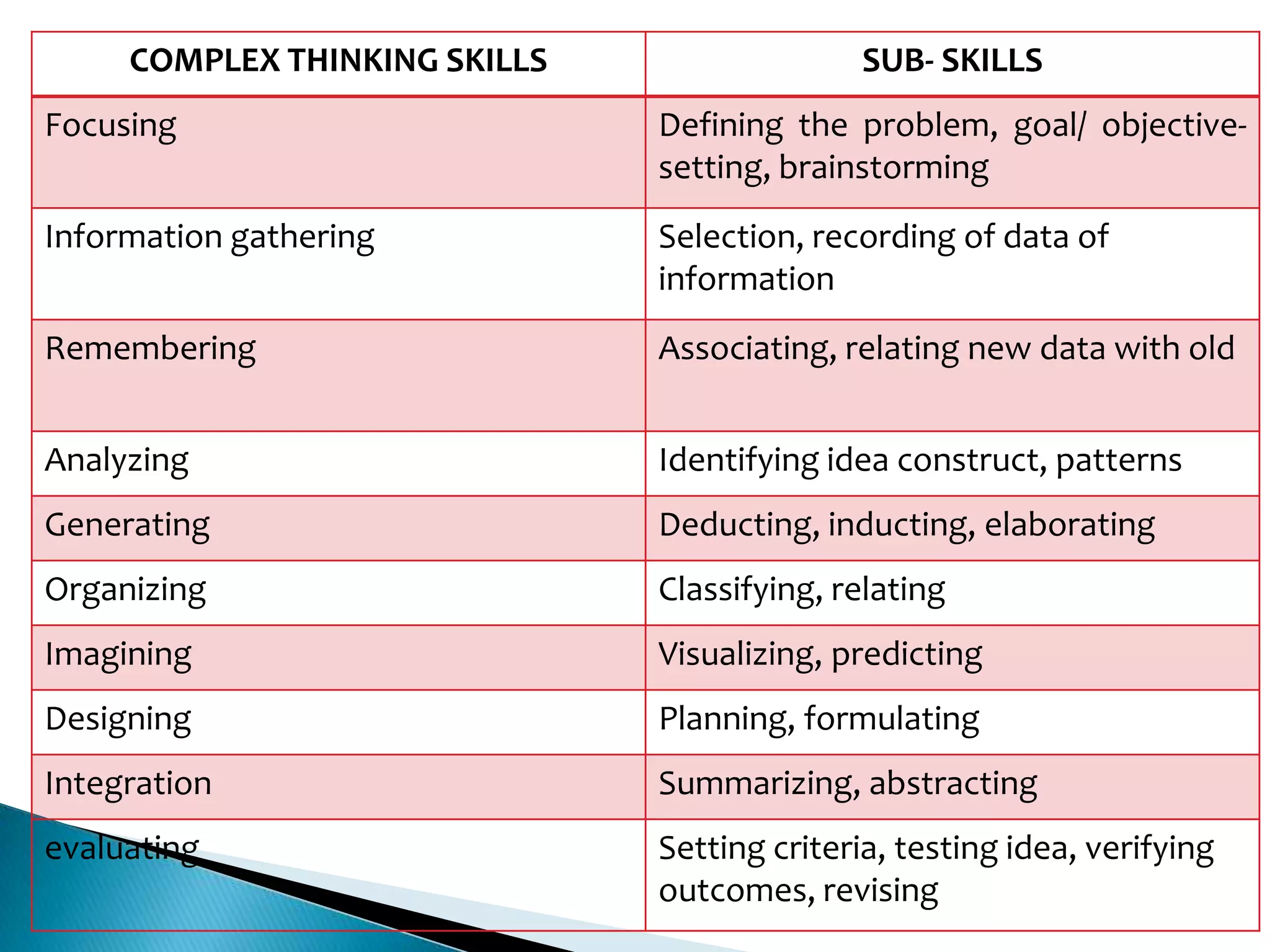
COMPLEX THINKING SKILLS

SUB- SKILLS

Focusing

Defining the problem, goal/ objectivesetting, brainstorming

Information gathering

Selection, recording of data of
information

Remembering

Associating, relating new data with old

Analyzing

Identifying idea construct, patterns

Generating

Deducting, inducting, elaborating

Organizing

Classifying, relating

Imagining

Visualizing, predicting

Designing

Planning, formulating

Integration

Summarizing, abstracting

evaluating

Setting criteria, testing idea, verifying
outcomes, revising
THE UPGRADED PROJECT METHOD
The modern day teacher can now be
guided on his goal to help student
achieve higher level thinking skills and
creativity
beyond
the
ordinary
benchmark of the students passing even
excelling achievement tests.
There is a tighter link between the
use of projects for simply coming up
with the products to having the
students undergo the process of
complex/ higher thinking under the
framework of the constructivist
paradigm.
The project method for
higher
learning
outcomes
consists in having the students
work on projects with depth,
complexity,
duration
and
relevance to the real world.
THE PROCESS
The process of project implementation
takes the students to the steps, efforts,
and experiences in project completion.

THE PROCESS IS MORE
THAN THE PRODUCT..
The process refers to the
thinking/ affective/ psychomotor
process that occurs on the part of
the learner. This comprises the
journey that actualizes learning.
The product is the result of this allimportant process consisting in a
possibly a summary, a poster, an essay,
a term paper, a dramatic presentation,
or an IT- based product.
Examples of IT- based projects:
 resource- based projects
 simple creations
 guided hyper- media projects
 web- based projects
But for now, let’s recap: LETS
TAKE THE JOURNEY TO HIGHER/
COMPLEX THINKING SKILLS AND
CREATIVITY for teaching-and-learning
in an information age.
THANK YOU FOR
LISTENING!!!!!!!
Prepared by:
MISCHELLE C. SANCHEZ
JESSICA BALELA
BSED 312/ SOCIAL STUDIES

Lesson 7 IT FOR HIGHER THINKING SKILLS AND CREATIVITY

  • 2.
     The presentationis followed by discussion and the giving of assignment. Among the assignments maybe a research on a given topic. This teaching approach has been proven successful for achieving learning outcomes following the lower end of Bloom’s Taxonomy: knowledge, comprehension and application are concerned.
  • 3.
     In thetraditional information absorption model of teaching, the teacher organizes and presents information to student- learners. He may use a variety of teaching resources to support the lesson such as chalkboard, videotape , newspapers or magazine and photos.
  • 4.
     Today studentsare expected to be not only cognitive, but also flexible , analytical and creative. In this lesson, there are methods proposed for the use of computer- based technologies as an integral support to higher thinking skills and creativity.
  • 5.
    HIGHER LEVEL LEARNING OUTCOMES  Todefine higher level thinking skills and creativity, we may adopt a framework that is a helpful synthesis of many models and definitions on the subject.
  • 6.
    COMPLEX THINKING SKILLS SUB-SKILLS Focusing Defining the problem, goal/ objectivesetting, brainstorming Information gathering Selection, recording of data of information Remembering Associating, relating new data with old Analyzing Identifying idea construct, patterns Generating Deducting, inducting, elaborating Organizing Classifying, relating Imagining Visualizing, predicting Designing Planning, formulating Integration Summarizing, abstracting evaluating Setting criteria, testing idea, verifying outcomes, revising
  • 7.
    THE UPGRADED PROJECTMETHOD The modern day teacher can now be guided on his goal to help student achieve higher level thinking skills and creativity beyond the ordinary benchmark of the students passing even excelling achievement tests.
  • 8.
    There is atighter link between the use of projects for simply coming up with the products to having the students undergo the process of complex/ higher thinking under the framework of the constructivist paradigm.
  • 9.
    The project methodfor higher learning outcomes consists in having the students work on projects with depth, complexity, duration and relevance to the real world.
  • 10.
    THE PROCESS The processof project implementation takes the students to the steps, efforts, and experiences in project completion. THE PROCESS IS MORE THAN THE PRODUCT..
  • 11.
    The process refersto the thinking/ affective/ psychomotor process that occurs on the part of the learner. This comprises the journey that actualizes learning.
  • 12.
    The product isthe result of this allimportant process consisting in a possibly a summary, a poster, an essay, a term paper, a dramatic presentation, or an IT- based product.
  • 13.
    Examples of IT-based projects:  resource- based projects  simple creations  guided hyper- media projects  web- based projects
  • 14.
    But for now,let’s recap: LETS TAKE THE JOURNEY TO HIGHER/ COMPLEX THINKING SKILLS AND CREATIVITY for teaching-and-learning in an information age.
  • 15.
  • 16.
    Prepared by: MISCHELLE C.SANCHEZ JESSICA BALELA BSED 312/ SOCIAL STUDIES