Christian S. Gle                                             Mr. Jose A. Espinueva, Ed. D.
BEEd 2nd-A

     COMPUTER AS INFORMATION AND COMMUNICATION TECHNOLOGY

Objectives:
      At the end of the lesson, the students will be able to:
              To identify the role of computers in education
              To determine how computer technology transform into an educative information
              and communication technology (ICT) in education
              To apply the computer-based technology in teaching pedagogy

Subject Matter:
      Topic:          Computer as Information and Communication Technology
      References:     Educational Technology 2
                             Paz I. Lucido, Lorimar Publishing
                             pp. 56-58
                      www.slideshare.net
       Materials:     power-point presentation, handouts

Lesson Content:

Introduction:

Through computer technology:
   1. Educators saw the amplification of learning along computer literacy.
   2. Much like reading, the modern student can now interact with computer messages; even
      respond to questions or to computer commands.
   3. Like writing, the learner can form messages using computer language or program.

     Soon computer-assisted instructed (CAI) was introduced using the principle of individualized
learning through a positive climate that includes realism and appeal with drill exercises that uses
color, music and animation.
     But the evolving pace of innovation in today’s Information Age is so dynamic that within the
first decade of the 21st century, computer technology in education has matured to transform into
an educative information and communication technology (ICT) in education.

The Rise of Personal Computer (PC)

With a computer in the classroom, teachers are able to:
1. Demonstrate a new lesson, present new material,
   2. Illustrate how to use new programs,
   3. Show new websites.

Comparison between Instructional Media and Educational Communication Media

                                                    EDUCATIONAL COMMUNICATION
         INSTRUCTIONAL MEDIA
                                                              MEDIA

    consist of audio-visual aids                    comprise the media of communication
    Examples are the blackboard, photo,             using the print, film, radio television or
     film and video.                                  satellite means of communication


Uses of the computer as Information and Communication Technology


                               THE PERSONAL COMPUTER
            Communication Media                               Audiovisual Media

(Internet)                                      (Multimedia)
     E-mail (text and video)                       Text, sound, graphics, chart, photos
     Chat rooms                                    Power-point presentation
     Blog sites                                    CD, VCD, DVD player
     News services (print, video clip)             Educational Software
     Music/movie/television room                   Educational Websites (internet)
                                                    School registration/records accounting

The programs (capabilities) normally installed in an ordinary modern PC
    Microsoft Office – program for composing text, graphics, photos into letters, articles,
       report, etc.
           Power point – for preparing lecture presentations.
           Excel – for spreadsheets and similar graphic sheets.
    Internet Explorer – access to the internet.
    Yahoo or Google – websites; e-mail, chat rooms, blog sites, news service (print/video)
       educational software etc.
    Adobe Reader – graphs/photo composition and editing.
    MSN – mail/chat messaging.
    Windows media player – CD, VCD player.
    Cyber Power – DVD player
    Windows media player – editing film/video.
Information and Communication Technology
    ICT covers any product that will store, retrieve, manipulate, transmit or receive
      information electronically in a digital form.
    ―Diverse set of technological tools and resources used to communicate, and to create,
      disseminate, store, and manage information.
    Include computers, the Internet, broadcasting technologies (radio and television), and
      telephony.

How can ICTs help expand access in education?
  1. ICTs make possible asynchronous learning, or learning characterized by a time lag
      between the delivery of instruction and its reception by learners.
           Online course materials, for example, may be accessed 24 hours a day, 7 days a
             week.
  2. Teachers and learners no longer have to rely solely on printed books and other materials
      in physical media housed in libraries (and available in limited quantities) for their
      educational needs.
  3. ICTs also facilitate access to resource persons—mentors, experts, researchers,
      professionals, business leaders, and peers—all over the world.

How can the use of ICTs help improve the quality of education?

   1. Motivating to learn
      ICTs such as videos, television and multimedia computer software that combine text,
      sound, and colorful, moving images can be used to provide challenging and authentic
      content that will engage the student in the learning process.
   2. Facilitating the acquisition of basic skills.
      Educational television programs such as Sesame Street use repetition and reinforcement
      to teach the alphabet, numbers, colors, shapes and other basic concepts.

How can ICTs help transform the learning environment into one that is
learner-centered?
    1. Active learning.
               ICT enhanced learning mobilizes tools for examination, calculation and analysis
       of information, thus providing a platform for student inquiry, analysis and construction of
       new information.
    2. Collaborative learning.
               ICT-supported learning encourages interaction and cooperation among students,
       teachers, and experts regardless of where they are.
    3. Creative Learning.
               ICT-supported learning promotes the manipulation of existing information and
       the creation of real-world products rather than the regurgitation of received information.
4. Integrative learning.
              ICT-enhanced learning promotes a thematic, integrative approach to teaching and
      learning.
              This approach eliminates the artificial separation between the different disciplines
      and between theory and practice that characterizes the traditional classroom approach.
   5. Evaluative learning.
              ICT-enhanced learning is student-directed and diagnostic.
              Unlike static, text- or print-based educational technologies, ICT-enhanced
      learning recognizes that there are many different learning pathways and many different
      articulations of knowledge.
              ICTs allow learners to explore and discover rather than merely listen and
      remember.


The Uses of ICT in Education
        Each of the different ICTs—print, audio/video cassettes, radio and TV broadcasts,
computers or the Internet—may be used for presentation and demonstration, the most basic of
the five levels.

How have radio and TV broadcasting been used in education?
   There are three general approaches to the use of radio and TV broadcasting in education:
     1. direct class teaching, where broadcast programming substitutes for teachers on a
         temporary basis;
     2. school broadcasting, where broadcast programming provides complementary teaching
         and learning resources not otherwise available; and
     3. General educational programming over community, national and international
         stations which provide general and informal educational opportunities.

How have computers and the Internet been used for teaching and learning?
  3 General Approaches to the instructional use of computers and the Internet
  1. Learning about computers and the Internet, in which technological literacy is the end
     goal;
  2. Learning with computers and the Internet, in which the technology facilitates learning
     across the curriculum; and
  3. Learning through computers and the Internet, integrating technological skills
     development with curriculum applications.

Computer as Information and Communication Technology

  • 1.
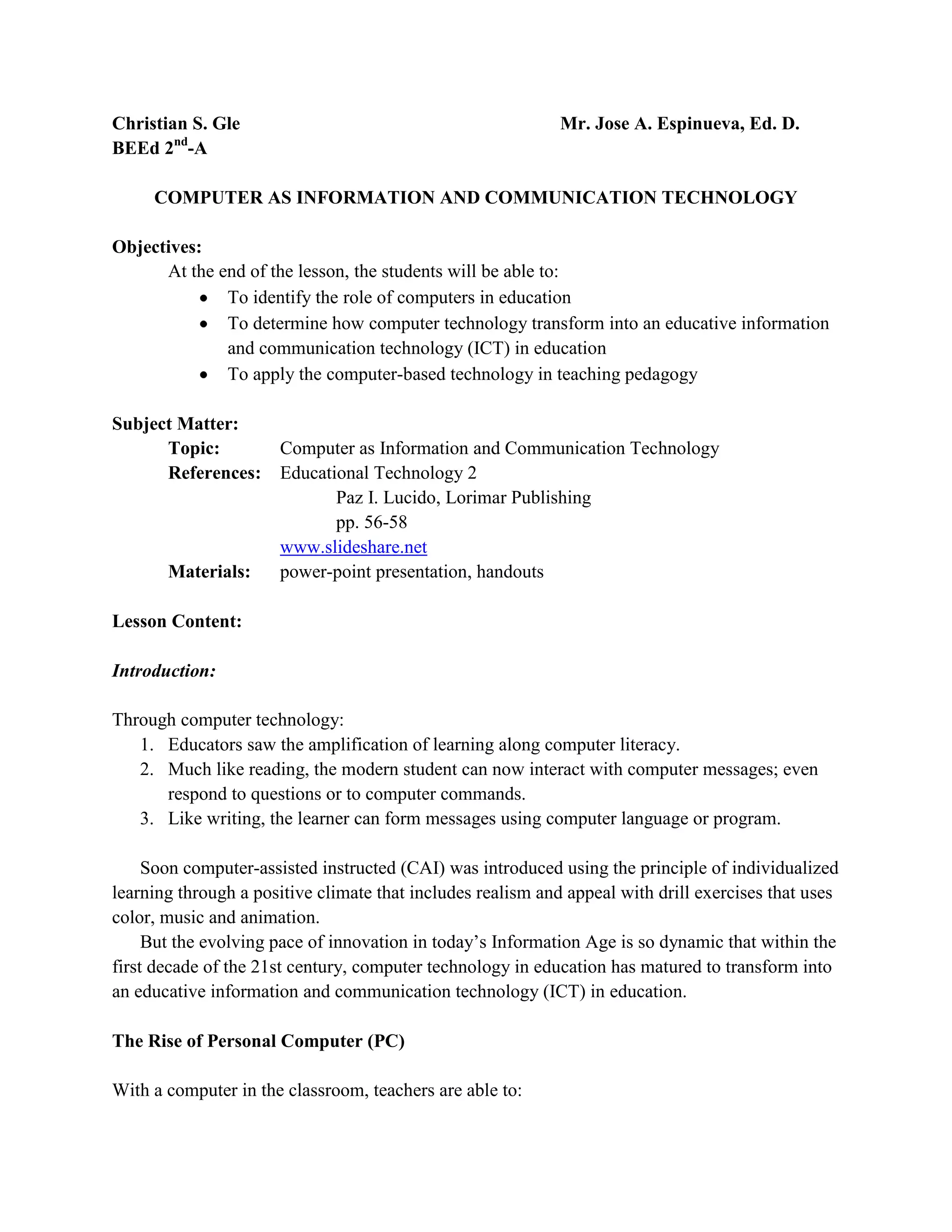
    Christian S. Gle Mr. Jose A. Espinueva, Ed. D. BEEd 2nd-A COMPUTER AS INFORMATION AND COMMUNICATION TECHNOLOGY Objectives: At the end of the lesson, the students will be able to: To identify the role of computers in education To determine how computer technology transform into an educative information and communication technology (ICT) in education To apply the computer-based technology in teaching pedagogy Subject Matter: Topic: Computer as Information and Communication Technology References: Educational Technology 2 Paz I. Lucido, Lorimar Publishing pp. 56-58 www.slideshare.net Materials: power-point presentation, handouts Lesson Content: Introduction: Through computer technology: 1. Educators saw the amplification of learning along computer literacy. 2. Much like reading, the modern student can now interact with computer messages; even respond to questions or to computer commands. 3. Like writing, the learner can form messages using computer language or program. Soon computer-assisted instructed (CAI) was introduced using the principle of individualized learning through a positive climate that includes realism and appeal with drill exercises that uses color, music and animation. But the evolving pace of innovation in today’s Information Age is so dynamic that within the first decade of the 21st century, computer technology in education has matured to transform into an educative information and communication technology (ICT) in education. The Rise of Personal Computer (PC) With a computer in the classroom, teachers are able to:
  • 2.
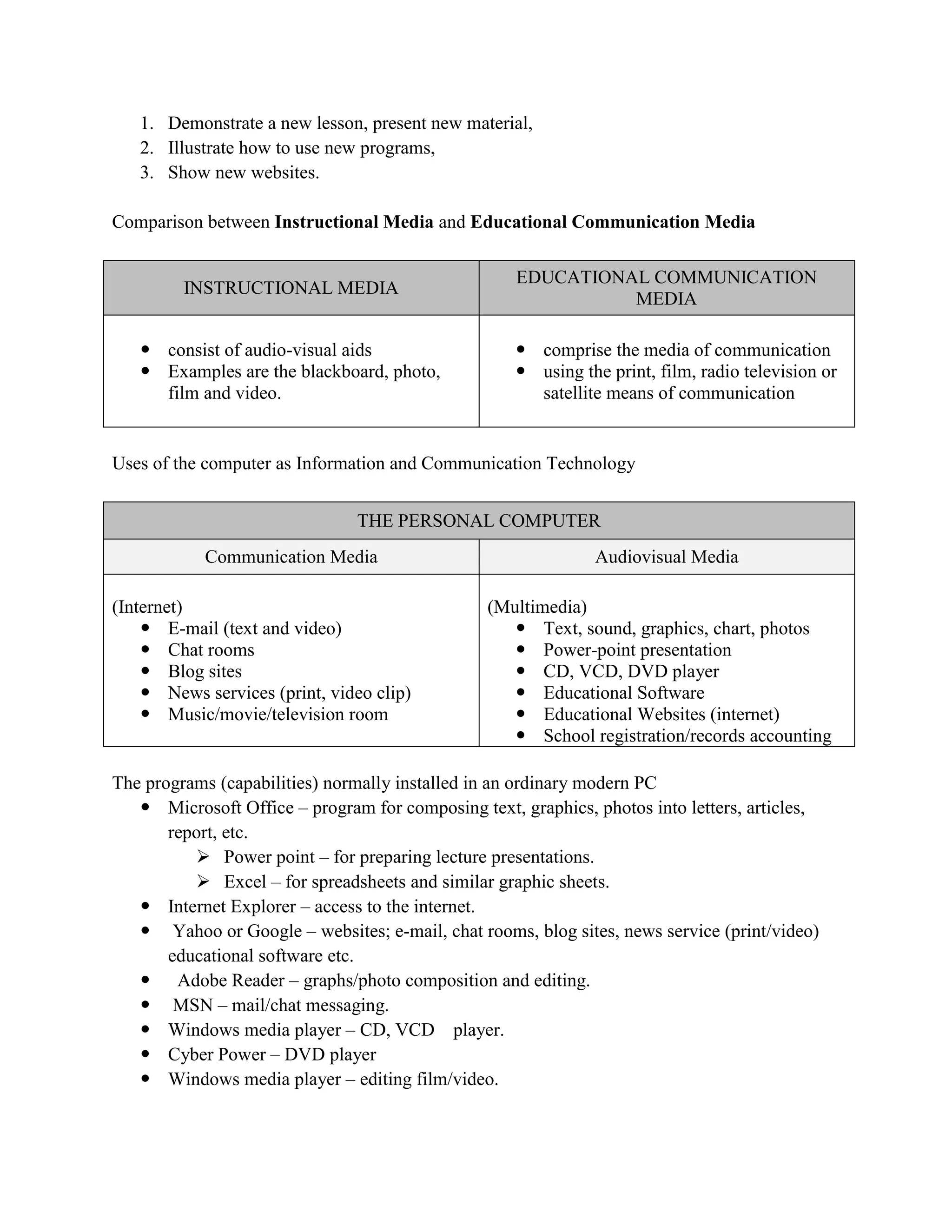
    1. Demonstrate anew lesson, present new material, 2. Illustrate how to use new programs, 3. Show new websites. Comparison between Instructional Media and Educational Communication Media EDUCATIONAL COMMUNICATION INSTRUCTIONAL MEDIA MEDIA  consist of audio-visual aids  comprise the media of communication  Examples are the blackboard, photo,  using the print, film, radio television or film and video. satellite means of communication Uses of the computer as Information and Communication Technology THE PERSONAL COMPUTER Communication Media Audiovisual Media (Internet) (Multimedia)  E-mail (text and video)  Text, sound, graphics, chart, photos  Chat rooms  Power-point presentation  Blog sites  CD, VCD, DVD player  News services (print, video clip)  Educational Software  Music/movie/television room  Educational Websites (internet)  School registration/records accounting The programs (capabilities) normally installed in an ordinary modern PC  Microsoft Office – program for composing text, graphics, photos into letters, articles, report, etc.  Power point – for preparing lecture presentations.  Excel – for spreadsheets and similar graphic sheets.  Internet Explorer – access to the internet.  Yahoo or Google – websites; e-mail, chat rooms, blog sites, news service (print/video) educational software etc.  Adobe Reader – graphs/photo composition and editing.  MSN – mail/chat messaging.  Windows media player – CD, VCD player.  Cyber Power – DVD player  Windows media player – editing film/video.
  • 3.
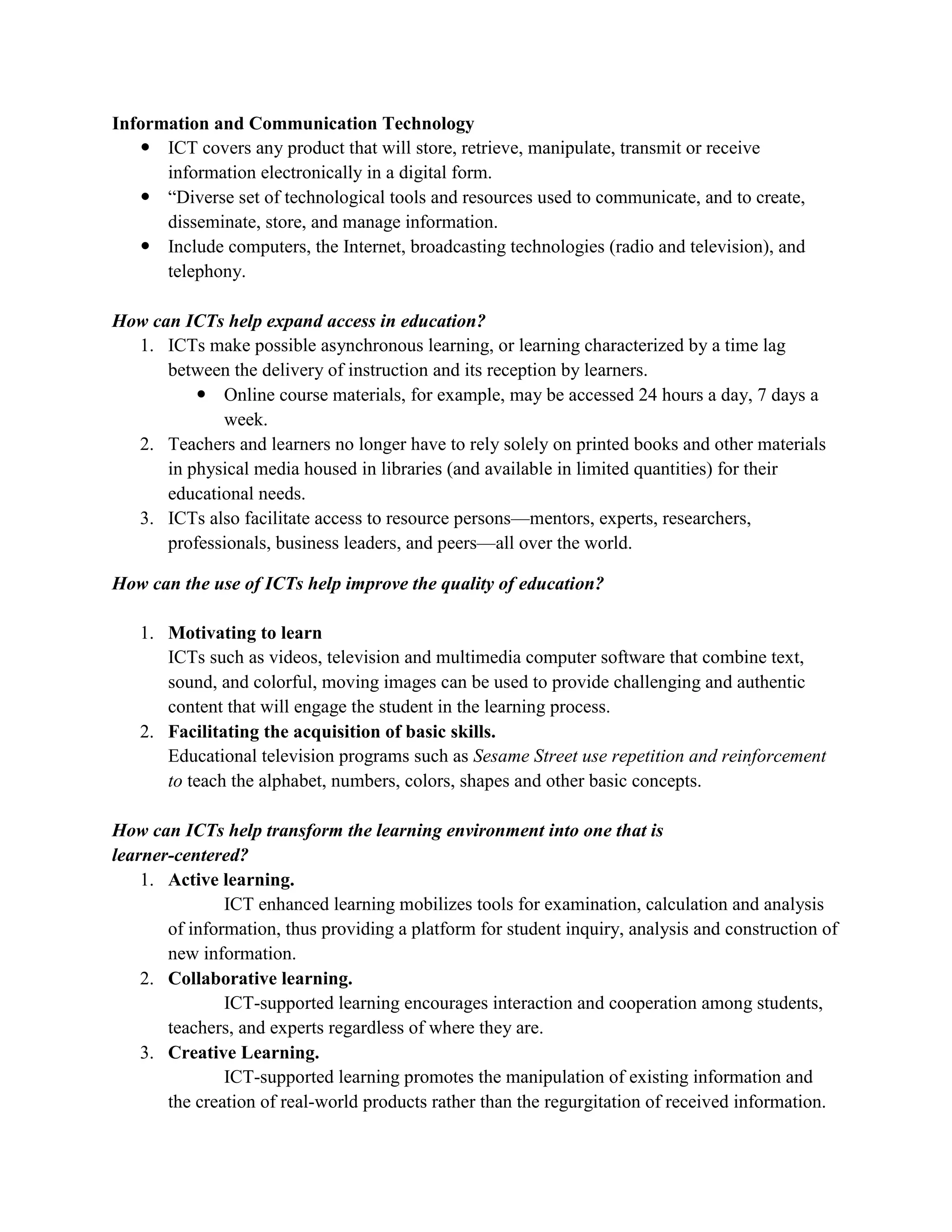
    Information and CommunicationTechnology  ICT covers any product that will store, retrieve, manipulate, transmit or receive information electronically in a digital form.  ―Diverse set of technological tools and resources used to communicate, and to create, disseminate, store, and manage information.  Include computers, the Internet, broadcasting technologies (radio and television), and telephony. How can ICTs help expand access in education? 1. ICTs make possible asynchronous learning, or learning characterized by a time lag between the delivery of instruction and its reception by learners.  Online course materials, for example, may be accessed 24 hours a day, 7 days a week. 2. Teachers and learners no longer have to rely solely on printed books and other materials in physical media housed in libraries (and available in limited quantities) for their educational needs. 3. ICTs also facilitate access to resource persons—mentors, experts, researchers, professionals, business leaders, and peers—all over the world. How can the use of ICTs help improve the quality of education? 1. Motivating to learn ICTs such as videos, television and multimedia computer software that combine text, sound, and colorful, moving images can be used to provide challenging and authentic content that will engage the student in the learning process. 2. Facilitating the acquisition of basic skills. Educational television programs such as Sesame Street use repetition and reinforcement to teach the alphabet, numbers, colors, shapes and other basic concepts. How can ICTs help transform the learning environment into one that is learner-centered? 1. Active learning. ICT enhanced learning mobilizes tools for examination, calculation and analysis of information, thus providing a platform for student inquiry, analysis and construction of new information. 2. Collaborative learning. ICT-supported learning encourages interaction and cooperation among students, teachers, and experts regardless of where they are. 3. Creative Learning. ICT-supported learning promotes the manipulation of existing information and the creation of real-world products rather than the regurgitation of received information.
  • 4.
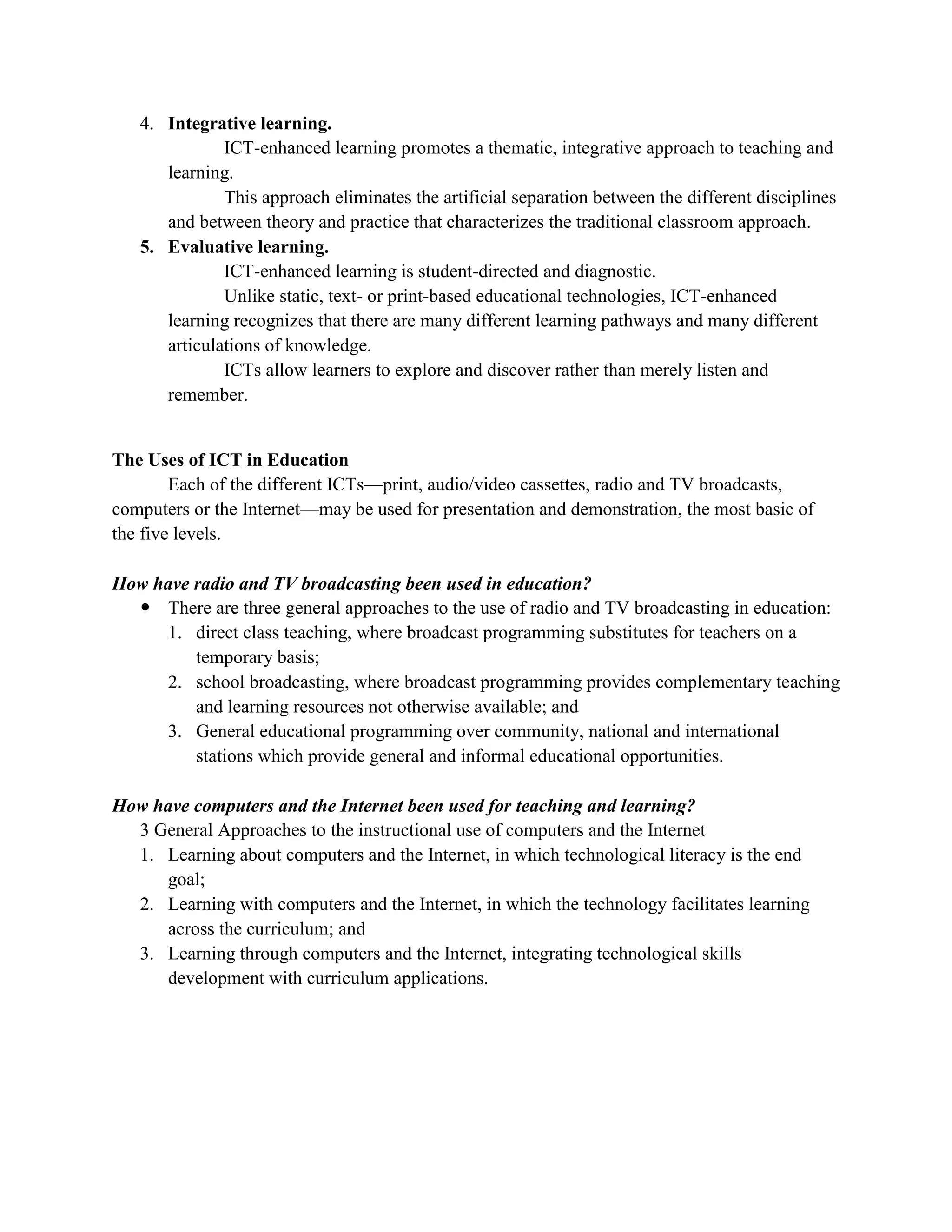
    4. Integrative learning. ICT-enhanced learning promotes a thematic, integrative approach to teaching and learning. This approach eliminates the artificial separation between the different disciplines and between theory and practice that characterizes the traditional classroom approach. 5. Evaluative learning. ICT-enhanced learning is student-directed and diagnostic. Unlike static, text- or print-based educational technologies, ICT-enhanced learning recognizes that there are many different learning pathways and many different articulations of knowledge. ICTs allow learners to explore and discover rather than merely listen and remember. The Uses of ICT in Education Each of the different ICTs—print, audio/video cassettes, radio and TV broadcasts, computers or the Internet—may be used for presentation and demonstration, the most basic of the five levels. How have radio and TV broadcasting been used in education?  There are three general approaches to the use of radio and TV broadcasting in education: 1. direct class teaching, where broadcast programming substitutes for teachers on a temporary basis; 2. school broadcasting, where broadcast programming provides complementary teaching and learning resources not otherwise available; and 3. General educational programming over community, national and international stations which provide general and informal educational opportunities. How have computers and the Internet been used for teaching and learning? 3 General Approaches to the instructional use of computers and the Internet 1. Learning about computers and the Internet, in which technological literacy is the end goal; 2. Learning with computers and the Internet, in which the technology facilitates learning across the curriculum; and 3. Learning through computers and the Internet, integrating technological skills development with curriculum applications.