IT FOR THE HIGHER
THINKING SKILLS AND
CREATIVITY
In the traditional information absorption model
of teaching, the teacher organizes and presents
information to students-learners. He may use a
variety of teaching resources to support lesson
such as chalkboard, videotape, newspaper or
magazine and photos. The presentation is
followed by discussion and the giving of
assignment. Among the assignments may be a
research on a given topic.
This teaching approach has proven
successful for achieving learning outcomes
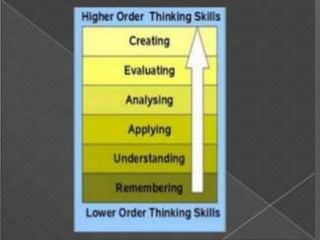
following the lower end of Bloom’s
Taxonomy: knowledge, comprehension, and
application are concerned.
But a new challenge has arisen for
today’s learners and this is not simply to
achieve learning objectives but to encourage
the development of students who can do
more than receive, recall, recite and apply
the knowledge they have acquired
Today, students are expected to be
not only cognitive, but also flexible,
analytical and creative. In this
lesson, there are methods
proposed by the use of computer-
based as an integral support to
higher thinking skills and creativity.
Higher Level Learning
Outcomes
To define higher level thinking
skills and creativity, we may adopt a
framework that is a helpful synthesis
of many models and definitions on the
subject matter. The framework is not
exhaustive but a helpful guide for the
teacher’s effort to understand the
learner’s higher learning skills.
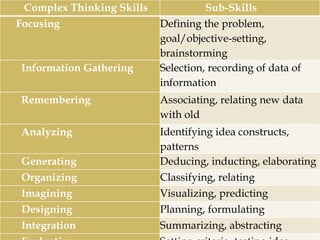
Complex Thinking Skills Sub-Skills
Focusing Defining the problem,
goal/objective-setting,
brainstorming
Information Gathering Selection, recording of data of
information
Remembering Associating, relating new data
with old
Analyzing Identifying idea constructs,
patterns
Generating Deducing, inducting, elaborating
Organizing Classifying, relating
Imagining Visualizing, predicting
Designing Planning, formulating
Integration Summarizing, abstracting
.
The Upgraded Project Method
In this modern day, the teachers are now
guided on their goal to help students achieve higher
level thinking skills and creativity beyond the
ordinary.
We know the fact that the ordinary classroom
is awfully lack in instructional toolkits; as a result
the teacher might have a difficulty to bring the
students to the higher domains of learning and
achieving, so the project method is suggested.
Project Method
Teachers assign the students to work on
projects with depth, complexity duration and
relevance to the real word.
Constructivist Paradigm
It emphasize on how the students construct
knowledge. The students, not the teacher are the one
who make decisions about what to put into the project,
how to organize information, how to package the
outcomes for presentation and the like.
Process- refers to the steps, effort and experiences in
project completion.
Product- is the result or the end point of the process.
As a future teacher, we must take into consideration
the process in every project because in the process, the
students were able to think and apply their creativity as
results they have develop their higher order thinking
skills.
Four Types of I-T Based
Projects
?Resource-based project
?Simple creations
?Guided hypermedia
?Web design project
www.google.com.ph
www.sourcenetblogspot.com
www.slideshareitforhigherthinking
skillsandcreative.com
Prepared by:
Welson S. Agripo
Rheamae Alberca
Beberly ann Alinsub
THANK YOU
FOR LISTENING!!!

IT for HIGHER THINKING SKILLS AND CREATIVITY

  • 1.
    IT FOR THEHIGHER THINKING SKILLS AND CREATIVITY
  • 2.
    In the traditionalinformation absorption model of teaching, the teacher organizes and presents information to students-learners. He may use a variety of teaching resources to support lesson such as chalkboard, videotape, newspaper or magazine and photos. The presentation is followed by discussion and the giving of assignment. Among the assignments may be a research on a given topic.
  • 3.
    This teaching approachhas proven successful for achieving learning outcomes following the lower end of Bloom’s Taxonomy: knowledge, comprehension, and application are concerned. But a new challenge has arisen for today’s learners and this is not simply to achieve learning objectives but to encourage the development of students who can do more than receive, recall, recite and apply the knowledge they have acquired
  • 5.
    Today, students areexpected to be not only cognitive, but also flexible, analytical and creative. In this lesson, there are methods proposed by the use of computer- based as an integral support to higher thinking skills and creativity.
  • 6.
    Higher Level Learning Outcomes Todefine higher level thinking skills and creativity, we may adopt a framework that is a helpful synthesis of many models and definitions on the subject matter. The framework is not exhaustive but a helpful guide for the teacher’s effort to understand the learner’s higher learning skills.
  • 7.
    Complex Thinking SkillsSub-Skills Focusing Defining the problem, goal/objective-setting, brainstorming Information Gathering Selection, recording of data of information Remembering Associating, relating new data with old Analyzing Identifying idea constructs, patterns Generating Deducing, inducting, elaborating Organizing Classifying, relating Imagining Visualizing, predicting Designing Planning, formulating Integration Summarizing, abstracting .
  • 8.
    The Upgraded ProjectMethod In this modern day, the teachers are now guided on their goal to help students achieve higher level thinking skills and creativity beyond the ordinary. We know the fact that the ordinary classroom is awfully lack in instructional toolkits; as a result the teacher might have a difficulty to bring the students to the higher domains of learning and achieving, so the project method is suggested. Project Method Teachers assign the students to work on projects with depth, complexity duration and relevance to the real word.
  • 9.
    Constructivist Paradigm It emphasizeon how the students construct knowledge. The students, not the teacher are the one who make decisions about what to put into the project, how to organize information, how to package the outcomes for presentation and the like. Process- refers to the steps, effort and experiences in project completion. Product- is the result or the end point of the process. As a future teacher, we must take into consideration the process in every project because in the process, the students were able to think and apply their creativity as results they have develop their higher order thinking skills.
  • 10.
    Four Types ofI-T Based Projects ?Resource-based project ?Simple creations ?Guided hypermedia ?Web design project
  • 11.
  • 13.