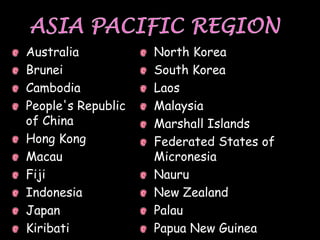
Australia           North Korea
Brunei              South Korea
Cambodia            Laos
People's Republic   Malaysia
of China            Marshall Islands
Hong Kong           Federated States of
Macau               Micronesia
Fiji                Nauru
Indonesia           New Zealand
Japan               Palau
Kiribati            Papua New Guinea
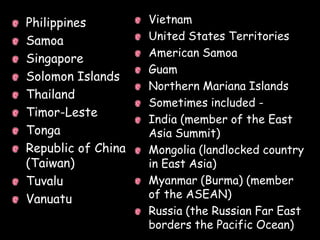
Philippines         Vietnam
Samoa               United States Territories
                    American Samoa
Singapore
                    Guam
Solomon Islands
                    Northern Mariana Islands
Thailand
                    Sometimes included -

Timor-Leste
                    India (member of the East
Tonga               Asia Summit)
Republic of China   Mongolia (landlocked country
(Taiwan)            in East Asia)
Tuvalu              Myanmar (Burma) (member
Vanuatu             of the ASEAN)
                    Russia (the Russian Far East
                    borders the Pacific Ocean)
   ICT refers to technologies that provide
    access to information
    through telecommunications. It is similar
    to Information Technology (IT), but
    focuses primarily on communication
    technologies. This includes
    the Internet, wireless networks, cell
    phones, and other communication
    mediums.
                                    WIKIPEDIA
E-learning
   is the computer and network- enabled
  transfer of skills and knowledge.
  often involves both out-of-classroom
  and in-classroom educational
  experiences via technology, even as
  advances continue in regard to devices
  and curriculum.
                                   Wikipedia
Blended learning
   Refers to learning models that combine
   traditional classroom practice with e-
   learning solutions.
Open and distance learning
   a way of providing learning opportunities
   that is characterized by the separation
   of teacher and learner in time and place.
                                     WIKIPEDIA
ICT strategy recognizes the
focus must be on extending and
deepening educational
experiences to work towards
further developing an innovative
and thriving society.
envisions to support the development
and capability of schools to use
information and communication
technologies in teaching-and-learning
process and administration.
                              WWW.TKI.ORG

To enhance the development of students’
knowledge, understanding, skills and
attitudes through the appropriate and
effective use of ICT.

                                  UNESCO
For all students, irrespective of
 their backgrounds:
   To develop the knowledge.
   Understanding, skills and attitudes;
   To participate actively in society;
   To achieve in global economy; and
   To have a strong sense of identity and
   culture.
It foresees schools to be:
   Improving learning outcomes for
   students using ICT to support the
   curriculum.
   Using ICT, to improve the efficiency
   and effectiveness of educational
   technology.
   Developing partnerships with
   communities to enhance access to
   learning through ICT.
Infrastructure for increasing
schools’ access to ICTs
Professional development
On-line Resource Center
Computer recycling scheme
Planning and implementation guide
ICT professional development
schools/ clusters
Students should be confident, creative
and productive users of new
technologies.
ICT enables better and more
personalized learning.
ICT provides powerful and effective
tool
ICT can improve efficiency and more
effective decision- making.
Fast local and wide area networks
Substantial number of computers
Continuing teacher training in the
use of technology for instruction
Sufficient hardware and software
Digital library resources
Technology demonstration
How will we change learning and teaching
practices?
What is digital resources are available and
how will we use them?
How will teachers and other staff learn to
use ICT resources?
How will we maintain student’s online
safety?
How can ICT be used to help us introduce
the national curriculum?
Difference between ICT
infrastructure planning and
   ICT strategic planning

 Comprises computers, mobile
 devices, peripherals, networks and
 operating software used by
 students, teachers and other staff.
 Requires careful technical
 management and support services.
Difference between ICT
infrastructure planning and ICT
       strategic planning


 Requires a whole school strategic
 focus.
 Shift from teacher- centered to
 student- centered learning
                           MOYLE (2006)
“VISION 2020”
Philosophy of Education calls for
“developing the potential of individuals in
a holistic and integrated manner, so as to
produce individuals who are
intellectually, spiritually, emotionally and
physically balanced and harmonious.”
ICT for all students
The role and function of ICT in
education as teaching and learning
tool
Using ICT to increase
productivity, efficiency, and
effectiveness of the management
system.
ICT-enabled Smart Schools act as a
catalyst within this process.
The Government envisages that all schools
will be converted into Smart Schools by
the year 2010.
The three pilot applications are:
  teaching learning materials;
  a more accurate assessment system; and
  an integrated management system.
Classrooms with multimedia, presentation
facilities, email and groupware for
collaborative work.
Library media canter
Computer laboratory
Multimedia development center
Studio/ theatrette
Teachers’ room with on-line access
Administration offices capable of managing
databases of students and facilities
The ministry is constantly working to
 enrich and transform the learning
 environments of students and to equip
 them with the critical competencies to
 succeed in a knowledge economy. A key
 thrust is the integration of ICT into
 lessons to enhance students' learning.
MISSION
  A catalyst in harnessing Information and
  Communication Technologies (ICT) to enrich
  learning and teaching.
The goal of the “In2015” Education and
  Learning plan is to foster an engaging
  learning experience to meet the diverse
  needs of learners in Singapore.
The plan aims to achieve these outcomes:
   Our people experience engaged learning and
   enriched lives, and Singapore benefits from
   enhanced national capacity
   Our educational institutions, with their pervasive
   and innovative use of ICT, are magnets for global
   talent
   Our ICT industry is recognized for its innovative
   Education and Learning products and services.
Creating an enriching and personalized
learner-centric environment in
educational institutions
Building a nation-wide Education and
Learning infrastructure
Positioning Singapore as a centre for
innovation in the use of ICT technologies
for the Education and Learning sector.
A balance between acquisition of factual
knowledge and mastery of concepts and
skills.
Students in more active and independent
learning.
Assessment to measure abilities in
applying information, thinking and
communicating
Development of a wide range of
educational software for instruction
Use of relevant Internet resources
for teaching-and- learning
Convenient and timely procurement
of software materials
Training on purposeful use of IT
for teaching
Equipping each trainee teacher
with core skills and teaching with
IT
Tie- ups with institutions of
higher learning and industry
partners
Pupil computer ratio of 2:1
Access to IT in all learning areas in the
school
School wide network and school linkages
through wide are network
The Hong Kong Special Administrative
Region (SAR) government launched a five-
year ICT strategy in schools in late
1998.
During the past decade there has been
an exponential growth in the use of
information and communication
technology (ICT) which has made
pervasive impacts both on society and on
our daily lives.
On average, 40 computers for each
primary school and 82 computers for
each secondary school.
About 85, 000 IT training places for
teachers at four levels
Technical support for all schools
An information Education Resource
Center for all schools and teachers
An IT coordinator for each of 250
schools should have sound IT plans
Computer rooms for use by students
after normal school hours
An IT Pilot Scheme
Review of school curriculum
Development of appropriate software in
collaboration with government, private
sector and tertiary institutions and
schools
Exploring the feasibility of setting up an
education- specific Intranet
Educational Technology in the Asia Pacific Region

Educational Technology in the Asia Pacific Region

  • 2.
    Australia North Korea Brunei South Korea Cambodia Laos People's Republic Malaysia of China Marshall Islands Hong Kong Federated States of Macau Micronesia Fiji Nauru Indonesia New Zealand Japan Palau Kiribati Papua New Guinea
  • 3.
    Philippines Vietnam Samoa United States Territories American Samoa Singapore Guam Solomon Islands Northern Mariana Islands Thailand Sometimes included - Timor-Leste India (member of the East Tonga Asia Summit) Republic of China Mongolia (landlocked country (Taiwan) in East Asia) Tuvalu Myanmar (Burma) (member Vanuatu of the ASEAN) Russia (the Russian Far East borders the Pacific Ocean)
  • 5.
    ICT refers to technologies that provide access to information through telecommunications. It is similar to Information Technology (IT), but focuses primarily on communication technologies. This includes the Internet, wireless networks, cell phones, and other communication mediums. WIKIPEDIA
  • 6.
    E-learning is the computer and network- enabled transfer of skills and knowledge. often involves both out-of-classroom and in-classroom educational experiences via technology, even as advances continue in regard to devices and curriculum. Wikipedia
  • 7.
    Blended learning Refers to learning models that combine traditional classroom practice with e- learning solutions. Open and distance learning a way of providing learning opportunities that is characterized by the separation of teacher and learner in time and place.  WIKIPEDIA
  • 9.
    ICT strategy recognizesthe focus must be on extending and deepening educational experiences to work towards further developing an innovative and thriving society.
  • 10.
    envisions to supportthe development and capability of schools to use information and communication technologies in teaching-and-learning process and administration. WWW.TKI.ORG To enhance the development of students’ knowledge, understanding, skills and attitudes through the appropriate and effective use of ICT. UNESCO
  • 11.
    For all students,irrespective of their backgrounds: To develop the knowledge. Understanding, skills and attitudes; To participate actively in society; To achieve in global economy; and To have a strong sense of identity and culture.
  • 12.
    It foresees schoolsto be: Improving learning outcomes for students using ICT to support the curriculum. Using ICT, to improve the efficiency and effectiveness of educational technology. Developing partnerships with communities to enhance access to learning through ICT.
  • 13.
    Infrastructure for increasing schools’access to ICTs Professional development
  • 14.
    On-line Resource Center Computerrecycling scheme Planning and implementation guide ICT professional development schools/ clusters
  • 15.
    Students should beconfident, creative and productive users of new technologies. ICT enables better and more personalized learning. ICT provides powerful and effective tool ICT can improve efficiency and more effective decision- making.
  • 16.
    Fast local andwide area networks Substantial number of computers Continuing teacher training in the use of technology for instruction Sufficient hardware and software Digital library resources Technology demonstration
  • 17.
    How will wechange learning and teaching practices? What is digital resources are available and how will we use them? How will teachers and other staff learn to use ICT resources? How will we maintain student’s online safety? How can ICT be used to help us introduce the national curriculum?
  • 18.
    Difference between ICT infrastructureplanning and ICT strategic planning Comprises computers, mobile devices, peripherals, networks and operating software used by students, teachers and other staff. Requires careful technical management and support services.
  • 19.
    Difference between ICT infrastructureplanning and ICT strategic planning Requires a whole school strategic focus. Shift from teacher- centered to student- centered learning MOYLE (2006)
  • 20.
    “VISION 2020” Philosophy ofEducation calls for “developing the potential of individuals in a holistic and integrated manner, so as to produce individuals who are intellectually, spiritually, emotionally and physically balanced and harmonious.”
  • 21.
    ICT for allstudents The role and function of ICT in education as teaching and learning tool Using ICT to increase productivity, efficiency, and effectiveness of the management system.
  • 22.
    ICT-enabled Smart Schoolsact as a catalyst within this process. The Government envisages that all schools will be converted into Smart Schools by the year 2010. The three pilot applications are: teaching learning materials; a more accurate assessment system; and an integrated management system.
  • 23.
    Classrooms with multimedia,presentation facilities, email and groupware for collaborative work. Library media canter Computer laboratory Multimedia development center Studio/ theatrette Teachers’ room with on-line access Administration offices capable of managing databases of students and facilities
  • 24.
    The ministry isconstantly working to enrich and transform the learning environments of students and to equip them with the critical competencies to succeed in a knowledge economy. A key thrust is the integration of ICT into lessons to enhance students' learning. MISSION A catalyst in harnessing Information and Communication Technologies (ICT) to enrich learning and teaching.
  • 25.
    The goal ofthe “In2015” Education and Learning plan is to foster an engaging learning experience to meet the diverse needs of learners in Singapore. The plan aims to achieve these outcomes: Our people experience engaged learning and enriched lives, and Singapore benefits from enhanced national capacity Our educational institutions, with their pervasive and innovative use of ICT, are magnets for global talent Our ICT industry is recognized for its innovative Education and Learning products and services.
  • 26.
    Creating an enrichingand personalized learner-centric environment in educational institutions Building a nation-wide Education and Learning infrastructure Positioning Singapore as a centre for innovation in the use of ICT technologies for the Education and Learning sector.
  • 27.
    A balance betweenacquisition of factual knowledge and mastery of concepts and skills. Students in more active and independent learning. Assessment to measure abilities in applying information, thinking and communicating
  • 28.
    Development of awide range of educational software for instruction Use of relevant Internet resources for teaching-and- learning Convenient and timely procurement of software materials
  • 29.
    Training on purposefuluse of IT for teaching Equipping each trainee teacher with core skills and teaching with IT Tie- ups with institutions of higher learning and industry partners
  • 30.
    Pupil computer ratioof 2:1 Access to IT in all learning areas in the school School wide network and school linkages through wide are network
  • 31.
    The Hong KongSpecial Administrative Region (SAR) government launched a five- year ICT strategy in schools in late 1998. During the past decade there has been an exponential growth in the use of information and communication technology (ICT) which has made pervasive impacts both on society and on our daily lives.
  • 32.
    On average, 40computers for each primary school and 82 computers for each secondary school. About 85, 000 IT training places for teachers at four levels Technical support for all schools An information Education Resource Center for all schools and teachers
  • 33.
    An IT coordinatorfor each of 250 schools should have sound IT plans Computer rooms for use by students after normal school hours An IT Pilot Scheme Review of school curriculum Development of appropriate software in collaboration with government, private sector and tertiary institutions and schools Exploring the feasibility of setting up an education- specific Intranet