IT Enters a New Learning Environment
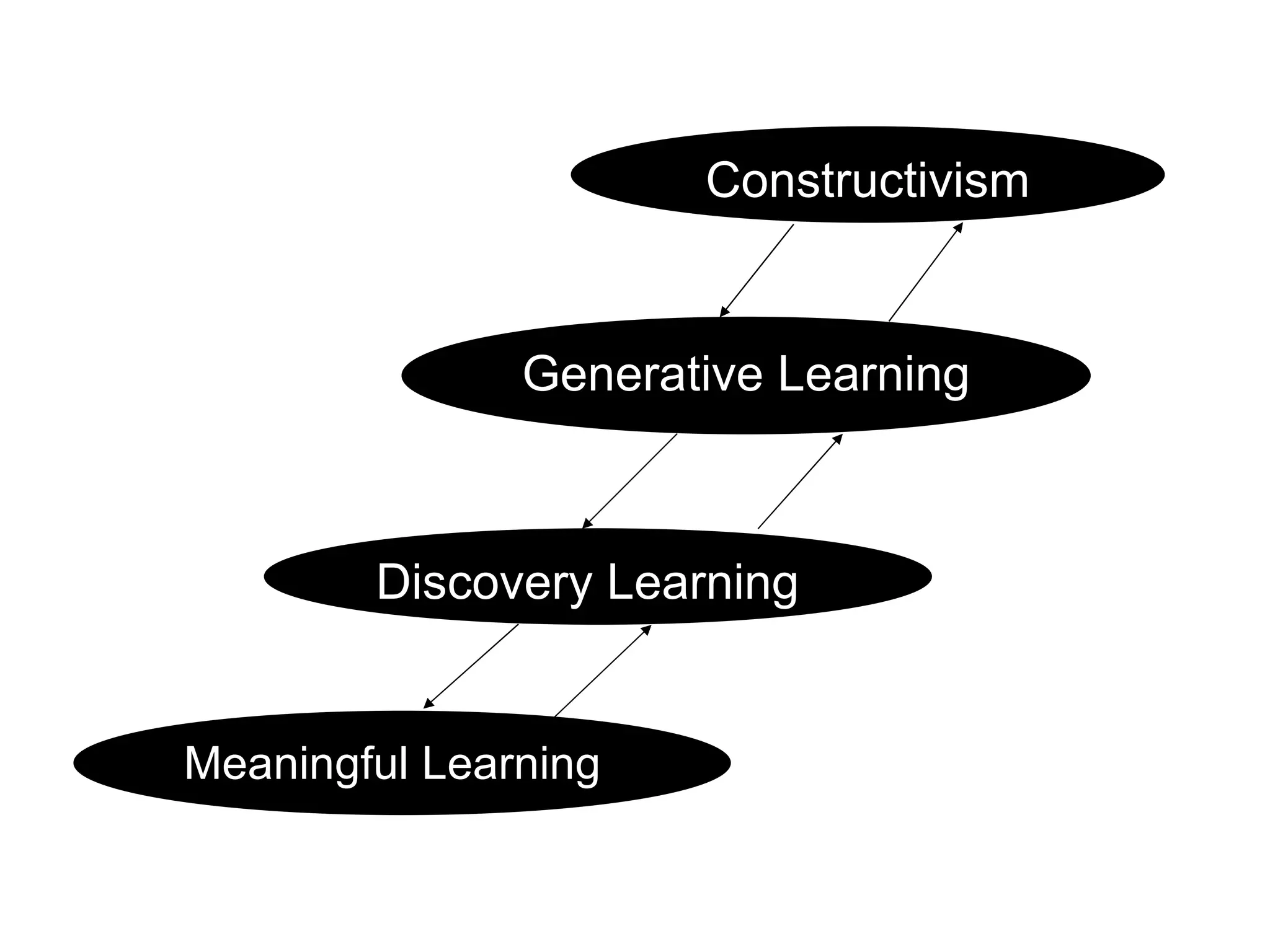
Constructivism Generative Learning  Discovery Learning  Meaningful Learning
MEANINGFUL LEARNING  gives focus to new experience that is related to what the learner already knows. New experience departs from the learning of a sequence of words but gives attention to meaning.
It assumes that:  Students already have some knowledge that is relevant to new learning  Students are willing to perform class work to find connections between what they already know and what they can learn.
In the learning process… the learner is encouraged to recognize relevant personal experiences. A reward structure is set so that the learner will have both interest and confidence, and this incentive system sets a positive environment to learning.  Facts that are subsequently assimilated are subjected to the learner’s understanding and application.
. In the classroom, hands-on activities are introduced so as to simulate learning in everyday living.
DISCOVERY LEARNING  Is differentiated from reception learning in which ideas are presented directly to students in a well-organized way, such as through a detailed set of instructions to complete an experiment or task.  discovery learning  - students perform tasks to uncover what is to be  learned.  - New ideas and new decisions are generated in the  learning process. - In discovery learning, it is important that the students  become personally engaged and not subjected by  the teacher to procedures he/she is not allowed to  depart from.
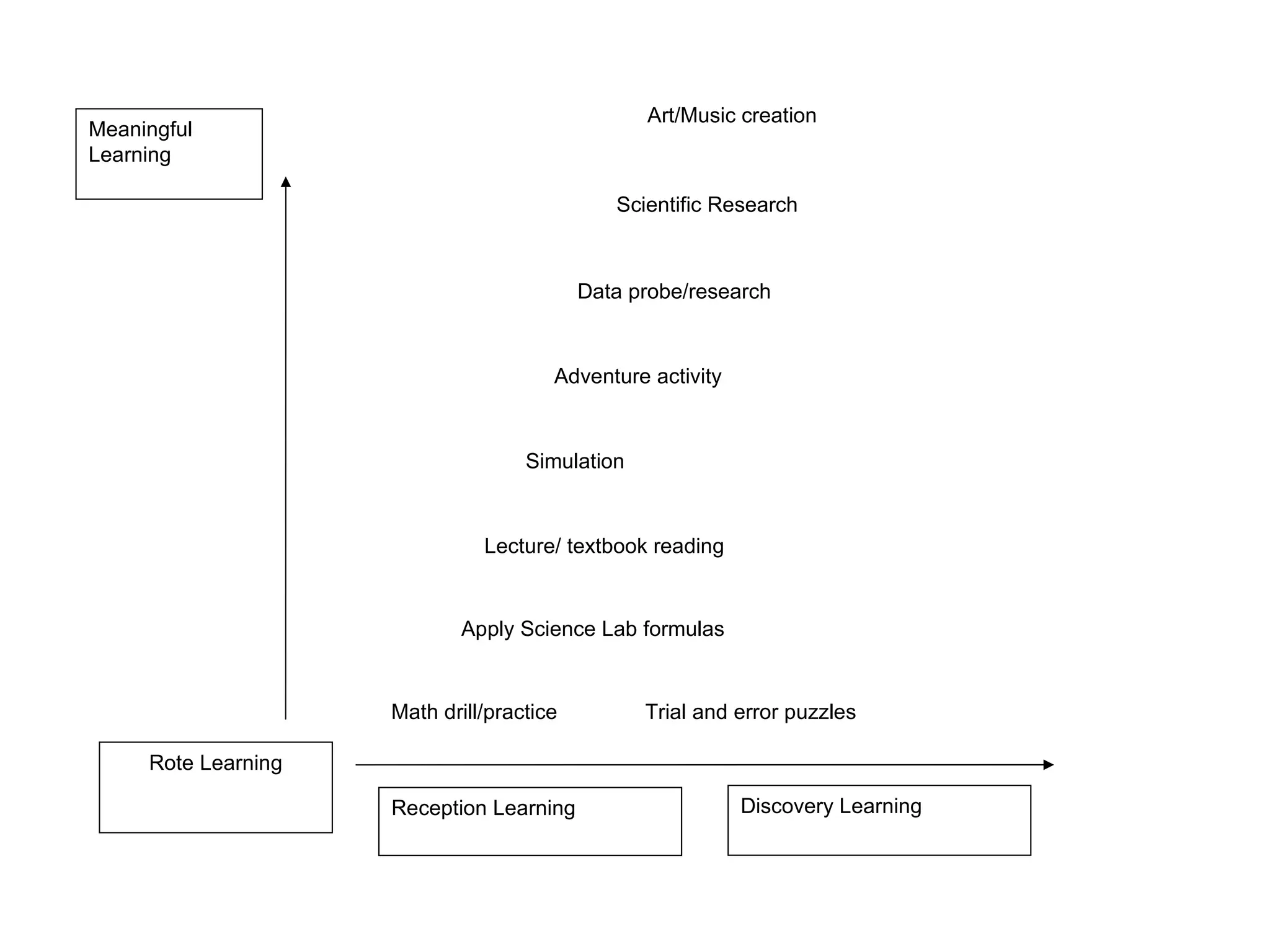
Rote Learning Meaningful  Learning  Reception Learning Discovery Learning  Math drill/practice Trial and error puzzles  Apply Science Lab formulas  Lecture/ textbook reading  Simulation Adventure activity  Data probe/research  Scientific Research  Art/Music creation
GENERATIVE LEARNING  active learners who attend to learning events and generate meaning from this experience and draw inferences thereby creating a personal model or explanation to the new experience in the context of existing knowledge.
is viewed as different from simple process of storing information.  Motivation and responsibility are seen to be crucial to this domain of learning.  The area of language comprehension offers examples of this type of generative learning activities,
such as…  writing paragraph summaries, developing answers and questions, drawing pictures, creating paragraph titles, organizing ideas/concepts, and others. In sum, generative learning gives emphasis to what can be done with pieces of information, not only on access to them
CONSTRUCTIVISM  In constructivism, the learner builds a personal understanding through appropriate learning activities and a good learning environment. The most accepted principles constructivisms are:  -Learning consists in what a person  can actively assemble for  himself and not what he can  receive passively.  -The role of learning is to help the  individual live/ adapt to his personal  world.
Practical implications:  The learner is directly responsible for learning. He creates personal understanding and transforms information into knowledge. The teacher plays an indirect role by modeling effective learning, assisting, facilitating and encouraging learners.  The context of meaningful learning consists in the learner “connecting” his school activity with real life.  The purpose of education is the acquisition of practical and personal knowledge, not abstract or universal truths.
common themes to these four learning domains  Learners… Are active, purposeful learners Set personal goals and strategies to achieve these goals  Make their learning experience meaningful and relevant to their lives Seek to build an understanding of thie personal worlds so they can work/live productively.  Build on what they already know in order to interpret and respond to new experiences.

It enters a new learning environment

  • 1.
    IT Enters aNew Learning Environment
  • 2.
    Constructivism Generative Learning Discovery Learning Meaningful Learning
  • 3.
    MEANINGFUL LEARNING gives focus to new experience that is related to what the learner already knows. New experience departs from the learning of a sequence of words but gives attention to meaning.
  • 4.
    It assumes that: Students already have some knowledge that is relevant to new learning Students are willing to perform class work to find connections between what they already know and what they can learn.
  • 5.
    In the learningprocess… the learner is encouraged to recognize relevant personal experiences. A reward structure is set so that the learner will have both interest and confidence, and this incentive system sets a positive environment to learning. Facts that are subsequently assimilated are subjected to the learner’s understanding and application.
  • 6.
    . In theclassroom, hands-on activities are introduced so as to simulate learning in everyday living.
  • 7.
    DISCOVERY LEARNING Is differentiated from reception learning in which ideas are presented directly to students in a well-organized way, such as through a detailed set of instructions to complete an experiment or task. discovery learning - students perform tasks to uncover what is to be learned. - New ideas and new decisions are generated in the learning process. - In discovery learning, it is important that the students become personally engaged and not subjected by the teacher to procedures he/she is not allowed to depart from.
  • 8.
    Rote Learning Meaningful Learning Reception Learning Discovery Learning Math drill/practice Trial and error puzzles Apply Science Lab formulas Lecture/ textbook reading Simulation Adventure activity Data probe/research Scientific Research Art/Music creation
  • 9.
    GENERATIVE LEARNING active learners who attend to learning events and generate meaning from this experience and draw inferences thereby creating a personal model or explanation to the new experience in the context of existing knowledge.
  • 10.
    is viewed asdifferent from simple process of storing information. Motivation and responsibility are seen to be crucial to this domain of learning. The area of language comprehension offers examples of this type of generative learning activities,
  • 11.
    such as… writing paragraph summaries, developing answers and questions, drawing pictures, creating paragraph titles, organizing ideas/concepts, and others. In sum, generative learning gives emphasis to what can be done with pieces of information, not only on access to them
  • 12.
    CONSTRUCTIVISM Inconstructivism, the learner builds a personal understanding through appropriate learning activities and a good learning environment. The most accepted principles constructivisms are: -Learning consists in what a person can actively assemble for himself and not what he can receive passively. -The role of learning is to help the individual live/ adapt to his personal world.
  • 13.
    Practical implications: The learner is directly responsible for learning. He creates personal understanding and transforms information into knowledge. The teacher plays an indirect role by modeling effective learning, assisting, facilitating and encouraging learners. The context of meaningful learning consists in the learner “connecting” his school activity with real life. The purpose of education is the acquisition of practical and personal knowledge, not abstract or universal truths.
  • 14.
    common themes tothese four learning domains Learners… Are active, purposeful learners Set personal goals and strategies to achieve these goals Make their learning experience meaningful and relevant to their lives Seek to build an understanding of thie personal worlds so they can work/live productively. Build on what they already know in order to interpret and respond to new experiences.