 Was introduce by :

 piaget (1981) and bruner(1990).
 They stress to KNOWLEDGE DISCOVERY

of new meaning/ concepts/ priciples in the
learning process.
Social constructivism

 This is an effort to show

that the construction of
knowledge is governed by
social, historical and
cultural context.
Vygotsky

 Stressed that learning is

affected by social
influences.

 He therefore suggested the

inter active process in
learning.
Dewey
 Sees language as a medium for

social coordination and
adaptation.

 For dewey human learning is

really human languaging that
occurs when students socially
share, build and agree upon
meanings and knowledge.
Summary of two
learning perspective
Learning framework

Constructivism

 social constructivism

individual.

social context.

DEFINITION OF
LEARNING

Students build their
own learning.

 Students build
knowledge influenced by
the social context.

 LEARNING S
SRATEGIES

Gather unorganized
information to create
new concepts and
principles.

Exchange and share
form ideas, stimulates
thinking.

GENERAL
ORIENTATION

Personal discovery of
knowledge.

Students discuss and
discover meanings.

EXAMPLE

8*5 - 8+8+8+8+8

 Two alternative job
offers option 1-8hrs /day

SUMMARY OF THE TWO LEARNING
ASSUMPTION
 Knowledge is
is
PERSPECTIVES  Knowledgewithin a
constructed by an
constructed

Option 2- 9 hrs/day
For 5 days/week.
The computer’s
capabilities
Teacher can employ the
computer as a/an:
•
•
•
•
•

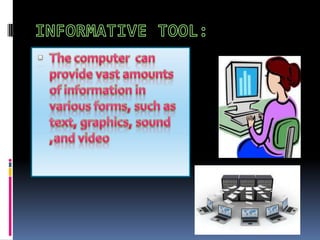
An information tool
A communication tool
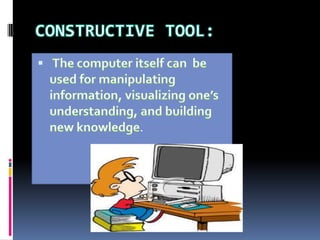
A constructive tool
As co-constructive tool
A situating tool


.
The (CSILE) the
Computer-Supported
Intentional Learning
Environments,
an example of an integrated
environment developed by
the Ontario Institute for
Studies in Education.
 By means of virtual reality(RS)

extension systems, the computer
can create 3-D images on display to
give the user the feeling that are
situated in a virtual environment.
 A flight simulation program is an

example of a situating tool which
places the user in a simulated flying
environment.
THE END
 THANK YOU FOR

LISTENING

The computer as the teacher’s tool.pptx a

  • 2.
     Was introduceby :  piaget (1981) and bruner(1990).  They stress to KNOWLEDGE DISCOVERY of new meaning/ concepts/ priciples in the learning process.
  • 3.
    Social constructivism  Thisis an effort to show that the construction of knowledge is governed by social, historical and cultural context.
  • 4.
    Vygotsky  Stressed thatlearning is affected by social influences.  He therefore suggested the inter active process in learning.
  • 5.
    Dewey  Sees languageas a medium for social coordination and adaptation.  For dewey human learning is really human languaging that occurs when students socially share, build and agree upon meanings and knowledge.
  • 6.
  • 7.
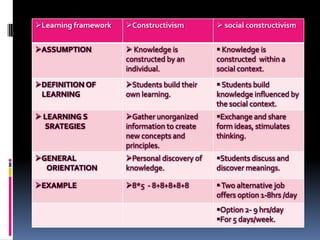
    Learning framework Constructivism  socialconstructivism individual. social context. DEFINITION OF LEARNING Students build their own learning.  Students build knowledge influenced by the social context.  LEARNING S SRATEGIES Gather unorganized information to create new concepts and principles. Exchange and share form ideas, stimulates thinking. GENERAL ORIENTATION Personal discovery of knowledge. Students discuss and discover meanings. EXAMPLE 8*5 - 8+8+8+8+8  Two alternative job offers option 1-8hrs /day SUMMARY OF THE TWO LEARNING ASSUMPTION  Knowledge is is PERSPECTIVES  Knowledgewithin a constructed by an constructed Option 2- 9 hrs/day For 5 days/week.
  • 8.
  • 9.
    Teacher can employthe computer as a/an: • • • • • An information tool A communication tool A constructive tool As co-constructive tool A situating tool
  • 11.
  • 13.
    The (CSILE) the Computer-Supported IntentionalLearning Environments, an example of an integrated environment developed by the Ontario Institute for Studies in Education.
  • 14.
     By meansof virtual reality(RS) extension systems, the computer can create 3-D images on display to give the user the feeling that are situated in a virtual environment.  A flight simulation program is an example of a situating tool which places the user in a simulated flying environment.
  • 15.
    THE END  THANKYOU FOR LISTENING