COMPOUNDING MORE THAN
ONCE AYEAR
ALAN S.ABERILLA
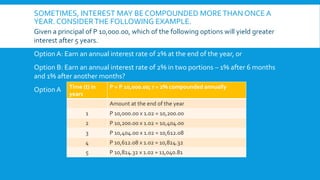
SOMETIMES, INTEREST MAY BE COMPOUNDED MORETHAN ONCE A
YEAR. CONSIDERTHE FOLLOWING EXAMPLE.
Given a principal of P 10,000.00, which of the following options will yield greater
interest after 5 years.
Option A: Earn an annual interest rate of 2% at the end of the year, or
Option B: Earn an annual interest rate of 2% in two portions – 1% after 6 months
and 1% after another months?
Option A Time (t) in
years
P = P 10,000.00; r = 2% compounded annually
Amount at the end of the year
1 P 10,000.00 x 1.02 = 10,200.00
2 P 10,200.00 x 1.02 = 10,404.00
3 P 10,404.00 x 1.02 = 10,612.08
4 P 10,612.08 x 1.02 = 10,824.32
5 P 10,824.32 x 1.02 = 11,040.81
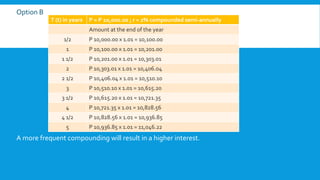
Option B
A more frequent compounding will result in a higher interest.
T (t) in years P = P 10,000.00 ; r = 2% compounded semi-annually
Amount at the end of the year
1/2 P 10,000.00 x 1.01 = 10,100.00
1 P 10,100.00 x 1.01 = 10,201.00
1 1/2 P 10,201.00 x 1.01 = 10,303.01
2 P 10,303.01 x 1.01 = 10,406.04
2 1/2 P 10,406.04 x 1.01 = 10,510.10
3 P 10,510.10 x 1.01 = 10,615.20
3 1/2 P 10,615.20 x 1.01 = 10,721.35
4 P 10,721.35 x 1.01 = 10,828.56
4 1/2 P 10,828.56 x 1.01 = 10,936.85
5 P 10,936.85 x 1.01 = 11,046.22
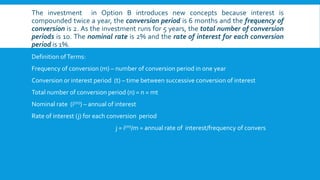
The investment in Option B introduces new concepts because interest is
compounded twice a year, the conversion period is 6 months and the frequency of
conversion is 2. As the investment runs for 5 years, the total number of conversion
periods is 10. The nominal rate is 2% and the rate of interest for each conversion
period is 1%.
Definition ofTerms:
Frequency of conversion (m) – number of conversion period in one year
Conversion or interest period (t) – time between successive conversion of interest
Total number of conversion period (n) = n = mt
Nominal rate (i(m)) – annual of interest
Rate of interest (j) for each conversion period
j = i(m)/m = annual rate of interest/frequency of convers
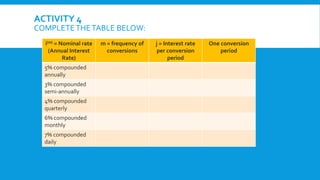
ACTIVITY 4
COMPLETETHETABLE BELOW:
i(m) = Nominal rate
(Annual Interest
Rate)
m = frequency of
conversions
j = Interest rate
per conversion
period
One conversion
period
5% compounded
annually
3% compounded
semi-annually
4% compounded
quarterly
6% compounded
monthly
7% compounded
daily
Note on rate notation: r, i(m), j
In earlier lessons, r was used to describe to denote the interest rate. Now that an interest rate can
refer to two rates (either nominal or rate per conversion period), the symbols i(m) and j will be used.
MaturityValue, Compounding m times a year
F = P[(1 + i(m)/m)]mt or F = P(1 + j)mt
F = maturity (future) value
P = principal
i(m) = nominal rate of interest (annual rate)
m = frequency of conversion
t = term/time in years
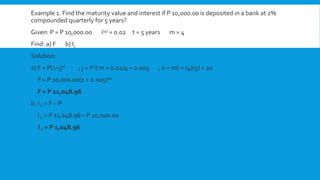
Example 1. Find the maturity value and interest if P 10,000.00 is deposited in a bank at 2%
compounded quarterly for 5 years?
Given: P = P 10,000.00 i(4) = 0.02 t = 5 years m = 4
Find: a) F b) Ic
Solution:
a) F = P(1+j)n ; j = i(4)/ m = 0.02/4 = 0.005 ; n = mt = (4)(5) = 20
F = P 10,000.00(1 + 0.005)20
F = P 11,048.96
b. I c = F – P
I c = P 11,048.96 – P 10,000.00
I c = P 1,048.96
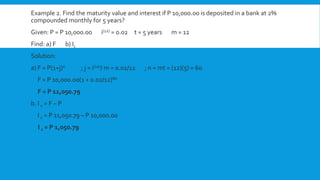
Example 2. Find the maturity value and interest if P 10,000.00 is deposited in a bank at 2%
compounded monthly for 5 years?
Given: P = P 10,000.00 i(12) = 0.02 t = 5 years m = 12
Find: a) F b) Ic
Solution:
a) F = P(1+j)n ; j = i(12)/ m = 0.02/12 ; n = mt = (12)(5) = 60
F = P 10,000.00(1 + 0.02/12)60
F = P 11,050.79
b. I c = F – P
I c = P 11,050.79 – P 10,000.00
I c = P 1,050.79
PresentValue P at Compound Interest
P = F/[(1 + i(m)/m)]mt or P = F/(1 + j)n
F = maturity (future) value
P = principal
i(m) = nominal rate of interest (annual rate)
m = frequency of conversion
t = term/time in years
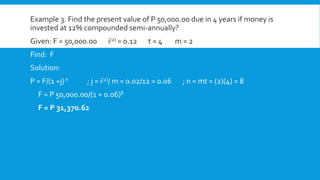
Example 3. Find the present value of P 50,000.00 due in 4 years if money is
invested at 12% compounded semi-annually?
Given: F = 50,000.00 i(2) = 0.12 t = 4 m = 2
Find: F
Solution:
P = F/(1 +j)n ; j = i(2)/ m = 0.02/12 = 0.06 ; n = mt = (2)(4) = 8
F = P 50,000.00/(1 + 0.06)8
F = P 31,370.62
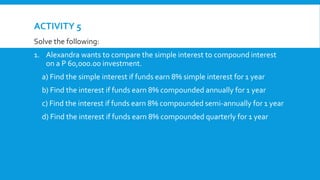
ACTIVITY 5
Solve the following: Solution:
1. Alexandra wants to compare the simple interest to compound interest
on a P 60,000.00 investment.
a) Find the simple interest if funds earn 8% simple interest for 1 year
b) Find the interest if funds earn 8% compounded annually for 1 year
c) Find the interest if funds earn 8% compounded semi-annually for 1 year
d) Find the interest if funds earn 8% compounded quarterly for 1 year
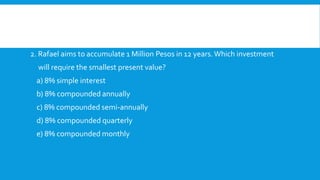
2. Rafael aims to accumulate 1 Million Pesos in 12 years.Which investment
will require the smallest present value?
a) 8% simple interest
b) 8% compounded annually
c) 8% compounded semi-annually
d) 8% compounded quarterly
e) 8% compounded monthly

Lesson 5 compounding more than once a year

  • 1.
    COMPOUNDING MORE THAN ONCEAYEAR ALAN S.ABERILLA
  • 2.
    SOMETIMES, INTEREST MAYBE COMPOUNDED MORETHAN ONCE A YEAR. CONSIDERTHE FOLLOWING EXAMPLE. Given a principal of P 10,000.00, which of the following options will yield greater interest after 5 years. Option A: Earn an annual interest rate of 2% at the end of the year, or Option B: Earn an annual interest rate of 2% in two portions – 1% after 6 months and 1% after another months? Option A Time (t) in years P = P 10,000.00; r = 2% compounded annually Amount at the end of the year 1 P 10,000.00 x 1.02 = 10,200.00 2 P 10,200.00 x 1.02 = 10,404.00 3 P 10,404.00 x 1.02 = 10,612.08 4 P 10,612.08 x 1.02 = 10,824.32 5 P 10,824.32 x 1.02 = 11,040.81
  • 3.
    Option B A morefrequent compounding will result in a higher interest. T (t) in years P = P 10,000.00 ; r = 2% compounded semi-annually Amount at the end of the year 1/2 P 10,000.00 x 1.01 = 10,100.00 1 P 10,100.00 x 1.01 = 10,201.00 1 1/2 P 10,201.00 x 1.01 = 10,303.01 2 P 10,303.01 x 1.01 = 10,406.04 2 1/2 P 10,406.04 x 1.01 = 10,510.10 3 P 10,510.10 x 1.01 = 10,615.20 3 1/2 P 10,615.20 x 1.01 = 10,721.35 4 P 10,721.35 x 1.01 = 10,828.56 4 1/2 P 10,828.56 x 1.01 = 10,936.85 5 P 10,936.85 x 1.01 = 11,046.22
  • 4.
    The investment inOption B introduces new concepts because interest is compounded twice a year, the conversion period is 6 months and the frequency of conversion is 2. As the investment runs for 5 years, the total number of conversion periods is 10. The nominal rate is 2% and the rate of interest for each conversion period is 1%. Definition ofTerms: Frequency of conversion (m) – number of conversion period in one year Conversion or interest period (t) – time between successive conversion of interest Total number of conversion period (n) = n = mt Nominal rate (i(m)) – annual of interest Rate of interest (j) for each conversion period j = i(m)/m = annual rate of interest/frequency of convers
  • 5.
    ACTIVITY 4 COMPLETETHETABLE BELOW: i(m)= Nominal rate (Annual Interest Rate) m = frequency of conversions j = Interest rate per conversion period One conversion period 5% compounded annually 3% compounded semi-annually 4% compounded quarterly 6% compounded monthly 7% compounded daily
  • 6.
    Note on ratenotation: r, i(m), j In earlier lessons, r was used to describe to denote the interest rate. Now that an interest rate can refer to two rates (either nominal or rate per conversion period), the symbols i(m) and j will be used. MaturityValue, Compounding m times a year F = P[(1 + i(m)/m)]mt or F = P(1 + j)mt F = maturity (future) value P = principal i(m) = nominal rate of interest (annual rate) m = frequency of conversion t = term/time in years
  • 7.
    Example 1. Findthe maturity value and interest if P 10,000.00 is deposited in a bank at 2% compounded quarterly for 5 years? Given: P = P 10,000.00 i(4) = 0.02 t = 5 years m = 4 Find: a) F b) Ic Solution: a) F = P(1+j)n ; j = i(4)/ m = 0.02/4 = 0.005 ; n = mt = (4)(5) = 20 F = P 10,000.00(1 + 0.005)20 F = P 11,048.96 b. I c = F – P I c = P 11,048.96 – P 10,000.00 I c = P 1,048.96
  • 8.
    Example 2. Findthe maturity value and interest if P 10,000.00 is deposited in a bank at 2% compounded monthly for 5 years? Given: P = P 10,000.00 i(12) = 0.02 t = 5 years m = 12 Find: a) F b) Ic Solution: a) F = P(1+j)n ; j = i(12)/ m = 0.02/12 ; n = mt = (12)(5) = 60 F = P 10,000.00(1 + 0.02/12)60 F = P 11,050.79 b. I c = F – P I c = P 11,050.79 – P 10,000.00 I c = P 1,050.79
  • 9.
    PresentValue P atCompound Interest P = F/[(1 + i(m)/m)]mt or P = F/(1 + j)n F = maturity (future) value P = principal i(m) = nominal rate of interest (annual rate) m = frequency of conversion t = term/time in years
  • 10.
    Example 3. Findthe present value of P 50,000.00 due in 4 years if money is invested at 12% compounded semi-annually? Given: F = 50,000.00 i(2) = 0.12 t = 4 m = 2 Find: F Solution: P = F/(1 +j)n ; j = i(2)/ m = 0.02/12 = 0.06 ; n = mt = (2)(4) = 8 F = P 50,000.00/(1 + 0.06)8 F = P 31,370.62
  • 11.
    ACTIVITY 5 Solve thefollowing: Solution: 1. Alexandra wants to compare the simple interest to compound interest on a P 60,000.00 investment. a) Find the simple interest if funds earn 8% simple interest for 1 year b) Find the interest if funds earn 8% compounded annually for 1 year c) Find the interest if funds earn 8% compounded semi-annually for 1 year d) Find the interest if funds earn 8% compounded quarterly for 1 year
  • 12.
    2. Rafael aimsto accumulate 1 Million Pesos in 12 years.Which investment will require the smallest present value? a) 8% simple interest b) 8% compounded annually c) 8% compounded semi-annually d) 8% compounded quarterly e) 8% compounded monthly