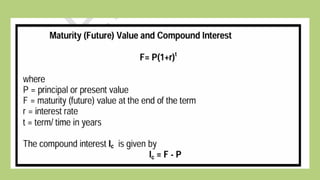
Definition of Terms:
Frequencyof conversion (m) – number of
conversion periods in one year
Conversion or interest period– time between
successive conversions of interest
Total number of conversion periods n
n = mt = (frequency of conversion)×(time in
years)
9.
Definition of Terms:
Frequencyof conversion (m) – number of
conversion periods in one year
Conversion or interest period– time between
successive conversions of interest
Total number of conversion periods n
n = mt = (frequency of conversion)×(time in
years)
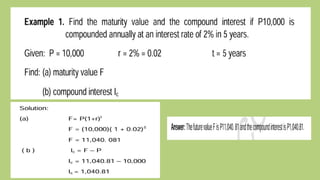
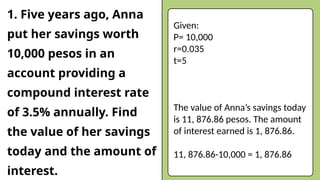
1. Five yearsago, Anna
put her savings worth
10,000 pesos in an
account providing a
compound interest rate
of 3.5% annually. Find
the value of her savings
today and the amount of
interest.
Given:
P= 10,000
r=0.035
t=5
The value of Anna’s savings today
is 11, 876.86 pesos. The amount
of interest earned is 1, 876.86.
11, 876.86-10,000 = 1, 876.86
24.
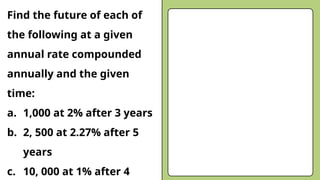
Find the futureof each of
the following at a given
annual rate compounded
annually and the given
time:
a. 1,000 at 2% after 3 years
b. 2, 500 at 2.27% after 5
years
c. 10, 000 at 1% after 4
25.
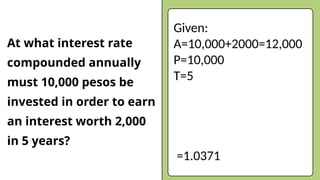
At what interestrate
compounded annually
must 10,000 pesos be
invested in order to earn
an interest worth 2,000
in 5 years?
Given:
A=10,000+2000=12,000
P=10,000
T=5
=1.0371
26.
Compounding
Periods
Interest can becompounded more
frequent than once per year.
Interest can be compounded
semiannually.
There are two compounding periods in a
year. Other common compounding
periods are four in a year (or quarterly)
27.
𝐴=𝑃 (1+
𝑟
𝑚 )
𝑚𝑡
Example1
To have a capital for a
small food business,
Mang Nestor borrowed
10, 000 pesos at 2%
interest rate
compounded quarterly.
How much does Mang
Nestor need to pay after
2 years?
¿10,000(1+
0.02
4 )
4(2)
¿ 10,000 ( 1.005 )8
¿10, 407.07
Therefore, Mang Nestor needs
to pay 10, 407.07 after 2 years.
28.
a. Quarterly
Example 2
Findthe future value of
2, 000 pesos after one
year at 3% interest rate
compounded:
a. Quarterly
b. Monthly
c. Daily
¿2,000 (1+
0.03
4 )
4(1)
¿ 2,000 ( 1.0075 )4
¿2,060.68
29.
b. Monthly
Example 2
Findthe future value of
2, 000 pesos after one
year at 3% interest rate
compounded:
a. Quarterly
b. Monthly
c. Daily
¿2,000 (1+
0.03
12 )
12(1)
¿ 2,000 ( 1.0025 )12
¿2,060.83
P=2,000, r=0.03
and t=4.5
Example1
What is the future value
of 2,000 pesos
compounded
continuously at 3%
interest after 4.5 years? ¿ 2,000 𝑒
0.03 ( 4.5)
¿2,289.07
𝐴= 𝑃𝑒𝑟𝑡
The future value is 2,
289.07.
32.
2 𝑃 =𝑃𝑒0.03 𝑡
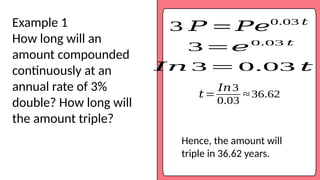
Example 1
How long will an
amount compounded
continuously at an
annual rate of 3%
double? How long will
the amount triple?
𝐼𝑛 2 =0.03 𝑡
𝑡=
𝐼𝑛 2
0.03
≈ 23.10
2 =𝑒0.03 𝑡
Thus, the amount will
double in 23.10 years.
33.
3 𝑃 =𝑃𝑒0.03 𝑡
Example 1
How long will an
amount compounded
continuously at an
annual rate of 3%
double? How long will
the amount triple?
𝐼𝑛 3 = 0.03 𝑡
𝑡=
𝐼𝑛3
0.03
≈ 36.62
3 =𝑒0.03 𝑡
Hence, the amount will
triple in 36.62 years.
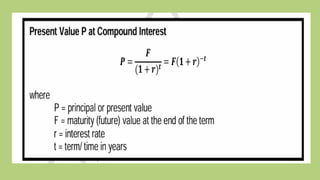
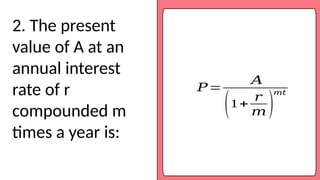
2. The present
valueof A at an
annual interest
rate of r
compounded m
times a year is:
𝑃=
𝐴
(1+
𝑟
𝑚 )
𝑚𝑡
37.
3. The present
valueof A at an
annual interest
rate of r
compounded
continuously is:
𝑃=
𝐴
𝑒
𝑟𝑡
= 𝐴𝑒
− 𝑟𝑡
38.
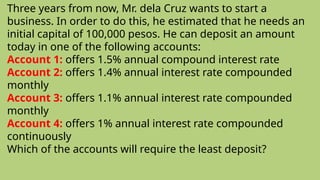
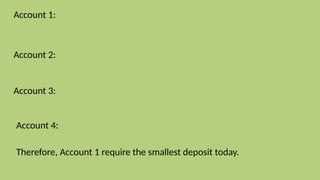
Three years fromnow, Mr. dela Cruz wants to start a
business. In order to do this, he estimated that he needs an
initial capital of 100,000 pesos. He can deposit an amount
today in one of the following accounts:
Account 1: offers 1.5% annual compound interest rate
Account 2: offers 1.4% annual interest rate compounded
monthly
Account 3: offers 1.1% annual interest rate compounded
monthly
Account 4: offers 1% annual interest rate compounded
continuously
Which of the accounts will require the least deposit?
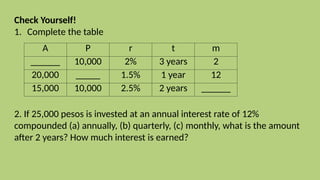
Check Yourself!
1. Completethe table
2. If 25,000 pesos is invested at an annual interest rate of 12%
compounded (a) annually, (b) quarterly, (c) monthly, what is the amount
after 2 years? How much interest is earned?
A P r t m
______ 10,000 2% 3 years 2
20,000 _____ 1.5% 1 year 12
15,000 10,000 2.5% 2 years ______
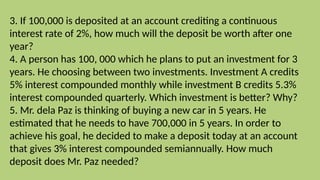
41.
3. If 100,000is deposited at an account crediting a continuous
interest rate of 2%, how much will the deposit be worth after one
year?
4. A person has 100, 000 which he plans to put an investment for 3
years. He choosing between two investments. Investment A credits
5% interest compounded monthly while investment B credits 5.3%
interest compounded quarterly. Which investment is better? Why?
5. Mr. dela Paz is thinking of buying a new car in 5 years. He
estimated that he needs to have 700,000 in 5 years. In order to
achieve his goal, he decided to make a deposit today at an account
that gives 3% interest compounded semiannually. How much
deposit does Mr. Paz needed?