I L L U S T R A T I N G
S I M P L E A N D
C O M P O U N D
I N T E R E S T
SIMPLE AND COMPOUND
INTEREST
D E F I N I T I O N O F T E R M S
Lender or creditor – person (or institution) who invests the money or
makes the funds available.
Borrower or debtor - person (or institution) who owes the money or avails
of the funds from the lender.
Origin or load date – date on which money is received by the borrower.
Repayment or maturity date – date on which the money is borrowed or
loan is to be completely repaid.
D E F I N I T I O N O F T E R M S
Rate (r) – annual rate, usually in percent, charged by the lender, or
rate of increase of the investment.
Time or term (t) – amount of time in years the money is borrowed or
invested; length of time between the origin and maturity dates.
Principal (P) – amount of money borrowed or invested on the origin
date.
D E F I N I T I O N O F T E R M S
Interest (i) - amount paid or earned for the use of money.
Simple Interest (Is) – interest that is computed on the principal and
then added to it.
Compound Interest (Ic) – interest that is computed on the principal and
also on the accumulated past interest.
Maturity value or Future value (F) – amount after t years that the lender
receives from the borrower on the maturity date.
S I M P L E A N D C O M P O U N D I N T E R E S T
• 1. SUPPOSE YOU WON P10,000 AND YOU
PLAN TO INVEST IT FOR 5 YEARS. A
COOPERATIVE GROUP OFFERS 2% SIMPLE
INTEREST RATE PER YEAR. A BANK OFFERS
2% COMPOUNDED ANNUALLY. WHICH
OFFER WILL YOU CHOOSE AND WHY?
S I M P L E A N D C O M P O U N D I N T E R E S T
• IN SIMPLE INTEREST, INTEREST REMAINS
CONSTANT THROUGHOUT THE
INVESTMENT TERM.
• IN COMPOUND INTEREST, THE INTEREST
FROM THE PREVIOUS TERMS ALSO EARNS
INTEREST. THUS, THE INTEREST GROWS
EVERY YEAR.
SIMPLE INTEREST
S I M P L E
I N T E R E S T
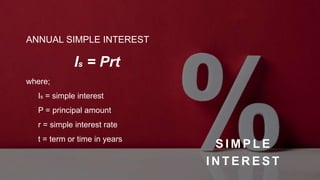
ANNUAL SIMPLE INTEREST
Is = Prt
where;
Is = simple interest
P = principal amount
r = simple interest rate
t = term or time in years
E X A M P L E 1
A bank offers 0.25% annual simple
interest rate for a particular deposit.
How much interest will be earned if 1
million pesos is deposited in this
savings account for 3 years?
E X A M P L E 2
How much interest is charged when
P50,000 is borrowed for 9 months at an
annual interest rate of 10%?
E X A M P L E 3
• Complete the table below by finding the
unknown.
E X A M P L E 4
When invested at an annual interest
rate of 7%, the amount earned P11,200
of simple interest in two years. How
much money was originally invested?
E X A M P L E 5
If an entrepreneur applies for a loan
amounting to P500,000 in a bank, the
simple interest of which is P157,500 for
3 years, what interest rate is being
charged?
M AT U R I T Y O R F U T U R E
VA L U E
M AT U R I T Y O R F U T U R E
VA L U E
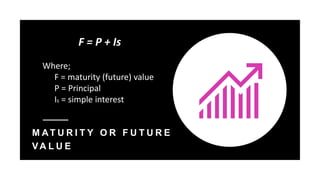
F = P + Is
Where;
F = maturity (future) value
P = Principal
Is = simple interest
M AT U R I T Y O R F U T U R E
VA L U E
F = P (1+rt)
Where;
r = interest rate
t = term or time in years
E X A M P L E 6
Find the maturity if 1 million pesos is
deposited in a bank at an annual simple
interest rate of 0.25% after (a) 1 year
(b) 5 years (c) 8 years (d) 15 years?
E X A M P L E 7
Find the maturity value when P50,000 is
borrowed for 9 months at an annual
interest rate of 10%?
SEATWOR
K
#1
November 08, 2022
S E AT W O R K
1. What are the amounts of interest and maturity value of a loan
for P25,000 at 12% simple interest for 5 years?
2. How much money will you have after 4 years and 3 months if
you deposited P10,000 in a bank that pays 0.5% simple interest?
3. At what simple interest rate per annum will P1 become P2 in 2
years?
4. How long will 1 million pesos earn a simple interest of 100,000 at
1% per annum?
5. How much should you invest if the simple interest is 7.5% in
order to have P300,000 in 2 years?
COMPOUND
INTEREST
• MATURITY VALUE
• PRESENT VALUE
• COMPOUNDING MORE THAN ONCE A YEAR
MATURITY VALUE
𝐹 = 𝑃 1 + 𝑟 𝑡
Where
P = principal value
F = Future/ maturity value
r = interest rate
t = term/ time in years
COMPOUND INTEREST
the compound interest Ic is given by
𝐼𝑐 = 𝐹 − 𝑃
E X A M P L E 1 : C O M P O U N D I N T E R E S T
Find the maturity value and the
compound interest if P10,000 is
compounded annually at an interest
rate of 2% in 5 years.
E X A M P L E 2 : C O M P O U N D I N T E R E S T
Find the maturity value and the
compound interest if P50,000 is
invested at 5% compounded annually
for 8 years.
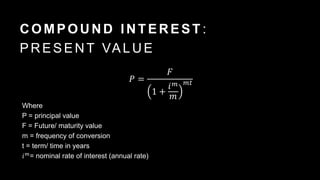
COMPOUND INTEREST :
PRESENT VALUE
𝑃 =
𝐹
1 + 𝑟 𝑡
Where
P = principal value
F = Future/ maturity value
r = interest rate
t = term/ time in years
E X A M P L E 3 : C O M P O U N D I N T E R E S T
What is the present value of P50,000
due in 7 years if money is worth 10%
compounded annually?
E X A M P L E 4 : C O M P O U N D I N T E R E S T
How much money should a student
place in a time deposit bank that pays
1.1% compounded annually so that he
will have P200,000 after 6 years?
E X A M P L E 5 : C O M P O U N D I N T E R E S T
How much money should a student
place in a time deposit bank that pays
1.1% compounded annually so that he
will have P200,000 after 6 years?
DEFINITION OF TERMS
FREQUENCY OF CONVERSION (m) – number of
conversion period in a year
CONVERSION OR INTEREST PERIOD – time between
successive conversions of interest
DEFINITION OF TERMS
NOMINAL RATE (𝑖𝑚
) - annual rate of interest
RATE (j) OF INTEREST FOR EACH CONVERSION PERIOD
𝑗 =
𝑖𝑚
𝑚
=
𝑎𝑛𝑛𝑢𝑎𝑙 𝑟𝑎𝑡𝑒 𝑜𝑓 𝑖𝑛𝑡𝑒𝑟𝑒𝑠𝑡
𝑓𝑟𝑒𝑞𝑢𝑒𝑛𝑐𝑦 𝑜𝑓 𝑐𝑜𝑛𝑣𝑒𝑟𝑠𝑖𝑜𝑛
MATURITY VALUE, COMPOUNDING
m TIMES A YEAR
𝐹 = 𝑃 1 +
𝑖𝑚
𝑚
𝑚𝑡
Where
P = principal value
F = Future/ maturity value
m = frequency of conversion
t = term/ time in years
𝑖𝑚= nominal rate of interest (annual rate)
E X A M P L E 1 : C O M P O U N D I N G M O R E T H A N A
Y E A R
Find the maturity value and interest if
P10,000 is deposited in a bank at 2%
compounded quarterly for 5 years.
E X A M P L E 2 : C O M P O U N D I N G M O R E T H A N A
Y E A R
Find the maturity value and interest if
P10,000 is deposited in a bank at 2%
compounded monthly for 5 years.
E X A M P L E 3 : C O M P O U N D I N G M O R E T H A N A
Y E A R
Kyle borrows P50,000 from Henny and
promises to pay the principal and
interest at 12% compounded monthly.
How much must he repay after 6 years?
COMPOUND INTEREST :
PRESENT VALUE
𝑃 =
𝐹
1 +
𝑖𝑚
𝑚
𝑚𝑡
Where
P = principal value
F = Future/ maturity value
m = frequency of conversion
t = term/ time in years
𝑖𝑚
= nominal rate of interest (annual rate)
E X A M P L E 4 : C O M P O U N D I N G M O R E T H A N A
Y E A R
Find the present value of P50,000 due in 4 years
if money is invested at 12% compounded semi-
annually.
E X A M P L E 5 : C O M P O U N D I N G M O R E T H A N A
Y E A R
What is the present value of P25,000 due in 2
years and 6 months if money is worth 10%
compounded quarterly?
SEATWOR
K
#2
November 11, 2022
B
C
(BONUS)
(13)
COMPOUND
INTEREST
• FINDING INTEREST RATE AND TIME
DEFINITION OF TERMS
NOMINAL RATE (𝑖𝑚
) - annual rate of interest
RATE (j) OF INTEREST FOR EACH CONVERSION PERIOD
𝑗 =
𝑖𝑚
𝑚
=
𝑎𝑛𝑛𝑢𝑎𝑙 𝑟𝑎𝑡𝑒 𝑜𝑓 𝑖𝑛𝑡𝑒𝑟𝑒𝑠𝑡
𝑓𝑟𝑒𝑞𝑢𝑒𝑛𝑐𝑦 𝑜𝑓 𝑐𝑜𝑛𝑣𝑒𝑟𝑠𝑖𝑜𝑛
DEFINITION OF TERMS
EQUIVALENT RATES - two annual rates with different
conversion periods that will earn the same maturity
value for the same time/term.
EFFECTIVE RATE – rate when compounded annually will
give the same compound each year with the nominal
rate; denoted by − 𝑖1
MATURITY VALUE, COMPOUNDING
m TIMES A YEAR
𝐹 = 𝑃 1 +
𝑖𝑚
𝑚
𝑚𝑡
Where
P = principal value
F = Future/ maturity value
m = frequency of conversion
t = term/ time in years
𝑖𝑚= nominal rate of interest (annual rate)
FINDING THE NUMBER OF PERIODS
n
𝐹 = 𝑃 1 + 𝑗 𝑛
Then,
𝑙𝑜𝑔𝐹 = 𝑙𝑜𝑔 1 + 𝑗 𝑛
= 𝑛𝑙𝑜𝑔(1 + 𝑗)
Thus,
𝑛 =
𝑙𝑜𝑔𝐹
𝑚𝑙𝑜𝑔 1 + 𝑗
Note that n, must be an integer. Some rounding off may be
E X A M P L E 1 : F I N D I N G I N T E R E S T R AT E S A N D
T I M E
How long will it take P3,000 to
accumulate P3,500 in a bank savings
account at 0.25% compounded
monthly?
E X A M P L E 2 : F I N D I N G I N T E R E S T R AT E S A N D
T I M E
How long will it take P1,000 to earn
P300 if the interest is 12% compounded
semi-annually?
FINDING THE INTEREST RATE j,
PER CONVERSION PERIOD
𝐹 = 𝑃 1 + 𝑗 𝑛
Then,
𝑛 𝐹
𝑃
= 1 + 𝑗
Thus,
𝑗 =
𝑛 𝐹
𝑃
− 1 using 𝑗 =
𝑖
𝑚
, then 𝑖 = 𝑗𝑚
E X A M P L E 3 : F I N D I N G I N T E R E S T R AT E S A N D
T I M E
At what nominal rate compounded
semi- annually will P10,000 accumulate
to P15,000 in 10 years?
E X A M P L E 4 : F I N D I N G I N T E R E S T R AT E S A N D
T I M E
At what interest rate compounded
quarterly will money be double itself in
10 years?
E X A M P L E 5 : F I N D I N G I N T E R E S T R AT E S A N D
T I M E
What effective rate is equivalent to 10%
compounded quarterly?
E X A M P L E 6 : F I N D I N G I N T E R E S T R AT E S A N D
T I M E
What nominal rate compounded
monthly is equivalent to 12%
compounded annually? Round off to six
decimal places.
F I N D I N G T H E E F F E C T I V E A N D
E Q U I VA L E N T R AT E S
For Equivalent rates F1=F2, then
𝑃 1 +
𝑖1
𝑚1
𝑚1
𝑡
= 𝑃 1 +
𝑖2
𝑚2
𝑚2
𝑡
Dividing both sides by P and getting the t root will give us,
1 +
𝑖1
𝑚1
𝑚1
= 1 +
𝑖2
𝑚2
𝑚2
For different compounding modes m1 & m2
F I N D I N G T H E E F F E C T I V E A N D
E Q U I VA L E N T R AT E S
𝐸𝑅𝐼 = 1 +
𝑖
𝑚
𝑚
− 1
For effective rate, the mode is for an annual compounding.
It is the actual interest earned in one-year period.
E X A M P L E 7 : F I N D I N G E F F E C T I V E A N D
E Q U I VA L E N T R AT E S
What is the effective rate corresponding
to 18% compounded daily? Take 1 year
equal to 360 days.
E X A M P L E 8 : F I N D I N G E F F E C T I V E A N D
E Q U I VA L E N T R AT E S
What nominal rate compounded
monthly is equivalent to 12%
compounded annually? (6 decimal
places)
E X A M P L E 9 : F I N D I N G E F F E C T I V E A N D
E Q U I VA L E N T R AT E S
What nominal rate, compounded semi-
annually, yields the same amount as
25% compounded quarterly?
E X A M P L E 1 0 : F I N D I N G E F F E C T I V E A N D
E Q U I VA L E N T R AT E S
What rate of interest compounded
annually is the same as the rate of
interest of 8% compounded quarterly?
E X A M P L E 1 1 : F I N D I N G I N T E R E S T R AT E S
A N D T I M E
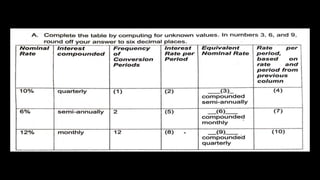
Complete the table by computing for the rates equivalent to
the following nominal rates. Round off to six decimal places.
SEATWOR
K
#3
November 22, 2022
SIMPLE & COMPOUND INTEREST copy.pptx

SIMPLE & COMPOUND INTEREST copy.pptx

  • 1.
    I L LU S T R A T I N G S I M P L E A N D C O M P O U N D I N T E R E S T SIMPLE AND COMPOUND INTEREST
  • 2.
    D E FI N I T I O N O F T E R M S Lender or creditor – person (or institution) who invests the money or makes the funds available. Borrower or debtor - person (or institution) who owes the money or avails of the funds from the lender. Origin or load date – date on which money is received by the borrower. Repayment or maturity date – date on which the money is borrowed or loan is to be completely repaid.
  • 3.
    D E FI N I T I O N O F T E R M S Rate (r) – annual rate, usually in percent, charged by the lender, or rate of increase of the investment. Time or term (t) – amount of time in years the money is borrowed or invested; length of time between the origin and maturity dates. Principal (P) – amount of money borrowed or invested on the origin date.
  • 4.
    D E FI N I T I O N O F T E R M S Interest (i) - amount paid or earned for the use of money. Simple Interest (Is) – interest that is computed on the principal and then added to it. Compound Interest (Ic) – interest that is computed on the principal and also on the accumulated past interest. Maturity value or Future value (F) – amount after t years that the lender receives from the borrower on the maturity date.
  • 5.
    S I MP L E A N D C O M P O U N D I N T E R E S T • 1. SUPPOSE YOU WON P10,000 AND YOU PLAN TO INVEST IT FOR 5 YEARS. A COOPERATIVE GROUP OFFERS 2% SIMPLE INTEREST RATE PER YEAR. A BANK OFFERS 2% COMPOUNDED ANNUALLY. WHICH OFFER WILL YOU CHOOSE AND WHY?
  • 6.
    S I MP L E A N D C O M P O U N D I N T E R E S T • IN SIMPLE INTEREST, INTEREST REMAINS CONSTANT THROUGHOUT THE INVESTMENT TERM. • IN COMPOUND INTEREST, THE INTEREST FROM THE PREVIOUS TERMS ALSO EARNS INTEREST. THUS, THE INTEREST GROWS EVERY YEAR.
  • 7.
  • 8.
    S I MP L E I N T E R E S T ANNUAL SIMPLE INTEREST Is = Prt where; Is = simple interest P = principal amount r = simple interest rate t = term or time in years
  • 9.
    E X AM P L E 1 A bank offers 0.25% annual simple interest rate for a particular deposit. How much interest will be earned if 1 million pesos is deposited in this savings account for 3 years?
  • 10.
    E X AM P L E 2 How much interest is charged when P50,000 is borrowed for 9 months at an annual interest rate of 10%?
  • 11.
    E X AM P L E 3 • Complete the table below by finding the unknown.
  • 12.
    E X AM P L E 4 When invested at an annual interest rate of 7%, the amount earned P11,200 of simple interest in two years. How much money was originally invested?
  • 13.
    E X AM P L E 5 If an entrepreneur applies for a loan amounting to P500,000 in a bank, the simple interest of which is P157,500 for 3 years, what interest rate is being charged?
  • 14.
    M AT UR I T Y O R F U T U R E VA L U E
  • 15.
    M AT UR I T Y O R F U T U R E VA L U E F = P + Is Where; F = maturity (future) value P = Principal Is = simple interest
  • 16.
    M AT UR I T Y O R F U T U R E VA L U E F = P (1+rt) Where; r = interest rate t = term or time in years
  • 17.
    E X AM P L E 6 Find the maturity if 1 million pesos is deposited in a bank at an annual simple interest rate of 0.25% after (a) 1 year (b) 5 years (c) 8 years (d) 15 years?
  • 18.
    E X AM P L E 7 Find the maturity value when P50,000 is borrowed for 9 months at an annual interest rate of 10%?
  • 19.
  • 20.
    S E ATW O R K 1. What are the amounts of interest and maturity value of a loan for P25,000 at 12% simple interest for 5 years? 2. How much money will you have after 4 years and 3 months if you deposited P10,000 in a bank that pays 0.5% simple interest? 3. At what simple interest rate per annum will P1 become P2 in 2 years? 4. How long will 1 million pesos earn a simple interest of 100,000 at 1% per annum? 5. How much should you invest if the simple interest is 7.5% in order to have P300,000 in 2 years?
  • 21.
    COMPOUND INTEREST • MATURITY VALUE •PRESENT VALUE • COMPOUNDING MORE THAN ONCE A YEAR
  • 22.
    MATURITY VALUE 𝐹 =𝑃 1 + 𝑟 𝑡 Where P = principal value F = Future/ maturity value r = interest rate t = term/ time in years
  • 23.
    COMPOUND INTEREST the compoundinterest Ic is given by 𝐼𝑐 = 𝐹 − 𝑃
  • 24.
    E X AM P L E 1 : C O M P O U N D I N T E R E S T Find the maturity value and the compound interest if P10,000 is compounded annually at an interest rate of 2% in 5 years.
  • 25.
    E X AM P L E 2 : C O M P O U N D I N T E R E S T Find the maturity value and the compound interest if P50,000 is invested at 5% compounded annually for 8 years.
  • 26.
    COMPOUND INTEREST : PRESENTVALUE 𝑃 = 𝐹 1 + 𝑟 𝑡 Where P = principal value F = Future/ maturity value r = interest rate t = term/ time in years
  • 27.
    E X AM P L E 3 : C O M P O U N D I N T E R E S T What is the present value of P50,000 due in 7 years if money is worth 10% compounded annually?
  • 28.
    E X AM P L E 4 : C O M P O U N D I N T E R E S T How much money should a student place in a time deposit bank that pays 1.1% compounded annually so that he will have P200,000 after 6 years?
  • 29.
    E X AM P L E 5 : C O M P O U N D I N T E R E S T How much money should a student place in a time deposit bank that pays 1.1% compounded annually so that he will have P200,000 after 6 years?
  • 30.
    DEFINITION OF TERMS FREQUENCYOF CONVERSION (m) – number of conversion period in a year CONVERSION OR INTEREST PERIOD – time between successive conversions of interest
  • 31.
    DEFINITION OF TERMS NOMINALRATE (𝑖𝑚 ) - annual rate of interest RATE (j) OF INTEREST FOR EACH CONVERSION PERIOD 𝑗 = 𝑖𝑚 𝑚 = 𝑎𝑛𝑛𝑢𝑎𝑙 𝑟𝑎𝑡𝑒 𝑜𝑓 𝑖𝑛𝑡𝑒𝑟𝑒𝑠𝑡 𝑓𝑟𝑒𝑞𝑢𝑒𝑛𝑐𝑦 𝑜𝑓 𝑐𝑜𝑛𝑣𝑒𝑟𝑠𝑖𝑜𝑛
  • 33.
    MATURITY VALUE, COMPOUNDING mTIMES A YEAR 𝐹 = 𝑃 1 + 𝑖𝑚 𝑚 𝑚𝑡 Where P = principal value F = Future/ maturity value m = frequency of conversion t = term/ time in years 𝑖𝑚= nominal rate of interest (annual rate)
  • 34.
    E X AM P L E 1 : C O M P O U N D I N G M O R E T H A N A Y E A R Find the maturity value and interest if P10,000 is deposited in a bank at 2% compounded quarterly for 5 years.
  • 35.
    E X AM P L E 2 : C O M P O U N D I N G M O R E T H A N A Y E A R Find the maturity value and interest if P10,000 is deposited in a bank at 2% compounded monthly for 5 years.
  • 36.
    E X AM P L E 3 : C O M P O U N D I N G M O R E T H A N A Y E A R Kyle borrows P50,000 from Henny and promises to pay the principal and interest at 12% compounded monthly. How much must he repay after 6 years?
  • 37.
    COMPOUND INTEREST : PRESENTVALUE 𝑃 = 𝐹 1 + 𝑖𝑚 𝑚 𝑚𝑡 Where P = principal value F = Future/ maturity value m = frequency of conversion t = term/ time in years 𝑖𝑚 = nominal rate of interest (annual rate)
  • 38.
    E X AM P L E 4 : C O M P O U N D I N G M O R E T H A N A Y E A R Find the present value of P50,000 due in 4 years if money is invested at 12% compounded semi- annually.
  • 39.
    E X AM P L E 5 : C O M P O U N D I N G M O R E T H A N A Y E A R What is the present value of P25,000 due in 2 years and 6 months if money is worth 10% compounded quarterly?
  • 40.
  • 42.
  • 43.
  • 44.
    DEFINITION OF TERMS NOMINALRATE (𝑖𝑚 ) - annual rate of interest RATE (j) OF INTEREST FOR EACH CONVERSION PERIOD 𝑗 = 𝑖𝑚 𝑚 = 𝑎𝑛𝑛𝑢𝑎𝑙 𝑟𝑎𝑡𝑒 𝑜𝑓 𝑖𝑛𝑡𝑒𝑟𝑒𝑠𝑡 𝑓𝑟𝑒𝑞𝑢𝑒𝑛𝑐𝑦 𝑜𝑓 𝑐𝑜𝑛𝑣𝑒𝑟𝑠𝑖𝑜𝑛
  • 45.
    DEFINITION OF TERMS EQUIVALENTRATES - two annual rates with different conversion periods that will earn the same maturity value for the same time/term. EFFECTIVE RATE – rate when compounded annually will give the same compound each year with the nominal rate; denoted by − 𝑖1
  • 46.
    MATURITY VALUE, COMPOUNDING mTIMES A YEAR 𝐹 = 𝑃 1 + 𝑖𝑚 𝑚 𝑚𝑡 Where P = principal value F = Future/ maturity value m = frequency of conversion t = term/ time in years 𝑖𝑚= nominal rate of interest (annual rate)
  • 47.
    FINDING THE NUMBEROF PERIODS n 𝐹 = 𝑃 1 + 𝑗 𝑛 Then, 𝑙𝑜𝑔𝐹 = 𝑙𝑜𝑔 1 + 𝑗 𝑛 = 𝑛𝑙𝑜𝑔(1 + 𝑗) Thus, 𝑛 = 𝑙𝑜𝑔𝐹 𝑚𝑙𝑜𝑔 1 + 𝑗 Note that n, must be an integer. Some rounding off may be
  • 48.
    E X AM P L E 1 : F I N D I N G I N T E R E S T R AT E S A N D T I M E How long will it take P3,000 to accumulate P3,500 in a bank savings account at 0.25% compounded monthly?
  • 49.
    E X AM P L E 2 : F I N D I N G I N T E R E S T R AT E S A N D T I M E How long will it take P1,000 to earn P300 if the interest is 12% compounded semi-annually?
  • 50.
    FINDING THE INTERESTRATE j, PER CONVERSION PERIOD 𝐹 = 𝑃 1 + 𝑗 𝑛 Then, 𝑛 𝐹 𝑃 = 1 + 𝑗 Thus, 𝑗 = 𝑛 𝐹 𝑃 − 1 using 𝑗 = 𝑖 𝑚 , then 𝑖 = 𝑗𝑚
  • 51.
    E X AM P L E 3 : F I N D I N G I N T E R E S T R AT E S A N D T I M E At what nominal rate compounded semi- annually will P10,000 accumulate to P15,000 in 10 years?
  • 52.
    E X AM P L E 4 : F I N D I N G I N T E R E S T R AT E S A N D T I M E At what interest rate compounded quarterly will money be double itself in 10 years?
  • 53.
    E X AM P L E 5 : F I N D I N G I N T E R E S T R AT E S A N D T I M E What effective rate is equivalent to 10% compounded quarterly?
  • 54.
    E X AM P L E 6 : F I N D I N G I N T E R E S T R AT E S A N D T I M E What nominal rate compounded monthly is equivalent to 12% compounded annually? Round off to six decimal places.
  • 55.
    F I ND I N G T H E E F F E C T I V E A N D E Q U I VA L E N T R AT E S For Equivalent rates F1=F2, then 𝑃 1 + 𝑖1 𝑚1 𝑚1 𝑡 = 𝑃 1 + 𝑖2 𝑚2 𝑚2 𝑡 Dividing both sides by P and getting the t root will give us, 1 + 𝑖1 𝑚1 𝑚1 = 1 + 𝑖2 𝑚2 𝑚2 For different compounding modes m1 & m2
  • 56.
    F I ND I N G T H E E F F E C T I V E A N D E Q U I VA L E N T R AT E S 𝐸𝑅𝐼 = 1 + 𝑖 𝑚 𝑚 − 1 For effective rate, the mode is for an annual compounding. It is the actual interest earned in one-year period.
  • 57.
    E X AM P L E 7 : F I N D I N G E F F E C T I V E A N D E Q U I VA L E N T R AT E S What is the effective rate corresponding to 18% compounded daily? Take 1 year equal to 360 days.
  • 58.
    E X AM P L E 8 : F I N D I N G E F F E C T I V E A N D E Q U I VA L E N T R AT E S What nominal rate compounded monthly is equivalent to 12% compounded annually? (6 decimal places)
  • 59.
    E X AM P L E 9 : F I N D I N G E F F E C T I V E A N D E Q U I VA L E N T R AT E S What nominal rate, compounded semi- annually, yields the same amount as 25% compounded quarterly?
  • 60.
    E X AM P L E 1 0 : F I N D I N G E F F E C T I V E A N D E Q U I VA L E N T R AT E S What rate of interest compounded annually is the same as the rate of interest of 8% compounded quarterly?
  • 61.
    E X AM P L E 1 1 : F I N D I N G I N T E R E S T R AT E S A N D T I M E Complete the table by computing for the rates equivalent to the following nominal rates. Round off to six decimal places.
  • 62.