At the end of the lesson,
the learner is able to
compute maturity value,
interest, and present
value, and solve
problems involving
compound interest
when compound
interest is computed
more than once a year.
Lesson Outline:
1.Compounding more than once a year
2.Maturity value, interest, and present value
when compound interest is computed
more than once a year
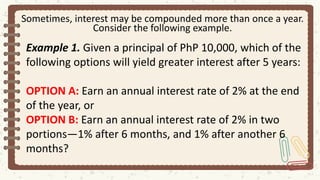
Sometimes, interest may be compounded more than once a year.
Consider the following example.
Example 1. Given a principal of PhP 10,000, which of the
following options will yield greater interest after 5 years:
OPTION A: Earn an annual interest rate of 2% at the end
of the year, or
OPTION B: Earn an annual interest rate of 2% in two
portions—1% after 6 months, and 1% after another 6
months?
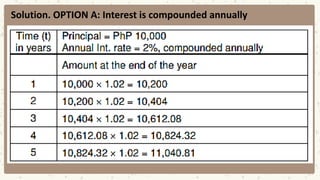
Solution. OPTION A: Interest is compounded annually
OPTION B: Interest is compounded semi-annually, or every 6 months. Under
this option, the interest rate every six months is 1% (2% divided by 2).
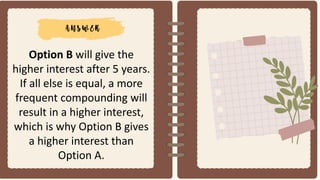
Option B will give the
higher interest after 5 years.
If all else is equal, a more
frequent compounding will
result in a higher interest,
which is why Option B gives
a higher interest than
Option A.
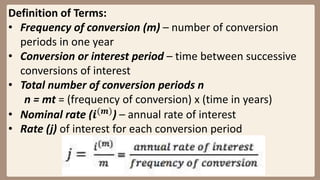
Definition of Terms:
• Frequency of conversion (m) – number of conversion
periods in one year
• Conversion or interest period – time between successive
conversions of interest
• Total number of conversion periods n
n = mt = (frequency of conversion) x (time in years)
• Nominal rate (𝒊(𝒎)
) – annual rate of interest
• Rate (j) of interest for each conversion period
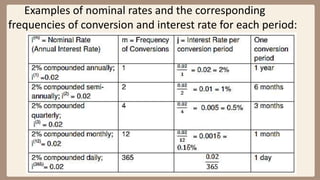
Examples of nominal rates and the corresponding
frequencies of conversion and interest rate for each period:
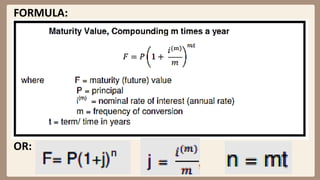
FORMULA:
OR:
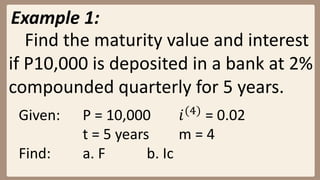
Example 1:
Find the maturity value and interest
if P10,000 is deposited in a bank at 2%
compounded quarterly for 5 years.
Given: P = 10,000 𝑖(4)
= 0.02
t = 5 years m = 4
Find: a. F b. Ic
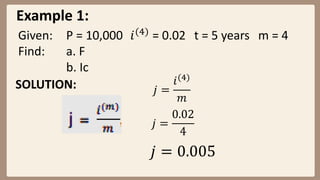
Example 1:
Given: P = 10,000 𝑖(4)
= 0.02 t = 5 years m = 4
Find: a. F
b. Ic
SOLUTION: 𝑗 =
𝑖(4)
𝑚
𝑗 =
0.02
4
𝑗 = 0.005
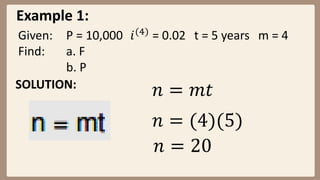
Example 1:
Given: P = 10,000 𝑖(4)
= 0.02 t = 5 years m = 4
Find: a. F
b. P
SOLUTION:
𝑛 = 𝑚𝑡
𝑛 = (4)(5)
𝑛 = 20
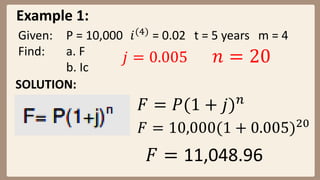
Example 1:
Given: P = 10,000 𝑖(4)
= 0.02 t = 5 years m = 4
Find: a. F
b. Ic
SOLUTION:
𝐹 = 𝑃(1 + 𝑗)𝑛
𝐹 = 10,000(1 + 0.005)20
𝐹 = 11,048.96
𝑗 = 0.005 𝑛 = 20
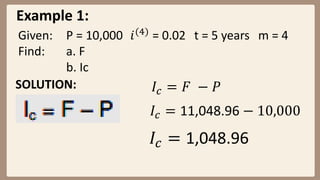
Example 1:
Given: P = 10,000 𝑖(4)
= 0.02 t = 5 years m = 4
Find: a. F
b. Ic
SOLUTION: 𝐼𝑐 = 𝐹 − 𝑃
𝐼𝑐 = 11,048.96 − 10,000
𝐼𝑐 = 1,048.96
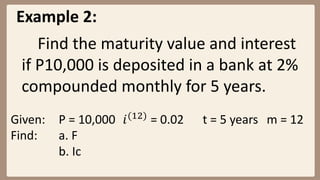
Example 2:
Find the maturity value and interest
if P10,000 is deposited in a bank at 2%
compounded monthly for 5 years.
Given: P = 10,000 𝑖(12)
= 0.02 t = 5 years m = 12
Find: a. F
b. Ic
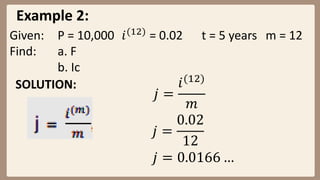
Example 2:
Given: P = 10,000 𝑖(12)
= 0.02 t = 5 years m = 12
Find: a. F
b. Ic
SOLUTION:
𝑗 =
𝑖(12)
𝑚
𝑗 =
0.02
12
𝑗 = 0.0166 …
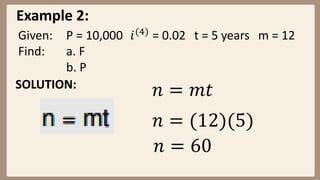
Example 2:
Given: P = 10,000 𝑖(4)
= 0.02 t = 5 years m = 12
Find: a. F
b. P
SOLUTION:
𝑛 = 𝑚𝑡
𝑛 = (12)(5)
𝑛 = 60
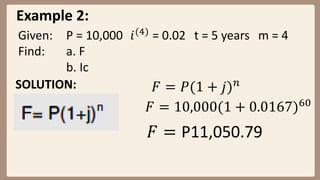
Example 2:
Given: P = 10,000 𝑖(4)
= 0.02 t = 5 years m = 4
Find: a. F
b. Ic
SOLUTION: 𝐹 = 𝑃(1 + 𝑗)𝑛
𝐹 = 10,000(1 + 0.0167)60
𝐹 = P11,050.79
Example 2:
Given: P = 10,000 𝑖(4)
= 0.02 t = 5 years m = 4
Find: a. F
b. Ic
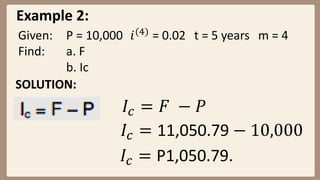
SOLUTION:
𝐼𝑐 = 𝐹 − 𝑃
𝐼𝑐 = 11,050.79 − 10,000
𝐼𝑐 = P1,050.79.
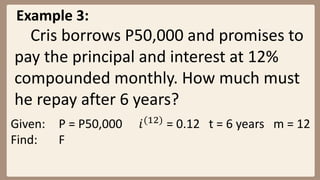
Example 3:
Cris borrows P50,000 and promises to
pay the principal and interest at 12%
compounded monthly. How much must
he repay after 6 years?
Given: P = P50,000 𝑖(12)
= 0.12 t = 6 years m = 12
Find: F
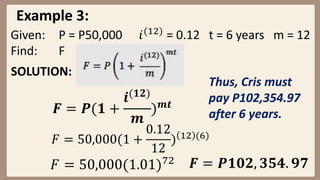
Example 3:
SOLUTION:
Given: P = P50,000 𝑖(12)
= 0.12 t = 6 years m = 12
Find: F
𝑭 = 𝑷(𝟏 +
𝒊(𝟏𝟐)
𝒎
)𝒎𝒕
𝐹 = 50,000(1 +
0.12
12
) 12 (6)
𝐹 = 50,000(1.01)72 𝑭 = 𝑷𝟏𝟎𝟐, 𝟑𝟓𝟒. 𝟗𝟕
Thus, Cris must
pay P102,354.97
after 6 years.
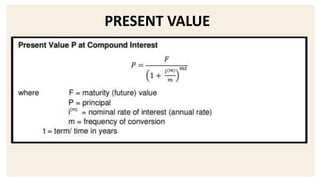
PRESENT VALUE
Example 1:
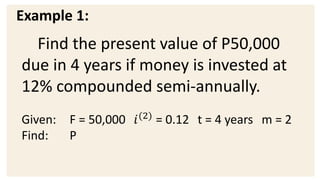
Find the present value of P50,000
due in 4 years if money is invested at
12% compounded semi-annually.
Given: F = 50,000 𝑖(2)
= 0.12 t = 4 years m = 2
Find: P
Example 1:
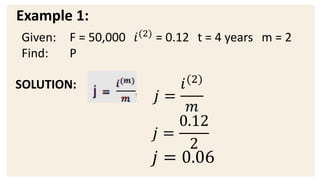
SOLUTION:
𝑗 =
𝑖(2)
𝑚
𝑗 =
0.12
2
𝑗 = 0.06
Given: F = 50,000 𝑖(2)
= 0.12 t = 4 years m = 2
Find: P
Example 1:
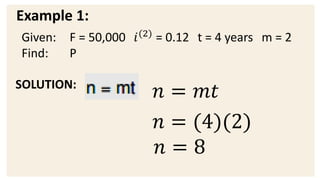
SOLUTION:
𝑛 = 𝑚𝑡
𝑛 = (4)(2)
𝑛 = 8
Given: F = 50,000 𝑖(2)
= 0.12 t = 4 years m = 2
Find: P
Example 1:
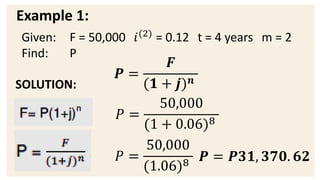
SOLUTION:
𝑷 =
𝑭
(𝟏 + 𝒋)𝒏
Given: F = 50,000 𝑖(2)
= 0.12 t = 4 years m = 2
Find: P
𝑃 =
50,000
(1 + 0.06)8
𝑃 =
50,000
(1.06)8 𝑷 = 𝑷𝟑𝟏, 𝟑𝟕𝟎. 𝟔𝟐
Example 2:
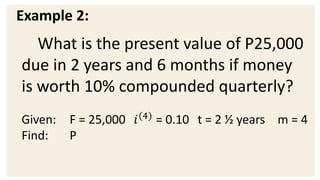
What is the present value of P25,000
due in 2 years and 6 months if money
is worth 10% compounded quarterly?
Given: F = 25,000 𝑖(4)
= 0.10 t = 2 ½ years m = 4
Find: P
Example 2:
SOLUTION:
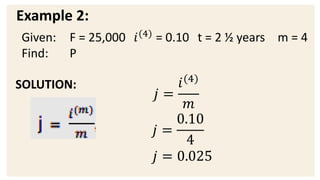
𝑗 =
𝑖(4)
𝑚
𝑗 =
0.10
4
𝑗 = 0.025
Given: F = 25,000 𝑖(4)
= 0.10 t = 2 ½ years m = 4
Find: P
Example 2:
SOLUTION:
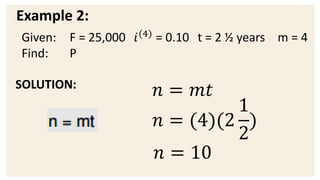
𝑛 = 𝑚𝑡
𝑛 = (4)(2
1
2
)
𝑛 = 10
Given: F = 25,000 𝑖(4)
= 0.10 t = 2 ½ years m = 4
Find: P
Example 2:
SOLUTION:
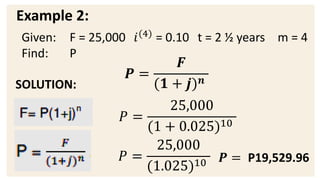
𝑷 =
𝑭
(𝟏 + 𝒋)𝒏
𝑃 =
25,000
(1 + 0.025)10
𝑃 =
25,000
(1.025)10 𝑷 = P19,529.96
Given: F = 25,000 𝑖(4)
= 0.10 t = 2 ½ years m = 4
Find: P
SEATWORK: (1 whole)
Solve the following problems on compound interest.
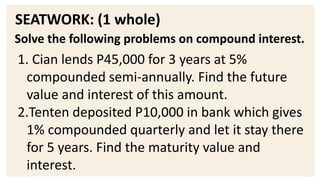
1. Cian lends P45,000 for 3 years at 5%
compounded semi-annually. Find the future
value and interest of this amount.
2.Tenten deposited P10,000 in bank which gives
1% compounded quarterly and let it stay there
for 5 years. Find the maturity value and
interest.
SEATWORK: (1 whole)
Solve the following problems on compound interest.
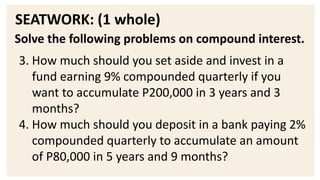
3. How much should you set aside and invest in a
fund earning 9% compounded quarterly if you
want to accumulate P200,000 in 3 years and 3
months?
4. How much should you deposit in a bank paying 2%
compounded quarterly to accumulate an amount
of P80,000 in 5 years and 9 months?
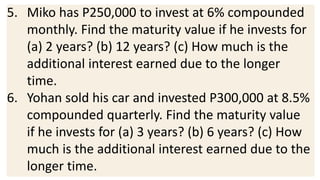
5. Miko has P250,000 to invest at 6% compounded
monthly. Find the maturity value if he invests for
(a) 2 years? (b) 12 years? (c) How much is the
additional interest earned due to the longer
time.
6. Yohan sold his car and invested P300,000 at 8.5%
compounded quarterly. Find the maturity value
if he invests for (a) 3 years? (b) 6 years? (c) How
much is the additional interest earned due to the
longer time.
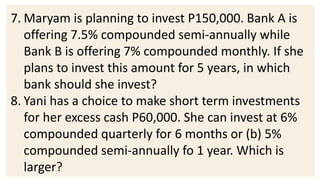
7. Maryam is planning to invest P150,000. Bank A is
offering 7.5% compounded semi-annually while
Bank B is offering 7% compounded monthly. If she
plans to invest this amount for 5 years, in which
bank should she invest?
8. Yani has a choice to make short term investments
for her excess cash P60,000. She can invest at 6%
compounded quarterly for 6 months or (b) 5%
compounded semi-annually fo 1 year. Which is
larger?
Compounding More than Once a Year week2.pptx

Compounding More than Once a Year week2.pptx

  • 2.
    At the endof the lesson, the learner is able to compute maturity value, interest, and present value, and solve problems involving compound interest when compound interest is computed more than once a year.
  • 3.
    Lesson Outline: 1.Compounding morethan once a year 2.Maturity value, interest, and present value when compound interest is computed more than once a year
  • 4.
    Sometimes, interest maybe compounded more than once a year. Consider the following example. Example 1. Given a principal of PhP 10,000, which of the following options will yield greater interest after 5 years: OPTION A: Earn an annual interest rate of 2% at the end of the year, or OPTION B: Earn an annual interest rate of 2% in two portions—1% after 6 months, and 1% after another 6 months?
  • 5.
    Solution. OPTION A:Interest is compounded annually
  • 6.
    OPTION B: Interestis compounded semi-annually, or every 6 months. Under this option, the interest rate every six months is 1% (2% divided by 2).
  • 7.
    Option B willgive the higher interest after 5 years. If all else is equal, a more frequent compounding will result in a higher interest, which is why Option B gives a higher interest than Option A.
  • 8.
    Definition of Terms: •Frequency of conversion (m) – number of conversion periods in one year • Conversion or interest period – time between successive conversions of interest • Total number of conversion periods n n = mt = (frequency of conversion) x (time in years) • Nominal rate (𝒊(𝒎) ) – annual rate of interest • Rate (j) of interest for each conversion period
  • 9.
    Examples of nominalrates and the corresponding frequencies of conversion and interest rate for each period:
  • 10.
  • 11.
    Example 1: Find thematurity value and interest if P10,000 is deposited in a bank at 2% compounded quarterly for 5 years. Given: P = 10,000 𝑖(4) = 0.02 t = 5 years m = 4 Find: a. F b. Ic
  • 12.
    Example 1: Given: P= 10,000 𝑖(4) = 0.02 t = 5 years m = 4 Find: a. F b. Ic SOLUTION: 𝑗 = 𝑖(4) 𝑚 𝑗 = 0.02 4 𝑗 = 0.005
  • 13.
    Example 1: Given: P= 10,000 𝑖(4) = 0.02 t = 5 years m = 4 Find: a. F b. P SOLUTION: 𝑛 = 𝑚𝑡 𝑛 = (4)(5) 𝑛 = 20
  • 14.
    Example 1: Given: P= 10,000 𝑖(4) = 0.02 t = 5 years m = 4 Find: a. F b. Ic SOLUTION: 𝐹 = 𝑃(1 + 𝑗)𝑛 𝐹 = 10,000(1 + 0.005)20 𝐹 = 11,048.96 𝑗 = 0.005 𝑛 = 20
  • 15.
    Example 1: Given: P= 10,000 𝑖(4) = 0.02 t = 5 years m = 4 Find: a. F b. Ic SOLUTION: 𝐼𝑐 = 𝐹 − 𝑃 𝐼𝑐 = 11,048.96 − 10,000 𝐼𝑐 = 1,048.96
  • 16.
    Example 2: Find thematurity value and interest if P10,000 is deposited in a bank at 2% compounded monthly for 5 years. Given: P = 10,000 𝑖(12) = 0.02 t = 5 years m = 12 Find: a. F b. Ic
  • 17.
    Example 2: Given: P= 10,000 𝑖(12) = 0.02 t = 5 years m = 12 Find: a. F b. Ic SOLUTION: 𝑗 = 𝑖(12) 𝑚 𝑗 = 0.02 12 𝑗 = 0.0166 …
  • 18.
    Example 2: Given: P= 10,000 𝑖(4) = 0.02 t = 5 years m = 12 Find: a. F b. P SOLUTION: 𝑛 = 𝑚𝑡 𝑛 = (12)(5) 𝑛 = 60
  • 19.
    Example 2: Given: P= 10,000 𝑖(4) = 0.02 t = 5 years m = 4 Find: a. F b. Ic SOLUTION: 𝐹 = 𝑃(1 + 𝑗)𝑛 𝐹 = 10,000(1 + 0.0167)60 𝐹 = P11,050.79
  • 20.
    Example 2: Given: P= 10,000 𝑖(4) = 0.02 t = 5 years m = 4 Find: a. F b. Ic SOLUTION: 𝐼𝑐 = 𝐹 − 𝑃 𝐼𝑐 = 11,050.79 − 10,000 𝐼𝑐 = P1,050.79.
  • 21.
    Example 3: Cris borrowsP50,000 and promises to pay the principal and interest at 12% compounded monthly. How much must he repay after 6 years? Given: P = P50,000 𝑖(12) = 0.12 t = 6 years m = 12 Find: F
  • 22.
    Example 3: SOLUTION: Given: P= P50,000 𝑖(12) = 0.12 t = 6 years m = 12 Find: F 𝑭 = 𝑷(𝟏 + 𝒊(𝟏𝟐) 𝒎 )𝒎𝒕 𝐹 = 50,000(1 + 0.12 12 ) 12 (6) 𝐹 = 50,000(1.01)72 𝑭 = 𝑷𝟏𝟎𝟐, 𝟑𝟓𝟒. 𝟗𝟕 Thus, Cris must pay P102,354.97 after 6 years.
  • 23.
  • 24.
    Example 1: Find thepresent value of P50,000 due in 4 years if money is invested at 12% compounded semi-annually. Given: F = 50,000 𝑖(2) = 0.12 t = 4 years m = 2 Find: P
  • 25.
    Example 1: SOLUTION: 𝑗 = 𝑖(2) 𝑚 𝑗= 0.12 2 𝑗 = 0.06 Given: F = 50,000 𝑖(2) = 0.12 t = 4 years m = 2 Find: P
  • 26.
    Example 1: SOLUTION: 𝑛 =𝑚𝑡 𝑛 = (4)(2) 𝑛 = 8 Given: F = 50,000 𝑖(2) = 0.12 t = 4 years m = 2 Find: P
  • 27.
    Example 1: SOLUTION: 𝑷 = 𝑭 (𝟏+ 𝒋)𝒏 Given: F = 50,000 𝑖(2) = 0.12 t = 4 years m = 2 Find: P 𝑃 = 50,000 (1 + 0.06)8 𝑃 = 50,000 (1.06)8 𝑷 = 𝑷𝟑𝟏, 𝟑𝟕𝟎. 𝟔𝟐
  • 28.
    Example 2: What isthe present value of P25,000 due in 2 years and 6 months if money is worth 10% compounded quarterly? Given: F = 25,000 𝑖(4) = 0.10 t = 2 ½ years m = 4 Find: P
  • 29.
    Example 2: SOLUTION: 𝑗 = 𝑖(4) 𝑚 𝑗= 0.10 4 𝑗 = 0.025 Given: F = 25,000 𝑖(4) = 0.10 t = 2 ½ years m = 4 Find: P
  • 30.
    Example 2: SOLUTION: 𝑛 =𝑚𝑡 𝑛 = (4)(2 1 2 ) 𝑛 = 10 Given: F = 25,000 𝑖(4) = 0.10 t = 2 ½ years m = 4 Find: P
  • 31.
    Example 2: SOLUTION: 𝑷 = 𝑭 (𝟏+ 𝒋)𝒏 𝑃 = 25,000 (1 + 0.025)10 𝑃 = 25,000 (1.025)10 𝑷 = P19,529.96 Given: F = 25,000 𝑖(4) = 0.10 t = 2 ½ years m = 4 Find: P
  • 32.
    SEATWORK: (1 whole) Solvethe following problems on compound interest. 1. Cian lends P45,000 for 3 years at 5% compounded semi-annually. Find the future value and interest of this amount. 2.Tenten deposited P10,000 in bank which gives 1% compounded quarterly and let it stay there for 5 years. Find the maturity value and interest.
  • 33.
    SEATWORK: (1 whole) Solvethe following problems on compound interest. 3. How much should you set aside and invest in a fund earning 9% compounded quarterly if you want to accumulate P200,000 in 3 years and 3 months? 4. How much should you deposit in a bank paying 2% compounded quarterly to accumulate an amount of P80,000 in 5 years and 9 months?
  • 34.
    5. Miko hasP250,000 to invest at 6% compounded monthly. Find the maturity value if he invests for (a) 2 years? (b) 12 years? (c) How much is the additional interest earned due to the longer time. 6. Yohan sold his car and invested P300,000 at 8.5% compounded quarterly. Find the maturity value if he invests for (a) 3 years? (b) 6 years? (c) How much is the additional interest earned due to the longer time.
  • 35.
    7. Maryam isplanning to invest P150,000. Bank A is offering 7.5% compounded semi-annually while Bank B is offering 7% compounded monthly. If she plans to invest this amount for 5 years, in which bank should she invest? 8. Yani has a choice to make short term investments for her excess cash P60,000. She can invest at 6% compounded quarterly for 6 months or (b) 5% compounded semi-annually fo 1 year. Which is larger?

Editor's Notes

  • #8 The investment scheme in Option B introduces new concepts because interest is compounded twice a year, the conversion period is 6 months, and the frequency of conversion is 2. As the investment runs for 5 years, the total number of conversion periods is 10. The nominal rate is 2% and the rate of interest for each conversion period is 1%.
  • #12 Frequency of conversion (m) – number of conversion periods in one year Conversion or interest period – time between successive conversions of interest Total number of conversion periods n n = mt = (frequency of conversion) x (time in years) Nominal rate ( 𝒊 (𝒎) ) – annual rate of interest Rate (j) of interest for each conversion period
  • #13 J = Interest rate in a conversion period Nominal rate of interest / frequency of conversion
  • #14 N = total number of conversion periods Frequency conversion x time
  • #17 Frequency of conversion (m) – number of conversion periods in one year Conversion or interest period – time between successive conversions of interest Total number of conversion periods n n = mt = (frequency of conversion) x (time in years) Nominal rate ( 𝒊 (𝒎) ) – annual rate of interest Rate (j) of interest for each conversion period
  • #18 J = Interest rate in a conversion period Nominal rate of interest / frequency of conversion
  • #19 N = total number of conversion periods Frequency conversion x time
  • #23 J = Interest rate in a conversion period Nominal rate of interest / frequency of conversion
  • #26 J = Interest rate in a conversion period Nominal rate of interest / frequency of conversion
  • #27 N = total number of conversion periods Frequency conversion x time
  • #30 J = Interest rate in a conversion period Nominal rate of interest / frequency of conversion
  • #31 N = total number of conversion periods Frequency conversion x time