E-BUSINESS SYSTEMS IN TOURISM
- Lesson 2 -
Angelina Njeguš, PhD
Associate Professor at Singidunum University
Belgrade - Serbia, 2013
Prof. dr Angelina Njeguš
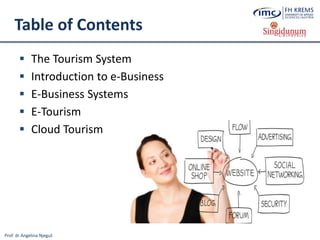
Table of Contents
 The Tourism System
 Introduction to e-Business
 E-Business Systems
 E-Tourism
 Cloud Tourism
Prof. dr Angelina Njeguš
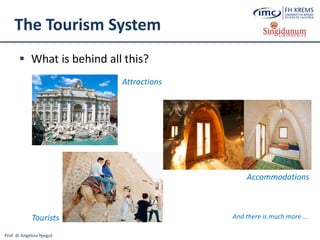
The Tourism System
 What is behind all this?
Attractions
Accommodations
Tourists And there is much more ...
Prof. dr Angelina Njeguš
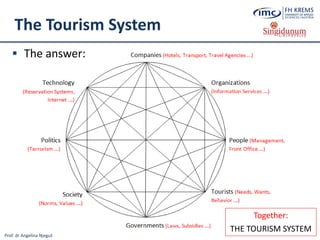
The Tourism System
 The answer:
Together:
THE TOURISM SYSTEM
Prof. dr Angelina Njeguš
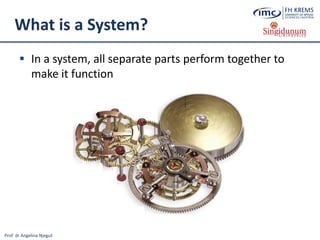
What is a System?
 In a system, all separate parts perform together to
make it function
Prof. dr Angelina Njeguš
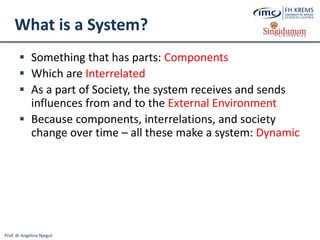
What is a System?
 Something that has parts: Components
 Which are Interrelated
 As a part of Society, the system receives and sends
influences from and to the External Environment
 Because components, interrelations, and society
change over time – all these make a system: Dynamic
Prof. dr Angelina Njeguš
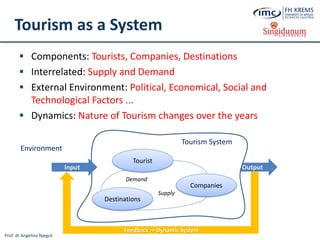
Output
Feedback -> Dynamic System
Tourism as a System
 Components: Tourists, Companies, Destinations
 Interrelated: Supply and Demand
 External Environment: Political, Economical, Social and
Technological Factors ...
 Dynamics: Nature of Tourism changes over the years
Tourist
Companies
Destinations
Input
Demand
Supply
Tourism System
Environment
Prof. dr Angelina Njeguš
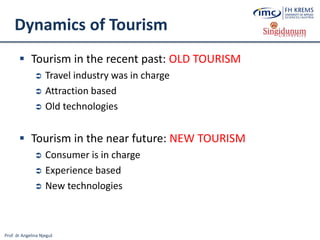
Dynamics of Tourism
 Tourism in the recent past: OLD TOURISM
 Travel industry was in charge
 Attraction based
 Old technologies
 Tourism in the near future: NEW TOURISM
 Consumer is in charge
 Experience based
 New technologies
Prof. dr Angelina Njeguš
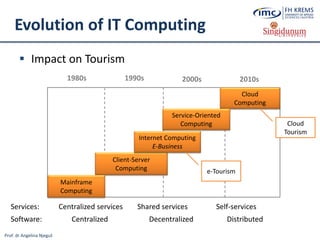
Evolution of IT Computing
 Impact on Tourism
1980s 1990s 2000s
Client-Server
Computing
Mainframe
Computing
Internet Computing
E-Business
Cloud
Computing
Service-Oriented
Computing
2010s
Centralized services Shared services Self-servicesServices:
Software: Centralized Decentralized Distributed
e-Tourism
Cloud
Tourism
Prof. dr Angelina Njeguš
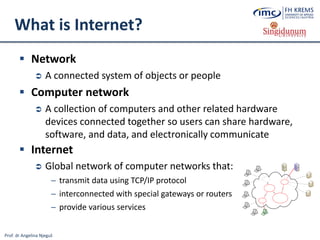
What is Internet?
 Network
 A connected system of objects or people
 Computer network
 A collection of computers and other related hardware
devices connected together so users can share hardware,
software, and data, and electronically communicate
 Internet
 Global network of computer networks that:
─ transmit data using TCP/IP protocol
─ interconnected with special gateways or routers
─ provide various services
Prof. dr Angelina Njeguš
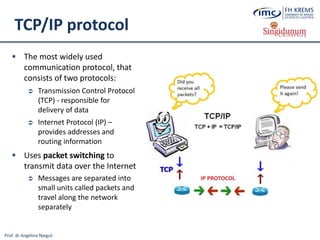
TCP/IP protocol
 The most widely used
communication protocol, that
consists of two protocols:
 Transmission Control Protocol
(TCP) - responsible for
delivery of data
 Internet Protocol (IP) –
provides addresses and
routing information
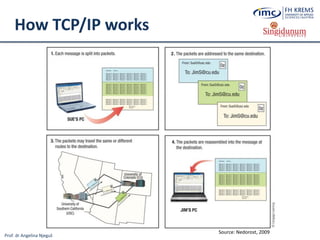
 Uses packet switching to
transmit data over the Internet
 Messages are separated into
small units called packets and
travel along the network
separately
Prof. dr Angelina Njeguš
How TCP/IP works
Source: Nedorost, 2009
Prof. dr Angelina Njeguš
Internet services
 Internet services can be grouped into:
 Basic services (e-mail, FTP, Telnet ...)
 Public services (IM, WWW ...)
 Search services (Yahoo, Google ...)
 Security services (Pretty Good Privacy - PGP, Secure Shell – SSH ...)
 System services (Ping, X-windows ...)
Prof. dr Angelina Njeguš
Internet service: World Wide Web
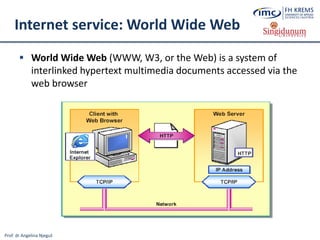
 World Wide Web (WWW, W3, or the Web) is a system of
interlinked hypertext multimedia documents accessed via the
web browser
Prof. dr Angelina Njeguš
Web generations: Web 1.0
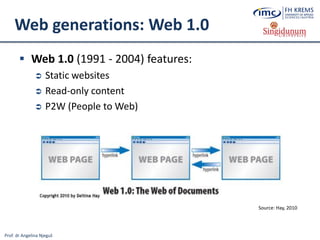
 Web 1.0 (1991 - 2004) features:
 Static websites
 Read-only content
 P2W (People to Web)
Source: Hay, 2010
Prof. dr Angelina Njeguš
Web generations: Web 2.0
 Web 2.0 (2004 – 2009)
features:
– User-generated content
– Read-write web
– Collaboration
– P2P (People to People)
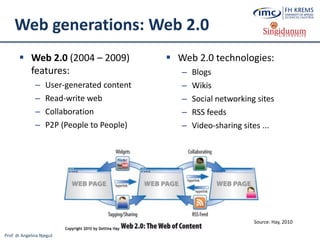
 Web 2.0 technologies:
– Blogs
– Wikis
– Social networking sites
– RSS feeds
– Video-sharing sites ...
Source: Hay, 2010
Prof. dr Angelina Njeguš
Web generations: Web 3.0
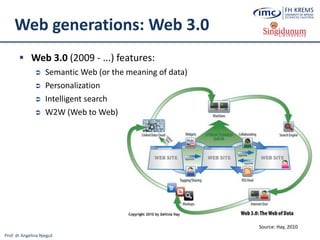
 Web 3.0 (2009 - ...) features:
 Semantic Web (or the meaning of data)
 Personalization
 Intelligent search
 W2W (Web to Web)
Source: Hay, 2010
Prof. dr Angelina Njeguš
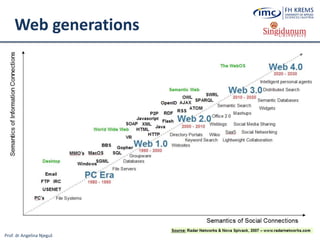
Web generations
Prof. dr Angelina Njeguš
Intranet
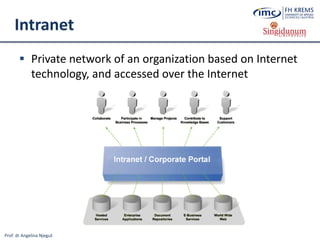
 Private network of an organization based on Internet
technology, and accessed over the Internet
Prof. dr Angelina Njeguš
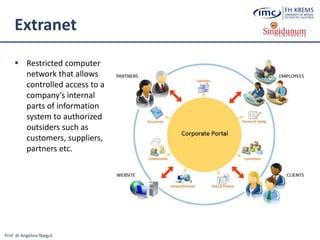
Extranet
 Restricted computer
network that allows
controlled access to a
company’s internal
parts of information
system to authorized
outsiders such as
customers, suppliers,
partners etc.
Prof. dr Angelina Njeguš
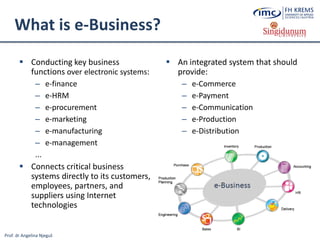
What is e-Business?
 Conducting key business
functions over electronic systems:
– e-finance
– e-HRM
– e-procurement
– e-marketing
– e-manufacturing
– e-management
...
 Connects critical business
systems directly to its customers,
employees, partners, and
suppliers using Internet
technologies
 An integrated system that should
provide:
– e-Commerce
– e-Payment
– e-Communication
– e-Production
– e-Distribution
Prof. dr Angelina Njeguš
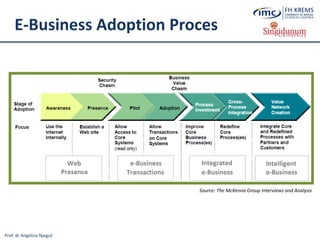
E-Business Adoption Proces
Source: The McKenna Group Interviews and Analysis
Prof. dr Angelina Njeguš
e-Commerce
 e-Commerce is a subset of an overall e-business strategy
 the sales aspect of e-business
 e-Commerce involves conducting business transactions over
electronic systems
 It is usually associated with buying and selling over the Internet, or
conducting any business transaction involving the transfer of
ownership or rights to use goods or services [6]
 The main e-commerce actors are represented as:
 B – Business
 C – Customer/Consumer/Citizen
 G – Government
 E – Employee
Prof. dr Angelina Njeguš
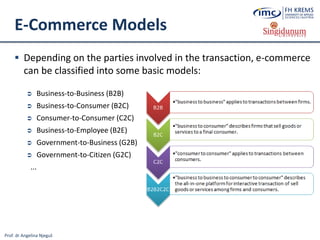
E-Commerce Models
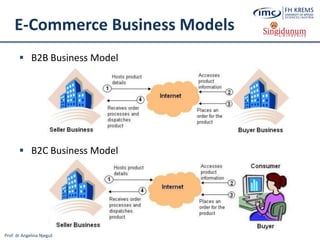
 Depending on the parties involved in the transaction, e-commerce
can be classified into some basic models:
 Business-to-Business (B2B)
 Business-to-Consumer (B2C)
 Consumer-to-Consumer (C2C)
 Business-to-Employee (B2E)
 Government-to-Business (G2B)
 Government-to-Citizen (G2C)
...
Prof. dr Angelina Njeguš
E-Commerce Business Models
 B2B Business Model
 B2C Business Model
Prof. dr Angelina Njeguš
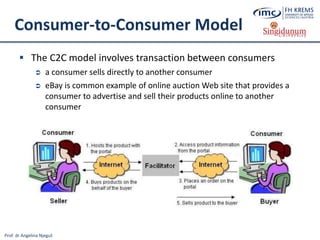
Consumer-to-Consumer Model
 The C2C model involves transaction between consumers
 a consumer sells directly to another consumer
 eBay is common example of online auction Web site that provides a
consumer to advertise and sell their products online to another
consumer
Prof. dr Angelina Njeguš
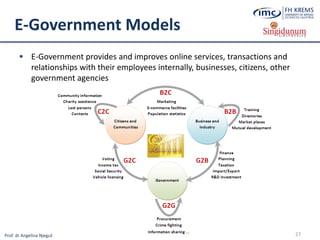
E-Government Models
 E-Government provides and improves online services, transactions and
relationships with their employees internally, businesses, citizens, other
government agencies
27
Prof. dr Angelina Njeguš
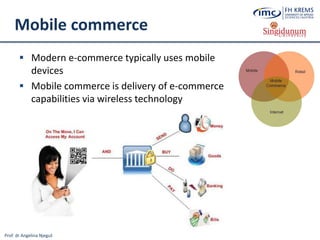
Mobile commerce
 Modern e-commerce typically uses mobile
devices
 Mobile commerce is delivery of e-commerce
capabilities via wireless technology
Prof. dr Angelina Njeguš
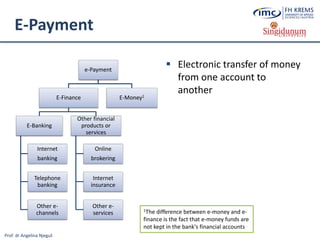
E-Payment
1The difference between e-money and e-
finance is the fact that e-money funds are
not kept in the bank's financial accounts
 Electronic transfer of money
from one account to
another
e-Payment
E-Finance
E-Banking
Internet
banking
Telephone
banking
Other e-
channels
Other financial
products or
services
Online
brokering
Internet
insurance
Other e-
services
E-Money1
Prof. dr Angelina Njeguš
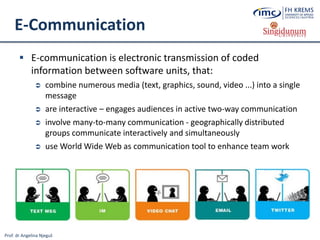
E-Communication
 E-communication is electronic transmission of coded
information between software units, that:
 combine numerous media (text, graphics, sound, video ...) into a single
message
 are interactive – engages audiences in active two-way communication
 involve many-to-many communication - geographically distributed
groups communicate interactively and simultaneously
 use World Wide Web as communication tool to enhance team work
Prof. dr Angelina Njeguš
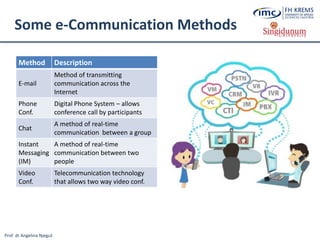
Some e-Communication Methods
Method Description
E-mail
Method of transmitting
communication across the
Internet
Phone
Conf.
Digital Phone System – allows
conference call by participants
Chat
A method of real-time
communication between a group
Instant
Messaging
(IM)
A method of real-time
communication between two
people
Video
Conf.
Telecommunication technology
that allows two way video conf.
Prof. dr Angelina Njeguš
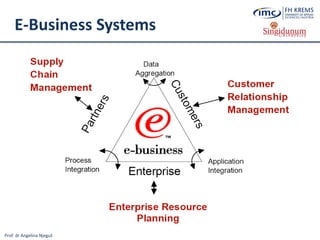
E-Business Systems
Prof. dr Angelina Njeguš
What is CRM?
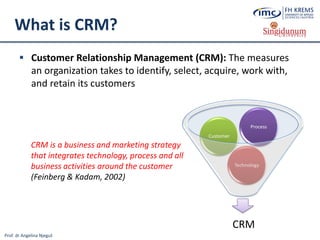
 Customer Relationship Management (CRM): The measures
an organization takes to identify, select, acquire, work with,
and retain its customers
CRM
Technology
Customer
Process
CRM is a business and marketing strategy
that integrates technology, process and all
business activities around the customer
(Feinberg & Kadam, 2002)
Prof. dr Angelina Njeguš
CRM parts
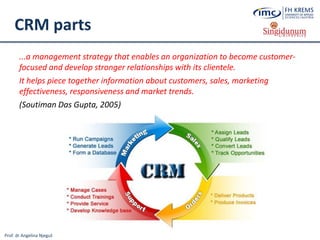
...a management strategy that enables an organization to become customer-
focused and develop stronger relationships with its clientele.
It helps piece together information about customers, sales, marketing
effectiveness, responsiveness and market trends.
(Soutiman Das Gupta, 2005)
Prof. dr Angelina Njeguš
CRM features
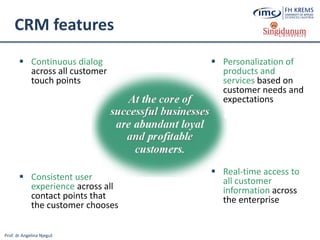
 Continuous dialog
across all customer
touch points
 Consistent user
experience across all
contact points that
the customer chooses
 Personalization of
products and
services based on
customer needs and
expectations
 Real-time access to
all customer
information across
the enterprise
Prof. dr Angelina Njeguš
CRM software
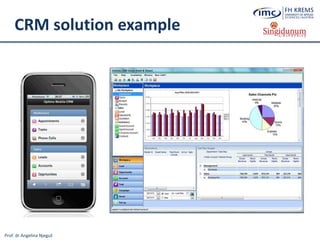
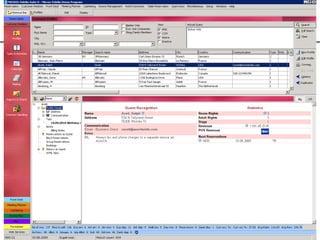
 CRM software provides sales,
marketing, and support teams
with powerful tools to efficiently
and effectively manage
customer relationships [7]
Prof. dr Angelina Njeguš
From Traditional to Social CRM
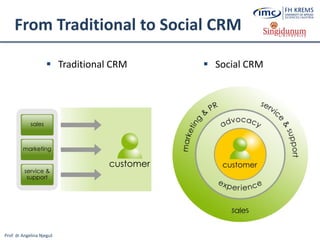
 Traditional CRM  Social CRM
Prof. dr Angelina Njeguš
CRM solution example
Prof. dr Angelina Njeguš
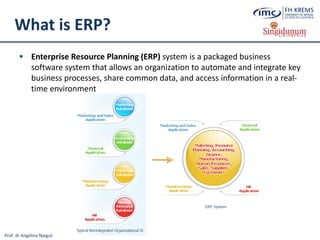
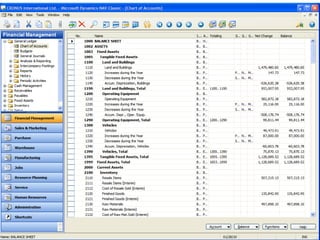
What is ERP?
 Enterprise Resource Planning (ERP) system is a packaged business
software system that allows an organization to automate and integrate key
business processes, share common data, and access information in a real-
time environment
Prof. dr Angelina Njeguš
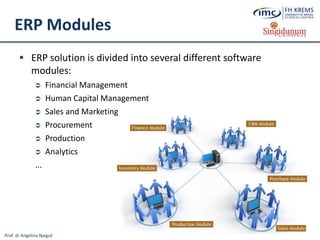
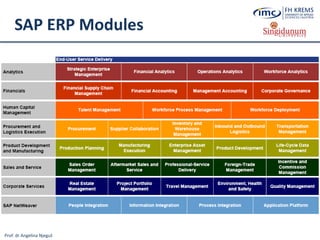
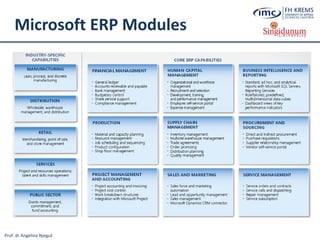
ERP Modules
 ERP solution is divided into several different software
modules:
 Financial Management
 Human Capital Management
 Sales and Marketing
 Procurement
 Production
 Analytics
...
Prof. dr Angelina Njeguš
SAP ERP Modules
Prof. dr Angelina Njeguš
Microsoft ERP Modules
Prof. dr Angelina Njeguš
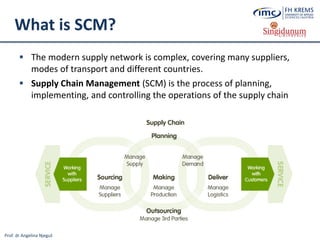
What is SCM?
 The modern supply network is complex, covering many suppliers,
modes of transport and different countries.
 Supply Chain Management (SCM) is the process of planning,
implementing, and controlling the operations of the supply chain
Prof. dr Angelina Njeguš
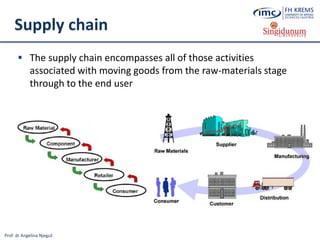
Supply chain
 The supply chain encompasses all of those activities
associated with moving goods from the raw-materials stage
through to the end user
Prof. dr Angelina Njeguš
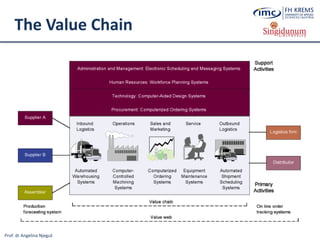
The Value Chain
Prof. dr Angelina Njeguš
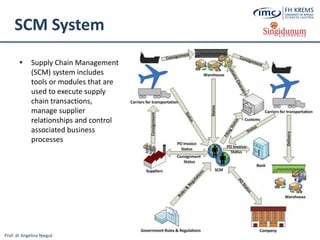
SCM System
 Supply Chain Management
(SCM) system includes
tools or modules that are
used to execute supply
chain transactions,
manage supplier
relationships and control
associated business
processes
Prof. dr Angelina Njeguš
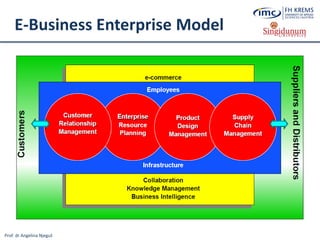
E-Business Enterprise Model
Prof. dr Angelina Njeguš
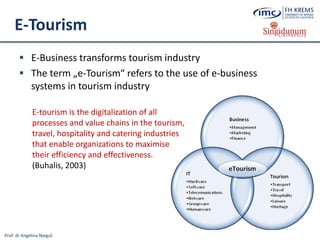
E-Tourism
 E-Business transforms tourism industry
 The term „e-Tourism“ refers to the use of e-business
systems in tourism industry
E-tourism is the digitalization of all
processes and value chains in the tourism,
travel, hospitality and catering industries
that enable organizations to maximise
their efficiency and effectiveness.
(Buhalis, 2003)
Prof. dr Angelina Njeguš
Cloud Tourism
What is Cloud Computing?
Cloud computing (often referred to as simply „the cloud“) is the delivery of
on-demand computing resources (software, infrastructure, platforms and
information) over the Internet and on a pay-for-use basis [8] without the
need to install, store, purchase and maintain them locally on client computers
Prof. dr Angelina Njeguš
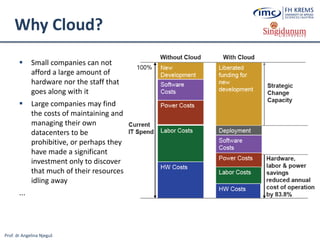
Why Cloud?
 Small companies can not
afford a large amount of
hardware nor the staff that
goes along with it
 Large companies may find
the costs of maintaining and
managing their own
datacenters to be
prohibitive, or perhaps they
have made a significant
investment only to discover
that much of their resources
idling away
...
Prof. dr Angelina Njeguš
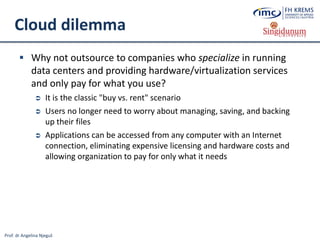
Cloud dilemma
 Why not outsource to companies who specialize in running
data centers and providing hardware/virtualization services
and only pay for what you use?
 It is the classic "buy vs. rent" scenario
 Users no longer need to worry about managing, saving, and backing
up their files
 Applications can be accessed from any computer with an Internet
connection, eliminating expensive licensing and hardware costs and
allowing organization to pay for only what it needs
Prof. dr Angelina Njeguš
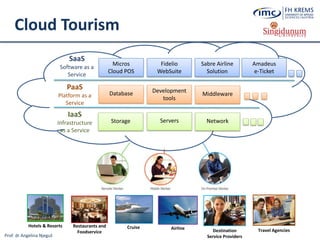
Cloud Tourism
Hotels & Resorts Restaurants and
Foodservice
Cruise Airline Destination
Service Providers
Travel Agencies
SaaS
Software as a
Service
PaaS
Platform as a
Service
IaaS
Infrastructure
as a Service
Micros
Cloud POS
Fidelio
WebSuite
Sabre Airline
Solution
Amadeus
e-Ticket
Database Development
tools
Middleware
Storage Servers Network
Prof. dr Angelina Njeguš
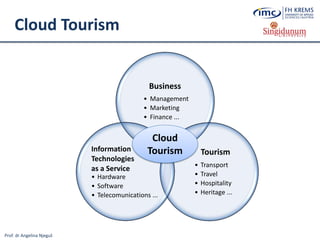
Cloud Tourism
Cloud
Tourism
Business
• Management
• Marketing
• Finance ...
Tourism
• Transport
• Travel
• Hospitality
• Heritage ...
Information
Technologies
as a Service
• Hardware
• Software
• Telecomunications ...
Cloud
Tourism
Prof. dr Angelina Njeguš
References
1. Swindoll, C. (2011) „Redefining Fundraising – Data“, Pursuant [Online]. Available at: http://www.pursuant.com/blog/tag/dikw-model/
(accessed: 1.11.2012)
2. Nedorost, T. (2009) „CGS1060 Introduction to Computer Science“, PowerPoint presentation [online]
3. Hay, D. (2010) „Web 3.0 demystified: An explanation in pictures“, Social Media. Available at: http://socialmedia.biz/2010/10/21/web-3-0-
demystified-an-explanation-in-pictures/ (accessed: 30.11.2012)
4. Venema, M. (2011) „An Introduction to the Tourism System“, Education for Tourism, Edutour BV.
5. Njeguš, A. (2012) Information Systems in Tourism Industry, Singidunum University, Belgrade.
6. WikiBooks, „E-Commerce and e-Buisness – Concepts and Definitions“. Available at: http://en.wikibooks.org/wiki/E-Commerce_and_E-
Business/Concepts_and_Definitions (accessed: 16.01.2013)
7. Sage CRM (2010) „Creating a customer focused business with CRM“. Available at: http://www.sagecrm.com/northamerica/what-is-crm/
(accessed: 17.01.2013)
8. IBM Smart Cloud, „Computing as a service over the Internet“, IBM. Available at: http://www.ibm.com/cloud-computing/us/en/what-is-cloud-
computing.html (accessed: 18.01.2013)

Lesson 2: e-Business Systems in Tourism

  • 1.
    E-BUSINESS SYSTEMS INTOURISM - Lesson 2 - Angelina Njeguš, PhD Associate Professor at Singidunum University Belgrade - Serbia, 2013
  • 2.
    Prof. dr AngelinaNjeguš Table of Contents  The Tourism System  Introduction to e-Business  E-Business Systems  E-Tourism  Cloud Tourism
  • 3.
    Prof. dr AngelinaNjeguš The Tourism System  What is behind all this? Attractions Accommodations Tourists And there is much more ...
  • 4.
    Prof. dr AngelinaNjeguš The Tourism System  The answer: Together: THE TOURISM SYSTEM
  • 5.
    Prof. dr AngelinaNjeguš What is a System?  In a system, all separate parts perform together to make it function
  • 6.
    Prof. dr AngelinaNjeguš What is a System?  Something that has parts: Components  Which are Interrelated  As a part of Society, the system receives and sends influences from and to the External Environment  Because components, interrelations, and society change over time – all these make a system: Dynamic
  • 7.
    Prof. dr AngelinaNjeguš Output Feedback -> Dynamic System Tourism as a System  Components: Tourists, Companies, Destinations  Interrelated: Supply and Demand  External Environment: Political, Economical, Social and Technological Factors ...  Dynamics: Nature of Tourism changes over the years Tourist Companies Destinations Input Demand Supply Tourism System Environment
  • 8.
    Prof. dr AngelinaNjeguš Dynamics of Tourism  Tourism in the recent past: OLD TOURISM  Travel industry was in charge  Attraction based  Old technologies  Tourism in the near future: NEW TOURISM  Consumer is in charge  Experience based  New technologies
  • 9.
    Prof. dr AngelinaNjeguš Evolution of IT Computing  Impact on Tourism 1980s 1990s 2000s Client-Server Computing Mainframe Computing Internet Computing E-Business Cloud Computing Service-Oriented Computing 2010s Centralized services Shared services Self-servicesServices: Software: Centralized Decentralized Distributed e-Tourism Cloud Tourism
  • 10.
    Prof. dr AngelinaNjeguš What is Internet?  Network  A connected system of objects or people  Computer network  A collection of computers and other related hardware devices connected together so users can share hardware, software, and data, and electronically communicate  Internet  Global network of computer networks that: ─ transmit data using TCP/IP protocol ─ interconnected with special gateways or routers ─ provide various services
  • 11.
    Prof. dr AngelinaNjeguš TCP/IP protocol  The most widely used communication protocol, that consists of two protocols:  Transmission Control Protocol (TCP) - responsible for delivery of data  Internet Protocol (IP) – provides addresses and routing information  Uses packet switching to transmit data over the Internet  Messages are separated into small units called packets and travel along the network separately
  • 12.
    Prof. dr AngelinaNjeguš How TCP/IP works Source: Nedorost, 2009
  • 13.
    Prof. dr AngelinaNjeguš Internet services  Internet services can be grouped into:  Basic services (e-mail, FTP, Telnet ...)  Public services (IM, WWW ...)  Search services (Yahoo, Google ...)  Security services (Pretty Good Privacy - PGP, Secure Shell – SSH ...)  System services (Ping, X-windows ...)
  • 14.
    Prof. dr AngelinaNjeguš Internet service: World Wide Web  World Wide Web (WWW, W3, or the Web) is a system of interlinked hypertext multimedia documents accessed via the web browser
  • 15.
    Prof. dr AngelinaNjeguš Web generations: Web 1.0  Web 1.0 (1991 - 2004) features:  Static websites  Read-only content  P2W (People to Web) Source: Hay, 2010
  • 16.
    Prof. dr AngelinaNjeguš Web generations: Web 2.0  Web 2.0 (2004 – 2009) features: – User-generated content – Read-write web – Collaboration – P2P (People to People)  Web 2.0 technologies: – Blogs – Wikis – Social networking sites – RSS feeds – Video-sharing sites ... Source: Hay, 2010
  • 17.
    Prof. dr AngelinaNjeguš Web generations: Web 3.0  Web 3.0 (2009 - ...) features:  Semantic Web (or the meaning of data)  Personalization  Intelligent search  W2W (Web to Web) Source: Hay, 2010
  • 18.
    Prof. dr AngelinaNjeguš Web generations
  • 19.
    Prof. dr AngelinaNjeguš Intranet  Private network of an organization based on Internet technology, and accessed over the Internet
  • 20.
    Prof. dr AngelinaNjeguš Extranet  Restricted computer network that allows controlled access to a company’s internal parts of information system to authorized outsiders such as customers, suppliers, partners etc.
  • 21.
    Prof. dr AngelinaNjeguš What is e-Business?  Conducting key business functions over electronic systems: – e-finance – e-HRM – e-procurement – e-marketing – e-manufacturing – e-management ...  Connects critical business systems directly to its customers, employees, partners, and suppliers using Internet technologies  An integrated system that should provide: – e-Commerce – e-Payment – e-Communication – e-Production – e-Distribution
  • 22.
    Prof. dr AngelinaNjeguš E-Business Adoption Proces Source: The McKenna Group Interviews and Analysis
  • 23.
    Prof. dr AngelinaNjeguš e-Commerce  e-Commerce is a subset of an overall e-business strategy  the sales aspect of e-business  e-Commerce involves conducting business transactions over electronic systems  It is usually associated with buying and selling over the Internet, or conducting any business transaction involving the transfer of ownership or rights to use goods or services [6]  The main e-commerce actors are represented as:  B – Business  C – Customer/Consumer/Citizen  G – Government  E – Employee
  • 24.
    Prof. dr AngelinaNjeguš E-Commerce Models  Depending on the parties involved in the transaction, e-commerce can be classified into some basic models:  Business-to-Business (B2B)  Business-to-Consumer (B2C)  Consumer-to-Consumer (C2C)  Business-to-Employee (B2E)  Government-to-Business (G2B)  Government-to-Citizen (G2C) ...
  • 25.
    Prof. dr AngelinaNjeguš E-Commerce Business Models  B2B Business Model  B2C Business Model
  • 26.
    Prof. dr AngelinaNjeguš Consumer-to-Consumer Model  The C2C model involves transaction between consumers  a consumer sells directly to another consumer  eBay is common example of online auction Web site that provides a consumer to advertise and sell their products online to another consumer
  • 27.
    Prof. dr AngelinaNjeguš E-Government Models  E-Government provides and improves online services, transactions and relationships with their employees internally, businesses, citizens, other government agencies 27
  • 28.
    Prof. dr AngelinaNjeguš Mobile commerce  Modern e-commerce typically uses mobile devices  Mobile commerce is delivery of e-commerce capabilities via wireless technology
  • 29.
    Prof. dr AngelinaNjeguš E-Payment 1The difference between e-money and e- finance is the fact that e-money funds are not kept in the bank's financial accounts  Electronic transfer of money from one account to another e-Payment E-Finance E-Banking Internet banking Telephone banking Other e- channels Other financial products or services Online brokering Internet insurance Other e- services E-Money1
  • 30.
    Prof. dr AngelinaNjeguš E-Communication  E-communication is electronic transmission of coded information between software units, that:  combine numerous media (text, graphics, sound, video ...) into a single message  are interactive – engages audiences in active two-way communication  involve many-to-many communication - geographically distributed groups communicate interactively and simultaneously  use World Wide Web as communication tool to enhance team work
  • 31.
    Prof. dr AngelinaNjeguš Some e-Communication Methods Method Description E-mail Method of transmitting communication across the Internet Phone Conf. Digital Phone System – allows conference call by participants Chat A method of real-time communication between a group Instant Messaging (IM) A method of real-time communication between two people Video Conf. Telecommunication technology that allows two way video conf.
  • 32.
    Prof. dr AngelinaNjeguš E-Business Systems
  • 33.
    Prof. dr AngelinaNjeguš What is CRM?  Customer Relationship Management (CRM): The measures an organization takes to identify, select, acquire, work with, and retain its customers CRM Technology Customer Process CRM is a business and marketing strategy that integrates technology, process and all business activities around the customer (Feinberg & Kadam, 2002)
  • 34.
    Prof. dr AngelinaNjeguš CRM parts ...a management strategy that enables an organization to become customer- focused and develop stronger relationships with its clientele. It helps piece together information about customers, sales, marketing effectiveness, responsiveness and market trends. (Soutiman Das Gupta, 2005)
  • 35.
    Prof. dr AngelinaNjeguš CRM features  Continuous dialog across all customer touch points  Consistent user experience across all contact points that the customer chooses  Personalization of products and services based on customer needs and expectations  Real-time access to all customer information across the enterprise
  • 36.
    Prof. dr AngelinaNjeguš CRM software  CRM software provides sales, marketing, and support teams with powerful tools to efficiently and effectively manage customer relationships [7]
  • 37.
    Prof. dr AngelinaNjeguš From Traditional to Social CRM  Traditional CRM  Social CRM
  • 38.
    Prof. dr AngelinaNjeguš CRM solution example
  • 39.
  • 40.
    Prof. dr AngelinaNjeguš What is ERP?  Enterprise Resource Planning (ERP) system is a packaged business software system that allows an organization to automate and integrate key business processes, share common data, and access information in a real- time environment
  • 41.
    Prof. dr AngelinaNjeguš ERP Modules  ERP solution is divided into several different software modules:  Financial Management  Human Capital Management  Sales and Marketing  Procurement  Production  Analytics ...
  • 42.
    Prof. dr AngelinaNjeguš SAP ERP Modules
  • 43.
    Prof. dr AngelinaNjeguš Microsoft ERP Modules
  • 44.
  • 45.
    Prof. dr AngelinaNjeguš What is SCM?  The modern supply network is complex, covering many suppliers, modes of transport and different countries.  Supply Chain Management (SCM) is the process of planning, implementing, and controlling the operations of the supply chain
  • 46.
    Prof. dr AngelinaNjeguš Supply chain  The supply chain encompasses all of those activities associated with moving goods from the raw-materials stage through to the end user
  • 47.
    Prof. dr AngelinaNjeguš The Value Chain
  • 48.
    Prof. dr AngelinaNjeguš SCM System  Supply Chain Management (SCM) system includes tools or modules that are used to execute supply chain transactions, manage supplier relationships and control associated business processes
  • 49.
    Prof. dr AngelinaNjeguš E-Business Enterprise Model
  • 50.
    Prof. dr AngelinaNjeguš E-Tourism  E-Business transforms tourism industry  The term „e-Tourism“ refers to the use of e-business systems in tourism industry E-tourism is the digitalization of all processes and value chains in the tourism, travel, hospitality and catering industries that enable organizations to maximise their efficiency and effectiveness. (Buhalis, 2003)
  • 51.
    Prof. dr AngelinaNjeguš Cloud Tourism What is Cloud Computing? Cloud computing (often referred to as simply „the cloud“) is the delivery of on-demand computing resources (software, infrastructure, platforms and information) over the Internet and on a pay-for-use basis [8] without the need to install, store, purchase and maintain them locally on client computers
  • 52.
    Prof. dr AngelinaNjeguš Why Cloud?  Small companies can not afford a large amount of hardware nor the staff that goes along with it  Large companies may find the costs of maintaining and managing their own datacenters to be prohibitive, or perhaps they have made a significant investment only to discover that much of their resources idling away ...
  • 53.
    Prof. dr AngelinaNjeguš Cloud dilemma  Why not outsource to companies who specialize in running data centers and providing hardware/virtualization services and only pay for what you use?  It is the classic "buy vs. rent" scenario  Users no longer need to worry about managing, saving, and backing up their files  Applications can be accessed from any computer with an Internet connection, eliminating expensive licensing and hardware costs and allowing organization to pay for only what it needs
  • 54.
    Prof. dr AngelinaNjeguš Cloud Tourism Hotels & Resorts Restaurants and Foodservice Cruise Airline Destination Service Providers Travel Agencies SaaS Software as a Service PaaS Platform as a Service IaaS Infrastructure as a Service Micros Cloud POS Fidelio WebSuite Sabre Airline Solution Amadeus e-Ticket Database Development tools Middleware Storage Servers Network
  • 55.
    Prof. dr AngelinaNjeguš Cloud Tourism Cloud Tourism Business • Management • Marketing • Finance ... Tourism • Transport • Travel • Hospitality • Heritage ... Information Technologies as a Service • Hardware • Software • Telecomunications ... Cloud Tourism
  • 56.
    Prof. dr AngelinaNjeguš References 1. Swindoll, C. (2011) „Redefining Fundraising – Data“, Pursuant [Online]. Available at: http://www.pursuant.com/blog/tag/dikw-model/ (accessed: 1.11.2012) 2. Nedorost, T. (2009) „CGS1060 Introduction to Computer Science“, PowerPoint presentation [online] 3. Hay, D. (2010) „Web 3.0 demystified: An explanation in pictures“, Social Media. Available at: http://socialmedia.biz/2010/10/21/web-3-0- demystified-an-explanation-in-pictures/ (accessed: 30.11.2012) 4. Venema, M. (2011) „An Introduction to the Tourism System“, Education for Tourism, Edutour BV. 5. Njeguš, A. (2012) Information Systems in Tourism Industry, Singidunum University, Belgrade. 6. WikiBooks, „E-Commerce and e-Buisness – Concepts and Definitions“. Available at: http://en.wikibooks.org/wiki/E-Commerce_and_E- Business/Concepts_and_Definitions (accessed: 16.01.2013) 7. Sage CRM (2010) „Creating a customer focused business with CRM“. Available at: http://www.sagecrm.com/northamerica/what-is-crm/ (accessed: 17.01.2013) 8. IBM Smart Cloud, „Computing as a service over the Internet“, IBM. Available at: http://www.ibm.com/cloud-computing/us/en/what-is-cloud- computing.html (accessed: 18.01.2013)