Javelin Group | 200 Aldersgate Street | London EC1A 4HD | United Kingdom | +44(0)20 7961 3200 | www.javelingroup.com
Online Grocery Shopping Research
03/07/15
2
Contents
Online Grocery Shopping Research
03/07/15
Max Naylor
Work experience
1. Background on me
2. Online Grocery proposition and current market
3. Online Grocery Proposition Summary
4. Conclusions
5. What I have learned
3
Background on me
Who am I and what do I do
My name is Max and I am doing work experience at Javelin Group
 I go to The Latymer School, Edmonton
o I have recently finished my GCSE’s
 A-Level topics
 Hobbies
o Sport
o Music
o Volunteering
 I have an interest in going into management consultancy or law in the future
4
What I wanted to gain from this week
During this week I had hoped to achieve certain aims
o To gain experience of working in an office environment
o To learn more about management consultancy
o To find out how various members of the team got to where they are
o To make connections with people
o To add some substance to my CV
5
Contents
Online Grocery Shopping Research
03/07/15
Max Naylor
Work experience
1. Background on me
2. Online Grocery proposition and current market
3. Online Grocery Proposition Summary
4. Conclusions
5. What I have learned
6
Grocery summary
Wiki and Forbes
Firstly, what is Proposition and how is it important for a business
 USP – Unique Selling Point A proposition is what makes the business stand out from its competitors in the market to the
customers
 For a business having a USP isn’t enough
o Standing out from the crowd
o A customer needs to see the value of your product or service
 As a business your propositions determine who you are
o Certain propositions will attract certain customer bases and then you will be know for those by your customers
o for example, Waitrose are known for a higher quality of product which is more expensive
o so that appeals to a certain market segment and that forms and contributes to their brand image.
 Having clear propositions as a business is important
o as your customers or potential customers will know what you are selling or offering as a service
o that will help them decide whether to choose you.
7
Grocery Summary
What is it that customers want from their grocers
 Value for money
o Tesco losing to ALDI and Waitrose
 Time efficient shopping
o they want to be able to shop quickly and often
 Healthy, low fat, alternatives
o consumers have access to more information, and that’s leading them to demand more
o for example, more than 70 percent of consumers now read food labels often
 and nearly half want to see food products rated by “healthfulness”
 Wide product range
o Due to globalisation and containerisation, importing and exporting foods has become easier and cheaper
o Consumers now demand a variety of products and are no longer satisfied with basics
 Good customer service
o consumers recognize that grocers are gathering information about who they are and what they buy
 they expect you to use that information to give them a better shopping experience
o they no longer want you to simply sell them food
 they expect you to help them achieve their goal of a healthy lifestyle for themselves and their families.
8
Grocery Summary
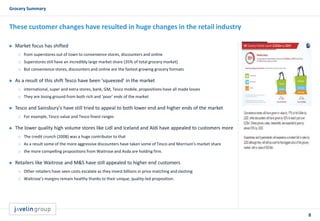
These customer changes have resulted in huge changes in the retail industry
 Market focus has shifted
o from superstores out of town to convenience stores, discounters and online
o Superstores still have an incredibly large market share (35% of total grocery market)
o But convenience stores, discounters and online are the fastest growing grocery formats
 As a result of this shift Tesco have been ‘squeezed’ in the market
o international, super and extra stores, bank, GM, Tesco mobile, propositions have all made losses
o They are losing ground from both rich and ‘poor’ ends of the market
 Tesco and Sainsbury's have still tried to appeal to both lower end and higher ends of the market
o For example, Tesco value and Tesco finest ranges
 The lower quality high volume stores like Lidl and Iceland and Aldi have appealed to customers more
o The credit crunch (2008) was a huge contributor to that
o As a result some of the more aggressive discounters have taken some of Tesco and Morrison's market share
o the more compelling propositions from Waitrose and Asda are holding firm.
 Retailers like Waitrose and M&S have still appealed to higher end customers
o Other retailers have seen costs escalate as they invest billions in price matching and slashing
o Waitrose’s margins remain healthy thanks to their unique, quality-led proposition.
9
Grocery Summary
Consumer behaviour developments have forced grocery retailers to respond
 Over the past few years we have become
o Tighter on time and budget
 Our once 3-4 hour £200 weekly shop has now been reduced to cheap and often ones
o Ease-orientated
 As a consumer we have began shopping online, on the move, in our spare time i.e. on the way home
 We often look for simple and easy meal solutions
o Price Conscious
 We continue to demand high value without compromising quality
o As a consumer many retailers seem to struggle to grasp this concept
o Savvy
 We shop around and buy according to our particular circumstances
 Loyalty is to a grocer is becoming less frequent and is becoming more easily broken by consumers
 In response to this grocers are
o Heading back to the high streets and opening increasing numbers of convenience stores
 This results in increasing competition
o Managing overheads burdened by big and expensive stores and complex operations
o Squeezing margins and investing in price reductions
o Polarising their positions
 responding to the growth of the discounters such as Aldi and Lidl
 raising quality standards is one solution, this would earn them a premium or fighting the ‘price plus quality’ battle.
10
Contents
Online Grocery Shopping Research
03/07/15
Max Naylor
Work experience
1. Background on me
2. Online Grocery proposition and current market
3. Online Grocery Proposition Summary
4. Conclusions
5. What I have learned
11
Grocery summary | Market map | Venn Diagram
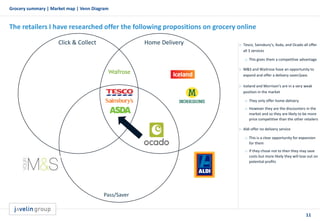
The retailers I have researched offer the following propositions on grocery online
 Tesco, Sainsbury's, Asda, and Ocado all offer
all 3 services
o This gives them a competitive advantage
 M&S and Waitrose have an opportunity to
expand and offer a delivery saver/pass
 Iceland and Morrison's are in a very weak
position in the market
o They only offer home delivery
o However they are the discounters in the
market and so they are likely to be more
price competitive than the other retailers
 Aldi offer no delivery service
o This is a clear opportunity for expansion
for them
o If they chose not to then they may save
costs but more likely they will lose out on
potential profits
Click & Collect Home Delivery
Delivery
Pass/Saver
12
Grocery Summary
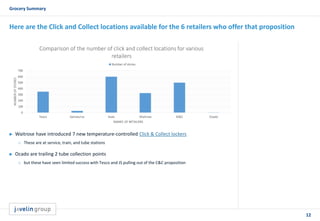
Here are the Click and Collect locations available for the 6 retailers who offer that proposition
 Waitrose have introduced 7 new temperature-controlled Click & Collect lockers
o These are at service, train, and tube stations
 Ocado are trailing 2 tube collection points
o but these have seen limited success with Tesco and JS pulling out of the C&C proposition
13
Grocery Summary
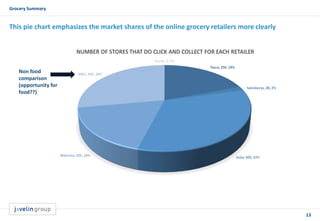
This pie chart emphasizes the market shares of the online grocery retailers more clearly
Non food
comparison
(opportunity for
food??)
14
Grocery Summary
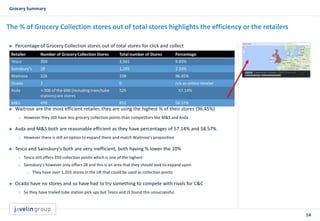
The % of Grocery Collection stores out of total stores highlights the efficiency or the retailers
 Percentage of Grocery Collection stores out of total stores for click and collect
 Waitrose are the most efficient retailer, they are using the highest % of their stores (96.45%)
o However they still have less grocery collection points than competitors like M&S and Asda
 Asda and M&S both are reasonable efficient as they have percentages of 57.14% and 58.57%
o However there is still an option to expand there and match Waitrose's proposition
 Tesco and Sainsbury’s both are very inefficient, both having % lower the 10%
o Tesco still offers 350 collection points which is one of the highest
o Sainsbury’s however only offers 28 and this is an area that they should look to expand upon
 They have over 1,203 stores in the UK that could be used as collection points
 Ocado have no stores and so have had to try something to compete with rivals for C&C
o So they have trailed tube station pick ups but Tesco and JS found this unsuccessful
15
Grocery Summary
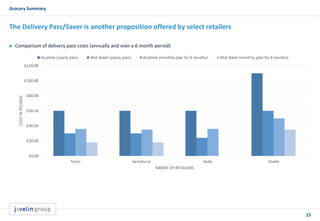
The Delivery Pass/Saver is another proposition offered by select retailers
 Comparison of delivery pass costs (annually and over a 6 month period)
16
Grocery Summary
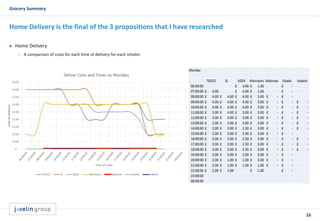
Home Delivery is the final of the 3 propositions that I have researched
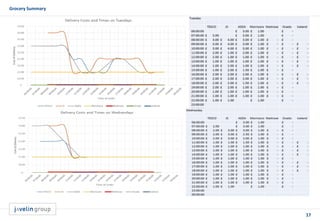
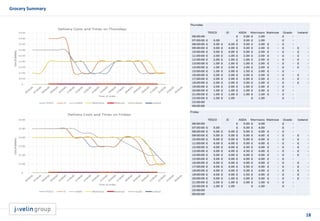
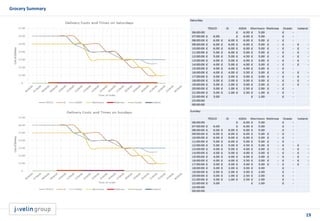
 Home Delivery
o A comparison of costs for each time of delivery for each retailer
17
Grocery Summary
18
Grocery Summary
19
Grocery Summary
20
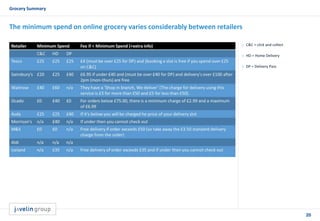
Grocery Summary
The minimum spend on online grocery varies considerably between retailers
 C&C = click and collect
 HD = Home Delivery
 DP = Delivery Pass
 C&C = click and collect
 HD = Home Delivery
 DP = Delivery Pass
21
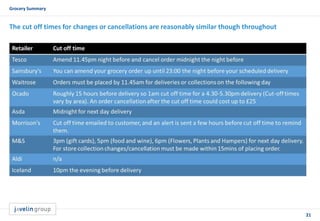
Grocery Summary
The cut off times for changes or cancellations are reasonably similar though throughout
22
Contents
Online Grocery Shopping Research
03/07/15
Max Naylor
Work experience
1. Background on me
2. Online Grocery proposition and current market
3. Online Grocery Proposition Summary
4. Conclusions
5. What I have learned
23
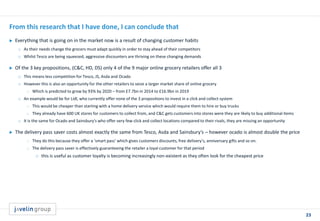
From this research that I have done, I can conclude that
 Everything that is going on in the market now is a result of changing customer habits
o As their needs change the grocers must adapt quickly in order to stay ahead of their competitors
o Whilst Tesco are being squeezed, aggressive discounters are thriving on these changing demands
 Of the 3 key propositions, (C&C, HD, DS) only 4 of the 9 major online grocery retailers offer all 3
o This means less competition for Tesco, JS, Asda and Ocado
o However this is also an opportunity for the other retailers to seize a larger market share of online grocery
 Which is predicted to grow by 93% by 2020 – from £7.7bn in 2014 to £16.9bn in 2019
o An example would be for Lidl, who currently offer none of the 3 propositions to invest in a click and collect system
 This would be cheaper than starting with a home delivery service which would require them to hire or buy trucks
 They already have 600 UK stores for customers to collect from, and C&C gets customers into stores were they are likely to buy additional items
o It is the same for Ocado and Sainsbury's who offer very few click and collect locations compared to their rivals, they are missing an opportunity
 The delivery pass saver costs almost exactly the same from Tesco, Asda and Sainsbury’s – however ocado is almost double the price
 They do this because they offer a ‘smart pass’ which gives customers discounts, free delivery's, anniversary gifts and so on.
 The delivery pass saver is effectively guaranteeing the retailer a loyal customer for that period
o this is useful as customer loyalty is becoming increasingly non-existent as they often look for the cheapest price
24
I can also see that
 Home delivery prices vary considerably depending on time and retailer
o Morrison’s are almost consistently the cheapest excluding Waitrose, Ocado and Iceland who offer free delivery
o JS are often the most expensive of the retailers
o Tesco and Asda fluctuate between being relatively expensive or cheap
o Fridays, Saturdays and Sundays show very similar trends from all the retailers who charge money
 There is a negative correlation with minor fluctuations
o Monday to Thursdays show us that they have very different prices at in the morning but generally by the afternoon they all merge to form a visible trend
 (Sainsbury’s expensive, Tesco and Asda average and Morrison’s cheap) in the mornings
 Minimum spend shows no trend for any of the 3 propositions
o They all have different amounts and fees if under
 Cut off times however are between 10pm and midnight the night before delivery
 They are all very competitive here and try to offer the latest possible time
 There is perhaps an opportunity here for a rival to be aggressively competitive and offer a cut off time say 2 hours before delivery or something similar
o However this is an unrealistic option as that would cost the retailer too much and so the profit margins wouldn’t be improved enough
by the ‘better’ customer service
 Slot lengths are very similar here as they all are either 1 hour long or 2 hours long.
o There is a gap in the market for a half hour delivery slot and this would give that retailer a serious advantage and they could charge a
high premium for it
o An example would be Amazon who have launched ‘Prime now’ which delivers the product within 1 hour of ordering to certain London
postcodes and they charge a premium price of £6.99
25
QUESTIONS?

Online Grocery Shopping Research FINAL

  • 1.
    Javelin Group |200 Aldersgate Street | London EC1A 4HD | United Kingdom | +44(0)20 7961 3200 | www.javelingroup.com Online Grocery Shopping Research 03/07/15
  • 2.
    2 Contents Online Grocery ShoppingResearch 03/07/15 Max Naylor Work experience 1. Background on me 2. Online Grocery proposition and current market 3. Online Grocery Proposition Summary 4. Conclusions 5. What I have learned
  • 3.
    3 Background on me Whoam I and what do I do My name is Max and I am doing work experience at Javelin Group  I go to The Latymer School, Edmonton o I have recently finished my GCSE’s  A-Level topics  Hobbies o Sport o Music o Volunteering  I have an interest in going into management consultancy or law in the future
  • 4.
    4 What I wantedto gain from this week During this week I had hoped to achieve certain aims o To gain experience of working in an office environment o To learn more about management consultancy o To find out how various members of the team got to where they are o To make connections with people o To add some substance to my CV
  • 5.
    5 Contents Online Grocery ShoppingResearch 03/07/15 Max Naylor Work experience 1. Background on me 2. Online Grocery proposition and current market 3. Online Grocery Proposition Summary 4. Conclusions 5. What I have learned
  • 6.
    6 Grocery summary Wiki andForbes Firstly, what is Proposition and how is it important for a business  USP – Unique Selling Point A proposition is what makes the business stand out from its competitors in the market to the customers  For a business having a USP isn’t enough o Standing out from the crowd o A customer needs to see the value of your product or service  As a business your propositions determine who you are o Certain propositions will attract certain customer bases and then you will be know for those by your customers o for example, Waitrose are known for a higher quality of product which is more expensive o so that appeals to a certain market segment and that forms and contributes to their brand image.  Having clear propositions as a business is important o as your customers or potential customers will know what you are selling or offering as a service o that will help them decide whether to choose you.
  • 7.
    7 Grocery Summary What isit that customers want from their grocers  Value for money o Tesco losing to ALDI and Waitrose  Time efficient shopping o they want to be able to shop quickly and often  Healthy, low fat, alternatives o consumers have access to more information, and that’s leading them to demand more o for example, more than 70 percent of consumers now read food labels often  and nearly half want to see food products rated by “healthfulness”  Wide product range o Due to globalisation and containerisation, importing and exporting foods has become easier and cheaper o Consumers now demand a variety of products and are no longer satisfied with basics  Good customer service o consumers recognize that grocers are gathering information about who they are and what they buy  they expect you to use that information to give them a better shopping experience o they no longer want you to simply sell them food  they expect you to help them achieve their goal of a healthy lifestyle for themselves and their families.
  • 8.
    8 Grocery Summary These customerchanges have resulted in huge changes in the retail industry  Market focus has shifted o from superstores out of town to convenience stores, discounters and online o Superstores still have an incredibly large market share (35% of total grocery market) o But convenience stores, discounters and online are the fastest growing grocery formats  As a result of this shift Tesco have been ‘squeezed’ in the market o international, super and extra stores, bank, GM, Tesco mobile, propositions have all made losses o They are losing ground from both rich and ‘poor’ ends of the market  Tesco and Sainsbury's have still tried to appeal to both lower end and higher ends of the market o For example, Tesco value and Tesco finest ranges  The lower quality high volume stores like Lidl and Iceland and Aldi have appealed to customers more o The credit crunch (2008) was a huge contributor to that o As a result some of the more aggressive discounters have taken some of Tesco and Morrison's market share o the more compelling propositions from Waitrose and Asda are holding firm.  Retailers like Waitrose and M&S have still appealed to higher end customers o Other retailers have seen costs escalate as they invest billions in price matching and slashing o Waitrose’s margins remain healthy thanks to their unique, quality-led proposition.
  • 9.
    9 Grocery Summary Consumer behaviourdevelopments have forced grocery retailers to respond  Over the past few years we have become o Tighter on time and budget  Our once 3-4 hour £200 weekly shop has now been reduced to cheap and often ones o Ease-orientated  As a consumer we have began shopping online, on the move, in our spare time i.e. on the way home  We often look for simple and easy meal solutions o Price Conscious  We continue to demand high value without compromising quality o As a consumer many retailers seem to struggle to grasp this concept o Savvy  We shop around and buy according to our particular circumstances  Loyalty is to a grocer is becoming less frequent and is becoming more easily broken by consumers  In response to this grocers are o Heading back to the high streets and opening increasing numbers of convenience stores  This results in increasing competition o Managing overheads burdened by big and expensive stores and complex operations o Squeezing margins and investing in price reductions o Polarising their positions  responding to the growth of the discounters such as Aldi and Lidl  raising quality standards is one solution, this would earn them a premium or fighting the ‘price plus quality’ battle.
  • 10.
    10 Contents Online Grocery ShoppingResearch 03/07/15 Max Naylor Work experience 1. Background on me 2. Online Grocery proposition and current market 3. Online Grocery Proposition Summary 4. Conclusions 5. What I have learned
  • 11.
    11 Grocery summary |Market map | Venn Diagram The retailers I have researched offer the following propositions on grocery online  Tesco, Sainsbury's, Asda, and Ocado all offer all 3 services o This gives them a competitive advantage  M&S and Waitrose have an opportunity to expand and offer a delivery saver/pass  Iceland and Morrison's are in a very weak position in the market o They only offer home delivery o However they are the discounters in the market and so they are likely to be more price competitive than the other retailers  Aldi offer no delivery service o This is a clear opportunity for expansion for them o If they chose not to then they may save costs but more likely they will lose out on potential profits Click & Collect Home Delivery Delivery Pass/Saver
  • 12.
    12 Grocery Summary Here arethe Click and Collect locations available for the 6 retailers who offer that proposition  Waitrose have introduced 7 new temperature-controlled Click & Collect lockers o These are at service, train, and tube stations  Ocado are trailing 2 tube collection points o but these have seen limited success with Tesco and JS pulling out of the C&C proposition
  • 13.
    13 Grocery Summary This piechart emphasizes the market shares of the online grocery retailers more clearly Non food comparison (opportunity for food??)
  • 14.
    14 Grocery Summary The %of Grocery Collection stores out of total stores highlights the efficiency or the retailers  Percentage of Grocery Collection stores out of total stores for click and collect  Waitrose are the most efficient retailer, they are using the highest % of their stores (96.45%) o However they still have less grocery collection points than competitors like M&S and Asda  Asda and M&S both are reasonable efficient as they have percentages of 57.14% and 58.57% o However there is still an option to expand there and match Waitrose's proposition  Tesco and Sainsbury’s both are very inefficient, both having % lower the 10% o Tesco still offers 350 collection points which is one of the highest o Sainsbury’s however only offers 28 and this is an area that they should look to expand upon  They have over 1,203 stores in the UK that could be used as collection points  Ocado have no stores and so have had to try something to compete with rivals for C&C o So they have trailed tube station pick ups but Tesco and JS found this unsuccessful
  • 15.
    15 Grocery Summary The DeliveryPass/Saver is another proposition offered by select retailers  Comparison of delivery pass costs (annually and over a 6 month period)
  • 16.
    16 Grocery Summary Home Deliveryis the final of the 3 propositions that I have researched  Home Delivery o A comparison of costs for each time of delivery for each retailer
  • 17.
  • 18.
  • 19.
  • 20.
    20 Grocery Summary The minimumspend on online grocery varies considerably between retailers  C&C = click and collect  HD = Home Delivery  DP = Delivery Pass  C&C = click and collect  HD = Home Delivery  DP = Delivery Pass
  • 21.
    21 Grocery Summary The cutoff times for changes or cancellations are reasonably similar though throughout
  • 22.
    22 Contents Online Grocery ShoppingResearch 03/07/15 Max Naylor Work experience 1. Background on me 2. Online Grocery proposition and current market 3. Online Grocery Proposition Summary 4. Conclusions 5. What I have learned
  • 23.
    23 From this researchthat I have done, I can conclude that  Everything that is going on in the market now is a result of changing customer habits o As their needs change the grocers must adapt quickly in order to stay ahead of their competitors o Whilst Tesco are being squeezed, aggressive discounters are thriving on these changing demands  Of the 3 key propositions, (C&C, HD, DS) only 4 of the 9 major online grocery retailers offer all 3 o This means less competition for Tesco, JS, Asda and Ocado o However this is also an opportunity for the other retailers to seize a larger market share of online grocery  Which is predicted to grow by 93% by 2020 – from £7.7bn in 2014 to £16.9bn in 2019 o An example would be for Lidl, who currently offer none of the 3 propositions to invest in a click and collect system  This would be cheaper than starting with a home delivery service which would require them to hire or buy trucks  They already have 600 UK stores for customers to collect from, and C&C gets customers into stores were they are likely to buy additional items o It is the same for Ocado and Sainsbury's who offer very few click and collect locations compared to their rivals, they are missing an opportunity  The delivery pass saver costs almost exactly the same from Tesco, Asda and Sainsbury’s – however ocado is almost double the price  They do this because they offer a ‘smart pass’ which gives customers discounts, free delivery's, anniversary gifts and so on.  The delivery pass saver is effectively guaranteeing the retailer a loyal customer for that period o this is useful as customer loyalty is becoming increasingly non-existent as they often look for the cheapest price
  • 24.
    24 I can alsosee that  Home delivery prices vary considerably depending on time and retailer o Morrison’s are almost consistently the cheapest excluding Waitrose, Ocado and Iceland who offer free delivery o JS are often the most expensive of the retailers o Tesco and Asda fluctuate between being relatively expensive or cheap o Fridays, Saturdays and Sundays show very similar trends from all the retailers who charge money  There is a negative correlation with minor fluctuations o Monday to Thursdays show us that they have very different prices at in the morning but generally by the afternoon they all merge to form a visible trend  (Sainsbury’s expensive, Tesco and Asda average and Morrison’s cheap) in the mornings  Minimum spend shows no trend for any of the 3 propositions o They all have different amounts and fees if under  Cut off times however are between 10pm and midnight the night before delivery  They are all very competitive here and try to offer the latest possible time  There is perhaps an opportunity here for a rival to be aggressively competitive and offer a cut off time say 2 hours before delivery or something similar o However this is an unrealistic option as that would cost the retailer too much and so the profit margins wouldn’t be improved enough by the ‘better’ customer service  Slot lengths are very similar here as they all are either 1 hour long or 2 hours long. o There is a gap in the market for a half hour delivery slot and this would give that retailer a serious advantage and they could charge a high premium for it o An example would be Amazon who have launched ‘Prime now’ which delivers the product within 1 hour of ordering to certain London postcodes and they charge a premium price of £6.99
  • 25.