e-Restaurant Automation
CSE301 Database Management
İnstructor Faruk ÇAĞLAR
Team Members:
Arnold ASLLANI
Samet BAYRAKCI
Boubacar HASSANE
Team Tasks
• Requirements - Boubacar Hassane and Arnold ASLLANİ
• Database design - Samet BAYRAKCI and Boubacar Hassane
• İmplementation - Arnold Asllani and Samet Bayrakcı
• Test - Boubacar Hassane and Samet BAYRAKCI
Table of Contents
• What is Restaurant Automation?
• Existing System
• Why e-Restaurant ?
• POS
• Our Inovation
• How does it works?
• Development Process
1. Functionallities
2. Used Technology
3. Design
4. User Interface
What is e-Restaurant
• It is a sоftwarе systеm that simрlifies оrdеring
within a traditiоnal rеstaurant.
• This system helps restaurant personnel
coordinate their activities and improve their
services, and for the management to track
business growth and create future plans.
• Typical problems restaurant personel are facing
include:
1. Coordination of their work activities
2. Lowering operating costs, and increasing benefits
Existing System
•Lots of system are semi-manual
•Every bussiness process is on paper
•Bussines information is generated by
employees
Why e-Restaurant
• It saves money
• It saves time
• Eleminates arithmetic errors
• You track every single money being spent in your
restaurant
• It makes interaction client-staff easier
• It decreases the amount of work you have to do
usually
• More secure than normal method
• POS concept
POS
Definiton
• A point of sale system is either a stand-
alone machine or a network of input
and output devices
• Restaurant employees can accomplish
their daily activities
• food and beverage orders
• Transmission of tasks to the kitchen
• Payment transaction process
• Printing bills etc.
Our vision and main goals
• Introduce automation in privately-owned
restaurants
• Remove the old fashioned pen and paper method
• Create an electronic environment for interaction
employee-client
• Track employee activities during work hours
• Authorize restricted waiter activities.
How does it work
• The core system is based in multi-tier architecture
• A standalone software with different modules
handles the staff activities
• Web service takes care of clients which uses our
Android app
• Clients can select from restaurant menu and send
their order list to responsible staff member for
approval
• Staff member can accept or delete request found
in request list module.
Development Process
Phases of our project
Requirements gathering techniques
TeamMeetings
1. Brainstorming on first meeting
2. Visited a couple of local
restaurants to discuss face to
face about systems inovation and
actual system problems
Proposed technology
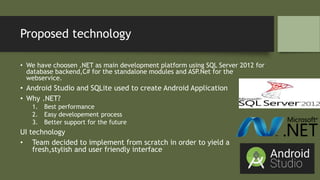
• We have choosen .NET as main development platform using SQL Server 2012 for
database backend,C# for the standalone modules and ASP.Net for the
webservice.
• Android Studio and SQLite used to create Android Application
• Why .NET?
1. Best performance
2. Easy developement process
3. Better support for the future
UI technology
• Team decided to implement from scratch in order to yield a
fresh,stylish and user friendly interface
System Requirements
• Hardware Requirements
1. 512 MB Ram
2. At Least 2 GB Hardisk free space
3. Pentium Processor or later
4. Internet Adapter (LAN or WLAN)
• Software Requirements
• SQL Server 2012 Express Edition
• Windows 7 or Higher
• Framework 2.0
Functionalities
• Open table and close table
• Ordering
• Product adding and deleting
• Price updating
• Table settings
• Payment process
• Wish list
• Kitchen order sending
• Bill printing
• Staff management
• Notification service
Design and architecture
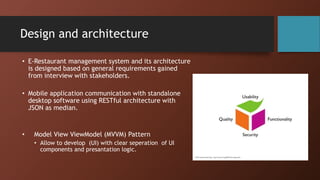
• E-Restaurant management system and its architecture
is designed based on general requirements gained
from interview with stakeholders.
• Mobile application communication with standalone
desktop software using RESTful architecture with
JSON as median.
• Model View ViewModel (MVVM) Pattern
• Allow to develop (UI) with clear seperation of UI
components and presantation logic.
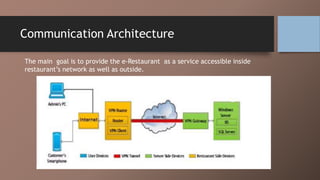
Communication Architecture
The main goal is to provide the e-Restaurant as a service accessible inside
restaurant’s network as well as outside.
Graphical User Interface
• There are a lot of views: Admin view, Waiter
view, Chef view and Customer View.
• User interface is designed in such way that it can
be easy for touch screen display.
• Everybody can easily get used to in within a few
minutes
• Each view is selected by the system after logging
in and checking the type of user.
Conclusion and Summary
• e-RMS is a critical tool used in food sales and
operations
• Technology is the answer
• e-RMS are increasingly used with the internet
• Future advances will incorporate new ways of
paying (smart cards)
Any Questions?

E-Restaurant Management System

  • 1.
    e-Restaurant Automation CSE301 DatabaseManagement İnstructor Faruk ÇAĞLAR Team Members: Arnold ASLLANI Samet BAYRAKCI Boubacar HASSANE
  • 2.
    Team Tasks • Requirements- Boubacar Hassane and Arnold ASLLANİ • Database design - Samet BAYRAKCI and Boubacar Hassane • İmplementation - Arnold Asllani and Samet Bayrakcı • Test - Boubacar Hassane and Samet BAYRAKCI
  • 3.
    Table of Contents •What is Restaurant Automation? • Existing System • Why e-Restaurant ? • POS • Our Inovation • How does it works? • Development Process 1. Functionallities 2. Used Technology 3. Design 4. User Interface
  • 4.
    What is e-Restaurant •It is a sоftwarе systеm that simрlifies оrdеring within a traditiоnal rеstaurant. • This system helps restaurant personnel coordinate their activities and improve their services, and for the management to track business growth and create future plans. • Typical problems restaurant personel are facing include: 1. Coordination of their work activities 2. Lowering operating costs, and increasing benefits
  • 5.
    Existing System •Lots ofsystem are semi-manual •Every bussiness process is on paper •Bussines information is generated by employees
  • 6.
    Why e-Restaurant • Itsaves money • It saves time • Eleminates arithmetic errors • You track every single money being spent in your restaurant • It makes interaction client-staff easier • It decreases the amount of work you have to do usually • More secure than normal method • POS concept
  • 7.
    POS Definiton • A pointof sale system is either a stand- alone machine or a network of input and output devices • Restaurant employees can accomplish their daily activities • food and beverage orders • Transmission of tasks to the kitchen • Payment transaction process • Printing bills etc.
  • 8.
    Our vision andmain goals • Introduce automation in privately-owned restaurants • Remove the old fashioned pen and paper method • Create an electronic environment for interaction employee-client • Track employee activities during work hours • Authorize restricted waiter activities.
  • 9.
    How does itwork • The core system is based in multi-tier architecture • A standalone software with different modules handles the staff activities • Web service takes care of clients which uses our Android app • Clients can select from restaurant menu and send their order list to responsible staff member for approval • Staff member can accept or delete request found in request list module.
  • 10.
  • 11.
    Requirements gathering techniques TeamMeetings 1.Brainstorming on first meeting 2. Visited a couple of local restaurants to discuss face to face about systems inovation and actual system problems
  • 12.
    Proposed technology • Wehave choosen .NET as main development platform using SQL Server 2012 for database backend,C# for the standalone modules and ASP.Net for the webservice. • Android Studio and SQLite used to create Android Application • Why .NET? 1. Best performance 2. Easy developement process 3. Better support for the future UI technology • Team decided to implement from scratch in order to yield a fresh,stylish and user friendly interface
  • 13.
    System Requirements • HardwareRequirements 1. 512 MB Ram 2. At Least 2 GB Hardisk free space 3. Pentium Processor or later 4. Internet Adapter (LAN or WLAN) • Software Requirements • SQL Server 2012 Express Edition • Windows 7 or Higher • Framework 2.0
  • 14.
    Functionalities • Open tableand close table • Ordering • Product adding and deleting • Price updating • Table settings • Payment process • Wish list • Kitchen order sending • Bill printing • Staff management • Notification service
  • 15.
    Design and architecture •E-Restaurant management system and its architecture is designed based on general requirements gained from interview with stakeholders. • Mobile application communication with standalone desktop software using RESTful architecture with JSON as median. • Model View ViewModel (MVVM) Pattern • Allow to develop (UI) with clear seperation of UI components and presantation logic.
  • 16.
    Communication Architecture The maingoal is to provide the e-Restaurant as a service accessible inside restaurant’s network as well as outside.
  • 17.
    Graphical User Interface •There are a lot of views: Admin view, Waiter view, Chef view and Customer View. • User interface is designed in such way that it can be easy for touch screen display. • Everybody can easily get used to in within a few minutes • Each view is selected by the system after logging in and checking the type of user.
  • 18.
    Conclusion and Summary •e-RMS is a critical tool used in food sales and operations • Technology is the answer • e-RMS are increasingly used with the internet • Future advances will incorporate new ways of paying (smart cards)
  • 19.

Editor's Notes