Electronic Commerce Systems Ryan Dinwiddie Intermediate Web Design UCC
Electronic Commerce (E-Commerce) Commerce refers to all the activities the purchase and sales of goods or services. Marketing, sales, payment, fulfillment, customer service Electronic commerce is doing commerce with the use of computers, networks and commerce-enabled software (more than just online shopping)
Brief History 1970s: Electronic Funds Transfer (EFT) Used by the banking industry to exchange account information over secured networks Late 1970s and early 1980s: Electronic Data Interchange (EDI) for e-commerce within companies Used by businesses to transmit data from one business to another 1990s: the World Wide Web on the  Internet provides easy-to-use technology for information publishing and dissemination Cheaper to do business (economies of scale) Enable diverse business activities (economies of scope)
E-commerce applications Supply chain management Video on demand Remote banking Procurement and purchasing Online marketing and advertisement Home shopping Auctions
Ecommerce infrastructure Information superhighway infrastructure Internet, LAN, WAN, routers, etc. telecom, cable TV, wireless, etc. Messaging and information distribution infrastructure HTML, XML, e-mail, HTTP, etc. Common business infrastructure Security, authentication, electronic payment, directories, catalogs, etc.
The Main Elements of  E-commerce Consumer shopping on the Web, called B2C (business to consumer) Transactions conducted between businesses on the Web, call B2B (business to business) Transactions and business processes that support selling and purchasing activities on the Web Supplier, inventory, distribution, payment management Financial management, purchasing products and information
Advantages of E-Commerce Increased sales Reach narrow market segments in geographically dispersed locations Create virtual communities Decreased costs Handling of sales inquiries Providing price quotes Determining product availability Being in the space
Disadvantages of E-Commerce Loss of ability to inspect products from remote locations Rapid developing pace of underlying technologies Difficult to calculate return on investment Cultural and legal impediments
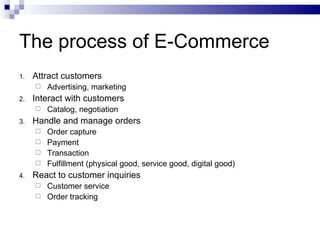
The process of E-Commerce Attract customers Advertising, marketing Interact with customers Catalog, negotiation Handle and manage orders Order capture Payment Transaction Fulfillment (physical good, service good, digital good) React to customer inquiries Customer service Order tracking
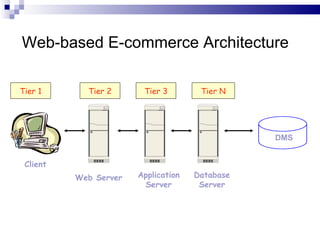
Web-based E-commerce Architecture Client Tier 1 Web Server Tier 3 Tier 2 Tier N Application Server Database Server DMS
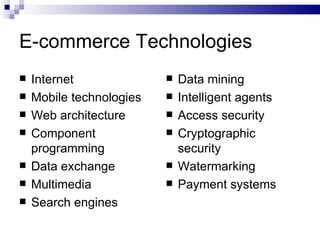
E-commerce Technologies Internet Mobile technologies Web architecture Component programming  Data exchange Multimedia Search engines Data mining Intelligent agents Access security Cryptographic security Watermarking Payment systems
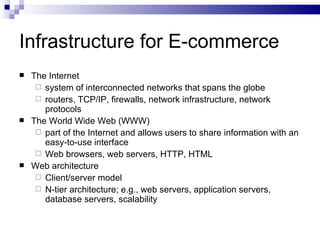
Infrastructure for E-commerce The Internet  system of interconnected networks that spans the globe routers, TCP/IP, firewalls, network infrastructure, network protocols The World Wide Web (WWW)  part of the Internet and allows users to share information with an easy-to-use interface Web browsers, web servers, HTTP, HTML Web architecture Client/server model N-tier architecture; e.g., web servers, application servers, database servers, scalability
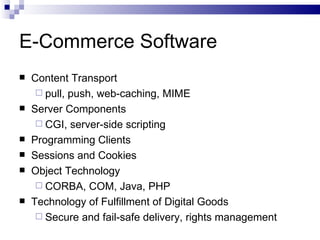
E-Commerce Software Content Transport  pull, push, web-caching, MIME Server Components CGI, server-side scripting Programming Clients Sessions and Cookies Object Technology CORBA, COM, Java, PHP Technology of Fulfillment of Digital Goods Secure and fail-safe delivery, rights management
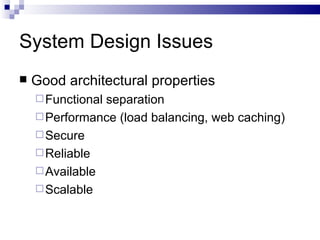
System Design Issues Good architectural properties Functional separation  Performance (load balancing, web caching) Secure Reliable Available Scalable
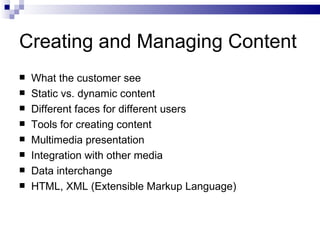
Creating and Managing Content What the customer see Static vs. dynamic content Different faces for different users Tools for creating content Multimedia presentation Integration with other media Data interchange HTML, XML (Extensible Markup Language)
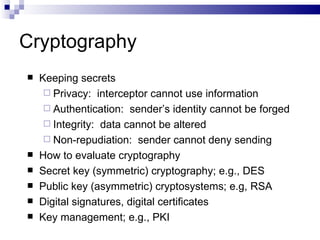
Cryptography Keeping secrets Privacy:  interceptor cannot use information Authentication:  sender’s identity cannot be forged Integrity:  data cannot be altered Non-repudiation:  sender cannot deny sending How to evaluate cryptography Secret key (symmetric) cryptography; e.g., DES Public key (asymmetric) cryptosystems; e.g, RSA Digital signatures, digital certificates Key management; e.g., PKI
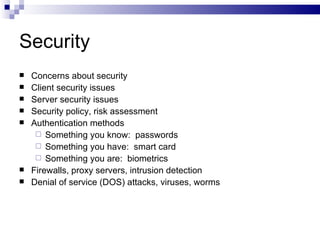
Security Concerns about security Client security issues Server security issues Security policy, risk assessment Authentication methods Something you know:  passwords Something you have:  smart card Something you are:  biometrics Firewalls, proxy servers, intrusion detection Denial of service (DOS) attacks, viruses, worms
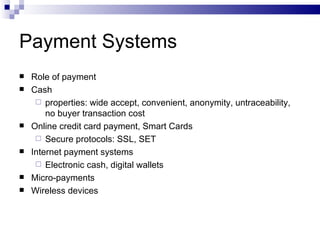
Payment Systems Role of payment Cash properties: wide accept, convenient, anonymity, untraceability, no buyer transaction cost Online credit card payment, Smart Cards Secure protocols: SSL, SET Internet payment systems Electronic cash, digital wallets Micro-payments Wireless devices
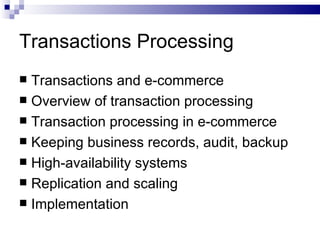
Transactions Processing Transactions and e-commerce Overview of transaction processing Transaction processing in e-commerce Keeping business records, audit, backup High-availability systems Replication and scaling Implementation
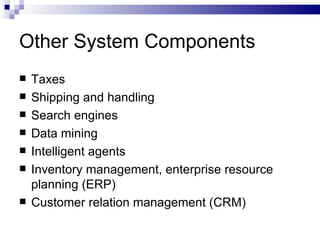
Other System Components Taxes Shipping and handling Search engines Data mining Intelligent agents Inventory management, enterprise resource planning (ERP) Customer relation management (CRM)

Int Lecture 4

  • 1.
    Electronic Commerce SystemsRyan Dinwiddie Intermediate Web Design UCC
  • 2.
    Electronic Commerce (E-Commerce)Commerce refers to all the activities the purchase and sales of goods or services. Marketing, sales, payment, fulfillment, customer service Electronic commerce is doing commerce with the use of computers, networks and commerce-enabled software (more than just online shopping)
  • 3.
    Brief History 1970s:Electronic Funds Transfer (EFT) Used by the banking industry to exchange account information over secured networks Late 1970s and early 1980s: Electronic Data Interchange (EDI) for e-commerce within companies Used by businesses to transmit data from one business to another 1990s: the World Wide Web on the Internet provides easy-to-use technology for information publishing and dissemination Cheaper to do business (economies of scale) Enable diverse business activities (economies of scope)
  • 4.
    E-commerce applications Supplychain management Video on demand Remote banking Procurement and purchasing Online marketing and advertisement Home shopping Auctions
  • 5.
    Ecommerce infrastructure Informationsuperhighway infrastructure Internet, LAN, WAN, routers, etc. telecom, cable TV, wireless, etc. Messaging and information distribution infrastructure HTML, XML, e-mail, HTTP, etc. Common business infrastructure Security, authentication, electronic payment, directories, catalogs, etc.
  • 6.
    The Main Elementsof E-commerce Consumer shopping on the Web, called B2C (business to consumer) Transactions conducted between businesses on the Web, call B2B (business to business) Transactions and business processes that support selling and purchasing activities on the Web Supplier, inventory, distribution, payment management Financial management, purchasing products and information
  • 7.
    Advantages of E-CommerceIncreased sales Reach narrow market segments in geographically dispersed locations Create virtual communities Decreased costs Handling of sales inquiries Providing price quotes Determining product availability Being in the space
  • 8.
    Disadvantages of E-CommerceLoss of ability to inspect products from remote locations Rapid developing pace of underlying technologies Difficult to calculate return on investment Cultural and legal impediments
  • 9.
    The process ofE-Commerce Attract customers Advertising, marketing Interact with customers Catalog, negotiation Handle and manage orders Order capture Payment Transaction Fulfillment (physical good, service good, digital good) React to customer inquiries Customer service Order tracking
  • 10.
    Web-based E-commerce ArchitectureClient Tier 1 Web Server Tier 3 Tier 2 Tier N Application Server Database Server DMS
  • 11.
    E-commerce Technologies InternetMobile technologies Web architecture Component programming Data exchange Multimedia Search engines Data mining Intelligent agents Access security Cryptographic security Watermarking Payment systems
  • 12.
    Infrastructure for E-commerceThe Internet system of interconnected networks that spans the globe routers, TCP/IP, firewalls, network infrastructure, network protocols The World Wide Web (WWW) part of the Internet and allows users to share information with an easy-to-use interface Web browsers, web servers, HTTP, HTML Web architecture Client/server model N-tier architecture; e.g., web servers, application servers, database servers, scalability
  • 13.
    E-Commerce Software ContentTransport pull, push, web-caching, MIME Server Components CGI, server-side scripting Programming Clients Sessions and Cookies Object Technology CORBA, COM, Java, PHP Technology of Fulfillment of Digital Goods Secure and fail-safe delivery, rights management
  • 14.
    System Design IssuesGood architectural properties Functional separation Performance (load balancing, web caching) Secure Reliable Available Scalable
  • 15.
    Creating and ManagingContent What the customer see Static vs. dynamic content Different faces for different users Tools for creating content Multimedia presentation Integration with other media Data interchange HTML, XML (Extensible Markup Language)
  • 16.
    Cryptography Keeping secretsPrivacy: interceptor cannot use information Authentication: sender’s identity cannot be forged Integrity: data cannot be altered Non-repudiation: sender cannot deny sending How to evaluate cryptography Secret key (symmetric) cryptography; e.g., DES Public key (asymmetric) cryptosystems; e.g, RSA Digital signatures, digital certificates Key management; e.g., PKI
  • 17.
    Security Concerns aboutsecurity Client security issues Server security issues Security policy, risk assessment Authentication methods Something you know: passwords Something you have: smart card Something you are: biometrics Firewalls, proxy servers, intrusion detection Denial of service (DOS) attacks, viruses, worms
  • 18.
    Payment Systems Roleof payment Cash properties: wide accept, convenient, anonymity, untraceability, no buyer transaction cost Online credit card payment, Smart Cards Secure protocols: SSL, SET Internet payment systems Electronic cash, digital wallets Micro-payments Wireless devices
  • 19.
    Transactions Processing Transactionsand e-commerce Overview of transaction processing Transaction processing in e-commerce Keeping business records, audit, backup High-availability systems Replication and scaling Implementation
  • 20.
    Other System ComponentsTaxes Shipping and handling Search engines Data mining Intelligent agents Inventory management, enterprise resource planning (ERP) Customer relation management (CRM)