PPTs on
E-MARKETING
MBA – III SEMESTER
(ELECTIVE – II)
Prepared by,
Ms. K. Mamatha,
Assistant Professor
E-Marketing (Electronic Marketing) are also known as
Internet Marketing, Web Marketing, Digital Marketing,
or Online Marketing. E-marketing is the process of marketing
a product or service using the Internet. E marketing not only
includes marketing on the Internet, but also includes
marketing done via e-mail and wireless media. It uses a range
of technologies to help connect businesses to their customers.
There are several ways in which companies can use internet
for marketing. Some ways of e-marketing are:
1. Article marketing
2. Affiliate marketing
3. Video marketing
4. Email marketing
5. Blogging
Transacting or facilitating business on the Internet is
called ecommerce. Ecommerce is short for "electronic
commerce."
In short, having a physical store is traditional commerce.
Traditional commerce is a type of business which focuses on
the exchange of products and services, and includes all those
activities which encourages exchange, in some way or the
other.
e-Business derived from such terms as "e-mail" and
"e-commerce," is the conduct of business
electronically, typically over the Internet, not only
buying and selling, but also servicing customers and
collaborating with business partners.
There are 6 basic types of e-commerce:
Business-to-Business (B2B)
Business-to-Consumer (B2C)
Consumer-to-Consumer (C2C)
Consumer-to-Business (C2B).
Business-to-Administration (B2A)
Consumer-to-Administration (C2A)
Business-to-Business (B2B)
Business-to-Business (B2B) e-commerce encompasses
all electronic transactions of goods or services
conducted between companies. Producers and
traditional commerce wholesalers typically operate
with this type of electronic commerce.
The Business-to-Consumer type of e-commerce is distinguished by the
establishment of electronic business relationships between businesses
and final consumers. It corresponds to the retail section of e-commerce,
where traditional retail trade normally operates.
These types of relationships can be easier and more dynamic, but also
more sporadic or discontinued. This type of commerce has developed
greatly, due to the advent of the web, and there are already many
virtual stores and malls on the Internet, which sell all kinds of
consumer goods, such as computers, software, books, shoes, cars, food,
financial products, digital publications, etc.
When compared to buying retail in traditional commerce, the consumer
usually has more information available in terms of informative content
and there is also a widespread idea that you’ll be buying cheaper,
without jeopardizing an equally personalized customer service, as well
as ensuring quick processing and delivery of your order.
3. Consumer-to-Consumer (C2C)
Consumer-to-Consumer (C2C) type e-commerce
encompasses all electronic transactions of goods or
services conducted between consumers. Generally,
these transactions are conducted through a thirdparty,
which provides the online platform where the
transactions are actually carried out.
4. Consumer-to-Business (C2B)
In C2B there is a complete reversal of the traditional sense of
exchanging goods. This type of e-commerce is very common
in crowd sourcing based projects. A large number of
individuals make their services or products available for
purchase for companies seeking precisely these types of
services or products.
5. Business-to-Administration (B2A)
This part of e-commerce encompasses all transactions
conducted online between companies and public
administration. This is an area that involves a large amount
and a variety of services, particularly in areas such as fiscal,
social security, employment, legal documents and registers,
etc. These types of services have increased considerably in
recent years with investments made in e-government.
6. Consumer-to-Administration (C2A)
The Consumer-to-Administration model encompasses all electronic
transactions conducted between individuals and public administration.
Examples of applications include:
Education – disseminating information, distance learning, etc.
Social Security – through the distribution of information, making
payments, etc.
Taxes – filing tax returns, payments, etc.
Health – appointments, information about illnesses, payment of health
services, etc.
Both models involving Public Administration (B2A and C2A) are
strongly associated to the idea of efficiency and easy usability of the
services provided to citizens by the government, with the support of
information and communication technologies.
The main advantage of e-commerce is its ability to reach a
global market, without necessarily implying a large financial
investment. The limits of this type of commerce are not
defined geographically, which allows consumers to make a
global choice, obtain the necessary information and compare
offers from all potential suppliers, regardless of their locations.
By allowing direct interaction with the final consumer, e-
commerce shortens the product distribution chain, sometimes
even eliminating it completely. This way, a direct channel
between the producer or service provider and the final user is
created, enabling them to offer products and services that suit
the individual preferences of the target market.
The main disadvantages associated with e-commerce are
the following:
Strong dependence on information and communication
technologies (ICT);
Lack of legislation that adequately regulates the new e-
commerce activities, both nationally and internationally;
Market culture is averse to electronic commerce
(customers cannot touch or try the products);
The users’ loss of privacy, the loss of regions’and
countries’ cultural and economic identity;
Insecurity in the conduct of online business transactions.
Because the Internet connects computers all over the world,
any business that engages in electronic commerce instantly
becomes an international business. When companies use the
Web to improve a business process, they are automatically
operating in a global environment. The key issues that any
company faces when it conducts international commerce
include trust and culture, language, and infrastructure.
It is important for all businesses to establish trusting
relationships with their customers. Companies with
established reputations in the physical world often create trust
by ensuring that customers know who they are. These
businesses can rely on their established brand names to create
trust on the Web. New companies that want to establish online
businesses face a more difficult challenge because a kind of
anonymity exists for companies trying to establish a Web
presence.
Most companies realize that the only way to do business
effectively in other cultures is to adapt to those cultures.
“Think Globally, Act Locally” The first step that a Web
business usually takes to reach potential customers in other
countries, and thus in other cultures, is to provide local
language or regional dialect.
An important element of business trust is anticipating how the
other party to a transaction will act in specific circumstances.
That is one reason why companies with established brands can
build online businesses more quickly and easily than a new
company without a reputation. The brand conveys some
expectations about how the company will behave.
Some parts of the world have cultural environments that are
extremely inhospitable to the type of online discussion that
occurs on the internet. The cultural conditions, in some cases,
lead to government controls that can limit electronic
commerce development. The internet is a very open form of
communication. This type of unfettered communication is not
desired or considered acceptable in some cultures
Internet infrastructure includes the computers and software
connected to the internet and communications networks over
which the massage packets travel. In many countries other
than the United States, the telecommunications industry is
either government owned or heavily regulated by the
government. More that half of all businesses on the Web turn
away international orders because they do not have the
processes in place to handle the orders.
The Internet’s potential is imperiled by digital anarchy, closed markets that
cannot use each other’s services, incompatible applications and
frameworks that cannot interoperate or build upon each other and an array
of security and payment options that confuse consumers
One solution to these problems is an object-oriented architectural
framework for Internet commerce. Several major vendors of E-commerce
solutions have announced versions of such a framework. The major
platforms are:
IBM Commerce Point
Microsoft Internet Commerce Framework
Netscape ONE (Open Network Environment)
Oracle NCA (Network ComputingArchitecture)
Sun/Javasoft JECF (Java E-commerce Framework).
Recently, four of these companies have agreed to support a
common distributed object model based on CORBA IIOP
(Common Object Request Broker Architecture Internet Inter-
ORB Protocol). Yet for commerce on the Internet to thrive,
such systems must also interoperate at a business application
level. A consumer or business using one framework should be
able to shop for, purchase and pay for goods and services
offered on a different framework. This is currently not
possible.
In response, Commerce Net, a non-profit organization
created to help businesses and consumers use the Internet
for buying and selling, is organizing Eco System, a cross-
industry effort to build a framework of frameworks,
involving both E- commerce vendors and end users.
The success of this process clearly depends on market
leaders in each area participating actively in their
respective task forces. Everyone’s software has to work
together because no single company can control what
platform its customers will use.
Definition: TCP/IP (Transmission Control Protocol/Internet
Protocol), also referred to as the Internet Protocol Suite, is the
World Wide Web's core communication system that enables
every Internet-connected device to communicate with every
other such device simultaneously. It is, in essence, a
computerized syntax (language) that is installed on every
computer, both for public (Internet) and private
(intranets and extranets) networks. The development of this
protocol has enabled the internet — and as a result, online
commerce — to grow quickly.
Many higher-level apps that ecommerce businesses need to be
familiar with utilize and/or are built on TCP/IP. These apps
constitute a higher layer of protocol language and are often
packaged along with TCP/IP as a single "suite." Examples
include:
HTTP (the Internet's Hyper-text Transfer Protocol)
FTP (the Internet's File Transfer Protocol)
Telnet, which enables logging on computers from remote
locations
SMTP (Simple Mail Transfer Protocol)
ICMP (Internet Control Message Protocol)
IGP (Interior Gateway Protocol)
EGP (Exterior Gateway Protocol)
BGP (Border Gateway Protocol)
This is the world-wide network of computers accessible to
anyone who knows their Internet Protocol (IP) address - the IP
address is a unique set of numbers (such as 209.33.27.100)
that defines the computer's location. Most will have accessed a
computer using a name such as Before this named computer
can be accessed, the name needs to be resolved (translated)
into an IP address.
This is a network that is not available to the world
outside of the Intranet. If the Intranet network is
connected to the Internet, the Intranet will reside
behind a firewall and, if it allows access from the
Internet, will be an Extranet. The firewall helps to
control access between the Intranet and Internet to
permit access to the Intranet only to people who are
members of the same company or organisation.
In its simplest form, an Intranet can be set up on a
networked PCwithout any PCon the network having
access via the Intranet network to the Internet.
An Extranet is actually an Intranet that is partially
accessible to authorised outsiders. The actual
server (the computer that serves up the web
pages) will reside behind a firewall.
The firewall helps to control access between the
Intranet and Internet permitting access to the
Intranet only to people who are suitably
authorised.
The level of access can be set to different levels
for individuals or groups of outside users. The
access can be based on a username and
password or an IPaddress (a unique set of
numbers such as 209.33.27.100 that defines the
computer that the user is on).
Internet connection options vary by Internet Service
Provider and by region. Customers should consider
some of the following factors before selecting an
Internet package: speed or bandwidth, cost,availability,
reliability and convenience. In order to determine what
Internet plan is right for you, we recommend you
review the different types of Internet connections
available on the market today.
WIRELESS
Radio frequency bands are used in place of
telephone or cable networks. One of the greatest
advantages of wireless Internet connections is
the "always-on" connection that can be accessed
from any location that falls within network
coverage. Wireless connections are made
possible through the use of a modem, which
picks up Internet signals and sends them to other
devices mobile.
Many cell phone and smart phone providers offer
voice plans with Internet access. Mobile Internet
connections provide good speeds and allow you
to access the Internet on the go.
Hotspots are sites that offer Internet access
over a wireless local area network (WLAN) by
way of a router that then connects to an
Internet service provider. Hotspots utilize Wi-
Fi technology, which allows electronic devices
to connect to the Internet or exchange data
wirelessly through radio waves. Hotspots can
be phone-based or free-standing,
commercial or free to the public.
Dial-up connections require users to link
their phone line to a computer in order to
access the Internet. This particular type of
connection—also referred to as analog—does
not permit users to make or receive phone
calls through their home phone service while
using the Internet.
This high-speed Internet connection is provided
through either cable or telephone companies.
One of the fastest options available, broadband
Internet uses multiple data channels to send
large quantities of information. The term
broadband is shorthand for broad bandwidth.
Broadband Internet connections such as DSL and
cable are considered high-bandwidth
connections. Although many DSL connections can
be considered broadband, not all broadband
connections are DSL.
DSL, which stands for Digital Subscriber Line,
uses existing 2-wire copper telephone line
connected to one's home so service is
delivered at the same time as landline
telephone service. Customers can still place
calls while surfing the Internet.
Cable Internet connection is a form of
broadband access. Through use of a cable
modem, users can access the Internet over
cable TV lines. Cable modems can provide
extremely fast access to the Internet.
In certain areas where broadband connection
is not yet offered, a satellite Internet option
may be available. Similar to wireless access,
satellite connection utilizes a modem.
ISDN (Integrated Services Digital Network)
allows users to send data, voice and video
content over digital telephone lines or
standard telephone wires. The installation of
an ISDN adapter is required at both ends of
the transmission—on the part of the user as
well as the Internet access provider
Why Do I Fear Financial Fraud Online?
One of my primary sources of fear is that fraud seems
to be all around us. When we hear of the websites of
the best of companies getting hacked all the time, I
know that I am small fry. Be it Sony or Google, just to
name two tech giants, both have been the targets of
hacking. If they could not protect themselves, how will
I? I think that I am not alone in my fear. The fact that I
am an e-commerce professional not withstanding, I fear
that someone somewhere wants to defraud me.
Fraud Is All AroundUs
Be it the constant flow of emails from a Nigerian general who
would like me to help him get to a large fortune, to phishing
emails that try to get me to part with my bank account details or
email passwords. Though one does develop a thick skin to these
blatant criminal attempts, there has to always be an underlying
worry that someday one would get taken for a ride.
The Global-Village Nature of the Internet Adds to theWorry
In some countries the laws regarding intellectual property as well
as online fraud might be quite stringent and well established. But
what if the fraud originates from a territory that is well known for
just the opposite. What courts would approach?
Everything May Be Fine and Dandy, But Security Could
Derail Ecommerce
Whenever I am conducting a workshop and I am asked
about my major area of concern regarding e-commerce, my
first response is always the same: security. Since financial
transactions are the backbone of e-commerce, if not the
entire purpose of it, any hesitation on the part of the
customer when it comes to making online payments could
spoil the e-commerce party. Surely we do not want to go to
the point where the only acceptable mode of payment in
B2C sales becomes cash on delivery.
There Are Too Many Players in the E-commerce
Environment, and Anyone Could Spring a Security Leak
It is not just about your e-commerce website getting
hacked. The fire could start in any corner of your e-
commerce edifice. It could be the payment gateway that
gets hacked. Or it could be an infected user-computer that
could bring in malware. Come to think of it, even
your shopping cart software provider might be exporting
vulnerability into your environment. And when these
participants do not know each other, or are not even located
on the same continent, then how would you expect them to
be able to rely on each other.
What Is the Solution to the E-commerce Security
Tangle?
I would like to scream "constant vigilance" like
Alastor Moody from the Harry Potter books.
It is not every day that one comes across a
security threat. But that should not allow you to
get callous about security related matters. Of
course, technology provides a solution too. Be it
the use of SSL(Secure Sockets Layer) or two-
factor authentication, every little bit helps in
making the web a more secure place to create
transactions. But technology is not the final
solution.
encryption is the process of hiding
information that is readable into a format that
can't be read. Encryption can be used for
many different things, but you're probably
most familiar with its function of transferring
information securely.
There are two types of encryption in
widespread use
today: symmetric and asymmetric encryption.
The name derives from whether or not the
same key is used for encryption and
decryption.
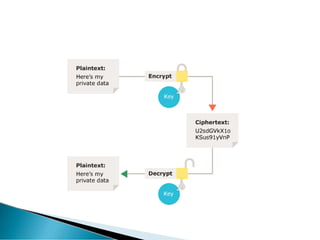
In symmetric encryption the same key is used
for encryption and decryption. It is therefore
critical that a secure method is considered to
transfer the key between sender and
recipient.
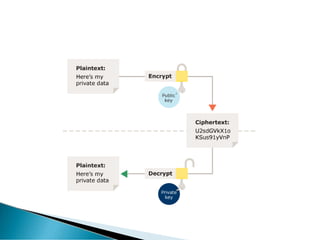
Asymmetric encryption uses the notion of a key
pair: a different key is used for the encryption
and decryption process. One of the keys is
typically known as the private key and the other
is known as the public key.
The private key is kept secret by the owner and
the public key is either shared amongst
authorised recipients or made available to the
public at large.
Data encrypted with the recipient’s public key
can only be decrypted with the corresponding
private key. Data can therefore be transferred
without the risk of unauthorised or unlawful
access to the data.
Hashing is a technique that generates a fixed
length value summarising a file or message
contents. It is often incorrectly referred to as
an encryption method. Hash functions are
used with cryptography to provide digital
signatures and integrity controls but as no
secret key is used it does not make the
message private as the hash can be
recreated.
Online Marketing is the art and science of selling
products and/or services over digital networks,
such as the internet and cellular phone networks.
The art of online marketing involves finding the
right online marketing mix of strategies that
appeals to your target market and will actually
translate into sales.
The science of online marketing is the research
and analysis that goes into both choosing the
online marketing strategies to use and measuring
the success of those strategies.
Search Engine Marketing
Online Advertising
Blogging
Social media marketing.
Email marketing
Mobile marketing
Online advertising, also called online
marketing or Internet advertising or web
advertising, is a form of marketing and
advertising which uses the Internet to
deliver promotional marketing messages to
consumers. Consumers view online
advertising as an unwanted distraction with
few benefits and have increasingly turned
to ad blocking for a variety of reasons.
Purchased Online Ads
Social Media Marketing
Newspaper Ads
Television Advertising
Public Speaking
Door Hangers and Flyers
Event Sponsorship
Repetition
Repetition is a simple yet effective technique
used to build identity awareness and customer
memory. Even advertisements using other
successful approaches mention the product or
company name more than once, particularly in
television because its combination of sight and
sound, allows the advertiser to disguise the
repetition by changing its delivery (from visual to
audio).
Advertising that promotes specific features or
makes claims about what a product or service
can do for the potential customers provides
successful results by informing, educating
and developing expectations in the buyer
Associating a product or company with a
famous person, catchy jingle, desirable state
of being or powerful emotion creates astrong
psychological connection in the customer.
The bandwagon technique sells a product or
service by convincing the customer that
others are using it and they should join the
crowd.
Coupons, sweepstakes, games with prizes
and gifts with purchases create excitement,
and participation encourages customers to
build a relationship with the sponsoring
product or service.
Online auctions are sales transactions
involving competitive bidding that are
conducted over the Internet. Whether the
sales take place between individuals, between
consumers and merchants, or between
businesses, online auctions have enjoyed a
rapid increase in popularity.
Online auctions offer small businesses a number of
potential benefits with very few risks. After all,
participating in online auctions does not prevent
businesses from continuing to use traditional sales
methods. In addition, companies can avoid financial
losses on sale items by setting the minimum bid price
high enough to cover costs. Among the few potential
drawbacks are that buyers are not able to personally
view and evaluate items before making a purchase,
which raises the possibility of fraud.
Supply chain management (SCM) is the active
management of supply chain activities to
maximize customer value and achieve a
sustainable competitive advantage. It represents
a conscious effort by the supply chain firms to
develop and run supply chains in the most
effective & efficient ways possible. Supply chain
activities cover everything from product
development, sourcing, production, and logistics,
as well as the information systems needed to
coordinate these activities.
The concept of Supply Chain Management (SCM) is based
on two core ideas:
The first is that practically every product that reachesan
end user represents the cumulative effort of multiple
organizations. These organizations are referred to
collectively as the supply chain.
The second idea is that while supply chains have existed
for a long time, most organizations have only paid
attention to what was happening within their “four walls.”
Few businesses understood, much less managed, the
entire chain of activities that ultimately delivered products
to the final customer. The result was disjointed and often
ineffective supply chains.
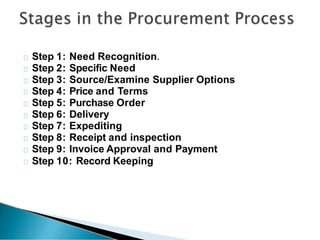
Step 1: Need Recognition.
Step 2: Specific Need
Step 3: Source/Examine Supplier Options
Step 4: Price and Terms
Step 5: Purchase Order
Step 6: Delivery
Step 7: Expediting
Step 8: Receipt and inspection
Step 9: Invoice Approval and Payment
Step 10: Record Keeping
In order to deal with the challenges of time for
synchronization and complexity in information distribution
a multi-tier supply chain management system can be
established. It helps to steer the collaboration between all
involved parties by establishing a central collaboration
platform. Mostly this platform is initiated by the Original
Equipment Manufacturer (OEM) and covers
several suppliers in a partnership. One distinguished chain
member has to drive the collaboration process and
platform by defining processes, rules and standards
(Stadler, Kilger, p.270)4). It helps to get transparency for all
partners in the value chain about demands, capacities and
stock data.
Consumer expectations are becoming increasingly higher.
When once consumers were happy with waiting a week to
receive a package in the mail, today anything longer than
two day delivery means that many consumers will forget
their order by the time it arrives, and maybe decide they
would rather not receive any item at all than wait.
Companies, retailers, and suppliers are now expected to
comply and come up with creative ways to meet consumer
demands. For example, Amazon recently announced that it
was expanding its same day delivery service on its Prime
Now app and EBay also tried a pilot in the US for same day
delivery (EBay however canceled the pilot in 2015, because
it wasn't performing as well as expected).
Some of the biggest global trends affecting
consumer activities are:
Changing consumer experience
Growing ecommerce
Crowding in urban centers
Insurance is a means of protection from financial loss. It is a
form of risk management primarily used to hedge against the
risk of a contingent, uncertain loss.
An entity which provides insurance is known as an insurer,
insurance company, or insurance carrier. A person or entity who
buys insurance is known as an insured or policyholder. The
insurance transaction involves the insured assuming a
guaranteed and known relatively small loss in the form of
payment to the insurer in exchange for the insurer's promise to
compensate the insured in the event of a covered loss. The loss
may or may not be financial, but it must be reducible to financial
terms, and must involve something in which the insured has
an insurable interest established by ownership, possession, or
preexisting relationship.
In accordance with study books of The Chartered Insurance
Institute, there are the following types of insurance:
Co-insurance – risks shared between insurers
Dual insurance – risks having two or more policies with same
coverage (Both the individual policies would not pay separately-
a concept named contribution, and would contribute together to
make up the policyholder's losses. However, in case of
contingency insurances like Life insurance, dual payment is
allowed)
Self-insurance – situations where risk is not transferred to
insurance companies and solely retained by the entities or
individuals themselves
Reinsurance – situations when Insurer passes some part of or all
risks to another Insurer called Reinsurer
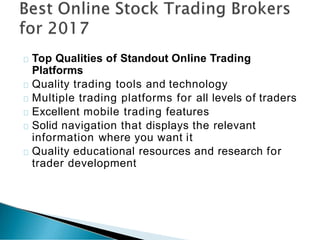
Top Qualities of Standout Online Trading
Platforms
Quality trading tools and technology
Multiple trading platforms for all levels of traders
Excellent mobile trading features
Solid navigation that displays the relevant
information where you want it
Quality educational resources and research for
trader development
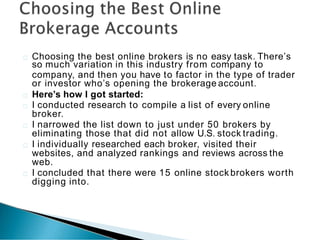
Choosing the best online brokers is no easy task. There’s
so much variation in this industry from company to
company, and then you have to factor in the type of trader
or investor who’s opening the brokerage account.
Here’s how I got started:
I conducted research to compile a list of every online
broker.
I narrowed the list down to just under 50 brokers by
eliminating those that did not allow U.S. stock trading.
I individually researched each broker, visited their
websites, and analyzed rankings and reviews across the
web.
I concluded that there were 15 online stock brokers worth
digging into.
As the leading global real estate services company,
we firmly believe and ensure that our clients come
first. In India, we are the most trusted partner when it
comes to providing the right expertise in real estate.
Our goal is to achieve customer delight with several
years of experience in the local market. From
property search and selection, to project
management and valuation and appraisal, we provide
comprehensive solutions to your most complex
requirements.
An online travel agen
[
c
3]
y(OTA) specializes in offering planning sources and
booking capabilities. Major OTAs include:
Voyages-sncf.com – revenue €2.23 billion (2008)
Expedia, Inc., including Expedia.com, Hote
]
ls.com, Hotwire.com, Travelocity and
others – revenue US$2.937 billion (2008), later expanded to
include Orbitz Worldwide, Inc., including
[6]
Orbitz, CheapTickets, ebookers,and
others – revenue US$870 million (2008)
Sabre Holdings, including lastminute.com and others – revenue US$2.9 billion
(2008)
Opodo – revenue €1.3 billion (2008)
The Priceline Group,
including Priceline.com, Booking.com,
]
Agoda.com, Kayak.com, OpenTable and
others – revenue US$1.9 billion (2008)
Travelgenio – revenue €344 million (2014)
Wotif.com – revenue A$145 million (2012)
Webjet – revenue A$59.3 million (2012)
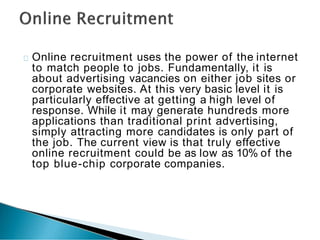
Online recruitment uses the power of the internet
to match people to jobs. Fundamentally, it is
about advertising vacancies on either job sites or
corporate websites. At this very basic level it is
particularly effective at getting a high level of
response. While it may generate hundreds more
applications than traditional print advertising,
simply attracting more candidates is only part of
the job. The current view is that truly effective
online recruitment could be as low as 10% of the
top blue-chip corporate companies.
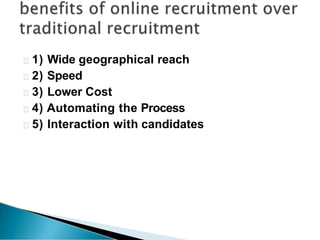
1) Wide geographical reach
2) Speed
3) Lower Cost
4) Automating the Process
5) Interaction with candidates
Online social entertainment blends entertaining interactive
functionality and content including live video streaming, video
chat communications, multi-player gaming, music and videos
streaming, with social networking service such as social graph
management, forums, reviews, ratings, and geo-
location options. It is the foundation for a more immersive,
interactive, enriching and engaging c
[
1
o
]
ntent consumption
experience through social channels. Social entertainment is
distinct from social networking websites in that the former is
based fundamentally on immersive engaging experiences with
functionality, content and people, while the latter is based
primarily on building and maintaining relationships with other
users. Typically, social entertainment is defined by the individual
sites dedicated to a particular type of entertainment experience
incorporating basic social networking services.
The e-Learning Centre was set up in August 2003 at
Mysore keeping with the demands of afast-changing
scene, the e-Learning Centre has accorded due role to
industry in developing e-Learning content and research
activity.VTU E-Learning Centre has diversified with its full
fledged activities like EDUSAT based live transmission,
Web based e-learning, E-Vidya Meadia Streaming
Solutions, Courses with 3D Animations, SCORM Content,
Innovative Workshops for VTU Research Scholars, Faculty
Development Programmes, NMEICT NPTEL Project and
other technology enhanced learning initiatives for the
benefit of VTU Students Community and Facult Members,
etc,.
Create EDUSAT satellite-based distance education facility
using Ku-band Multimedia Based Data Dissemination
System (MBDDS)
Create web-based e-learning facility
Collect, process and disseminate content developed by the
faculty drawn from both academia and industry
Provide interaction/guidance/feedback tools to learners
and act as a facilitator between the experts and the
students
Supplement the conventional system of training and
education and bring uniformity in technical education
Explore the possibility of using the EDUSAT network for
administrative purposes and other activities of the VTU
Online social entertainment blends entertaining interactive
functionality and content including live video streaming, video
chat communications, multi-player gaming, music and videos
streaming, with social networking service such as social graph
management, forums, reviews, ratings, and geo-
location options. It is the foundation for a more immersive,
interactive, enriching and engaging c
[
1
o
]
ntent consumption
experience through social channels. Social entertainment is
distinct from social networking websites in that the former is
based fundamentally on immersive engaging experiences with
functionality, content and people, while the latter is based
primarily on building and maintaining relationships with other
users. Typically, social entertainment is defined by the individual
sites dedicated to a particular type of entertainment experience
incorporating basic social networking services.
E-Learning is the use of technology to enable
people to learn anytime and anywhere. E-
Learning can include training, the delivery of
just-in-time information and guidance from
experts.
This online programme is complementary to the
ongoing GFATM training programme conducted
by the 55 nursing institution all over India.
The E-Learning course is a flexible, web-based
learn-on-demand system that allows nurses and
others to complete the course in a way that suits
their individual schedules.
1.Registration
2.Login
3.Fill up the pretest form
4.Proceed to elearning
5.Check your score - (Score Board)
M-commerce (mobile commerce) is the buying
and selling of goods and services through
wireless handheld devices such as cellular
telephone and personal digital assistants (PDAs).
Known as next-generation e-commerce, m -
commerce enables users to access the Internet
without needing to find a place to plug in. The
emerging technology behind m-commerce,
which is based on the Wireless Application
Protocol (WAP), has made far greater strides in
Europe, where mobile devices equipped with
Web-ready micro-browsers are much more
common than in the United States.
1. Cover wild distance : Mobile is the only technology
which is now become necessary for any person in social
and business life than computers. So, it is easy to reach
users through mCommerce.
2. Consumer deals : As more users use mCommerce, there
are lots of companies use the mCommerce site to reach
them by giving different and better deals in comparison to
their competitor.
3. Savings : Companies try to reach to the consumer
directly through mCommerce, so users have no need to go
far to the store physically and at the end it saves user’s
time and money.
4. Easy to use : There is no need of the skilled consumer.
Buyers can have look thousands of items on their cell
phones and there is no need of online checkout process.
Every invention has its own merits and demerits. It is applicable
in this mCommerce business also.
1. Smartphone limitation : Mobile has no big screen like desktop
or laptops, so sometimes users tired to navigate more and more
to choose just one item from thousands. It affects shopping
rates.
2. Habituate : Every new technology has some problem at the
starting phase. Here mCommerce is a new application, so
sometimes people avoid to change which are rapidly change. As
they are habituated to buy products from eCommerce.
3. Risk factor : Each business has its own risk. Same Moblie
commerce is the growing field and a lot of investment in this
field becomes risky. Because technology changes day by day.
Moreover, there less security in the wireless network, so in data
transfer hacking chances are more.
4. Connectivity : Moblie commerce needs high-speed
connectivity of 3G. Otherwise, it is become hectic for the user to
go through entire product purchase process.
If you go deep into the Internet archives and
check out the first pages there, you will see that
the sites back then looked very simple, with a
plain design, relying solely on text and text
formatting. However, the World Wide Web is
famous for its extremely rapid evolution and very
soon, different websitesstarted including
pictures, audio, video files, making the web more
multimedia rich
Multimedia
Video clips
Audio
Images
Multimedia represents various types of media
content, used together. If we have a text with
pictures, we have multimedia. If we add a video,
we have multimedia too. The use of multimedia
in websites has helped the Internet evolution a
lot, since it gave web designers a job and made
the web pages much more interesting for
everyone. And with today’s connection speeds,
we can all enjoy much better looking websites,
which are also rich in media content - you can
watch a video directly from the site without the
need to download it, listen to a song or browse a
high quality image gallery. Multimedia content is
what shapes the Internet as we know it.
Video clips incorporated in a website are all the
rage now. Before the YouTube revolution, video
clips had to be downloaded before anyone could
see them. With the advances in technology,
Internet speeds got a lot faster, which allowed for
live video streaming over the net, and YouTube-
like sites were born. Today, embedding a video
clip in a web page is more than easy, and video
clips can be easily shared via your blog, forum or
even a small video commercial which you can put
on your online store - something, which would
cost you a fortune if you had to air it on the
television.
Audio is another thing, which was affected by the
technology advances. And while a video clip will
require much more bandwidth and server resources,
audio files are much faster to process from a server’s
point of view. This helped for their distribution
among website creators much faster. Today, a
website with a musical background is something
more than normal, and on a lot of websites you can
easily listen to an audio track, which is uploaded on
the web server with the help of a simple player. This
has also assisted many independent musicians in
promoting their music and has allowed even for the
creation of Internet music labels.
Images were the first type of multimedia to be ever used in
a web page. They quickly became an indispensable part of
the website design process. Due to the fact that images
were pretty small back then, and mostly in the GIF file
format, they used very little disk space and bandwidth and
were ideal to illustrate every article. This gave birth to the
first online news portals, which intended to replacethe
regular newspapers, offering last minute news without the
need to purchase a separate newspaper.
Images in the websites also inspired the creation of image
galleries - websites, dedicated specifically to the display of
various pictures, painting or photographs. With the
introduction of the thumbnails, galleries and website
perfected themselves with the ability to offer asmall
version of the image as a thumbnail, instead of the full
picture.
Mobile payment is a part of the mobile
transactions and is catching the imagination
of a lot of people. This is clear evident from
the number of comments I got on my last
post “Mobile Payments – Will the Consumers
Adopt it”. In the last post, I had discussed
the consumer issues. Now I am going to talk
about the emerging business models in the
mobile payment space and the pros and cons
of each of the model.
any payment mechanism, the key entities of the value
chain are
Merchants – accept payments from the consumers by
reading the card at the Point of Sale (PoS) machine
Acquirers – hold merchant accounts and manage
merchant payments
Payment networks – Connect and switch transactions
between merchants & issuing banks
Issuers – manage consumer accounts and also take
the associated risk
M-Wallet/Stored Value Account (SVA) – Issue and
provisioning of the mobile wallet/SVA (only if case
mobile payments)
There are essentially four models in mobile payments:
Carrier Dominance Model – In this model, the carrier is
responsible for all the roles across the value chain, i.e.
carrier is the acquirer, payment network as well as the
issuer. The carrier provides the mobile payment
application to the customer. The customer holds a prepaid
or a postpaid account with the carrier. When the customer
pays through his mobile, the bill is charged to hisprepaid
or postpaid account. The entire network andinterchange
is managed by the carriers themselves. The PoS is also
provided to the merchants by the carrier. The payment to
the merchant can be made using NFC or Peer-to-Peer SMS.
In this model, the financial institutions takes
the center stage and is similar to current
credit card system. The merchant acquiring
banks and issuer banks could be different
and the payment network could be managed
by yet another financial institution like Visaor
MasterCard. The only difference here is that
instead of the credit card, the phone is waved
in front of the PoS
This model is about collaboration between the
carriers and the banks who can distribute the
roles of the value chain amongst themselves. The
carriers typically are responsible for providing
and provisioning m-wallet on the consumer’s
hand phone apart from the providing the POS
equipment to the merchants. The roles of
acquirer, payment network and issuer remain
with the financial institutions; one or more
financial institutions may collaborate together in
assuming the roles of acquirer, payment network
and issuer.
This model is has been made popular by new
entrants in the payment industry like Paypal,
Obopay, mChek, etc. The 3rd party company
acts as a conduit between the customers,
merchants and the bankers. The 3rd party
service provider takes the payment from the
customer, deducts its commission and
passed on the payment to the merchant. It
also pays the payment processing fee to the
bank or the payment gateways like
Visa/Master.
M-Commerce for finance
The customer (using the mobile) can pay
from their bank account using mobile
commerce facilities. Mobile users can transfer
funds between account or receive any
information related to finance from financial
institutions or banks. WAPbased mobile
devices allow the user to access the internet
or the website of the financial institutions.
Companies can also make online catalog of
products so that the mobile users can access
the catalog from their mobile devices.
Customers are able to shop, place orders or
hire services and pay for dues through mobile
phones.
It is easy for business organizations to send
text messages to promote a new product or
carryout any form of promotional campaign.
Airline tickets can be purchased through
mobile phone. It also enables users of mobile
phone to make changes in their tickets. For
example, With “flybuy SMS” launched by
Kingfisher Airlines and paymate, customers
can get the details of Kingfisher airlines
flights by sending SMS. The customer can
book the ticket after receiving a reply.
Besides the above, movie tickets can also be
booked through mobile phones.
Mobile terminal acts as a portable music
player. Downloading ringtones has become
successful m-commerce application. Mobile
phone manufacturers and wireless providers
are making good money by selling different
kinds of customized ringtones.
Using mobile devices, customer can reserve
for restaurants and hotels according to their
needs.
Wireless services are used in healthcare and
medicine for billing, lab ordering, referrals,
prescriptions and clinical decisions. For
example, in United States, healthcare
professionals are able to obtain patient
information from any location by getting
connected wirelessly to the hospital’s
information system. They are able to access
the pharmaceutical information of patients
and provide better patient care.
Sales personnel, who are always on the move,
may need to access to the company information
system to check price of products. But mobile
allows the traveling sales personnel to track
inventory and maintain communication with
seniors at ease. Traveling salesmen do not have
to wait for long to get approval from the seniors.
Any information could be transferred easily and
quickly with the help of mobile devices. It
removes barriers in intra-office communication.
Mobiles enable customers to get information
like sport news or political news of their
choice. For example, today through SMS,
students are able to check their university
results or public examination results.
Customers can play multi player games
through mobiles. Mobile games are very
popular with colourful displays and it
generates good revenue

Emarketing.pptx

  • 1.
    PPTs on E-MARKETING MBA –III SEMESTER (ELECTIVE – II) Prepared by, Ms. K. Mamatha, Assistant Professor
  • 2.
    E-Marketing (Electronic Marketing)are also known as Internet Marketing, Web Marketing, Digital Marketing, or Online Marketing. E-marketing is the process of marketing a product or service using the Internet. E marketing not only includes marketing on the Internet, but also includes marketing done via e-mail and wireless media. It uses a range of technologies to help connect businesses to their customers.
  • 3.
    There are severalways in which companies can use internet for marketing. Some ways of e-marketing are: 1. Article marketing 2. Affiliate marketing 3. Video marketing 4. Email marketing 5. Blogging
  • 4.
    Transacting or facilitatingbusiness on the Internet is called ecommerce. Ecommerce is short for "electronic commerce."
  • 5.
    In short, havinga physical store is traditional commerce. Traditional commerce is a type of business which focuses on the exchange of products and services, and includes all those activities which encourages exchange, in some way or the other.
  • 6.
    e-Business derived fromsuch terms as "e-mail" and "e-commerce," is the conduct of business electronically, typically over the Internet, not only buying and selling, but also servicing customers and collaborating with business partners.
  • 7.
    There are 6basic types of e-commerce: Business-to-Business (B2B) Business-to-Consumer (B2C) Consumer-to-Consumer (C2C) Consumer-to-Business (C2B). Business-to-Administration (B2A) Consumer-to-Administration (C2A)
  • 8.
    Business-to-Business (B2B) Business-to-Business (B2B)e-commerce encompasses all electronic transactions of goods or services conducted between companies. Producers and traditional commerce wholesalers typically operate with this type of electronic commerce.
  • 9.
    The Business-to-Consumer typeof e-commerce is distinguished by the establishment of electronic business relationships between businesses and final consumers. It corresponds to the retail section of e-commerce, where traditional retail trade normally operates. These types of relationships can be easier and more dynamic, but also more sporadic or discontinued. This type of commerce has developed greatly, due to the advent of the web, and there are already many virtual stores and malls on the Internet, which sell all kinds of consumer goods, such as computers, software, books, shoes, cars, food, financial products, digital publications, etc. When compared to buying retail in traditional commerce, the consumer usually has more information available in terms of informative content and there is also a widespread idea that you’ll be buying cheaper, without jeopardizing an equally personalized customer service, as well as ensuring quick processing and delivery of your order.
  • 10.
    3. Consumer-to-Consumer (C2C) Consumer-to-Consumer(C2C) type e-commerce encompasses all electronic transactions of goods or services conducted between consumers. Generally, these transactions are conducted through a thirdparty, which provides the online platform where the transactions are actually carried out.
  • 11.
    4. Consumer-to-Business (C2B) InC2B there is a complete reversal of the traditional sense of exchanging goods. This type of e-commerce is very common in crowd sourcing based projects. A large number of individuals make their services or products available for purchase for companies seeking precisely these types of services or products.
  • 12.
    5. Business-to-Administration (B2A) Thispart of e-commerce encompasses all transactions conducted online between companies and public administration. This is an area that involves a large amount and a variety of services, particularly in areas such as fiscal, social security, employment, legal documents and registers, etc. These types of services have increased considerably in recent years with investments made in e-government.
  • 13.
    6. Consumer-to-Administration (C2A) TheConsumer-to-Administration model encompasses all electronic transactions conducted between individuals and public administration. Examples of applications include: Education – disseminating information, distance learning, etc. Social Security – through the distribution of information, making payments, etc. Taxes – filing tax returns, payments, etc. Health – appointments, information about illnesses, payment of health services, etc. Both models involving Public Administration (B2A and C2A) are strongly associated to the idea of efficiency and easy usability of the services provided to citizens by the government, with the support of information and communication technologies.
  • 14.
    The main advantageof e-commerce is its ability to reach a global market, without necessarily implying a large financial investment. The limits of this type of commerce are not defined geographically, which allows consumers to make a global choice, obtain the necessary information and compare offers from all potential suppliers, regardless of their locations. By allowing direct interaction with the final consumer, e- commerce shortens the product distribution chain, sometimes even eliminating it completely. This way, a direct channel between the producer or service provider and the final user is created, enabling them to offer products and services that suit the individual preferences of the target market.
  • 15.
    The main disadvantagesassociated with e-commerce are the following: Strong dependence on information and communication technologies (ICT); Lack of legislation that adequately regulates the new e- commerce activities, both nationally and internationally; Market culture is averse to electronic commerce (customers cannot touch or try the products); The users’ loss of privacy, the loss of regions’and countries’ cultural and economic identity; Insecurity in the conduct of online business transactions.
  • 16.
    Because the Internetconnects computers all over the world, any business that engages in electronic commerce instantly becomes an international business. When companies use the Web to improve a business process, they are automatically operating in a global environment. The key issues that any company faces when it conducts international commerce include trust and culture, language, and infrastructure.
  • 17.
    It is importantfor all businesses to establish trusting relationships with their customers. Companies with established reputations in the physical world often create trust by ensuring that customers know who they are. These businesses can rely on their established brand names to create trust on the Web. New companies that want to establish online businesses face a more difficult challenge because a kind of anonymity exists for companies trying to establish a Web presence.
  • 18.
    Most companies realizethat the only way to do business effectively in other cultures is to adapt to those cultures. “Think Globally, Act Locally” The first step that a Web business usually takes to reach potential customers in other countries, and thus in other cultures, is to provide local language or regional dialect.
  • 19.
    An important elementof business trust is anticipating how the other party to a transaction will act in specific circumstances. That is one reason why companies with established brands can build online businesses more quickly and easily than a new company without a reputation. The brand conveys some expectations about how the company will behave.
  • 20.
    Some parts ofthe world have cultural environments that are extremely inhospitable to the type of online discussion that occurs on the internet. The cultural conditions, in some cases, lead to government controls that can limit electronic commerce development. The internet is a very open form of communication. This type of unfettered communication is not desired or considered acceptable in some cultures
  • 21.
    Internet infrastructure includesthe computers and software connected to the internet and communications networks over which the massage packets travel. In many countries other than the United States, the telecommunications industry is either government owned or heavily regulated by the government. More that half of all businesses on the Web turn away international orders because they do not have the processes in place to handle the orders.
  • 22.
    The Internet’s potentialis imperiled by digital anarchy, closed markets that cannot use each other’s services, incompatible applications and frameworks that cannot interoperate or build upon each other and an array of security and payment options that confuse consumers One solution to these problems is an object-oriented architectural framework for Internet commerce. Several major vendors of E-commerce solutions have announced versions of such a framework. The major platforms are: IBM Commerce Point Microsoft Internet Commerce Framework Netscape ONE (Open Network Environment) Oracle NCA (Network ComputingArchitecture) Sun/Javasoft JECF (Java E-commerce Framework).
  • 23.
    Recently, four ofthese companies have agreed to support a common distributed object model based on CORBA IIOP (Common Object Request Broker Architecture Internet Inter- ORB Protocol). Yet for commerce on the Internet to thrive, such systems must also interoperate at a business application level. A consumer or business using one framework should be able to shop for, purchase and pay for goods and services offered on a different framework. This is currently not possible.
  • 24.
    In response, CommerceNet, a non-profit organization created to help businesses and consumers use the Internet for buying and selling, is organizing Eco System, a cross- industry effort to build a framework of frameworks, involving both E- commerce vendors and end users. The success of this process clearly depends on market leaders in each area participating actively in their respective task forces. Everyone’s software has to work together because no single company can control what platform its customers will use.
  • 25.
    Definition: TCP/IP (TransmissionControl Protocol/Internet Protocol), also referred to as the Internet Protocol Suite, is the World Wide Web's core communication system that enables every Internet-connected device to communicate with every other such device simultaneously. It is, in essence, a computerized syntax (language) that is installed on every computer, both for public (Internet) and private (intranets and extranets) networks. The development of this protocol has enabled the internet — and as a result, online commerce — to grow quickly.
  • 26.
    Many higher-level appsthat ecommerce businesses need to be familiar with utilize and/or are built on TCP/IP. These apps constitute a higher layer of protocol language and are often packaged along with TCP/IP as a single "suite." Examples include: HTTP (the Internet's Hyper-text Transfer Protocol) FTP (the Internet's File Transfer Protocol) Telnet, which enables logging on computers from remote locations SMTP (Simple Mail Transfer Protocol)
  • 27.
    ICMP (Internet ControlMessage Protocol) IGP (Interior Gateway Protocol) EGP (Exterior Gateway Protocol) BGP (Border Gateway Protocol)
  • 28.
    This is theworld-wide network of computers accessible to anyone who knows their Internet Protocol (IP) address - the IP address is a unique set of numbers (such as 209.33.27.100) that defines the computer's location. Most will have accessed a computer using a name such as Before this named computer can be accessed, the name needs to be resolved (translated) into an IP address.
  • 29.
    This is anetwork that is not available to the world outside of the Intranet. If the Intranet network is connected to the Internet, the Intranet will reside behind a firewall and, if it allows access from the Internet, will be an Extranet. The firewall helps to control access between the Intranet and Internet to permit access to the Intranet only to people who are members of the same company or organisation. In its simplest form, an Intranet can be set up on a networked PCwithout any PCon the network having access via the Intranet network to the Internet.
  • 30.
    An Extranet isactually an Intranet that is partially accessible to authorised outsiders. The actual server (the computer that serves up the web pages) will reside behind a firewall. The firewall helps to control access between the Intranet and Internet permitting access to the Intranet only to people who are suitably authorised. The level of access can be set to different levels for individuals or groups of outside users. The access can be based on a username and password or an IPaddress (a unique set of numbers such as 209.33.27.100 that defines the computer that the user is on).
  • 31.
    Internet connection optionsvary by Internet Service Provider and by region. Customers should consider some of the following factors before selecting an Internet package: speed or bandwidth, cost,availability, reliability and convenience. In order to determine what Internet plan is right for you, we recommend you review the different types of Internet connections available on the market today.
  • 32.
    WIRELESS Radio frequency bandsare used in place of telephone or cable networks. One of the greatest advantages of wireless Internet connections is the "always-on" connection that can be accessed from any location that falls within network coverage. Wireless connections are made possible through the use of a modem, which picks up Internet signals and sends them to other devices mobile. Many cell phone and smart phone providers offer voice plans with Internet access. Mobile Internet connections provide good speeds and allow you to access the Internet on the go.
  • 33.
    Hotspots are sitesthat offer Internet access over a wireless local area network (WLAN) by way of a router that then connects to an Internet service provider. Hotspots utilize Wi- Fi technology, which allows electronic devices to connect to the Internet or exchange data wirelessly through radio waves. Hotspots can be phone-based or free-standing, commercial or free to the public.
  • 34.
    Dial-up connections requireusers to link their phone line to a computer in order to access the Internet. This particular type of connection—also referred to as analog—does not permit users to make or receive phone calls through their home phone service while using the Internet.
  • 35.
    This high-speed Internetconnection is provided through either cable or telephone companies. One of the fastest options available, broadband Internet uses multiple data channels to send large quantities of information. The term broadband is shorthand for broad bandwidth. Broadband Internet connections such as DSL and cable are considered high-bandwidth connections. Although many DSL connections can be considered broadband, not all broadband connections are DSL.
  • 36.
    DSL, which standsfor Digital Subscriber Line, uses existing 2-wire copper telephone line connected to one's home so service is delivered at the same time as landline telephone service. Customers can still place calls while surfing the Internet.
  • 37.
    Cable Internet connectionis a form of broadband access. Through use of a cable modem, users can access the Internet over cable TV lines. Cable modems can provide extremely fast access to the Internet.
  • 38.
    In certain areaswhere broadband connection is not yet offered, a satellite Internet option may be available. Similar to wireless access, satellite connection utilizes a modem.
  • 39.
    ISDN (Integrated ServicesDigital Network) allows users to send data, voice and video content over digital telephone lines or standard telephone wires. The installation of an ISDN adapter is required at both ends of the transmission—on the part of the user as well as the Internet access provider
  • 40.
    Why Do IFear Financial Fraud Online? One of my primary sources of fear is that fraud seems to be all around us. When we hear of the websites of the best of companies getting hacked all the time, I know that I am small fry. Be it Sony or Google, just to name two tech giants, both have been the targets of hacking. If they could not protect themselves, how will I? I think that I am not alone in my fear. The fact that I am an e-commerce professional not withstanding, I fear that someone somewhere wants to defraud me.
  • 41.
    Fraud Is AllAroundUs Be it the constant flow of emails from a Nigerian general who would like me to help him get to a large fortune, to phishing emails that try to get me to part with my bank account details or email passwords. Though one does develop a thick skin to these blatant criminal attempts, there has to always be an underlying worry that someday one would get taken for a ride. The Global-Village Nature of the Internet Adds to theWorry In some countries the laws regarding intellectual property as well as online fraud might be quite stringent and well established. But what if the fraud originates from a territory that is well known for just the opposite. What courts would approach?
  • 42.
    Everything May BeFine and Dandy, But Security Could Derail Ecommerce Whenever I am conducting a workshop and I am asked about my major area of concern regarding e-commerce, my first response is always the same: security. Since financial transactions are the backbone of e-commerce, if not the entire purpose of it, any hesitation on the part of the customer when it comes to making online payments could spoil the e-commerce party. Surely we do not want to go to the point where the only acceptable mode of payment in B2C sales becomes cash on delivery.
  • 43.
    There Are TooMany Players in the E-commerce Environment, and Anyone Could Spring a Security Leak It is not just about your e-commerce website getting hacked. The fire could start in any corner of your e- commerce edifice. It could be the payment gateway that gets hacked. Or it could be an infected user-computer that could bring in malware. Come to think of it, even your shopping cart software provider might be exporting vulnerability into your environment. And when these participants do not know each other, or are not even located on the same continent, then how would you expect them to be able to rely on each other.
  • 44.
    What Is theSolution to the E-commerce Security Tangle? I would like to scream "constant vigilance" like Alastor Moody from the Harry Potter books. It is not every day that one comes across a security threat. But that should not allow you to get callous about security related matters. Of course, technology provides a solution too. Be it the use of SSL(Secure Sockets Layer) or two- factor authentication, every little bit helps in making the web a more secure place to create transactions. But technology is not the final solution.
  • 45.
    encryption is theprocess of hiding information that is readable into a format that can't be read. Encryption can be used for many different things, but you're probably most familiar with its function of transferring information securely.
  • 46.
    There are twotypes of encryption in widespread use today: symmetric and asymmetric encryption. The name derives from whether or not the same key is used for encryption and decryption.
  • 47.
    In symmetric encryptionthe same key is used for encryption and decryption. It is therefore critical that a secure method is considered to transfer the key between sender and recipient.
  • 49.
    Asymmetric encryption usesthe notion of a key pair: a different key is used for the encryption and decryption process. One of the keys is typically known as the private key and the other is known as the public key. The private key is kept secret by the owner and the public key is either shared amongst authorised recipients or made available to the public at large. Data encrypted with the recipient’s public key can only be decrypted with the corresponding private key. Data can therefore be transferred without the risk of unauthorised or unlawful access to the data.
  • 51.
    Hashing is atechnique that generates a fixed length value summarising a file or message contents. It is often incorrectly referred to as an encryption method. Hash functions are used with cryptography to provide digital signatures and integrity controls but as no secret key is used it does not make the message private as the hash can be recreated.
  • 52.
    Online Marketing isthe art and science of selling products and/or services over digital networks, such as the internet and cellular phone networks. The art of online marketing involves finding the right online marketing mix of strategies that appeals to your target market and will actually translate into sales. The science of online marketing is the research and analysis that goes into both choosing the online marketing strategies to use and measuring the success of those strategies.
  • 53.
    Search Engine Marketing OnlineAdvertising Blogging Social media marketing. Email marketing Mobile marketing
  • 54.
    Online advertising, alsocalled online marketing or Internet advertising or web advertising, is a form of marketing and advertising which uses the Internet to deliver promotional marketing messages to consumers. Consumers view online advertising as an unwanted distraction with few benefits and have increasingly turned to ad blocking for a variety of reasons.
  • 55.
    Purchased Online Ads SocialMedia Marketing Newspaper Ads Television Advertising Public Speaking Door Hangers and Flyers Event Sponsorship
  • 56.
    Repetition Repetition is asimple yet effective technique used to build identity awareness and customer memory. Even advertisements using other successful approaches mention the product or company name more than once, particularly in television because its combination of sight and sound, allows the advertiser to disguise the repetition by changing its delivery (from visual to audio).
  • 57.
    Advertising that promotesspecific features or makes claims about what a product or service can do for the potential customers provides successful results by informing, educating and developing expectations in the buyer
  • 58.
    Associating a productor company with a famous person, catchy jingle, desirable state of being or powerful emotion creates astrong psychological connection in the customer.
  • 59.
    The bandwagon techniquesells a product or service by convincing the customer that others are using it and they should join the crowd.
  • 60.
    Coupons, sweepstakes, gameswith prizes and gifts with purchases create excitement, and participation encourages customers to build a relationship with the sponsoring product or service.
  • 61.
    Online auctions aresales transactions involving competitive bidding that are conducted over the Internet. Whether the sales take place between individuals, between consumers and merchants, or between businesses, online auctions have enjoyed a rapid increase in popularity.
  • 62.
    Online auctions offersmall businesses a number of potential benefits with very few risks. After all, participating in online auctions does not prevent businesses from continuing to use traditional sales methods. In addition, companies can avoid financial losses on sale items by setting the minimum bid price high enough to cover costs. Among the few potential drawbacks are that buyers are not able to personally view and evaluate items before making a purchase, which raises the possibility of fraud.
  • 63.
    Supply chain management(SCM) is the active management of supply chain activities to maximize customer value and achieve a sustainable competitive advantage. It represents a conscious effort by the supply chain firms to develop and run supply chains in the most effective & efficient ways possible. Supply chain activities cover everything from product development, sourcing, production, and logistics, as well as the information systems needed to coordinate these activities.
  • 64.
    The concept ofSupply Chain Management (SCM) is based on two core ideas: The first is that practically every product that reachesan end user represents the cumulative effort of multiple organizations. These organizations are referred to collectively as the supply chain. The second idea is that while supply chains have existed for a long time, most organizations have only paid attention to what was happening within their “four walls.” Few businesses understood, much less managed, the entire chain of activities that ultimately delivered products to the final customer. The result was disjointed and often ineffective supply chains.
  • 65.
    Step 1: NeedRecognition. Step 2: Specific Need Step 3: Source/Examine Supplier Options Step 4: Price and Terms Step 5: Purchase Order Step 6: Delivery Step 7: Expediting Step 8: Receipt and inspection Step 9: Invoice Approval and Payment Step 10: Record Keeping
  • 66.
    In order todeal with the challenges of time for synchronization and complexity in information distribution a multi-tier supply chain management system can be established. It helps to steer the collaboration between all involved parties by establishing a central collaboration platform. Mostly this platform is initiated by the Original Equipment Manufacturer (OEM) and covers several suppliers in a partnership. One distinguished chain member has to drive the collaboration process and platform by defining processes, rules and standards (Stadler, Kilger, p.270)4). It helps to get transparency for all partners in the value chain about demands, capacities and stock data.
  • 67.
    Consumer expectations arebecoming increasingly higher. When once consumers were happy with waiting a week to receive a package in the mail, today anything longer than two day delivery means that many consumers will forget their order by the time it arrives, and maybe decide they would rather not receive any item at all than wait. Companies, retailers, and suppliers are now expected to comply and come up with creative ways to meet consumer demands. For example, Amazon recently announced that it was expanding its same day delivery service on its Prime Now app and EBay also tried a pilot in the US for same day delivery (EBay however canceled the pilot in 2015, because it wasn't performing as well as expected).
  • 68.
    Some of thebiggest global trends affecting consumer activities are: Changing consumer experience Growing ecommerce Crowding in urban centers
  • 69.
    Insurance is ameans of protection from financial loss. It is a form of risk management primarily used to hedge against the risk of a contingent, uncertain loss. An entity which provides insurance is known as an insurer, insurance company, or insurance carrier. A person or entity who buys insurance is known as an insured or policyholder. The insurance transaction involves the insured assuming a guaranteed and known relatively small loss in the form of payment to the insurer in exchange for the insurer's promise to compensate the insured in the event of a covered loss. The loss may or may not be financial, but it must be reducible to financial terms, and must involve something in which the insured has an insurable interest established by ownership, possession, or preexisting relationship.
  • 70.
    In accordance withstudy books of The Chartered Insurance Institute, there are the following types of insurance: Co-insurance – risks shared between insurers Dual insurance – risks having two or more policies with same coverage (Both the individual policies would not pay separately- a concept named contribution, and would contribute together to make up the policyholder's losses. However, in case of contingency insurances like Life insurance, dual payment is allowed) Self-insurance – situations where risk is not transferred to insurance companies and solely retained by the entities or individuals themselves Reinsurance – situations when Insurer passes some part of or all risks to another Insurer called Reinsurer
  • 71.
    Top Qualities ofStandout Online Trading Platforms Quality trading tools and technology Multiple trading platforms for all levels of traders Excellent mobile trading features Solid navigation that displays the relevant information where you want it Quality educational resources and research for trader development
  • 72.
    Choosing the bestonline brokers is no easy task. There’s so much variation in this industry from company to company, and then you have to factor in the type of trader or investor who’s opening the brokerage account. Here’s how I got started: I conducted research to compile a list of every online broker. I narrowed the list down to just under 50 brokers by eliminating those that did not allow U.S. stock trading. I individually researched each broker, visited their websites, and analyzed rankings and reviews across the web. I concluded that there were 15 online stock brokers worth digging into.
  • 73.
    As the leadingglobal real estate services company, we firmly believe and ensure that our clients come first. In India, we are the most trusted partner when it comes to providing the right expertise in real estate. Our goal is to achieve customer delight with several years of experience in the local market. From property search and selection, to project management and valuation and appraisal, we provide comprehensive solutions to your most complex requirements.
  • 74.
    An online travelagen [ c 3] y(OTA) specializes in offering planning sources and booking capabilities. Major OTAs include: Voyages-sncf.com – revenue €2.23 billion (2008) Expedia, Inc., including Expedia.com, Hote ] ls.com, Hotwire.com, Travelocity and others – revenue US$2.937 billion (2008), later expanded to include Orbitz Worldwide, Inc., including [6] Orbitz, CheapTickets, ebookers,and others – revenue US$870 million (2008) Sabre Holdings, including lastminute.com and others – revenue US$2.9 billion (2008) Opodo – revenue €1.3 billion (2008) The Priceline Group, including Priceline.com, Booking.com, ] Agoda.com, Kayak.com, OpenTable and others – revenue US$1.9 billion (2008) Travelgenio – revenue €344 million (2014) Wotif.com – revenue A$145 million (2012) Webjet – revenue A$59.3 million (2012)
  • 75.
    Online recruitment usesthe power of the internet to match people to jobs. Fundamentally, it is about advertising vacancies on either job sites or corporate websites. At this very basic level it is particularly effective at getting a high level of response. While it may generate hundreds more applications than traditional print advertising, simply attracting more candidates is only part of the job. The current view is that truly effective online recruitment could be as low as 10% of the top blue-chip corporate companies.
  • 76.
    1) Wide geographicalreach 2) Speed 3) Lower Cost 4) Automating the Process 5) Interaction with candidates
  • 77.
    Online social entertainmentblends entertaining interactive functionality and content including live video streaming, video chat communications, multi-player gaming, music and videos streaming, with social networking service such as social graph management, forums, reviews, ratings, and geo- location options. It is the foundation for a more immersive, interactive, enriching and engaging c [ 1 o ] ntent consumption experience through social channels. Social entertainment is distinct from social networking websites in that the former is based fundamentally on immersive engaging experiences with functionality, content and people, while the latter is based primarily on building and maintaining relationships with other users. Typically, social entertainment is defined by the individual sites dedicated to a particular type of entertainment experience incorporating basic social networking services.
  • 78.
    The e-Learning Centrewas set up in August 2003 at Mysore keeping with the demands of afast-changing scene, the e-Learning Centre has accorded due role to industry in developing e-Learning content and research activity.VTU E-Learning Centre has diversified with its full fledged activities like EDUSAT based live transmission, Web based e-learning, E-Vidya Meadia Streaming Solutions, Courses with 3D Animations, SCORM Content, Innovative Workshops for VTU Research Scholars, Faculty Development Programmes, NMEICT NPTEL Project and other technology enhanced learning initiatives for the benefit of VTU Students Community and Facult Members, etc,.
  • 79.
    Create EDUSAT satellite-baseddistance education facility using Ku-band Multimedia Based Data Dissemination System (MBDDS) Create web-based e-learning facility Collect, process and disseminate content developed by the faculty drawn from both academia and industry Provide interaction/guidance/feedback tools to learners and act as a facilitator between the experts and the students Supplement the conventional system of training and education and bring uniformity in technical education Explore the possibility of using the EDUSAT network for administrative purposes and other activities of the VTU
  • 80.
    Online social entertainmentblends entertaining interactive functionality and content including live video streaming, video chat communications, multi-player gaming, music and videos streaming, with social networking service such as social graph management, forums, reviews, ratings, and geo- location options. It is the foundation for a more immersive, interactive, enriching and engaging c [ 1 o ] ntent consumption experience through social channels. Social entertainment is distinct from social networking websites in that the former is based fundamentally on immersive engaging experiences with functionality, content and people, while the latter is based primarily on building and maintaining relationships with other users. Typically, social entertainment is defined by the individual sites dedicated to a particular type of entertainment experience incorporating basic social networking services.
  • 81.
    E-Learning is theuse of technology to enable people to learn anytime and anywhere. E- Learning can include training, the delivery of just-in-time information and guidance from experts. This online programme is complementary to the ongoing GFATM training programme conducted by the 55 nursing institution all over India. The E-Learning course is a flexible, web-based learn-on-demand system that allows nurses and others to complete the course in a way that suits their individual schedules.
  • 82.
    1.Registration 2.Login 3.Fill up thepretest form 4.Proceed to elearning 5.Check your score - (Score Board)
  • 83.
    M-commerce (mobile commerce)is the buying and selling of goods and services through wireless handheld devices such as cellular telephone and personal digital assistants (PDAs). Known as next-generation e-commerce, m - commerce enables users to access the Internet without needing to find a place to plug in. The emerging technology behind m-commerce, which is based on the Wireless Application Protocol (WAP), has made far greater strides in Europe, where mobile devices equipped with Web-ready micro-browsers are much more common than in the United States.
  • 84.
    1. Cover wilddistance : Mobile is the only technology which is now become necessary for any person in social and business life than computers. So, it is easy to reach users through mCommerce. 2. Consumer deals : As more users use mCommerce, there are lots of companies use the mCommerce site to reach them by giving different and better deals in comparison to their competitor. 3. Savings : Companies try to reach to the consumer directly through mCommerce, so users have no need to go far to the store physically and at the end it saves user’s time and money. 4. Easy to use : There is no need of the skilled consumer. Buyers can have look thousands of items on their cell phones and there is no need of online checkout process.
  • 85.
    Every invention hasits own merits and demerits. It is applicable in this mCommerce business also. 1. Smartphone limitation : Mobile has no big screen like desktop or laptops, so sometimes users tired to navigate more and more to choose just one item from thousands. It affects shopping rates. 2. Habituate : Every new technology has some problem at the starting phase. Here mCommerce is a new application, so sometimes people avoid to change which are rapidly change. As they are habituated to buy products from eCommerce. 3. Risk factor : Each business has its own risk. Same Moblie commerce is the growing field and a lot of investment in this field becomes risky. Because technology changes day by day. Moreover, there less security in the wireless network, so in data transfer hacking chances are more. 4. Connectivity : Moblie commerce needs high-speed connectivity of 3G. Otherwise, it is become hectic for the user to go through entire product purchase process.
  • 86.
    If you godeep into the Internet archives and check out the first pages there, you will see that the sites back then looked very simple, with a plain design, relying solely on text and text formatting. However, the World Wide Web is famous for its extremely rapid evolution and very soon, different websitesstarted including pictures, audio, video files, making the web more multimedia rich Multimedia Video clips Audio Images
  • 87.
    Multimedia represents varioustypes of media content, used together. If we have a text with pictures, we have multimedia. If we add a video, we have multimedia too. The use of multimedia in websites has helped the Internet evolution a lot, since it gave web designers a job and made the web pages much more interesting for everyone. And with today’s connection speeds, we can all enjoy much better looking websites, which are also rich in media content - you can watch a video directly from the site without the need to download it, listen to a song or browse a high quality image gallery. Multimedia content is what shapes the Internet as we know it.
  • 88.
    Video clips incorporatedin a website are all the rage now. Before the YouTube revolution, video clips had to be downloaded before anyone could see them. With the advances in technology, Internet speeds got a lot faster, which allowed for live video streaming over the net, and YouTube- like sites were born. Today, embedding a video clip in a web page is more than easy, and video clips can be easily shared via your blog, forum or even a small video commercial which you can put on your online store - something, which would cost you a fortune if you had to air it on the television.
  • 89.
    Audio is anotherthing, which was affected by the technology advances. And while a video clip will require much more bandwidth and server resources, audio files are much faster to process from a server’s point of view. This helped for their distribution among website creators much faster. Today, a website with a musical background is something more than normal, and on a lot of websites you can easily listen to an audio track, which is uploaded on the web server with the help of a simple player. This has also assisted many independent musicians in promoting their music and has allowed even for the creation of Internet music labels.
  • 90.
    Images were thefirst type of multimedia to be ever used in a web page. They quickly became an indispensable part of the website design process. Due to the fact that images were pretty small back then, and mostly in the GIF file format, they used very little disk space and bandwidth and were ideal to illustrate every article. This gave birth to the first online news portals, which intended to replacethe regular newspapers, offering last minute news without the need to purchase a separate newspaper. Images in the websites also inspired the creation of image galleries - websites, dedicated specifically to the display of various pictures, painting or photographs. With the introduction of the thumbnails, galleries and website perfected themselves with the ability to offer asmall version of the image as a thumbnail, instead of the full picture.
  • 91.
    Mobile payment isa part of the mobile transactions and is catching the imagination of a lot of people. This is clear evident from the number of comments I got on my last post “Mobile Payments – Will the Consumers Adopt it”. In the last post, I had discussed the consumer issues. Now I am going to talk about the emerging business models in the mobile payment space and the pros and cons of each of the model.
  • 92.
    any payment mechanism,the key entities of the value chain are Merchants – accept payments from the consumers by reading the card at the Point of Sale (PoS) machine Acquirers – hold merchant accounts and manage merchant payments Payment networks – Connect and switch transactions between merchants & issuing banks Issuers – manage consumer accounts and also take the associated risk M-Wallet/Stored Value Account (SVA) – Issue and provisioning of the mobile wallet/SVA (only if case mobile payments)
  • 93.
    There are essentiallyfour models in mobile payments: Carrier Dominance Model – In this model, the carrier is responsible for all the roles across the value chain, i.e. carrier is the acquirer, payment network as well as the issuer. The carrier provides the mobile payment application to the customer. The customer holds a prepaid or a postpaid account with the carrier. When the customer pays through his mobile, the bill is charged to hisprepaid or postpaid account. The entire network andinterchange is managed by the carriers themselves. The PoS is also provided to the merchants by the carrier. The payment to the merchant can be made using NFC or Peer-to-Peer SMS.
  • 94.
    In this model,the financial institutions takes the center stage and is similar to current credit card system. The merchant acquiring banks and issuer banks could be different and the payment network could be managed by yet another financial institution like Visaor MasterCard. The only difference here is that instead of the credit card, the phone is waved in front of the PoS
  • 95.
    This model isabout collaboration between the carriers and the banks who can distribute the roles of the value chain amongst themselves. The carriers typically are responsible for providing and provisioning m-wallet on the consumer’s hand phone apart from the providing the POS equipment to the merchants. The roles of acquirer, payment network and issuer remain with the financial institutions; one or more financial institutions may collaborate together in assuming the roles of acquirer, payment network and issuer.
  • 96.
    This model ishas been made popular by new entrants in the payment industry like Paypal, Obopay, mChek, etc. The 3rd party company acts as a conduit between the customers, merchants and the bankers. The 3rd party service provider takes the payment from the customer, deducts its commission and passed on the payment to the merchant. It also pays the payment processing fee to the bank or the payment gateways like Visa/Master.
  • 97.
    M-Commerce for finance Thecustomer (using the mobile) can pay from their bank account using mobile commerce facilities. Mobile users can transfer funds between account or receive any information related to finance from financial institutions or banks. WAPbased mobile devices allow the user to access the internet or the website of the financial institutions.
  • 98.
    Companies can alsomake online catalog of products so that the mobile users can access the catalog from their mobile devices. Customers are able to shop, place orders or hire services and pay for dues through mobile phones.
  • 99.
    It is easyfor business organizations to send text messages to promote a new product or carryout any form of promotional campaign.
  • 100.
    Airline tickets canbe purchased through mobile phone. It also enables users of mobile phone to make changes in their tickets. For example, With “flybuy SMS” launched by Kingfisher Airlines and paymate, customers can get the details of Kingfisher airlines flights by sending SMS. The customer can book the ticket after receiving a reply. Besides the above, movie tickets can also be booked through mobile phones.
  • 101.
    Mobile terminal actsas a portable music player. Downloading ringtones has become successful m-commerce application. Mobile phone manufacturers and wireless providers are making good money by selling different kinds of customized ringtones.
  • 102.
    Using mobile devices,customer can reserve for restaurants and hotels according to their needs.
  • 103.
    Wireless services areused in healthcare and medicine for billing, lab ordering, referrals, prescriptions and clinical decisions. For example, in United States, healthcare professionals are able to obtain patient information from any location by getting connected wirelessly to the hospital’s information system. They are able to access the pharmaceutical information of patients and provide better patient care.
  • 104.
    Sales personnel, whoare always on the move, may need to access to the company information system to check price of products. But mobile allows the traveling sales personnel to track inventory and maintain communication with seniors at ease. Traveling salesmen do not have to wait for long to get approval from the seniors. Any information could be transferred easily and quickly with the help of mobile devices. It removes barriers in intra-office communication.
  • 105.
    Mobiles enable customersto get information like sport news or political news of their choice. For example, today through SMS, students are able to check their university results or public examination results.
  • 106.
    Customers can playmulti player games through mobiles. Mobile games are very popular with colourful displays and it generates good revenue