CHAPTER 4/5:
         Exponential and
      Logarithmic Functions
4.2/5.2 Exponential Functions and Graphs
4.3/5.3 Logarithmic Functions and Graphs
4.4/5.4 Properties of Logarithmic Functions
4.5/5.5 Solving Exponential and Logarithmic
        Equations
4.6/5.6 Applications and Models: Growth and
        Decay; and Compound Interest
4.5/5.5
            Solving Exponential and
             Logarithmic Equations

•   Solve exponential equations.
•   Solve logarithmic equations.
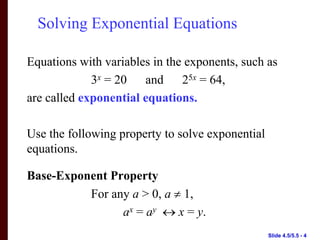
Solving Exponential Equations

Equations with variables in the exponents, such as
             3x = 20 and 25x = 64,
are called exponential equations.

Use the following property to solve exponential
equations.

Base-Exponent Property
          For any a > 0, a ≠ 1,
                ax = ay ↔ x = y.
                                                  Slide 4.5/5.5 - 4
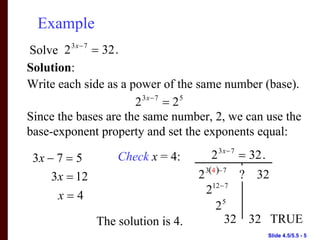
Example
Solve 2 3x−7
             = 32.
Solution:
Write each side as a power of the same number (base).
                      2 3x−7 = 2 5
Since the bases are the same number, 2, we can use the
base-exponent property and set the exponents equal:
                                          3 x −7
 3x − 7 = 5        Check x = 4:       2            = 32.
     3x = 12                        2 3(4 )−7 ? 32
      x=4                             212−7
                                         25
               The solution is 4.           32 32 TRUE
                                                           Slide 4.5/5.5 - 5
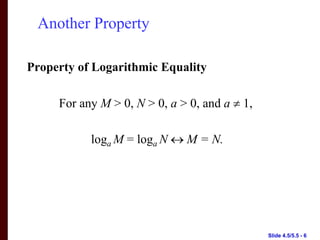
Another Property

Property of Logarithmic Equality

     For any M > 0, N > 0, a > 0, and a ≠ 1,

           loga M = loga N ↔ M = N.


                                               Slide 4.5/5.5 - 6
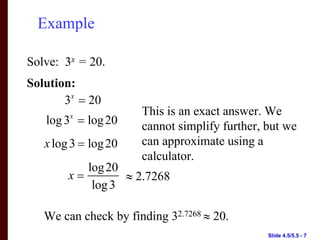
Example

Solve: 3x = 20.
Solution:
       3x = 20
                      This is an exact answer. We
   log 3 = log 20
        x
                      cannot simplify further, but we
   x log 3 = log 20   can approximate using a
                      calculator.
           log 20
        x=        ≈ 2.7268
            log 3

   We can check by finding 32.7268 ≈ 20.
                                               Slide 4.5/5.5 - 7
Example
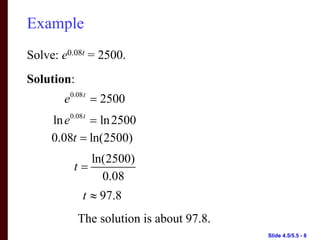
Solve: e0.08t = 2500.
Solution:
        e0.08 t = 2500
     ln e0.08 t = ln 2500
     0.08t = ln(2500)
             ln(2500)
          t=
               0.08
             t ≈ 97.8
            The solution is about 97.8.
                                          Slide 4.5/5.5 - 8
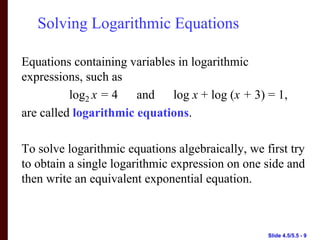
Solving Logarithmic Equations

Equations containing variables in logarithmic
expressions, such as
          log2 x = 4 and log x + log (x + 3) = 1,
are called logarithmic equations.

To solve logarithmic equations algebraically, we first try
to obtain a single logarithmic expression on one side and
then write an equivalent exponential equation.


                                                  Slide 4.5/5.5 - 9
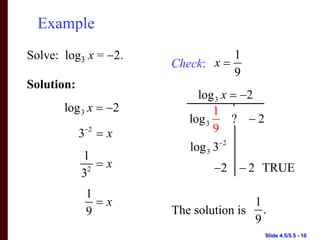
Example
Solve: log3 x = −2.              1
                      Check: x =
                                 9
Solution:
                           log 3 x = −2
       log 3 x = −2            1
                         log 3     ? −2
            3−2 = x            9
                         log 3 3−2
            1
             2
               =x            −2 − 2 TRUE
            3
             1
               =x                     1
             9        The solution is .
                                      9
                                          Slide 4.5/5.5 - 10
Example
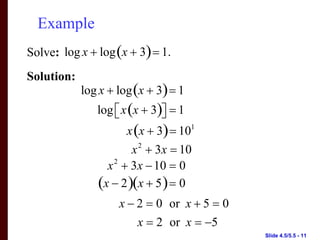
Solve: log x + log (x + 3) = 1.
Solution:
            log x + log (x + 3) = 1
               log ⎡ x (x + 3)⎤ = 1
                   ⎣          ⎦
                      x (x + 3) = 101
                       x + 3x = 10
                         2

                 x 2 + 3x − 10 = 0
               (x − 2 )(x + 5 ) = 0
                    x − 2 = 0 or x + 5 = 0
                        x = 2 or x = −5
                                             Slide 4.5/5.5 - 11
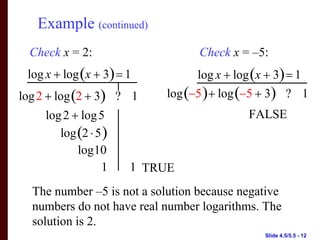
Example (continued)
  Check x = 2:                    Check x = –5:
 log x + log (x + 3) = 1         log x + log (x + 3) = 1
log 2 + log (2 + 3) ? 1    log (−5 ) + log (−5 + 3) ? 1
     log 2 + log 5                         FALSE
        log (2 ⋅ 5 )
            log10
                  1    1 TRUE
  The number –5 is not a solution because negative
  numbers do not have real number logarithms. The
  solution is 2.
                                               Slide 4.5/5.5 - 12
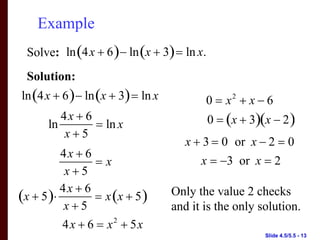
Example
 Solve: ln (4x + 6 ) − ln (x + 3) = ln x.
 Solution:
ln (4x + 6 ) − ln (x + 3) = ln x          0 = x2 + x − 6
         4x + 6                             0 = (x + 3)(x − 2 )
      ln        = ln x
          x+5
                                      x + 3 = 0 or x − 2 = 0
          4x + 6
                 =x                      x = −3 or x = 2
           x+5
          4x + 6
(x + 5 )⋅        = x (x + 5 )      Only the value 2 checks
           x+5                     and it is the only solution.
          4x + 6 = x 2 + 5x
                                                        Slide 4.5/5.5 - 13
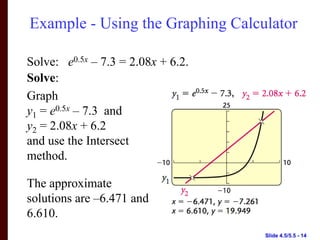
Example - Using the Graphing Calculator

Solve: e0.5x – 7.3 = 2.08x + 6.2.
Solve:
Graph
y1 = e0.5x – 7.3 and
y2 = 2.08x + 6.2
and use the Intersect
method.

The approximate
solutions are –6.471 and
6.610.
                                    Slide 4.5/5.5 - 14

4.5 5.5 notes 1

  • 2.
    CHAPTER 4/5: Exponential and Logarithmic Functions 4.2/5.2 Exponential Functions and Graphs 4.3/5.3 Logarithmic Functions and Graphs 4.4/5.4 Properties of Logarithmic Functions 4.5/5.5 Solving Exponential and Logarithmic Equations 4.6/5.6 Applications and Models: Growth and Decay; and Compound Interest
  • 3.
    4.5/5.5 Solving Exponential and Logarithmic Equations • Solve exponential equations. • Solve logarithmic equations.
  • 4.
    Solving Exponential Equations Equationswith variables in the exponents, such as 3x = 20 and 25x = 64, are called exponential equations. Use the following property to solve exponential equations. Base-Exponent Property For any a > 0, a ≠ 1, ax = ay ↔ x = y. Slide 4.5/5.5 - 4
  • 5.
    Example Solve 2 3x−7 = 32. Solution: Write each side as a power of the same number (base). 2 3x−7 = 2 5 Since the bases are the same number, 2, we can use the base-exponent property and set the exponents equal: 3 x −7 3x − 7 = 5 Check x = 4: 2 = 32. 3x = 12 2 3(4 )−7 ? 32 x=4 212−7 25 The solution is 4. 32 32 TRUE Slide 4.5/5.5 - 5
  • 6.
    Another Property Property ofLogarithmic Equality For any M > 0, N > 0, a > 0, and a ≠ 1, loga M = loga N ↔ M = N. Slide 4.5/5.5 - 6
  • 7.
    Example Solve: 3x =20. Solution: 3x = 20 This is an exact answer. We log 3 = log 20 x cannot simplify further, but we x log 3 = log 20 can approximate using a calculator. log 20 x= ≈ 2.7268 log 3 We can check by finding 32.7268 ≈ 20. Slide 4.5/5.5 - 7
  • 8.
    Example Solve: e0.08t =2500. Solution: e0.08 t = 2500 ln e0.08 t = ln 2500 0.08t = ln(2500) ln(2500) t= 0.08 t ≈ 97.8 The solution is about 97.8. Slide 4.5/5.5 - 8
  • 9.
    Solving Logarithmic Equations Equationscontaining variables in logarithmic expressions, such as log2 x = 4 and log x + log (x + 3) = 1, are called logarithmic equations. To solve logarithmic equations algebraically, we first try to obtain a single logarithmic expression on one side and then write an equivalent exponential equation. Slide 4.5/5.5 - 9
  • 10.
    Example Solve: log3 x= −2. 1 Check: x = 9 Solution: log 3 x = −2 log 3 x = −2 1 log 3 ? −2 3−2 = x 9 log 3 3−2 1 2 =x −2 − 2 TRUE 3 1 =x 1 9 The solution is . 9 Slide 4.5/5.5 - 10
  • 11.
    Example Solve: log x+ log (x + 3) = 1. Solution: log x + log (x + 3) = 1 log ⎡ x (x + 3)⎤ = 1 ⎣ ⎦ x (x + 3) = 101 x + 3x = 10 2 x 2 + 3x − 10 = 0 (x − 2 )(x + 5 ) = 0 x − 2 = 0 or x + 5 = 0 x = 2 or x = −5 Slide 4.5/5.5 - 11
  • 12.
    Example (continued) Check x = 2: Check x = –5: log x + log (x + 3) = 1 log x + log (x + 3) = 1 log 2 + log (2 + 3) ? 1 log (−5 ) + log (−5 + 3) ? 1 log 2 + log 5 FALSE log (2 ⋅ 5 ) log10 1 1 TRUE The number –5 is not a solution because negative numbers do not have real number logarithms. The solution is 2. Slide 4.5/5.5 - 12
  • 13.
    Example Solve: ln(4x + 6 ) − ln (x + 3) = ln x. Solution: ln (4x + 6 ) − ln (x + 3) = ln x 0 = x2 + x − 6 4x + 6 0 = (x + 3)(x − 2 ) ln = ln x x+5 x + 3 = 0 or x − 2 = 0 4x + 6 =x x = −3 or x = 2 x+5 4x + 6 (x + 5 )⋅ = x (x + 5 ) Only the value 2 checks x+5 and it is the only solution. 4x + 6 = x 2 + 5x Slide 4.5/5.5 - 13
  • 14.
    Example - Usingthe Graphing Calculator Solve: e0.5x – 7.3 = 2.08x + 6.2. Solve: Graph y1 = e0.5x – 7.3 and y2 = 2.08x + 6.2 and use the Intersect method. The approximate solutions are –6.471 and 6.610. Slide 4.5/5.5 - 14