C h a p t e r 1 D e s c r i b i n g D a t a – L e s s o n 2 Page 1
Chapter 1:
Describing Data
Lesson 2: Data Collection and Organization: Fruit Preferences
TIME FRAME: 1 hour session
OVERVIEW OF LESSON
In this activity, students will also collect some other data in groups about their preferences for
some fruits. The data on fruit preferences will be then compiled for the entire class. Students
discuss how data gathered could be summarized to determine what is the class’ favorite fruit.
LEARNING COMPETENCIES: At the end of the lesson, the learner should be able to:
 develop skills in collecting data
 illustrate how to summarize data (i.e., sort, classify, and organize data in tabular form
and present the summary into a pictographs, bar charts, etc., and/or generate some
summary measures).
 provide meaningful interpretation of data collected
LESSON OUTLINE:
1. Introduction: Recall of Past Learnings
2. Data Collection
3. Data Exploration
DEVELOPMENT OF THE LESSON
(A)Introduction
After students are given their “student numbers”, begin the session with a recall of learnings
from the first lesson:
 data are facts (counts, measurements, or opinions) collected to answer statistical
questions
 data varies across subjects, and they may show up more than once
 Statistics is a science that studies data,
(B) Data Collection
Divide the students into groups of five, and ask the groups to submit Activity Sheets Number
1-02. The objective of the activity is to help determine which fruit is the class favorite among
the four fruits banana, watermelon, mango and pineapple. In the Activity Sheet, ask each
student in each group to rank the four fruits banana, mango, pineapple and watermelon
according to order of preference: 1 is the most preferred fruit, and 4 is the least preferred.
C h a p t e r 1 D e s c r i b i n g D a t a – L e s s o n 2 Page 2
Highly Recommended: It may be helpful to use a projector and collect the data for the class
recording sheet in a spreadsheet application (such as Microsoft Excel), for ease of generating
data summaries and figures.
(C) Data Exploration: Summarizing the Data of Activity Sheet 1-02 and Interpreting the Results
Show a copy of the Class Recording Sheet 1-02 to students (preferably using a projector). If
not, show all the data on the blackboard.
Ask students whether the data presented on the data recording sheet answers the question
about which fruit is the favorite. If the response is positive, ask which fruit is the favorite
and which is least favorite. Be sure to ask what they based their responses on.
One possible method is to take the sum of the responses (lowest sum = favorite, highest sum
= least favorite).
Another method of describing the (“categorical”) data is by using a picture graph. A picture
graph refers to a graph where an object is used to represent one person on a graph. The
picture graph is a variation on the dotplot and bar graph. Students can also make a picture
graph of the least favorite fruit.
Still another method is to use a bar graph. Students should construct a bar graph for each
fruit and use it to compare the distributions.
The teacher should facilitate a discussion about which fruit is most/least favorite, using the
recorded data to help answer the questions. Are there natural groupings among the four
fruits? Ask students to describe any potentially meaningful patterns. There should be a
discussion about how to best interpret the data.
Some students might think that the best way to determine the favorite fruit is to see which
one had the most scores of 1. The teacher should use the word “mode” to describe the fruit
that has the most scores of 1. Students should recognize that this fruit has the highest bar on a
bar graph.
You might ask for some disadvantages of using the mode to determine the class favorite. For
example, this doesn’t take into account that the first choice of most students may also be the
least favorite of many classmates.
Another approach to determine the class favorite is to use the median. Although the data in
this set is categorical, it can be placed in order numerically from most to least favorite. The
median score for each candy is determined by the middle number in the data set if there is an
odd number of data points, and by the average of the two middle numbers if there is an even
number of data points.
Other students might think that the sum of scores should determine the class favorite. An
advantage of this approach is that all scores would be used to determine the favorite.
Ask students to show their first choices (favorite) and last choices (least favored) in a pie
chart.
C h a p t e r 1 D e s c r i b i n g D a t a – L e s s o n 2 Page 3
KEY POINTS
 There are various ways to summarize and examine data :
o Graphs (pictographs, bar graphs)
o Summary numbers (median, mode)
 There is no unique way to determine the “class favorite” fruit
o Analysis depends on methodology
C h a p t e r 1 D e s c r i b i n g D a t a – L e s s o n 2 Page 4
REFERENCES
Much of the material here adapted from:
“Candy Judging” Lesson Plan by Susan Haller, St. Cloud State University in STatistics
Education Web (STEW) Online Journal of K-12 Statistics Lesson Plans.
http://www.amstat.org/education/stew/pdfs/CandyJudging.pdf
C h a p t e r 1 D e s c r i b i n g D a t a – L e s s o n 2 Page 5
ACTIVITY SHEET NUMBER 1-02
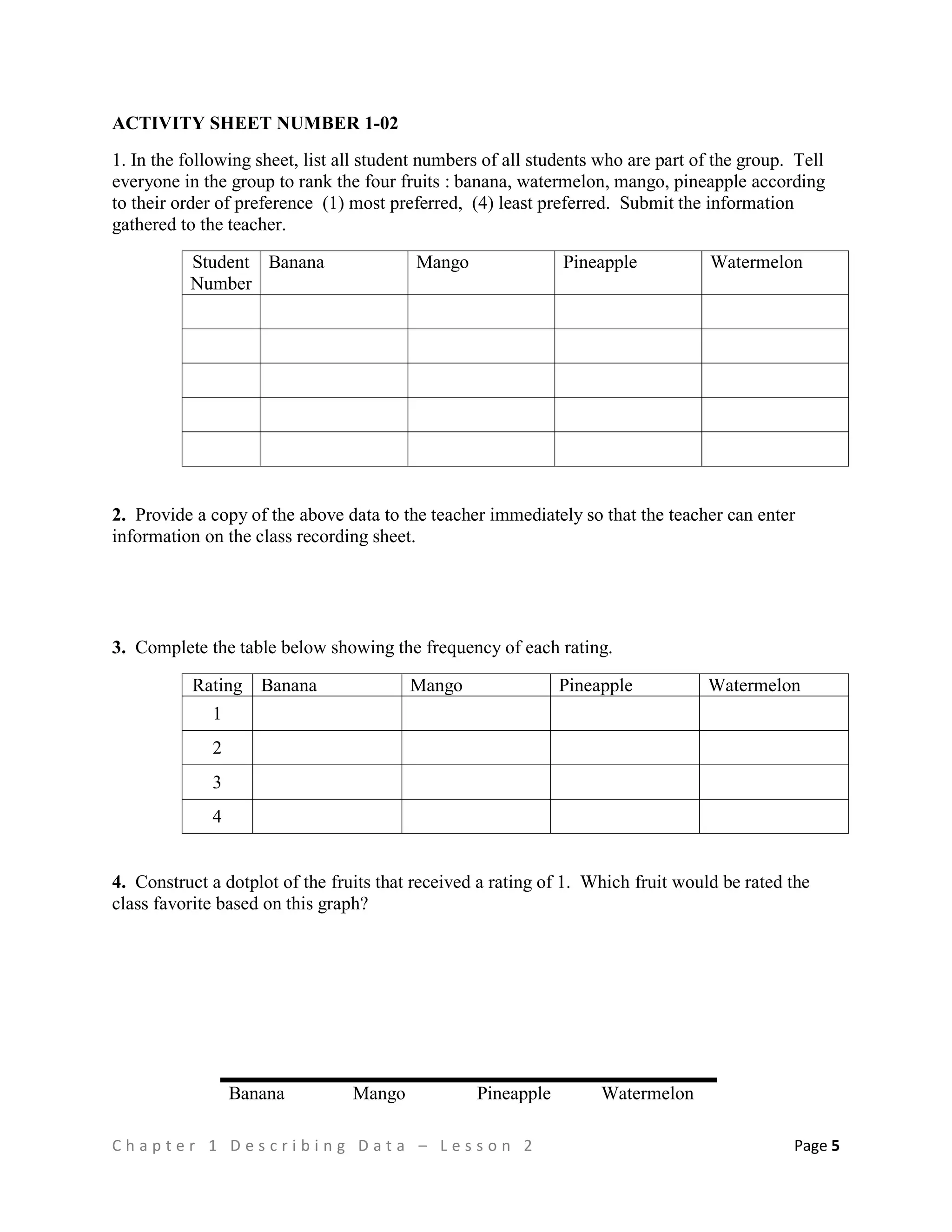
1. In the following sheet, list all student numbers of all students who are part of the group. Tell
everyone in the group to rank the four fruits : banana, watermelon, mango, pineapple according
to their order of preference (1) most preferred, (4) least preferred. Submit the information
gathered to the teacher.
Student
Number
Banana Mango Pineapple Watermelon
2. Provide a copy of the above data to the teacher immediately so that the teacher can enter
information on the class recording sheet.
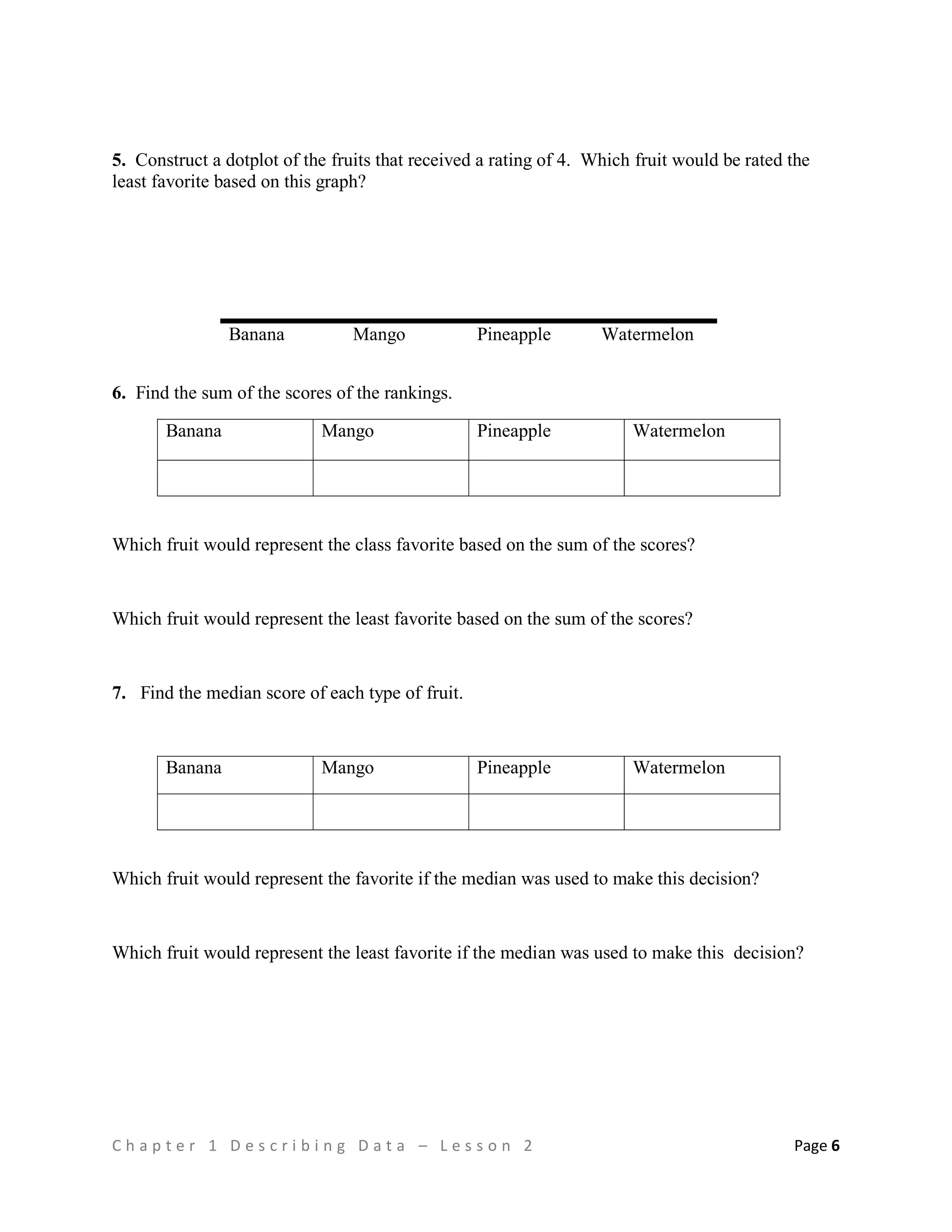
3. Complete the table below showing the frequency of each rating.
Rating Banana Mango Pineapple Watermelon
1
2
3
4
4. Construct a dotplot of the fruits that received a rating of 1. Which fruit would be rated the
class favorite based on this graph?
Banana Mango Pineapple Watermelon
C h a p t e r 1 D e s c r i b i n g D a t a – L e s s o n 2 Page 6
5. Construct a dotplot of the fruits that received a rating of 4. Which fruit would be rated the
least favorite based on this graph?
Banana Mango Pineapple Watermelon
6. Find the sum of the scores of the rankings.
Banana Mango Pineapple Watermelon
Which fruit would represent the class favorite based on the sum of the scores?
Which fruit would represent the least favorite based on the sum of the scores?
7. Find the median score of each type of fruit.
Banana Mango Pineapple Watermelon
Which fruit would represent the favorite if the median was used to make this decision?
Which fruit would represent the least favorite if the median was used to make this decision?
C h a p t e r 1 D e s c r i b i n g D a t a – L e s s o n 2 Page 7
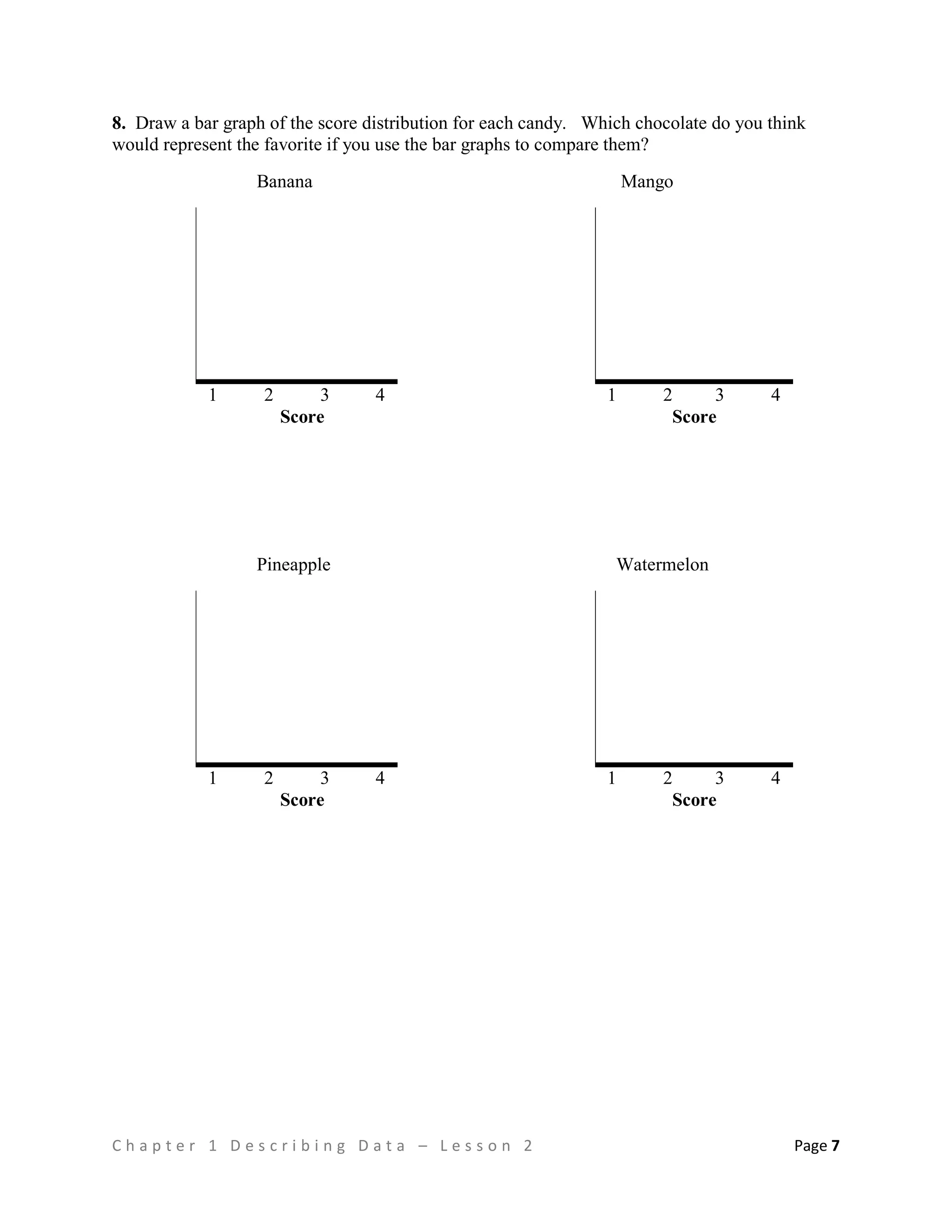
8. Draw a bar graph of the score distribution for each candy. Which chocolate do you think
would represent the favorite if you use the bar graphs to compare them?
Banana Mango
1 2 3 4 1 2 3 4
Score Score
Pineapple Watermelon
1 2 3 4 1 2 3 4
Score Score
C h a p t e r 1 D e s c r i b i n g D a t a – L e s s o n 2 Page 8
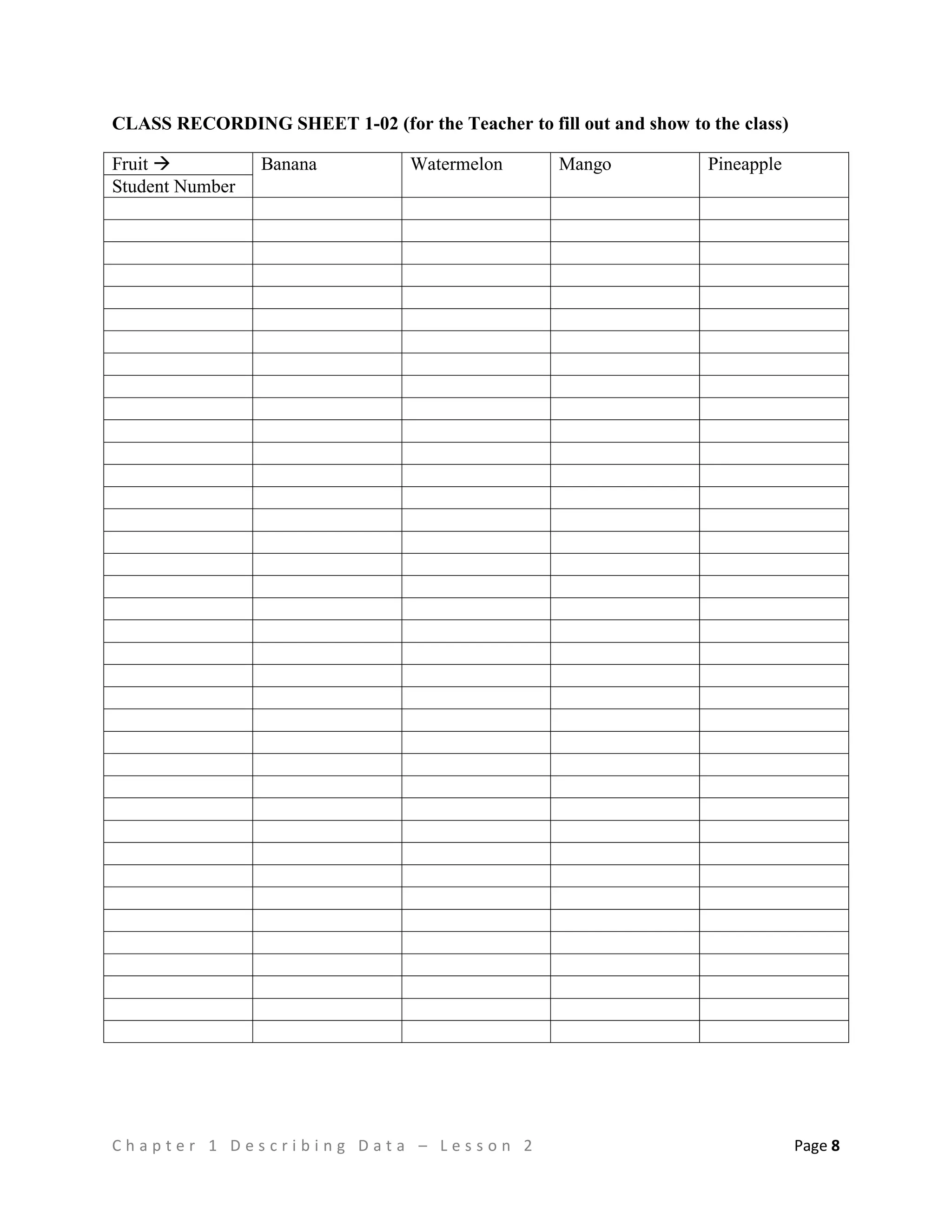
CLASS RECORDING SHEET 1-02 (for the Teacher to fill out and show to the class)
Fruit  Banana Watermelon Mango Pineapple
Student Number
C h a p t e r 1 D e s c r i b i n g D a t a – L e s s o n 2 Page 9
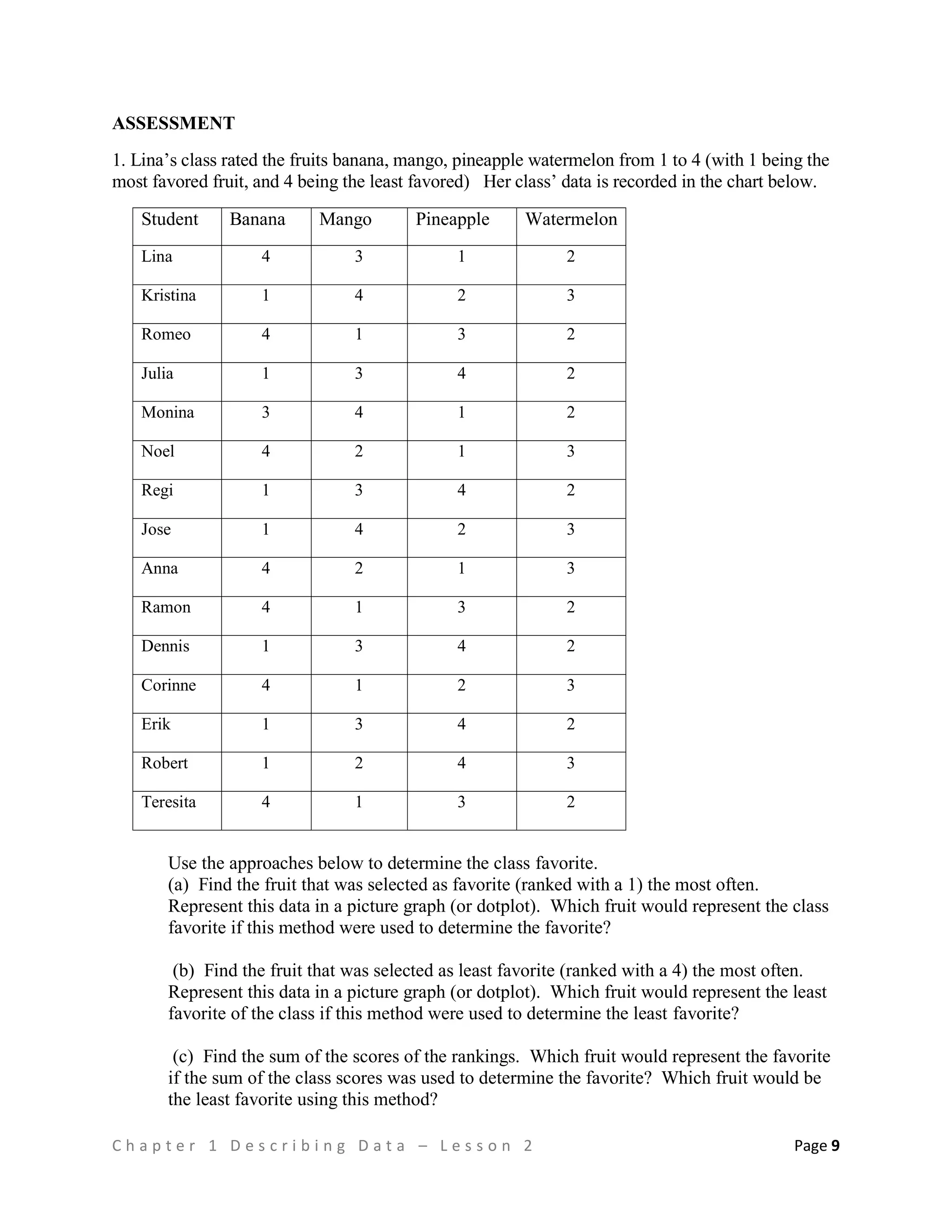
ASSESSMENT
1. Lina’s class rated the fruits banana, mango, pineapple watermelon from 1 to 4 (with 1 being the
most favored fruit, and 4 being the least favored) Her class’ data is recorded in the chart below.
Student Banana Mango Pineapple Watermelon
Lina 4 3 1 2
Kristina 1 4 2 3
Romeo 4 1 3 2
Julia 1 3 4 2
Monina 3 4 1 2
Noel 4 2 1 3
Regi 1 3 4 2
Jose 1 4 2 3
Anna 4 2 1 3
Ramon 4 1 3 2
Dennis 1 3 4 2
Corinne 4 1 2 3
Erik 1 3 4 2
Robert 1 2 4 3
Teresita 4 1 3 2
Use the approaches below to determine the class favorite.
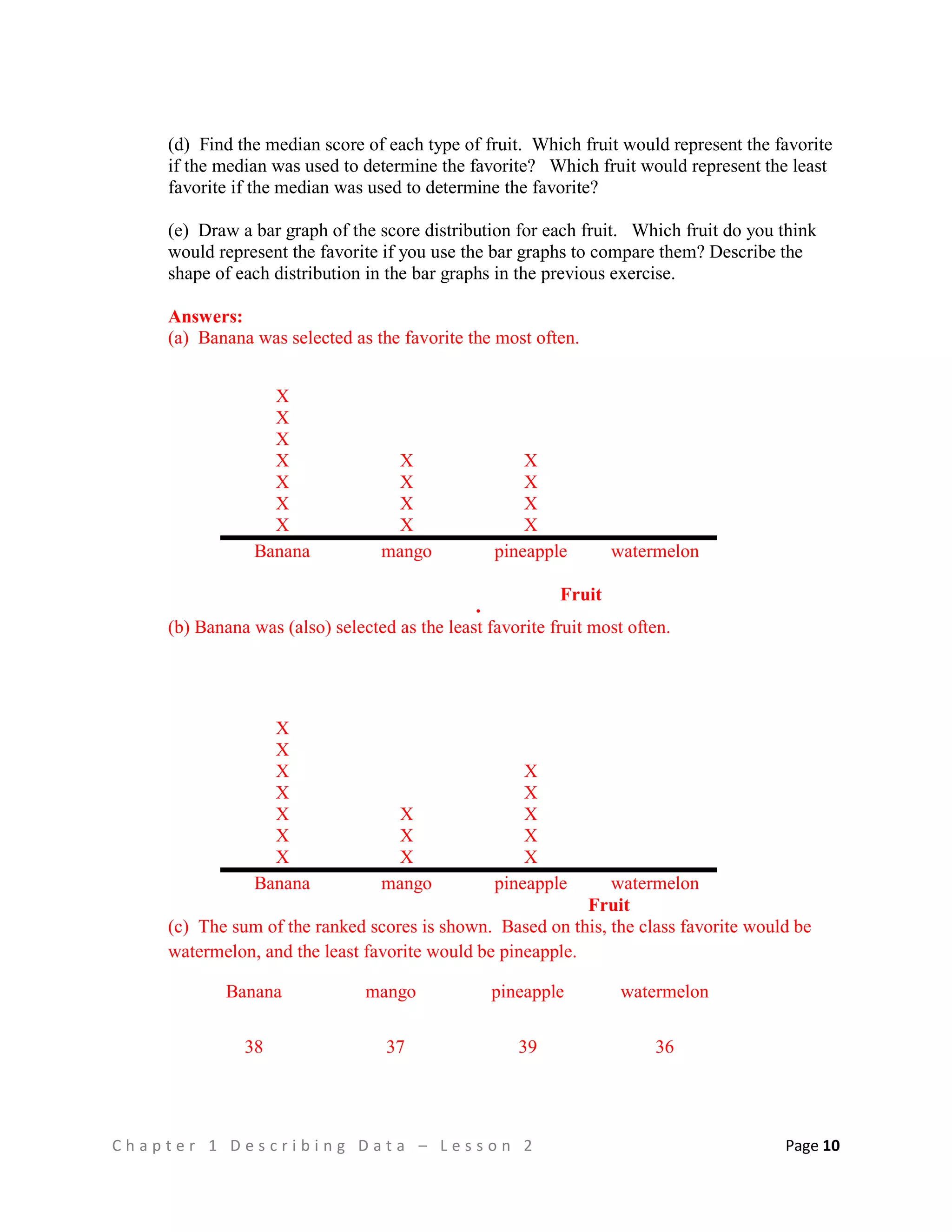
(a) Find the fruit that was selected as favorite (ranked with a 1) the most often.
Represent this data in a picture graph (or dotplot). Which fruit would represent the class
favorite if this method were used to determine the favorite?
(b) Find the fruit that was selected as least favorite (ranked with a 4) the most often.
Represent this data in a picture graph (or dotplot). Which fruit would represent the least
favorite of the class if this method were used to determine the least favorite?
(c) Find the sum of the scores of the rankings. Which fruit would represent the favorite
if the sum of the class scores was used to determine the favorite? Which fruit would be
the least favorite using this method?
C h a p t e r 1 D e s c r i b i n g D a t a – L e s s o n 2 Page 10
(d) Find the median score of each type of fruit. Which fruit would represent the favorite
if the median was used to determine the favorite? Which fruit would represent the least
favorite if the median was used to determine the favorite?
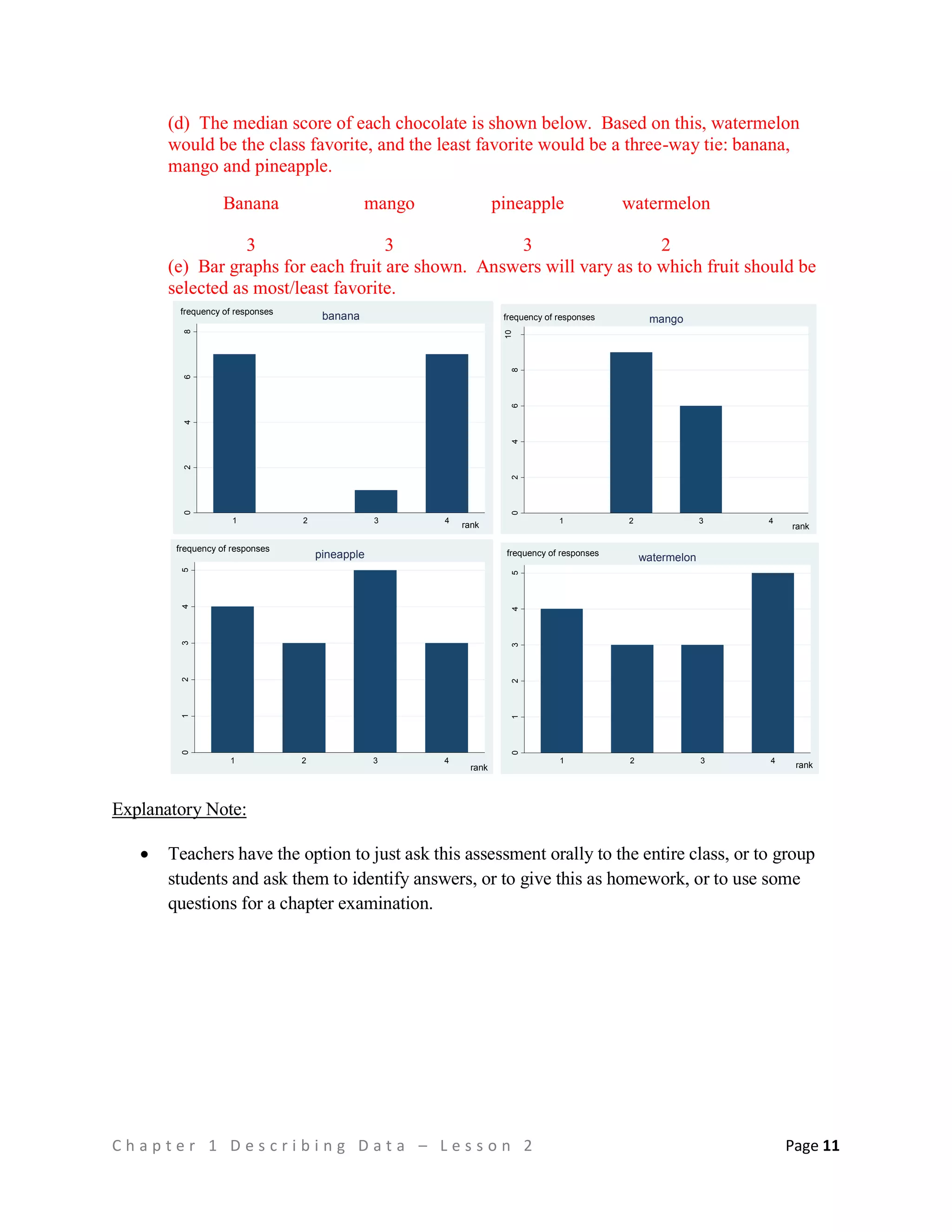
(e) Draw a bar graph of the score distribution for each fruit. Which fruit do you think
would represent the favorite if you use the bar graphs to compare them? Describe the
shape of each distribution in the bar graphs in the previous exercise.
Answers:
(a) Banana was selected as the favorite the most often.
X
X
X
X X X
X X X
X X X
X X X
Banana mango pineapple watermelon
Fruit

(b) Banana was (also) selected as the least favorite fruit most often.
X
X
X X
X X
X X X
X X X
X X X
Banana mango pineapple watermelon
Fruit
(c) The sum of the ranked scores is shown. Based on this, the class favorite would be
watermelon, and the least favorite would be pineapple.
Banana mango pineapple watermelon
38 37 39 36
C h a p t e r 1 D e s c r i b i n g D a t a – L e s s o n 2 Page 11
(d) The median score of each chocolate is shown below. Based on this, watermelon
would be the class favorite, and the least favorite would be a three-way tie: banana,
mango and pineapple.
Banana mango pineapple watermelon
3 3 3 2
(e) Bar graphs for each fruit are shown. Answers will vary as to which fruit should be
selected as most/least favorite.
Explanatory Note:
 Teachers have the option to just ask this assessment orally to the entire class, or to group
students and ask them to identify answers, or to give this as homework, or to use some
questions for a chapter examination.
02468
1 2 3 4
bananafrequency of responses
rank
02468
10
1 2 3 4
mangofrequency of responses
rank
012345
1 2 3 4
pineapple
frequency of responses
rank
012345
1 2 3 4
watermelonfrequency of responses
rank
C h a p t e r 1 D e s c r i b i n g D a t a – L e s s o n 2 Page 12
HOMEWORK
1. Inform students that in the next lesson, groups will be recording heights and weights of
students in each group. Thus, each group must assign someone to bring at least one tape
measure, and preferably, a weighing scale. If weighing scales can not be brought, each group
must go to the clinic before class begins, and take two records of their weights. If tape measures
can also not be brought to class, each group must also get two measurements of their heights
(with the rulers metric, attachment to Lesson 1-03), or with measuring devices in the clinic.
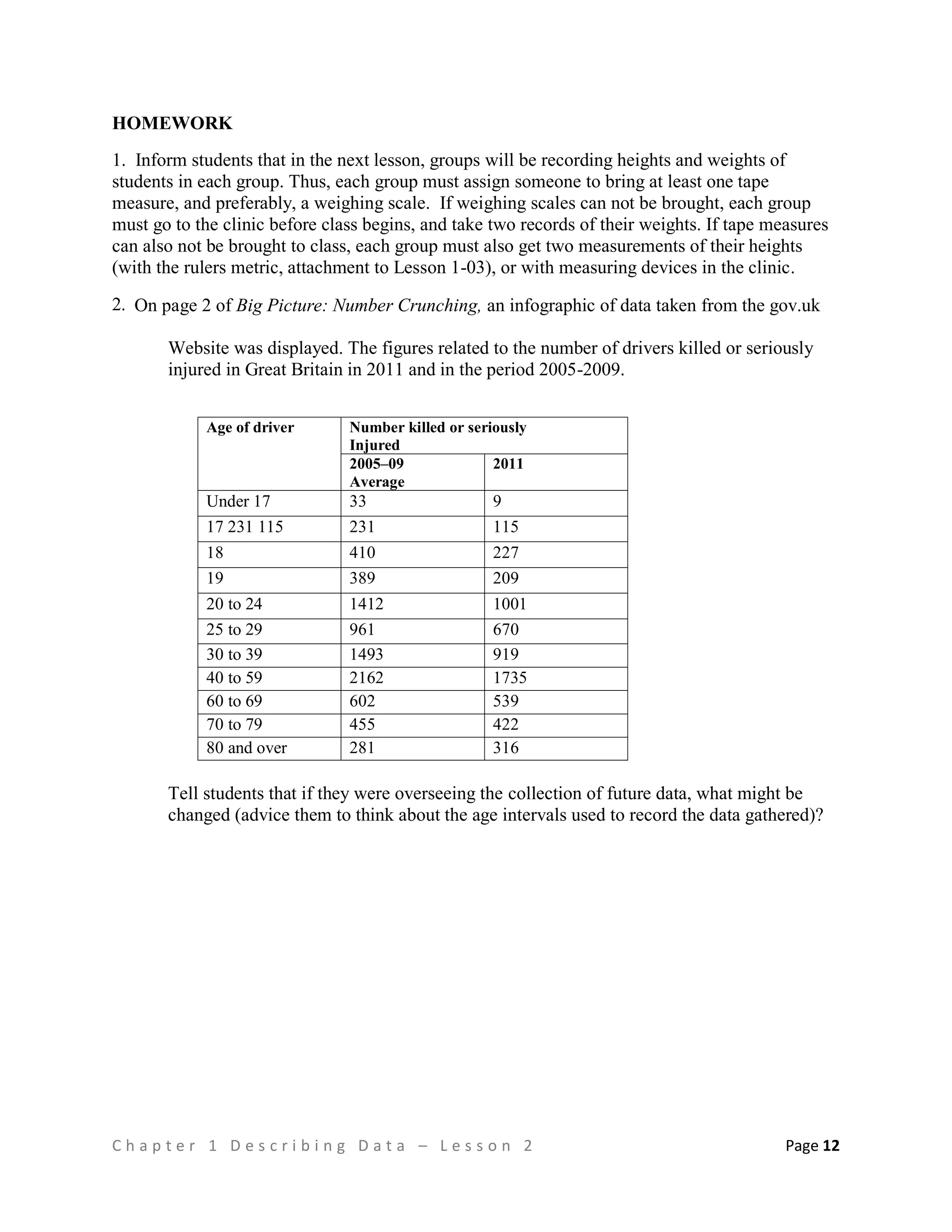
2. On page 2 of Big Picture: Number Crunching, an infographic of data taken from the gov.uk
Website was displayed. The figures related to the number of drivers killed or seriously
injured in Great Britain in 2011 and in the period 2005-2009.
Age of driver Number killed or seriously
Injured
2005–09
Average
2011
Under 17 33 9
17 231 115 231 115
18 410 227
19 389 209
20 to 24 1412 1001
25 to 29 961 670
30 to 39 1493 919
40 to 59 2162 1735
60 to 69 602 539
70 to 79 455 422
80 and over 281 316
Tell students that if they were overseeing the collection of future data, what might be
changed (advice them to think about the age intervals used to record the data gathered)?

Lesson 1 02 data collection and analysis

  • 1.
    C h ap t e r 1 D e s c r i b i n g D a t a – L e s s o n 2 Page 1 Chapter 1: Describing Data Lesson 2: Data Collection and Organization: Fruit Preferences TIME FRAME: 1 hour session OVERVIEW OF LESSON In this activity, students will also collect some other data in groups about their preferences for some fruits. The data on fruit preferences will be then compiled for the entire class. Students discuss how data gathered could be summarized to determine what is the class’ favorite fruit. LEARNING COMPETENCIES: At the end of the lesson, the learner should be able to:  develop skills in collecting data  illustrate how to summarize data (i.e., sort, classify, and organize data in tabular form and present the summary into a pictographs, bar charts, etc., and/or generate some summary measures).  provide meaningful interpretation of data collected LESSON OUTLINE: 1. Introduction: Recall of Past Learnings 2. Data Collection 3. Data Exploration DEVELOPMENT OF THE LESSON (A)Introduction After students are given their “student numbers”, begin the session with a recall of learnings from the first lesson:  data are facts (counts, measurements, or opinions) collected to answer statistical questions  data varies across subjects, and they may show up more than once  Statistics is a science that studies data, (B) Data Collection Divide the students into groups of five, and ask the groups to submit Activity Sheets Number 1-02. The objective of the activity is to help determine which fruit is the class favorite among the four fruits banana, watermelon, mango and pineapple. In the Activity Sheet, ask each student in each group to rank the four fruits banana, mango, pineapple and watermelon according to order of preference: 1 is the most preferred fruit, and 4 is the least preferred.
  • 2.
    C h ap t e r 1 D e s c r i b i n g D a t a – L e s s o n 2 Page 2 Highly Recommended: It may be helpful to use a projector and collect the data for the class recording sheet in a spreadsheet application (such as Microsoft Excel), for ease of generating data summaries and figures. (C) Data Exploration: Summarizing the Data of Activity Sheet 1-02 and Interpreting the Results Show a copy of the Class Recording Sheet 1-02 to students (preferably using a projector). If not, show all the data on the blackboard. Ask students whether the data presented on the data recording sheet answers the question about which fruit is the favorite. If the response is positive, ask which fruit is the favorite and which is least favorite. Be sure to ask what they based their responses on. One possible method is to take the sum of the responses (lowest sum = favorite, highest sum = least favorite). Another method of describing the (“categorical”) data is by using a picture graph. A picture graph refers to a graph where an object is used to represent one person on a graph. The picture graph is a variation on the dotplot and bar graph. Students can also make a picture graph of the least favorite fruit. Still another method is to use a bar graph. Students should construct a bar graph for each fruit and use it to compare the distributions. The teacher should facilitate a discussion about which fruit is most/least favorite, using the recorded data to help answer the questions. Are there natural groupings among the four fruits? Ask students to describe any potentially meaningful patterns. There should be a discussion about how to best interpret the data. Some students might think that the best way to determine the favorite fruit is to see which one had the most scores of 1. The teacher should use the word “mode” to describe the fruit that has the most scores of 1. Students should recognize that this fruit has the highest bar on a bar graph. You might ask for some disadvantages of using the mode to determine the class favorite. For example, this doesn’t take into account that the first choice of most students may also be the least favorite of many classmates. Another approach to determine the class favorite is to use the median. Although the data in this set is categorical, it can be placed in order numerically from most to least favorite. The median score for each candy is determined by the middle number in the data set if there is an odd number of data points, and by the average of the two middle numbers if there is an even number of data points. Other students might think that the sum of scores should determine the class favorite. An advantage of this approach is that all scores would be used to determine the favorite. Ask students to show their first choices (favorite) and last choices (least favored) in a pie chart.
  • 3.
    C h ap t e r 1 D e s c r i b i n g D a t a – L e s s o n 2 Page 3 KEY POINTS  There are various ways to summarize and examine data : o Graphs (pictographs, bar graphs) o Summary numbers (median, mode)  There is no unique way to determine the “class favorite” fruit o Analysis depends on methodology
  • 4.
    C h ap t e r 1 D e s c r i b i n g D a t a – L e s s o n 2 Page 4 REFERENCES Much of the material here adapted from: “Candy Judging” Lesson Plan by Susan Haller, St. Cloud State University in STatistics Education Web (STEW) Online Journal of K-12 Statistics Lesson Plans. http://www.amstat.org/education/stew/pdfs/CandyJudging.pdf
  • 5.
    C h ap t e r 1 D e s c r i b i n g D a t a – L e s s o n 2 Page 5 ACTIVITY SHEET NUMBER 1-02 1. In the following sheet, list all student numbers of all students who are part of the group. Tell everyone in the group to rank the four fruits : banana, watermelon, mango, pineapple according to their order of preference (1) most preferred, (4) least preferred. Submit the information gathered to the teacher. Student Number Banana Mango Pineapple Watermelon 2. Provide a copy of the above data to the teacher immediately so that the teacher can enter information on the class recording sheet. 3. Complete the table below showing the frequency of each rating. Rating Banana Mango Pineapple Watermelon 1 2 3 4 4. Construct a dotplot of the fruits that received a rating of 1. Which fruit would be rated the class favorite based on this graph? Banana Mango Pineapple Watermelon
  • 6.
    C h ap t e r 1 D e s c r i b i n g D a t a – L e s s o n 2 Page 6 5. Construct a dotplot of the fruits that received a rating of 4. Which fruit would be rated the least favorite based on this graph? Banana Mango Pineapple Watermelon 6. Find the sum of the scores of the rankings. Banana Mango Pineapple Watermelon Which fruit would represent the class favorite based on the sum of the scores? Which fruit would represent the least favorite based on the sum of the scores? 7. Find the median score of each type of fruit. Banana Mango Pineapple Watermelon Which fruit would represent the favorite if the median was used to make this decision? Which fruit would represent the least favorite if the median was used to make this decision?
  • 7.
    C h ap t e r 1 D e s c r i b i n g D a t a – L e s s o n 2 Page 7 8. Draw a bar graph of the score distribution for each candy. Which chocolate do you think would represent the favorite if you use the bar graphs to compare them? Banana Mango 1 2 3 4 1 2 3 4 Score Score Pineapple Watermelon 1 2 3 4 1 2 3 4 Score Score
  • 8.
    C h ap t e r 1 D e s c r i b i n g D a t a – L e s s o n 2 Page 8 CLASS RECORDING SHEET 1-02 (for the Teacher to fill out and show to the class) Fruit  Banana Watermelon Mango Pineapple Student Number
  • 9.
    C h ap t e r 1 D e s c r i b i n g D a t a – L e s s o n 2 Page 9 ASSESSMENT 1. Lina’s class rated the fruits banana, mango, pineapple watermelon from 1 to 4 (with 1 being the most favored fruit, and 4 being the least favored) Her class’ data is recorded in the chart below. Student Banana Mango Pineapple Watermelon Lina 4 3 1 2 Kristina 1 4 2 3 Romeo 4 1 3 2 Julia 1 3 4 2 Monina 3 4 1 2 Noel 4 2 1 3 Regi 1 3 4 2 Jose 1 4 2 3 Anna 4 2 1 3 Ramon 4 1 3 2 Dennis 1 3 4 2 Corinne 4 1 2 3 Erik 1 3 4 2 Robert 1 2 4 3 Teresita 4 1 3 2 Use the approaches below to determine the class favorite. (a) Find the fruit that was selected as favorite (ranked with a 1) the most often. Represent this data in a picture graph (or dotplot). Which fruit would represent the class favorite if this method were used to determine the favorite? (b) Find the fruit that was selected as least favorite (ranked with a 4) the most often. Represent this data in a picture graph (or dotplot). Which fruit would represent the least favorite of the class if this method were used to determine the least favorite? (c) Find the sum of the scores of the rankings. Which fruit would represent the favorite if the sum of the class scores was used to determine the favorite? Which fruit would be the least favorite using this method?
  • 10.
    C h ap t e r 1 D e s c r i b i n g D a t a – L e s s o n 2 Page 10 (d) Find the median score of each type of fruit. Which fruit would represent the favorite if the median was used to determine the favorite? Which fruit would represent the least favorite if the median was used to determine the favorite? (e) Draw a bar graph of the score distribution for each fruit. Which fruit do you think would represent the favorite if you use the bar graphs to compare them? Describe the shape of each distribution in the bar graphs in the previous exercise. Answers: (a) Banana was selected as the favorite the most often. X X X X X X X X X X X X X X X Banana mango pineapple watermelon Fruit  (b) Banana was (also) selected as the least favorite fruit most often. X X X X X X X X X X X X X X X Banana mango pineapple watermelon Fruit (c) The sum of the ranked scores is shown. Based on this, the class favorite would be watermelon, and the least favorite would be pineapple. Banana mango pineapple watermelon 38 37 39 36
  • 11.
    C h ap t e r 1 D e s c r i b i n g D a t a – L e s s o n 2 Page 11 (d) The median score of each chocolate is shown below. Based on this, watermelon would be the class favorite, and the least favorite would be a three-way tie: banana, mango and pineapple. Banana mango pineapple watermelon 3 3 3 2 (e) Bar graphs for each fruit are shown. Answers will vary as to which fruit should be selected as most/least favorite. Explanatory Note:  Teachers have the option to just ask this assessment orally to the entire class, or to group students and ask them to identify answers, or to give this as homework, or to use some questions for a chapter examination. 02468 1 2 3 4 bananafrequency of responses rank 02468 10 1 2 3 4 mangofrequency of responses rank 012345 1 2 3 4 pineapple frequency of responses rank 012345 1 2 3 4 watermelonfrequency of responses rank
  • 12.
    C h ap t e r 1 D e s c r i b i n g D a t a – L e s s o n 2 Page 12 HOMEWORK 1. Inform students that in the next lesson, groups will be recording heights and weights of students in each group. Thus, each group must assign someone to bring at least one tape measure, and preferably, a weighing scale. If weighing scales can not be brought, each group must go to the clinic before class begins, and take two records of their weights. If tape measures can also not be brought to class, each group must also get two measurements of their heights (with the rulers metric, attachment to Lesson 1-03), or with measuring devices in the clinic. 2. On page 2 of Big Picture: Number Crunching, an infographic of data taken from the gov.uk Website was displayed. The figures related to the number of drivers killed or seriously injured in Great Britain in 2011 and in the period 2005-2009. Age of driver Number killed or seriously Injured 2005–09 Average 2011 Under 17 33 9 17 231 115 231 115 18 410 227 19 389 209 20 to 24 1412 1001 25 to 29 961 670 30 to 39 1493 919 40 to 59 2162 1735 60 to 69 602 539 70 to 79 455 422 80 and over 281 316 Tell students that if they were overseeing the collection of future data, what might be changed (advice them to think about the age intervals used to record the data gathered)?