Practical Research 1:
Qualitative Research
Grade 11 –St. Luke
JOHN NINO DOLIGOL, LPT, MACDDS
Subject teacher
LESSON 1: WHAT IS RESEARCH?
1. Research is defined as the scientific investigation of phenomena which
includes collection, presentation, analysis and interpretation of facts
that lines an individual ‘s speculation with reality.
2. Solutions to problems must be based on knowledge not on mere beliefs,
guesses or theories.
3. In research a systematic and well-planned procedure is required to
meet the need in order that information is acquired and evaluate its
accuracy and effectiveness.
4. It is a process of inquiring.
NATURE OF INQUIRY
1. Inquiry is defined as “a seeking for truth, information or
knowledge”. It is a problem-solving technique.
2. The information and data pursued through questioning begins
with gathering by applying the different human senses.
3. Individuals carry on the process of inquiry from birth till
death.
4. Inquiry is synonymous with the word investigation.
Investigation and Immersion
• Investigation has a deeper meaning compared to “inquiry”.
• It is a systematic examination of a certain event or phenomenon.
• Immersion is a process whereby a researcher immerses (deeply involves)
himself in the data gathering activities and the data he has gathered is
carefully read or examined by him in detail.
• Combining the idea of “inquiry”, “investigation” and “immersion”, the concept
of “research” comes in.
Differentiate Inquiry from Research
Inquiry is a term that is synonymous with the word ‘investigation’.
When you inquire or investigate, you tend to ask questions to probe
or examine something to request for truth, information, or
knowledge.
Research is systematic and objective creation of knowledge
systematic (with a system or method, the scientific method),
objective (no bias, all angles presented), knowledge creation (a
creative process)
Purpose of Research
1. To inform action.
2. To prove or generate a theory.
3. To augment knowledge in a field or study.
Importance of Research in Daily Life
1. Research directs us to inquire about the right information by conducting
further investigation of the actual condition. It leads us to be cautious in
giving results and findings by proving lies and supporting the truth.
2. Research empowers us with knowledge and discovers new things and issues
in life. It helps us solve problems in health, crimes, business, technology
and environment.
3. Research facilitates learning as an opportunity to share valuable
information to others as a way of recognizing various concerns for public
awareness.
LEARNING EXPERIENCES: Activity 1
Directions: Answer the questions briefly.
1. What is Research?
2. What is inquiry and its nature?
3. What is the difference between inquiry and research?
4. How important is research in your daily life activities?
CHARACTERISTICS OF
RESEARCH
CHARACTERISTICS OF RESEARCH
1. Empirical. Research is based on direct experience or
observation by the researcher.
2. Logical. Research is based on valid procedures and principles.
3. Cyclical. Research is a cyclical process because it starts with
a problem and ends with a problem.
4. Analytical. Research utilizes proven analytical procedures in
gathering the data, whether historical, descriptive, and
experimental and case study.
CHARACTERISTICS OF RESEARCH
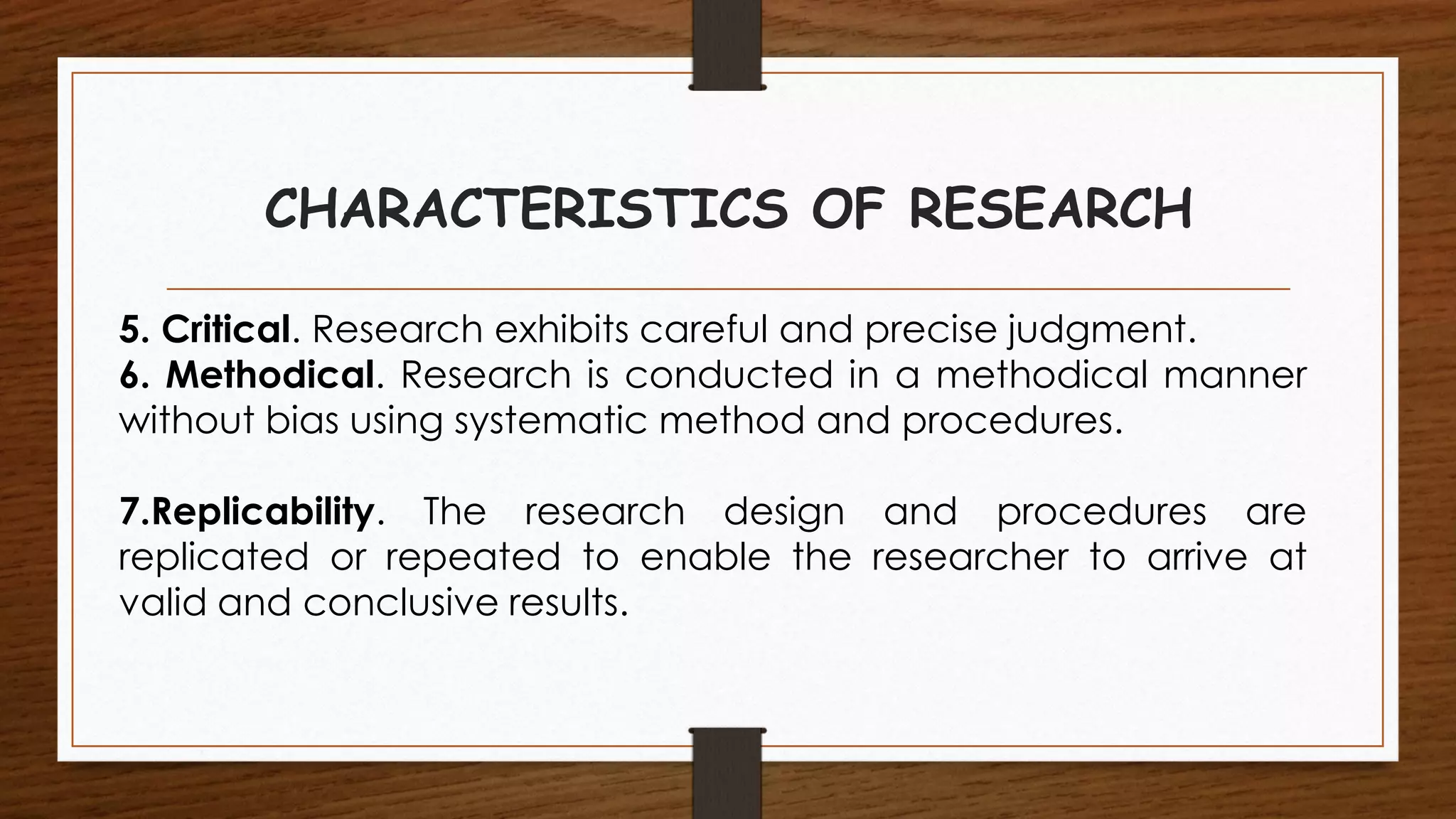
5. Critical. Research exhibits careful and precise judgment.
6. Methodical. Research is conducted in a methodical manner
without bias using systematic method and procedures.
7.Replicability. The research design and procedures are
replicated or repeated to enable the researcher to arrive at
valid and conclusive results.
The Seven Steps of the
Research Process
The Seven Steps of the Research Process
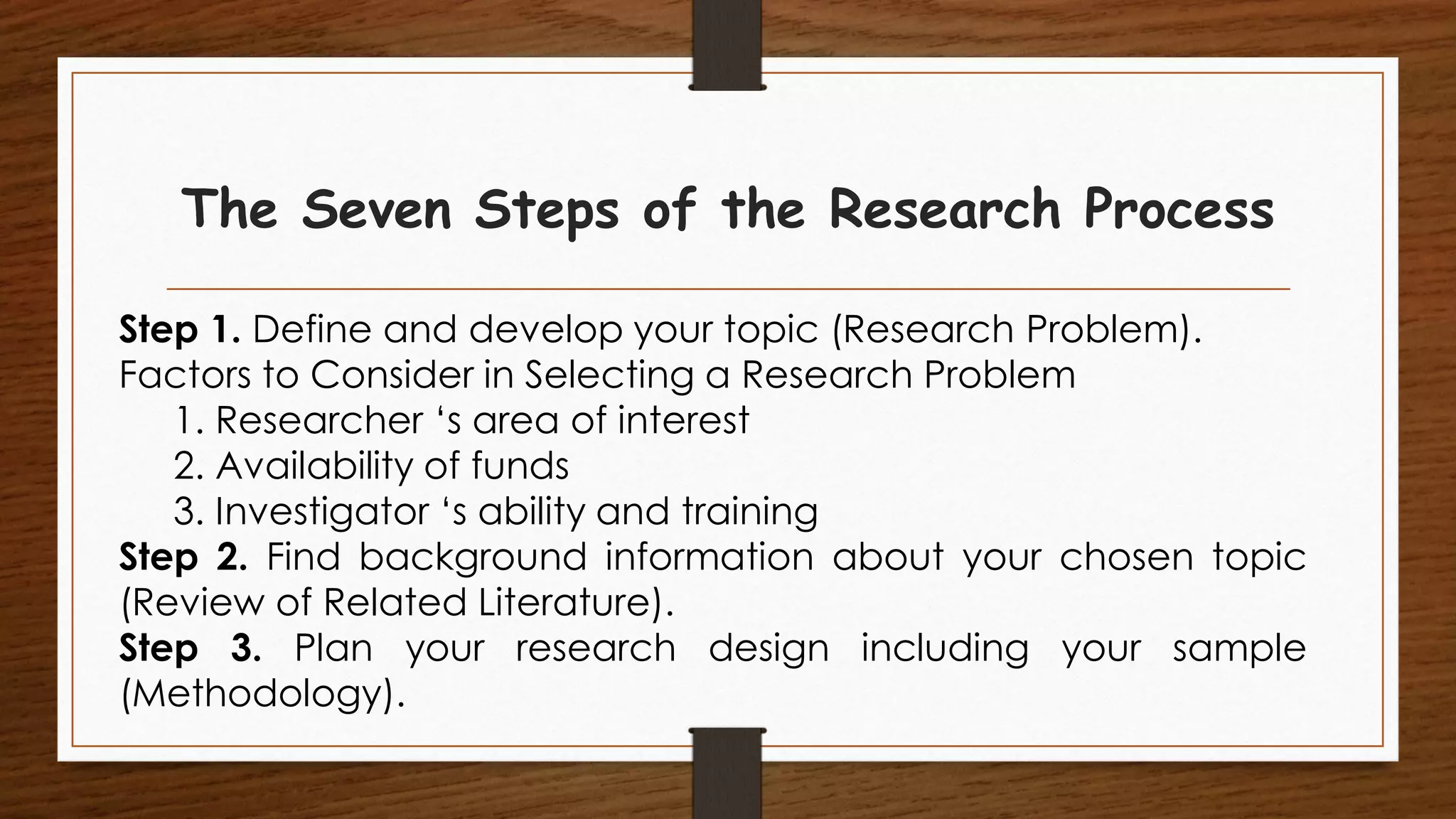
Step 1. Define and develop your topic (Research Problem).
Factors to Consider in Selecting a Research Problem
1. Researcher ‘s area of interest
2. Availability of funds
3. Investigator ‘s ability and training
Step 2. Find background information about your chosen topic
(Review of Related Literature).
Step 3. Plan your research design including your sample
(Methodology).
The Seven Steps of the Research Process
Step 4. Gather necessary data using open ended questions (for
qualitative research) and closed-ended questionnaire or paper
pencil test questionnaire (for quantitative research) (Data
Gathering Activities).
Step 5. Process and analyze data using thematic analysis (for
qualitative research) and statistical tools (for quantitative
research).
Step 6. Formulate new insights gained (for qualitative research)
conclusions (for quantitative research) and recommendations.
Step 7. Define new problem.
Ethics in Research
Research ethics are guidelines for the responsible conduct of
research which educates and monitors researchers to ensure
high standard. It promotes the aim of research, such as
expanding knowledge and supports the values required for
collaborative work, such as mutual respect and fairness.
Ethical considerations in
conducting research
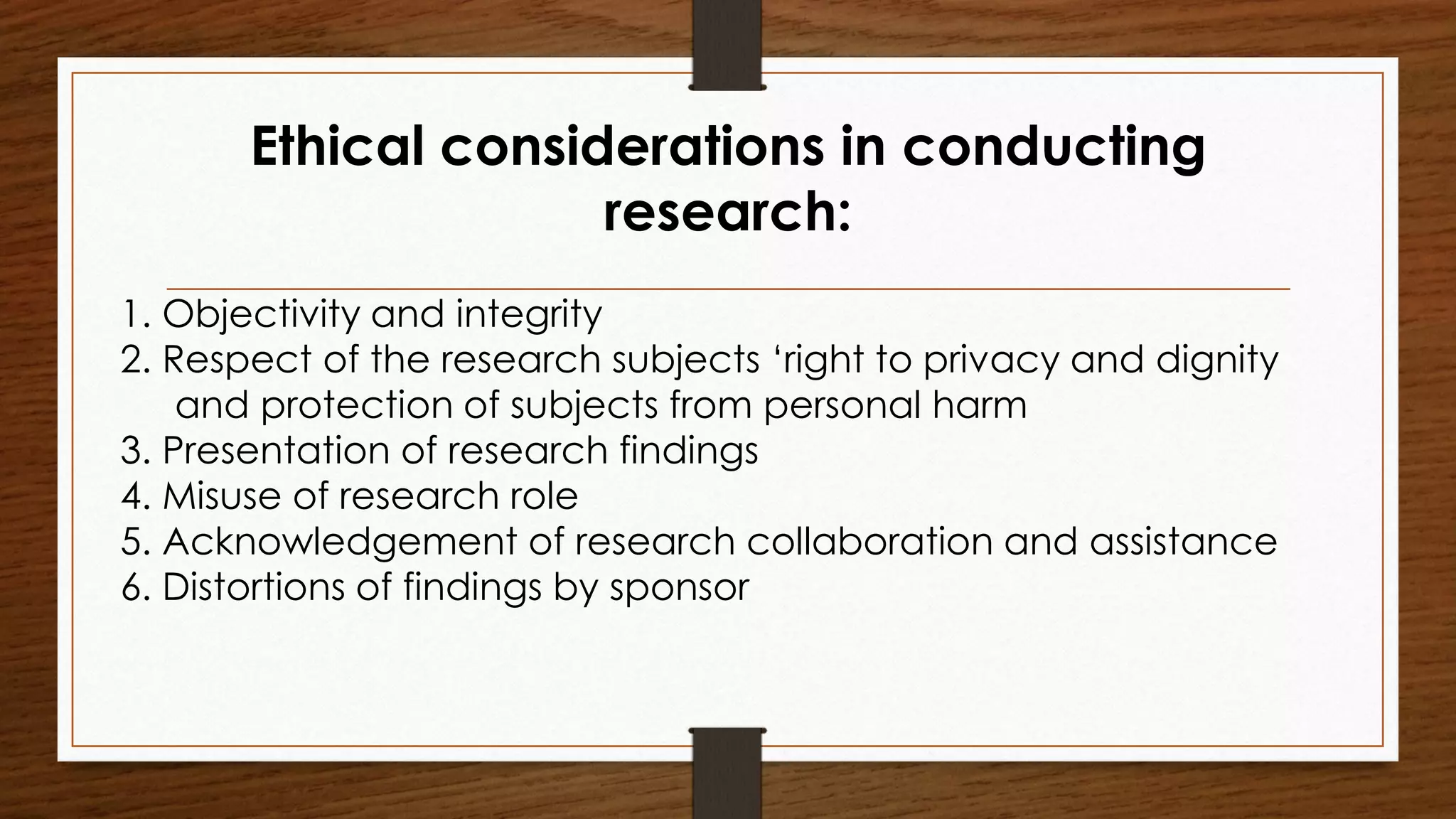
Ethical considerations in conducting
research:
1. Objectivity and integrity
2. Respect of the research subjects ‘right to privacy and dignity
and protection of subjects from personal harm
3. Presentation of research findings
4. Misuse of research role
5. Acknowledgement of research collaboration and assistance
6. Distortions of findings by sponsor
What are these ethics in research?
1. Informed Consent. This is required to secure in order protect
the rights of the participants in your study. Inform your
participants about the criteria set for choosing them as
informants and the schedule of one-on-one interview at the
convenient time they are available. Participation to the study
will be completely voluntary.
2. Honesty. It reports data, results, methods and procedures, and
publication status. Do not fabricate, falsify and misrepresent the
data.
What are these ethics in research?
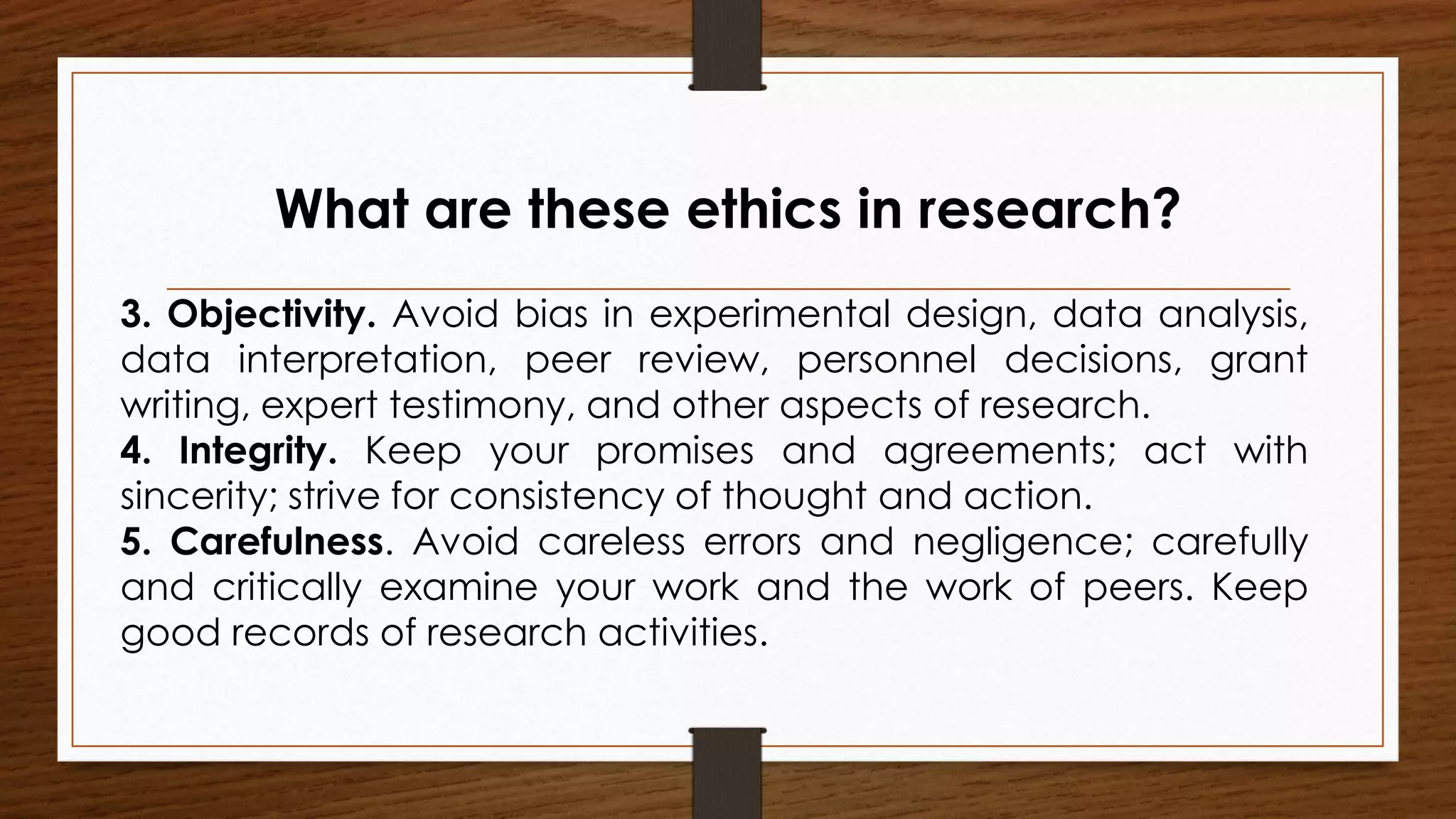
3. Objectivity. Avoid bias in experimental design, data analysis,
data interpretation, peer review, personnel decisions, grant
writing, expert testimony, and other aspects of research.
4. Integrity. Keep your promises and agreements; act with
sincerity; strive for consistency of thought and action.
5. Carefulness. Avoid careless errors and negligence; carefully
and critically examine your work and the work of peers. Keep
good records of research activities.
What are these ethics in research?
6. Openness. Share data, results, ideas, tools and resources. Be
open to criticism and new ideas.
7. Respect for Intellectual Property. Honor patents, copyrights,
trademarks, trade secrets and other forms of intellectual
property. Do not use published or unpublished data, methods, or
results without permission. Give credit where credit is due. Never
plagiarize, fabricate and falsify.
8. Confidentiality. Protect confidential communications, such as
papers or grants submitted for publication, personnel records,
trade or military secrets, and patient records.
What are these ethics in research?
12. Social responsibility. Strive to promote social acceptance
and prevent or mitigate social harms through research, public
education, and advocacy.
13. Non-discrimination. Avoid discrimination against colleagues
or students on the basis of sex, race, ethnicity, or other factors
that are not related to their scientific competence and integrity.
14. Competence. Maintain and improve your own professional
competence and expertise through lifelong education and
learning; take steps to promote competence in science as a
whole.
Rights of Research Participants
1. Human Rights. They are moral principles or norms that
describe certain standards of human behavior and are
regularly protected as natural and legal rights. They
constitute a set of rights and duties necessary for the
protection of human dignity, inherent to all human beings.
2. Intellectual Property. It protects creations of the mind, which
have both a moral and a commercial value.
Rights of Research Participants
3. Copyright Infringement. It is the use or production of
copyright-protected material without permission of the
copyright holder. Copyright infringement means that the rights
accorded to the copyright holder, such as the exclusive use of a
work for a set period of time, are breached by a third-party
Examples: a. Downloading movies and music without proper
payment for use. b. Recording movies in a theatre c. Using
others’ photographs for a blog without permission d. Copying
software code without giving proper credit e. Creating videos
with unlicensed music clips.
Rights of Research Participants
4. Voluntary Participation. People must not be coerced into
participating in research process. Essentially, this means that
prospective research participants must be informed about the
procedures and risks involved in research and must give their consent
to participate.
5. Anonymity. It is the protection of people’s identity through not
disclosing their name or not exposing their identity. It is a situation in
data gathering activities in which informant’s name is not given nor
known.
6. Privacy. It is someone’s right to keep his personal matters and
relationships secret. It is the ability of an individual to seclude him from
disturbance of any research activity.
Ethical Standards in Research Writing
Research Misconduct includes fabrication, falsification, or
plagiarism. It doesn’t include honest error of differences of
opinion. It can erode trust between researchers and funding
agencies, which make it more difficult for colleagues at the
same institution to receive grants.
Ethical Standards in Research
Writing
Ethical Standards in Research Writing
Plagiarism
Plagiarism refers to the act of using another person’s ideas,
works, processes, and results without giving due credit. It should not
be tolerated as the unauthorized use of original works, a violation
of intellectual property rights. Three different acts are considered
plagiarism:
1. Failure to cite quotations and borrowed ideas,
2. Failure to enclose borrowed language in quotation marks, and.
3. Failure to put summaries and paraphrases in your own words.
WRITTEN WORK
Activity : Question and Answer
Directions: Answer the questions briefly.
1. Why is research practical and realistic?
2. Explain briefly. Research starts with a problem and ends with a
new problem.
3. What is the purpose of research ethics in doing research
work?
4. A research can be replicated but not the findings. Why?
Quiz #1
Direction: Identify what characteristic of a researcher is being
referred to in the following statements. Choose the letter of the
correct answer
1. All the data to be reported should include all facts and accuracy.
a. Honesty
b. Objectivity
c. Competence
d. Care
2. Whatever agreed upon by the participants must be actualized.
a. Integrity
b. Legality
c. Social Responsibility
d. Responsible Publication
Quiz #1
Direction: Identify what characteristic of a researcher is being
referred to in the following statements. Choose the letter of the
correct answer
3. The researchers should accept all comments and considerations.
a. Openness
b. Respect for intellectual property
c. Non-discrimination
d. Responsible mentoring
4. When a paper is already submitted to a publication, no submission to
another should be done.
a. Objectivity
b. Legality
c. Care
d. Responsible Publication
Quiz #1
Direction: Identify what characteristic of a researcher is being
referred to in the following statements. Choose the letter of the
correct answer
5. The researcher should be fully equipped with research skills when
conducting the study.
a. Confidentiality
b. Competence
c. Legality
d. Openness
6. An experience researcher should impart knowledge to his or her
students.
a. Responsible Publication
b. Non-discrimination
c. Respect for colleagues
d. Social Responsibility
Quiz #1
Direction: Identify what characteristic of a researcher is being
referred to in the following statements. Choose the letter of the
correct answer
7. The researcher should ensure that the participants will not be
adversely affected by the research and its results.
a. Care
b. Human subjects’ protection
c. Respect for colleagues
d. Social Responsibility.
8. Any participants to any research activity must not be forced to take
part in the study.
a. Voluntary participation
b. Informed consent
c. Risk of harm
d. social responsibility
Quiz #1
Direction: Identify what characteristic of a researcher is being
referred to in the following statements. Choose the letter of the
correct answer
9. Informed consent for a participant is best exemplified in which of the
following actions?
a. Talking to him or her privately
b. Surprising him or her with a questionnaire
c. Writing him or her a letter
d. Using a padrino system
10. Confidentiality of a participant is best exemplified in which of the
following actions?
a. Asking the participant to write his or her name in the questionnaire
b. Not mentioning his or her name in the Participants of the study section
c. Introducing himself or herself in an interview
d. Taking his or her picture

Practical Research 1 ACTIVITY 1.1 L1.pdf

  • 1.
    Practical Research 1: QualitativeResearch Grade 11 –St. Luke JOHN NINO DOLIGOL, LPT, MACDDS Subject teacher
  • 2.
    LESSON 1: WHATIS RESEARCH? 1. Research is defined as the scientific investigation of phenomena which includes collection, presentation, analysis and interpretation of facts that lines an individual ‘s speculation with reality. 2. Solutions to problems must be based on knowledge not on mere beliefs, guesses or theories. 3. In research a systematic and well-planned procedure is required to meet the need in order that information is acquired and evaluate its accuracy and effectiveness. 4. It is a process of inquiring.
  • 3.
    NATURE OF INQUIRY 1.Inquiry is defined as “a seeking for truth, information or knowledge”. It is a problem-solving technique. 2. The information and data pursued through questioning begins with gathering by applying the different human senses. 3. Individuals carry on the process of inquiry from birth till death. 4. Inquiry is synonymous with the word investigation.
  • 4.
    Investigation and Immersion •Investigation has a deeper meaning compared to “inquiry”. • It is a systematic examination of a certain event or phenomenon. • Immersion is a process whereby a researcher immerses (deeply involves) himself in the data gathering activities and the data he has gathered is carefully read or examined by him in detail. • Combining the idea of “inquiry”, “investigation” and “immersion”, the concept of “research” comes in.
  • 5.
    Differentiate Inquiry fromResearch Inquiry is a term that is synonymous with the word ‘investigation’. When you inquire or investigate, you tend to ask questions to probe or examine something to request for truth, information, or knowledge. Research is systematic and objective creation of knowledge systematic (with a system or method, the scientific method), objective (no bias, all angles presented), knowledge creation (a creative process)
  • 6.
    Purpose of Research 1.To inform action. 2. To prove or generate a theory. 3. To augment knowledge in a field or study.
  • 7.
    Importance of Researchin Daily Life 1. Research directs us to inquire about the right information by conducting further investigation of the actual condition. It leads us to be cautious in giving results and findings by proving lies and supporting the truth. 2. Research empowers us with knowledge and discovers new things and issues in life. It helps us solve problems in health, crimes, business, technology and environment. 3. Research facilitates learning as an opportunity to share valuable information to others as a way of recognizing various concerns for public awareness.
  • 8.
    LEARNING EXPERIENCES: Activity1 Directions: Answer the questions briefly. 1. What is Research? 2. What is inquiry and its nature? 3. What is the difference between inquiry and research? 4. How important is research in your daily life activities?
  • 9.
  • 10.
    CHARACTERISTICS OF RESEARCH 1.Empirical. Research is based on direct experience or observation by the researcher. 2. Logical. Research is based on valid procedures and principles. 3. Cyclical. Research is a cyclical process because it starts with a problem and ends with a problem. 4. Analytical. Research utilizes proven analytical procedures in gathering the data, whether historical, descriptive, and experimental and case study.
  • 11.
    CHARACTERISTICS OF RESEARCH 5.Critical. Research exhibits careful and precise judgment. 6. Methodical. Research is conducted in a methodical manner without bias using systematic method and procedures. 7.Replicability. The research design and procedures are replicated or repeated to enable the researcher to arrive at valid and conclusive results.
  • 12.
    The Seven Stepsof the Research Process
  • 13.
    The Seven Stepsof the Research Process Step 1. Define and develop your topic (Research Problem). Factors to Consider in Selecting a Research Problem 1. Researcher ‘s area of interest 2. Availability of funds 3. Investigator ‘s ability and training Step 2. Find background information about your chosen topic (Review of Related Literature). Step 3. Plan your research design including your sample (Methodology).
  • 14.
    The Seven Stepsof the Research Process Step 4. Gather necessary data using open ended questions (for qualitative research) and closed-ended questionnaire or paper pencil test questionnaire (for quantitative research) (Data Gathering Activities). Step 5. Process and analyze data using thematic analysis (for qualitative research) and statistical tools (for quantitative research). Step 6. Formulate new insights gained (for qualitative research) conclusions (for quantitative research) and recommendations. Step 7. Define new problem.
  • 15.
    Ethics in Research Researchethics are guidelines for the responsible conduct of research which educates and monitors researchers to ensure high standard. It promotes the aim of research, such as expanding knowledge and supports the values required for collaborative work, such as mutual respect and fairness.
  • 16.
  • 17.
    Ethical considerations inconducting research: 1. Objectivity and integrity 2. Respect of the research subjects ‘right to privacy and dignity and protection of subjects from personal harm 3. Presentation of research findings 4. Misuse of research role 5. Acknowledgement of research collaboration and assistance 6. Distortions of findings by sponsor
  • 18.
    What are theseethics in research? 1. Informed Consent. This is required to secure in order protect the rights of the participants in your study. Inform your participants about the criteria set for choosing them as informants and the schedule of one-on-one interview at the convenient time they are available. Participation to the study will be completely voluntary. 2. Honesty. It reports data, results, methods and procedures, and publication status. Do not fabricate, falsify and misrepresent the data.
  • 19.
    What are theseethics in research? 3. Objectivity. Avoid bias in experimental design, data analysis, data interpretation, peer review, personnel decisions, grant writing, expert testimony, and other aspects of research. 4. Integrity. Keep your promises and agreements; act with sincerity; strive for consistency of thought and action. 5. Carefulness. Avoid careless errors and negligence; carefully and critically examine your work and the work of peers. Keep good records of research activities.
  • 20.
    What are theseethics in research? 6. Openness. Share data, results, ideas, tools and resources. Be open to criticism and new ideas. 7. Respect for Intellectual Property. Honor patents, copyrights, trademarks, trade secrets and other forms of intellectual property. Do not use published or unpublished data, methods, or results without permission. Give credit where credit is due. Never plagiarize, fabricate and falsify. 8. Confidentiality. Protect confidential communications, such as papers or grants submitted for publication, personnel records, trade or military secrets, and patient records.
  • 21.
    What are theseethics in research? 12. Social responsibility. Strive to promote social acceptance and prevent or mitigate social harms through research, public education, and advocacy. 13. Non-discrimination. Avoid discrimination against colleagues or students on the basis of sex, race, ethnicity, or other factors that are not related to their scientific competence and integrity. 14. Competence. Maintain and improve your own professional competence and expertise through lifelong education and learning; take steps to promote competence in science as a whole.
  • 22.
    Rights of ResearchParticipants
  • 23.
    Rights of ResearchParticipants 1. Human Rights. They are moral principles or norms that describe certain standards of human behavior and are regularly protected as natural and legal rights. They constitute a set of rights and duties necessary for the protection of human dignity, inherent to all human beings. 2. Intellectual Property. It protects creations of the mind, which have both a moral and a commercial value.
  • 24.
    Rights of ResearchParticipants 3. Copyright Infringement. It is the use or production of copyright-protected material without permission of the copyright holder. Copyright infringement means that the rights accorded to the copyright holder, such as the exclusive use of a work for a set period of time, are breached by a third-party Examples: a. Downloading movies and music without proper payment for use. b. Recording movies in a theatre c. Using others’ photographs for a blog without permission d. Copying software code without giving proper credit e. Creating videos with unlicensed music clips.
  • 25.
    Rights of ResearchParticipants 4. Voluntary Participation. People must not be coerced into participating in research process. Essentially, this means that prospective research participants must be informed about the procedures and risks involved in research and must give their consent to participate. 5. Anonymity. It is the protection of people’s identity through not disclosing their name or not exposing their identity. It is a situation in data gathering activities in which informant’s name is not given nor known. 6. Privacy. It is someone’s right to keep his personal matters and relationships secret. It is the ability of an individual to seclude him from disturbance of any research activity.
  • 26.
    Ethical Standards inResearch Writing Research Misconduct includes fabrication, falsification, or plagiarism. It doesn’t include honest error of differences of opinion. It can erode trust between researchers and funding agencies, which make it more difficult for colleagues at the same institution to receive grants.
  • 27.
    Ethical Standards inResearch Writing
  • 28.
    Ethical Standards inResearch Writing Plagiarism Plagiarism refers to the act of using another person’s ideas, works, processes, and results without giving due credit. It should not be tolerated as the unauthorized use of original works, a violation of intellectual property rights. Three different acts are considered plagiarism: 1. Failure to cite quotations and borrowed ideas, 2. Failure to enclose borrowed language in quotation marks, and. 3. Failure to put summaries and paraphrases in your own words.
  • 29.
  • 30.
    Activity : Questionand Answer Directions: Answer the questions briefly. 1. Why is research practical and realistic? 2. Explain briefly. Research starts with a problem and ends with a new problem. 3. What is the purpose of research ethics in doing research work? 4. A research can be replicated but not the findings. Why?
  • 31.
    Quiz #1 Direction: Identifywhat characteristic of a researcher is being referred to in the following statements. Choose the letter of the correct answer 1. All the data to be reported should include all facts and accuracy. a. Honesty b. Objectivity c. Competence d. Care 2. Whatever agreed upon by the participants must be actualized. a. Integrity b. Legality c. Social Responsibility d. Responsible Publication
  • 32.
    Quiz #1 Direction: Identifywhat characteristic of a researcher is being referred to in the following statements. Choose the letter of the correct answer 3. The researchers should accept all comments and considerations. a. Openness b. Respect for intellectual property c. Non-discrimination d. Responsible mentoring 4. When a paper is already submitted to a publication, no submission to another should be done. a. Objectivity b. Legality c. Care d. Responsible Publication
  • 33.
    Quiz #1 Direction: Identifywhat characteristic of a researcher is being referred to in the following statements. Choose the letter of the correct answer 5. The researcher should be fully equipped with research skills when conducting the study. a. Confidentiality b. Competence c. Legality d. Openness 6. An experience researcher should impart knowledge to his or her students. a. Responsible Publication b. Non-discrimination c. Respect for colleagues d. Social Responsibility
  • 34.
    Quiz #1 Direction: Identifywhat characteristic of a researcher is being referred to in the following statements. Choose the letter of the correct answer 7. The researcher should ensure that the participants will not be adversely affected by the research and its results. a. Care b. Human subjects’ protection c. Respect for colleagues d. Social Responsibility. 8. Any participants to any research activity must not be forced to take part in the study. a. Voluntary participation b. Informed consent c. Risk of harm d. social responsibility
  • 35.
    Quiz #1 Direction: Identifywhat characteristic of a researcher is being referred to in the following statements. Choose the letter of the correct answer 9. Informed consent for a participant is best exemplified in which of the following actions? a. Talking to him or her privately b. Surprising him or her with a questionnaire c. Writing him or her a letter d. Using a padrino system 10. Confidentiality of a participant is best exemplified in which of the following actions? a. Asking the participant to write his or her name in the questionnaire b. Not mentioning his or her name in the Participants of the study section c. Introducing himself or herself in an interview d. Taking his or her picture