Leishmaniasis
        Fatima Al-Awadh
INTRODUCTION
Learning Objectives
1. Define and classify parasites.
2. Explain the pathogenesis of parasite.
3. Define leishmaniasis.
4. Mention the types & causes, risk
   factors, signs & symptoms, diagnosis,
   complications, treatment &
   prevention.
5. Explain the life cycle of Leishmania.
What is a parasite ?
• A parasite is an organism that benefits
  from a close prolonged relationship with
  its host, which is harmed.
• The parasite grows, feeds, or uses
  shelter of the host organism (including
  the host itself) contributing negatively to
  the relationship.
• May be ectoparasites or endoparasites
  which can be intra- or extra- cellular
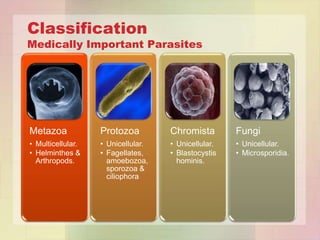
Classification
Medically Important Parasites


Metazoa            Protozoa         Chromista        Fungi
• Multicellular.   • Unicellular.   • Unicellular.   • Unicellular.
• Helminthes &     • Fagellates,    • Blastocystis   • Microsporidia.
  Arthropods.        amoebozoa,       hominis.
                     sporozoa &
                     ciliophora
Parasitic pathogenesis
• Given the wide diversity among human
  parasites, the pathogenesis is highly
  variable.
• Although the human parasites exhibit
  direct pathogenic mechanisms, in most
  instances the organisms themselves are
  not highly virulent!
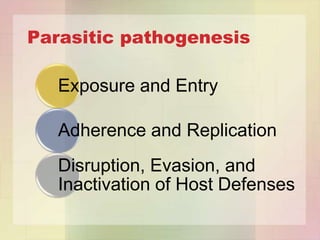
Parasitic pathogenesis

   Exposure and Entry

   Adherence and Replication
   Disruption, Evasion, and
   Inactivation of Host Defenses
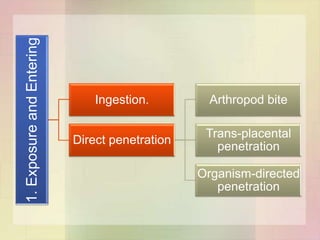
1. Exposure and Entering


                               Ingestion.         Arthropod bite

                                                 Trans-placental
                           Direct penetration
                                                   penetration

                                                Organism-directed
                                                   penetration
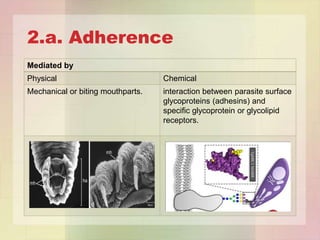
2.a. Adherence
Mediated by
Physical                           Chemical
Mechanical or biting mouthparts.   interaction between parasite surface
                                   glycoproteins (adhesins) and
                                   specific glycoprotein or glycolipid
                                   receptors.
2.b. Replication
• Parasites replicate intracellularly or
  extracellularly in human
• Helminthes generally do not replicate.
• Temperature is important for the ability
  to infect and cause disease.
Disruption, Evasion, and
   Inactivation of Host Defenses
   • Like other organisms, parasites elicit
     humoral and cell-mediated immune
     responses.
   • parasites are particularly adept at
     interfering with or avoiding these
     defense mechanisms.

Antigenic variation,
Molecular mimicry &    Intra-cellular location   Immuno-suppression
     Masking
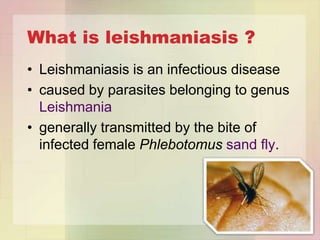
What is leishmaniasis ?
• Leishmaniasis is an infectious disease
• caused by parasites belonging to genus
  Leishmania
• generally transmitted by the bite of
  infected female Phlebotomus sand fly.
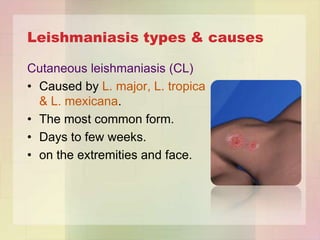
Leishmaniasis types & causes

Cutaneous leishmaniasis (CL)
• Caused by L. major, L. tropica
  & L. mexicana.
• The most common form.
• Days to few weeks.
• on the extremities and face.
Leishmaniasis types & causes

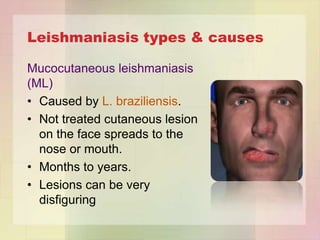
Mucocutaneous leishmaniasis
(ML)
• Caused by L. braziliensis.
• Not treated cutaneous lesion
  on the face spreads to the
  nose or mouth.
• Months to years.
• Lesions can be very
  disfiguring
Leishmaniasis types & causes

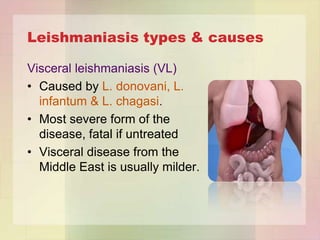
Visceral leishmaniasis (VL)
• Caused by L. donovani, L.
  infantum & L. chagasi.
• Most severe form of the
  disease, fatal if untreated
• Visceral disease from the
  Middle East is usually milder.
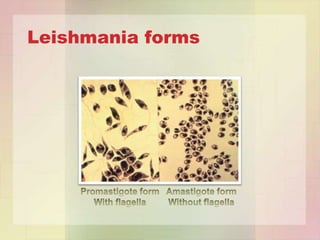
Leishmania forms
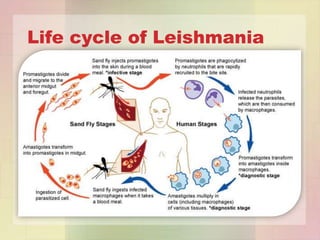
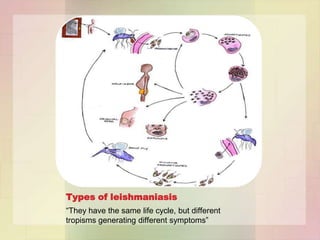
Life cycle of Leishmania
Types of leishmaniasis
“They have the same life cycle, but different
tropisms generating different symptoms”
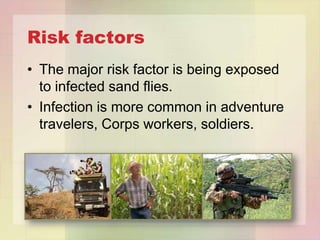
Risk factors
• The major risk factor is being exposed
  to infected sand flies.
• Infection is more common in adventure
  travelers, Corps workers, soldiers.
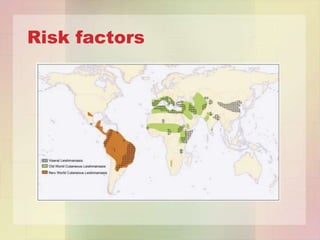
Risk factors
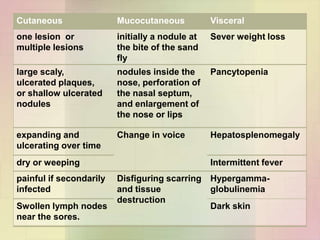
SIGNS AND SYMPTOMS
Cutaneous                Mucocutaneous           Visceral
one lesion or            initially a nodule at   Sever weight loss
multiple lesions         the bite of the sand
                         fly
large scaly,             nodules inside the      Pancytopenia
ulcerated plaques,       nose, perforation of
or shallow ulcerated     the nasal septum,
nodules                  and enlargement of
                         the nose or lips

expanding and            Change in voice         Hepatosplenomegaly
ulcerating over time
dry or weeping                                   Intermittent fever
painful if secondarily   Disfiguring scarring    Hypergamma-
infected                 and tissue              globulinemia
                         destruction
Swollen lymph nodes                              Dark skin
near the sores.
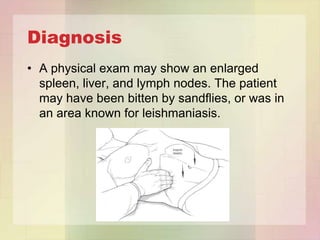
Diagnosis
• A physical exam may show an enlarged
  spleen, liver, and lymph nodes. The patient
  may have been bitten by sandflies, or was in
  an area known for leishmaniasis.
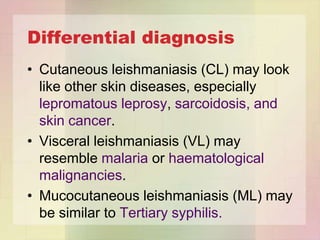
Differential diagnosis
• Cutaneous leishmaniasis (CL) may look
  like other skin diseases, especially
  lepromatous leprosy, sarcoidosis, and
  skin cancer.
• Visceral leishmaniasis (VL) may
  resemble malaria or haematological
  malignancies.
• Mucocutaneous leishmaniasis (ML) may
  be similar to Tertiary syphilis.
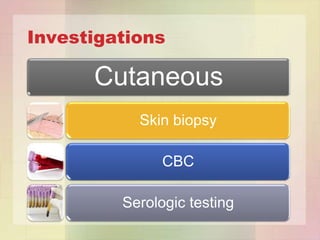
Investigations

      Cutaneous
           Skin biopsy

               CBC

         Serologic testing
Visceral

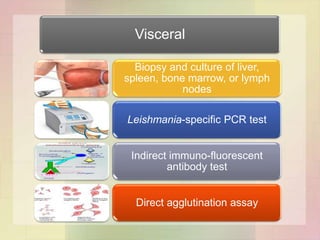
  Biopsy and culture of liver,
spleen, bone marrow, or lymph
            nodes

Leishmania-specific PCR test


 Indirect immuno-fluorescent
         antibody test


  Direct agglutination assay
Complication
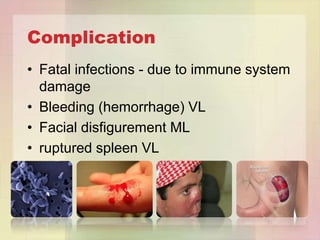
• Fatal infections - due to immune system
  damage
• Bleeding (hemorrhage) VL
• Facial disfigurement ML
• ruptured spleen VL
Treatment
Antimony-containing
                        Other drugs :       Surgery
    compounds :


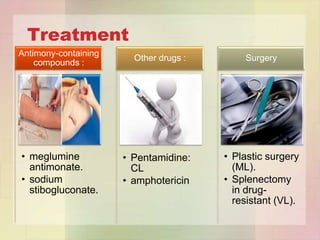
• meglumine           • Pentamidine:    • Plastic surgery
  antimonate.           CL                (ML).
• sodium              • amphotericin    • Splenectomy
  stibogluconate.                         in drug-
                                          resistant (VL).
Prognosis
Cutaneous                Mucocutaneous             Visceral
Localized cutaneous      relatively resistant to   Untreated visceral
leishmaniasis lesions    treatment.                leishmaniasis has a
usually heal                                       90% death rate, but
themselves completely.                             only a 10% death rate
Diffuse cutaneous                                  with treatment.
leishmaniasis may
smolder on for years
without treatment
Prevention
Preventing sand fly bites is the most immediate
form of protection. You can prevent a bite by:

• Putting fine mesh netting around the bed
• Screening windows
• Wearing insect repellent
• Wearing protective clothing
• Public health measures to reduce the sandfly
  population and animal reservoirs.
• There are no vaccines or drugs that prevent
  leishmaniasis
Conclusion
References
• Merck manual, Pg 1379-1381
  Medical microbiology, Pg 797-801
• http://www.youtube.com/watch?v=7poF
  ARIxPoE
• http://www.medicinenet.com/leishmania
  sis/page6.htm#what_is_the_prognosis_
  of_leishmaniasis
• http://www.the-travel-
  doctor.com/leishmaniasis.htm
Leishmaniasis

Leishmaniasis

  • 1.
    Leishmaniasis Fatima Al-Awadh
  • 2.
  • 3.
    Learning Objectives 1. Defineand classify parasites. 2. Explain the pathogenesis of parasite. 3. Define leishmaniasis. 4. Mention the types & causes, risk factors, signs & symptoms, diagnosis, complications, treatment & prevention. 5. Explain the life cycle of Leishmania.
  • 4.
    What is aparasite ? • A parasite is an organism that benefits from a close prolonged relationship with its host, which is harmed. • The parasite grows, feeds, or uses shelter of the host organism (including the host itself) contributing negatively to the relationship. • May be ectoparasites or endoparasites which can be intra- or extra- cellular
  • 5.
    Classification Medically Important Parasites Metazoa Protozoa Chromista Fungi • Multicellular. • Unicellular. • Unicellular. • Unicellular. • Helminthes & • Fagellates, • Blastocystis • Microsporidia. Arthropods. amoebozoa, hominis. sporozoa & ciliophora
  • 6.
    Parasitic pathogenesis • Giventhe wide diversity among human parasites, the pathogenesis is highly variable. • Although the human parasites exhibit direct pathogenic mechanisms, in most instances the organisms themselves are not highly virulent!
  • 7.
    Parasitic pathogenesis Exposure and Entry Adherence and Replication Disruption, Evasion, and Inactivation of Host Defenses
  • 8.
    1. Exposure andEntering Ingestion. Arthropod bite Trans-placental Direct penetration penetration Organism-directed penetration
  • 9.
    2.a. Adherence Mediated by Physical Chemical Mechanical or biting mouthparts. interaction between parasite surface glycoproteins (adhesins) and specific glycoprotein or glycolipid receptors.
  • 10.
    2.b. Replication • Parasitesreplicate intracellularly or extracellularly in human • Helminthes generally do not replicate. • Temperature is important for the ability to infect and cause disease.
  • 11.
    Disruption, Evasion, and Inactivation of Host Defenses • Like other organisms, parasites elicit humoral and cell-mediated immune responses. • parasites are particularly adept at interfering with or avoiding these defense mechanisms. Antigenic variation, Molecular mimicry & Intra-cellular location Immuno-suppression Masking
  • 12.
    What is leishmaniasis? • Leishmaniasis is an infectious disease • caused by parasites belonging to genus Leishmania • generally transmitted by the bite of infected female Phlebotomus sand fly.
  • 13.
    Leishmaniasis types &causes Cutaneous leishmaniasis (CL) • Caused by L. major, L. tropica & L. mexicana. • The most common form. • Days to few weeks. • on the extremities and face.
  • 14.
    Leishmaniasis types &causes Mucocutaneous leishmaniasis (ML) • Caused by L. braziliensis. • Not treated cutaneous lesion on the face spreads to the nose or mouth. • Months to years. • Lesions can be very disfiguring
  • 15.
    Leishmaniasis types &causes Visceral leishmaniasis (VL) • Caused by L. donovani, L. infantum & L. chagasi. • Most severe form of the disease, fatal if untreated • Visceral disease from the Middle East is usually milder.
  • 16.
  • 17.
    Life cycle ofLeishmania
  • 18.
    Types of leishmaniasis “Theyhave the same life cycle, but different tropisms generating different symptoms”
  • 19.
    Risk factors • Themajor risk factor is being exposed to infected sand flies. • Infection is more common in adventure travelers, Corps workers, soldiers.
  • 20.
  • 21.
  • 22.
    Cutaneous Mucocutaneous Visceral one lesion or initially a nodule at Sever weight loss multiple lesions the bite of the sand fly large scaly, nodules inside the Pancytopenia ulcerated plaques, nose, perforation of or shallow ulcerated the nasal septum, nodules and enlargement of the nose or lips expanding and Change in voice Hepatosplenomegaly ulcerating over time dry or weeping Intermittent fever painful if secondarily Disfiguring scarring Hypergamma- infected and tissue globulinemia destruction Swollen lymph nodes Dark skin near the sores.
  • 23.
    Diagnosis • A physicalexam may show an enlarged spleen, liver, and lymph nodes. The patient may have been bitten by sandflies, or was in an area known for leishmaniasis.
  • 24.
    Differential diagnosis • Cutaneousleishmaniasis (CL) may look like other skin diseases, especially lepromatous leprosy, sarcoidosis, and skin cancer. • Visceral leishmaniasis (VL) may resemble malaria or haematological malignancies. • Mucocutaneous leishmaniasis (ML) may be similar to Tertiary syphilis.
  • 25.
    Investigations Cutaneous Skin biopsy CBC Serologic testing
  • 26.
    Visceral Biopsyand culture of liver, spleen, bone marrow, or lymph nodes Leishmania-specific PCR test Indirect immuno-fluorescent antibody test Direct agglutination assay
  • 27.
    Complication • Fatal infections- due to immune system damage • Bleeding (hemorrhage) VL • Facial disfigurement ML • ruptured spleen VL
  • 28.
    Treatment Antimony-containing Other drugs : Surgery compounds : • meglumine • Pentamidine: • Plastic surgery antimonate. CL (ML). • sodium • amphotericin • Splenectomy stibogluconate. in drug- resistant (VL).
  • 29.
    Prognosis Cutaneous Mucocutaneous Visceral Localized cutaneous relatively resistant to Untreated visceral leishmaniasis lesions treatment. leishmaniasis has a usually heal 90% death rate, but themselves completely. only a 10% death rate Diffuse cutaneous with treatment. leishmaniasis may smolder on for years without treatment
  • 30.
    Prevention Preventing sand flybites is the most immediate form of protection. You can prevent a bite by: • Putting fine mesh netting around the bed • Screening windows • Wearing insect repellent • Wearing protective clothing • Public health measures to reduce the sandfly population and animal reservoirs. • There are no vaccines or drugs that prevent leishmaniasis
  • 31.
  • 32.
    References • Merck manual,Pg 1379-1381 Medical microbiology, Pg 797-801 • http://www.youtube.com/watch?v=7poF ARIxPoE • http://www.medicinenet.com/leishmania sis/page6.htm#what_is_the_prognosis_ of_leishmaniasis • http://www.the-travel- doctor.com/leishmaniasis.htm

Editor's Notes

  • #4 complication
  • #25 http://www.patient.co.uk/doctor/Leishmaniasis.htm
  • #31 Spray living/sleeping areas with an insecticide to kill insects.If you are not sleeping in a well-screened or air-conditioned area, use a bed net and tuck it under your mattress. If possible, use a bed net that has been soaked in or sprayed with a pyrethroid-containing insecticide (permethrin or deltamethrin). The same treatment can be applied to screens, curtains, sheets, and clothing (clothing should be retreated after five washings).Source:http://www.cdc.gov/parasites/leishmaniasis/prevent.html