
Topic:
Inkjet Printer
By: Danish Amin
Introduction
• Inkjet printing is a type of computer printing that recreates a digital image by
propelling droplets of ink onto paper, plastic, or other substrates. Inkjet printers are
the most commonly used type of printer, and range from small inexpensive consumer
models to expensive professional machines.
• The concept of inkjet printing originated in the 20th century, and the technology was
first extensively developed in the early 1950s. Starting in the late 1970s, inkjet
printers that could reproduce digital images generated by computers were
developed, mainly by Epson, Hewlett-Packard (HP) and Canon.
• In the worldwide consumer market, four manufacturers account for the majority of
inkjet printer sales: Canon, HP, Epson and Brother. The emerging ink jet material
deposition market also uses inkjet technologies, typically print heads using
piezoelectric crystals, to deposit materials directly on substrates.
Methods
There are two main technologies in use in
contemporary inkjet printers:
Continuous (CIJ)
Drop-on-demand (DOD).
Continuous inkjet
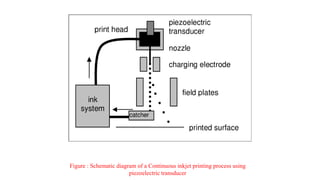
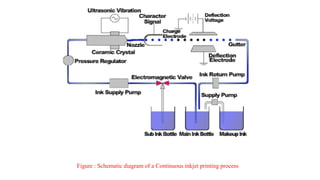
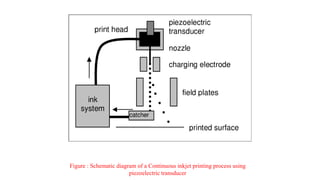
In CIJ technology, a high-pressure pump directs liquid ink from a reservoir through a
gunbody and a microscopic nozzle, creating a continuous stream of ink droplets via the
Plateau-Rayleigh instability. A piezoelectric crystal creates an acoustic wave as it vibrates
within the gunbody and causes the stream of liquid to break into droplets at regular
intervals: 64,000 to 165,000 droplets per second may be achieved. The ink droplets are
subjected to an electrostatic field created by a charging electrode as they form; the field
varies according to the degree of drop deflection desired. This results in a controlled,
variable electrostatic charge on each droplet. Charged droplets are separated by one or
more uncharged "guard droplets" to minimize electrostatic repulsion between neighbouring
droplets.
The charged droplets pass through another electrostatic field and are directed (deflected)
by electrostatic deflection plates to print on the receptor material (substrate), or allowed to
continue on undeflected to a collection gutter for re-use. The more highly charged droplets
are deflected to a greater degree. Only a small fraction of the droplets is used to print, the
majority being recycled.
CIJ is one of the oldest ink jet technologies in use and is fairly mature. The
major advantages are the very high velocity (≈20 m/s) of the ink droplets,
which allows for a relatively long distance between print head and substrate,
and the very high drop ejection frequency, allowing for very high speed
printing. Another advantage is freedom from nozzle clogging as the jet is
always in use, therefore allowing volatile solvents such as ketones and
alcohols to be employed, giving the ink th ability to "bite" into the substrate
and dry quickly.
The ink system requires active solvent regulation to counter solvent
evaporation during the time of flight (time between nozzle ejection and gutter
recycling), and from the venting process whereby air that is drawn into the
gutter along with the unused drops is vented from the reservoir. Viscosity is
monitored and a solvent (or solvent blend) is added to counteract solvent loss.
Figure : Schematic diagram of a Continuous inkjet printing process using
piezoelectric transducer
Figure : Schematic diagram of a Continuous inkjet printing process
Drop-on-demand
Drop-on-demand (DOD) is divided into thermal DOD and piezoelectric DOD.
Thermal DOD:
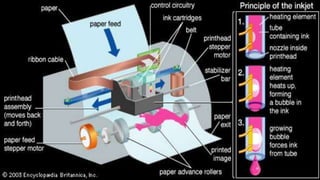
 In the thermal inkjet process, the print cartridges consist of a series of tiny chambers, each
containing a heater, all of which are constructed by photolithography.
 To eject a droplet from each chamber, a pulse of current is passed through the heating
element causing a rapid vaporization of the ink in the chamber and forming a bubble, which
causes a large pressure increase, propelling a droplet of ink onto the paper (hence Canon's
trade name of BubbleJet).
 The ink's surface tension, as well as the condensation and resultant contraction of the
vapour bubble, pulls a further charge of ink into the chamber through a narrow channel
attached to an ink reservoir. The inks involved are usually water-based and use either
pigments or dyes as the colorant.
 The inks must have a volatile component to form the vapor bubble; otherwise droplet
ejection cannot occur. As no special materials are required, the print head is generally
cheaper to produce than in other inkjet technologies.
Piezoelectric DOD (Drop-on-demand)
 Most commercial and industrial inkjet printers and some consumer printers (those produced
by Epson and Brother Industries) use a piezoelectric material in an ink-filled chamber
behind each nozzle instead of a heating element.
 When a voltage is applied, the piezoelectric material changes shape, generating a pressure
pulse in the fluid, which forces a droplet of ink from the nozzle.
 Piezoelectric (also called Piezo) inkjet allows a wider variety of inks than thermal inkjet as
there is no requirement for a volatile component, and no issue with kogation (buildup of ink
residue), but the print heads are more expensive to manufacture due to the use of
piezoelectric material (usually PZT, lead zirconium titanate).
 A DOD process uses software that directs the heads to apply between zero and eight droplets
of ink per dot, only where needed.
 Piezo inkjet technology is often used on production lines to mark products. For instance, the
"use-before" date is often applied to products with this technique; in this application the
head is stationary and the product moves past. This application requires a relatively large
gap between the print head and the substrate, but also yields a high speed, a long service life,
and low operating cost.
Figure : Schematic diagram of a Continuous inkjet printing process using
piezoelectric transducer
Printing heads
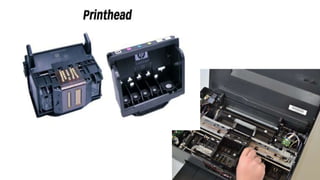
 There are two main design philosophies in inkjet head design: fixed-head and disposable
head. Each has its own strengths and weaknesses.
 The fixed-head philosophy provides an inbuilt print head (often referred to as a gaiter- head)
that is designed to last for the life of the printer. The idea is that because the head need not
be replaced every time the ink runs out, consumable costs can be made lower and the head
itself can be more precise than a cheap disposable one, typically requiring no calibration. On
the other hand, if a fixed head is damaged, obtaining a replacement head can become
expensive, if removing and replacing the head is even possible. If the printer's head cannot
be removed, the printer itself will then need to be replaced.
 Fixed head designs are available in consumer products, but are more likely to be found on
industrial high-end printers and large format plotters. In the consumer space, fixed-head
printers are manufactured primarily by Epson and Canon; however, many more recent
Hewlett-Packard models use a fixed-head, such as the Office jet Pro 8620 and HP's Page
wide series.
Disposable head
 The disposable head philosophy uses a print head which is supplied as a partof a replaceable
ink cartridge. Every time a cartridge is exhausted, the entire cartridge and print head are
replaced with a new one. This adds to the cost of consumables and makes it more difficult to
manufacture a high-precision head at a reasonable cost, but also means that a damaged or
clogged print head is only a minor problem: the user can simply buy a new cartridge.
Hewlett-Packard has traditionally favoured the disposable print head, as did Canon in its
early models. This type of construction can also be seen as an effort by printer
manufacturers to stem third party ink cartridge assembly replacements, as these would-be
suppliers don't have the ability to manufacture specialized print heads.
 An intermediate method does exist: a disposable ink tank connected to a disposable head,
which is replaced infrequently(perhaps every tenth ink tank or so). Most high-volume
Hewlett-Packard inkjet printers use this setup, with the disposable print heads used on lower
volume models. A similar approach is used by Kodak, where the printhead intended for
permanent use is nevertheless inexpensive and can be replaced by the user. Canon now uses
(in most models) replaceable print heads which are designed to last the life of the printer, but
can be replaced by the user should they become clogged.
Cleaning mechanisms
 The primary cause of inkjet printing problems is ink drying on the printhead's
nozzles, causing the pigments and dyes to dry out and form a solid block of
hardened mass that plugs the microscopic ink passageways. Most printers
attempt to prevent this drying from occurring by covering the printhead
nozzles with a rubber cap when the printer is not in use.
 Abrupt power losses, or unplugging the printer before it has capped the
printhead, can cause the printhead to be left in an uncapped state.
 Even when the head is capped, thisseal is not perfect, and over a period of
several weeks the moisture (or other solvent) can still seep out, causing the ink
to dry and harden.
 Once ink begins to collect and harden, the drop volume can be affected, drop
trajectory can change, or the nozzle can completely fail to jet ink.
Cleaning mechanisms
 To combat this drying, nearly all inkjet printers include a mechanism to
reapply moisture to the printhead. Typically there is no separate supply of pure
ink-free solvent available to do this job, and so instead the ink itself is used to
remoisten the printhead. The printer attempts to fire all nozzles at once, and as
the ink sprays out, some of it wicks across the printhead to the dry channels
and partially softens the hardened ink. After spraying, a rubber wiper blade is
swept across the printhead to spread the moisture evenly across the printhead,
and the jets are again all fired to dislodge any ink clumps blocking the
channels.
 Some printers use a supplemental air-suction pump, using the rubber capping
station to suck ink through a severely clogged cartridge. The suction pump
mechanism is frequently driven by the page feed stepper motor: it is connected
to the end of the shaft.
Ink Delivery Developments
 Ink cartridges have been the traditional method for delivering ink to
the printhead. Continuous ink system (CISS) inkjet printers connect
the printhead either to high-capacity ink tanks or packs, or replenish
the built-in cartridges via external tanks connected via tubes,
typically a retrofit configuration.
 Supertank printers–a subset of CISS printers–have high-capacity
integrated ink tanks or ink packs, and are manually refilled via ink
bottles. When supertank ink systems are paired with disposable
printhead technology, replaceable cartridges are used to replace the
exhausted print heads.
Advantages
 They are quieter in operation than impact dot matrix or daisywheel printers.
They can print finer, smoother details through higher resolution.
 Consumer inkjet printers with photographic-quality printing are widely
available.
 In comparison to technologies like thermal wax, dye sublimation, and laser
printing, inkjets have the advantage of practically no warm up time, and often
lower cost per page. However, low-cost laser printers can have lower per-page
costs, at least for black-and-white printing, and possibly for colour.
 Some types of industrial inkjet printers are now capable of printing at very
high speeds, in wide formats, or for a variety of industrial applications ranging
from signage, textiles, ceramics and 3-D printing into biomedical applications
and conductive circuitry.
Disadvantages
 Many "intelligent" ink cartridges contain a microchip that communicates the
estimated ink level to the printer; this may cause the printer to display an error
message, or incorrectly inform the user that the ink cartridge is empty. In some
cases, these messages can be ignored, but some inkjet printers will refuse to
print with a cartridge that declares itself empty, to prevent consumers from
refilling cartridges.
 For example, Epson embeds a chip which prevents printing when the chip
claims the cartridge is empty, although a researcher who over-rode the system
found that in one case he could print up to 38% more good quality pages, even
though the chip stated that the cartridge was empty.
THANK
YOU

INKJET PRINTERS

  • 1.
  • 2.
    Introduction • Inkjet printingis a type of computer printing that recreates a digital image by propelling droplets of ink onto paper, plastic, or other substrates. Inkjet printers are the most commonly used type of printer, and range from small inexpensive consumer models to expensive professional machines. • The concept of inkjet printing originated in the 20th century, and the technology was first extensively developed in the early 1950s. Starting in the late 1970s, inkjet printers that could reproduce digital images generated by computers were developed, mainly by Epson, Hewlett-Packard (HP) and Canon. • In the worldwide consumer market, four manufacturers account for the majority of inkjet printer sales: Canon, HP, Epson and Brother. The emerging ink jet material deposition market also uses inkjet technologies, typically print heads using piezoelectric crystals, to deposit materials directly on substrates.
  • 4.
    Methods There are twomain technologies in use in contemporary inkjet printers: Continuous (CIJ) Drop-on-demand (DOD).
  • 5.
    Continuous inkjet In CIJtechnology, a high-pressure pump directs liquid ink from a reservoir through a gunbody and a microscopic nozzle, creating a continuous stream of ink droplets via the Plateau-Rayleigh instability. A piezoelectric crystal creates an acoustic wave as it vibrates within the gunbody and causes the stream of liquid to break into droplets at regular intervals: 64,000 to 165,000 droplets per second may be achieved. The ink droplets are subjected to an electrostatic field created by a charging electrode as they form; the field varies according to the degree of drop deflection desired. This results in a controlled, variable electrostatic charge on each droplet. Charged droplets are separated by one or more uncharged "guard droplets" to minimize electrostatic repulsion between neighbouring droplets. The charged droplets pass through another electrostatic field and are directed (deflected) by electrostatic deflection plates to print on the receptor material (substrate), or allowed to continue on undeflected to a collection gutter for re-use. The more highly charged droplets are deflected to a greater degree. Only a small fraction of the droplets is used to print, the majority being recycled.
  • 6.
    CIJ is oneof the oldest ink jet technologies in use and is fairly mature. The major advantages are the very high velocity (≈20 m/s) of the ink droplets, which allows for a relatively long distance between print head and substrate, and the very high drop ejection frequency, allowing for very high speed printing. Another advantage is freedom from nozzle clogging as the jet is always in use, therefore allowing volatile solvents such as ketones and alcohols to be employed, giving the ink th ability to "bite" into the substrate and dry quickly. The ink system requires active solvent regulation to counter solvent evaporation during the time of flight (time between nozzle ejection and gutter recycling), and from the venting process whereby air that is drawn into the gutter along with the unused drops is vented from the reservoir. Viscosity is monitored and a solvent (or solvent blend) is added to counteract solvent loss.
  • 7.
    Figure : Schematicdiagram of a Continuous inkjet printing process using piezoelectric transducer
  • 8.
    Figure : Schematicdiagram of a Continuous inkjet printing process
  • 9.
    Drop-on-demand Drop-on-demand (DOD) isdivided into thermal DOD and piezoelectric DOD. Thermal DOD:  In the thermal inkjet process, the print cartridges consist of a series of tiny chambers, each containing a heater, all of which are constructed by photolithography.  To eject a droplet from each chamber, a pulse of current is passed through the heating element causing a rapid vaporization of the ink in the chamber and forming a bubble, which causes a large pressure increase, propelling a droplet of ink onto the paper (hence Canon's trade name of BubbleJet).  The ink's surface tension, as well as the condensation and resultant contraction of the vapour bubble, pulls a further charge of ink into the chamber through a narrow channel attached to an ink reservoir. The inks involved are usually water-based and use either pigments or dyes as the colorant.  The inks must have a volatile component to form the vapor bubble; otherwise droplet ejection cannot occur. As no special materials are required, the print head is generally cheaper to produce than in other inkjet technologies.
  • 10.
    Piezoelectric DOD (Drop-on-demand) Most commercial and industrial inkjet printers and some consumer printers (those produced by Epson and Brother Industries) use a piezoelectric material in an ink-filled chamber behind each nozzle instead of a heating element.  When a voltage is applied, the piezoelectric material changes shape, generating a pressure pulse in the fluid, which forces a droplet of ink from the nozzle.  Piezoelectric (also called Piezo) inkjet allows a wider variety of inks than thermal inkjet as there is no requirement for a volatile component, and no issue with kogation (buildup of ink residue), but the print heads are more expensive to manufacture due to the use of piezoelectric material (usually PZT, lead zirconium titanate).  A DOD process uses software that directs the heads to apply between zero and eight droplets of ink per dot, only where needed.  Piezo inkjet technology is often used on production lines to mark products. For instance, the "use-before" date is often applied to products with this technique; in this application the head is stationary and the product moves past. This application requires a relatively large gap between the print head and the substrate, but also yields a high speed, a long service life, and low operating cost.
  • 11.
    Figure : Schematicdiagram of a Continuous inkjet printing process using piezoelectric transducer
  • 12.
    Printing heads  Thereare two main design philosophies in inkjet head design: fixed-head and disposable head. Each has its own strengths and weaknesses.  The fixed-head philosophy provides an inbuilt print head (often referred to as a gaiter- head) that is designed to last for the life of the printer. The idea is that because the head need not be replaced every time the ink runs out, consumable costs can be made lower and the head itself can be more precise than a cheap disposable one, typically requiring no calibration. On the other hand, if a fixed head is damaged, obtaining a replacement head can become expensive, if removing and replacing the head is even possible. If the printer's head cannot be removed, the printer itself will then need to be replaced.  Fixed head designs are available in consumer products, but are more likely to be found on industrial high-end printers and large format plotters. In the consumer space, fixed-head printers are manufactured primarily by Epson and Canon; however, many more recent Hewlett-Packard models use a fixed-head, such as the Office jet Pro 8620 and HP's Page wide series.
  • 14.
    Disposable head  Thedisposable head philosophy uses a print head which is supplied as a partof a replaceable ink cartridge. Every time a cartridge is exhausted, the entire cartridge and print head are replaced with a new one. This adds to the cost of consumables and makes it more difficult to manufacture a high-precision head at a reasonable cost, but also means that a damaged or clogged print head is only a minor problem: the user can simply buy a new cartridge. Hewlett-Packard has traditionally favoured the disposable print head, as did Canon in its early models. This type of construction can also be seen as an effort by printer manufacturers to stem third party ink cartridge assembly replacements, as these would-be suppliers don't have the ability to manufacture specialized print heads.  An intermediate method does exist: a disposable ink tank connected to a disposable head, which is replaced infrequently(perhaps every tenth ink tank or so). Most high-volume Hewlett-Packard inkjet printers use this setup, with the disposable print heads used on lower volume models. A similar approach is used by Kodak, where the printhead intended for permanent use is nevertheless inexpensive and can be replaced by the user. Canon now uses (in most models) replaceable print heads which are designed to last the life of the printer, but can be replaced by the user should they become clogged.
  • 15.
    Cleaning mechanisms  Theprimary cause of inkjet printing problems is ink drying on the printhead's nozzles, causing the pigments and dyes to dry out and form a solid block of hardened mass that plugs the microscopic ink passageways. Most printers attempt to prevent this drying from occurring by covering the printhead nozzles with a rubber cap when the printer is not in use.  Abrupt power losses, or unplugging the printer before it has capped the printhead, can cause the printhead to be left in an uncapped state.  Even when the head is capped, thisseal is not perfect, and over a period of several weeks the moisture (or other solvent) can still seep out, causing the ink to dry and harden.  Once ink begins to collect and harden, the drop volume can be affected, drop trajectory can change, or the nozzle can completely fail to jet ink.
  • 16.
    Cleaning mechanisms  Tocombat this drying, nearly all inkjet printers include a mechanism to reapply moisture to the printhead. Typically there is no separate supply of pure ink-free solvent available to do this job, and so instead the ink itself is used to remoisten the printhead. The printer attempts to fire all nozzles at once, and as the ink sprays out, some of it wicks across the printhead to the dry channels and partially softens the hardened ink. After spraying, a rubber wiper blade is swept across the printhead to spread the moisture evenly across the printhead, and the jets are again all fired to dislodge any ink clumps blocking the channels.  Some printers use a supplemental air-suction pump, using the rubber capping station to suck ink through a severely clogged cartridge. The suction pump mechanism is frequently driven by the page feed stepper motor: it is connected to the end of the shaft.
  • 17.
    Ink Delivery Developments Ink cartridges have been the traditional method for delivering ink to the printhead. Continuous ink system (CISS) inkjet printers connect the printhead either to high-capacity ink tanks or packs, or replenish the built-in cartridges via external tanks connected via tubes, typically a retrofit configuration.  Supertank printers–a subset of CISS printers–have high-capacity integrated ink tanks or ink packs, and are manually refilled via ink bottles. When supertank ink systems are paired with disposable printhead technology, replaceable cartridges are used to replace the exhausted print heads.
  • 18.
    Advantages  They arequieter in operation than impact dot matrix or daisywheel printers. They can print finer, smoother details through higher resolution.  Consumer inkjet printers with photographic-quality printing are widely available.  In comparison to technologies like thermal wax, dye sublimation, and laser printing, inkjets have the advantage of practically no warm up time, and often lower cost per page. However, low-cost laser printers can have lower per-page costs, at least for black-and-white printing, and possibly for colour.  Some types of industrial inkjet printers are now capable of printing at very high speeds, in wide formats, or for a variety of industrial applications ranging from signage, textiles, ceramics and 3-D printing into biomedical applications and conductive circuitry.
  • 19.
    Disadvantages  Many "intelligent"ink cartridges contain a microchip that communicates the estimated ink level to the printer; this may cause the printer to display an error message, or incorrectly inform the user that the ink cartridge is empty. In some cases, these messages can be ignored, but some inkjet printers will refuse to print with a cartridge that declares itself empty, to prevent consumers from refilling cartridges.  For example, Epson embeds a chip which prevents printing when the chip claims the cartridge is empty, although a researcher who over-rode the system found that in one case he could print up to 38% more good quality pages, even though the chip stated that the cartridge was empty.
  • 20.