Unit-IV
Lasers and Fiber
optics
LASERS
History of the LASER
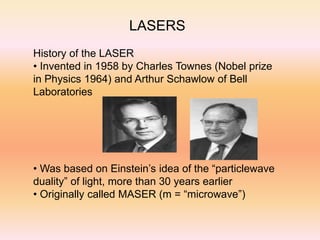
• Invented in 1958 by Charles Townes (Nobel prize
in Physics 1964) and Arthur Schawlow of Bell
Laboratories
• Was based on Einstein’s idea of the “particlewave
duality” of light, more than 30 years earlier
• Originally called MASER (m = “microwave”)
Laser printer Laser pointer
Laser: everywhere in your life
What is Laser?
Light Amplification by Stimulated
Emission of Radiation
• A device produces a coherent beam of
optical radiation by stimulating electronic,
ionic, or molecular transitions to higher
energy levels
• When they return to lower energy levels by
stimulated emission, they emit energy.
5
Properties of Laser
 The light emitted from a laser is monochromatic, that is, it is of one
color/wavelength. In contrast, ordinary white light is a combination of many
colors (or wavelengths) of light.
 Lasers emit light that is highly directional, that is, laser light is emitted as
a relatively narrow beam in a specific direction. Ordinary light, such as
from a light bulb, is emitted in many directions away from the source.
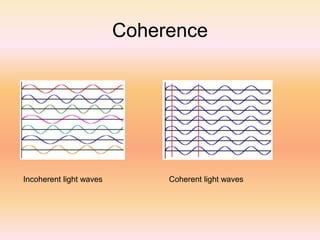
 The light from a laser is said to be coherent, which means that the
wavelengths of the laser light are in phase in space and time. Ordinary
light can be a mixture of many wavelengths.
These three properties of laser light are what can make it more
hazardous than ordinary light. Laser light can deposit a lot of energy
within a small area.
Monochromacity
Nearly monochromatic light
Example:
He-Ne Laser
λ0 = 632.5 nm
Δλ = 0.2 nm
Diode Laser
λ0 = 900 nm
Δλ = 10 nm
Comparison of the wavelengths of red and
blue light
Directionality
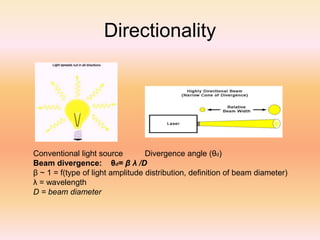
Conventional light source Divergence angle (θd)
Beam divergence: θd= β λ /D
β ~ 1 = f(type of light amplitude distribution, definition of beam diameter)
λ = wavelength
D = beam diameter
Coherence
Incoherent light waves Coherent light waves
9
Incandescent vs. Laser Light
1. Many wavelengths
2. Multidirectional
3. Incoherent
1. Monochromatic
2. Directional
3. Coherent
Basic concepts for a laser
• Absorption
• Spontaneous Emission
• Stimulated Emission
• Population inversion
Absorption
• Energy is absorbed by an atom, the electrons
are excited into vacant energy shells.
Spontaneous Emission
• The atom decays from level 2 to level 1 through
the emission of a photon with the energy hv. It is
a completely random process.
Stimulated Emission
atoms in an upper energy level can be triggered
or stimulated in phase by an incoming photon of
a specific energy.
Stimulated Emission
The stimulated photons have unique properties:
– In phase with the incident photon
– Same wavelength as the incident photon
– Travel in same direction as incident photon
Population Inversion
• A state in which a substance has been
energized, or excited to specific energy levels.
• More atoms or molecules are in a higher excited
state.
• The process of producing a population inversion
is called pumping.
• Examples:
→by lamps of appropriate intensity
→by electrical discharge
Pumping
•Optical: Uses flashlamps and high-energy light sources (Ruby
Laser)
•Electrical Discharge: application of a potential difference across
the laser medium (He-Ne Laser)
•Inelastic Collisions between Atoms: Atoms exchange energies
with other by in-elastic collisions and gets excited due to
additional absorbed energy. (He-Ne Laser)
•Direct Conversion: Electrical energy is directly converted into
optical energy as LASER beam (Gallium Arsenide
semiconducting Laser)
•Chemical Reaction: Many exothermic reactions provide
essential energy for pumping of atoms.
Two level system
absorption Spontaneous
emission
Stimulated
emission
hn hn
hn
E1
E2
E1
E2
hn =E2-E1
E1
E2
• n1 - the number of electrons of energy E1
• n2 - the number of electrons of energy E2
•Population inversion-
n2>>n1
2 2 1
1
( )
exp
n E E
n kT
 
 
  
 
Boltzmann’s equation
example: T=3000 K E2-E1=2.0
eV
4
2
1
4.4 10
n
n

 
Resonance Cavities
and Longitudinal Modes
Since the wavelengths involved with lasers and
masers spread over small ranges, and are also
absolutely small, most cavities will achieve
lengthwise resonance
Plane
parallel
resonator
Concentric
resonator
Confocal
resonator
Unstable
resonator
Hemispheric
al resonator
Hemifocal
resonator
c
c
f
f
c: center of curvature, f: focal point
L = nλ
Transverse Modes
TEM00:
I(r) = (2P/πd2)*exp(-2r2/d2)
(d is spot size measured
to the 1/e2 points)
Due to boundary conditions and
quantum mechanical wave
equations
Einstein’s coefficients
Probability of stimulated absorption R1-2
R1-2 = r (n) B1-2
Probability of stimulated and spontaneous emission :
R2-1 = r (n) B2-1 + A2-1
assumption: n1 atoms of energy e 1 and n2 atoms of energy e 2 are in thermal
equilibrium at temperature T with the radiation of spectral density r (n):
n1 R1-2 = n2 R2-1 n1r (n) B1-2 = n2 (r (n) B2-1 + A2-1)

2 1 2 1
1 1 2
2 2 1
/
=
1
A B
n B
n B
r n  


 

E1
E2
B1-2/B2-1 = 1
According to Boltzman statistics:
r (n) = =
1
2 1
2
exp( ) / exp( / )
n
E E kT h kT
n
n
  
1
)
exp(
/
1
2
2
1
1
2
1
2





kT
h
B
B
B
A
n 1
)
/
exp(
/
8 3
3

kT
h
c
h
n
n

3
3
1
2
1
2 8
c
h
B
A n




Planck’s law
The probability of spontaneous emission A2-1 /the probability of
stimulated emission B2-1r(n :
1. Visible photons, energy: 1.6eV – 3.1eV.
2. kT at 300K ~ 0.025eV.
3. stimulated emission dominates solely when hn /kT <<1!
(for microwaves: hn <0.0015eV)
The frequency of emission acts to the absorption:
if hn /kT <<1.
1
)
/
exp(
)
(
1
2
1
2 


 kT
h
B
A
n
n
r
1
2
1
2
1
2
1
2
2
1
1
1
2
2
1
2
2 ]
)
(
1
[
)
(
)
(
n
n
n
n
B
A
B
n
B
n
A
n
x 









n
r
n
r
n
r
x~ n2/n1
Condition for the laser operation
If n1 > n2
• radiation is mostly absorbed absorbowane
• spontaneous radiation dominates.
• most atoms occupy level E2, weak absorption
• stimulated emission prevails
• light is amplified
if n2 >> n1 - population inversion
Necessary condition:
population inversion
E1
E2
How to realize the population inversion?
Thermal excitation:
2
1
exp
n E
n kT

 
  
 
Optically,
electrically.
impossible.
The system has to be „pumped”
E1
E2

laser-ppt.ppt

  • 1.
  • 2.
    LASERS History of theLASER • Invented in 1958 by Charles Townes (Nobel prize in Physics 1964) and Arthur Schawlow of Bell Laboratories • Was based on Einstein’s idea of the “particlewave duality” of light, more than 30 years earlier • Originally called MASER (m = “microwave”)
  • 3.
    Laser printer Laserpointer Laser: everywhere in your life
  • 4.
    What is Laser? LightAmplification by Stimulated Emission of Radiation • A device produces a coherent beam of optical radiation by stimulating electronic, ionic, or molecular transitions to higher energy levels • When they return to lower energy levels by stimulated emission, they emit energy.
  • 5.
    5 Properties of Laser The light emitted from a laser is monochromatic, that is, it is of one color/wavelength. In contrast, ordinary white light is a combination of many colors (or wavelengths) of light.  Lasers emit light that is highly directional, that is, laser light is emitted as a relatively narrow beam in a specific direction. Ordinary light, such as from a light bulb, is emitted in many directions away from the source.  The light from a laser is said to be coherent, which means that the wavelengths of the laser light are in phase in space and time. Ordinary light can be a mixture of many wavelengths. These three properties of laser light are what can make it more hazardous than ordinary light. Laser light can deposit a lot of energy within a small area.
  • 6.
    Monochromacity Nearly monochromatic light Example: He-NeLaser λ0 = 632.5 nm Δλ = 0.2 nm Diode Laser λ0 = 900 nm Δλ = 10 nm Comparison of the wavelengths of red and blue light
  • 7.
    Directionality Conventional light sourceDivergence angle (θd) Beam divergence: θd= β λ /D β ~ 1 = f(type of light amplitude distribution, definition of beam diameter) λ = wavelength D = beam diameter
  • 8.
  • 9.
    9 Incandescent vs. LaserLight 1. Many wavelengths 2. Multidirectional 3. Incoherent 1. Monochromatic 2. Directional 3. Coherent
  • 10.
    Basic concepts fora laser • Absorption • Spontaneous Emission • Stimulated Emission • Population inversion
  • 11.
    Absorption • Energy isabsorbed by an atom, the electrons are excited into vacant energy shells.
  • 12.
    Spontaneous Emission • Theatom decays from level 2 to level 1 through the emission of a photon with the energy hv. It is a completely random process.
  • 13.
    Stimulated Emission atoms inan upper energy level can be triggered or stimulated in phase by an incoming photon of a specific energy.
  • 14.
    Stimulated Emission The stimulatedphotons have unique properties: – In phase with the incident photon – Same wavelength as the incident photon – Travel in same direction as incident photon
  • 15.
    Population Inversion • Astate in which a substance has been energized, or excited to specific energy levels. • More atoms or molecules are in a higher excited state. • The process of producing a population inversion is called pumping. • Examples: →by lamps of appropriate intensity →by electrical discharge
  • 16.
    Pumping •Optical: Uses flashlampsand high-energy light sources (Ruby Laser) •Electrical Discharge: application of a potential difference across the laser medium (He-Ne Laser) •Inelastic Collisions between Atoms: Atoms exchange energies with other by in-elastic collisions and gets excited due to additional absorbed energy. (He-Ne Laser) •Direct Conversion: Electrical energy is directly converted into optical energy as LASER beam (Gallium Arsenide semiconducting Laser) •Chemical Reaction: Many exothermic reactions provide essential energy for pumping of atoms.
  • 17.
    Two level system absorptionSpontaneous emission Stimulated emission hn hn hn E1 E2 E1 E2 hn =E2-E1
  • 18.
    E1 E2 • n1 -the number of electrons of energy E1 • n2 - the number of electrons of energy E2 •Population inversion- n2>>n1 2 2 1 1 ( ) exp n E E n kT          Boltzmann’s equation example: T=3000 K E2-E1=2.0 eV 4 2 1 4.4 10 n n   
  • 19.
    Resonance Cavities and LongitudinalModes Since the wavelengths involved with lasers and masers spread over small ranges, and are also absolutely small, most cavities will achieve lengthwise resonance Plane parallel resonator Concentric resonator Confocal resonator Unstable resonator Hemispheric al resonator Hemifocal resonator c c f f c: center of curvature, f: focal point L = nλ
  • 20.
    Transverse Modes TEM00: I(r) =(2P/πd2)*exp(-2r2/d2) (d is spot size measured to the 1/e2 points) Due to boundary conditions and quantum mechanical wave equations
  • 21.
    Einstein’s coefficients Probability ofstimulated absorption R1-2 R1-2 = r (n) B1-2 Probability of stimulated and spontaneous emission : R2-1 = r (n) B2-1 + A2-1 assumption: n1 atoms of energy e 1 and n2 atoms of energy e 2 are in thermal equilibrium at temperature T with the radiation of spectral density r (n): n1 R1-2 = n2 R2-1 n1r (n) B1-2 = n2 (r (n) B2-1 + A2-1)  2 1 2 1 1 1 2 2 2 1 / = 1 A B n B n B r n        E1 E2
  • 22.
    B1-2/B2-1 = 1 Accordingto Boltzman statistics: r (n) = = 1 2 1 2 exp( ) / exp( / ) n E E kT h kT n n    1 ) exp( / 1 2 2 1 1 2 1 2      kT h B B B A n 1 ) / exp( / 8 3 3  kT h c h n n  3 3 1 2 1 2 8 c h B A n     Planck’s law
  • 23.
    The probability ofspontaneous emission A2-1 /the probability of stimulated emission B2-1r(n : 1. Visible photons, energy: 1.6eV – 3.1eV. 2. kT at 300K ~ 0.025eV. 3. stimulated emission dominates solely when hn /kT <<1! (for microwaves: hn <0.0015eV) The frequency of emission acts to the absorption: if hn /kT <<1. 1 ) / exp( ) ( 1 2 1 2     kT h B A n n r 1 2 1 2 1 2 1 2 2 1 1 1 2 2 1 2 2 ] ) ( 1 [ ) ( ) ( n n n n B A B n B n A n x           n r n r n r x~ n2/n1
  • 24.
    Condition for thelaser operation If n1 > n2 • radiation is mostly absorbed absorbowane • spontaneous radiation dominates. • most atoms occupy level E2, weak absorption • stimulated emission prevails • light is amplified if n2 >> n1 - population inversion Necessary condition: population inversion E1 E2
  • 25.
    How to realizethe population inversion? Thermal excitation: 2 1 exp n E n kT         Optically, electrically. impossible. The system has to be „pumped” E1 E2