Energy and Organisms Organisms are classified based on the kind of energy they use. Autotrophs Use the energy from sunlight to make organic molecules (sugar) Use the energy in the organic molecules to make ATP Heterotrophs Obtain organic molecules by eating the autotrophs Use the energy in the organic molecules to make ATP Autotrophs use photosynthesis. To use the energy from light to make organic molecules All organisms use cellular respiration. To harvest the energy from organic molecules and use it to make ATP Copyright © The McGraw-Hill Companies, Inc. Permission required for reproduction or display. 6- Chapter 6
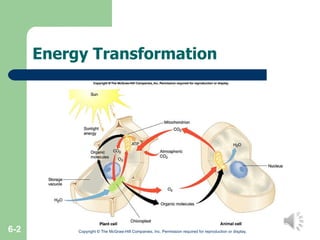
Energy Transformation Copyright © The McGraw-Hill Companies, Inc. Permission required for reproduction or display. 6-
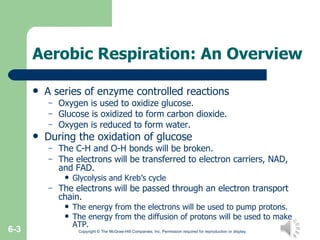
Aerobic Respiration: An Overview A series of enzyme controlled reactions Oxygen is used to oxidize glucose. Glucose is oxidized to form carbon dioxide. Oxygen is reduced to form water. During the oxidation of glucose The C-H and O-H bonds will be broken. The electrons will be transferred to electron carriers, NAD, and FAD. Glycolysis and Kreb’s cycle The electrons will be passed through an electron transport chain. The energy from the electrons will be used to pump protons. The energy from the diffusion of protons will be used to make ATP. Copyright © The McGraw-Hill Companies, Inc. Permission required for reproduction or display. 6-
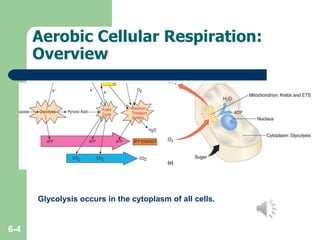
Aerobic Cellular Respiration: Overview 6- Glycolysis occurs in the cytoplasm of all cells.
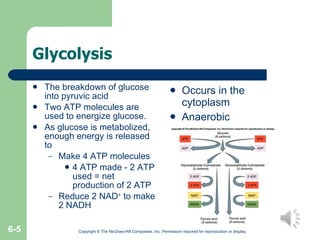
Glycolysis The breakdown of glucose into pyruvic acid Two ATP molecules are used to energize glucose. As glucose is metabolized, enough energy is released to Make 4 ATP molecules 4 ATP made - 2 ATP used = net production of 2 ATP Reduce 2 NAD +  to make 2 NADH Occurs in the cytoplasm Anaerobic Copyright © The McGraw-Hill Companies, Inc. Permission required for reproduction or display. 6-
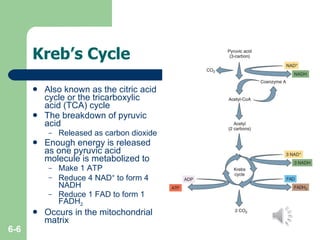
Kreb’s Cycle Also known as the citric acid cycle or the tricarboxylic acid (TCA) cycle The breakdown of pyruvic acid Released as carbon dioxide Enough energy is released as one pyruvic acid molecule is metabolized to Make 1 ATP Reduce 4 NAD +  to form 4 NADH Reduce 1 FAD to form 1 FADH 2. Occurs in the mitochondrial matrix 6-
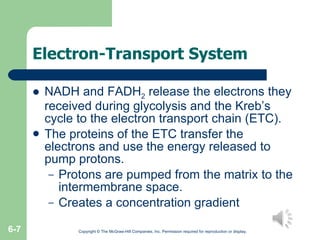
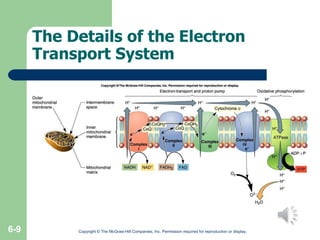
Electron-Transport System NADH and FADH 2  release the electrons they received during glycolysis and the Kreb’s cycle to the electron transport chain (ETC). The proteins of the ETC transfer the electrons and use the energy released to pump protons. Protons are pumped from the matrix to the intermembrane space. Creates a concentration gradient Copyright © The McGraw-Hill Companies, Inc. Permission required for reproduction or display. 6-
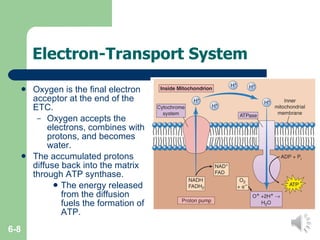
Electron-Transport System Oxygen is the final electron acceptor at the end of the ETC. Oxygen accepts the electrons, combines with protons, and becomes water. The accumulated protons diffuse back into the matrix through ATP synthase. The energy released from the diffusion fuels the formation of ATP. 6-
The Details of the Electron Transport System Copyright © The McGraw-Hill Companies, Inc. Permission required for reproduction or display. 6-
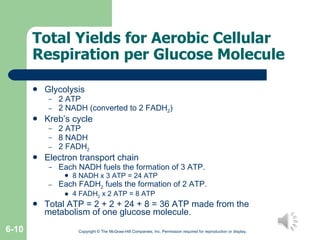
Total Yields for Aerobic Cellular Respiration per Glucose Molecule Glycolysis 2 ATP 2 NADH (converted to 2 FADH 2 ) Kreb’s cycle 2 ATP 8 NADH 2 FADH 2 Electron transport chain Each NADH fuels the formation of 3 ATP. 8 NADH x 3 ATP = 24 ATP Each FADH 2  fuels the formation of 2 ATP. 4 FADH 2  x 2 ATP = 8 ATP Total ATP = 2 + 2 + 24 + 8 = 36 ATP made from the metabolism of one glucose molecule. Copyright © The McGraw-Hill Companies, Inc. Permission required for reproduction or display. 6-
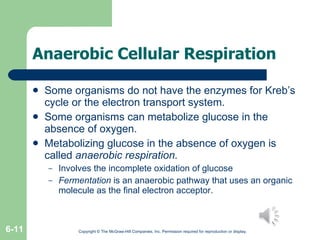
Anaerobic Cellular Respiration Some organisms do not have the enzymes for Kreb’s cycle or the electron transport system. Some organisms can metabolize glucose in the absence of oxygen. Metabolizing glucose in the absence of oxygen is called  anaerobic respiration. Involves the incomplete oxidation of glucose Fermentation  is an anaerobic pathway that uses an organic molecule as the final electron acceptor. Copyright © The McGraw-Hill Companies, Inc. Permission required for reproduction or display. 6-
Anaerobic Cellular Respiration Anaerobic respiration usually starts with glycolysis. Glucose is metabolized into pyruvic acid. 2 ATP are made. The fermentation reactions oxidize NADH to regenerate the NAD +  that is needed in glycolysis. In the process, pyruvic acid is reduced to either lactic acid or ethanol or another organic molecule. Copyright © The McGraw-Hill Companies, Inc. Permission required for reproduction or display. 6-
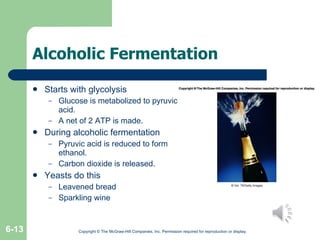
Alcoholic Fermentation Starts with glycolysis Glucose is metabolized to pyruvic acid. A net of 2 ATP is made. During alcoholic fermentation Pyruvic acid is reduced to form ethanol. Carbon dioxide is released. Yeasts do this Leavened bread Sparkling wine Copyright © The McGraw-Hill Companies, Inc. Permission required for reproduction or display. 6-
Lactic Acid Fermentation Starts with glycolysis Glucose is metabolized to pyruvic acid. A net of 2 ATP is made. During lactic acid fermentation Pyruvic acid is reduced to form lactic acid. No carbon dioxide is released. Muscle cells have the enzymes to do this, but brain cells do not. Muscle cells can survive brief periods of oxygen deprivation, but brain cells cannot. Lactic acid “burns” in muscles. Copyright © The McGraw-Hill Companies, Inc. Permission required for reproduction or display. 6-
The Bottom Line Carbohydrates, fats, and proteins can all be used for energy. Glycolysis and the Kreb’s cycle allow these types of molecules to be interchanged. If more calories are consumed than used The excess food will be stored as fat Homeotherms –  have a high metabolic rate and use this energy to maintain their body temperature. Copyright © The McGraw-Hill Companies, Inc. Permission required for reproduction or display. 6-
What’s next? Review your notes Review this presentation if you feel you have missed something or need clarification Review the animations located in the learning module to help you understand these processes. Finally, use your book and notes to answer your HW questions; then submit them before the end of the day on Wednesday (6/22). Copyright © The McGraw-Hill Companies, Inc. Permission required for reproduction or display. 6-

Lectures ch06

  • 1.
    Energy and OrganismsOrganisms are classified based on the kind of energy they use. Autotrophs Use the energy from sunlight to make organic molecules (sugar) Use the energy in the organic molecules to make ATP Heterotrophs Obtain organic molecules by eating the autotrophs Use the energy in the organic molecules to make ATP Autotrophs use photosynthesis. To use the energy from light to make organic molecules All organisms use cellular respiration. To harvest the energy from organic molecules and use it to make ATP Copyright © The McGraw-Hill Companies, Inc. Permission required for reproduction or display. 6- Chapter 6
  • 2.
    Energy Transformation Copyright© The McGraw-Hill Companies, Inc. Permission required for reproduction or display. 6-
  • 3.
    Aerobic Respiration: AnOverview A series of enzyme controlled reactions Oxygen is used to oxidize glucose. Glucose is oxidized to form carbon dioxide. Oxygen is reduced to form water. During the oxidation of glucose The C-H and O-H bonds will be broken. The electrons will be transferred to electron carriers, NAD, and FAD. Glycolysis and Kreb’s cycle The electrons will be passed through an electron transport chain. The energy from the electrons will be used to pump protons. The energy from the diffusion of protons will be used to make ATP. Copyright © The McGraw-Hill Companies, Inc. Permission required for reproduction or display. 6-
  • 4.
    Aerobic Cellular Respiration:Overview 6- Glycolysis occurs in the cytoplasm of all cells.
  • 5.
    Glycolysis The breakdownof glucose into pyruvic acid Two ATP molecules are used to energize glucose. As glucose is metabolized, enough energy is released to Make 4 ATP molecules 4 ATP made - 2 ATP used = net production of 2 ATP Reduce 2 NAD + to make 2 NADH Occurs in the cytoplasm Anaerobic Copyright © The McGraw-Hill Companies, Inc. Permission required for reproduction or display. 6-
  • 6.
    Kreb’s Cycle Alsoknown as the citric acid cycle or the tricarboxylic acid (TCA) cycle The breakdown of pyruvic acid Released as carbon dioxide Enough energy is released as one pyruvic acid molecule is metabolized to Make 1 ATP Reduce 4 NAD + to form 4 NADH Reduce 1 FAD to form 1 FADH 2. Occurs in the mitochondrial matrix 6-
  • 7.
    Electron-Transport System NADHand FADH 2 release the electrons they received during glycolysis and the Kreb’s cycle to the electron transport chain (ETC). The proteins of the ETC transfer the electrons and use the energy released to pump protons. Protons are pumped from the matrix to the intermembrane space. Creates a concentration gradient Copyright © The McGraw-Hill Companies, Inc. Permission required for reproduction or display. 6-
  • 8.
    Electron-Transport System Oxygenis the final electron acceptor at the end of the ETC. Oxygen accepts the electrons, combines with protons, and becomes water. The accumulated protons diffuse back into the matrix through ATP synthase. The energy released from the diffusion fuels the formation of ATP. 6-
  • 9.
    The Details ofthe Electron Transport System Copyright © The McGraw-Hill Companies, Inc. Permission required for reproduction or display. 6-
  • 10.
    Total Yields forAerobic Cellular Respiration per Glucose Molecule Glycolysis 2 ATP 2 NADH (converted to 2 FADH 2 ) Kreb’s cycle 2 ATP 8 NADH 2 FADH 2 Electron transport chain Each NADH fuels the formation of 3 ATP. 8 NADH x 3 ATP = 24 ATP Each FADH 2 fuels the formation of 2 ATP. 4 FADH 2 x 2 ATP = 8 ATP Total ATP = 2 + 2 + 24 + 8 = 36 ATP made from the metabolism of one glucose molecule. Copyright © The McGraw-Hill Companies, Inc. Permission required for reproduction or display. 6-
  • 11.
    Anaerobic Cellular RespirationSome organisms do not have the enzymes for Kreb’s cycle or the electron transport system. Some organisms can metabolize glucose in the absence of oxygen. Metabolizing glucose in the absence of oxygen is called anaerobic respiration. Involves the incomplete oxidation of glucose Fermentation is an anaerobic pathway that uses an organic molecule as the final electron acceptor. Copyright © The McGraw-Hill Companies, Inc. Permission required for reproduction or display. 6-
  • 12.
    Anaerobic Cellular RespirationAnaerobic respiration usually starts with glycolysis. Glucose is metabolized into pyruvic acid. 2 ATP are made. The fermentation reactions oxidize NADH to regenerate the NAD + that is needed in glycolysis. In the process, pyruvic acid is reduced to either lactic acid or ethanol or another organic molecule. Copyright © The McGraw-Hill Companies, Inc. Permission required for reproduction or display. 6-
  • 13.
    Alcoholic Fermentation Startswith glycolysis Glucose is metabolized to pyruvic acid. A net of 2 ATP is made. During alcoholic fermentation Pyruvic acid is reduced to form ethanol. Carbon dioxide is released. Yeasts do this Leavened bread Sparkling wine Copyright © The McGraw-Hill Companies, Inc. Permission required for reproduction or display. 6-
  • 14.
    Lactic Acid FermentationStarts with glycolysis Glucose is metabolized to pyruvic acid. A net of 2 ATP is made. During lactic acid fermentation Pyruvic acid is reduced to form lactic acid. No carbon dioxide is released. Muscle cells have the enzymes to do this, but brain cells do not. Muscle cells can survive brief periods of oxygen deprivation, but brain cells cannot. Lactic acid “burns” in muscles. Copyright © The McGraw-Hill Companies, Inc. Permission required for reproduction or display. 6-
  • 15.
    The Bottom LineCarbohydrates, fats, and proteins can all be used for energy. Glycolysis and the Kreb’s cycle allow these types of molecules to be interchanged. If more calories are consumed than used The excess food will be stored as fat Homeotherms – have a high metabolic rate and use this energy to maintain their body temperature. Copyright © The McGraw-Hill Companies, Inc. Permission required for reproduction or display. 6-
  • 16.
    What’s next? Reviewyour notes Review this presentation if you feel you have missed something or need clarification Review the animations located in the learning module to help you understand these processes. Finally, use your book and notes to answer your HW questions; then submit them before the end of the day on Wednesday (6/22). Copyright © The McGraw-Hill Companies, Inc. Permission required for reproduction or display. 6-