© 2010 McGraw-Hill Higher Education. All rights reserved.
Chapter 10
Current Societal Health Trends
© 2010 McGraw-Hill Higher Education. All rights reserved.
Introduction
 A century ago, physical inactivity was not a
contributing factor to any of the major
problems experienced by the populace of the
United States
 Fast forward 100 years…….
© 2010 McGraw-Hill Higher Education. All rights reserved.
Historical Context for Health in
the U.S.
 100 years ago
 Mortality statistics
 Mortality rate--the number of people who die in a
given number of people
 Infant mortality rate--100 out of 1000 died within one
year
 Maternal mortality rate--six to nine per 1000 live births
© 2010 McGraw-Hill Higher Education. All rights reserved.
Historical Context for Health in
the U.S.
 100 years ago
 Life expectancy statistics
 47.3 years in the U.S.
 31years in the world
 Causes of mortality
 Infectious/Communicable diseases such as
pneumonia, influenza, tuberculosis, and dysentery
© 2010 McGraw-Hill Higher Education. All rights reserved.
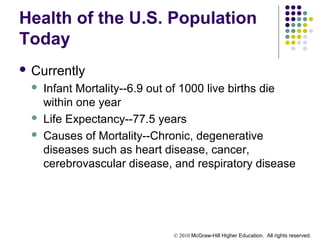
Health of the U.S. Population
Today
 Currently
 Infant Mortality--6.9 out of 1000 live births die
within one year
 Life Expectancy--77.5 years
 Causes of Mortality--Chronic, degenerative
diseases such as heart disease, cancer,
cerebrovascular disease, and respiratory disease
© 2010 McGraw-Hill Higher Education. All rights reserved.
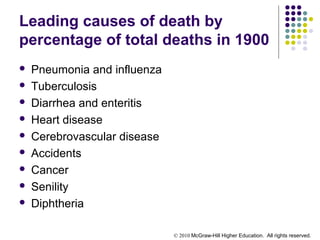
Leading causes of death by
percentage of total deaths in 1900
 Pneumonia and influenza
 Tuberculosis
 Diarrhea and enteritis
 Heart disease
 Cerebrovascular disease
 Accidents
 Cancer
 Senility
 Diphtheria
© 2010 McGraw-Hill Higher Education. All rights reserved.
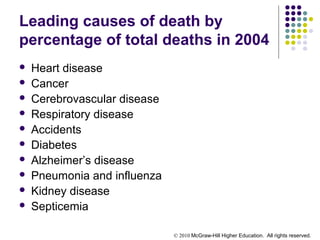
Leading causes of death by
percentage of total deaths in 2004
 Heart disease
 Cancer
 Cerebrovascular disease
 Respiratory disease
 Accidents
 Diabetes
 Alzheimer’s disease
 Pneumonia and influenza
 Kidney disease
 Septicemia
© 2010 McGraw-Hill Higher Education. All rights reserved.
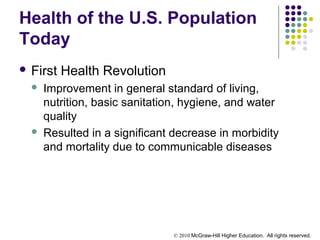
Health of the U.S. Population
Today
 First Health Revolution
 Improvement in general standard of living,
nutrition, basic sanitation, hygiene, and water
quality
 Resulted in a significant decrease in morbidity
and mortality due to communicable diseases
© 2010 McGraw-Hill Higher Education. All rights reserved.
Health of the U.S. Population
Today
 Pharmacologic Revolution
 Discovery of antibiotics
 1928--Alexander Fleming discovered penicillin
 1930’s--Sulfa drugs
 1940’s--Streptomycin, and other antibiotics
 Vaccines
© 2010 McGraw-Hill Higher Education. All rights reserved.
Current Influences on
Population Health
 Two Major Demographic Trends
 Population of the country is more diverse
 Aging of the population
© 2010 McGraw-Hill Higher Education. All rights reserved.
Current Influences on
Population Health
 Demographic Trends
 Diversity of our country
 Different racial, ethnic, and cultural groups have
different rates of prevalence for individual diseases
and illness
 Varying health beliefs that affect prevention or
treatment of health conditions
 Health providers must be attentive to issues relating to
cultural, lifestyle, and genetic factors in different
segments of the population
© 2010 McGraw-Hill Higher Education. All rights reserved.
Current Influences on
Population Health
 Demographic Trends
 Aging of the Population
 In 1900, the 65-plus age group was only 4%
 By 2050, the 65-plus age group will be over 20%
 The 75-plus age group has been growing also
 This leads to an increased prevalence of chronic and
degenerative diseases
© 2010 McGraw-Hill Higher Education. All rights reserved.
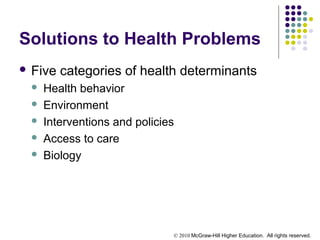
Solutions to Health Problems
 Five categories of health determinants
 Health behavior
 Environment
 Interventions and policies
 Access to care
 Biology
© 2010 McGraw-Hill Higher Education. All rights reserved.
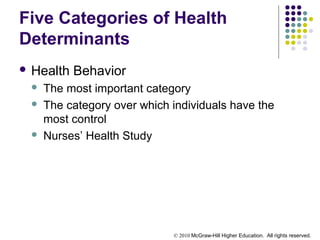
Five Categories of Health
Determinants
 Health Behavior
 The most important category
 The category over which individuals have the
most control
 Nurses’ Health Study
© 2010 McGraw-Hill Higher Education. All rights reserved.
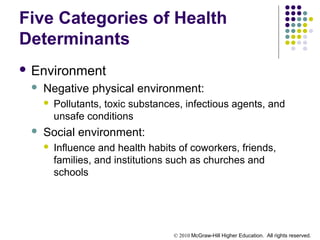
Five Categories of Health
Determinants
 Environment
 Negative physical environment:
 Pollutants, toxic substances, infectious agents, and
unsafe conditions
 Social environment:
 Influence and health habits of coworkers, friends,
families, and institutions such as churches and
schools
© 2010 McGraw-Hill Higher Education. All rights reserved.
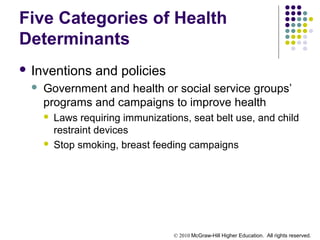
Five Categories of Health
Determinants
 Inventions and policies
 Government and health or social service groups’
programs and campaigns to improve health
 Laws requiring immunizations, seat belt use, and child
restraint devices
 Stop smoking, breast feeding campaigns
© 2010 McGraw-Hill Higher Education. All rights reserved.
Five Categories of Health
Determinants
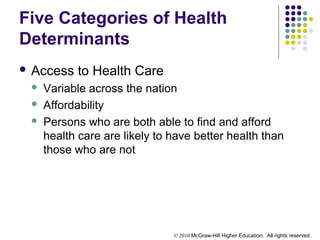
 Access to Health Care
 Variable across the nation
 Affordability
 Persons who are both able to find and afford
health care are likely to have better health than
those who are not
© 2010 McGraw-Hill Higher Education. All rights reserved.
Five Categories of Health
Determinants
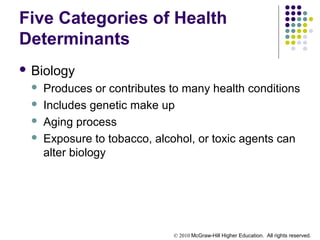
 Biology
 Produces or contributes to many health conditions
 Includes genetic make up
 Aging process
 Exposure to tobacco, alcohol, or toxic agents can
alter biology
© 2010 McGraw-Hill Higher Education. All rights reserved.
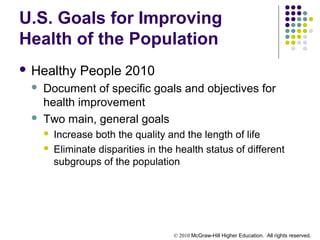
U.S. Goals for Improving
Health of the Population
 Healthy People 2010
 Document of specific goals and objectives for
health improvement
 Two main, general goals
 Increase both the quality and the length of life
 Eliminate disparities in the health status of different
subgroups of the population
© 2010 McGraw-Hill Higher Education. All rights reserved.
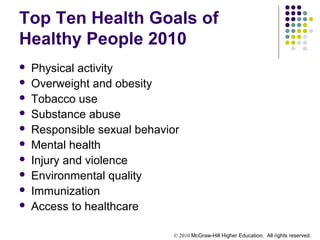
Top Ten Health Goals of
Healthy People 2010
 Physical activity
 Overweight and obesity
 Tobacco use
 Substance abuse
 Responsible sexual behavior
 Mental health
 Injury and violence
 Environmental quality
 Immunization
 Access to healthcare
© 2010 McGraw-Hill Higher Education. All rights reserved.
U.S. Goals for Improving
Health of the Population
 The Surgeons General’s Report on Physical Activity
and Health (1996)
 Greatest health benefit-- consistently active five days per
week
 Does not need to be vigorous activity
 Helps to prevent or reduce the risk of:
 Heart disease
 High blood pressure
 High cholesterol
 Cancers
 Type 2 diabetes

FW275 Health Trends

  • 1.
    © 2010 McGraw-HillHigher Education. All rights reserved. Chapter 10 Current Societal Health Trends
  • 2.
    © 2010 McGraw-HillHigher Education. All rights reserved. Introduction  A century ago, physical inactivity was not a contributing factor to any of the major problems experienced by the populace of the United States  Fast forward 100 years…….
  • 3.
    © 2010 McGraw-HillHigher Education. All rights reserved. Historical Context for Health in the U.S.  100 years ago  Mortality statistics  Mortality rate--the number of people who die in a given number of people  Infant mortality rate--100 out of 1000 died within one year  Maternal mortality rate--six to nine per 1000 live births
  • 4.
    © 2010 McGraw-HillHigher Education. All rights reserved. Historical Context for Health in the U.S.  100 years ago  Life expectancy statistics  47.3 years in the U.S.  31years in the world  Causes of mortality  Infectious/Communicable diseases such as pneumonia, influenza, tuberculosis, and dysentery
  • 5.
    © 2010 McGraw-HillHigher Education. All rights reserved. Health of the U.S. Population Today  Currently  Infant Mortality--6.9 out of 1000 live births die within one year  Life Expectancy--77.5 years  Causes of Mortality--Chronic, degenerative diseases such as heart disease, cancer, cerebrovascular disease, and respiratory disease
  • 6.
    © 2010 McGraw-HillHigher Education. All rights reserved. Leading causes of death by percentage of total deaths in 1900  Pneumonia and influenza  Tuberculosis  Diarrhea and enteritis  Heart disease  Cerebrovascular disease  Accidents  Cancer  Senility  Diphtheria
  • 7.
    © 2010 McGraw-HillHigher Education. All rights reserved. Leading causes of death by percentage of total deaths in 2004  Heart disease  Cancer  Cerebrovascular disease  Respiratory disease  Accidents  Diabetes  Alzheimer’s disease  Pneumonia and influenza  Kidney disease  Septicemia
  • 8.
    © 2010 McGraw-HillHigher Education. All rights reserved. Health of the U.S. Population Today  First Health Revolution  Improvement in general standard of living, nutrition, basic sanitation, hygiene, and water quality  Resulted in a significant decrease in morbidity and mortality due to communicable diseases
  • 9.
    © 2010 McGraw-HillHigher Education. All rights reserved. Health of the U.S. Population Today  Pharmacologic Revolution  Discovery of antibiotics  1928--Alexander Fleming discovered penicillin  1930’s--Sulfa drugs  1940’s--Streptomycin, and other antibiotics  Vaccines
  • 10.
    © 2010 McGraw-HillHigher Education. All rights reserved. Current Influences on Population Health  Two Major Demographic Trends  Population of the country is more diverse  Aging of the population
  • 11.
    © 2010 McGraw-HillHigher Education. All rights reserved. Current Influences on Population Health  Demographic Trends  Diversity of our country  Different racial, ethnic, and cultural groups have different rates of prevalence for individual diseases and illness  Varying health beliefs that affect prevention or treatment of health conditions  Health providers must be attentive to issues relating to cultural, lifestyle, and genetic factors in different segments of the population
  • 12.
    © 2010 McGraw-HillHigher Education. All rights reserved. Current Influences on Population Health  Demographic Trends  Aging of the Population  In 1900, the 65-plus age group was only 4%  By 2050, the 65-plus age group will be over 20%  The 75-plus age group has been growing also  This leads to an increased prevalence of chronic and degenerative diseases
  • 13.
    © 2010 McGraw-HillHigher Education. All rights reserved. Solutions to Health Problems  Five categories of health determinants  Health behavior  Environment  Interventions and policies  Access to care  Biology
  • 14.
    © 2010 McGraw-HillHigher Education. All rights reserved. Five Categories of Health Determinants  Health Behavior  The most important category  The category over which individuals have the most control  Nurses’ Health Study
  • 15.
    © 2010 McGraw-HillHigher Education. All rights reserved. Five Categories of Health Determinants  Environment  Negative physical environment:  Pollutants, toxic substances, infectious agents, and unsafe conditions  Social environment:  Influence and health habits of coworkers, friends, families, and institutions such as churches and schools
  • 16.
    © 2010 McGraw-HillHigher Education. All rights reserved. Five Categories of Health Determinants  Inventions and policies  Government and health or social service groups’ programs and campaigns to improve health  Laws requiring immunizations, seat belt use, and child restraint devices  Stop smoking, breast feeding campaigns
  • 17.
    © 2010 McGraw-HillHigher Education. All rights reserved. Five Categories of Health Determinants  Access to Health Care  Variable across the nation  Affordability  Persons who are both able to find and afford health care are likely to have better health than those who are not
  • 18.
    © 2010 McGraw-HillHigher Education. All rights reserved. Five Categories of Health Determinants  Biology  Produces or contributes to many health conditions  Includes genetic make up  Aging process  Exposure to tobacco, alcohol, or toxic agents can alter biology
  • 19.
    © 2010 McGraw-HillHigher Education. All rights reserved. U.S. Goals for Improving Health of the Population  Healthy People 2010  Document of specific goals and objectives for health improvement  Two main, general goals  Increase both the quality and the length of life  Eliminate disparities in the health status of different subgroups of the population
  • 20.
    © 2010 McGraw-HillHigher Education. All rights reserved. Top Ten Health Goals of Healthy People 2010  Physical activity  Overweight and obesity  Tobacco use  Substance abuse  Responsible sexual behavior  Mental health  Injury and violence  Environmental quality  Immunization  Access to healthcare
  • 21.
    © 2010 McGraw-HillHigher Education. All rights reserved. U.S. Goals for Improving Health of the Population  The Surgeons General’s Report on Physical Activity and Health (1996)  Greatest health benefit-- consistently active five days per week  Does not need to be vigorous activity  Helps to prevent or reduce the risk of:  Heart disease  High blood pressure  High cholesterol  Cancers  Type 2 diabetes