
© 2010 McGraw-Hill Higher Education. All rights reserved.
Chapter 7
Athletic Training
© 2010 McGraw-Hill Higher Education. All rights reserved.
Introduction to Athletic
Training
 16th
fastest-growing profession among
professions requiring minimum of a
Bachelor’s
 Over 30,000 ATC’s worldwide
© 2010 McGraw-Hill Higher Education. All rights reserved.
Early Notable Persons in
Athletic Training
 The “athletic trainer” had its earliest origins in
the late 1800’s
 Male only profession for many years
 James Robinson
 Michael Murphy
© 2010 McGraw-Hill Higher Education. All rights reserved.
Early Notable Persons in
Athletic Training
 Dr. Samuel E. Bilik
 “Father of Athletic Training”
 “Athletic Training” and “The Trainers’ Bible”
 Charles and Frank Cramer
 Cramer Chemical Company--produced liniment
for athletic teams
 Began traveling with sports teams in their quest
for knowledge
 Today Cramer products continues to support the
athletic training profession
© 2010 McGraw-Hill Higher Education. All rights reserved.
Athletic Trainers Unite To
Form a National Organization
 1938, the first National Athletic Trainers
Association (NATA) was formed
 Re-birth in 1950, after World War II
 Today’s organization
 Highly structured
 “Code of ethics”
 Organized on state levels and NATA Districts
© 2010 McGraw-Hill Higher Education. All rights reserved.
Membership and Gender
Milestones in Athletic Training
 Until the mid-1990’s, the athletic training
profession was a predominantly male
profession
 Dotty Cohen
 Currently, women account for 48% of the
Certified Athletic Trainers (ATC)
© 2010 McGraw-Hill Higher Education. All rights reserved.
Sharing Research and Clinical
Evidence to Improve Healthcare
 Information sources through which to share
and create consistent, efficient, and current
healthcare practices
 Position statements
 Official statements
 Consensus statements
 Support statements
 Professional peer-reviewed journals
© 2010 McGraw-Hill Higher Education. All rights reserved.
Sharing Research and Clinical
Evidence to Improve Healthcare
 Position Statements
 Formal statements related to specific topic areas
that have been developed by experts in athletic
training
 Emergency Planning in Athletics
 Exertional Heat Illnesses
 Fluid replacement in athletics
 Head down contact and spearing in tackle football
 Management of asthma in athletes
© 2010 McGraw-Hill Higher Education. All rights reserved.
Sharing Research and Clinical
Evidence to Improve Healthcare
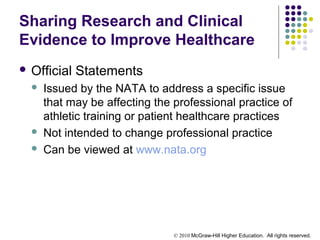
 Official Statements
 Issued by the NATA to address a specific issue
that may be affecting the professional practice of
athletic training or patient healthcare practices
 Not intended to change professional practice
 Can be viewed at www.nata.org
© 2010 McGraw-Hill Higher Education. All rights reserved.
Sharing Research and Clinical
Evidence to Improve Healthcare
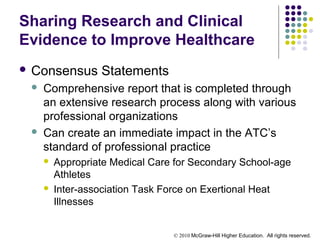
 Consensus Statements
 Comprehensive report that is completed through
an extensive research process along with various
professional organizations
 Can create an immediate impact in the ATC’s
standard of professional practice
 Appropriate Medical Care for Secondary School-age
Athletes
 Inter-association Task Force on Exertional Heat
Illnesses
© 2010 McGraw-Hill Higher Education. All rights reserved.
Sharing Research and Clinical
Evidence to Improve Healthcare
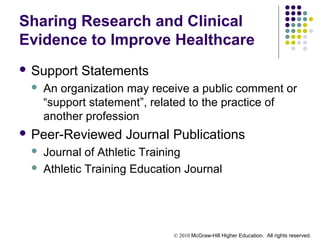
 Support Statements
 An organization may receive a public comment or
“support statement”, related to the practice of
another profession
 Peer-Reviewed Journal Publications
 Journal of Athletic Training
 Athletic Training Education Journal
© 2010 McGraw-Hill Higher Education. All rights reserved.
Content Areas of Study/
Educational Preparation
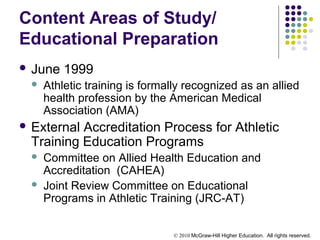
 June 1999
 Athletic training is formally recognized as an allied
health profession by the American Medical
Association (AMA)
 External Accreditation Process for Athletic
Training Education Programs
 Committee on Allied Health Education and
Accreditation (CAHEA)
 Joint Review Committee on Educational
Programs in Athletic Training (JRC-AT)
© 2010 McGraw-Hill Higher Education. All rights reserved.
External Accreditation Process
for Athletic Training Education
 1993
 The NATA removed the curriculum approval
process from the Professional Education
Committee to the JRC-AT
© 2010 McGraw-Hill Higher Education. All rights reserved.
External Accreditation Process
for Athletic Training Education
 2006
 Commission on Accreditation of Athletic Training
Education (CAATE)
 All accredited programs must:
 Complete an extensive accreditation self-study review
 On-campus accreditation site visit by external
reviewers every 5 years
© 2010 McGraw-Hill Higher Education. All rights reserved.
Professional Preparation of
Today’s ATC
 To become an ATC, you must:
 Complete a medical education program that
combines classroom and clinical education
components
 Must graduate from an accredited entry-level
athletic training education program
 Formal clinical experiences in a variety of
healthcare setting for a minimum of two years
© 2010 McGraw-Hill Higher Education. All rights reserved.
Foundational Behaviors of
Professional Practice
 Primacy of the Patient
 Teamed Approach to Practice
 Legal Practice
 Ethical Practice
 Advancing Knowledge
 Cultural Competence
 Professionalism
© 2010 McGraw-Hill Higher Education. All rights reserved.
Major Educational Content
Areas
 Risk Management and Injury Prevention
 Pathology of Injuries and Illnesses
 Orthopedic Clinical Evaluation and Diagnosis
 Medical Conditions and Diseases
 Acute Care of Injury and Illness
 Therapeutic Modalities
 Conditioning and Rehabilitative Exercise
 Pharmacology
© 2010 McGraw-Hill Higher Education. All rights reserved.
Major Educational Content
Areas
 Psychosocial Intervention and Referral
 Nutritional Aspects of Injuries and Illnesses
 Health Care Administration
 Professional Development and Responsibility
© 2010 McGraw-Hill Higher Education. All rights reserved.
Professional Certifications For
Athletic Trainers
 Board of Certification (BOC)
 State Regulation of Athletic Training
 Licensure
 Certification
 Registration
 Exemption
© 2010 McGraw-Hill Higher Education. All rights reserved.
Defining the Professional Practice
of the BOC Certified ATC
 BOC Role Delineation Study
 Six domains which delineate major
responsibilities performed by the ATC
 Prevention
 Clinical Evaluation and Diagnosis
 Immediate Care
 Treatment, Rehabilitation, and Reconditioning
 Organization and Administration
 Professional Responsibility
© 2010 McGraw-Hill Higher Education. All rights reserved.
Defining the Professional Practice
of the BOC Certified ATC
 BOC Standards of Professional Practice
 Help the public understand the type and level of
care from an ATC
 Guide the ATC to effectively evaluate their level of
patient care
 Assist the ATC to understand his/her roles and
responsibilities
© 2010 McGraw-Hill Higher Education. All rights reserved.
Defining the Professional Practice
of the BOC Certified ATC
 BOC Certification Examination
 Three-part examination
 Written
 Written simulation
 Practical
 To sit for the examination, you must:
 Be eligible to graduate form an entry-level degree
program
© 2010 McGraw-Hill Higher Education. All rights reserved.
Professional Development for
ATC’s
 Post-certification Continuing Education:
Maintaining Professional Competence
 Continuing Education Unites
 Attendance/participation/presentation of a medicine-
related topic
 Home-study course
 Writing a chapter in a textbook or acceptance of a
research article in a journal
© 2010 McGraw-Hill Higher Education. All rights reserved.
Professional Development for
ATC’s
 Post-certification Continuing Education:
Advanced Degrees
 Master’s Degree
 NATA-approved Graduate Athletic Training
Education Program
© 2010 McGraw-Hill Higher Education. All rights reserved.
Career Options in Athletic
Training
 Clinic--Outreach
 Clinic
 College/University--Athletic Dept.
 College/University--Instructor
 College/University--Professor
 College/University--Intramural/Recreational
Sports
 Corporate/Industrial
© 2010 McGraw-Hill Higher Education. All rights reserved.
Career Options in Athletic
Training
 Military
 Performing Arts
 Physician Extender
 Professional Sports Teams
 Secondary School Athletic Trainer
 United States Olympic Committee
 Medical Sales
 Government

FW275 Athletic Training

  • 1.
    © 2010 McGraw-HillHigher Education. All rights reserved. Chapter 7 Athletic Training
  • 2.
    © 2010 McGraw-HillHigher Education. All rights reserved. Introduction to Athletic Training  16th fastest-growing profession among professions requiring minimum of a Bachelor’s  Over 30,000 ATC’s worldwide
  • 3.
    © 2010 McGraw-HillHigher Education. All rights reserved. Early Notable Persons in Athletic Training  The “athletic trainer” had its earliest origins in the late 1800’s  Male only profession for many years  James Robinson  Michael Murphy
  • 4.
    © 2010 McGraw-HillHigher Education. All rights reserved. Early Notable Persons in Athletic Training  Dr. Samuel E. Bilik  “Father of Athletic Training”  “Athletic Training” and “The Trainers’ Bible”  Charles and Frank Cramer  Cramer Chemical Company--produced liniment for athletic teams  Began traveling with sports teams in their quest for knowledge  Today Cramer products continues to support the athletic training profession
  • 5.
    © 2010 McGraw-HillHigher Education. All rights reserved. Athletic Trainers Unite To Form a National Organization  1938, the first National Athletic Trainers Association (NATA) was formed  Re-birth in 1950, after World War II  Today’s organization  Highly structured  “Code of ethics”  Organized on state levels and NATA Districts
  • 6.
    © 2010 McGraw-HillHigher Education. All rights reserved. Membership and Gender Milestones in Athletic Training  Until the mid-1990’s, the athletic training profession was a predominantly male profession  Dotty Cohen  Currently, women account for 48% of the Certified Athletic Trainers (ATC)
  • 7.
    © 2010 McGraw-HillHigher Education. All rights reserved. Sharing Research and Clinical Evidence to Improve Healthcare  Information sources through which to share and create consistent, efficient, and current healthcare practices  Position statements  Official statements  Consensus statements  Support statements  Professional peer-reviewed journals
  • 8.
    © 2010 McGraw-HillHigher Education. All rights reserved. Sharing Research and Clinical Evidence to Improve Healthcare  Position Statements  Formal statements related to specific topic areas that have been developed by experts in athletic training  Emergency Planning in Athletics  Exertional Heat Illnesses  Fluid replacement in athletics  Head down contact and spearing in tackle football  Management of asthma in athletes
  • 9.
    © 2010 McGraw-HillHigher Education. All rights reserved. Sharing Research and Clinical Evidence to Improve Healthcare  Official Statements  Issued by the NATA to address a specific issue that may be affecting the professional practice of athletic training or patient healthcare practices  Not intended to change professional practice  Can be viewed at www.nata.org
  • 10.
    © 2010 McGraw-HillHigher Education. All rights reserved. Sharing Research and Clinical Evidence to Improve Healthcare  Consensus Statements  Comprehensive report that is completed through an extensive research process along with various professional organizations  Can create an immediate impact in the ATC’s standard of professional practice  Appropriate Medical Care for Secondary School-age Athletes  Inter-association Task Force on Exertional Heat Illnesses
  • 11.
    © 2010 McGraw-HillHigher Education. All rights reserved. Sharing Research and Clinical Evidence to Improve Healthcare  Support Statements  An organization may receive a public comment or “support statement”, related to the practice of another profession  Peer-Reviewed Journal Publications  Journal of Athletic Training  Athletic Training Education Journal
  • 12.
    © 2010 McGraw-HillHigher Education. All rights reserved. Content Areas of Study/ Educational Preparation  June 1999  Athletic training is formally recognized as an allied health profession by the American Medical Association (AMA)  External Accreditation Process for Athletic Training Education Programs  Committee on Allied Health Education and Accreditation (CAHEA)  Joint Review Committee on Educational Programs in Athletic Training (JRC-AT)
  • 13.
    © 2010 McGraw-HillHigher Education. All rights reserved. External Accreditation Process for Athletic Training Education  1993  The NATA removed the curriculum approval process from the Professional Education Committee to the JRC-AT
  • 14.
    © 2010 McGraw-HillHigher Education. All rights reserved. External Accreditation Process for Athletic Training Education  2006  Commission on Accreditation of Athletic Training Education (CAATE)  All accredited programs must:  Complete an extensive accreditation self-study review  On-campus accreditation site visit by external reviewers every 5 years
  • 15.
    © 2010 McGraw-HillHigher Education. All rights reserved. Professional Preparation of Today’s ATC  To become an ATC, you must:  Complete a medical education program that combines classroom and clinical education components  Must graduate from an accredited entry-level athletic training education program  Formal clinical experiences in a variety of healthcare setting for a minimum of two years
  • 16.
    © 2010 McGraw-HillHigher Education. All rights reserved. Foundational Behaviors of Professional Practice  Primacy of the Patient  Teamed Approach to Practice  Legal Practice  Ethical Practice  Advancing Knowledge  Cultural Competence  Professionalism
  • 17.
    © 2010 McGraw-HillHigher Education. All rights reserved. Major Educational Content Areas  Risk Management and Injury Prevention  Pathology of Injuries and Illnesses  Orthopedic Clinical Evaluation and Diagnosis  Medical Conditions and Diseases  Acute Care of Injury and Illness  Therapeutic Modalities  Conditioning and Rehabilitative Exercise  Pharmacology
  • 18.
    © 2010 McGraw-HillHigher Education. All rights reserved. Major Educational Content Areas  Psychosocial Intervention and Referral  Nutritional Aspects of Injuries and Illnesses  Health Care Administration  Professional Development and Responsibility
  • 19.
    © 2010 McGraw-HillHigher Education. All rights reserved. Professional Certifications For Athletic Trainers  Board of Certification (BOC)  State Regulation of Athletic Training  Licensure  Certification  Registration  Exemption
  • 20.
    © 2010 McGraw-HillHigher Education. All rights reserved. Defining the Professional Practice of the BOC Certified ATC  BOC Role Delineation Study  Six domains which delineate major responsibilities performed by the ATC  Prevention  Clinical Evaluation and Diagnosis  Immediate Care  Treatment, Rehabilitation, and Reconditioning  Organization and Administration  Professional Responsibility
  • 21.
    © 2010 McGraw-HillHigher Education. All rights reserved. Defining the Professional Practice of the BOC Certified ATC  BOC Standards of Professional Practice  Help the public understand the type and level of care from an ATC  Guide the ATC to effectively evaluate their level of patient care  Assist the ATC to understand his/her roles and responsibilities
  • 22.
    © 2010 McGraw-HillHigher Education. All rights reserved. Defining the Professional Practice of the BOC Certified ATC  BOC Certification Examination  Three-part examination  Written  Written simulation  Practical  To sit for the examination, you must:  Be eligible to graduate form an entry-level degree program
  • 23.
    © 2010 McGraw-HillHigher Education. All rights reserved. Professional Development for ATC’s  Post-certification Continuing Education: Maintaining Professional Competence  Continuing Education Unites  Attendance/participation/presentation of a medicine- related topic  Home-study course  Writing a chapter in a textbook or acceptance of a research article in a journal
  • 24.
    © 2010 McGraw-HillHigher Education. All rights reserved. Professional Development for ATC’s  Post-certification Continuing Education: Advanced Degrees  Master’s Degree  NATA-approved Graduate Athletic Training Education Program
  • 25.
    © 2010 McGraw-HillHigher Education. All rights reserved. Career Options in Athletic Training  Clinic--Outreach  Clinic  College/University--Athletic Dept.  College/University--Instructor  College/University--Professor  College/University--Intramural/Recreational Sports  Corporate/Industrial
  • 26.
    © 2010 McGraw-HillHigher Education. All rights reserved. Career Options in Athletic Training  Military  Performing Arts  Physician Extender  Professional Sports Teams  Secondary School Athletic Trainer  United States Olympic Committee  Medical Sales  Government