Lecture 8: Multi Class SVM
Stéphane Canu
stephane.canu@litislab.eu
Sao Paulo 2014
April 10, 2014
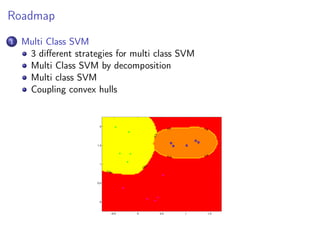
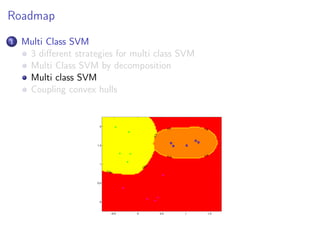
Roadmap
1 Multi Class SVM
3 different strategies for multi class SVM
Multi Class SVM by decomposition
Multi class SVM
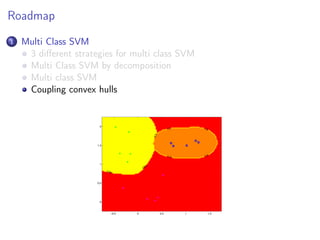
Coupling convex hulls
1.5 1.5
1.51.5
1.5
1.5
2.5
2.5
2.5
−0.5 0 0.5 1 1.5
0
0.5
1
1.5
2
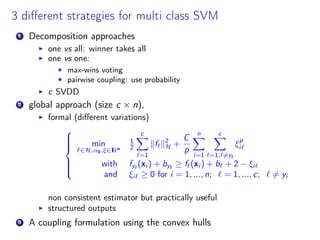
3 different strategies for multi class SVM
1 Decomposition approaches
one vs all: winner takes all
one vs one:
max-wins voting
pairwise coupling: use probability
c SVDD
2 global approach (size c × n),
formal (different variations)



min
f ∈H,α0,ξ∈IRn
1
2
c
=1
f 2
H +
C
p
n
i=1
c
=1, =yi
ξp
i
with fyi
(xi ) + byi
≥ f (xi ) + b + 2 − ξi
and ξi ≥ 0 for i = 1, ..., n; = 1, ..., c; = yi
non consistent estimator but practically useful
structured outputs
3 A coupling formulation using the convex hulls
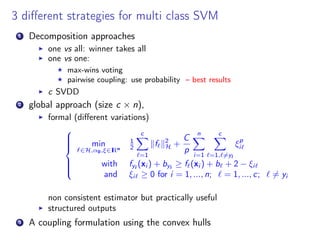
3 different strategies for multi class SVM
1 Decomposition approaches
one vs all: winner takes all
one vs one:
max-wins voting
pairwise coupling: use probability – best results
c SVDD
2 global approach (size c × n),
formal (different variations)



min
f ∈H,α0,ξ∈IRn
1
2
c
=1
f 2
H +
C
p
n
i=1
c
=1, =yi
ξp
i
with fyi
(xi ) + byi
≥ f (xi ) + b + 2 − ξi
and ξi ≥ 0 for i = 1, ..., n; = 1, ..., c; = yi
non consistent estimator but practically useful
structured outputs
3 A coupling formulation using the convex hulls
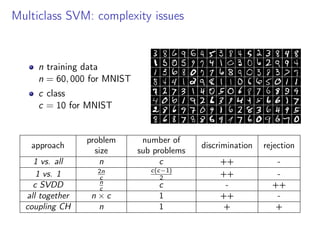
Multiclass SVM: complexity issues
n training data
n = 60, 000 for MNIST
c class
c = 10 for MNIST
approach
problem
size
number of
sub problems
discrimination rejection
1 vs. all n c ++ -
1 vs. 1 2n
c
c(c−1)
2 ++ -
c SVDD n
c c - ++
all together n × c 1 ++ -
coupling CH n 1 + +
Roadmap
1 Multi Class SVM
3 different strategies for multi class SVM
Multi Class SVM by decomposition
Multi class SVM
Coupling convex hulls
1.5 1.5
1.51.5
1.5
1.5
2.5
2.5
2.5
−0.5 0 0.5 1 1.5
0
0.5
1
1.5
2
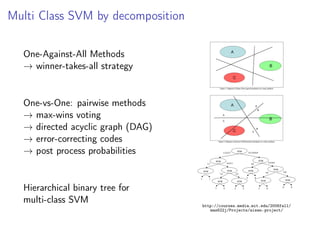
Multi Class SVM by decomposition
One-Against-All Methods
→ winner-takes-all strategy
One-vs-One: pairwise methods
→ max-wins voting
→ directed acyclic graph (DAG)
→ error-correcting codes
→ post process probabilities
Hierarchical binary tree for
multi-class SVM http://courses.media.mit.edu/2006fall/
mas622j/Projects/aisen-project/
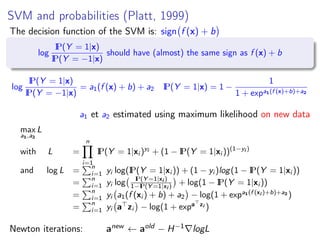
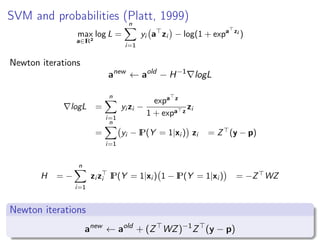
SVM and probabilities (Platt, 1999)
The decision function of the SVM is: sign f (x) + b
log
IP(Y = 1|x)
IP(Y = −1|x)
should have (almost) the same sign as f (x) + b
log
IP(Y = 1|x)
IP(Y = −1|x)
= a1(f (x) + b) + a2 IP(Y = 1|x) = 1 −
1
1 + expa1(f (x)+b)+a2
a1 et a2 estimated using maximum likelihood on new data
max
a1,a2
L
with L =
n
i=1
IP(Y = 1|xi )yi
+ (1 − IP(Y = 1|xi ))(1−yi )
and log L =
n
i=1 yi log(IP(Y = 1|xi )) + (1 − yi )log(1 − IP(Y = 1|xi ))
=
n
i=1 yi log IP(Y =1|xi )
1−IP(Y =1|xi ) + log(1 − IP(Y = 1|xi ))
=
n
i=1 yi a1(f (xi ) + b) + a2 − log(1 + expa1(f (xi )+b)+a2
)
=
n
i=1 yi a zi − log(1 + expa zi )
Newton iterations: anew ← aold − H−1 logL
SVM and probabilities (Platt, 1999)
max
a∈IR2
log L =
n
i=1
yi a zi − log(1 + expa zi
)
Newton iterations
anew
← aold
− H−1
logL
logL =
n
i=1
yi zi −
expa z
1 + expa z
zi
=
n
i=1
yi − IP(Y = 1|xi ) zi = Z (y − p)
H = −
n
i=1
zi zi IP(Y = 1|xi ) 1 − IP(Y = 1|xi ) = −Z WZ
Newton iterations
anew
← aold
+ (Z WZ)−1
Z (y − p)
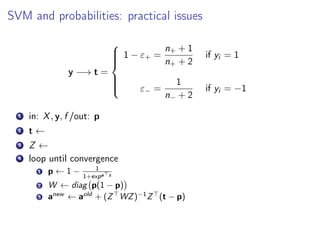
SVM and probabilities: practical issues
y −→ t =



1 − ε+ =
n+ + 1
n+ + 2
if yi = 1
ε− =
1
n− + 2
if yi = −1
1 in: X, y, f /out: p
2 t ←
3 Z ←
4 loop until convergence
1 p ← 1 − 1
1+expa z
2 W ← diag p(1 − p)
3 anew
← aold
+ (Z WZ)−1
Z (t − p)
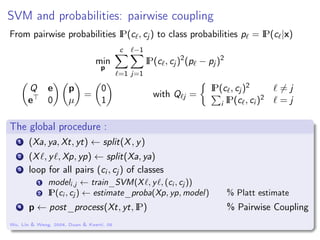
SVM and probabilities: pairwise coupling
From pairwise probabilities IP(c , cj ) to class probabilities p = IP(c |x)
min
p
c
=1
−1
j=1
IP(c , cj )2
(p − pj )2
Q e
e 0
p
µ
=
0
1
with Q j =
IP(c , cj )2 = j
i IP(c , ci )2 = j
The global procedure :
1 (Xa, ya, Xt, yt) ← split(X, y)
2 (X , y , Xp, yp) ← split(Xa, ya)
3 loop for all pairs (ci , cj ) of classes
1 modeli,j ← train_SVM(X , y , (ci , cj ))
2 IP(ci , cj ) ← estimate_proba(Xp, yp, model) % Platt estimate
4 p ← post_process(Xt, yt, IP) % Pairwise Coupling
Wu, Lin & Weng, 2004, Duan & Keerti, 05
SVM and probabilities
Some facts
SVM is universally consistent (converges towards the Bayes risk)
SVM asymptotically implements the bayes rule
but theoretically: no consistency towards conditional probabilities (due
to the nature of sparsity)
to estimate conditional probabilities on an interval
(typically[1
2 − η, 1
2 + η]) to sparseness in this interval (all data points
have to be support vectors)
Bartlett & Tewari, JMLR, 07
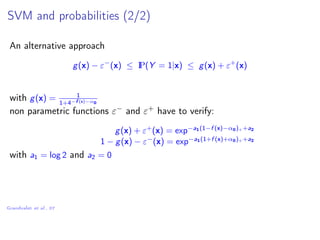
SVM and probabilities (2/2)
An alternative approach
g(x) − ε−
(x) ≤ IP(Y = 1|x) ≤ g(x) + ε+
(x)
with g(x) = 1
1+4−f (x)−α0
non parametric functions ε− and ε+ have to verify:
g(x) + ε+
(x) = exp−a1(1−f (x)−α0)++a2
1 − g(x) − ε−
(x) = exp−a1(1+f (x)+α0)++a2
with a1 = log 2 and a2 = 0
Grandvalet et al., 07
Roadmap
1 Multi Class SVM
3 different strategies for multi class SVM
Multi Class SVM by decomposition
Multi class SVM
Coupling convex hulls
1.5 1.5
1.51.5
1.5
1.5
2.5
2.5
2.5
−0.5 0 0.5 1 1.5
0
0.5
1
1.5
2
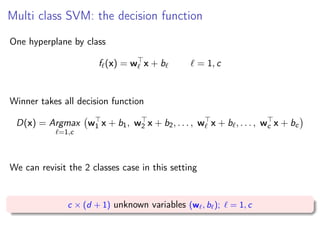
Multi class SVM: the decision function
One hyperplane by class
f (x) = w x + b = 1, c
Winner takes all decision function
D(x) = Argmax
=1,c
w1 x + b1, w2 x + b2, . . . , w x + b , . . . , wc x + bc
We can revisit the 2 classes case in this setting
c × (d + 1) unknown variables (w , b ); = 1, c
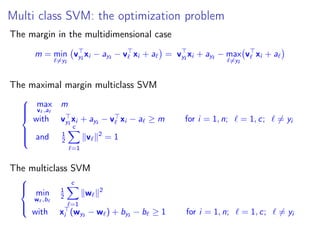
Multi class SVM: the optimization problem
The margin in the multidimensional case
m = min
=yi
vyi
xi − ayi
− v xi + a = vyi
xi + ayi
− max
=yi
v xi + a
The maximal margin multiclass SVM



max
v ,a
m
with vyi
xi + ayi
− v xi − a ≥ m for i = 1, n; = 1, c; = yi
and 1
2
c
=1
v 2
= 1
The multiclass SVM



min
w ,b
1
2
c
=1
w 2
with xi (wyi
− w ) + byi
− b ≥ 1 for i = 1, n; = 1, c; = yi
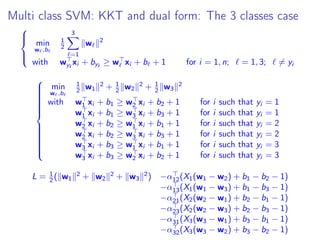
Multi class SVM: KKT and dual form: The 3 classes case



min
w ,b
1
2
3
=1
w 2
with wyi
xi + byi
≥ w xi + b + 1 for i = 1, n; = 1, 3; = yi



min
w ,b
1
2 w1
2
+ 1
2 w2
2
+ 1
2 w3
2
with w1 xi + b1 ≥ w2 xi + b2 + 1 for i such that yi = 1
w1 xi + b1 ≥ w3 xi + b3 + 1 for i such that yi = 1
w2 xi + b2 ≥ w1 xi + b1 + 1 for i such that yi = 2
w2 xi + b2 ≥ w3 xi + b3 + 1 for i such that yi = 2
w3 xi + b3 ≥ w1 xi + b1 + 1 for i such that yi = 3
w3 xi + b3 ≥ w2 xi + b2 + 1 for i such that yi = 3
L = 1
2 ( w1
2
+ w2
2
+ w3
2
) −α12(X1(w1 − w2) + b1 − b2 − 1)
−α13(X1(w1 − w3) + b1 − b3 − 1)
−α21(X2(w2 − w1) + b2 − b1 − 1)
−α23(X2(w2 − w3) + b2 − b3 − 1)
−α31(X3(w3 − w1) + b3 − b1 − 1)
−α32(X3(w3 − w2) + b3 − b2 − 1)
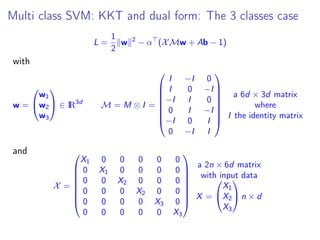
Multi class SVM: KKT and dual form: The 3 classes case
L =
1
2
w 2
− α (XMw + Ab − 1)
with
w =


w1
w2
w3

 ∈ IR3d
M = M ⊗ I =








I −I 0
I 0 −I
−I I 0
0 I −I
−I 0 I
0 −I I








a 6d × 3d matrix
where
I the identity matrix
and
X =








X1 0 0 0 0 0
0 X1 0 0 0 0
0 0 X2 0 0 0
0 0 0 X2 0 0
0 0 0 0 X3 0
0 0 0 0 0 X3








a 2n × 6d matrix
with input data
X =


X1
X2
X3

 n × d
Multi class SVM: KKT and dual form: The 3 classes case
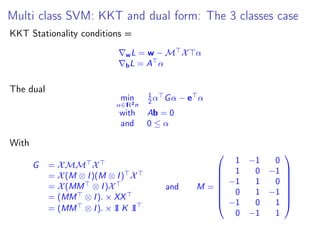
KKT Stationality conditions =
wL = w − M X α
bL = A α
The dual
min
α∈IR2n
1
2 α Gα − e α
with Ab = 0
and 0 ≤ α
With
G = XMM X
= X(M ⊗ I)(M ⊗ I) X
= X(MM ⊗ I)X
= (MM ⊗ I). × XX
= (MM ⊗ I). × 1I K 1I
and M =








1 −1 0
1 0 −1
−1 1 0
0 1 −1
−1 0 1
0 −1 1








Multi class SVM and slack variables (2 variants)
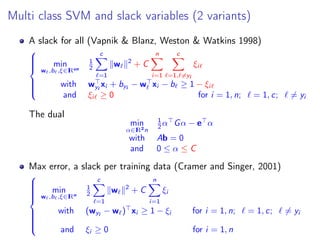
A slack for all (Vapnik & Blanz, Weston & Watkins 1998)



min
w ,b ,ξ∈IRcn
1
2
c
=1
w 2
+ C
n
i=1
c
=1, =yi
ξi
with wyi
xi + byi
− w xi − b ≥ 1 − ξi
and ξi ≥ 0 for i = 1, n; = 1, c; = yi
The dual
min
α∈IR2n
1
2 α Gα − e α
with Ab = 0
and 0 ≤ α ≤ C
Max error, a slack per training data (Cramer and Singer, 2001)



min
w ,b ,ξ∈IRn
1
2
c
=1
w 2
+ C
n
i=1
ξi
with (wyi
− w ) xi ≥ 1 − ξi for i = 1, n; = 1, c; = yi
i=1
and ξi ≥ 0 for i = 1, n
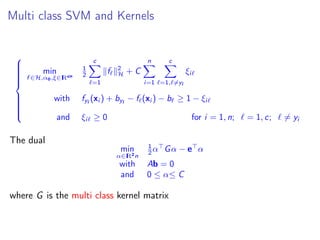
Multi class SVM and Kernels



min
f ∈H,α0,ξ∈IRcn
1
2
c
=1
f 2
H + C
n
i=1
c
=1, =yi
ξi
with fyi
(xi ) + byi
− f (xi ) − b ≥ 1 − ξi
n
i=1
and ξi ≥ 0 for i = 1, n; = 1, c; = yi
The dual
min
α∈IR2n
1
2 α Gα − e α
with Ab = 0
and 0 ≤ α≤ C
where G is the multi class kernel matrix
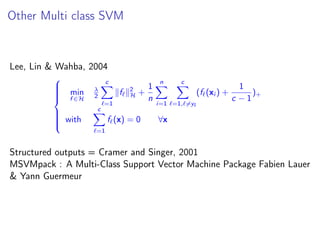
Other Multi class SVM
Lee, Lin & Wahba, 2004



min
f ∈H
λ
2
c
=1
f 2
H +
1
n
n
i=1
c
=1, =yi
(f (xi ) +
1
c − 1
)+
with
c
=1
f (x) = 0 ∀x
Structured outputs = Cramer and Singer, 2001
MSVMpack : A Multi-Class Support Vector Machine Package Fabien Lauer
& Yann Guermeur
Roadmap
1 Multi Class SVM
3 different strategies for multi class SVM
Multi Class SVM by decomposition
Multi class SVM
Coupling convex hulls
1.5 1.5
1.51.5
1.5
1.5
2.5
2.5
2.5
−0.5 0 0.5 1 1.5
0
0.5
1
1.5
2
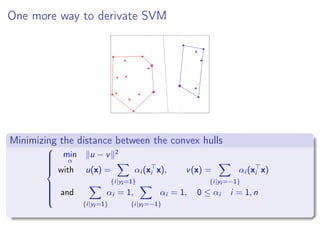
One more way to derivate SVM
Minimizing the distance between the convex hulls



min
α
u − v 2
with u(x) =
{i|yi =1}
αi (xi x), v(x) =
{i|yi =−1}
αi (xi x)
and
{i|yi =1}
αi = 1,
{i|yi =−1}
αi = 1, 0 ≤ αi i = 1, n
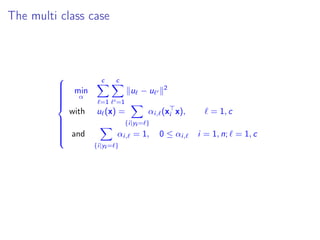
The multi class case



min
α
c
=1
c
=1
u − u 2
with u (x) =
{i|yi = }
αi, (xi x), = 1, c
and
{i|yi = }
αi, = 1, 0 ≤ αi, i = 1, n; = 1, c
Bibliography
Estimating probabilities
Platt, J. (2000). Probabilistic outputs for support vector machines and
comparison to regularized likelihood methods. In Advances in large
margin classifiers. MIT Press.
T. Lin, C.-J. Lin, R.C. Weng, A note on Platt’s probabilistic outputs
for support vector machines, Mach. Learn. 68 (2007) 267–276
http://www.cs.cornell.edu/courses/cs678/2007sp/platt.pdf
Multiclass SVM
K.-B. Duan & S. Keerthi (2005). "Which Is the Best Multiclass SVM
Method? An Empirical Study".
T.-F. Wu, C.-J. Lin, R.C. Weng, Probability estimates for multi-class
classification by pairwise coupling, JMLR. 5 (2004) 975–1005.
K. Crammer & Y. Singer (2001). "On the Algorithmic Implementation
of Multiclass Kernel-based Vector Machines". JMLR 2: 265–292.
Lee, Y.; Lin, Y.; and Wahba, G. (2001). "Multicategory Support
Vector Machines". Computing Science and Statistics 33.
http://www.loria.fr/~guermeur/NN2008_M_SVM_YG.pdf
http://jmlr.org/papers/volume12/lauer11a/lauer11a.pdf
Stéphane Canu (INSA Rouen - LITIS) April 10, 2014 25 / 25

Lecture8 multi class_svm

  • 1.
    Lecture 8: MultiClass SVM Stéphane Canu stephane.canu@litislab.eu Sao Paulo 2014 April 10, 2014
  • 2.
    Roadmap 1 Multi ClassSVM 3 different strategies for multi class SVM Multi Class SVM by decomposition Multi class SVM Coupling convex hulls 1.5 1.5 1.51.5 1.5 1.5 2.5 2.5 2.5 −0.5 0 0.5 1 1.5 0 0.5 1 1.5 2
  • 3.
    3 different strategiesfor multi class SVM 1 Decomposition approaches one vs all: winner takes all one vs one: max-wins voting pairwise coupling: use probability c SVDD 2 global approach (size c × n), formal (different variations)    min f ∈H,α0,ξ∈IRn 1 2 c =1 f 2 H + C p n i=1 c =1, =yi ξp i with fyi (xi ) + byi ≥ f (xi ) + b + 2 − ξi and ξi ≥ 0 for i = 1, ..., n; = 1, ..., c; = yi non consistent estimator but practically useful structured outputs 3 A coupling formulation using the convex hulls
  • 4.
    3 different strategiesfor multi class SVM 1 Decomposition approaches one vs all: winner takes all one vs one: max-wins voting pairwise coupling: use probability – best results c SVDD 2 global approach (size c × n), formal (different variations)    min f ∈H,α0,ξ∈IRn 1 2 c =1 f 2 H + C p n i=1 c =1, =yi ξp i with fyi (xi ) + byi ≥ f (xi ) + b + 2 − ξi and ξi ≥ 0 for i = 1, ..., n; = 1, ..., c; = yi non consistent estimator but practically useful structured outputs 3 A coupling formulation using the convex hulls
  • 5.
    Multiclass SVM: complexityissues n training data n = 60, 000 for MNIST c class c = 10 for MNIST approach problem size number of sub problems discrimination rejection 1 vs. all n c ++ - 1 vs. 1 2n c c(c−1) 2 ++ - c SVDD n c c - ++ all together n × c 1 ++ - coupling CH n 1 + +
  • 6.
    Roadmap 1 Multi ClassSVM 3 different strategies for multi class SVM Multi Class SVM by decomposition Multi class SVM Coupling convex hulls 1.5 1.5 1.51.5 1.5 1.5 2.5 2.5 2.5 −0.5 0 0.5 1 1.5 0 0.5 1 1.5 2
  • 7.
    Multi Class SVMby decomposition One-Against-All Methods → winner-takes-all strategy One-vs-One: pairwise methods → max-wins voting → directed acyclic graph (DAG) → error-correcting codes → post process probabilities Hierarchical binary tree for multi-class SVM http://courses.media.mit.edu/2006fall/ mas622j/Projects/aisen-project/
  • 8.
    SVM and probabilities(Platt, 1999) The decision function of the SVM is: sign f (x) + b log IP(Y = 1|x) IP(Y = −1|x) should have (almost) the same sign as f (x) + b log IP(Y = 1|x) IP(Y = −1|x) = a1(f (x) + b) + a2 IP(Y = 1|x) = 1 − 1 1 + expa1(f (x)+b)+a2 a1 et a2 estimated using maximum likelihood on new data max a1,a2 L with L = n i=1 IP(Y = 1|xi )yi + (1 − IP(Y = 1|xi ))(1−yi ) and log L = n i=1 yi log(IP(Y = 1|xi )) + (1 − yi )log(1 − IP(Y = 1|xi )) = n i=1 yi log IP(Y =1|xi ) 1−IP(Y =1|xi ) + log(1 − IP(Y = 1|xi )) = n i=1 yi a1(f (xi ) + b) + a2 − log(1 + expa1(f (xi )+b)+a2 ) = n i=1 yi a zi − log(1 + expa zi ) Newton iterations: anew ← aold − H−1 logL
  • 9.
    SVM and probabilities(Platt, 1999) max a∈IR2 log L = n i=1 yi a zi − log(1 + expa zi ) Newton iterations anew ← aold − H−1 logL logL = n i=1 yi zi − expa z 1 + expa z zi = n i=1 yi − IP(Y = 1|xi ) zi = Z (y − p) H = − n i=1 zi zi IP(Y = 1|xi ) 1 − IP(Y = 1|xi ) = −Z WZ Newton iterations anew ← aold + (Z WZ)−1 Z (y − p)
  • 10.
    SVM and probabilities:practical issues y −→ t =    1 − ε+ = n+ + 1 n+ + 2 if yi = 1 ε− = 1 n− + 2 if yi = −1 1 in: X, y, f /out: p 2 t ← 3 Z ← 4 loop until convergence 1 p ← 1 − 1 1+expa z 2 W ← diag p(1 − p) 3 anew ← aold + (Z WZ)−1 Z (t − p)
  • 11.
    SVM and probabilities:pairwise coupling From pairwise probabilities IP(c , cj ) to class probabilities p = IP(c |x) min p c =1 −1 j=1 IP(c , cj )2 (p − pj )2 Q e e 0 p µ = 0 1 with Q j = IP(c , cj )2 = j i IP(c , ci )2 = j The global procedure : 1 (Xa, ya, Xt, yt) ← split(X, y) 2 (X , y , Xp, yp) ← split(Xa, ya) 3 loop for all pairs (ci , cj ) of classes 1 modeli,j ← train_SVM(X , y , (ci , cj )) 2 IP(ci , cj ) ← estimate_proba(Xp, yp, model) % Platt estimate 4 p ← post_process(Xt, yt, IP) % Pairwise Coupling Wu, Lin & Weng, 2004, Duan & Keerti, 05
  • 12.
    SVM and probabilities Somefacts SVM is universally consistent (converges towards the Bayes risk) SVM asymptotically implements the bayes rule but theoretically: no consistency towards conditional probabilities (due to the nature of sparsity) to estimate conditional probabilities on an interval (typically[1 2 − η, 1 2 + η]) to sparseness in this interval (all data points have to be support vectors) Bartlett & Tewari, JMLR, 07
  • 13.
    SVM and probabilities(2/2) An alternative approach g(x) − ε− (x) ≤ IP(Y = 1|x) ≤ g(x) + ε+ (x) with g(x) = 1 1+4−f (x)−α0 non parametric functions ε− and ε+ have to verify: g(x) + ε+ (x) = exp−a1(1−f (x)−α0)++a2 1 − g(x) − ε− (x) = exp−a1(1+f (x)+α0)++a2 with a1 = log 2 and a2 = 0 Grandvalet et al., 07
  • 14.
    Roadmap 1 Multi ClassSVM 3 different strategies for multi class SVM Multi Class SVM by decomposition Multi class SVM Coupling convex hulls 1.5 1.5 1.51.5 1.5 1.5 2.5 2.5 2.5 −0.5 0 0.5 1 1.5 0 0.5 1 1.5 2
  • 15.
    Multi class SVM:the decision function One hyperplane by class f (x) = w x + b = 1, c Winner takes all decision function D(x) = Argmax =1,c w1 x + b1, w2 x + b2, . . . , w x + b , . . . , wc x + bc We can revisit the 2 classes case in this setting c × (d + 1) unknown variables (w , b ); = 1, c
  • 16.
    Multi class SVM:the optimization problem The margin in the multidimensional case m = min =yi vyi xi − ayi − v xi + a = vyi xi + ayi − max =yi v xi + a The maximal margin multiclass SVM    max v ,a m with vyi xi + ayi − v xi − a ≥ m for i = 1, n; = 1, c; = yi and 1 2 c =1 v 2 = 1 The multiclass SVM    min w ,b 1 2 c =1 w 2 with xi (wyi − w ) + byi − b ≥ 1 for i = 1, n; = 1, c; = yi
  • 17.
    Multi class SVM:KKT and dual form: The 3 classes case    min w ,b 1 2 3 =1 w 2 with wyi xi + byi ≥ w xi + b + 1 for i = 1, n; = 1, 3; = yi    min w ,b 1 2 w1 2 + 1 2 w2 2 + 1 2 w3 2 with w1 xi + b1 ≥ w2 xi + b2 + 1 for i such that yi = 1 w1 xi + b1 ≥ w3 xi + b3 + 1 for i such that yi = 1 w2 xi + b2 ≥ w1 xi + b1 + 1 for i such that yi = 2 w2 xi + b2 ≥ w3 xi + b3 + 1 for i such that yi = 2 w3 xi + b3 ≥ w1 xi + b1 + 1 for i such that yi = 3 w3 xi + b3 ≥ w2 xi + b2 + 1 for i such that yi = 3 L = 1 2 ( w1 2 + w2 2 + w3 2 ) −α12(X1(w1 − w2) + b1 − b2 − 1) −α13(X1(w1 − w3) + b1 − b3 − 1) −α21(X2(w2 − w1) + b2 − b1 − 1) −α23(X2(w2 − w3) + b2 − b3 − 1) −α31(X3(w3 − w1) + b3 − b1 − 1) −α32(X3(w3 − w2) + b3 − b2 − 1)
  • 18.
    Multi class SVM:KKT and dual form: The 3 classes case L = 1 2 w 2 − α (XMw + Ab − 1) with w =   w1 w2 w3   ∈ IR3d M = M ⊗ I =         I −I 0 I 0 −I −I I 0 0 I −I −I 0 I 0 −I I         a 6d × 3d matrix where I the identity matrix and X =         X1 0 0 0 0 0 0 X1 0 0 0 0 0 0 X2 0 0 0 0 0 0 X2 0 0 0 0 0 0 X3 0 0 0 0 0 0 X3         a 2n × 6d matrix with input data X =   X1 X2 X3   n × d
  • 19.
    Multi class SVM:KKT and dual form: The 3 classes case KKT Stationality conditions = wL = w − M X α bL = A α The dual min α∈IR2n 1 2 α Gα − e α with Ab = 0 and 0 ≤ α With G = XMM X = X(M ⊗ I)(M ⊗ I) X = X(MM ⊗ I)X = (MM ⊗ I). × XX = (MM ⊗ I). × 1I K 1I and M =         1 −1 0 1 0 −1 −1 1 0 0 1 −1 −1 0 1 0 −1 1        
  • 20.
    Multi class SVMand slack variables (2 variants) A slack for all (Vapnik & Blanz, Weston & Watkins 1998)    min w ,b ,ξ∈IRcn 1 2 c =1 w 2 + C n i=1 c =1, =yi ξi with wyi xi + byi − w xi − b ≥ 1 − ξi and ξi ≥ 0 for i = 1, n; = 1, c; = yi The dual min α∈IR2n 1 2 α Gα − e α with Ab = 0 and 0 ≤ α ≤ C Max error, a slack per training data (Cramer and Singer, 2001)    min w ,b ,ξ∈IRn 1 2 c =1 w 2 + C n i=1 ξi with (wyi − w ) xi ≥ 1 − ξi for i = 1, n; = 1, c; = yi i=1 and ξi ≥ 0 for i = 1, n
  • 21.
    Multi class SVMand Kernels    min f ∈H,α0,ξ∈IRcn 1 2 c =1 f 2 H + C n i=1 c =1, =yi ξi with fyi (xi ) + byi − f (xi ) − b ≥ 1 − ξi n i=1 and ξi ≥ 0 for i = 1, n; = 1, c; = yi The dual min α∈IR2n 1 2 α Gα − e α with Ab = 0 and 0 ≤ α≤ C where G is the multi class kernel matrix
  • 22.
    Other Multi classSVM Lee, Lin & Wahba, 2004    min f ∈H λ 2 c =1 f 2 H + 1 n n i=1 c =1, =yi (f (xi ) + 1 c − 1 )+ with c =1 f (x) = 0 ∀x Structured outputs = Cramer and Singer, 2001 MSVMpack : A Multi-Class Support Vector Machine Package Fabien Lauer & Yann Guermeur
  • 23.
    Roadmap 1 Multi ClassSVM 3 different strategies for multi class SVM Multi Class SVM by decomposition Multi class SVM Coupling convex hulls 1.5 1.5 1.51.5 1.5 1.5 2.5 2.5 2.5 −0.5 0 0.5 1 1.5 0 0.5 1 1.5 2
  • 24.
    One more wayto derivate SVM Minimizing the distance between the convex hulls    min α u − v 2 with u(x) = {i|yi =1} αi (xi x), v(x) = {i|yi =−1} αi (xi x) and {i|yi =1} αi = 1, {i|yi =−1} αi = 1, 0 ≤ αi i = 1, n
  • 25.
    The multi classcase    min α c =1 c =1 u − u 2 with u (x) = {i|yi = } αi, (xi x), = 1, c and {i|yi = } αi, = 1, 0 ≤ αi, i = 1, n; = 1, c
  • 26.
    Bibliography Estimating probabilities Platt, J.(2000). Probabilistic outputs for support vector machines and comparison to regularized likelihood methods. In Advances in large margin classifiers. MIT Press. T. Lin, C.-J. Lin, R.C. Weng, A note on Platt’s probabilistic outputs for support vector machines, Mach. Learn. 68 (2007) 267–276 http://www.cs.cornell.edu/courses/cs678/2007sp/platt.pdf Multiclass SVM K.-B. Duan & S. Keerthi (2005). "Which Is the Best Multiclass SVM Method? An Empirical Study". T.-F. Wu, C.-J. Lin, R.C. Weng, Probability estimates for multi-class classification by pairwise coupling, JMLR. 5 (2004) 975–1005. K. Crammer & Y. Singer (2001). "On the Algorithmic Implementation of Multiclass Kernel-based Vector Machines". JMLR 2: 265–292. Lee, Y.; Lin, Y.; and Wahba, G. (2001). "Multicategory Support Vector Machines". Computing Science and Statistics 33. http://www.loria.fr/~guermeur/NN2008_M_SVM_YG.pdf http://jmlr.org/papers/volume12/lauer11a/lauer11a.pdf Stéphane Canu (INSA Rouen - LITIS) April 10, 2014 25 / 25