Machine Learning Interviews – 
Day 2 
Arpit Agarwal
Decision Trees 
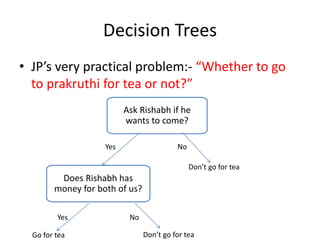
• JP’s very practical problem:- “Whether to go 
to prakruthi for tea or not?” 
Ask Rishabh if he 
wants to come? 
Yes No 
Does Rishabh has 
money for both of us? 
Don’t go for tea 
Yes No 
Go for tea Don’t go for tea
Decision Trees 
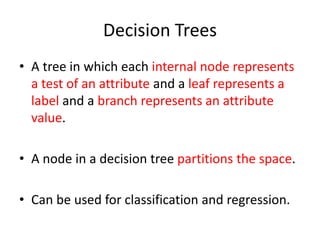
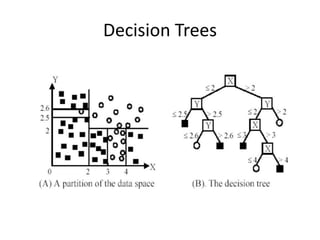
• A tree in which each internal node represents 
a test of an attribute and a leaf represents a 
label and a branch represents an attribute 
value. 
• A node in a decision tree partitions the space. 
• Can be used for classification and regression.
Decision Trees
Decision Tree Learning 
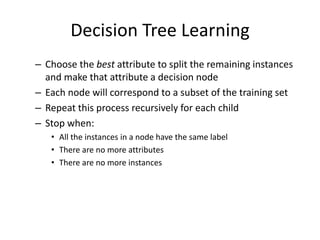
– Choose the best attribute to split the remaining instances 
and make that attribute a decision node 
– Each node will correspond to a subset of the training set 
– Repeat this process recursively for each child 
– Stop when: 
• All the instances in a node have the same label 
• There are no more attributes 
• There are no more instances
How to select the best attribute? 
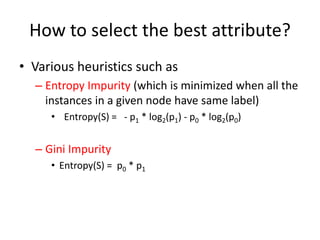
• Various heuristics such as 
– Entropy Impurity (which is minimized when all the 
instances in a given node have same label) 
• Entropy(S) = - p1 * log2(p1) - p0 * log2(p0) 
– Gini Impurity 
• Entropy(S) = p0 * p1
Decision Tree Pruning 
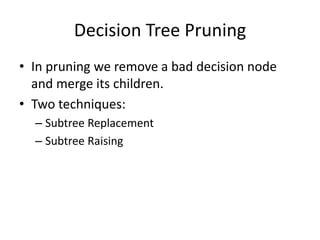
• In pruning we remove a bad decision node 
and merge its children. 
• Two techniques: 
– Subtree Replacement 
– Subtree Raising
Decision Trees 
• Advantage- Easy to understand and interpret; 
can be applied to wide variety of problems 
• Disadvantage- Difficult to learn, Overfittting 
problem, Error-propagation
Support Vector Machine (SVM) 
• Belong to the ‘Marwari’ family of algorithms 
- “Always thinks about maximizing its margins”
SVM 
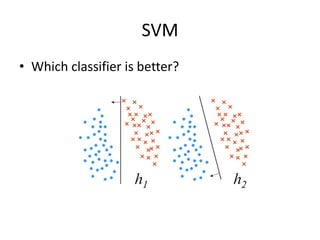
• Which classifier is better?
SVM 
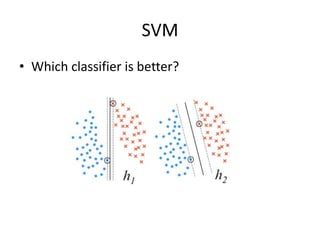
• Which classifier is better?
SVM 
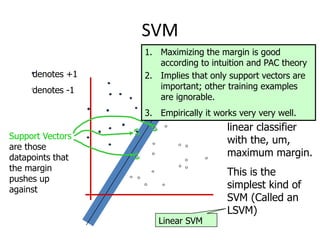
denotes +1 
denotes -1 
f(x,w,b) = sign(w x + b) 
The maximum 
margin linear 
classifier is the 
linear classifier 
with the, um, 
maximum margin. 
This is the 
simplest kind of 
SVM (Called an 
LSVM) 
Linear SVM 
Support Vectors 
are those 
datapoints that 
the margin 
pushes up 
against 
1. Maximizing the margin is good 
according to intuition and PAC theory 
2. Implies that only support vectors are 
important; other training examples 
are ignorable. 
3. Empirically it works very very well.
Hard Margin SVM 
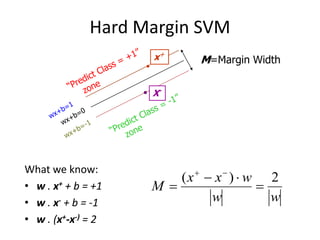
What we know: 
• w . x+ + b = +1 
• w . x- + b = -1 
• w . (x+-x-) = 2 
X-x+ 
M=Margin Width 
x x w 
w w 
M 
( ) 2 
 
  
 
 
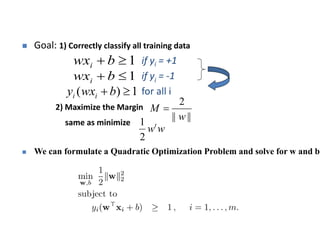
 Goal: 1) Correctly classify all training data 
if yi = +1 
if yi = -1 
for all i 
wx  b 1 i 
wx  b 1 i 
y (wx  b) 1 i i 
2) Maximize the Margin 
same as minimize 
2 
w 
|| || 
M  
1 
w w t 
2 
 We can formulate a Quadratic Optimization Problem and solve for w and b
Hard Margin SVM 
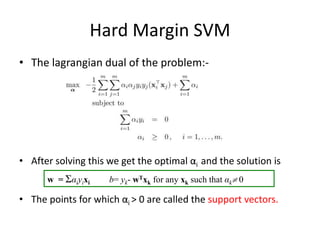
• The lagrangian dual of the problem:- 
• After solving this we get the optimal αi and the solution is 
w = Σαiyixi b= yk- wTxk for any xk such that αk 0 
• The points for which αi > 0 are called the support vectors.
Soft Margin SVM 
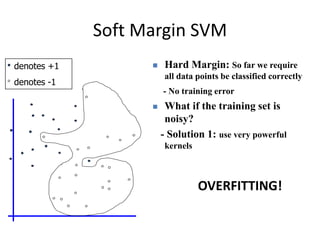
 Hard Margin: So far we require 
all data points be classified correctly 
- No training error 
 What if the training set is 
noisy? 
- Solution 1: use very powerful 
kernels 
denotes +1 
denotes -1 
OVERFITTING!
Soft Margin SVM 
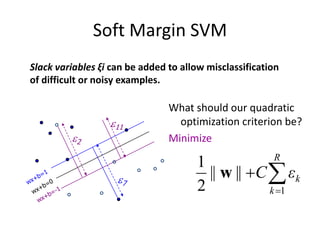
Slack variables ξi can be added to allow misclassification 
of difficult or noisy examples. 
e11 
e7 
e2 
What should our quadratic 
optimization criterion be? 
Minimize 
 
 
R 
C εk 
k 
1 
1 
|| w 
|| 
2
Soft Margin SVM 
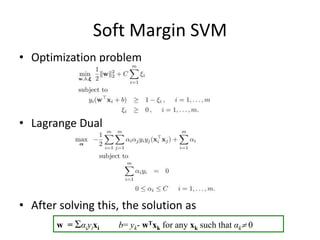
• Optimization problem 
• Lagrange Dual 
• After solving this, the solution as 
w = Σαiyixi b= yk- wTxk for any xk such that αk 0
Kernel SVM 
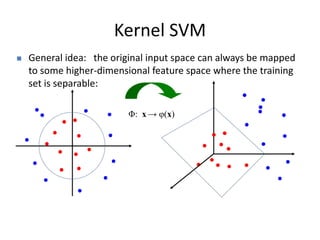
 General idea: the original input space can always be mapped 
to some higher-dimensional feature space where the training 
set is separable: 
Φ: x → φ(x)
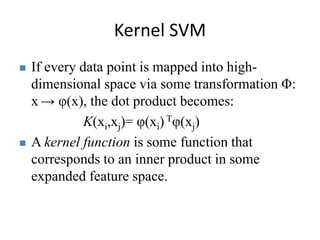
Kernel SVM 
 If every data point is mapped into high-dimensional 
space via some transformation Φ: 
x → φ(x), the dot product becomes: 
K(xi,xj)= φ(xi) Tφ(xj) 
 A kernel function is some function that 
corresponds to an inner product in some 
expanded feature space.
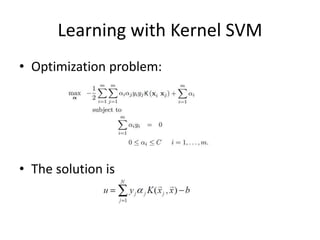
Learning with Kernel SVM 
• Optimization problem: 
• The solution is
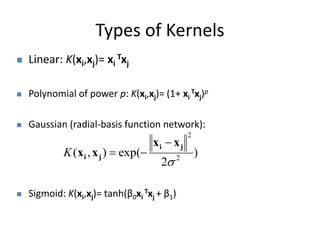
Types of Kernels 
 Linear: K(xi,xj)= xi 
Txj 
 Polynomial of power p: K(xi,xj)= (1+ xi 
Txj)p 
 Gaussian (radial-basis function network): 
i j 
( , ) exp( 2 
 Sigmoid: K(xi,xj)= tanh(β0xi 
Txj + β1) 
) 
2 
2 
 
i j 
x x 
x x 
 
K  
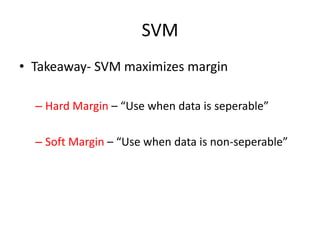
SVM 
• Takeaway- SVM maximizes margin 
– Hard Margin – “Use when data is seperable” 
– Soft Margin – “Use when data is non-seperable”
- What is Overfitting? How to avoid it? 
- “Cross-validation, regularization” 
- What is regularization? Why do we need it? 
- What is Bias-Variance tradeoff?
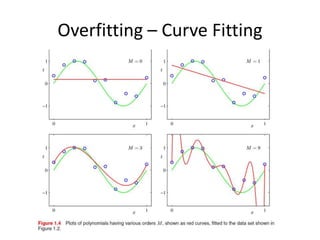
Overfitting – Curve Fitting
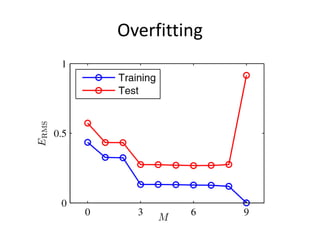
Overfitting

Machine learning interviews day2

  • 1.
    Machine Learning Interviews– Day 2 Arpit Agarwal
  • 2.
    Decision Trees •JP’s very practical problem:- “Whether to go to prakruthi for tea or not?” Ask Rishabh if he wants to come? Yes No Does Rishabh has money for both of us? Don’t go for tea Yes No Go for tea Don’t go for tea
  • 3.
    Decision Trees •A tree in which each internal node represents a test of an attribute and a leaf represents a label and a branch represents an attribute value. • A node in a decision tree partitions the space. • Can be used for classification and regression.
  • 4.
  • 5.
    Decision Tree Learning – Choose the best attribute to split the remaining instances and make that attribute a decision node – Each node will correspond to a subset of the training set – Repeat this process recursively for each child – Stop when: • All the instances in a node have the same label • There are no more attributes • There are no more instances
  • 6.
    How to selectthe best attribute? • Various heuristics such as – Entropy Impurity (which is minimized when all the instances in a given node have same label) • Entropy(S) = - p1 * log2(p1) - p0 * log2(p0) – Gini Impurity • Entropy(S) = p0 * p1
  • 7.
    Decision Tree Pruning • In pruning we remove a bad decision node and merge its children. • Two techniques: – Subtree Replacement – Subtree Raising
  • 8.
    Decision Trees •Advantage- Easy to understand and interpret; can be applied to wide variety of problems • Disadvantage- Difficult to learn, Overfittting problem, Error-propagation
  • 9.
    Support Vector Machine(SVM) • Belong to the ‘Marwari’ family of algorithms - “Always thinks about maximizing its margins”
  • 10.
    SVM • Whichclassifier is better?
  • 11.
    SVM • Whichclassifier is better?
  • 12.
    SVM denotes +1 denotes -1 f(x,w,b) = sign(w x + b) The maximum margin linear classifier is the linear classifier with the, um, maximum margin. This is the simplest kind of SVM (Called an LSVM) Linear SVM Support Vectors are those datapoints that the margin pushes up against 1. Maximizing the margin is good according to intuition and PAC theory 2. Implies that only support vectors are important; other training examples are ignorable. 3. Empirically it works very very well.
  • 13.
    Hard Margin SVM What we know: • w . x+ + b = +1 • w . x- + b = -1 • w . (x+-x-) = 2 X-x+ M=Margin Width x x w w w M ( ) 2      
  • 14.
     Goal: 1)Correctly classify all training data if yi = +1 if yi = -1 for all i wx  b 1 i wx  b 1 i y (wx  b) 1 i i 2) Maximize the Margin same as minimize 2 w || || M  1 w w t 2  We can formulate a Quadratic Optimization Problem and solve for w and b
  • 15.
    Hard Margin SVM • The lagrangian dual of the problem:- • After solving this we get the optimal αi and the solution is w = Σαiyixi b= yk- wTxk for any xk such that αk 0 • The points for which αi > 0 are called the support vectors.
  • 16.
    Soft Margin SVM  Hard Margin: So far we require all data points be classified correctly - No training error  What if the training set is noisy? - Solution 1: use very powerful kernels denotes +1 denotes -1 OVERFITTING!
  • 17.
    Soft Margin SVM Slack variables ξi can be added to allow misclassification of difficult or noisy examples. e11 e7 e2 What should our quadratic optimization criterion be? Minimize   R C εk k 1 1 || w || 2
  • 18.
    Soft Margin SVM • Optimization problem • Lagrange Dual • After solving this, the solution as w = Σαiyixi b= yk- wTxk for any xk such that αk 0
  • 19.
    Kernel SVM General idea: the original input space can always be mapped to some higher-dimensional feature space where the training set is separable: Φ: x → φ(x)
  • 20.
    Kernel SVM If every data point is mapped into high-dimensional space via some transformation Φ: x → φ(x), the dot product becomes: K(xi,xj)= φ(xi) Tφ(xj)  A kernel function is some function that corresponds to an inner product in some expanded feature space.
  • 21.
    Learning with KernelSVM • Optimization problem: • The solution is
  • 22.
    Types of Kernels  Linear: K(xi,xj)= xi Txj  Polynomial of power p: K(xi,xj)= (1+ xi Txj)p  Gaussian (radial-basis function network): i j ( , ) exp( 2  Sigmoid: K(xi,xj)= tanh(β0xi Txj + β1) ) 2 2  i j x x x x  K  
  • 23.
    SVM • Takeaway-SVM maximizes margin – Hard Margin – “Use when data is seperable” – Soft Margin – “Use when data is non-seperable”
  • 24.
    - What isOverfitting? How to avoid it? - “Cross-validation, regularization” - What is regularization? Why do we need it? - What is Bias-Variance tradeoff?
  • 25.
  • 26.