1
18ECC303J – Computer
CommunicationNetworks
Course Credit : 4
Theory : 9 Hours
1. Behrouz A. Fehrouzan, “Data communication & Networking”, Mc-Graw Hill, 5th Edition Reprint,
2014.
2.Andrew S.Tanenbaum,“Computer Networks”, Pearson Education India, 5th Edition, 2013.
3.William Stallings,“Data & Computer Communication”, Pearson Education India, 10th Edition, 2014.
Prepared by Dr. M.S.Vasanthi, SRMIST
2.
Prepared by Dr.M.S.Vasanthi, SRMIST 2
Unit 5 – Application Layer
Introduction to Application Layer
Application Layer Paradigms
Client Server Interaction
Session Initiation Protocol (SIP)
Compression Techniques
Introduction to Cryptography
Types, Attacks and Services
DES
RSA
Email, FTP, HTTP
SNMP
3.
Prepared by Dr.M.S.Vasanthi, SRMIST 3
Unit 5 – Week 2
Session 1
Compression Techniques
ReferenceText Books:
1. Behrouz A. Fehrouzan, “Data communication & Networking”, Mc-Graw Hill, 5th Edition Reprint,
2014.
2.Andrew S.Tanenbaum,“Computer Networks”, Pearson Education India, 5th Edition, 2013.
Session 2
Introduction to
Cryptography
Types,Attacks, Services
Session 3
DES
4.
Prepared by Dr.M.S.Vasanthi, SRMIST 4
Data Encryption standard
Objectives :
To define characteristics of good ciphers
To describe key and key strength
To describe Data encryption standard(DES)
5.
Prepared by Dr.M.S.Vasanthi, SRMIST 5
Ciphers
Shannon’s Characteristics of “Good” Ciphers
• The amount of secrecy needed should determine the
amount of labor appropriate for the encryption and
decryption.
• The set of keys and the enciphering algorithm should be
free from complexity.
• The implementation of the process should be as simple
as possible.
• Errors in ciphering should not propagate and cause
corruption of further information in the message.
• The size of the enciphered text should be no larger than
the text of the original message.
Types of Ciphers
• Block Ciphers
• Encrypt data one block at a time (typically 64
bits, or 128 bits)
• Used for a single message
• Stream Ciphers
• Encrypt data one bit or one byte at a time
• Used if data is a constant stream of information
6.
6
Ciphers
Key Strength
•Strength of algorithm is determined by the size of the key
• The longer the key the more difficult it is to crack
• Key length is expressed in bits
• Typical key sizes vary between 48 bits and 448 bits
• Set of possible keys for a cipher is called key space
• For 40-bit key there are 240
possible keys
• For 128-bit key there are 2128
possible keys
• Each additional bit added to the key length doubles the security
• To crack the key the hacker has to use brute-force
• (i.e. try all the possible keys till a key that works is found)
Prepared by D. M.S.Vasanthi, SRMIST
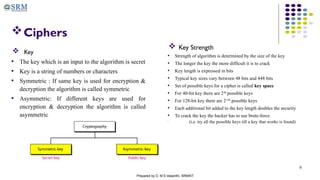
Key
• The key which is an input to the algorithm is secret
• Key is a string of numbers or characters
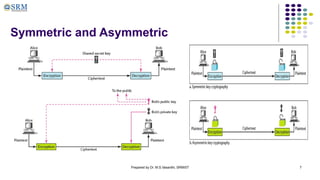
• Symmetric : If same key is used for encryption &
decryption the algorithm is called symmetric
• Asymmetric: If different keys are used for
encryption & decryption the algorithm is called
asymmetric
7.
Prepared by Dr.M.S.Vasanthi, SRMIST 7
Symmetric and Asymmetric
8.
Prepared by Dr.M.S.Vasanthi, SRMIST 8
Data Encryption Standard (DES) Basics
DES
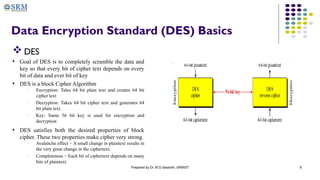
• Goal of DES is to completely scramble the data and
key so that every bit of cipher text depends on every
bit of data and ever bit of key
• DES is a block Cipher Algorithm
• Encryption: Tales 64 bit plain text and creates 64 bit
cipher text
• Decryption: Takes 64 bit cipher text and generates 64
bit plain text.
• Key: Same 56 bit key is used for encryption and
decryption
• DES satisfies both the desired properties of block
cipher. These two properties make cipher very strong.
• Avalanche effect − A small change in plaintext results in
the very great change in the ciphertext.
• Completeness − Each bit of ciphertext depends on many
bits of plaintext.
9.
Prepared by Dr.M.S.Vasanthi, SRMIST 9
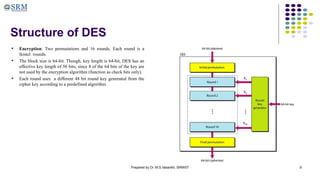
Structure of DES
• Encryption: Two permutations and 16 rounds. Each round is a
feistel rounds.
• The block size is 64-bit. Though, key length is 64-bit, DES has an
effective key length of 56 bits, since 8 of the 64 bits of the key are
not used by the encryption algorithm (function as check bits only).
• Each round uses a different 48 bit round key generated from the
cipher key according to a predefined algorithm.
10.
Prepared by Dr.M.S.Vasanthi, SRMIST 10
DES
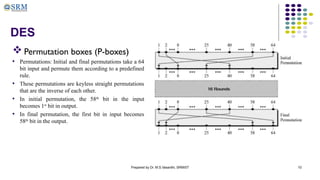
Permutation boxes (P-boxes)
• Permutations: Initial and final permutations take a 64
bit input and permute them according to a predefined
rule.
• These permutations are keyless straight permutations
that are the inverse of each other.
• In initial permutation, the 58th
bit in the input
becomes 1st
bit in output.
• In final permutation, the first bit in input becomes
58th
bit in the output.
11.
Prepared by Dr.M.S.Vasanthi, SRMIST 11
DES
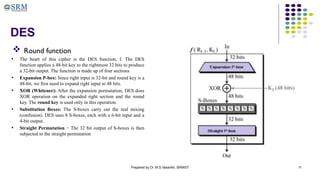
Round function
• The heart of this cipher is the DES function, f. The DES
function applies a 48-bit key to the rightmost 32 bits to produce
a 32-bit output. The function is made up of four sections.
• Expansion P-box: Since right input is 32-bit and round key is a
48-bit, we first need to expand right input to 48 bits.
• XOR (Whitener): After the expansion permutation, DES does
XOR operation on the expanded right section and the round
key. The round key is used only in this operation.
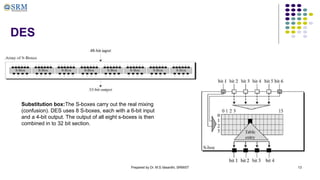
• Substitution Boxes: The S-boxes carry out the real mixing
(confusion). DES uses 8 S-boxes, each with a 6-bit input and a
4-bit output.
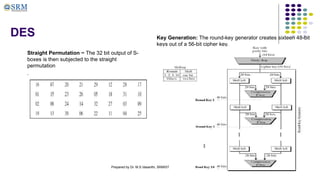
• Straight Permutation − The 32 bit output of S-boxes is then
subjected to the straight permutation
12.
Prepared by Dr.M.S.Vasanthi, SRMIST 12
DES
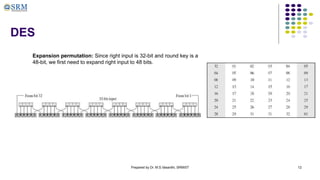
Expansion permutation: Since right input is 32-bit and round key is a
48-bit, we first need to expand right input to 48 bits.
13.
Prepared by Dr.M.S.Vasanthi, SRMIST 13
DES
Substitution box:The S-boxes carry out the real mixing
(confusion). DES uses 8 S-boxes, each with a 6-bit input
and a 4-bit output. The output of all eight s-boxes is then
combined in to 32 bit section.
14.
14
DES
Straight Permutation −The 32 bit output of S-
boxes is then subjected to the straight
permutation
.
Key Generation: The round-key generator creates sixteen 48-bit
keys out of a 56-bit cipher key.
Prepared by Dr. M.S.Vasanthi, SRMIST