Doppler effect
GRADE 12 PHYSICAL SCIENCES
MR B.T MALAZA
Doppler effect
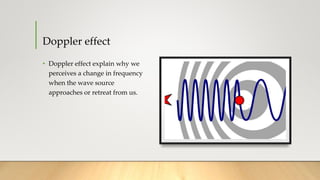
• Doppler effect explain why we
perceives a change in frequency
when the wave source
approaches or retreat from us.
Definition of Doppler Effect. Explanation of Doppler Effect. Doppler Effect
equation. Applications of Doppler Effect.
Objective:
Learners must be able to:
State the Doppler Effect.
Explain (using appropriate illustrations) the change in pitch observed when a source moves toward or away from
a listener.
Solve doppler effect problems.
State applications of the Doppler Effect
Doppler Effect
• The Doppler effect is the change in
frequency (or pitch) of the sound detected
by a listener because the sound source and
the listener have different velocities relative
to the medium of sound propagation.
Concept of Doppler
effect
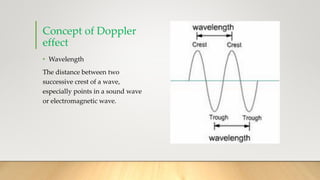
• Wavelength
The distance between two
successive crest of a wave,
especially points in a sound wave
or electromagnetic wave.
Introduction:
• From your experience you have noticed that if a police car is parked in the side of the
highway, sounding its 1000 Hz siren and if you are also parked in the highway, you will hear
the same frequency. But if there is relative motion between you and the police car, either
toward or away from each other, you will hear a different frequency (pitch). For example if
you are driving toward the police car at 120 km·h-1you will hear a higher frequency (1096 Hz
an increase by 96 Hz). If you are driving away from the police car at the same speed, you will
hear a lower frequency (904 Hz a decrease of 96 Hz).
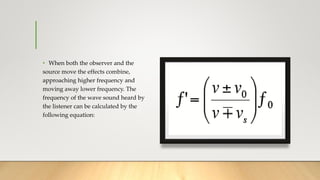
• When both the observer and the
source move the effects combine,
approaching higher frequency and
moving away lower frequency. The
frequency of the wave sound heard by
the listener can be calculated by the
following equation:
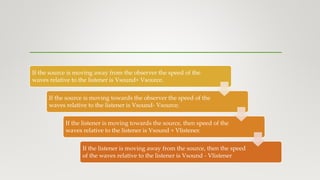
If the source is moving away from the observer the speed of the
waves relative to the listener is Vsound+ Vsource.
If the source is moving towards the observer the speed of the
waves relative to the listener is Vsound- Vsource.
If the listener is moving towards the source, then speed of the
waves relative to the listener is Vsound + Vlistener.
If the listener is moving away from the source, then the speed
of the waves relative to the listener is Vsound - Vlistener
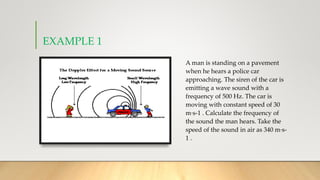
EXAMPLE 1
A man is standing on a pavement
when he hears a police car
approaching. The siren of the car is
emitting a wave sound with a
frequency of 500 Hz. The car is
moving with constant speed of 30
m·s-1 . Calculate the frequency of
the sound the man hears. Take the
speed of the sound in air as 340 m·s-
1 .
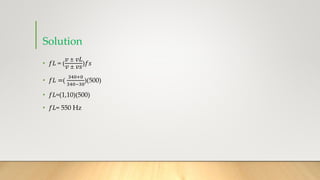
Solution
• 𝑓𝐿 = (
‫ݒ‬ ± ‫𝐿ݒ‬
‫ݒ‬ ± ‫ݏݒ‬
)𝑓‫ݏ‬
• 𝑓𝐿 =(
340+0
340−30
)(500)
• 𝑓𝐿=(1,10)(500)
• 𝑓𝐿= 550 Hz
Applications of
doppler effect
• The Doppler effect is used in some types
of radar, to measure the speed of
detected objects.
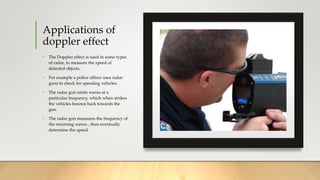
• For example a police officer uses radar
guns to check for speeding vehicles.
• The radar gun emits waves at a
particular frequency, which when strikes
the vehicles bounce back towards the
gun
• The radar gun measures the frequency of
the returning waves , then eventually
determine the speed.
• END OF
SLIDES THANK YOU
Reference list
• Heine, R. (2015). The Doppler effect. Available at:
https://www.slideshare.net/jheinerivera/doppler-effect-45275262
• Ramsey, S. (2016). Doppler effect. Available at:
https://www.slideshare.net/RamseySmall/doppler-effect-69641341
• Syeda, Z. (2015). The Doppler effect. Available at:
https://www.slideshare.net/SyedaZermeenFatima/dopplers-effect
• Nusrah , A. (2017). Doppler effect. Available at:
https://www.slideshare.net/NusrahAdeolaAdedewe/doppler-effect-76264239
• Katieli, W. (2015). Doppler effect. Available at: https://www.slideshare.net/katieliw/the-
doppler-effect-45304450

Doppler effect lesson slides

  • 1.
    Doppler effect GRADE 12PHYSICAL SCIENCES MR B.T MALAZA
  • 2.
    Doppler effect • Dopplereffect explain why we perceives a change in frequency when the wave source approaches or retreat from us.
  • 3.
    Definition of DopplerEffect. Explanation of Doppler Effect. Doppler Effect equation. Applications of Doppler Effect. Objective: Learners must be able to: State the Doppler Effect. Explain (using appropriate illustrations) the change in pitch observed when a source moves toward or away from a listener. Solve doppler effect problems. State applications of the Doppler Effect
  • 4.
    Doppler Effect • TheDoppler effect is the change in frequency (or pitch) of the sound detected by a listener because the sound source and the listener have different velocities relative to the medium of sound propagation.
  • 5.
    Concept of Doppler effect •Wavelength The distance between two successive crest of a wave, especially points in a sound wave or electromagnetic wave.
  • 6.
    Introduction: • From yourexperience you have noticed that if a police car is parked in the side of the highway, sounding its 1000 Hz siren and if you are also parked in the highway, you will hear the same frequency. But if there is relative motion between you and the police car, either toward or away from each other, you will hear a different frequency (pitch). For example if you are driving toward the police car at 120 km·h-1you will hear a higher frequency (1096 Hz an increase by 96 Hz). If you are driving away from the police car at the same speed, you will hear a lower frequency (904 Hz a decrease of 96 Hz).
  • 7.
    • When boththe observer and the source move the effects combine, approaching higher frequency and moving away lower frequency. The frequency of the wave sound heard by the listener can be calculated by the following equation:
  • 8.
    If the sourceis moving away from the observer the speed of the waves relative to the listener is Vsound+ Vsource. If the source is moving towards the observer the speed of the waves relative to the listener is Vsound- Vsource. If the listener is moving towards the source, then speed of the waves relative to the listener is Vsound + Vlistener. If the listener is moving away from the source, then the speed of the waves relative to the listener is Vsound - Vlistener
  • 9.
    EXAMPLE 1 A manis standing on a pavement when he hears a police car approaching. The siren of the car is emitting a wave sound with a frequency of 500 Hz. The car is moving with constant speed of 30 m·s-1 . Calculate the frequency of the sound the man hears. Take the speed of the sound in air as 340 m·s- 1 .
  • 10.
    Solution • 𝑓𝐿 =( ‫ݒ‬ ± ‫𝐿ݒ‬ ‫ݒ‬ ± ‫ݏݒ‬ )𝑓‫ݏ‬ • 𝑓𝐿 =( 340+0 340−30 )(500) • 𝑓𝐿=(1,10)(500) • 𝑓𝐿= 550 Hz
  • 11.
    Applications of doppler effect •The Doppler effect is used in some types of radar, to measure the speed of detected objects. • For example a police officer uses radar guns to check for speeding vehicles. • The radar gun emits waves at a particular frequency, which when strikes the vehicles bounce back towards the gun • The radar gun measures the frequency of the returning waves , then eventually determine the speed.
  • 12.
  • 13.
    Reference list • Heine,R. (2015). The Doppler effect. Available at: https://www.slideshare.net/jheinerivera/doppler-effect-45275262 • Ramsey, S. (2016). Doppler effect. Available at: https://www.slideshare.net/RamseySmall/doppler-effect-69641341 • Syeda, Z. (2015). The Doppler effect. Available at: https://www.slideshare.net/SyedaZermeenFatima/dopplers-effect • Nusrah , A. (2017). Doppler effect. Available at: https://www.slideshare.net/NusrahAdeolaAdedewe/doppler-effect-76264239 • Katieli, W. (2015). Doppler effect. Available at: https://www.slideshare.net/katieliw/the- doppler-effect-45304450