COST CONCEPTS AND DESIGN ECONOMICS INSPIRING CREATIVE AND  INNOVATIVE  MINDS
COST ESTIMATING USED TO Provide information used in setting a selling price for quoting, bidding, or evaluating contracts Determine whether a proposed product can be made and distributed at a profit (EG: price = cost + profit) Evaluate how much capital can be justified for process changes or other improvements Establish benchmarks for productivity improvement programs
COST ESTIMATING Used to describe the process by which the present and future cost consequences of engineering designs are forecast
COST ESTIMATING APPROACHES Top-down Approach Bottom-up Approach
TOP-DOWN APPROACH   Uses historical data from similar engineering projects  Used to estimate costs, revenues, and other parameters for current project Modifies original data for changes in inflation / deflation, activity level, weight, energy consumption, size, etc… Best use is early in estimating process
BOTTOM-UP APPROACH More detailed cost-estimating method Attempts to break down project into small, manageable units and estimate costs, etc…. Smaller unit costs added together with other types of costs to obtain overall cost estimate Works best when detail concerning desired output defined and clarified
Fixed cost : unaffected by changes in activity level Variable cost : vary in total with the quantity of output (or similar measure of activity) Incremental cost : additional cost resulting from increasing output of a system by one (or more) units Costs can be categorized in several different ways.
Direct : can be measured and allocated to a specific work activity Indirect : difficult to attribute or allocate to a specific output or work activity (also  overhead  or  burden ) Standard cost : cost per unit of output, established in advance of production or service delivery
Opportunity cost : the monetary advantage foregone due to limited resources.  The cost of the best rejected opportunity. Life-cycle cost : the summation of all costs related to a product, structure, system, or service during its life span.
Cash cost: a cost that involves a payment of cash. Book cost: a cost that does not involve a cash transaction but is reflected in the accounting system. Sunk cost: a cost that has occurred in the past and has no relevance to estimates of future costs and revenues related to an alternative course of action.
Investment Cost  or capital investment is the capital (money) required for most activities of the acquisition phase; Working Capital  refers to the funds required for current assets needed for start-up and subsequent support of operation activities; Operation and Maintenance Cost  includes many of the recurring annual expense items associated with the operation phase of the life cycle; Disposal Cost  includes non-recurring costs of shutting down the operation; CAPITAL AND  INVESTMENT
Overhead  consists of plant operating costs that are not direct labor or material costs indirect costs, overhead and burden are the same; Prime Cost   is a common method of allocating overhead costs among products, services and activities in proportion the sum of direct labor and materials cost ; DIRECT, INDIRECT AND OVERHEAD COSTS
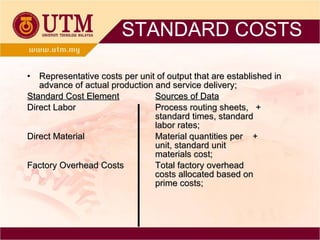
STANDARD COSTS Representative costs per unit of output that are established in advance of actual production and service delivery; Standard Cost Element Sources of Data Direct Labor Process routing sheets,  + standard times, standard  labor rates; Direct Material Material quantities per  + unit, standard unit  materials cost; Factory Overhead Costs Total factory overhead    costs allocated based on  prime costs;
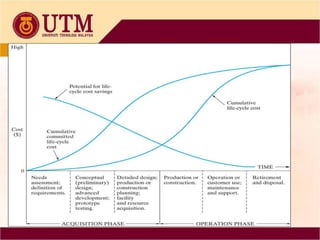
Figure 2-1
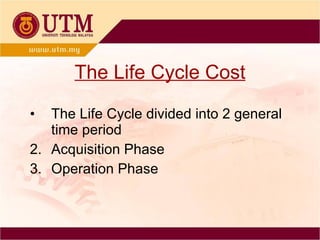
The Life Cycle Cost The Life Cycle divided into 2 general time period  Acquisition Phase Operation Phase
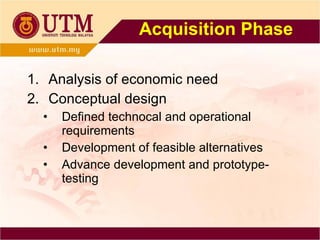
Acquisition Phase Analysis of economic need Conceptual design Defined technocal and operational requirements Development of feasible alternatives Advance development and prototype-testing
Acquisition Phase 3. Detailed design -activities to prepare, acquire and make ready for operation
Operation Phase Production, delivery or construction of the end item Operation and customer use Retirement from active operation or use
Fixed and Variable Cost A  Fixed Cost (FC)  is any cost that does not vary in proportion to the quantity of output. Examples include rent, depreciation, lighting,  and supervisor salaries. Fixed Costs are commonly fixed only over a certain range of production, called the  relevant range . For example supervisor salaries or lighting are fixed for one shift operation but step to a new higher level for two shift operation. Successive relevant ranges are often represented graphically as a step function.
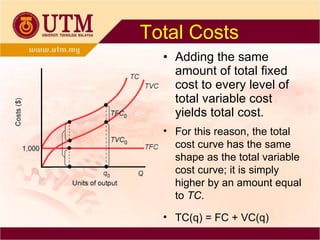
Fixed and Variable Cost A  Variable Cost (VC)  is a cost that varies in proportion to the quantity of output. Common examples include direct materials and direct labor. Variable Costs are often represented as a linear function of output VC(q) = rate * q; where q is the level of production Total Cost  is the sum of fixed costs and variable costs TC(q) = FC + VC(q)
Total Costs Adding the same amount of total fixed cost to every level of total variable cost yields total cost. For this reason, the total cost curve has the same shape as the total variable cost curve; it is simply higher by an amount equal to  TC . TC(q) = FC + VC(q)
Revenue Price x Quantity P x q
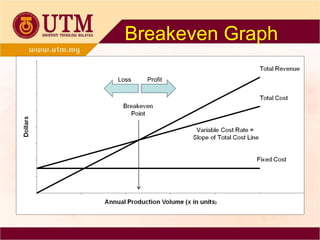
Breakeven Total Revenue (TR)  is the sum of revenues received for the units sold. Total Revenue is often represented as a linear function of units sold.  TR(q) = price * q; where q is the number of units sold If steady state inventory is assumed then units sold will be equal to the units produced. The point of  Breakeven , where total costs equal total revenues, can be found by solving: TR(q) = FC + VC(q)
Breakeven Graph Profit Loss
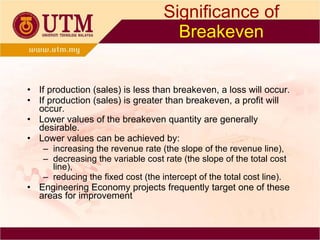
Significance of   Breakeven If production (sales) is less than breakeven, a loss will occur. If production (sales) is greater than breakeven, a profit will occur. Lower values of the breakeven quantity are generally  desirable. Lower values can be achieved by: increasing the revenue rate (the slope of the revenue line), decreasing the variable cost rate (the slope of the total cost line),  reducing the fixed cost (the intercept of the total cost line). Engineering Economy projects frequently target one of these areas for improvement
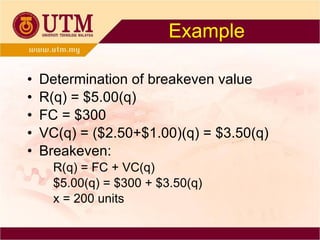
Example Determination of breakeven value R(q) = $5.00(q) FC = $300 VC(q) = ($2.50+$1.00)(q) = $3.50(q) Breakeven: R(q) = FC + VC(q) $5.00(q) = $300 + $3.50(q) x = 200 units
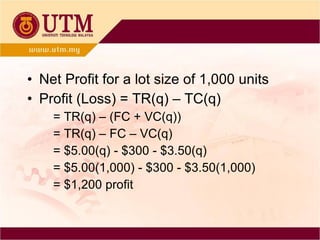
Net Profit for a lot size of 1,000 units Profit (Loss) = TR(q) – TC(q) = TR(q) – (FC + VC(q)) = TR(q) – FC – VC(q) = $5.00(q) - $300 - $3.50(q) = $5.00(1,000) - $300 - $3.50(1,000) = $1,200 profit

Lecture2

  • 1.
    COST CONCEPTS ANDDESIGN ECONOMICS INSPIRING CREATIVE AND INNOVATIVE MINDS
  • 2.
    COST ESTIMATING USEDTO Provide information used in setting a selling price for quoting, bidding, or evaluating contracts Determine whether a proposed product can be made and distributed at a profit (EG: price = cost + profit) Evaluate how much capital can be justified for process changes or other improvements Establish benchmarks for productivity improvement programs
  • 3.
    COST ESTIMATING Usedto describe the process by which the present and future cost consequences of engineering designs are forecast
  • 4.
    COST ESTIMATING APPROACHESTop-down Approach Bottom-up Approach
  • 5.
    TOP-DOWN APPROACH Uses historical data from similar engineering projects Used to estimate costs, revenues, and other parameters for current project Modifies original data for changes in inflation / deflation, activity level, weight, energy consumption, size, etc… Best use is early in estimating process
  • 6.
    BOTTOM-UP APPROACH Moredetailed cost-estimating method Attempts to break down project into small, manageable units and estimate costs, etc…. Smaller unit costs added together with other types of costs to obtain overall cost estimate Works best when detail concerning desired output defined and clarified
  • 7.
    Fixed cost :unaffected by changes in activity level Variable cost : vary in total with the quantity of output (or similar measure of activity) Incremental cost : additional cost resulting from increasing output of a system by one (or more) units Costs can be categorized in several different ways.
  • 8.
    Direct : canbe measured and allocated to a specific work activity Indirect : difficult to attribute or allocate to a specific output or work activity (also overhead or burden ) Standard cost : cost per unit of output, established in advance of production or service delivery
  • 9.
    Opportunity cost :the monetary advantage foregone due to limited resources. The cost of the best rejected opportunity. Life-cycle cost : the summation of all costs related to a product, structure, system, or service during its life span.
  • 10.
    Cash cost: acost that involves a payment of cash. Book cost: a cost that does not involve a cash transaction but is reflected in the accounting system. Sunk cost: a cost that has occurred in the past and has no relevance to estimates of future costs and revenues related to an alternative course of action.
  • 11.
    Investment Cost or capital investment is the capital (money) required for most activities of the acquisition phase; Working Capital refers to the funds required for current assets needed for start-up and subsequent support of operation activities; Operation and Maintenance Cost includes many of the recurring annual expense items associated with the operation phase of the life cycle; Disposal Cost includes non-recurring costs of shutting down the operation; CAPITAL AND INVESTMENT
  • 12.
    Overhead consistsof plant operating costs that are not direct labor or material costs indirect costs, overhead and burden are the same; Prime Cost is a common method of allocating overhead costs among products, services and activities in proportion the sum of direct labor and materials cost ; DIRECT, INDIRECT AND OVERHEAD COSTS
  • 13.
    STANDARD COSTS Representativecosts per unit of output that are established in advance of actual production and service delivery; Standard Cost Element Sources of Data Direct Labor Process routing sheets, + standard times, standard labor rates; Direct Material Material quantities per + unit, standard unit materials cost; Factory Overhead Costs Total factory overhead costs allocated based on prime costs;
  • 14.
  • 15.
    The Life CycleCost The Life Cycle divided into 2 general time period Acquisition Phase Operation Phase
  • 16.
    Acquisition Phase Analysisof economic need Conceptual design Defined technocal and operational requirements Development of feasible alternatives Advance development and prototype-testing
  • 17.
    Acquisition Phase 3.Detailed design -activities to prepare, acquire and make ready for operation
  • 18.
    Operation Phase Production,delivery or construction of the end item Operation and customer use Retirement from active operation or use
  • 19.
    Fixed and VariableCost A Fixed Cost (FC) is any cost that does not vary in proportion to the quantity of output. Examples include rent, depreciation, lighting, and supervisor salaries. Fixed Costs are commonly fixed only over a certain range of production, called the relevant range . For example supervisor salaries or lighting are fixed for one shift operation but step to a new higher level for two shift operation. Successive relevant ranges are often represented graphically as a step function.
  • 20.
    Fixed and VariableCost A Variable Cost (VC) is a cost that varies in proportion to the quantity of output. Common examples include direct materials and direct labor. Variable Costs are often represented as a linear function of output VC(q) = rate * q; where q is the level of production Total Cost is the sum of fixed costs and variable costs TC(q) = FC + VC(q)
  • 21.
    Total Costs Addingthe same amount of total fixed cost to every level of total variable cost yields total cost. For this reason, the total cost curve has the same shape as the total variable cost curve; it is simply higher by an amount equal to TC . TC(q) = FC + VC(q)
  • 22.
    Revenue Price xQuantity P x q
  • 23.
    Breakeven Total Revenue(TR) is the sum of revenues received for the units sold. Total Revenue is often represented as a linear function of units sold. TR(q) = price * q; where q is the number of units sold If steady state inventory is assumed then units sold will be equal to the units produced. The point of Breakeven , where total costs equal total revenues, can be found by solving: TR(q) = FC + VC(q)
  • 24.
  • 25.
    Significance of Breakeven If production (sales) is less than breakeven, a loss will occur. If production (sales) is greater than breakeven, a profit will occur. Lower values of the breakeven quantity are generally desirable. Lower values can be achieved by: increasing the revenue rate (the slope of the revenue line), decreasing the variable cost rate (the slope of the total cost line), reducing the fixed cost (the intercept of the total cost line). Engineering Economy projects frequently target one of these areas for improvement
  • 26.
    Example Determination ofbreakeven value R(q) = $5.00(q) FC = $300 VC(q) = ($2.50+$1.00)(q) = $3.50(q) Breakeven: R(q) = FC + VC(q) $5.00(q) = $300 + $3.50(q) x = 200 units
  • 27.
    Net Profit fora lot size of 1,000 units Profit (Loss) = TR(q) – TC(q) = TR(q) – (FC + VC(q)) = TR(q) – FC – VC(q) = $5.00(q) - $300 - $3.50(q) = $5.00(1,000) - $300 - $3.50(1,000) = $1,200 profit