CHAPTER 2CHAPTER 2
Cost Concepts and ApplicationCost Concepts and Application
COSTCOST
 Cost is a resource sacrificed or forgone toCost is a resource sacrificed or forgone to
achieve a specific objective. It is usuallyachieve a specific objective. It is usually
measured as the monetary amount (ormeasured as the monetary amount (or
money) that must be paid to acquiremoney) that must be paid to acquire
goods and services.goods and services.
Cost TerminologyCost Terminology
Others cost terminologyOthers cost terminology
 Opportunity costOpportunity cost
 Social costSocial cost
 Direct costsDirect costs
 Indirect costIndirect cost
 Sunk costSunk cost
 Explicit costExplicit cost
 Implicit costImplicit cost
 Recurring/Non-recurring costRecurring/Non-recurring cost
Cost Terminology
base on behaviour
 Fixed cost
 Variable costs
Cost TerminologyCost Terminology
 AnAn opportunity costopportunity cost is the cost of the bestis the cost of the best
rejected ( i.e., foregone ) opportunity andrejected ( i.e., foregone ) opportunity and
is hidden or implied. (Used inis hidden or implied. (Used in
Replacement Analysis)Replacement Analysis)

a student who could earn $20,000 for workinga student who could earn $20,000 for working
during a year, but chooses instead to go toduring a year, but chooses instead to go to
school for a year and spend $5,000 to do so.school for a year and spend $5,000 to do so.
The opportunity cost of going to school forThe opportunity cost of going to school for
that year is $25,000: $5,000 cash outlay andthat year is $25,000: $5,000 cash outlay and
$20,000 for income$20,000 for income
Cost TerminologyCost Terminology
 Social cost – A cost due to negativeSocial cost – A cost due to negative
impact from the economy activities. (B/Cimpact from the economy activities. (B/C
ratio analysis) Example : pollution, traffic-ratio analysis) Example : pollution, traffic-
jam, inflation.jam, inflation.

Environmental pollution, traffic jam or priceEnvironmental pollution, traffic jam or price
increase on certain products.increase on certain products.

Government will imposed tax to theGovernment will imposed tax to the
responsible party.responsible party.
Cost TerminologyCost Terminology
 Direct costsDirect costs can be reasonably measured andcan be reasonably measured and
allocated to a specific output or work activity --allocated to a specific output or work activity --
labor and material directly allocated with alabor and material directly allocated with a
product, service or construction activity;product, service or construction activity;
 Indirect costsIndirect costs are difficult to allocate to a specificare difficult to allocate to a specific
output or activity -- costs of common tools,output or activity -- costs of common tools,
general supplies, and equipment maintenance ;general supplies, and equipment maintenance ;
Cost TerminologyCost Terminology
 AA sunk costsunk cost is one that has occurred in the past and has nois one that has occurred in the past and has no
relevance to estimates of future costs and revenues relatedrelevance to estimates of future costs and revenues related
to an alternative course of action. (Replacement Analysis)to an alternative course of action. (Replacement Analysis)

Sunk cost = present book value- market valueSunk cost = present book value- market value

Example: A new car was bought for RM50,000 with life-Example: A new car was bought for RM50,000 with life-
period for 10 year.period for 10 year.

Considering shrink in value, the present book value forConsidering shrink in value, the present book value for
the item is RM35,000.the item is RM35,000.

As the car experiencing too much defects, it was sold forAs the car experiencing too much defects, it was sold for
RM25,000.RM25,000.

The sunk cost for this case, is RM10,000 (35000-The sunk cost for this case, is RM10,000 (35000-
25000).25000).
Cost TerminologyCost Terminology
 AnAn Explicit costExplicit cost is an easy accounted cost, such asis an easy accounted cost, such as
wage, rent and materials. It can be transacted in thewage, rent and materials. It can be transacted in the
form of money payment and is lost directlyform of money payment and is lost directly
 AnAn implicit costimplicit cost occurs when one foregoes an alternativeoccurs when one foregoes an alternative
action but does not make an actual payment . Example-action but does not make an actual payment . Example-
Sundry shop’s owner who open & manage his businessSundry shop’s owner who open & manage his business
using his own property and wealth. Implicit cost include:using his own property and wealth. Implicit cost include:

Importing workers from other place and paid their salaries.Importing workers from other place and paid their salaries.

Interest to be received by him if invest at another place.Interest to be received by him if invest at another place.

Potential gain from the shop if he choose to rent his shop.Potential gain from the shop if he choose to rent his shop.
Cost TerminologyCost Terminology
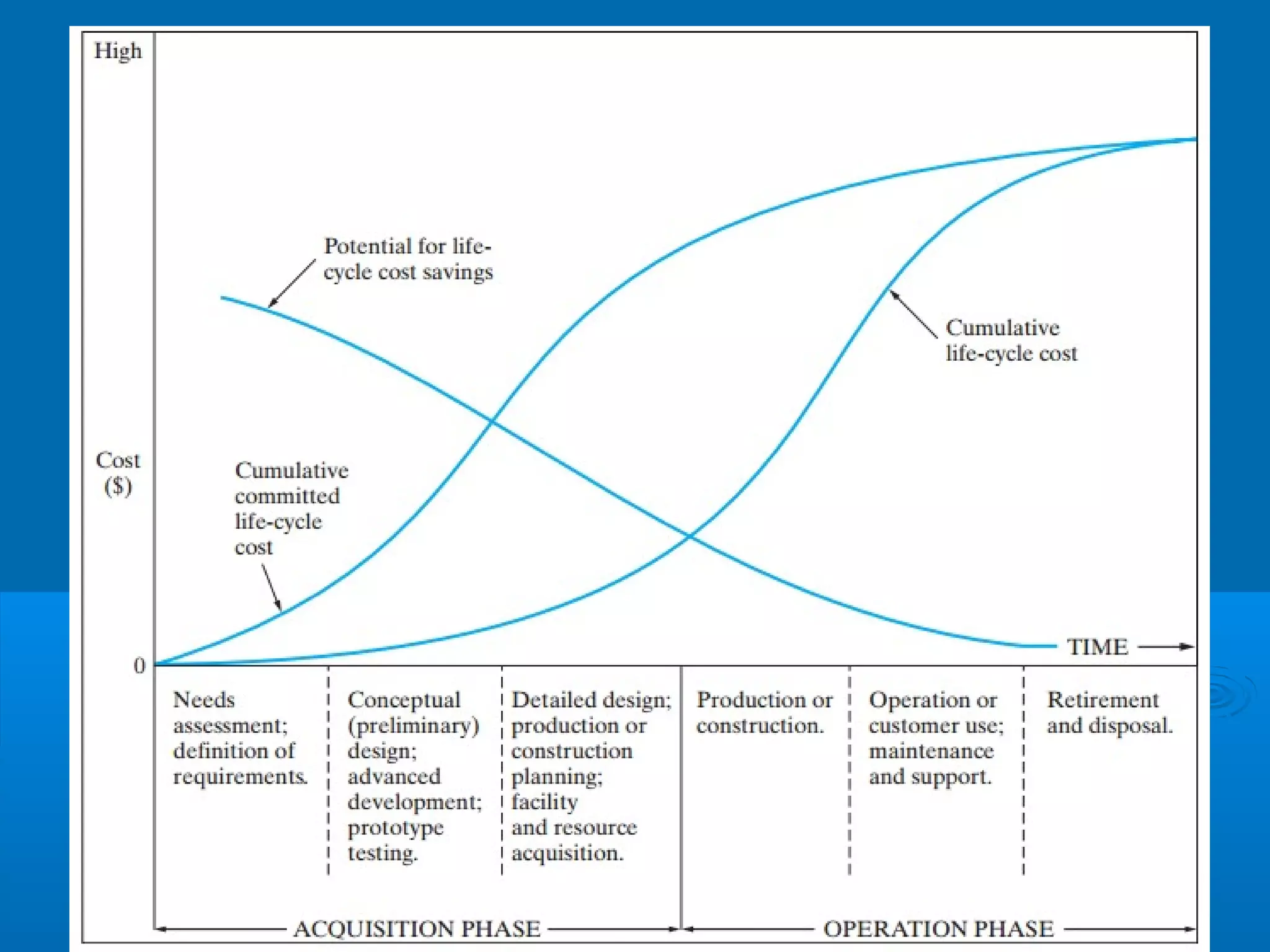
 Life-Cycle CostLife-Cycle Cost

In engineering practice, the term life-cycle cost is oftenIn engineering practice, the term life-cycle cost is often
encountered. This term refers to a summation of all the costsencountered. This term refers to a summation of all the costs
related to a product, structure, system, or service during its liferelated to a product, structure, system, or service during its life
spanspan
Cost Concept & Cost CurveCost Concept & Cost Curve
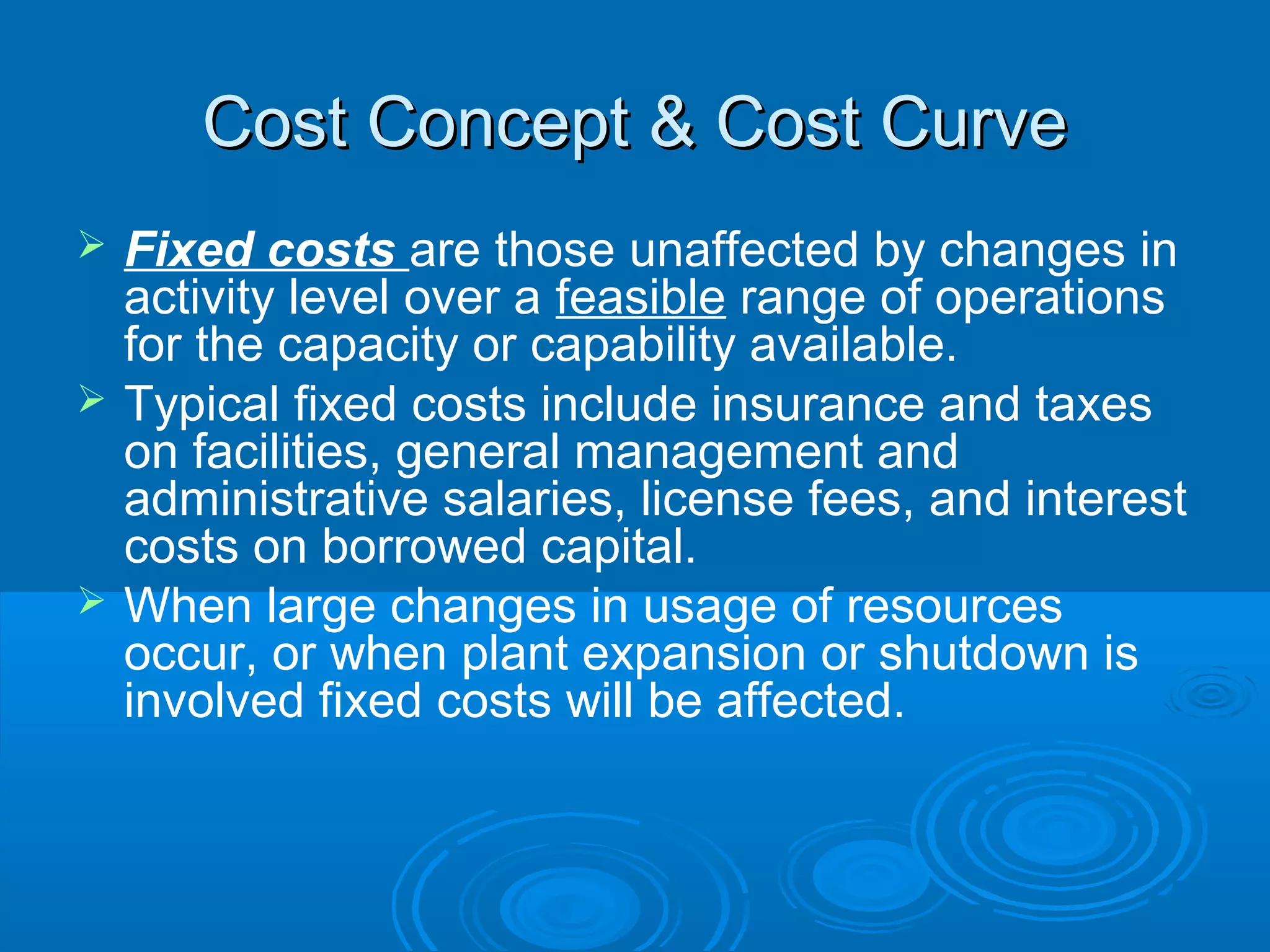
 Fixed costs are those unaffected by changes in
activity level over a feasible range of operations
for the capacity or capability available.
 Typical fixed costs include insurance and taxes
on facilities, general management and
administrative salaries, license fees, and interest
costs on borrowed capital.
 When large changes in usage of resources
occur, or when plant expansion or shutdown is
involved fixed costs will be affected.
Cost Classification & Cost CurveCost Classification & Cost Curve
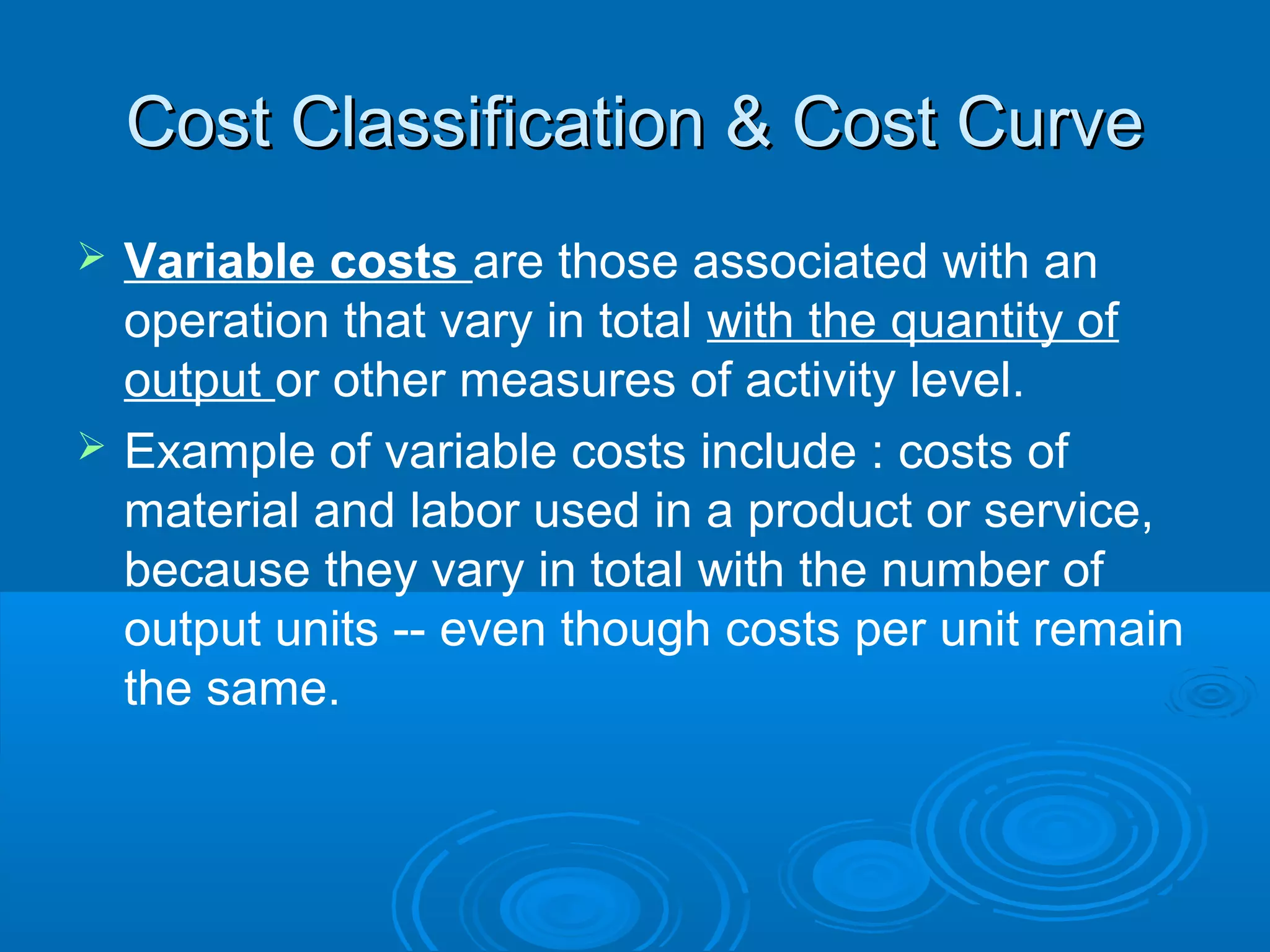
 Variable costs are those associated with an
operation that vary in total with the quantity of
output or other measures of activity level.
 Example of variable costs include : costs of
material and labor used in a product or service,
because they vary in total with the number of
output units -- even though costs per unit remain
the same.
Cost Classification & Cost CurveCost Classification & Cost Curve
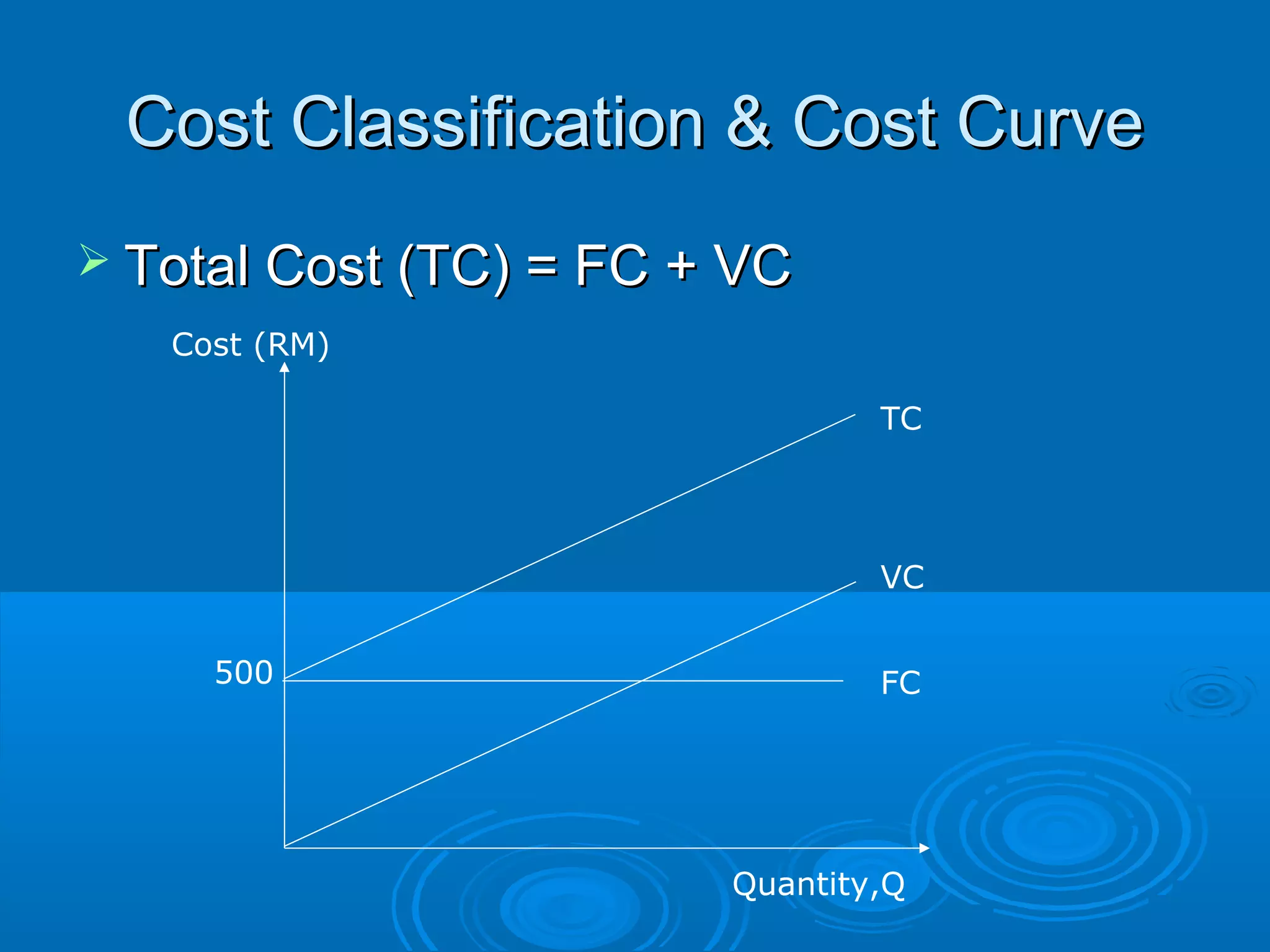
 Total Cost (TC) = FC + VCTotal Cost (TC) = FC + VC
TC
VC
FC500
Quantity,Q
Cost (RM)
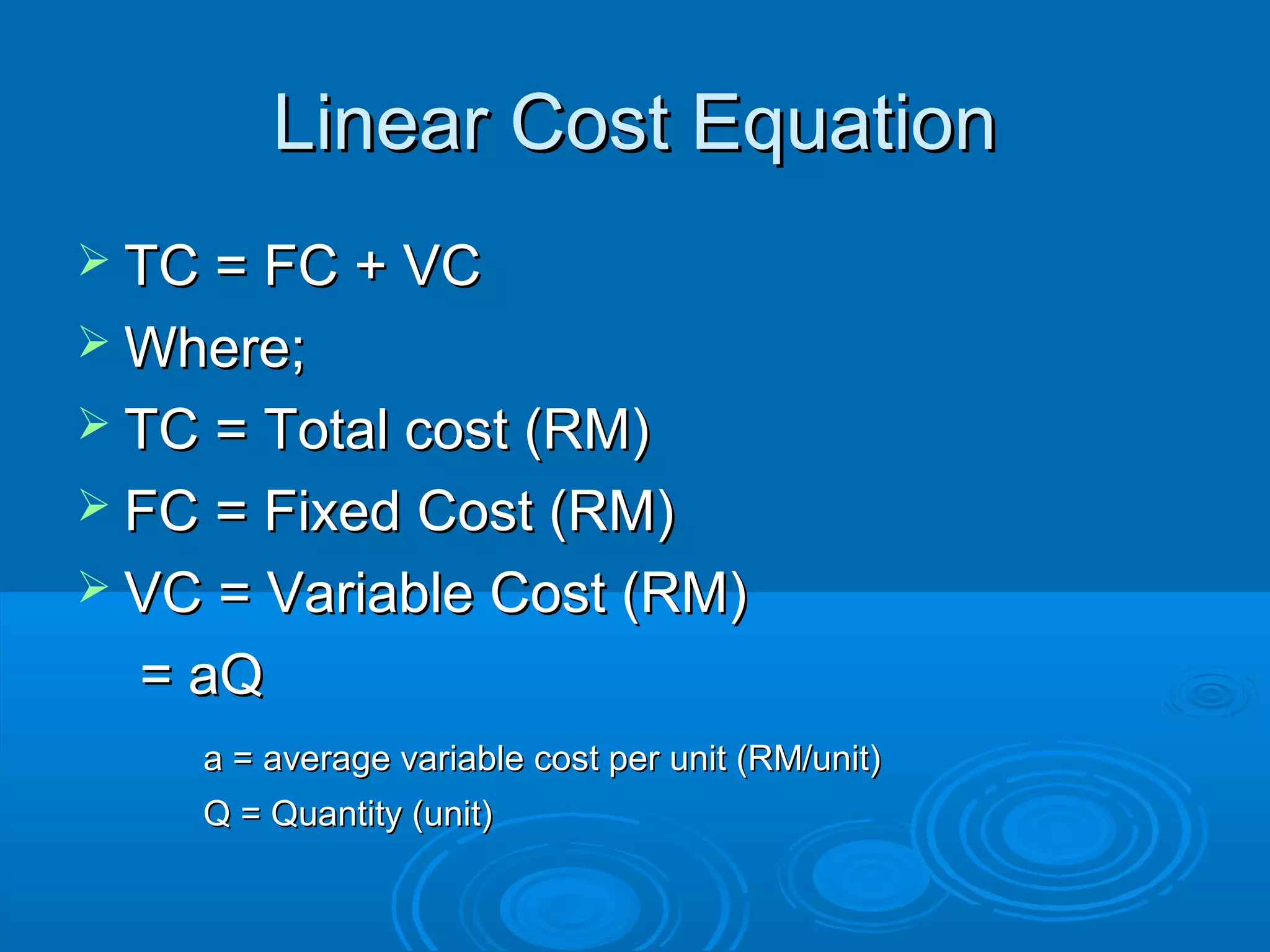
Linear Cost EquationLinear Cost Equation
 TC = FC + VCTC = FC + VC
 Where;Where;
 TC = Total cost (RM)TC = Total cost (RM)
 FC = Fixed Cost (RM)FC = Fixed Cost (RM)
 VC = Variable Cost (RM)VC = Variable Cost (RM)
= aQ= aQ
a = average variable cost per unit (RM/unit)a = average variable cost per unit (RM/unit)
Q = Quantity (unit)Q = Quantity (unit)
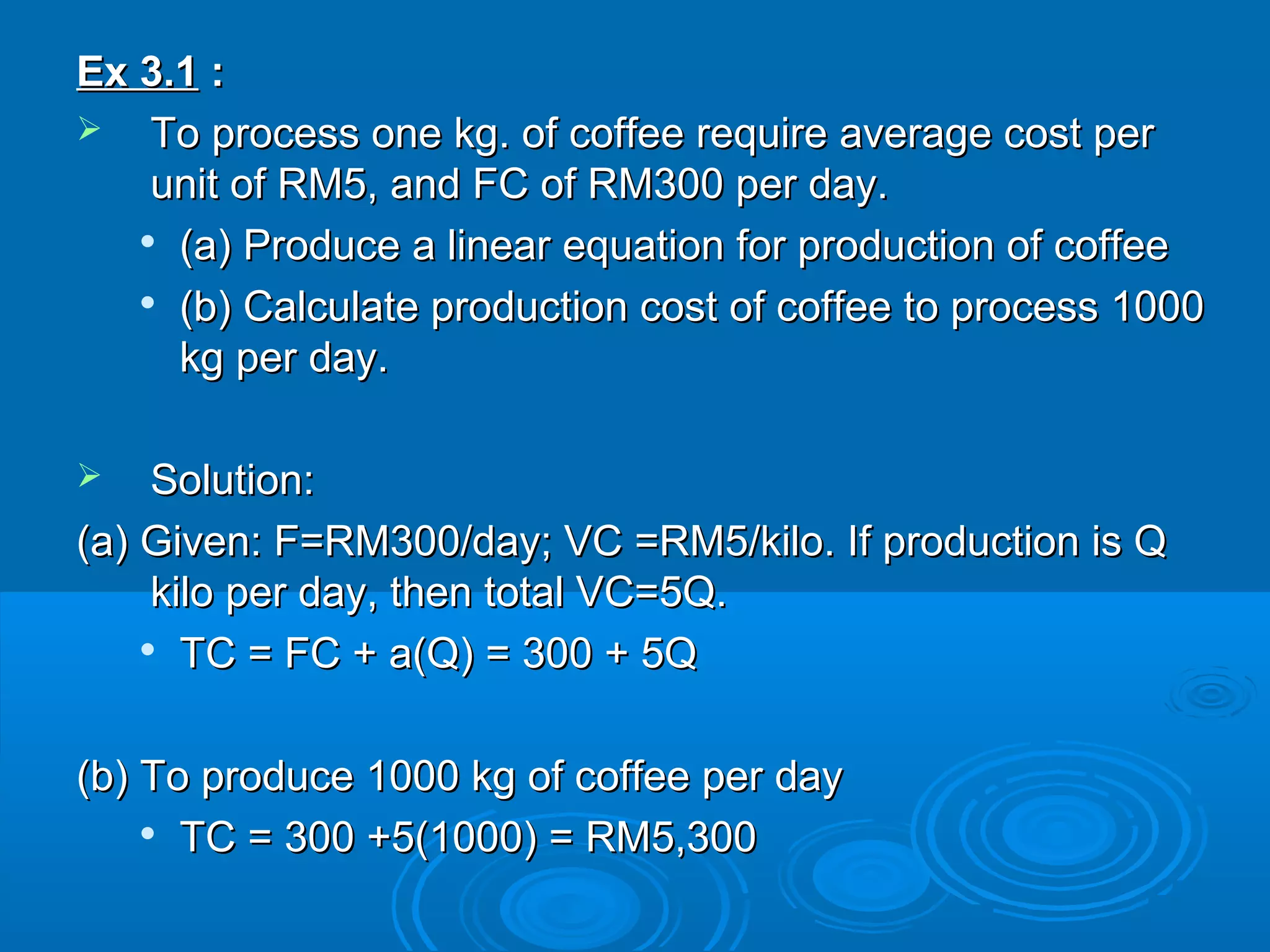
Ex 3.1Ex 3.1 ::
 To process one kg. of coffee require average cost perTo process one kg. of coffee require average cost per
unit of RM5, and FC of RM300 per day.unit of RM5, and FC of RM300 per day.

(a) Produce a linear equation for production of coffee(a) Produce a linear equation for production of coffee

(b) Calculate production cost of coffee to process 1000(b) Calculate production cost of coffee to process 1000
kg per day.kg per day.
 Solution:Solution:
(a) Given: F=RM300/day; VC =RM5/kilo. If production is Q(a) Given: F=RM300/day; VC =RM5/kilo. If production is Q
kilo per day, then total VC=5Q.kilo per day, then total VC=5Q.

TC = FC + a(Q) = 300 + 5QTC = FC + a(Q) = 300 + 5Q
(b) To produce 1000 kg of coffee per day(b) To produce 1000 kg of coffee per day

TC = 300 +5(1000) = RM5,300TC = 300 +5(1000) = RM5,300
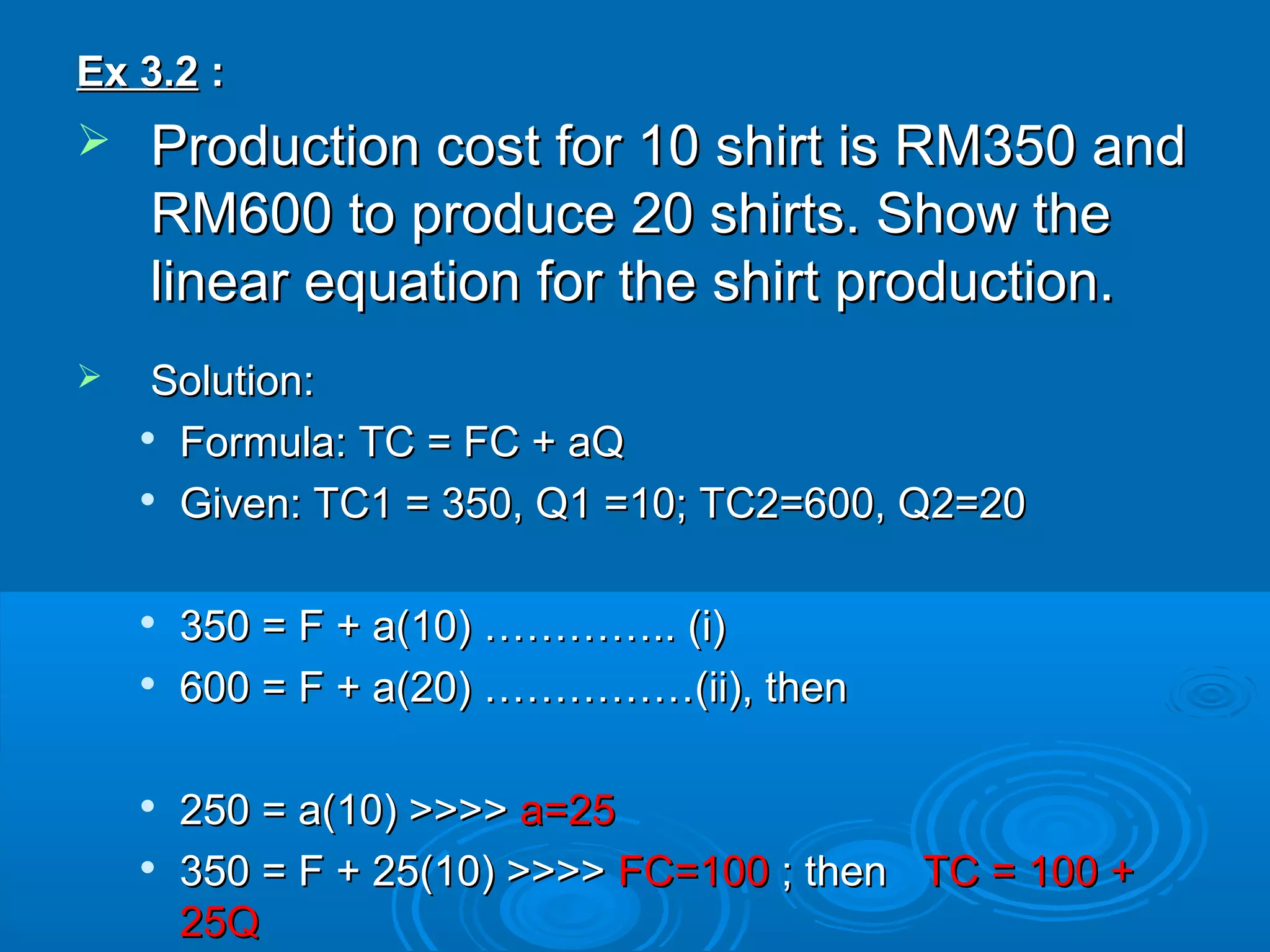
Ex 3.2Ex 3.2 ::
 Production cost for 10 shirt is RM350 andProduction cost for 10 shirt is RM350 and
RM600 to produce 20 shirts. Show theRM600 to produce 20 shirts. Show the
linear equation for the shirt production.linear equation for the shirt production.
 Solution:Solution:

Formula: TC = FC + aQFormula: TC = FC + aQ

Given: TC1 = 350, Q1 =10; TC2=600, Q2=20Given: TC1 = 350, Q1 =10; TC2=600, Q2=20

350 = F + a(10) ………….. (i)350 = F + a(10) ………….. (i)

600 = F + a(20) ……………(ii), then600 = F + a(20) ……………(ii), then

250 = a(10) >>>>250 = a(10) >>>> a=25a=25

350 = F + 25(10) >>>>350 = F + 25(10) >>>> FC=100FC=100 ; then; then TC = 100 +TC = 100 +
25Q25Q
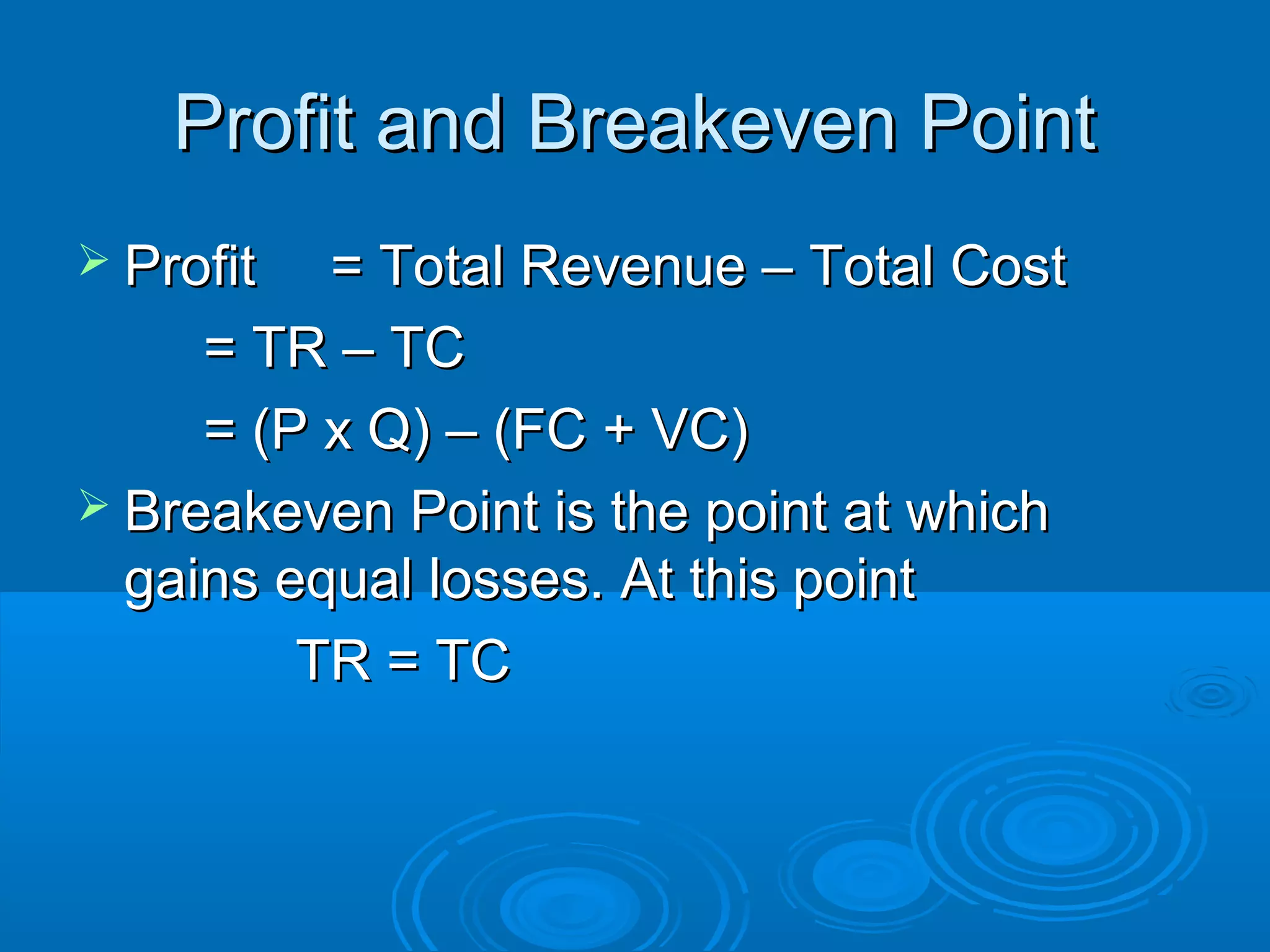
Profit and Breakeven PointProfit and Breakeven Point
 ProfitProfit = Total Revenue – Total Cost= Total Revenue – Total Cost
= TR – TC= TR – TC
= (P x Q) – (FC + VC)= (P x Q) – (FC + VC)
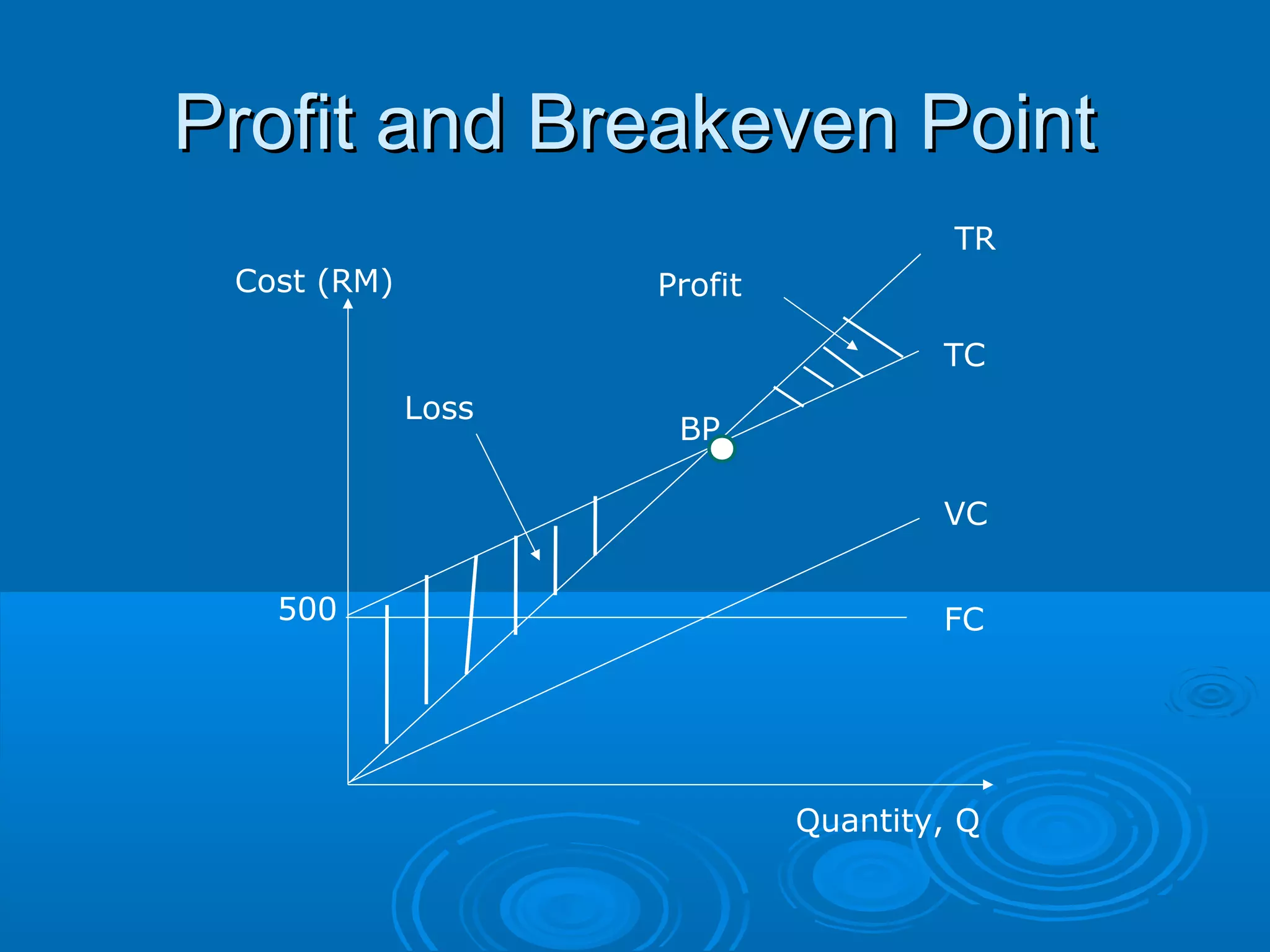
 Breakeven Point is the point at whichBreakeven Point is the point at which
gains equal losses. At this pointgains equal losses. At this point
TR = TCTR = TC
Profit and Breakeven PointProfit and Breakeven Point
TC
VC
FC500
Quantity, Q
Cost (RM)
TR
BP
Profit
Loss
Contoh 3.3Contoh 3.3 ::
Daripada Contoh 3.1,Daripada Contoh 3.1,
Persamaam linear Jumlah kos, TC = 300 + 5QPersamaam linear Jumlah kos, TC = 300 + 5Q
Katakan kopi dijual RM10 per Kg.Katakan kopi dijual RM10 per Kg.
a)a) Hitungkan titik pulang modal.Hitungkan titik pulang modal.
b)b) Keuntungan jika syarikat mengeluarkan / menjual kopiKeuntungan jika syarikat mengeluarkan / menjual kopi
(i) 100 Kg sehari (ii) 50 Kg sehari(i) 100 Kg sehari (ii) 50 Kg sehari
Penyelesaian:Penyelesaian:
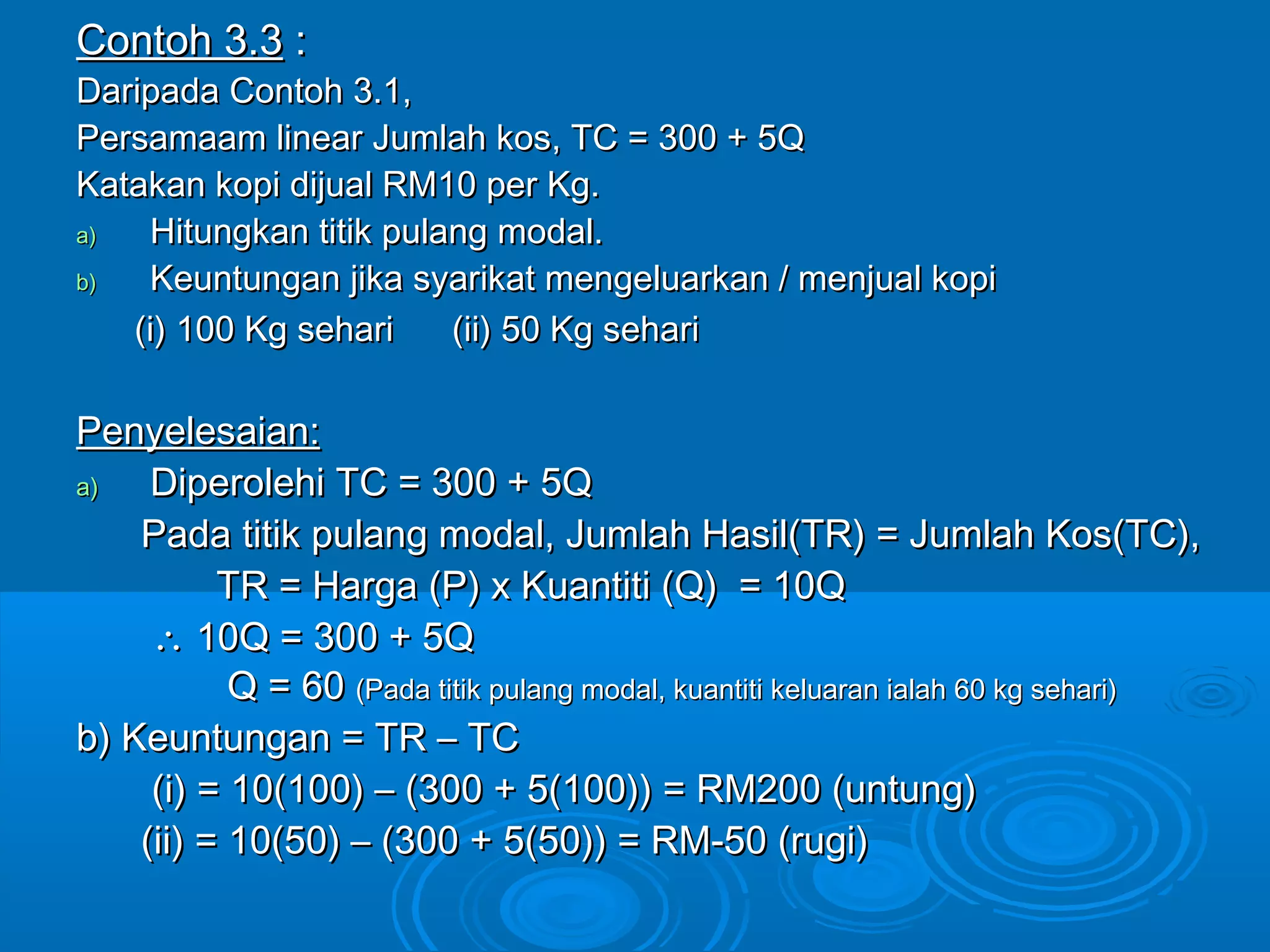
a)a) Diperolehi TC = 300 + 5QDiperolehi TC = 300 + 5Q
Pada titik pulang modal, Jumlah Hasil(TR) = Jumlah Kos(TC),Pada titik pulang modal, Jumlah Hasil(TR) = Jumlah Kos(TC),
TR = Harga (P) x Kuantiti (Q) = 10QTR = Harga (P) x Kuantiti (Q) = 10Q
∴∴ 10Q = 300 + 5Q10Q = 300 + 5Q
Q = 60Q = 60 (Pada titik pulang modal, kuantiti keluaran ialah 60 kg sehari)(Pada titik pulang modal, kuantiti keluaran ialah 60 kg sehari)
b) Keuntungan = TR – TCb) Keuntungan = TR – TC
(i) = 10(100) – (300 + 5(100)) = RM200 (untung)(i) = 10(100) – (300 + 5(100)) = RM200 (untung)
(ii) = 10(50) – (300 + 5(50)) = RM-50 (rugi)(ii) = 10(50) – (300 + 5(50)) = RM-50 (rugi)
Contoh 3.3Contoh 3.3 ::
In relation to Ex.1, if coffee is sold for RM10 per kilo,
(a) calculate the breakeven point
(b) compute TR if the firm produce and sell (i) 100 kilo/day & (ii) 50 kilo/day.
Solution:
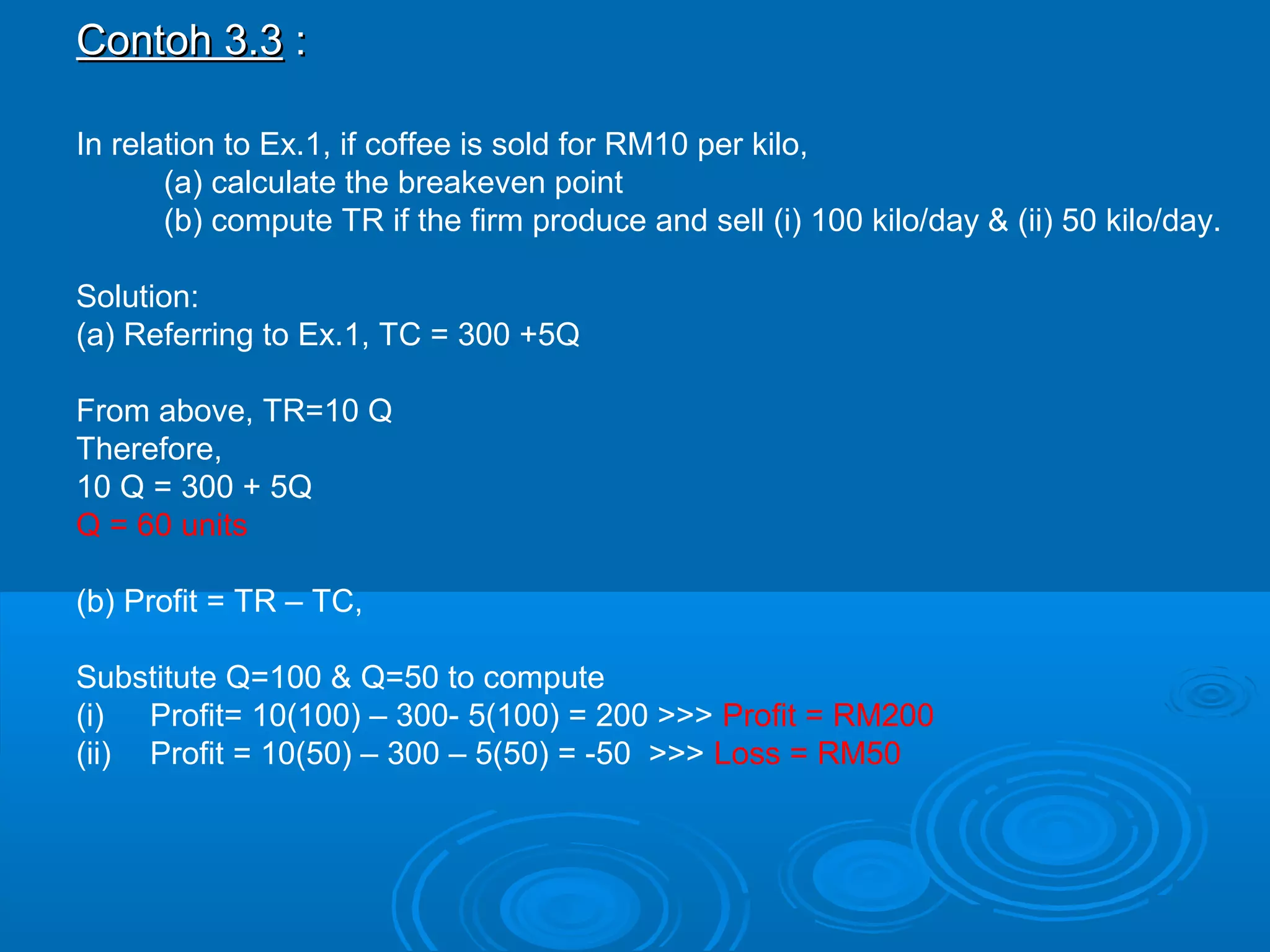
(a) Referring to Ex.1, TC = 300 +5Q
From above, TR=10 Q
Therefore,
10 Q = 300 + 5Q
Q = 60 units
(b) Profit = TR – TC,
Substitute Q=100 & Q=50 to compute
(i) Profit= 10(100) – 300- 5(100) = 200 >>> Profit = RM200
(ii) Profit = 10(50) – 300 – 5(50) = -50 >>> Loss = RM50
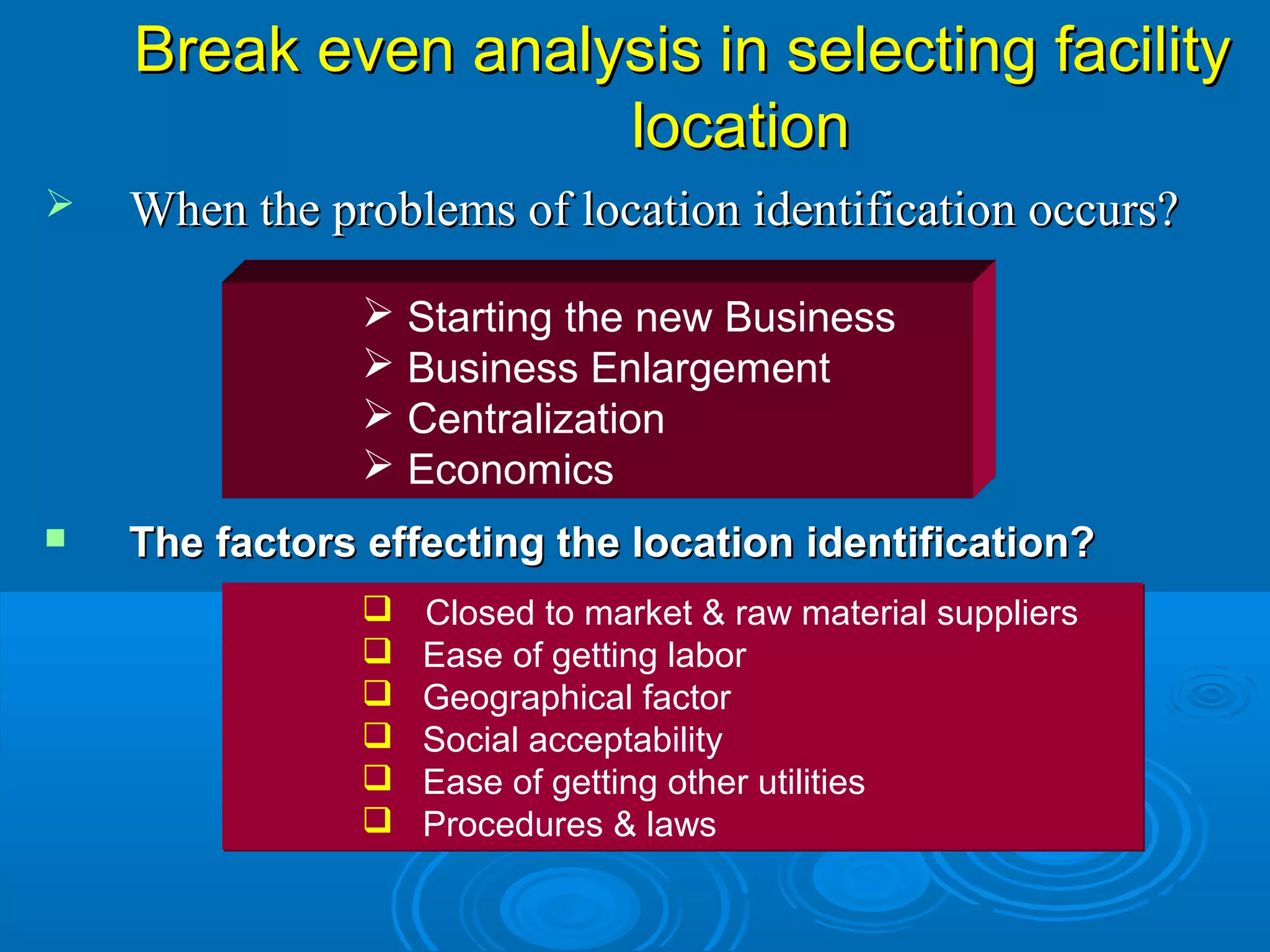
 When the problems of location identification occurs?When the problems of location identification occurs?
 Starting the new Business
 Business Enlargement
 Centralization
 Economics
 The factors effecting the location identification?The factors effecting the location identification?
 Closed to market & raw material suppliers
 Ease of getting labor
 Geographical factor
 Social acceptability
 Ease of getting other utilities
 Procedures & laws
 Closed to market & raw material suppliers
 Ease of getting labor
 Geographical factor
 Social acceptability
 Ease of getting other utilities
 Procedures & laws
Break even analysis in selecting facilityBreak even analysis in selecting facility
locationlocation
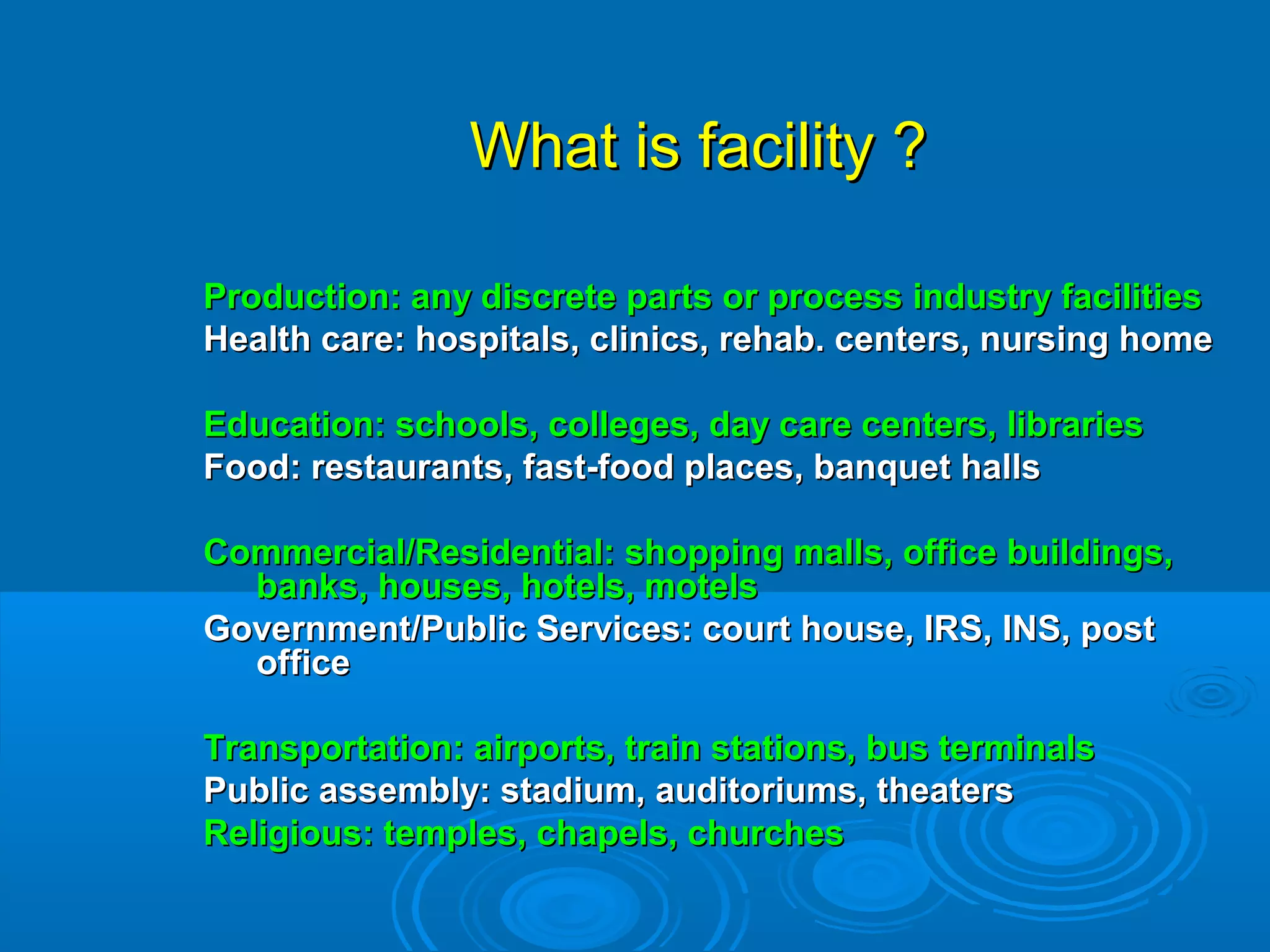
What is facility ?What is facility ?
Production: any discrete parts or process industry facilitiesProduction: any discrete parts or process industry facilities
Health care: hospitals, clinics, rehab. centers, nursing homeHealth care: hospitals, clinics, rehab. centers, nursing home
Education: schools, colleges, day care centers, librariesEducation: schools, colleges, day care centers, libraries
Food: restaurants, fast-food places, banquet hallsFood: restaurants, fast-food places, banquet halls
Commercial/Residential: shopping malls, office buildings,Commercial/Residential: shopping malls, office buildings,
banks, houses, hotels, motelsbanks, houses, hotels, motels
Government/Public Services: court house, IRS, INS, postGovernment/Public Services: court house, IRS, INS, post
officeoffice
Transportation: airports, train stations, bus terminalsTransportation: airports, train stations, bus terminals
Public assembly: stadium, auditoriums, theatersPublic assembly: stadium, auditoriums, theaters
Religious: temples, chapels, churchesReligious: temples, chapels, churches
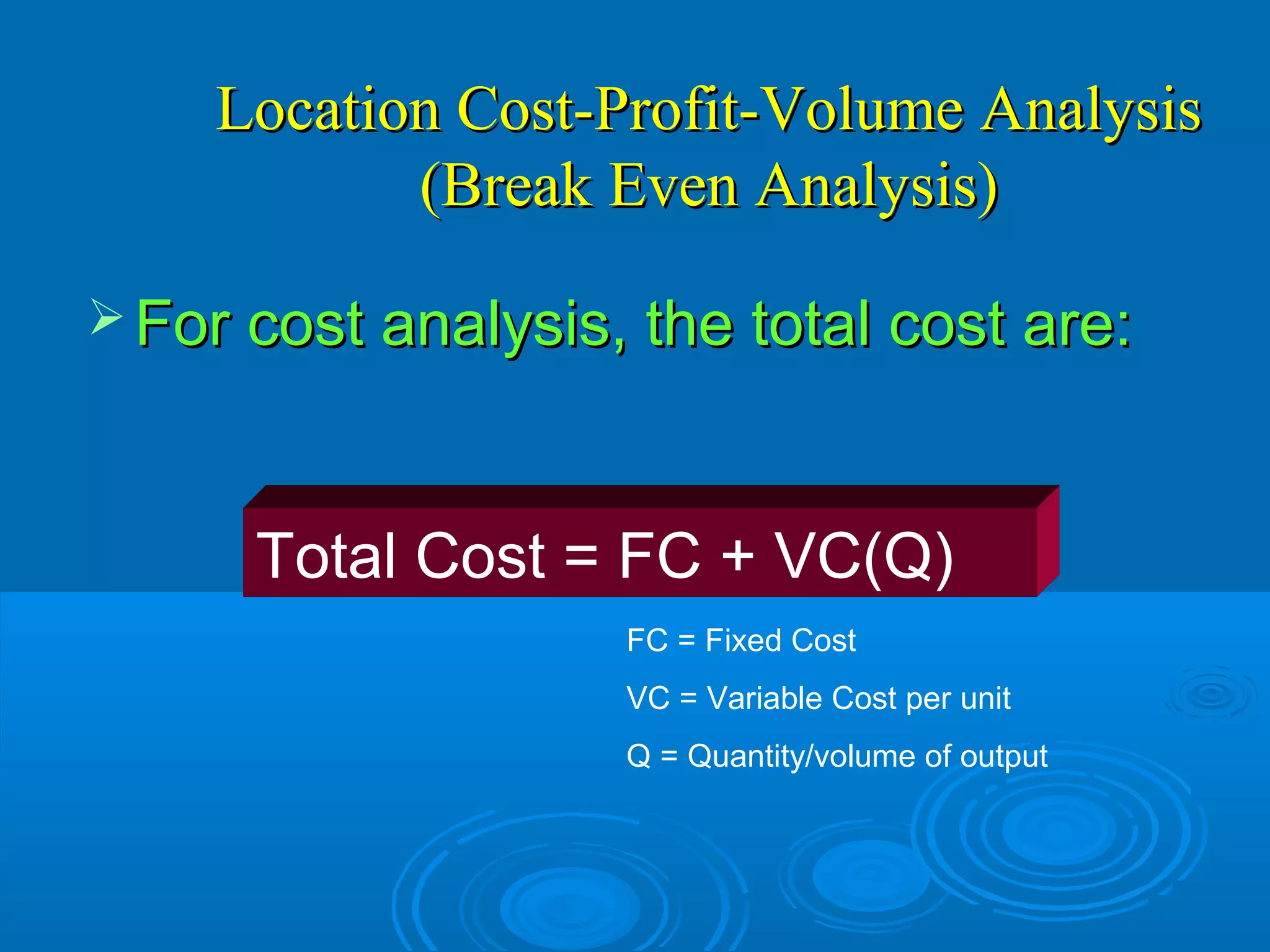
Location Cost-Profit-Volume AnalysisLocation Cost-Profit-Volume Analysis
(Break Even Analysis)(Break Even Analysis)
 For cost analysis, the total cost are:For cost analysis, the total cost are:
Total Cost = FC + VC(Q)
FC = Fixed Cost
VC = Variable Cost per unit
Q = Quantity/volume of output
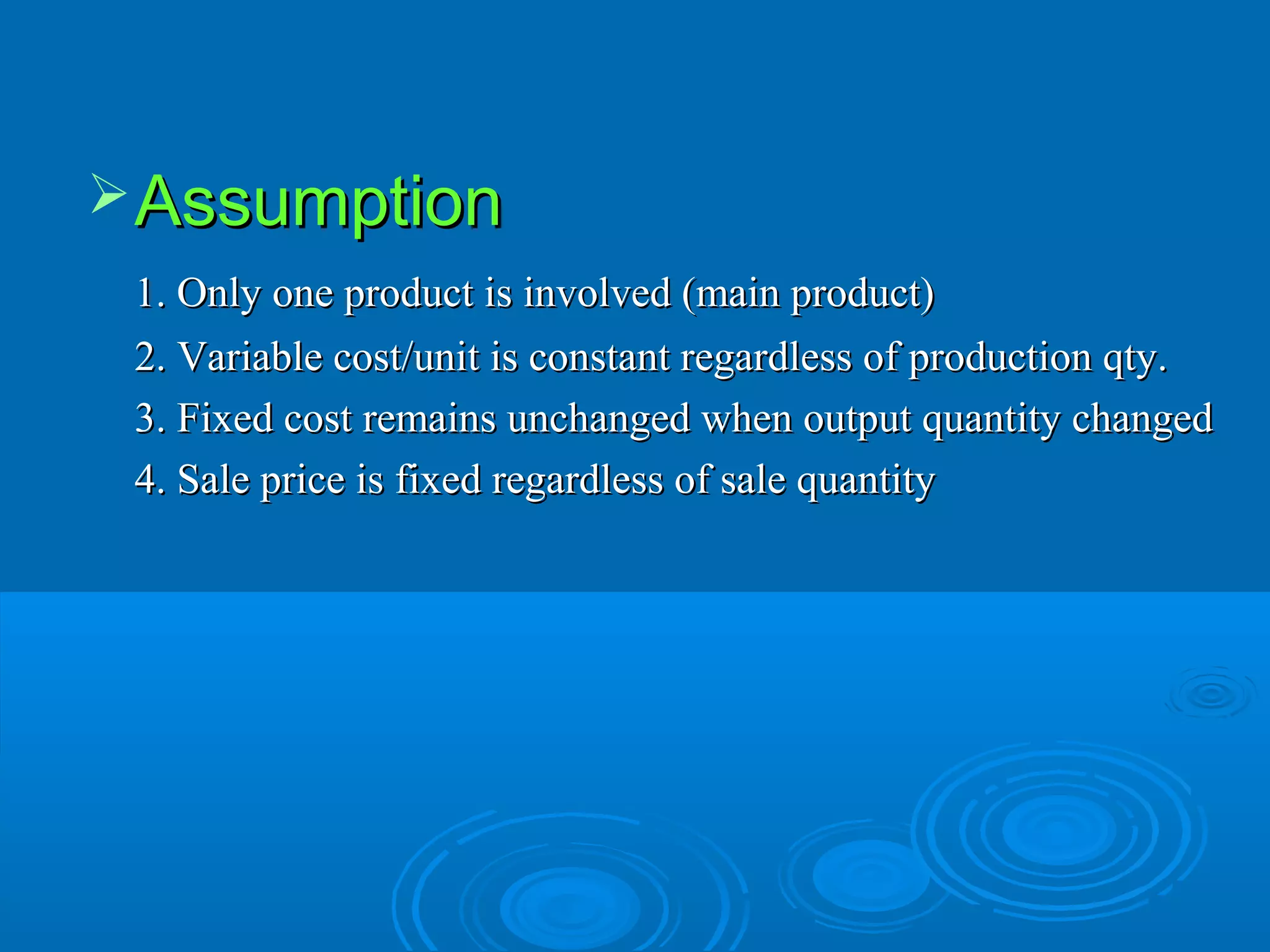
AssumptionAssumption
1. Only one product is involved (main product)1. Only one product is involved (main product)
2. Variable cost/unit is constant regardless of production qty.2. Variable cost/unit is constant regardless of production qty.
3. Fixed cost remains unchanged when output quantity changed3. Fixed cost remains unchanged when output quantity changed
4. Sale price is fixed regardless of sale quantity4. Sale price is fixed regardless of sale quantity
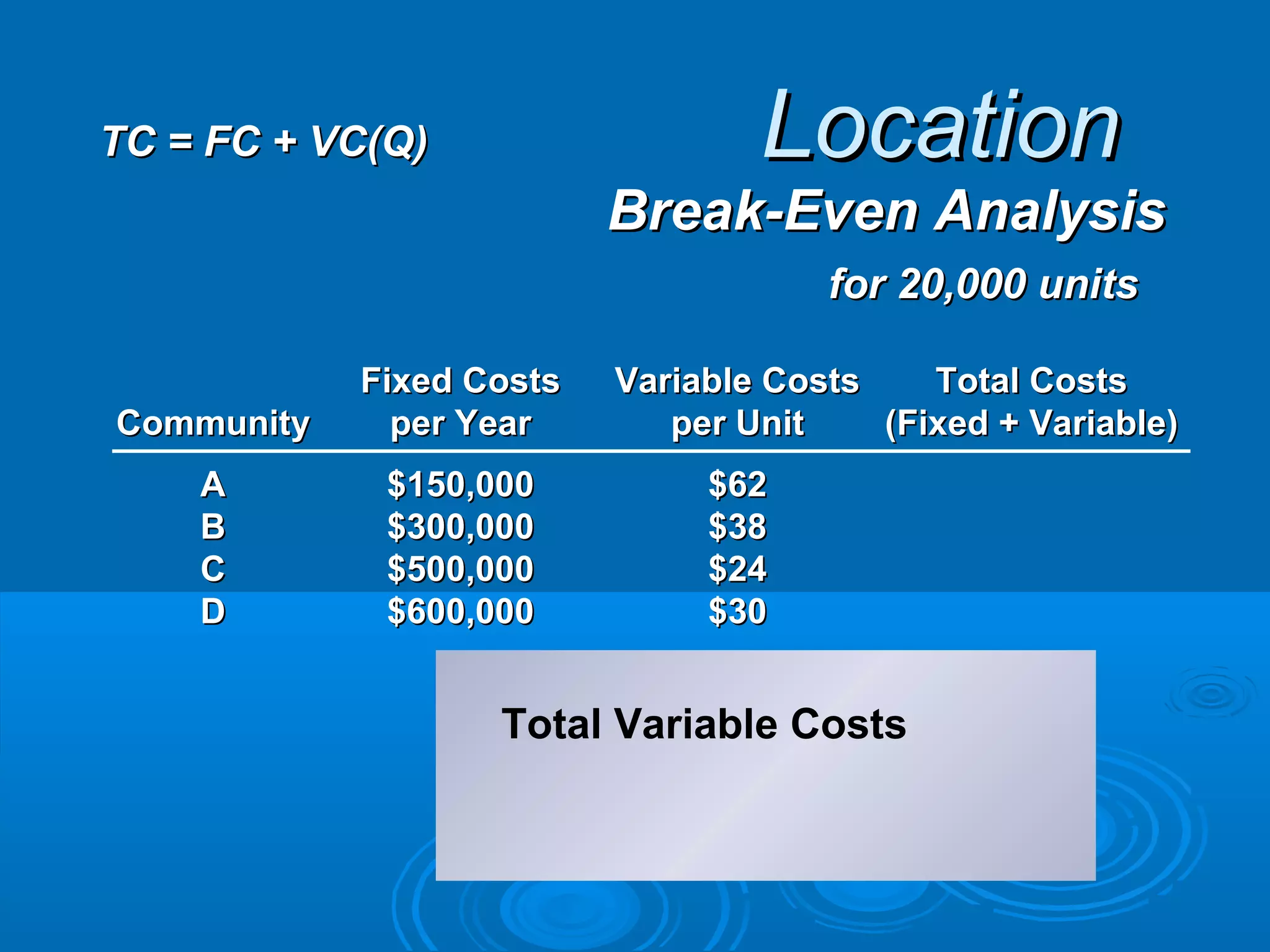
LocationLocation
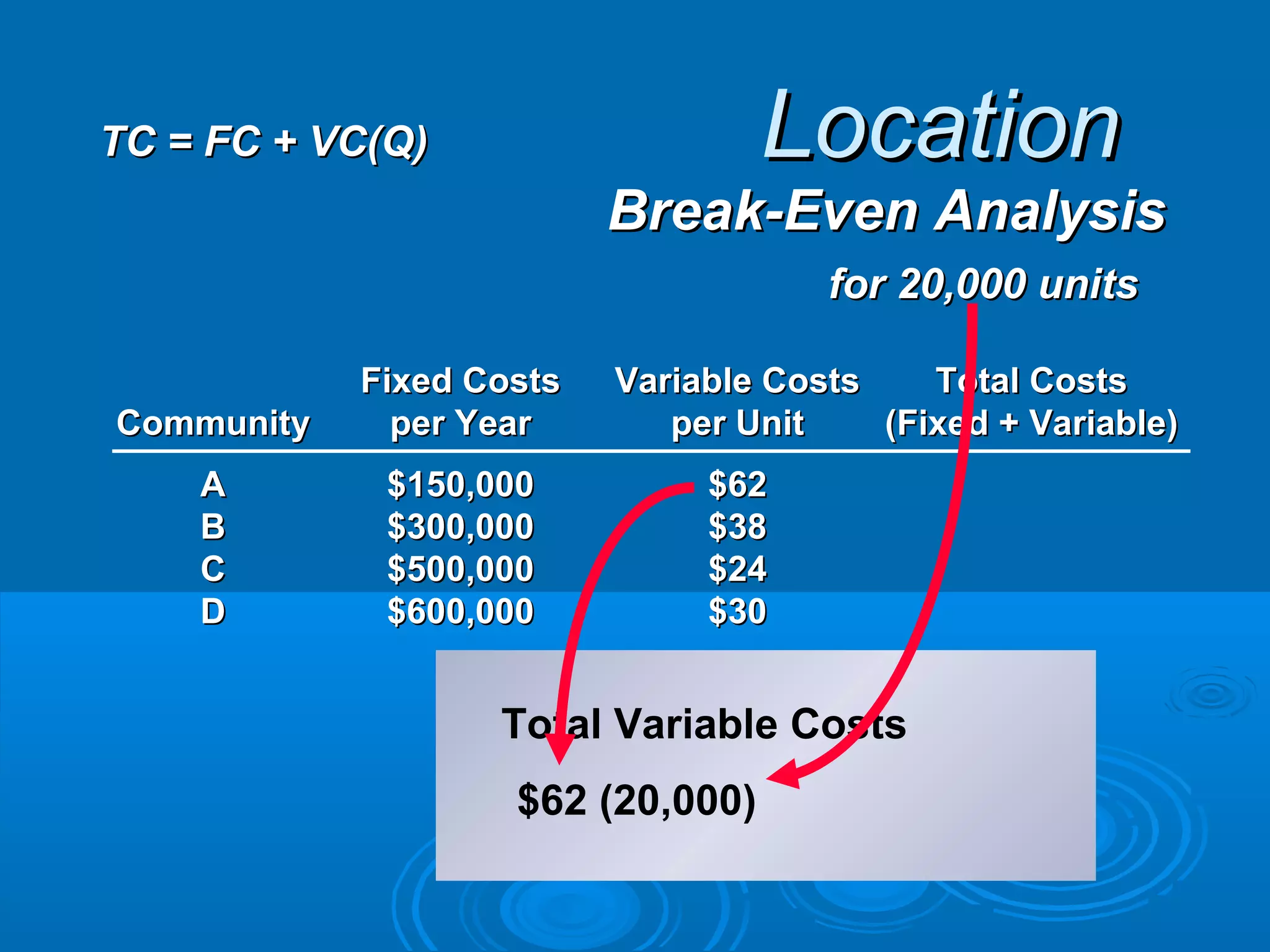
Break-Even AnalysisBreak-Even Analysis
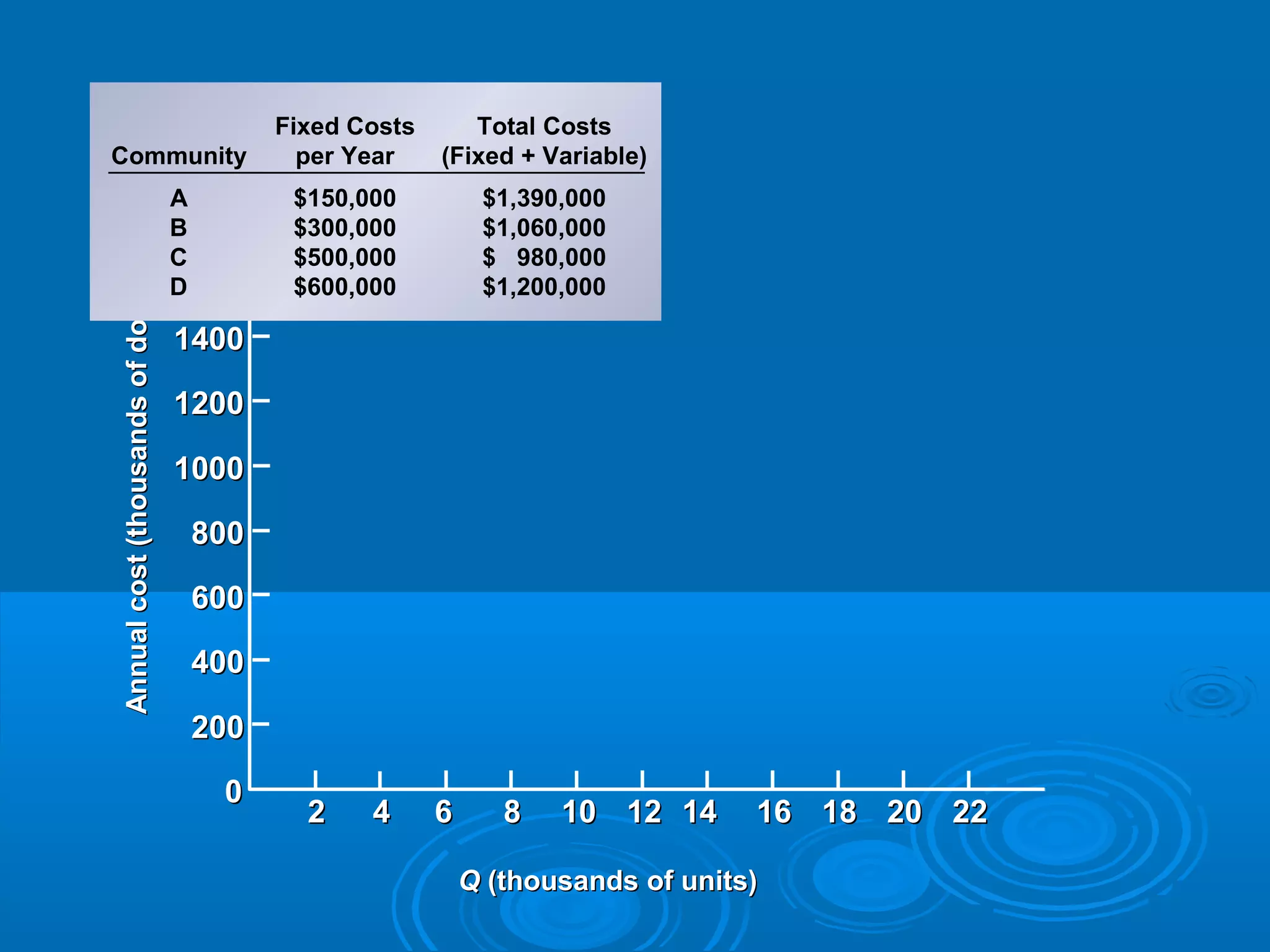
Fixed CostsFixed Costs Variable CostsVariable Costs Total CostsTotal Costs
CommunityCommunity per Yearper Year per Unitper Unit (Fixed + Variable)(Fixed + Variable)
AA $150,000$150,000 $62$62
BB $300,000$300,000 $38$38
CC $500,000$500,000 $24$24
DD $600,000$600,000 $30$30
TC = FC + VC(Q)TC = FC + VC(Q)
LocationLocation
Break-Even AnalysisBreak-Even Analysis
Fixed CostsFixed Costs Variable CostsVariable Costs Total CostsTotal Costs
CommunityCommunity per Yearper Year per Unitper Unit (Fixed + Variable)(Fixed + Variable)
AA $150,000$150,000 $62$62
BB $300,000$300,000 $38$38
CC $500,000$500,000 $24$24
DD $600,000$600,000 $30$30
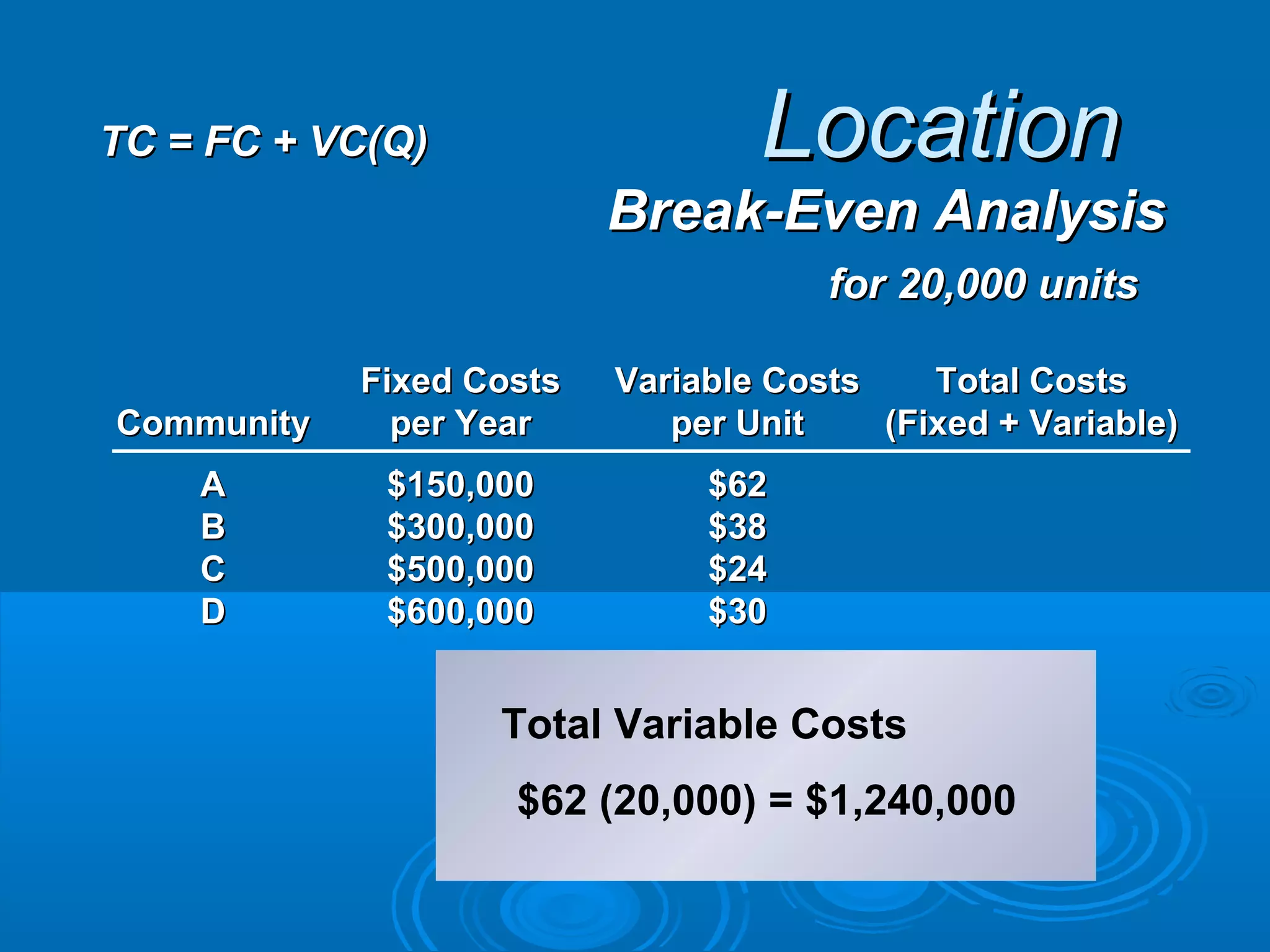
for 20,000 unitsfor 20,000 units
Total Variable Costs
TC = FC + VC(Q)TC = FC + VC(Q)
LocationLocation
Break-Even AnalysisBreak-Even Analysis
Fixed CostsFixed Costs Variable CostsVariable Costs Total CostsTotal Costs
CommunityCommunity per Yearper Year per Unitper Unit (Fixed + Variable)(Fixed + Variable)
AA $150,000$150,000 $62$62
BB $300,000$300,000 $38$38
CC $500,000$500,000 $24$24
DD $600,000$600,000 $30$30
for 20,000 unitsfor 20,000 units
Total Variable Costs
$62 (20,000)
TC = FC + VC(Q)TC = FC + VC(Q)
LocationLocation
Break-Even AnalysisBreak-Even Analysis
Fixed CostsFixed Costs Variable CostsVariable Costs Total CostsTotal Costs
CommunityCommunity per Yearper Year per Unitper Unit (Fixed + Variable)(Fixed + Variable)
AA $150,000$150,000 $62$62
BB $300,000$300,000 $38$38
CC $500,000$500,000 $24$24
DD $600,000$600,000 $30$30
for 20,000 unitsfor 20,000 units
Total Variable Costs
$62 (20,000) = $1,240,000
TC = FC + VC(Q)TC = FC + VC(Q)
LocationLocation
Break-Even AnalysisBreak-Even Analysis
Fixed CostsFixed Costs Variable CostsVariable Costs Total CostsTotal Costs
CommunityCommunity per Yearper Year per Unitper Unit (Fixed + Variable)(Fixed + Variable)
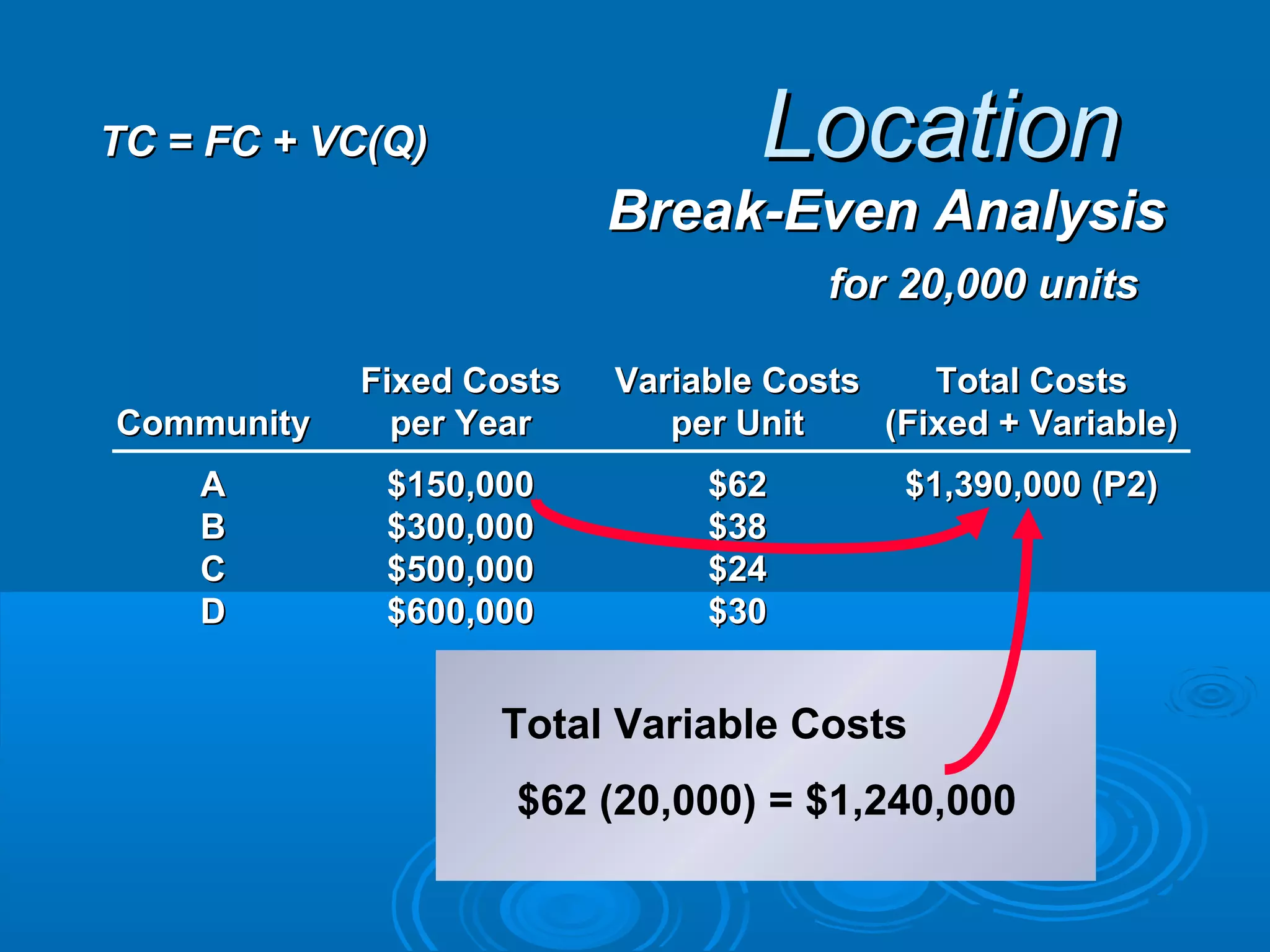
AA $150,000$150,000 $62$62 $1,390,000 (P2)$1,390,000 (P2)
BB $300,000$300,000 $38$38
CC $500,000$500,000 $24$24
DD $600,000$600,000 $30$30
for 20,000 unitsfor 20,000 units
Total Variable Costs
$62 (20,000) = $1,240,000
TC = FC + VC(Q)TC = FC + VC(Q)
LocationLocation
Break-Even AnalysisBreak-Even Analysis
Fixed CostsFixed Costs Variable CostsVariable Costs Total CostsTotal Costs
CommunityCommunity per Yearper Year per Unitper Unit (Fixed + Variable)(Fixed + Variable)
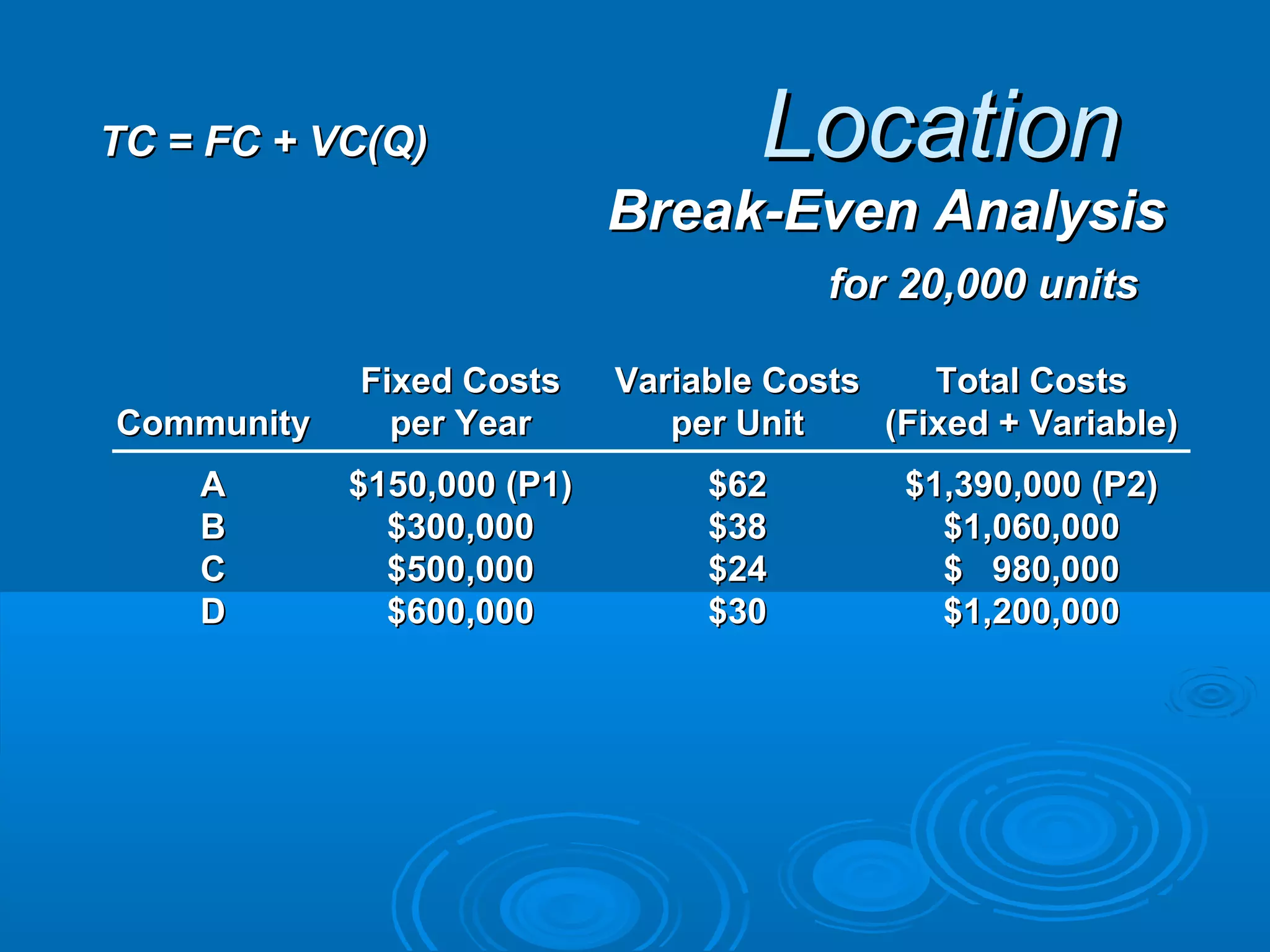
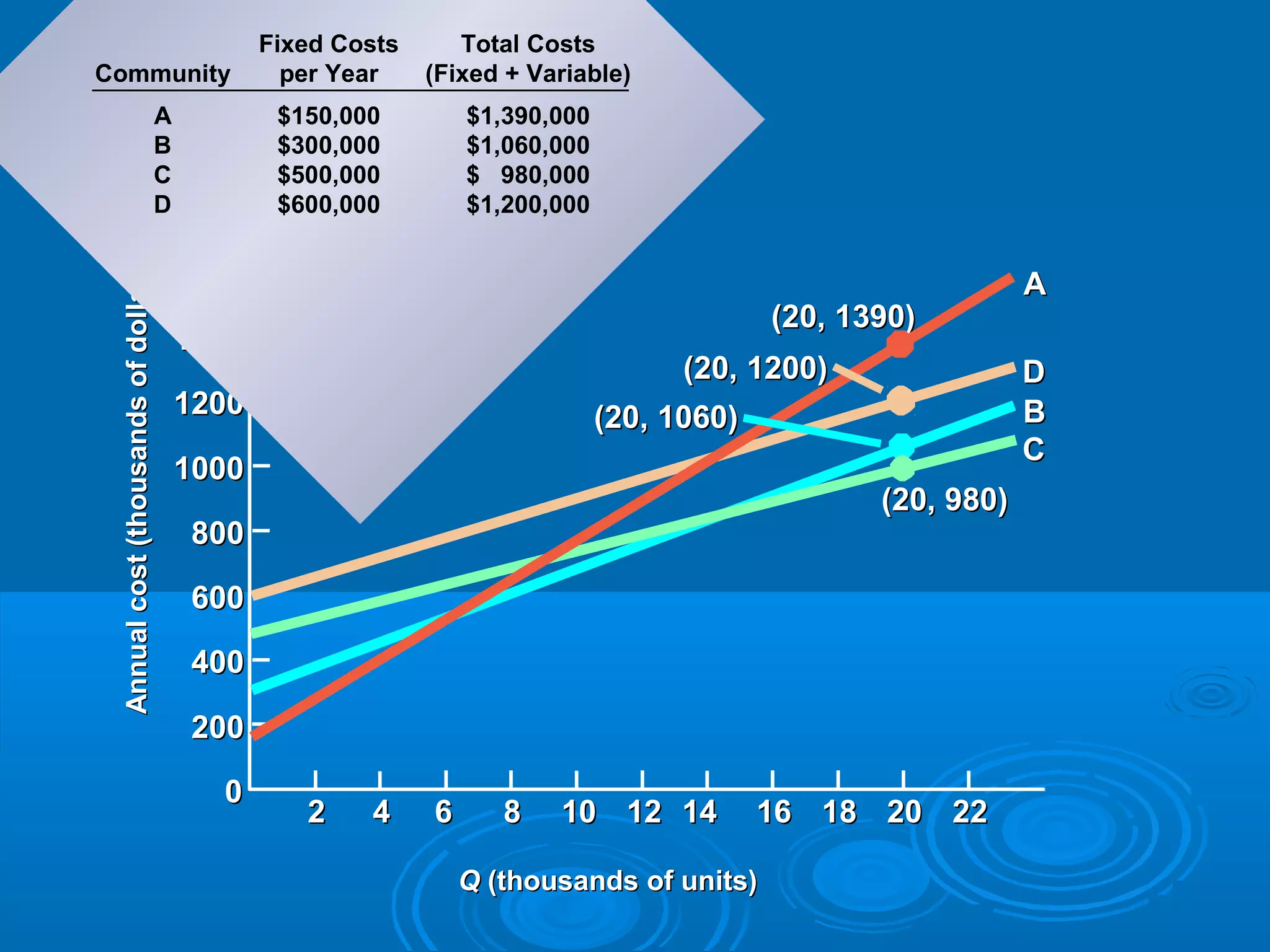
AA $150,000 (P1)$150,000 (P1) $62$62 $1,390,000 (P2)$1,390,000 (P2)
BB $300,000$300,000 $38$38 $1,060,000$1,060,000
CC $500,000$500,000 $24$24 $ 980,000$ 980,000
DD $600,000$600,000 $30$30 $1,200,000$1,200,000
for 20,000 unitsfor 20,000 units
TC = FC + VC(Q)TC = FC + VC(Q)
QQ (thousands of units)(thousands of units)
00
200200
400400
600600
800800
10001000
12001200
14001400
16001600
22 44 66 88 1010 1212 1414 1616 1818 2020 2222
Annualcost(thousandsofdollars)Annualcost(thousandsofdollars) Fixed Costs Total Costs
Community per Year (Fixed + Variable)
A $150,000 $1,390,000
B $300,000 $1,060,000
C $500,000 $ 980,000
D $600,000 $1,200,000
QQ (thousands of units)(thousands of units)
00
200200
400400
600600
800800
10001000
12001200
14001400
16001600
22 44 66 88 1010 1212 1414 1616 1818 2020 2222
AA
DD
BB
CC
(20, 1390)(20, 1390)
(20, 1200)(20, 1200)
(20, 1060)(20, 1060)
(20, 980)(20, 980)
Annualcost(thousandsofdollars)Annualcost(thousandsofdollars)
Fixed Costs Total Costs
Community per Year (Fixed + Variable)
A $150,000 $1,390,000
B $300,000 $1,060,000
C $500,000 $ 980,000
D $600,000 $1,200,000
AA
DD
BB
CC
(20, 1390)(20, 1390)
(20, 1200)(20, 1200)
(20, 1060)(20, 1060)
(20, 980)(20, 980)
A bestA best
Break-evenBreak-even
pointpoint
QQ (thousands of units)(thousands of units)
00
200200
400400
600600
800800
10001000
12001200
14001400
16001600
22 44 66 88 1010 1212 1414 1616 1818 2020 2222
Annualcost(thousandsofdollars)Annualcost(thousandsofdollars) Fixed Costs Total Costs
Community per Year (Fixed + Variable)
A $150,000 $1,390,000
B $300,000 $1,060,000
C $500,000 $ 980,000
D $600,000 $1,200,000
B bestB best
Break-even pointBreak-even point
AA
DD
BB
CC
(20, 1390)(20, 1390)
(20, 1200)(20, 1200)
(20, 1060)(20, 1060)
(20, 980)(20, 980)
A bestA best
6.256.25
Break-even
point
QQ (thousands of units)(thousands of units)
00
200200
400400
600600
800800
10001000
12001200
14001400
16001600
22 44 66 88 1010 1212 1414 1616 1818 2020 2222
14.314.3
Annualcost(thousandsofdollars)Annualcost(thousandsofdollars) Fixed Costs Total Costs
Community per Year (Fixed + Variable)
A $150,000 $1,390,000
B $300,000 $1,060,000
C $500,000 $ 980,000
D $600,000 $1,200,000
C bestC best
(20, 980)(20, 980)
B bestB best
Break-even point
AA
DD
BB
CC
(20, 1390)(20, 1390)
(20, 1200)(20, 1200)
(20, 1060)(20, 1060)
A bestA best
6.256.25
Break-even
point
QQ (thousands of units)(thousands of units)
00
200200
400400
600600
800800
10001000
12001200
14001400
16001600
22 44 66 88 1010 1212 1414 1616 1818 2020 2222
14.314.3
Annualcost(thousandsofdollars)Annualcost(thousandsofdollars) Fixed Costs Total Costs
Community per Year (Fixed + Variable)
A $150,000 $1,390,000
B $300,000 $1,060,000
C $500,000 $ 980,000
D $600,000 $1,200,000
LocationLocation
Break-Even AnalysisBreak-Even Analysis
QQ (thousands of units)(thousands of units)
00
200200
400400
600600
800800
10001000
12001200
14001400
16001600
22 44 66 88 1010 1212 1414 1616 1818 2020 2222
A bestA best B bestB best C bestC best
Break-even point
6.256.25 14.314.3
AA
DD
BB
CC
(20, 1390)(20, 1390)
(20, 1200)(20, 1200)
(20, 1060)(20, 1060)
(20, 980)(20, 980)
Break-even
point
Annualcost(thousandsofdollars)Annualcost(thousandsofdollars)
QQ (thousands of units)(thousands of units)
00
200200
400400
600600
800800
10001000
12001200
14001400
16001600
22 44 66 88 1010 1212 1414 1616 1818 2020 2222
A bestA best B bestB best C bestC best
Break-even pointBreak-even point
6.256.25 14.314.3
AA
DD
BB
CC
(20, 1390)(20, 1390)
(20, 1200)(20, 1200)
(20, 1060)(20, 1060)
(20, 980)(20, 980)
Break-evenBreak-even
pointpoint
Annualcost(thousandsofdollars)Annualcost(thousandsofdollars)
LocationLocation
Break-Even AnalysisBreak-Even Analysis
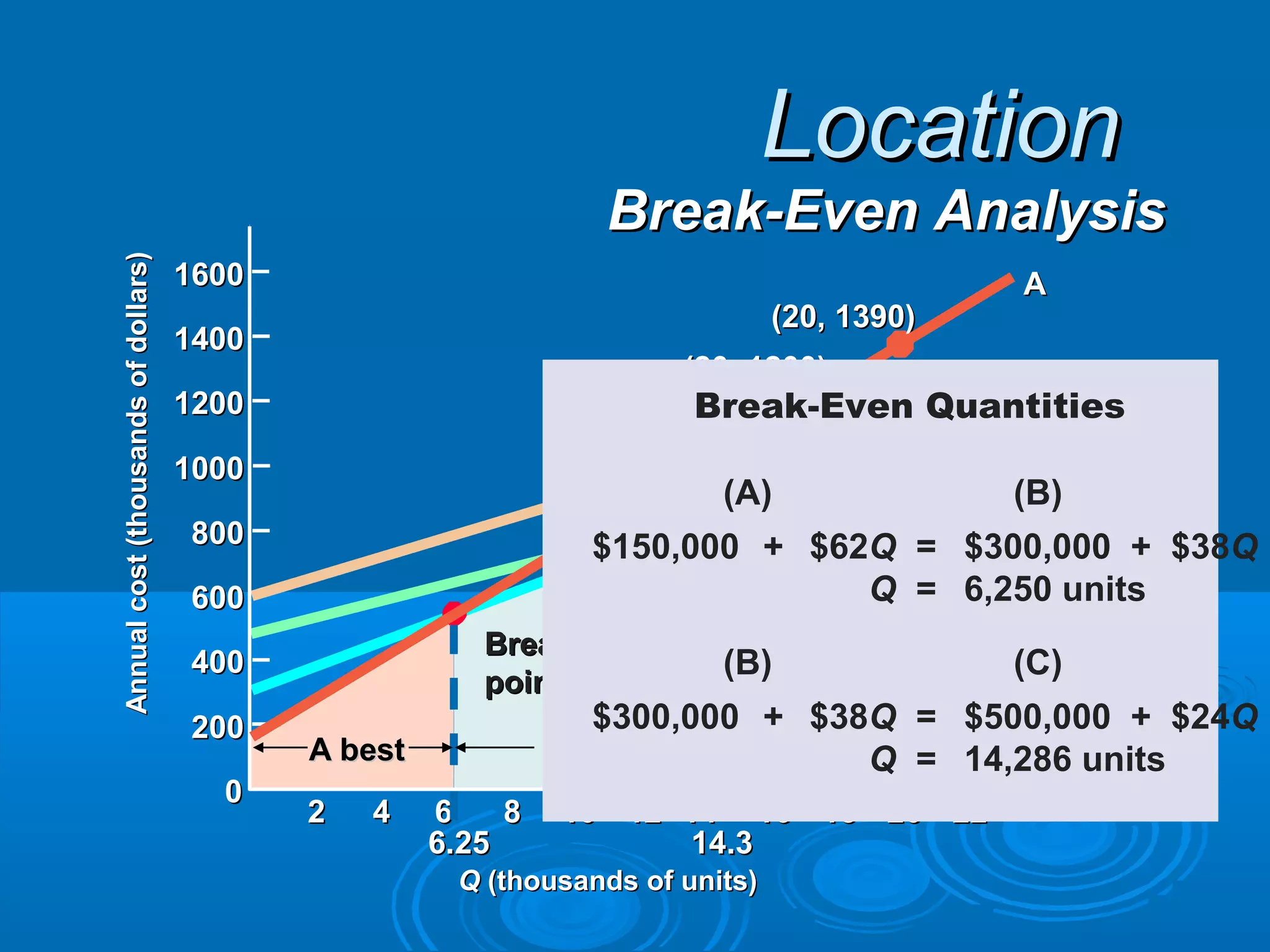
(A) (B)
$150,000 + $62Q = $300,000 + $38Q
Q = 6,250 units
$300,000 + $38Q = $500,000 + $24Q
Q = 14,286 units
(B) (C)
Break-Even Quantities
Present Economy StudyPresent Economy Study
When alternatives for accomplishing a specific
task are being compared over one year or less and
the influence of time on money can be ignored,
engineering economic analyses are referred to as
present economy studies
RULE 1: When revenues and other economic benefits are present and
vary among alternatives, choose the alternative that maximizes overall
profitability based on the number of defect-free units of a product or service
produced.
RULE 2: When revenues and other economic benefits are not present or
are constant among all alternatives, consider only the costs and select the
alternative that minimizes total cost per defect-free unit of product or
service output.
Present Economy StudyPresent Economy Study
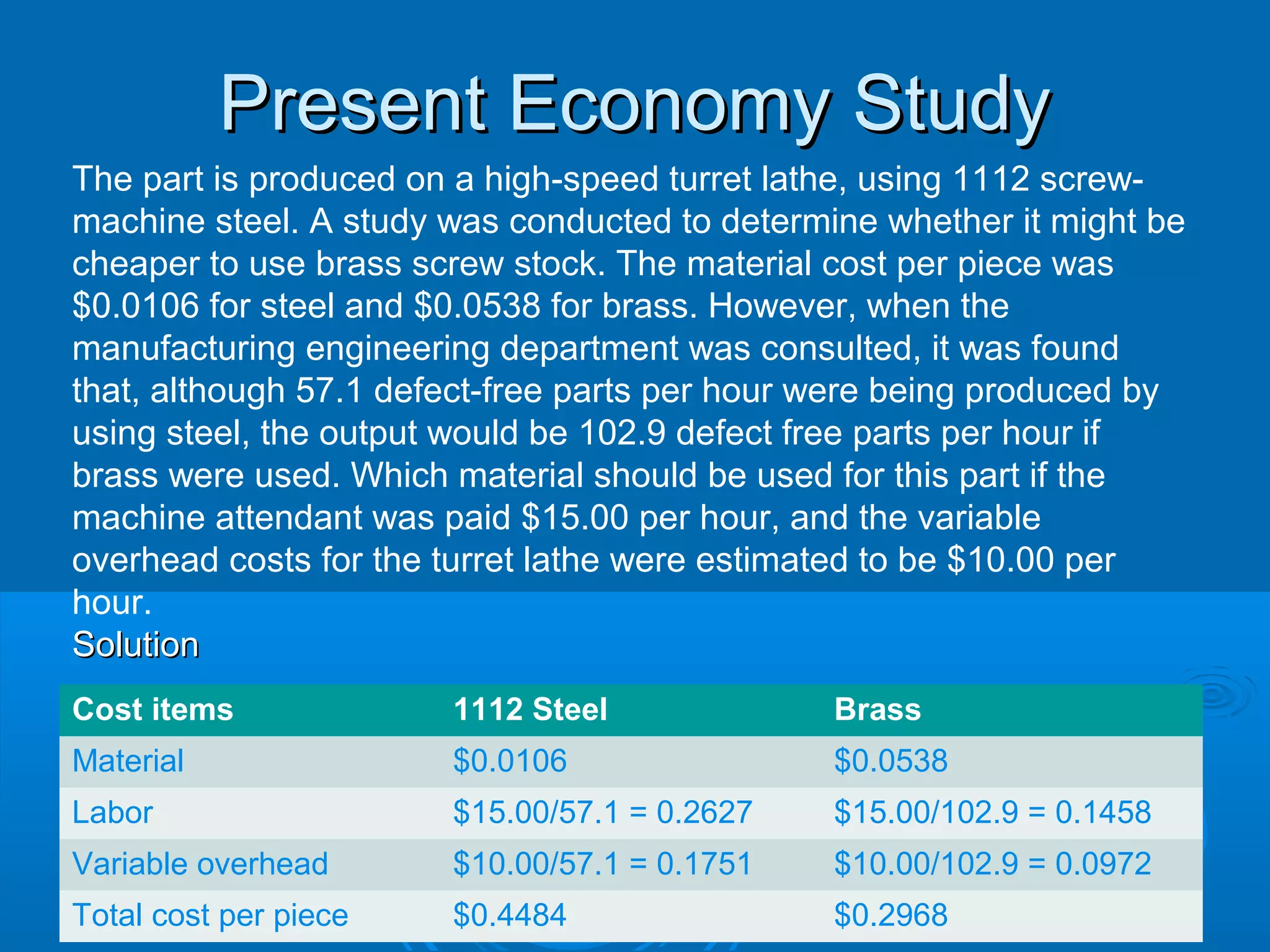
The part is produced on a high-speed turret lathe, using 1112 screw-
machine steel. A study was conducted to determine whether it might be
cheaper to use brass screw stock. The material cost per piece was
$0.0106 for steel and $0.0538 for brass. However, when the
manufacturing engineering department was consulted, it was found
that, although 57.1 defect-free parts per hour were being produced by
using steel, the output would be 102.9 defect free parts per hour if
brass were used. Which material should be used for this part if the
machine attendant was paid $15.00 per hour, and the variable
overhead costs for the turret lathe were estimated to be $10.00 per
hour.
SolutionSolution
Cost items 1112 Steel Brass
Material $0.0106 $0.0538
Labor $15.00/57.1 = 0.2627 $15.00/102.9 = 0.1458
Variable overhead $10.00/57.1 = 0.1751 $10.00/102.9 = 0.0972
Total cost per piece $0.4484 $0.2968
Present Economy StudyPresent Economy Study
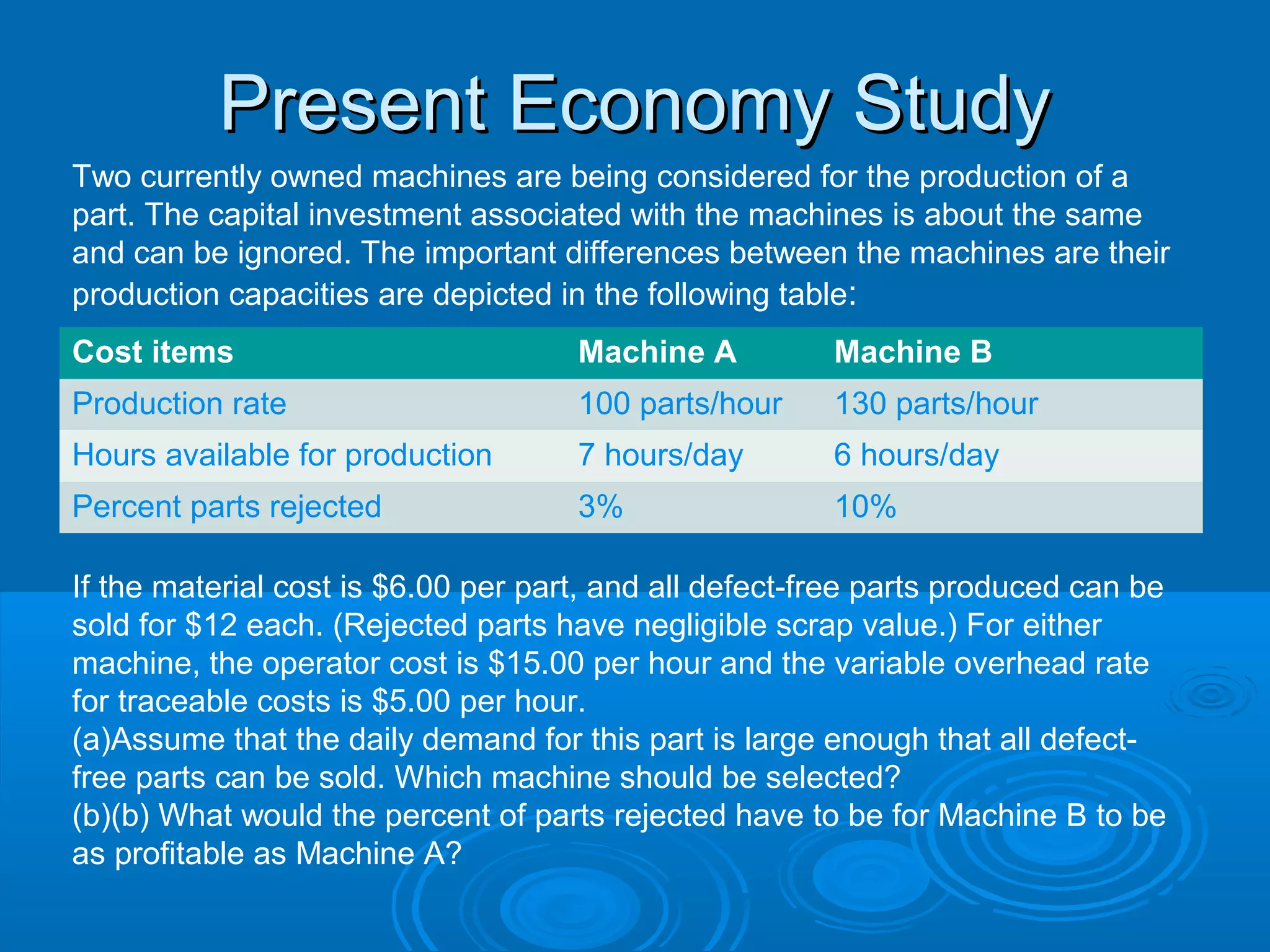
Two currently owned machines are being considered for the production of a
part. The capital investment associated with the machines is about the same
and can be ignored. The important differences between the machines are their
production capacities are depicted in the following table:
If the material cost is $6.00 per part, and all defect-free parts produced can be
sold for $12 each. (Rejected parts have negligible scrap value.) For either
machine, the operator cost is $15.00 per hour and the variable overhead rate
for traceable costs is $5.00 per hour.
(a)Assume that the daily demand for this part is large enough that all defect-
free parts can be sold. Which machine should be selected?
(b)(b) What would the percent of parts rejected have to be for Machine B to be
as profitable as Machine A?
Cost items Machine A Machine B
Production rate 100 parts/hour 130 parts/hour
Hours available for production 7 hours/day 6 hours/day
Percent parts rejected 3% 10%
Present Economy StudyPresent Economy Study
Profit per day = Revenue per day − Cost per day
= (Production rate)(Production hours)($12/part) × [1 − (%rejected/100)] −
(Production rate)(Production hours)($6/part) − (Production hours)($15/hour +
$5/hour).
Machine A:
Profit per day = (100 parts/hour)(7 hours/day )( $12/part)(1 − 0.03) − (100
parts/hour)(7 hours/day)( $6/part) (7 hours day)($15/hour + $5/hour) = $3,808
per day.
Machine B:
Profit per day = (130 parts/hour)(6 hours/day)($12/part)(1 − 0.10) − (130
parts/hour )(6 hours/day)($6/part) (6 hours/day)($15/hour + $5/hour) = $3,624
per day.
Therefore, select Machine A to maximize profit per day

Cost Concept

  • 1.
    CHAPTER 2CHAPTER 2 CostConcepts and ApplicationCost Concepts and Application
  • 2.
    COSTCOST  Cost isa resource sacrificed or forgone toCost is a resource sacrificed or forgone to achieve a specific objective. It is usuallyachieve a specific objective. It is usually measured as the monetary amount (ormeasured as the monetary amount (or money) that must be paid to acquiremoney) that must be paid to acquire goods and services.goods and services.
  • 3.
    Cost TerminologyCost Terminology Otherscost terminologyOthers cost terminology  Opportunity costOpportunity cost  Social costSocial cost  Direct costsDirect costs  Indirect costIndirect cost  Sunk costSunk cost  Explicit costExplicit cost  Implicit costImplicit cost  Recurring/Non-recurring costRecurring/Non-recurring cost Cost Terminology base on behaviour  Fixed cost  Variable costs
  • 4.
    Cost TerminologyCost Terminology AnAn opportunity costopportunity cost is the cost of the bestis the cost of the best rejected ( i.e., foregone ) opportunity andrejected ( i.e., foregone ) opportunity and is hidden or implied. (Used inis hidden or implied. (Used in Replacement Analysis)Replacement Analysis)  a student who could earn $20,000 for workinga student who could earn $20,000 for working during a year, but chooses instead to go toduring a year, but chooses instead to go to school for a year and spend $5,000 to do so.school for a year and spend $5,000 to do so. The opportunity cost of going to school forThe opportunity cost of going to school for that year is $25,000: $5,000 cash outlay andthat year is $25,000: $5,000 cash outlay and $20,000 for income$20,000 for income
  • 5.
    Cost TerminologyCost Terminology Social cost – A cost due to negativeSocial cost – A cost due to negative impact from the economy activities. (B/Cimpact from the economy activities. (B/C ratio analysis) Example : pollution, traffic-ratio analysis) Example : pollution, traffic- jam, inflation.jam, inflation.  Environmental pollution, traffic jam or priceEnvironmental pollution, traffic jam or price increase on certain products.increase on certain products.  Government will imposed tax to theGovernment will imposed tax to the responsible party.responsible party.
  • 6.
    Cost TerminologyCost Terminology Direct costsDirect costs can be reasonably measured andcan be reasonably measured and allocated to a specific output or work activity --allocated to a specific output or work activity -- labor and material directly allocated with alabor and material directly allocated with a product, service or construction activity;product, service or construction activity;  Indirect costsIndirect costs are difficult to allocate to a specificare difficult to allocate to a specific output or activity -- costs of common tools,output or activity -- costs of common tools, general supplies, and equipment maintenance ;general supplies, and equipment maintenance ;
  • 7.
    Cost TerminologyCost Terminology AA sunk costsunk cost is one that has occurred in the past and has nois one that has occurred in the past and has no relevance to estimates of future costs and revenues relatedrelevance to estimates of future costs and revenues related to an alternative course of action. (Replacement Analysis)to an alternative course of action. (Replacement Analysis)  Sunk cost = present book value- market valueSunk cost = present book value- market value  Example: A new car was bought for RM50,000 with life-Example: A new car was bought for RM50,000 with life- period for 10 year.period for 10 year.  Considering shrink in value, the present book value forConsidering shrink in value, the present book value for the item is RM35,000.the item is RM35,000.  As the car experiencing too much defects, it was sold forAs the car experiencing too much defects, it was sold for RM25,000.RM25,000.  The sunk cost for this case, is RM10,000 (35000-The sunk cost for this case, is RM10,000 (35000- 25000).25000).
  • 8.
    Cost TerminologyCost Terminology AnAn Explicit costExplicit cost is an easy accounted cost, such asis an easy accounted cost, such as wage, rent and materials. It can be transacted in thewage, rent and materials. It can be transacted in the form of money payment and is lost directlyform of money payment and is lost directly  AnAn implicit costimplicit cost occurs when one foregoes an alternativeoccurs when one foregoes an alternative action but does not make an actual payment . Example-action but does not make an actual payment . Example- Sundry shop’s owner who open & manage his businessSundry shop’s owner who open & manage his business using his own property and wealth. Implicit cost include:using his own property and wealth. Implicit cost include:  Importing workers from other place and paid their salaries.Importing workers from other place and paid their salaries.  Interest to be received by him if invest at another place.Interest to be received by him if invest at another place.  Potential gain from the shop if he choose to rent his shop.Potential gain from the shop if he choose to rent his shop.
  • 9.
    Cost TerminologyCost Terminology Life-Cycle CostLife-Cycle Cost  In engineering practice, the term life-cycle cost is oftenIn engineering practice, the term life-cycle cost is often encountered. This term refers to a summation of all the costsencountered. This term refers to a summation of all the costs related to a product, structure, system, or service during its liferelated to a product, structure, system, or service during its life spanspan
  • 11.
    Cost Concept &Cost CurveCost Concept & Cost Curve  Fixed costs are those unaffected by changes in activity level over a feasible range of operations for the capacity or capability available.  Typical fixed costs include insurance and taxes on facilities, general management and administrative salaries, license fees, and interest costs on borrowed capital.  When large changes in usage of resources occur, or when plant expansion or shutdown is involved fixed costs will be affected.
  • 12.
    Cost Classification &Cost CurveCost Classification & Cost Curve  Variable costs are those associated with an operation that vary in total with the quantity of output or other measures of activity level.  Example of variable costs include : costs of material and labor used in a product or service, because they vary in total with the number of output units -- even though costs per unit remain the same.
  • 13.
    Cost Classification &Cost CurveCost Classification & Cost Curve  Total Cost (TC) = FC + VCTotal Cost (TC) = FC + VC TC VC FC500 Quantity,Q Cost (RM)
  • 14.
    Linear Cost EquationLinearCost Equation  TC = FC + VCTC = FC + VC  Where;Where;  TC = Total cost (RM)TC = Total cost (RM)  FC = Fixed Cost (RM)FC = Fixed Cost (RM)  VC = Variable Cost (RM)VC = Variable Cost (RM) = aQ= aQ a = average variable cost per unit (RM/unit)a = average variable cost per unit (RM/unit) Q = Quantity (unit)Q = Quantity (unit)
  • 15.
    Ex 3.1Ex 3.1::  To process one kg. of coffee require average cost perTo process one kg. of coffee require average cost per unit of RM5, and FC of RM300 per day.unit of RM5, and FC of RM300 per day.  (a) Produce a linear equation for production of coffee(a) Produce a linear equation for production of coffee  (b) Calculate production cost of coffee to process 1000(b) Calculate production cost of coffee to process 1000 kg per day.kg per day.  Solution:Solution: (a) Given: F=RM300/day; VC =RM5/kilo. If production is Q(a) Given: F=RM300/day; VC =RM5/kilo. If production is Q kilo per day, then total VC=5Q.kilo per day, then total VC=5Q.  TC = FC + a(Q) = 300 + 5QTC = FC + a(Q) = 300 + 5Q (b) To produce 1000 kg of coffee per day(b) To produce 1000 kg of coffee per day  TC = 300 +5(1000) = RM5,300TC = 300 +5(1000) = RM5,300
  • 16.
    Ex 3.2Ex 3.2::  Production cost for 10 shirt is RM350 andProduction cost for 10 shirt is RM350 and RM600 to produce 20 shirts. Show theRM600 to produce 20 shirts. Show the linear equation for the shirt production.linear equation for the shirt production.  Solution:Solution:  Formula: TC = FC + aQFormula: TC = FC + aQ  Given: TC1 = 350, Q1 =10; TC2=600, Q2=20Given: TC1 = 350, Q1 =10; TC2=600, Q2=20  350 = F + a(10) ………….. (i)350 = F + a(10) ………….. (i)  600 = F + a(20) ……………(ii), then600 = F + a(20) ……………(ii), then  250 = a(10) >>>>250 = a(10) >>>> a=25a=25  350 = F + 25(10) >>>>350 = F + 25(10) >>>> FC=100FC=100 ; then; then TC = 100 +TC = 100 + 25Q25Q
  • 17.
    Profit and BreakevenPointProfit and Breakeven Point  ProfitProfit = Total Revenue – Total Cost= Total Revenue – Total Cost = TR – TC= TR – TC = (P x Q) – (FC + VC)= (P x Q) – (FC + VC)  Breakeven Point is the point at whichBreakeven Point is the point at which gains equal losses. At this pointgains equal losses. At this point TR = TCTR = TC
  • 18.
    Profit and BreakevenPointProfit and Breakeven Point TC VC FC500 Quantity, Q Cost (RM) TR BP Profit Loss
  • 19.
    Contoh 3.3Contoh 3.3:: Daripada Contoh 3.1,Daripada Contoh 3.1, Persamaam linear Jumlah kos, TC = 300 + 5QPersamaam linear Jumlah kos, TC = 300 + 5Q Katakan kopi dijual RM10 per Kg.Katakan kopi dijual RM10 per Kg. a)a) Hitungkan titik pulang modal.Hitungkan titik pulang modal. b)b) Keuntungan jika syarikat mengeluarkan / menjual kopiKeuntungan jika syarikat mengeluarkan / menjual kopi (i) 100 Kg sehari (ii) 50 Kg sehari(i) 100 Kg sehari (ii) 50 Kg sehari Penyelesaian:Penyelesaian: a)a) Diperolehi TC = 300 + 5QDiperolehi TC = 300 + 5Q Pada titik pulang modal, Jumlah Hasil(TR) = Jumlah Kos(TC),Pada titik pulang modal, Jumlah Hasil(TR) = Jumlah Kos(TC), TR = Harga (P) x Kuantiti (Q) = 10QTR = Harga (P) x Kuantiti (Q) = 10Q ∴∴ 10Q = 300 + 5Q10Q = 300 + 5Q Q = 60Q = 60 (Pada titik pulang modal, kuantiti keluaran ialah 60 kg sehari)(Pada titik pulang modal, kuantiti keluaran ialah 60 kg sehari) b) Keuntungan = TR – TCb) Keuntungan = TR – TC (i) = 10(100) – (300 + 5(100)) = RM200 (untung)(i) = 10(100) – (300 + 5(100)) = RM200 (untung) (ii) = 10(50) – (300 + 5(50)) = RM-50 (rugi)(ii) = 10(50) – (300 + 5(50)) = RM-50 (rugi)
  • 20.
    Contoh 3.3Contoh 3.3:: In relation to Ex.1, if coffee is sold for RM10 per kilo, (a) calculate the breakeven point (b) compute TR if the firm produce and sell (i) 100 kilo/day & (ii) 50 kilo/day. Solution: (a) Referring to Ex.1, TC = 300 +5Q From above, TR=10 Q Therefore, 10 Q = 300 + 5Q Q = 60 units (b) Profit = TR – TC, Substitute Q=100 & Q=50 to compute (i) Profit= 10(100) – 300- 5(100) = 200 >>> Profit = RM200 (ii) Profit = 10(50) – 300 – 5(50) = -50 >>> Loss = RM50
  • 21.
     When theproblems of location identification occurs?When the problems of location identification occurs?  Starting the new Business  Business Enlargement  Centralization  Economics  The factors effecting the location identification?The factors effecting the location identification?  Closed to market & raw material suppliers  Ease of getting labor  Geographical factor  Social acceptability  Ease of getting other utilities  Procedures & laws  Closed to market & raw material suppliers  Ease of getting labor  Geographical factor  Social acceptability  Ease of getting other utilities  Procedures & laws Break even analysis in selecting facilityBreak even analysis in selecting facility locationlocation
  • 22.
    What is facility?What is facility ? Production: any discrete parts or process industry facilitiesProduction: any discrete parts or process industry facilities Health care: hospitals, clinics, rehab. centers, nursing homeHealth care: hospitals, clinics, rehab. centers, nursing home Education: schools, colleges, day care centers, librariesEducation: schools, colleges, day care centers, libraries Food: restaurants, fast-food places, banquet hallsFood: restaurants, fast-food places, banquet halls Commercial/Residential: shopping malls, office buildings,Commercial/Residential: shopping malls, office buildings, banks, houses, hotels, motelsbanks, houses, hotels, motels Government/Public Services: court house, IRS, INS, postGovernment/Public Services: court house, IRS, INS, post officeoffice Transportation: airports, train stations, bus terminalsTransportation: airports, train stations, bus terminals Public assembly: stadium, auditoriums, theatersPublic assembly: stadium, auditoriums, theaters Religious: temples, chapels, churchesReligious: temples, chapels, churches
  • 23.
    Location Cost-Profit-Volume AnalysisLocationCost-Profit-Volume Analysis (Break Even Analysis)(Break Even Analysis)  For cost analysis, the total cost are:For cost analysis, the total cost are: Total Cost = FC + VC(Q) FC = Fixed Cost VC = Variable Cost per unit Q = Quantity/volume of output
  • 24.
    AssumptionAssumption 1. Only oneproduct is involved (main product)1. Only one product is involved (main product) 2. Variable cost/unit is constant regardless of production qty.2. Variable cost/unit is constant regardless of production qty. 3. Fixed cost remains unchanged when output quantity changed3. Fixed cost remains unchanged when output quantity changed 4. Sale price is fixed regardless of sale quantity4. Sale price is fixed regardless of sale quantity
  • 25.
    LocationLocation Break-Even AnalysisBreak-Even Analysis FixedCostsFixed Costs Variable CostsVariable Costs Total CostsTotal Costs CommunityCommunity per Yearper Year per Unitper Unit (Fixed + Variable)(Fixed + Variable) AA $150,000$150,000 $62$62 BB $300,000$300,000 $38$38 CC $500,000$500,000 $24$24 DD $600,000$600,000 $30$30 TC = FC + VC(Q)TC = FC + VC(Q)
  • 26.
    LocationLocation Break-Even AnalysisBreak-Even Analysis FixedCostsFixed Costs Variable CostsVariable Costs Total CostsTotal Costs CommunityCommunity per Yearper Year per Unitper Unit (Fixed + Variable)(Fixed + Variable) AA $150,000$150,000 $62$62 BB $300,000$300,000 $38$38 CC $500,000$500,000 $24$24 DD $600,000$600,000 $30$30 for 20,000 unitsfor 20,000 units Total Variable Costs TC = FC + VC(Q)TC = FC + VC(Q)
  • 27.
    LocationLocation Break-Even AnalysisBreak-Even Analysis FixedCostsFixed Costs Variable CostsVariable Costs Total CostsTotal Costs CommunityCommunity per Yearper Year per Unitper Unit (Fixed + Variable)(Fixed + Variable) AA $150,000$150,000 $62$62 BB $300,000$300,000 $38$38 CC $500,000$500,000 $24$24 DD $600,000$600,000 $30$30 for 20,000 unitsfor 20,000 units Total Variable Costs $62 (20,000) TC = FC + VC(Q)TC = FC + VC(Q)
  • 28.
    LocationLocation Break-Even AnalysisBreak-Even Analysis FixedCostsFixed Costs Variable CostsVariable Costs Total CostsTotal Costs CommunityCommunity per Yearper Year per Unitper Unit (Fixed + Variable)(Fixed + Variable) AA $150,000$150,000 $62$62 BB $300,000$300,000 $38$38 CC $500,000$500,000 $24$24 DD $600,000$600,000 $30$30 for 20,000 unitsfor 20,000 units Total Variable Costs $62 (20,000) = $1,240,000 TC = FC + VC(Q)TC = FC + VC(Q)
  • 29.
    LocationLocation Break-Even AnalysisBreak-Even Analysis FixedCostsFixed Costs Variable CostsVariable Costs Total CostsTotal Costs CommunityCommunity per Yearper Year per Unitper Unit (Fixed + Variable)(Fixed + Variable) AA $150,000$150,000 $62$62 $1,390,000 (P2)$1,390,000 (P2) BB $300,000$300,000 $38$38 CC $500,000$500,000 $24$24 DD $600,000$600,000 $30$30 for 20,000 unitsfor 20,000 units Total Variable Costs $62 (20,000) = $1,240,000 TC = FC + VC(Q)TC = FC + VC(Q)
  • 30.
    LocationLocation Break-Even AnalysisBreak-Even Analysis FixedCostsFixed Costs Variable CostsVariable Costs Total CostsTotal Costs CommunityCommunity per Yearper Year per Unitper Unit (Fixed + Variable)(Fixed + Variable) AA $150,000 (P1)$150,000 (P1) $62$62 $1,390,000 (P2)$1,390,000 (P2) BB $300,000$300,000 $38$38 $1,060,000$1,060,000 CC $500,000$500,000 $24$24 $ 980,000$ 980,000 DD $600,000$600,000 $30$30 $1,200,000$1,200,000 for 20,000 unitsfor 20,000 units TC = FC + VC(Q)TC = FC + VC(Q)
  • 31.
    QQ (thousands ofunits)(thousands of units) 00 200200 400400 600600 800800 10001000 12001200 14001400 16001600 22 44 66 88 1010 1212 1414 1616 1818 2020 2222 Annualcost(thousandsofdollars)Annualcost(thousandsofdollars) Fixed Costs Total Costs Community per Year (Fixed + Variable) A $150,000 $1,390,000 B $300,000 $1,060,000 C $500,000 $ 980,000 D $600,000 $1,200,000
  • 32.
    QQ (thousands ofunits)(thousands of units) 00 200200 400400 600600 800800 10001000 12001200 14001400 16001600 22 44 66 88 1010 1212 1414 1616 1818 2020 2222 AA DD BB CC (20, 1390)(20, 1390) (20, 1200)(20, 1200) (20, 1060)(20, 1060) (20, 980)(20, 980) Annualcost(thousandsofdollars)Annualcost(thousandsofdollars) Fixed Costs Total Costs Community per Year (Fixed + Variable) A $150,000 $1,390,000 B $300,000 $1,060,000 C $500,000 $ 980,000 D $600,000 $1,200,000
  • 33.
    AA DD BB CC (20, 1390)(20, 1390) (20,1200)(20, 1200) (20, 1060)(20, 1060) (20, 980)(20, 980) A bestA best Break-evenBreak-even pointpoint QQ (thousands of units)(thousands of units) 00 200200 400400 600600 800800 10001000 12001200 14001400 16001600 22 44 66 88 1010 1212 1414 1616 1818 2020 2222 Annualcost(thousandsofdollars)Annualcost(thousandsofdollars) Fixed Costs Total Costs Community per Year (Fixed + Variable) A $150,000 $1,390,000 B $300,000 $1,060,000 C $500,000 $ 980,000 D $600,000 $1,200,000
  • 34.
    B bestB best Break-evenpointBreak-even point AA DD BB CC (20, 1390)(20, 1390) (20, 1200)(20, 1200) (20, 1060)(20, 1060) (20, 980)(20, 980) A bestA best 6.256.25 Break-even point QQ (thousands of units)(thousands of units) 00 200200 400400 600600 800800 10001000 12001200 14001400 16001600 22 44 66 88 1010 1212 1414 1616 1818 2020 2222 14.314.3 Annualcost(thousandsofdollars)Annualcost(thousandsofdollars) Fixed Costs Total Costs Community per Year (Fixed + Variable) A $150,000 $1,390,000 B $300,000 $1,060,000 C $500,000 $ 980,000 D $600,000 $1,200,000
  • 35.
    C bestC best (20,980)(20, 980) B bestB best Break-even point AA DD BB CC (20, 1390)(20, 1390) (20, 1200)(20, 1200) (20, 1060)(20, 1060) A bestA best 6.256.25 Break-even point QQ (thousands of units)(thousands of units) 00 200200 400400 600600 800800 10001000 12001200 14001400 16001600 22 44 66 88 1010 1212 1414 1616 1818 2020 2222 14.314.3 Annualcost(thousandsofdollars)Annualcost(thousandsofdollars) Fixed Costs Total Costs Community per Year (Fixed + Variable) A $150,000 $1,390,000 B $300,000 $1,060,000 C $500,000 $ 980,000 D $600,000 $1,200,000
  • 36.
    LocationLocation Break-Even AnalysisBreak-Even Analysis QQ(thousands of units)(thousands of units) 00 200200 400400 600600 800800 10001000 12001200 14001400 16001600 22 44 66 88 1010 1212 1414 1616 1818 2020 2222 A bestA best B bestB best C bestC best Break-even point 6.256.25 14.314.3 AA DD BB CC (20, 1390)(20, 1390) (20, 1200)(20, 1200) (20, 1060)(20, 1060) (20, 980)(20, 980) Break-even point Annualcost(thousandsofdollars)Annualcost(thousandsofdollars)
  • 37.
    QQ (thousands ofunits)(thousands of units) 00 200200 400400 600600 800800 10001000 12001200 14001400 16001600 22 44 66 88 1010 1212 1414 1616 1818 2020 2222 A bestA best B bestB best C bestC best Break-even pointBreak-even point 6.256.25 14.314.3 AA DD BB CC (20, 1390)(20, 1390) (20, 1200)(20, 1200) (20, 1060)(20, 1060) (20, 980)(20, 980) Break-evenBreak-even pointpoint Annualcost(thousandsofdollars)Annualcost(thousandsofdollars) LocationLocation Break-Even AnalysisBreak-Even Analysis (A) (B) $150,000 + $62Q = $300,000 + $38Q Q = 6,250 units $300,000 + $38Q = $500,000 + $24Q Q = 14,286 units (B) (C) Break-Even Quantities
  • 38.
    Present Economy StudyPresentEconomy Study When alternatives for accomplishing a specific task are being compared over one year or less and the influence of time on money can be ignored, engineering economic analyses are referred to as present economy studies RULE 1: When revenues and other economic benefits are present and vary among alternatives, choose the alternative that maximizes overall profitability based on the number of defect-free units of a product or service produced. RULE 2: When revenues and other economic benefits are not present or are constant among all alternatives, consider only the costs and select the alternative that minimizes total cost per defect-free unit of product or service output.
  • 39.
    Present Economy StudyPresentEconomy Study The part is produced on a high-speed turret lathe, using 1112 screw- machine steel. A study was conducted to determine whether it might be cheaper to use brass screw stock. The material cost per piece was $0.0106 for steel and $0.0538 for brass. However, when the manufacturing engineering department was consulted, it was found that, although 57.1 defect-free parts per hour were being produced by using steel, the output would be 102.9 defect free parts per hour if brass were used. Which material should be used for this part if the machine attendant was paid $15.00 per hour, and the variable overhead costs for the turret lathe were estimated to be $10.00 per hour. SolutionSolution Cost items 1112 Steel Brass Material $0.0106 $0.0538 Labor $15.00/57.1 = 0.2627 $15.00/102.9 = 0.1458 Variable overhead $10.00/57.1 = 0.1751 $10.00/102.9 = 0.0972 Total cost per piece $0.4484 $0.2968
  • 40.
    Present Economy StudyPresentEconomy Study Two currently owned machines are being considered for the production of a part. The capital investment associated with the machines is about the same and can be ignored. The important differences between the machines are their production capacities are depicted in the following table: If the material cost is $6.00 per part, and all defect-free parts produced can be sold for $12 each. (Rejected parts have negligible scrap value.) For either machine, the operator cost is $15.00 per hour and the variable overhead rate for traceable costs is $5.00 per hour. (a)Assume that the daily demand for this part is large enough that all defect- free parts can be sold. Which machine should be selected? (b)(b) What would the percent of parts rejected have to be for Machine B to be as profitable as Machine A? Cost items Machine A Machine B Production rate 100 parts/hour 130 parts/hour Hours available for production 7 hours/day 6 hours/day Percent parts rejected 3% 10%
  • 41.
    Present Economy StudyPresentEconomy Study Profit per day = Revenue per day − Cost per day = (Production rate)(Production hours)($12/part) × [1 − (%rejected/100)] − (Production rate)(Production hours)($6/part) − (Production hours)($15/hour + $5/hour). Machine A: Profit per day = (100 parts/hour)(7 hours/day )( $12/part)(1 − 0.03) − (100 parts/hour)(7 hours/day)( $6/part) (7 hours day)($15/hour + $5/hour) = $3,808 per day. Machine B: Profit per day = (130 parts/hour)(6 hours/day)($12/part)(1 − 0.10) − (130 parts/hour )(6 hours/day)($6/part) (6 hours/day)($15/hour + $5/hour) = $3,624 per day. Therefore, select Machine A to maximize profit per day

Editor's Notes

  • #26 To present the break-even analysis, the basic data is displayed.
  • #27 A small worksheet is added to calculate the costs.
  • #28 Arrows show the source of the data. This slide advances automatically.
  • #29 The total variable cost is calculated.
  • #30 Arrows show the source and results of the total cost calculation. This slide advances automatically.
  • #31 The worksheet is removed and the remaining totals are added to the data set.
  • #32 Taking only the necessary information and placing it in the corner, the coordinates are drawn for the graph.
  • #33 The four total cost lines are added to the graph.
  • #34 The first break-even point occurs where A and B intersect and is shown here.
  • #35 The second break-even point occurs where B and C intersect and is shown here.
  • #36 Beyond the second break-even point, C will remain the best alternative.
  • #37 The data is removed for a clean view of the graph.
  • #38 Finally, we can calculate the exact break-even quantities at the two decision points.
  • #39 2002 : According to Fortune magazine’s annual survey, GE is the most admired company in America.