Starting and Financing a Small Business
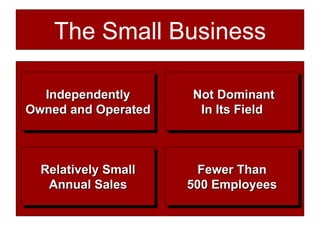
The Small Business Not Dominant In Its Field Fewer Than 500 Employees Independently Owned and Operated Relatively Small Annual Sales
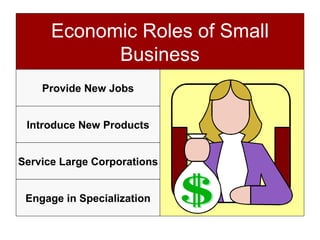
Economic Roles of Small Business Provide New Jobs Introduce New Products Service Large Corporations Engage in Specialization
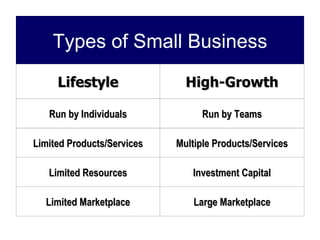
Types of Small Business Lifestyle High-Growth Run by Individuals Limited Products/Services Limited Resources Limited Marketplace Run by Teams Multiple Products/Services Investment Capital Large Marketplace
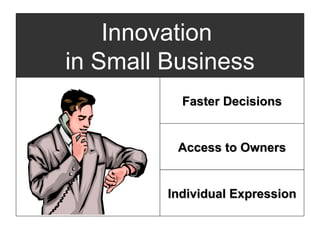
Innovation  in Small Business Faster Decisions Access to Owners Individual Expression
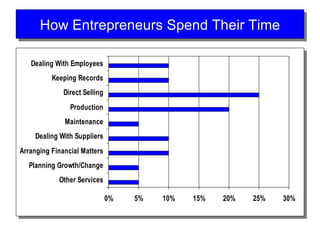
How Entrepreneurs Spend Their Time
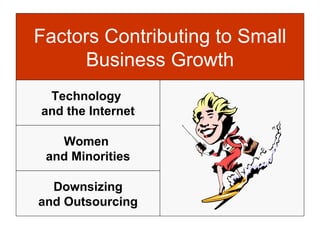
Factors Contributing to Small Business Growth Technology  and the Internet Women  and Minorities Downsizing and Outsourcing
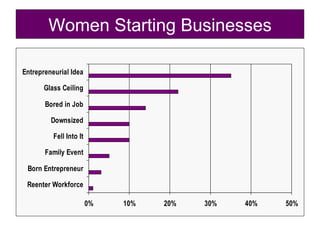
Women Starting Businesses
Characteristics of Entrepreneurs Highly disciplined Like to control their destiny Listen to their intuition Relate well with others Eager to acquire new skills Learn from their mistakes
Characteristics of Entrepreneurs Stay abreast of market changes Willing to exploit new opportunities Seldom follow trends Driven by ambition Think positively Prefer risk taking over security
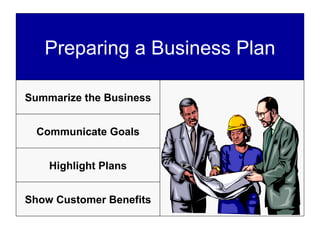
Preparing a Business Plan Summarize the Business Communicate Goals Highlight Plans Show Customer Benefits
Importance  of a Business Plan Guides Company Operations Outlines Strategy Attracts Lenders and Investors
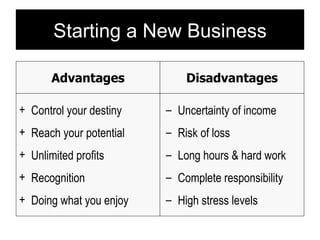
Starting a New Business Control your destiny Reach your potential Unlimited profits Recognition Doing what you enjoy Uncertainty of income Risk of loss Long hours & hard work Complete responsibility High stress levels Advantages Disadvantages
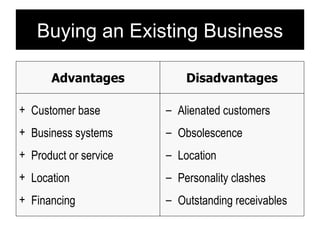
Buying an Existing Business Customer base Business systems Product or service Location Financing Alienated customers Obsolescence Location Personality clashes Outstanding receivables Advantages Disadvantages
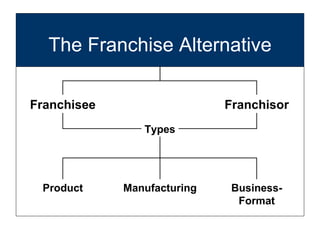
The Franchise Alternative Franchisee Franchisor Types Product Manufacturing Business- Format
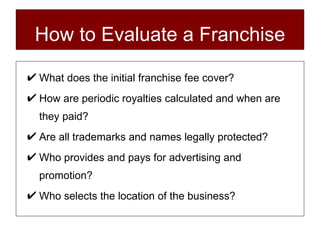
How to Evaluate a Franchise What does the initial franchise fee cover? How are periodic royalties calculated and when are they paid? Are all trademarks and names legally protected? Who provides and pays for advertising and promotion? Who selects the location of the business?
How to Evaluate a Franchise Is the franchise assigned an exclusive territory? Does the franchisee have the right of first refusal on additional nearby franchises? Is the franchisee required to purchase equipment and supplies from the franchisor? How can the franchise agreement be terminated? Can the franchise be assigned to heirs?
The Pros and Cons of Franchising Advantages Get a viable business Instant name recognition Built in support group Marketing & advertising Disadvantages No guarantee of success Expensive to obtain High monthly royalties Limited independence
Why New Businesses Fail Management Incompetence Lack of Industry Experience Inadequate Financing Poor Business Planning Unworkable Goals Diminished Customer Base Uncontrolled Growth Inappropriate Location Poor System of Controls Lack of Entrepreneurial Skills
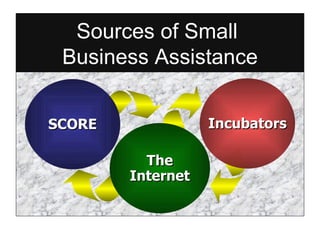
Sources of Small  Business Assistance The Internet Incubators SCORE
Financing A New Business Length of Term Cost of Capital Debt or Equity
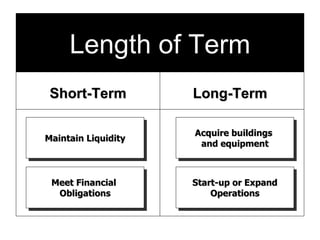
Length of Term Short-Term Long-Term  Meet Financial  Obligations Acquire buildings  and equipment Start-up or Expand Operations Maintain Liquidity
The Cost of Capital Risk Factors Interest Rates Funding Vehicles
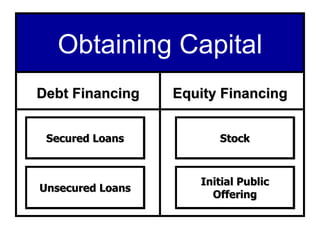
Obtaining Capital Debt Financing Equity Financing  Unsecured Loans Stock Initial Public Offering Secured Loans
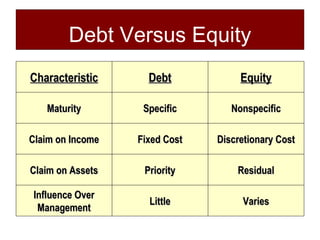
Debt Versus Equity Characteristic Debt Equity Maturity Claim on Income Claim on Assets Influence Over Management Specific Fixed Cost Priority Little Nonspecific Discretionary Cost Residual Varies
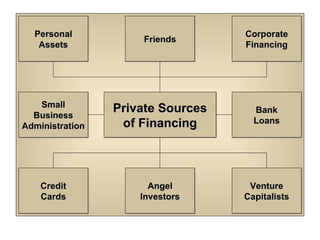
Corporate Financing Personal Assets Credit Cards Venture Capitalists Bank Loans Small Business Administration Private Sources of Financing Friends Angel Investors

eng economy Lecture5

  • 1.
    Starting and Financinga Small Business
  • 2.
    The Small BusinessNot Dominant In Its Field Fewer Than 500 Employees Independently Owned and Operated Relatively Small Annual Sales
  • 3.
    Economic Roles ofSmall Business Provide New Jobs Introduce New Products Service Large Corporations Engage in Specialization
  • 4.
    Types of SmallBusiness Lifestyle High-Growth Run by Individuals Limited Products/Services Limited Resources Limited Marketplace Run by Teams Multiple Products/Services Investment Capital Large Marketplace
  • 5.
    Innovation inSmall Business Faster Decisions Access to Owners Individual Expression
  • 6.
  • 7.
    Factors Contributing toSmall Business Growth Technology and the Internet Women and Minorities Downsizing and Outsourcing
  • 8.
  • 9.
    Characteristics of EntrepreneursHighly disciplined Like to control their destiny Listen to their intuition Relate well with others Eager to acquire new skills Learn from their mistakes
  • 10.
    Characteristics of EntrepreneursStay abreast of market changes Willing to exploit new opportunities Seldom follow trends Driven by ambition Think positively Prefer risk taking over security
  • 11.
    Preparing a BusinessPlan Summarize the Business Communicate Goals Highlight Plans Show Customer Benefits
  • 12.
    Importance ofa Business Plan Guides Company Operations Outlines Strategy Attracts Lenders and Investors
  • 13.
    Starting a NewBusiness Control your destiny Reach your potential Unlimited profits Recognition Doing what you enjoy Uncertainty of income Risk of loss Long hours & hard work Complete responsibility High stress levels Advantages Disadvantages
  • 14.
    Buying an ExistingBusiness Customer base Business systems Product or service Location Financing Alienated customers Obsolescence Location Personality clashes Outstanding receivables Advantages Disadvantages
  • 15.
    The Franchise AlternativeFranchisee Franchisor Types Product Manufacturing Business- Format
  • 16.
    How to Evaluatea Franchise What does the initial franchise fee cover? How are periodic royalties calculated and when are they paid? Are all trademarks and names legally protected? Who provides and pays for advertising and promotion? Who selects the location of the business?
  • 17.
    How to Evaluatea Franchise Is the franchise assigned an exclusive territory? Does the franchisee have the right of first refusal on additional nearby franchises? Is the franchisee required to purchase equipment and supplies from the franchisor? How can the franchise agreement be terminated? Can the franchise be assigned to heirs?
  • 18.
    The Pros andCons of Franchising Advantages Get a viable business Instant name recognition Built in support group Marketing & advertising Disadvantages No guarantee of success Expensive to obtain High monthly royalties Limited independence
  • 19.
    Why New BusinessesFail Management Incompetence Lack of Industry Experience Inadequate Financing Poor Business Planning Unworkable Goals Diminished Customer Base Uncontrolled Growth Inappropriate Location Poor System of Controls Lack of Entrepreneurial Skills
  • 20.
    Sources of Small Business Assistance The Internet Incubators SCORE
  • 21.
    Financing A NewBusiness Length of Term Cost of Capital Debt or Equity
  • 22.
    Length of TermShort-Term Long-Term Meet Financial Obligations Acquire buildings and equipment Start-up or Expand Operations Maintain Liquidity
  • 23.
    The Cost ofCapital Risk Factors Interest Rates Funding Vehicles
  • 24.
    Obtaining Capital DebtFinancing Equity Financing Unsecured Loans Stock Initial Public Offering Secured Loans
  • 25.
    Debt Versus EquityCharacteristic Debt Equity Maturity Claim on Income Claim on Assets Influence Over Management Specific Fixed Cost Priority Little Nonspecific Discretionary Cost Residual Varies
  • 26.
    Corporate Financing PersonalAssets Credit Cards Venture Capitalists Bank Loans Small Business Administration Private Sources of Financing Friends Angel Investors

Editor's Notes

  • #5 Small businesses are of two distinct types: lifestyle businesses and high-growth ventures. Roughly 80 to 90 percent are modest operations with little growth potential (although some have attractive income potential for the solo businessperson). The self-employed consultant working part-time from a home office, the corner florist, and the neighborhood pizza parlor fall into the category of lifestyle businesses --firms built around the personal and financial needs of an individual or a family. Lifestyle businesses aren’t designed to grow into large enterprises. In contrast to lifestyle businesses, some firms are small simply because they are new. Many companies--such as FedEx, Microsoft, and Papa John’s--start out as small entrepreneurial firms but quickly outgrow their small-business status. These high-growth ventures are usually run by a team rather than by one individual, and they expand rapidly by obtaining a sizable supply of investment capital and by introducing new products or services to a large market. But expanding from a small firm into a large enterprise is no easy task; there’s a world of difference between the two. The typical small business has few products or services, focuses on a narrow group of customers, and remains in close contact with its markets. In addition, most small-business owners work with limited resources and tend to be more innovative.
  • #15 Another way to go into business for yourself is to buy an existing business. This approach tends to reduce the risks--provided, of course, that you check out the company carefully. When you buy a business, you generally purchase an established customer base, functioning business systems, a proven product or service, and a known location. You don’t have to go through the painful period of building a reputation, establishing a clientele, finding suppliers, and hiring and training employees. In addition, financing an existing business is often much easier than financing a new one; lenders are reassured by the company’s history and existing assets and customer base. With these major details already settled, you can concentrate on making improvements. Still, buying an existing business is not without disadvantages. For one thing, the business may be overpriced. For another, inventories and equipment may be obsolete. Furthermore, the location may no longer be satisfactory, the previous owner may have created ill will, your personality may clash with those of existing managers and employees, and outstanding bills owed by customers may be difficult to collect. Keep in mind that no matter how fast you learn and how much investigating you do, you’re likely to find that the challenges of running an existing business are far greater than you anticipated