Production Cost
Concepts
Contents
1. Introduction
2. Cost of Production
3. Cost Centre and Unit
4. Steps to Calculate Overhead Cost Per Unit
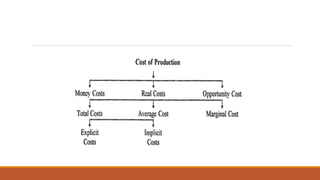
5. Classification of Costs of Production
6. Cost Analysis
7. Break Even Analysis
8. References
Introduction
Production or product costs refer to all the costs incurred by a business from manufacturing a
product or providing a service. Production costs can include a variety of expenses, such as
labor, raw materials, consumable manufacturing supplies, and general overhead.
•For an expense to qualify as a production cost it must be directly connected to generating
revenue for the company.
•Manufacturers carry production costs related to the raw materials and labor needed to create
the product.
• Service industries carry production costs related to the labor required to implement the service
and any materials costs involved in delivering the service.
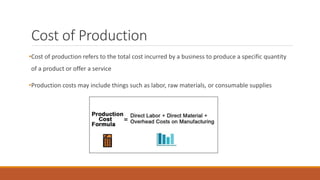
Cost of Production
•Cost of production refers to the total cost incurred by a business to produce a specific quantity
of a product or offer a service
•Production costs may include things such as labor, raw materials, or consumable supplies
Cost Centre and Unit
Cost center includes a production or service location, function, activity or plant item in relation
to which costs are determined. It may include a single expensive machine, a group of these
machines and may be extended to individual departments or even the whole factory may be
treated as a cost center in some cases.
There are two types of cost center:
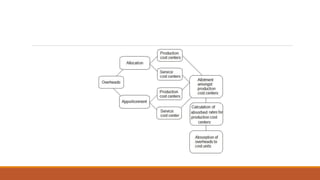
1) Production Cost Centers:
Production cost centers are the cost centers directly involved in the manufacturing operations.
Examples include molding, machining, assembly, shaping, welding, binding, cutting, etc.
2) Service Cost Centers:
•Service cost centers are incidental to the production process as products or cost units are not
produced by them. However these are although necessary for it to take place.
• Examples are canteen, personnel, stores, boiler house and maintenance, etc. Any cost which is
incurred or charged to service cost centers must be reapportioned subsequently to production
cost centers for absorbing overheads in the total costs of the product.
Cost Unit
•Cost unit is a unit of output (or a unit of service provided) which absorbs the cost center’s
overhead cost.
•Often the cost units are the final products manufactured by the organization, e.g. vehicles for a
vehicle manufacturer, passenger-mile in a transport business, operation in a hospital are
examples of a cost unit.
Steps to Calculate Overhead Cost Per Unit
1. Record all estimated overheads.
2. Classify all overheads as variable, fixed or mixed.
3. Charge cost units to direct costs as they are directly attributed to cost units.
4. Allocate or apportion indirect cost to production or services cost centers.
5. Reallocate cost of service cost centers among production cost centers to get total overheads
of production cost centers.
6. Determine an estimated budgeted level.
7. Calculate an overhead absorption (recovery) rate by dividing the total budgeted overheads
by the total budgeted activity level.
8. Assign production overheads to production units by applying overhead rate.
9. Calculate total costs by adding indirect and direct costs.
Classification of Costs of Production
1. Fixed costs
2. Variable costs
3. Total cost
4. Average cost
5. Marginal cost
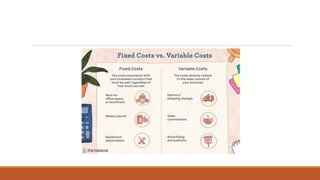
Fixed costs
•Fixed costs are expenses that do not change with the amount of output produced
•This means that the costs remain unchanged even when there is zero production or when the
business has reached its maximum production capacity
•For example, a restaurant business must pay its monthly, quarterly, or yearly rent regardless of
the number of customers it serves
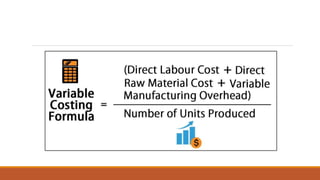
Variable costs
•Variable costs are costs that change with the changes in the level of production.
•That is, they rise as the production volume increases and decrease as the production volume
decreases.
•If the production volume is zero, then no variable costs are incurred.
•Examples of variable costs include sales commissions, utility costs, raw materials, and direct
labor costs.
Total cost
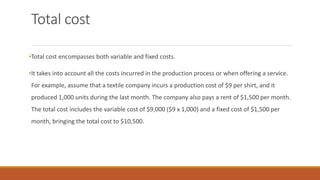
•Total cost encompasses both variable and fixed costs.
•It takes into account all the costs incurred in the production process or when offering a service.
For example, assume that a textile company incurs a production cost of $9 per shirt, and it
produced 1,000 units during the last month. The company also pays a rent of $1,500 per month.
The total cost includes the variable cost of $9,000 ($9 x 1,000) and a fixed cost of $1,500 per
month, bringing the total cost to $10,500.
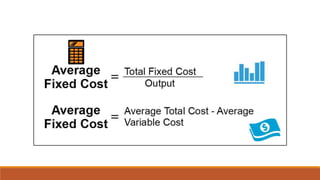
Average cost
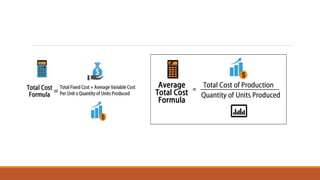
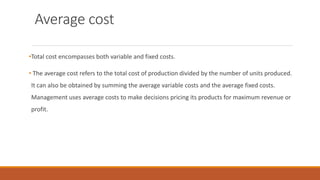
•Total cost encompasses both variable and fixed costs.
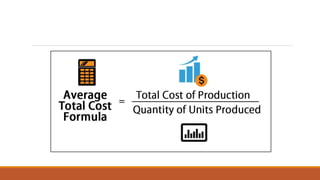
• The average cost refers to the total cost of production divided by the number of units produced.
It can also be obtained by summing the average variable costs and the average fixed costs.
Management uses average costs to make decisions pricing its products for maximum revenue or
profit.
Marginal cost
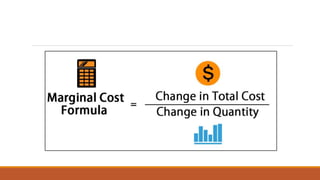
•Marginal cost is the cost of producing one additional unit of output. It shows the increase in
total cost coming from the production of one more product unit
•marginal cost is mainly affected by changes in variable costs
•The management of a company relies on marginal costing to make decisions on resource
allocation, looking to allocate production resources in a way that is optimally profitable
Cost Analysis
The Cost Analysis refers to the measure of the cost – output relationship, i.e. the economists are
concerned with determining the cost incurred in hiring the inputs and how well these can be re-
arranged to increase the productivity (output) of the firm
In other words, the cost analysis is concerned with determining money value of inputs (labor,
raw material), called as the overall cost of production which helps in deciding the optimum level
of production
Types
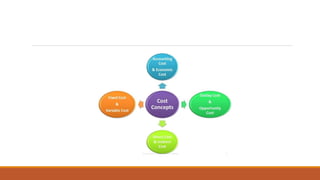
There are several cost concepts relevant to the business operations and decisions and for the
convenience of understanding these can be
1. Cost Concepts Used for Accounting Purposes
2. Analytical Cost Concepts Used for Economic Analysis of Business Activities
Cost Concepts Used for Accounting
Purposes
Generally, the accountants use these cost concepts to study the financial position of the firm.
They are concerned with arranging the finances of the firm and therefore keep a track of the
assets and liabilities of the firm.
The accounting costs are used for taxation purposes and calculating the profit and loss of the firm. These are:
1. Opportunity Cost
2. Business Cost
3. Full Cost
4. Explicit Cost
5. Implicit Cost
6. Out-of-Pocket Cost
7. Book Cost
Analytical Cost Concepts Used for
Economic Analysis of Business Activities
These cost concepts are used by the economists to analyze the likely cost of production in the
future. They are concerned with how the cost of production can be managed or how the input
and output can be re-arranged such that the overall profitability of the firm gets improved.
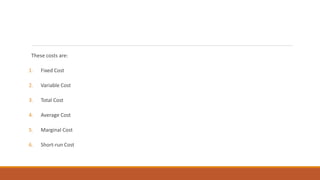
These costs are:
1. Fixed Cost
2. Variable Cost
3. Total Cost
4. Average Cost
5. Marginal Cost
6. Short-run Cost
Break Even Analysis
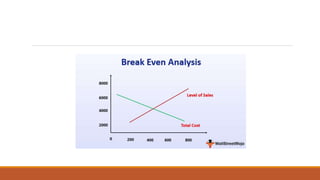
•Break-even analysis entails calculating and examining the margin of safety for an entity based on
the revenues collected and associated costs.
• In other words, the analysis shows how many sales it takes to pay for the cost of doing business.
•Analyzing different price levels relating to various levels of demand, the break-even analysis
determines what level of sales are necessary to cover the company's total fixed costs.
• A demand-side analysis would give a seller significant insight into selling capabilities.
How Break-Even Analysis Works
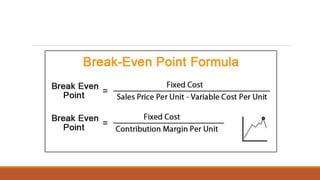
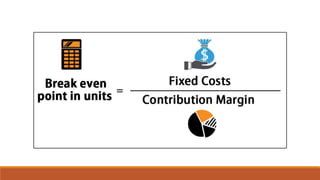
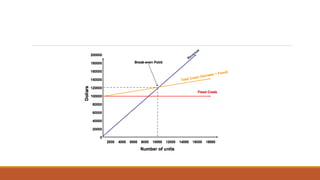
•This type of analysis involves a calculation of the break-even point (BEP). The break-even point is
calculated by dividing the total fixed costs of production by the price per individual unit less the
variable costs of production. Fixed costs are costs that remain the same regardless of how many
units are sold.
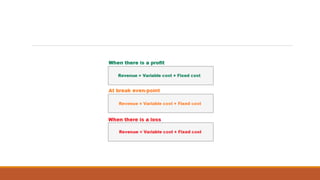
•Break-even analysis looks at the level of fixed costs relative to the profit earned by each
additional unit produced and sold. In general, a company with lower fixed costs will have a lower
break-even point of sale.
•For example, a company with $0 of fixed costs will automatically have broken even upon the sale
of the first product assuming variable costs do not exceed sales revenue.
References
•Wikipedia
•Investopedia.com
•Economicsdiscussion.net
•Corporatefinanceinstitute.com
•Financialaccountancy.org
•Businessjargons.com
•Investopedia.com
THANK YOU

Production Cost Concepts (ppt)

  • 1.
  • 2.
    Contents 1. Introduction 2. Costof Production 3. Cost Centre and Unit 4. Steps to Calculate Overhead Cost Per Unit 5. Classification of Costs of Production 6. Cost Analysis 7. Break Even Analysis 8. References
  • 3.
    Introduction Production or productcosts refer to all the costs incurred by a business from manufacturing a product or providing a service. Production costs can include a variety of expenses, such as labor, raw materials, consumable manufacturing supplies, and general overhead.
  • 5.
    •For an expenseto qualify as a production cost it must be directly connected to generating revenue for the company. •Manufacturers carry production costs related to the raw materials and labor needed to create the product. • Service industries carry production costs related to the labor required to implement the service and any materials costs involved in delivering the service.
  • 6.
    Cost of Production •Costof production refers to the total cost incurred by a business to produce a specific quantity of a product or offer a service •Production costs may include things such as labor, raw materials, or consumable supplies
  • 8.
    Cost Centre andUnit Cost center includes a production or service location, function, activity or plant item in relation to which costs are determined. It may include a single expensive machine, a group of these machines and may be extended to individual departments or even the whole factory may be treated as a cost center in some cases.
  • 9.
    There are twotypes of cost center: 1) Production Cost Centers: Production cost centers are the cost centers directly involved in the manufacturing operations. Examples include molding, machining, assembly, shaping, welding, binding, cutting, etc.
  • 10.
    2) Service CostCenters: •Service cost centers are incidental to the production process as products or cost units are not produced by them. However these are although necessary for it to take place. • Examples are canteen, personnel, stores, boiler house and maintenance, etc. Any cost which is incurred or charged to service cost centers must be reapportioned subsequently to production cost centers for absorbing overheads in the total costs of the product.
  • 11.
    Cost Unit •Cost unitis a unit of output (or a unit of service provided) which absorbs the cost center’s overhead cost. •Often the cost units are the final products manufactured by the organization, e.g. vehicles for a vehicle manufacturer, passenger-mile in a transport business, operation in a hospital are examples of a cost unit.
  • 12.
    Steps to CalculateOverhead Cost Per Unit 1. Record all estimated overheads. 2. Classify all overheads as variable, fixed or mixed. 3. Charge cost units to direct costs as they are directly attributed to cost units. 4. Allocate or apportion indirect cost to production or services cost centers. 5. Reallocate cost of service cost centers among production cost centers to get total overheads of production cost centers.
  • 13.
    6. Determine anestimated budgeted level. 7. Calculate an overhead absorption (recovery) rate by dividing the total budgeted overheads by the total budgeted activity level. 8. Assign production overheads to production units by applying overhead rate. 9. Calculate total costs by adding indirect and direct costs.
  • 15.
    Classification of Costsof Production 1. Fixed costs 2. Variable costs 3. Total cost 4. Average cost 5. Marginal cost
  • 16.
    Fixed costs •Fixed costsare expenses that do not change with the amount of output produced •This means that the costs remain unchanged even when there is zero production or when the business has reached its maximum production capacity •For example, a restaurant business must pay its monthly, quarterly, or yearly rent regardless of the number of customers it serves
  • 19.
    Variable costs •Variable costsare costs that change with the changes in the level of production. •That is, they rise as the production volume increases and decrease as the production volume decreases. •If the production volume is zero, then no variable costs are incurred. •Examples of variable costs include sales commissions, utility costs, raw materials, and direct labor costs.
  • 21.
    Total cost •Total costencompasses both variable and fixed costs. •It takes into account all the costs incurred in the production process or when offering a service. For example, assume that a textile company incurs a production cost of $9 per shirt, and it produced 1,000 units during the last month. The company also pays a rent of $1,500 per month. The total cost includes the variable cost of $9,000 ($9 x 1,000) and a fixed cost of $1,500 per month, bringing the total cost to $10,500.
  • 23.
    Average cost •Total costencompasses both variable and fixed costs. • The average cost refers to the total cost of production divided by the number of units produced. It can also be obtained by summing the average variable costs and the average fixed costs. Management uses average costs to make decisions pricing its products for maximum revenue or profit.
  • 25.
    Marginal cost •Marginal costis the cost of producing one additional unit of output. It shows the increase in total cost coming from the production of one more product unit •marginal cost is mainly affected by changes in variable costs •The management of a company relies on marginal costing to make decisions on resource allocation, looking to allocate production resources in a way that is optimally profitable
  • 27.
    Cost Analysis The CostAnalysis refers to the measure of the cost – output relationship, i.e. the economists are concerned with determining the cost incurred in hiring the inputs and how well these can be re- arranged to increase the productivity (output) of the firm
  • 28.
    In other words,the cost analysis is concerned with determining money value of inputs (labor, raw material), called as the overall cost of production which helps in deciding the optimum level of production
  • 29.
    Types There are severalcost concepts relevant to the business operations and decisions and for the convenience of understanding these can be 1. Cost Concepts Used for Accounting Purposes 2. Analytical Cost Concepts Used for Economic Analysis of Business Activities
  • 30.
    Cost Concepts Usedfor Accounting Purposes Generally, the accountants use these cost concepts to study the financial position of the firm. They are concerned with arranging the finances of the firm and therefore keep a track of the assets and liabilities of the firm.
  • 31.
    The accounting costsare used for taxation purposes and calculating the profit and loss of the firm. These are: 1. Opportunity Cost 2. Business Cost 3. Full Cost 4. Explicit Cost 5. Implicit Cost 6. Out-of-Pocket Cost 7. Book Cost
  • 32.
    Analytical Cost ConceptsUsed for Economic Analysis of Business Activities These cost concepts are used by the economists to analyze the likely cost of production in the future. They are concerned with how the cost of production can be managed or how the input and output can be re-arranged such that the overall profitability of the firm gets improved.
  • 33.
    These costs are: 1.Fixed Cost 2. Variable Cost 3. Total Cost 4. Average Cost 5. Marginal Cost 6. Short-run Cost
  • 35.
    Break Even Analysis •Break-evenanalysis entails calculating and examining the margin of safety for an entity based on the revenues collected and associated costs. • In other words, the analysis shows how many sales it takes to pay for the cost of doing business.
  • 36.
    •Analyzing different pricelevels relating to various levels of demand, the break-even analysis determines what level of sales are necessary to cover the company's total fixed costs. • A demand-side analysis would give a seller significant insight into selling capabilities.
  • 37.
    How Break-Even AnalysisWorks •This type of analysis involves a calculation of the break-even point (BEP). The break-even point is calculated by dividing the total fixed costs of production by the price per individual unit less the variable costs of production. Fixed costs are costs that remain the same regardless of how many units are sold.
  • 38.
    •Break-even analysis looksat the level of fixed costs relative to the profit earned by each additional unit produced and sold. In general, a company with lower fixed costs will have a lower break-even point of sale. •For example, a company with $0 of fixed costs will automatically have broken even upon the sale of the first product assuming variable costs do not exceed sales revenue.
  • 44.
  • 45.