BUSINESS BASICS
WHAT IS A BUSINESS? A  business  is defined as an entity that transform inputs into outputs which increases their value (wealth). A business incur  cost  to acquire inputs, then receive  sales revenue  or  turnover  from selling the outputs.  Added value  is the difference between revenue of outputs and cost of inputs. Creating  wealth  is what business is all about .
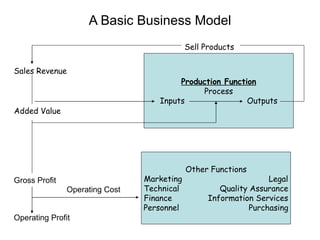
A Basic Business Model Production Function Process Inputs  Outputs Other Functions Marketing    Legal Technical    Quality Assurance Finance  Information Services Personnel  Purchasing Sell Products Sales Revenue Added Value Gross Profit Operating Profit Operating Cost
The model shown is an illustration showing a manufacturing business. The production function shows a process of transforming inputs into outputs. The production function is supported by other functions (marketing & sales, technical, finance, etc)
The products (outputs) are sold to generate income called sales revenue. The income derived will be used to pay for purchasing inputs, operate production, other supporting functions and costs. The surplus is the operating profit. But if it is a deficit, it is a loss!
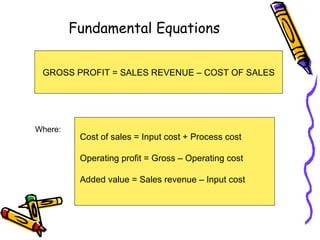
Fundamental Equations GROSS PROFIT = SALES REVENUE – COST OF SALES Cost of sales = Input cost + Process cost Operating profit = Gross – Operating cost Added value = Sales revenue – Input cost Where:
Product Value, Price and Cost A seller perceive product value as less than product price because they rather have the money than the product A purchaser perceive product value as greater than product price because they rather have the product than the money
Types of Business Business can be classified by product or services, size and type of ownership.
Classification by product or services Manufacturing business is a business that creates tangible/ physical products for example cars, computers, food, clothes, etc Service business is a business that creates non-tangible products that adds value to people. E.g.: Hairdresser, consultancy, education, health, banks, transportation, etc
Classification by Size Interestingly, most large business have grown from small business. This is described in four stages: 1. Tiny - A single business managed by one individual, trade limited range of products in restricted local area e.g.: Sundry shop in Kampung Seri, Labis.
2. Small  – A single business managed by a team, sell single broad range of products over a wider geographical area. 3. Medium  – An central organization managing several small businesses as in (2) above. 4. Large  – A central organization managing several medium businesses as described in (3) above.
Classification by ownership A business can belong to owner (s) who are individuals, other business, institutions or governments. 1. Sole proprietorship   - owned by one individual - no legal distinction between owner    and business.  - owner is responsible for all debts - run small retail and service business
2. Partnership - between 2 – 20 - Bank : between 2- 10 - Professional : 2 – 50 - partners are jointly responsible    for any debts and share business    profits (or losses) - run small retail and service      business
3. Limited liability companies  - Sendirian Berhad which is owned    between 2 – 50 shareholders - Berhad (traded in Bursa Malaysia)    is a public owned company,        therefore, has unlimited no. of    shareholders - can enter into contracts, own and    sell property, can sue and be sued - it is a legal separate entity and      enjoy limited liability
Functions and Organization Business functions is seen as systems of  transforming information inputs into higher value information outputs. Various functions in an organization share a common business purpose (goal), rather than concentrating on particular professional skills. E.g: Operation, Production, Accounting & Finance, Marketing & Sales, R & D, etc.
Marketing and sales The marketing and sales functions are usually part of an organization because both interact the business to its market-place, concern with products, customers, prices and costs
Marketing can be defined as the task of capturing and keeping customers by ensuring that the right product is available at the right price with the right promotion in the right place at the right time. The sub-tasks of marketing are identified as follows: 1. Market research – to locate ,  define and evaluate customer  needs
2. Specify new products and enhance  current products 3. Define and enhance pricing strategies 4. Define and implement adequate and  economic promotional strategies 5. Define and implement adequate and  economic product distribution 6. Define and implement adequate and  economic arrangements for after-sales  customer support (e.g: warranties,  maintenance, repair facilities, etc)
While, Sales functions is primarily to achieve economically the planned orders of products from customers. Involves person-to-person selling activities and the people-related skills to ensure success in selling of the products.
Technical The main role of technical function is technical innovation. This involves product research & development, design, or product creation process. It is an important role mainly in technology-based companies.  It is the intermediary between the marketing and production functions.
Production Production function include the product manufacturing operation and the manufacturing support services. The manufacturing operation is where inputs are converted into finished products. While, manufacturing support services are the principal supporting service activities which includes:
1. Facilities maintenance – aims to sustain the performance of manufacturing machineries. E.G.: inspection, services, preventive maintenance & repair. 2. Industrial engineering – focus on the efficiency of systems including human operators & machines to achieve best output at lowest cost. E.G.: study and specify working methods & procedures, measuring work and determine work standards
3. Production engineering – concern with manufacturing technology in all related areas. Production engineers perform capacity planning, introduce new manufacturing technologies & evaluate new machines. Also involves in developing & design new products, enhance existing products, solve problems relating to established products and concerns on the product cost.
4. Production planning & control – scheduling the individual sub-operations that make up to the manufacturing operation. Mainly to maximize the utilization of available resources at cost efficient level. However, their main challenge is delivery time, cost and quality. 5. Purchasing & Quality assurance – resides within the production function as supporting services to manufacturing, ensure activities are properly fitted into functions and report to the ‘top line management’.
Finance Finance function relates to every aspects of a business because all business activities have financial consequences. Its major tasks include: 1. Cash Control – A company’s activity to optimize management of cash. E.g: managing short-term credit, loans & currency exchange transactions
2. Accounting – The most important aspect and finance. It is about financial planning, control & reporting (i) Bookkeeping – identifying,    classifying & recording of    transactions (ii) Mgt Acctg – concerns on    financial planning, analysis &      reporting to assist mgrs at all      levels to prepare, monitor and    control their budgets.
(iii) Financial Acctg – preparation of    formal accounts & reports to    meet  legal requirement to publish    specified financial information    (refer Companies Act 1965) 3. Investment Planning & Evaluation –investment activities including purchase of new manuftg machines, development of new product & acquisition of another business.
4. Tax responsibilities – a duty that govt impose on companies. E.g.: , corporate tax, employee income tax, sales tax 5. Payroll – task to calculate the remuneration/ salary of employees & paying it to them accordingly
Personnel (Human Resource) Responsible for the human resource within the company Ensure resource matches required skills, numbers & location Ensure employment environment is most conducive to allow people give their best Major task of HR are: 1. resource planning
2. increasing ‘headcount’ 3. decreasing ‘headcount’ 4. define & implement remuneration      policies 5. Provide facilities for training &    career development   6. Monitor operation of grievance &      disciplinary procedures at all levels   7. Negotiating with employee        representative (e.g.: trade union)
Purchasing Handle purchasing of materials from external suppliers to ensure efficient purchasing in materials management. Involves overall planning & control of materials Quality assurance Activities aimed at achieving & maintaining appropriate level of product quality at an economic cost
This is important to ensure the product quality is maintained at highest level possible. Information service An important activity of a company that always aim to deliver efficient information at all times (info on stocks, suppliers, sales, finance customers, competitors, etc) Also named as EDP dept, MIS, IT dept
Legal Every activities in a company are influenced by legal requirements/ constraints. The legal function assist the company to ensure the business activities are within proper direction and are accordingly to laws & regulation. E.g: Statutory financial reporting under Co Act 1965, tax responsibilities, trade legislations, legality of contracts, etc
Board of Directors (BOD) A BOD usually comprise a Chairman, a managing director, few other directors, and non-executive directors. The BOD are responsible to shareholders for its performance The BOD meets to discuss long-term policies, set & define objectives, assess performances, plan & initiate corrective actions, motivate mgrs & select mgrs
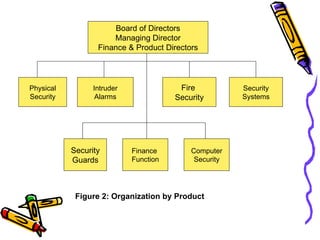
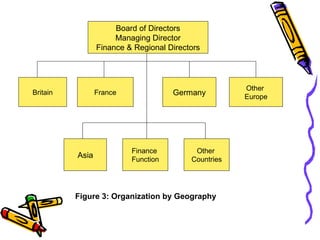
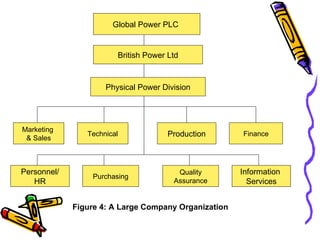
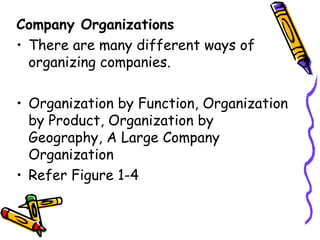
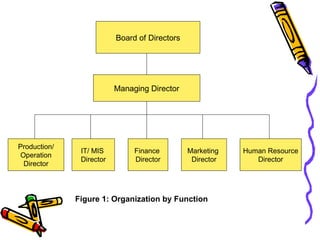
Company Organizations There are many different ways of organizing companies. Organization by Function, Organization by Product, Organization by Geography, A Large Company Organization Refer Figure 1-4
Board of Directors Managing Director Production/ Operation Director IT/ MIS  Director Marketing  Director Finance  Director Human Resource Director Figure 1: Organization by Function
Board of Directors Managing Director Finance & Product Directors Fire  Security Intruder Alarms Physical Security Computer Security Finance  Function Security Systems Figure 2: Organization by Product Security Guards
Board of Directors Managing Director Finance & Regional Directors Germany France Britain Other  Countries Finance  Function Other  Europe Figure 3: Organization by Geography Asia
Global Power PLC  Production Technical Marketing  & Sales Quality Assurance Purchasing Finance Figure 4: A Large Company Organization Personnel/ HR Information  Services British Power Ltd Physical Power Division
Business Objectives The mgrs of a business aim to determine its future by: 1. setting business objectives 2. directing its resources towards achieving the objectives
Drucker (1989) identified 8 critical performance areas where objectives should be set. 1. market standing 2. Innovation 3. Productivity 4. physical & finance resources 5. profitability 6. worker performance & attitudes 7. manager performance & development 8. public responsibility
Market Standing Is an index of importance in marketing product Percentage of market share is the normal measure & can only be measured if the total market size in a period is known Threats to maintaining good market standing include price war, legal constraint, complacency of products
Innovation Is one path of a better market standing & its objectives must align with the marketing objectives Innovation is aimed to enhance profit and also to improve efficiency of the whole business process The ultimate choice for all business operating in competitive market is to ‘innovate or die’
Productivity Measures management competency how efficient does a business use its resources (people, total assets & capital employed) Productivity is the only way to compare different businesses that operates in the same market/ industry
Physical & financial resources Obtaining adequate financial resources is the most critical objective to achieve other objectives There are 3 ways to obtain financial resources for investment: 1. retained profit 2. borrowing 3. issue/ sell more shares
Profitability There are 2 productivity measures: 1. Return on asset (ROA) 2. Return on equity (ROE) Profitability measure is mainly to describe business & management performance  Profit is needed for the business to survive & generate more wealth
Worker performance & attitudes The performance & attitudes of workers must coincides/ commonly aims to achieve same goals/ objectives Employees at all level should contribute to the business & maintain performance quality The management should motivate & encourage lower–level employees to participate in the business. This will  enhance employee job satisfaction, improve performance & increase sense of belonging in the company
Manager performance & development Managers are among the top management people. Management quality is a factor that distinguish one competitor from another Measuring mgr performance in a defined mgt job is not difficult but developing mgt talent & skill is not easy.
Public responsibility A business is should not focus solely on gaining profits but also has social & economic responsibility. E.g: Products that benefit the customer most, promote safe environment & no pollution, recycling, safe & healthy work–place, etc However, not all business voluntarily accept this responsibility that laws need to be enforced
About Management Management competency is a critical factor for determining the health of a business This section explains briefly the nature of management & identifies some personal traits/ qualities that managers require
Management Tasks There are four management tasks: Planning  – setting objectives & define and economic way to achieve those objectives Organizing  – mobilizing resources & people to implement the plans
3.  Leading  – motivating people to deliver their best performance & work toward achieving the set goals 4.  Controlling  – assessing deviations from plan & taking necessary corrective actions
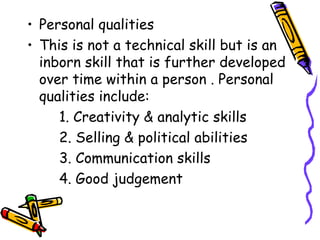
Personal qualities This is not a technical skill but is an inborn skill that is further developed over time within a person . Personal qualities include: 1. Creativity & analytic skills 2. Selling & political abilities 3. Communication skills 4. Good judgement
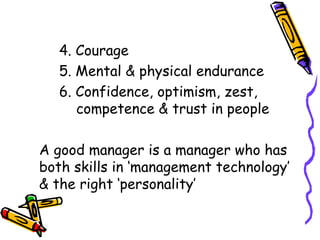
4. Courage 5. Mental & physical endurance 6. Confidence, optimism, zest,    competence & trust in people A good manager is a manager who has both skills in ‘management technology’ & the right ‘personality’
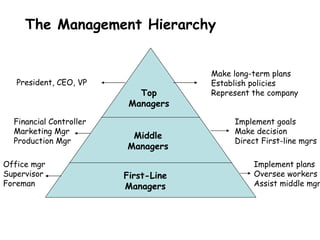
The Management Hierarchy Top Managers Middle Managers First-Line Managers President, CEO, VP Make long-term plans  Establish policies  Represent the company Financial Controller Marketing Mgr  Production Mgr Implement goals Make decision Direct First-line mgrs Office mgr Supervisor Foreman Implement plans Oversee workers Assist middle mgr


Lecture4

  • 1.
  • 2.
    WHAT IS ABUSINESS? A business is defined as an entity that transform inputs into outputs which increases their value (wealth). A business incur cost to acquire inputs, then receive sales revenue or turnover from selling the outputs. Added value is the difference between revenue of outputs and cost of inputs. Creating wealth is what business is all about .
  • 3.
    A Basic BusinessModel Production Function Process Inputs Outputs Other Functions Marketing Legal Technical Quality Assurance Finance Information Services Personnel Purchasing Sell Products Sales Revenue Added Value Gross Profit Operating Profit Operating Cost
  • 4.
    The model shownis an illustration showing a manufacturing business. The production function shows a process of transforming inputs into outputs. The production function is supported by other functions (marketing & sales, technical, finance, etc)
  • 5.
    The products (outputs)are sold to generate income called sales revenue. The income derived will be used to pay for purchasing inputs, operate production, other supporting functions and costs. The surplus is the operating profit. But if it is a deficit, it is a loss!
  • 6.
    Fundamental Equations GROSSPROFIT = SALES REVENUE – COST OF SALES Cost of sales = Input cost + Process cost Operating profit = Gross – Operating cost Added value = Sales revenue – Input cost Where:
  • 7.
    Product Value, Priceand Cost A seller perceive product value as less than product price because they rather have the money than the product A purchaser perceive product value as greater than product price because they rather have the product than the money
  • 8.
    Types of BusinessBusiness can be classified by product or services, size and type of ownership.
  • 9.
    Classification by productor services Manufacturing business is a business that creates tangible/ physical products for example cars, computers, food, clothes, etc Service business is a business that creates non-tangible products that adds value to people. E.g.: Hairdresser, consultancy, education, health, banks, transportation, etc
  • 10.
    Classification by SizeInterestingly, most large business have grown from small business. This is described in four stages: 1. Tiny - A single business managed by one individual, trade limited range of products in restricted local area e.g.: Sundry shop in Kampung Seri, Labis.
  • 11.
    2. Small – A single business managed by a team, sell single broad range of products over a wider geographical area. 3. Medium – An central organization managing several small businesses as in (2) above. 4. Large – A central organization managing several medium businesses as described in (3) above.
  • 12.
    Classification by ownershipA business can belong to owner (s) who are individuals, other business, institutions or governments. 1. Sole proprietorship - owned by one individual - no legal distinction between owner and business. - owner is responsible for all debts - run small retail and service business
  • 13.
    2. Partnership -between 2 – 20 - Bank : between 2- 10 - Professional : 2 – 50 - partners are jointly responsible for any debts and share business profits (or losses) - run small retail and service business
  • 14.
    3. Limited liabilitycompanies - Sendirian Berhad which is owned between 2 – 50 shareholders - Berhad (traded in Bursa Malaysia) is a public owned company, therefore, has unlimited no. of shareholders - can enter into contracts, own and sell property, can sue and be sued - it is a legal separate entity and enjoy limited liability
  • 15.
    Functions and OrganizationBusiness functions is seen as systems of transforming information inputs into higher value information outputs. Various functions in an organization share a common business purpose (goal), rather than concentrating on particular professional skills. E.g: Operation, Production, Accounting & Finance, Marketing & Sales, R & D, etc.
  • 16.
    Marketing and salesThe marketing and sales functions are usually part of an organization because both interact the business to its market-place, concern with products, customers, prices and costs
  • 17.
    Marketing can bedefined as the task of capturing and keeping customers by ensuring that the right product is available at the right price with the right promotion in the right place at the right time. The sub-tasks of marketing are identified as follows: 1. Market research – to locate , define and evaluate customer needs
  • 18.
    2. Specify newproducts and enhance current products 3. Define and enhance pricing strategies 4. Define and implement adequate and economic promotional strategies 5. Define and implement adequate and economic product distribution 6. Define and implement adequate and economic arrangements for after-sales customer support (e.g: warranties, maintenance, repair facilities, etc)
  • 19.
    While, Sales functionsis primarily to achieve economically the planned orders of products from customers. Involves person-to-person selling activities and the people-related skills to ensure success in selling of the products.
  • 20.
    Technical The mainrole of technical function is technical innovation. This involves product research & development, design, or product creation process. It is an important role mainly in technology-based companies. It is the intermediary between the marketing and production functions.
  • 21.
    Production Production functioninclude the product manufacturing operation and the manufacturing support services. The manufacturing operation is where inputs are converted into finished products. While, manufacturing support services are the principal supporting service activities which includes:
  • 22.
    1. Facilities maintenance– aims to sustain the performance of manufacturing machineries. E.G.: inspection, services, preventive maintenance & repair. 2. Industrial engineering – focus on the efficiency of systems including human operators & machines to achieve best output at lowest cost. E.G.: study and specify working methods & procedures, measuring work and determine work standards
  • 23.
    3. Production engineering– concern with manufacturing technology in all related areas. Production engineers perform capacity planning, introduce new manufacturing technologies & evaluate new machines. Also involves in developing & design new products, enhance existing products, solve problems relating to established products and concerns on the product cost.
  • 24.
    4. Production planning& control – scheduling the individual sub-operations that make up to the manufacturing operation. Mainly to maximize the utilization of available resources at cost efficient level. However, their main challenge is delivery time, cost and quality. 5. Purchasing & Quality assurance – resides within the production function as supporting services to manufacturing, ensure activities are properly fitted into functions and report to the ‘top line management’.
  • 25.
    Finance Finance functionrelates to every aspects of a business because all business activities have financial consequences. Its major tasks include: 1. Cash Control – A company’s activity to optimize management of cash. E.g: managing short-term credit, loans & currency exchange transactions
  • 26.
    2. Accounting –The most important aspect and finance. It is about financial planning, control & reporting (i) Bookkeeping – identifying, classifying & recording of transactions (ii) Mgt Acctg – concerns on financial planning, analysis & reporting to assist mgrs at all levels to prepare, monitor and control their budgets.
  • 27.
    (iii) Financial Acctg– preparation of formal accounts & reports to meet legal requirement to publish specified financial information (refer Companies Act 1965) 3. Investment Planning & Evaluation –investment activities including purchase of new manuftg machines, development of new product & acquisition of another business.
  • 28.
    4. Tax responsibilities– a duty that govt impose on companies. E.g.: , corporate tax, employee income tax, sales tax 5. Payroll – task to calculate the remuneration/ salary of employees & paying it to them accordingly
  • 29.
    Personnel (Human Resource)Responsible for the human resource within the company Ensure resource matches required skills, numbers & location Ensure employment environment is most conducive to allow people give their best Major task of HR are: 1. resource planning
  • 30.
    2. increasing ‘headcount’3. decreasing ‘headcount’ 4. define & implement remuneration policies 5. Provide facilities for training & career development 6. Monitor operation of grievance & disciplinary procedures at all levels 7. Negotiating with employee representative (e.g.: trade union)
  • 31.
    Purchasing Handle purchasingof materials from external suppliers to ensure efficient purchasing in materials management. Involves overall planning & control of materials Quality assurance Activities aimed at achieving & maintaining appropriate level of product quality at an economic cost
  • 32.
    This is importantto ensure the product quality is maintained at highest level possible. Information service An important activity of a company that always aim to deliver efficient information at all times (info on stocks, suppliers, sales, finance customers, competitors, etc) Also named as EDP dept, MIS, IT dept
  • 33.
    Legal Every activitiesin a company are influenced by legal requirements/ constraints. The legal function assist the company to ensure the business activities are within proper direction and are accordingly to laws & regulation. E.g: Statutory financial reporting under Co Act 1965, tax responsibilities, trade legislations, legality of contracts, etc
  • 34.
    Board of Directors(BOD) A BOD usually comprise a Chairman, a managing director, few other directors, and non-executive directors. The BOD are responsible to shareholders for its performance The BOD meets to discuss long-term policies, set & define objectives, assess performances, plan & initiate corrective actions, motivate mgrs & select mgrs
  • 35.
    Company Organizations Thereare many different ways of organizing companies. Organization by Function, Organization by Product, Organization by Geography, A Large Company Organization Refer Figure 1-4
  • 36.
    Board of DirectorsManaging Director Production/ Operation Director IT/ MIS Director Marketing Director Finance Director Human Resource Director Figure 1: Organization by Function
  • 37.
    Board of DirectorsManaging Director Finance & Product Directors Fire Security Intruder Alarms Physical Security Computer Security Finance Function Security Systems Figure 2: Organization by Product Security Guards
  • 38.
    Board of DirectorsManaging Director Finance & Regional Directors Germany France Britain Other Countries Finance Function Other Europe Figure 3: Organization by Geography Asia
  • 39.
    Global Power PLC Production Technical Marketing & Sales Quality Assurance Purchasing Finance Figure 4: A Large Company Organization Personnel/ HR Information Services British Power Ltd Physical Power Division
  • 40.
    Business Objectives Themgrs of a business aim to determine its future by: 1. setting business objectives 2. directing its resources towards achieving the objectives
  • 41.
    Drucker (1989) identified8 critical performance areas where objectives should be set. 1. market standing 2. Innovation 3. Productivity 4. physical & finance resources 5. profitability 6. worker performance & attitudes 7. manager performance & development 8. public responsibility
  • 42.
    Market Standing Isan index of importance in marketing product Percentage of market share is the normal measure & can only be measured if the total market size in a period is known Threats to maintaining good market standing include price war, legal constraint, complacency of products
  • 43.
    Innovation Is onepath of a better market standing & its objectives must align with the marketing objectives Innovation is aimed to enhance profit and also to improve efficiency of the whole business process The ultimate choice for all business operating in competitive market is to ‘innovate or die’
  • 44.
    Productivity Measures managementcompetency how efficient does a business use its resources (people, total assets & capital employed) Productivity is the only way to compare different businesses that operates in the same market/ industry
  • 45.
    Physical & financialresources Obtaining adequate financial resources is the most critical objective to achieve other objectives There are 3 ways to obtain financial resources for investment: 1. retained profit 2. borrowing 3. issue/ sell more shares
  • 46.
    Profitability There are2 productivity measures: 1. Return on asset (ROA) 2. Return on equity (ROE) Profitability measure is mainly to describe business & management performance Profit is needed for the business to survive & generate more wealth
  • 47.
    Worker performance &attitudes The performance & attitudes of workers must coincides/ commonly aims to achieve same goals/ objectives Employees at all level should contribute to the business & maintain performance quality The management should motivate & encourage lower–level employees to participate in the business. This will enhance employee job satisfaction, improve performance & increase sense of belonging in the company
  • 48.
    Manager performance &development Managers are among the top management people. Management quality is a factor that distinguish one competitor from another Measuring mgr performance in a defined mgt job is not difficult but developing mgt talent & skill is not easy.
  • 49.
    Public responsibility Abusiness is should not focus solely on gaining profits but also has social & economic responsibility. E.g: Products that benefit the customer most, promote safe environment & no pollution, recycling, safe & healthy work–place, etc However, not all business voluntarily accept this responsibility that laws need to be enforced
  • 50.
    About Management Managementcompetency is a critical factor for determining the health of a business This section explains briefly the nature of management & identifies some personal traits/ qualities that managers require
  • 51.
    Management Tasks Thereare four management tasks: Planning – setting objectives & define and economic way to achieve those objectives Organizing – mobilizing resources & people to implement the plans
  • 52.
    3. Leading – motivating people to deliver their best performance & work toward achieving the set goals 4. Controlling – assessing deviations from plan & taking necessary corrective actions
  • 53.
    Personal qualities Thisis not a technical skill but is an inborn skill that is further developed over time within a person . Personal qualities include: 1. Creativity & analytic skills 2. Selling & political abilities 3. Communication skills 4. Good judgement
  • 54.
    4. Courage 5.Mental & physical endurance 6. Confidence, optimism, zest, competence & trust in people A good manager is a manager who has both skills in ‘management technology’ & the right ‘personality’
  • 55.
    The Management HierarchyTop Managers Middle Managers First-Line Managers President, CEO, VP Make long-term plans Establish policies Represent the company Financial Controller Marketing Mgr Production Mgr Implement goals Make decision Direct First-line mgrs Office mgr Supervisor Foreman Implement plans Oversee workers Assist middle mgr
  • 56.
  • 57.
  • 58.
  • 59.
  • 60.