NSHM KNOWLEDGE CAMPUS, DURGAPUR-
GOI (College Code: 273)
ECONOMICS FOR ENGINEERS
Presented By
Student Name: ARKA RAJ SAHA
University Roll No.: 27332020003
University Registration No.: 202730132010001
Branch: Robotics Engineering
Year: 4TH
Semester: 7TH
Paper Name: Economics for Engineers
Paper Code: HM HU 701
CONTEN
TS
ECONOMIC DECISION MAKING
FIXED COST
VARIABLE COST
OPPORTUNITY COST
LIFE CYCLE COSTING
ECONOMIC DECISION MAKING
Whether it is a business situation or a day-to-day event in somebody’s personal life,
there are a large number of economic decision making involved. One can manage many of
these decision problems by using simple economic analysis.
The following factors will affect the decision:
• Price of the raw material
• Transportation cost of the raw material
• Availability of the raw material
• Quality of the raw material
Consider the alternative of sourcing raw materials from a nearby place with the following
characteristics:
• The raw material is more costly in the nearby area.
• The availability of the raw material is not sufficient enough to support
the operation of the industry throughout the year.
• The raw material requires pre-processing before it is used in the
• production process. This would certainly add cost to the product.
• The cost of transportation is minimal under this alternative.
On the other hand, consider another alternative of sourcing the raw materials from a far-off
place with the following characteristics:
• The raw material is less costly at the far off place.
• The cost of transportation is very high.
• The availability of the raw material at this site is abundant and it can support the plant
throughout the year.
• The raw material from this site does not require any pre-processing before using it for
production.
SIMPLE ECONOMICANALYSIS
In this section, the concept of simple economic analysis is illustrated using suitable
examples in the following areas:
• Material selection for a product
a) Cheaper raw material price
b) Reduced machining/process time
c) Enhanced durability of the product
• Design selection for a product
• Design selection for a process industry
• Building material selection for construction activities
• Process planning/Process modification
1. Analyze the part drawing to get an overall picture of what is required.
2. Make recommendations to or consult with product engineers on product design changes.
3. List the basic operations required to produce the part to the drawing or specifications.
4. Determine the most practical and economical manufacturing method and the form or
tooling required for each operation.
5. Devise the best way to combine the operations and put them in sequence.
6. Specify the gauging required for the process.
FIXED COST
What Is a Fixed Cost?
The term fixed cost refers to a cost that does not change with an increase or decrease
in the number of goods or services produced or sold. Fixed costs are expenses that have to be
paid by a company, independent of any specific business activities. This means fixed costs are
generally indirect, in that they don't apply to a company's production of any goods or services.
Companies can generally have two types of costs—fixed or variable costs—which together
result in their total costs. Shutdown points tend to be applied to reduce fixed costs.
Understanding Fixed Costs
The costs associated with doing business can be broken out by indirect, direct, and
capital costs on the income statement and notated as either short- or long-term liabilities on the
balance sheet. Both fixed and variable costs make up the total cost structure of a company.
Cost analysts analyze both fixed and variable costs through various types of cost structure
analysis. Costs are generally a key factor influencing total profitability.
Fixed costs are those that don't change over the course of time. They are usually
established by contract agreements or schedules. These are the base costs involved in operating
a business comprehensively. Once established, fixed costs do not change over the life of an
agreement or cost schedule.
Fixed costs are allocated in the indirect expense section of the income statement which leads to
operating profit. Depreciation is one common fixed cost that is recorded as an indirect expense.
Companies create a depreciation expense schedule for asset investments with values falling
over time. For example, a company might buy machinery for a manufacturing assembly line that is expensed
over time using depreciation. Another primary fixed, indirect cost is salaries for management.
ANY FIXED COSTS ON THE INCOME STATEMENT ARE ACCOUNTED FOR ON THE BALANCE SHEET
AND CASH FLOW STATEMENT. FIXED COSTS ON THE BALANCE SHEET MAY BE EITHER SHORT-
OR LONG-TERM LIABILITIES. FINALLY, ANY CASH PAID FOR THE EXPENSES OF FIXED COSTS IS
SHOWN ON THE CASH FLOW STATEMENT. IN GENERAL, THE OPPORTUNITY TO LOWER FIXED
COSTS CAN BENEFIT A COMPANY’S BOTTOM LINE BY REDUCING EXPENSES AND INCREASING
PROFIT.
Factors Associated With Fixed Costs
Companies can associate fixed (and variable) costs when analyzing costs per unit. As such, the cost of goods
sold (COGS) can include both types of costs. All costs directly associated with the production of a good are
summed collectively and subtracted from revenue to arrive at gross profit. Cost accounting varies for each
company depending on the costs they are working with. Economies of scale can also be a factor for companies
that can produce large quantities of goods. Fixed costs can be a contributor to better economies of scale because
fixed costs can decrease per unit when larger quantities are produced. Fixed costs that may be directly associated
with production will vary by company but can include costs like direct labor and rent.
Examples of Fixed Costs
Fixed costs include any number of expenses, including rental lease payments, salaries, insurance,
property taxes, interest expenses, depreciation, and potentially some utilities.
FOR INSTANCE, SOMEONE WHO STARTS A NEW BUSINESS WOULD
LIKELY BEGIN WITH FIXED COSTS FOR RENT AND MANAGEMENT SALARIES.
ALL TYPES OF COMPANIES HAVE FIXED COST AGREEMENTS THAT THEY
MONITOR REGULARLY. WHILE THESE FIXED COSTS MAY CHANGE OVER TIME,
THE CHANGE IS NOT RELATED TO PRODUCTION LEVELS BUT ARE INSTEAD
RELATED TO NEW CONTRACTUAL AGREEMENTS OR SCHEDULES.
HowAre Fixed Costs Treated inAccounting?
Fixed costs are associated with the basic operating and overhead costs of a business.
Fixed costs are considered indirect costs of production, which means they are not costs
incurred directly by the production process, such as parts needed for assembly, but they do
factor into total production costs. As a result, they are depreciated over time instead of being
expensed.
AreAll Fixed Costs Considered Sunk Costs?
All sunk costs are fixed costs in financial accounting, but not all fixed costs are considered to
be sunk. The defining characteristic of sunk costs is that they cannot be recovered.
It's easy to imagine a scenario where fixed costs are not sunk. For example, equipment might
be resold or returned at the purchase price.
Individuals and businesses both incur sunk costs. For example, someone might drive to the
store to buy a television, only to decide upon arrival to not make the purchase.
The gasoline used in the drive is, however, a sunk cost—the customer cannot demand that the
gas station or the electronics store compensate them for the mileage.
VARIABLE COST
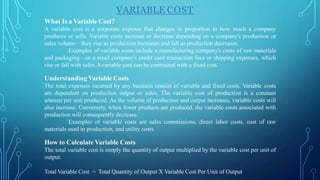
What Is a Variable Cost?
A variable cost is a corporate expense that changes in proportion to how much a company
produces or sells. Variable costs increase or decrease depending on a company's production or
sales volume—they rise as production increases and fall as production decreases.
Examples of variable costs include a manufacturing company's costs of raw materials
and packaging—or a retail company's credit card transaction fees or shipping expenses, which
rise or fall with sales.Avariable cost can be contrasted with a fixed cost.
Understanding Variable Costs
The total expenses incurred by any business consist of variable and fixed costs. Variable costs
are dependent on production output or sales. The variable cost of production is a constant
amount per unit produced. As the volume of production and output increases, variable costs will
also increase. Conversely, when fewer products are produced, the variable costs associated with
production will consequently decrease.
Examples of variable costs are sales commissions, direct labor costs, cost of raw
materials used in production, and utility costs.
How to Calculate Variable Costs
The total variable cost is simply the quantity of output multiplied by the variable cost per unit of
output:
Total Variable Cost = Total Quantity of Output X Variable Cost Per Unit of Output
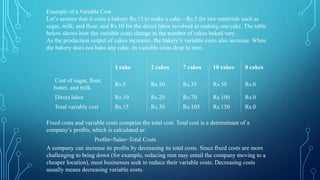
1 cake 2 cakes 7 cakes 10 cakes 0 cakes
Cost of sugar, flour,
butter, and milk
Rs.5 Rs.10 Rs.35 Rs.50 Rs.0
Direct labor Rs.10 Rs.20 Rs.70 Rs.100 Rs.0
Total variable cost Rs.15 Rs.30 Rs.105 Rs.150 Rs.0
Example of a Variable Cost
Let’s assume that it costs a bakery Rs.15 to make a cake—Rs.5 for raw materials such as
sugar, milk, and flour, and Rs.10 for the direct labor involved in making one cake. The table
below shows how the variable costs change as the number of cakes baked vary.
As the production output of cakes increases, the bakery’s variable costs also increase. When
the bakery does not bake any cake, its variable costs drop to zero.
Fixed costs and variable costs comprise the total cost. Total cost is a determinant of a
company’s profits, which is calculated as:
Profits=Sales−Total Costs
A company can increase its profits by decreasing its total costs. Since fixed costs are more
challenging to bring down (for example, reducing rent may entail the company moving to a
cheaper location), most businesses seek to reduce their variable costs. Decreasing costs
usually means decreasing variable costs.
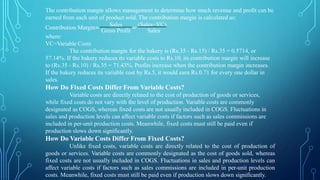
The contribution margin allows management to determine how much revenue and profit can be
earned from each unit of product sold. The contribution margin is calculated as:
Contribution Margin= Sales =
(Sales−VC)
Gross Profit Sales
where:
VC=Variable Costs
The contribution margin for the bakery is (Rs.35 - Rs.15) / Rs.35 = 0.5714, or
57.14%. If the bakery reduces its variable costs to Rs.10, its contribution margin will increase
to (Rs.35 - Rs.10) / Rs.35 = 71.43%. Profits increase when the contribution margin increases.
If the bakery reduces its variable cost by Rs.5, it would earn Rs.0.71 for every one dollar in
sales.
How Do Fixed Costs Differ From Variable Costs?
Variable costs are directly related to the cost of production of goods or services,
while fixed costs do not vary with the level of production. Variable costs are commonly
designated as COGS, whereas fixed costs are not usually included in COGS. Fluctuations in
sales and production levels can affect variable costs if factors such as sales commissions are
included in per-unit production costs. Meanwhile, fixed costs must still be paid even if
production slows down significantly.
How Do Variable Costs Differ From Fixed Costs?
Unlike fixed costs, variable costs are directly related to the cost of production of
goods or services. Variable costs are commonly designated as the cost of goods sold, whereas
fixed costs are not usually included in COGS. Fluctuations in sales and production levels can
affect variable costs if factors such as sales commissions are included in per-unit production
costs. Meanwhile, fixed costs must still be paid even if production slows down significantly.
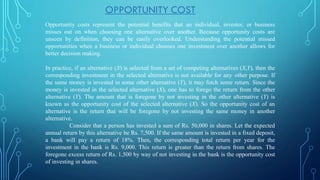
Opportunity costs represent the potential benefits that an individual, investor, or business
misses out on when choosing one alternative over another. Because opportunity costs are
unseen by definition, they can be easily overlooked. Understanding the potential missed
opportunities when a business or individual chooses one investment over another allows for
better decision making.
In practice, if an alternative (X) is selected from a set of competing alternatives (X,Y), then the
corresponding investment in the selected alternative is not available for any other purpose. If
the same money is invested in some other alternative (Y), it may fetch some return. Since the
money is invested in the selected alternative (X), one has to forego the return from the other
alternative (Y). The amount that is foregone by not investing in the other alternative (Y) is
known as the opportunity cost of the selected alternative (X). So the opportunity cost of an
alternative is the return that will be foregone by not investing the same money in another
alternative.
Consider that a person has invested a sum of Rs. 50,000 in shares. Let the expected
annual return by this alternative be Rs. 7,500. If the same amount is invested in a fixed deposit,
a bank will pay a return of 18%. Then, the corresponding total return per year for the
investment in the bank is Rs. 9,000. This return is greater than the return from shares. The
foregone excess return of Rs. 1,500 by way of not investing in the bank is the opportunity cost
of investing in shares.
OPPORTUNITY COST
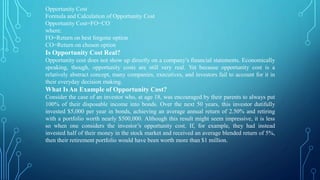
Opportunity Cost
Formula and Calculation of Opportunity Cost
Opportunity Cost=FO−CO
where:
FO=Return on best forgone option
CO=Return on chosen option
Is Opportunity Cost Real?
Opportunity cost does not show up directly on a company’s financial statements. Economically
speaking, though, opportunity costs are still very real. Yet because opportunity cost is a
relatively abstract concept, many companies, executives, and investors fail to account for it in
their everyday decision making.
What IsAn Example of Opportunity Cost?
Consider the case of an investor who, at age 18, was encouraged by their parents to always put
100% of their disposable income into bonds. Over the next 50 years, this investor dutifully
invested $5,000 per year in bonds, achieving an average annual return of 2.50% and retiring
with a portfolio worth nearly $500,000. Although this result might seem impressive, it is less
so when one considers the investor’s opportunity cost. If, for example, they had instead
invested half of their money in the stock market and received an average blended return of 5%,
then their retirement portfolio would have been worth more than $1 million.
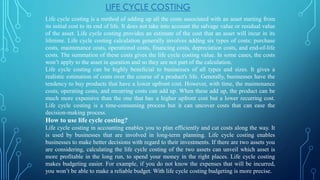
Life cycle costing is a method of adding up all the costs associated with an asset starting from
its initial cost to its end of life. It does not take into account the salvage value or residual value
of the asset. Life cycle costing provides an estimate of the cost that an asset will incur in its
lifetime. Life cycle costing calculation generally involves adding six types of costs; purchase
costs, maintenance costs, operational costs, financing costs, depreciation costs, and end-of-life
costs. The summation of these costs gives the life cycle costing value. In some cases, the costs
won’t apply to the asset in question and so they are not part of the calculation.
Life cycle costing can be highly beneficial to businesses of all types and sizes. It gives a
realistic estimation of costs over the course of a product's life. Generally, businesses have the
tendency to buy products that have a lower upfront cost. However, with time, the maintenance
costs, operating costs, and recurring costs can add up. When these add up, the product can be
much more expensive than the one that has a higher upfront cost but a lower recurring cost.
Life cycle costing is a time-consuming process but it can uncover costs that can ease the
decision-making process.
How to use life cycle costing?
Life cycle costing in accounting enables you to plan efficiently and cut costs along the way. It
is used by businesses that are involved in long-term planning. Life cycle costing enables
businesses to make better decisions with regard to their investments. If there are two assets you
are considering, calculating the life cycle costing of the two assets can unveil which asset is
more profitable in the long run, to spend your money in the right places. Life cycle costing
makes budgeting easier. For example, if you do not know the expenses that will be incurred,
you won’t be able to make a reliable budget. With life cycle costing budgeting is more precise.
LIFE CYCLE COSTING
Let us explore the use of life cycle costing in different areas. In the engineering industry, life
cycle costing aids in the development and manufacturing process of the products. These
products are made such that they do their job but aren’t too expensive for the customer either.
That is the total lifetime cost of the product isn’t a burden to the customer. In the procurement
area, businesses will consider life cycle costing to determine which products they should buy
and which they should avoid. They will look for items that are cheap to maintain and operate.
In capital budgeting, life cycle costing can be used to figure out the ROI which aids in the
purchase decisions.
Life cycle costing is mostly used for tangible assets. However, it is applicable to
intangible assets too. For example, a business patent. While the costs may be trickier to add up
in the case of intangible assets, it is possible to calculate the value of life cycle costing. For
example, patents cost money. They require that you hire a knowledgeable individual such as a
lawyer. You need to pay for the patent maintenance and so on. When you add all of these costs
up, you can come up with the life cycle costing value. In this way, life cycle costing has
numerous applications in all aspects of business expenditure.
Life cycle costing process
The Life cycle costing process consists of three major stages. The first stage is developing a
plan that will aid in decision-making. It involves determining the objectives such as
determining what different options mean for the business. The second stage is the analysis
stage which helps with cost control and management. It involves setting targets that can change
later on due to precise estimation from other assets that work similarly. The third stage is the
implementation and monitoring stage. In this, the performance is implemented and monitored
to determine if additional cost savings are possible. This activity can be useful for future
investments in assets and planning.
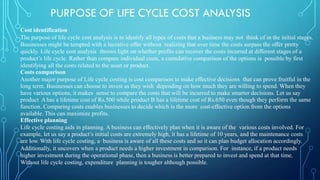
PURPOSE OF LIFE CYCLE COST ANALYSIS
Cost identification
The purpose of life cycle cost analysis is to identify all types of costs that a business may not think of in the initial stages.
Businesses might be tempted with a lucrative offer without realizing that over time the costs surpass the offer pretty
quickly. Life cycle cost analysis throws light on whether profits can recover the costs incurred at different stages of a
product’s life cycle. Rather than compare individual costs, a cumulative comparison of the options is possible by first
identifying all the costs related to the asset or product.
Costs comparison
Another major purpose of Life cycle costing is cost comparison to make effective decisions that can prove fruitful in the
long term. Businesses can choose to invest as they wish depending on how much they are willing to spend. When they
have various options, it makes sense to compare the costs that will be incurred to make smarter decisions. Let us say
product Ahas a lifetime cost of Rs.500 while product B has a lifetime cost of Rs.650 even though they perform the same
function. Comparing costs enables businesses to decide which is the more cost-effective option from the options
available. This can maximize profits.
Effective planning
Life cycle costing aids in planning. A business can effectively plan when it is aware of the various costs involved. For
example, let us say a product’s initial costs are extremely high, it has a lifetime of 10 years, and the maintenance costs
are low. With life cycle costing, a business is aware of all these costs and so it can plan budget allocation accordingly.
Additionally, it uncovers when a product needs a higher investment in comparison. For instance, if a product needs
higher investment during the operational phase, then a business is better prepared to invest and spend at that time.
Without life cycle costing, expenditure planning is tougher although possible.
THANK
YOU

ARKA RAJ SAHA 27332020003.....pdf

  • 1.
    NSHM KNOWLEDGE CAMPUS,DURGAPUR- GOI (College Code: 273) ECONOMICS FOR ENGINEERS Presented By Student Name: ARKA RAJ SAHA University Roll No.: 27332020003 University Registration No.: 202730132010001 Branch: Robotics Engineering Year: 4TH Semester: 7TH Paper Name: Economics for Engineers Paper Code: HM HU 701
  • 2.
    CONTEN TS ECONOMIC DECISION MAKING FIXEDCOST VARIABLE COST OPPORTUNITY COST LIFE CYCLE COSTING
  • 3.
    ECONOMIC DECISION MAKING Whetherit is a business situation or a day-to-day event in somebody’s personal life, there are a large number of economic decision making involved. One can manage many of these decision problems by using simple economic analysis. The following factors will affect the decision: • Price of the raw material • Transportation cost of the raw material • Availability of the raw material • Quality of the raw material Consider the alternative of sourcing raw materials from a nearby place with the following characteristics: • The raw material is more costly in the nearby area. • The availability of the raw material is not sufficient enough to support the operation of the industry throughout the year. • The raw material requires pre-processing before it is used in the • production process. This would certainly add cost to the product. • The cost of transportation is minimal under this alternative. On the other hand, consider another alternative of sourcing the raw materials from a far-off place with the following characteristics: • The raw material is less costly at the far off place. • The cost of transportation is very high.
  • 4.
    • The availabilityof the raw material at this site is abundant and it can support the plant throughout the year. • The raw material from this site does not require any pre-processing before using it for production. SIMPLE ECONOMICANALYSIS In this section, the concept of simple economic analysis is illustrated using suitable examples in the following areas: • Material selection for a product a) Cheaper raw material price b) Reduced machining/process time c) Enhanced durability of the product • Design selection for a product • Design selection for a process industry • Building material selection for construction activities • Process planning/Process modification 1. Analyze the part drawing to get an overall picture of what is required. 2. Make recommendations to or consult with product engineers on product design changes. 3. List the basic operations required to produce the part to the drawing or specifications. 4. Determine the most practical and economical manufacturing method and the form or tooling required for each operation. 5. Devise the best way to combine the operations and put them in sequence. 6. Specify the gauging required for the process.
  • 5.
    FIXED COST What Isa Fixed Cost? The term fixed cost refers to a cost that does not change with an increase or decrease in the number of goods or services produced or sold. Fixed costs are expenses that have to be paid by a company, independent of any specific business activities. This means fixed costs are generally indirect, in that they don't apply to a company's production of any goods or services. Companies can generally have two types of costs—fixed or variable costs—which together result in their total costs. Shutdown points tend to be applied to reduce fixed costs. Understanding Fixed Costs The costs associated with doing business can be broken out by indirect, direct, and capital costs on the income statement and notated as either short- or long-term liabilities on the balance sheet. Both fixed and variable costs make up the total cost structure of a company. Cost analysts analyze both fixed and variable costs through various types of cost structure analysis. Costs are generally a key factor influencing total profitability. Fixed costs are those that don't change over the course of time. They are usually established by contract agreements or schedules. These are the base costs involved in operating a business comprehensively. Once established, fixed costs do not change over the life of an agreement or cost schedule. Fixed costs are allocated in the indirect expense section of the income statement which leads to operating profit. Depreciation is one common fixed cost that is recorded as an indirect expense. Companies create a depreciation expense schedule for asset investments with values falling
  • 6.
    over time. Forexample, a company might buy machinery for a manufacturing assembly line that is expensed over time using depreciation. Another primary fixed, indirect cost is salaries for management. ANY FIXED COSTS ON THE INCOME STATEMENT ARE ACCOUNTED FOR ON THE BALANCE SHEET AND CASH FLOW STATEMENT. FIXED COSTS ON THE BALANCE SHEET MAY BE EITHER SHORT- OR LONG-TERM LIABILITIES. FINALLY, ANY CASH PAID FOR THE EXPENSES OF FIXED COSTS IS SHOWN ON THE CASH FLOW STATEMENT. IN GENERAL, THE OPPORTUNITY TO LOWER FIXED COSTS CAN BENEFIT A COMPANY’S BOTTOM LINE BY REDUCING EXPENSES AND INCREASING PROFIT. Factors Associated With Fixed Costs Companies can associate fixed (and variable) costs when analyzing costs per unit. As such, the cost of goods sold (COGS) can include both types of costs. All costs directly associated with the production of a good are summed collectively and subtracted from revenue to arrive at gross profit. Cost accounting varies for each company depending on the costs they are working with. Economies of scale can also be a factor for companies that can produce large quantities of goods. Fixed costs can be a contributor to better economies of scale because fixed costs can decrease per unit when larger quantities are produced. Fixed costs that may be directly associated with production will vary by company but can include costs like direct labor and rent. Examples of Fixed Costs Fixed costs include any number of expenses, including rental lease payments, salaries, insurance, property taxes, interest expenses, depreciation, and potentially some utilities.
  • 7.
    FOR INSTANCE, SOMEONEWHO STARTS A NEW BUSINESS WOULD LIKELY BEGIN WITH FIXED COSTS FOR RENT AND MANAGEMENT SALARIES. ALL TYPES OF COMPANIES HAVE FIXED COST AGREEMENTS THAT THEY MONITOR REGULARLY. WHILE THESE FIXED COSTS MAY CHANGE OVER TIME, THE CHANGE IS NOT RELATED TO PRODUCTION LEVELS BUT ARE INSTEAD RELATED TO NEW CONTRACTUAL AGREEMENTS OR SCHEDULES. HowAre Fixed Costs Treated inAccounting? Fixed costs are associated with the basic operating and overhead costs of a business. Fixed costs are considered indirect costs of production, which means they are not costs incurred directly by the production process, such as parts needed for assembly, but they do factor into total production costs. As a result, they are depreciated over time instead of being expensed. AreAll Fixed Costs Considered Sunk Costs? All sunk costs are fixed costs in financial accounting, but not all fixed costs are considered to be sunk. The defining characteristic of sunk costs is that they cannot be recovered. It's easy to imagine a scenario where fixed costs are not sunk. For example, equipment might be resold or returned at the purchase price. Individuals and businesses both incur sunk costs. For example, someone might drive to the store to buy a television, only to decide upon arrival to not make the purchase. The gasoline used in the drive is, however, a sunk cost—the customer cannot demand that the gas station or the electronics store compensate them for the mileage.
  • 8.
    VARIABLE COST What Isa Variable Cost? A variable cost is a corporate expense that changes in proportion to how much a company produces or sells. Variable costs increase or decrease depending on a company's production or sales volume—they rise as production increases and fall as production decreases. Examples of variable costs include a manufacturing company's costs of raw materials and packaging—or a retail company's credit card transaction fees or shipping expenses, which rise or fall with sales.Avariable cost can be contrasted with a fixed cost. Understanding Variable Costs The total expenses incurred by any business consist of variable and fixed costs. Variable costs are dependent on production output or sales. The variable cost of production is a constant amount per unit produced. As the volume of production and output increases, variable costs will also increase. Conversely, when fewer products are produced, the variable costs associated with production will consequently decrease. Examples of variable costs are sales commissions, direct labor costs, cost of raw materials used in production, and utility costs. How to Calculate Variable Costs The total variable cost is simply the quantity of output multiplied by the variable cost per unit of output: Total Variable Cost = Total Quantity of Output X Variable Cost Per Unit of Output
  • 9.
    1 cake 2cakes 7 cakes 10 cakes 0 cakes Cost of sugar, flour, butter, and milk Rs.5 Rs.10 Rs.35 Rs.50 Rs.0 Direct labor Rs.10 Rs.20 Rs.70 Rs.100 Rs.0 Total variable cost Rs.15 Rs.30 Rs.105 Rs.150 Rs.0 Example of a Variable Cost Let’s assume that it costs a bakery Rs.15 to make a cake—Rs.5 for raw materials such as sugar, milk, and flour, and Rs.10 for the direct labor involved in making one cake. The table below shows how the variable costs change as the number of cakes baked vary. As the production output of cakes increases, the bakery’s variable costs also increase. When the bakery does not bake any cake, its variable costs drop to zero. Fixed costs and variable costs comprise the total cost. Total cost is a determinant of a company’s profits, which is calculated as: Profits=Sales−Total Costs A company can increase its profits by decreasing its total costs. Since fixed costs are more challenging to bring down (for example, reducing rent may entail the company moving to a cheaper location), most businesses seek to reduce their variable costs. Decreasing costs usually means decreasing variable costs.
  • 10.
    The contribution marginallows management to determine how much revenue and profit can be earned from each unit of product sold. The contribution margin is calculated as: Contribution Margin= Sales = (Sales−VC) Gross Profit Sales where: VC=Variable Costs The contribution margin for the bakery is (Rs.35 - Rs.15) / Rs.35 = 0.5714, or 57.14%. If the bakery reduces its variable costs to Rs.10, its contribution margin will increase to (Rs.35 - Rs.10) / Rs.35 = 71.43%. Profits increase when the contribution margin increases. If the bakery reduces its variable cost by Rs.5, it would earn Rs.0.71 for every one dollar in sales. How Do Fixed Costs Differ From Variable Costs? Variable costs are directly related to the cost of production of goods or services, while fixed costs do not vary with the level of production. Variable costs are commonly designated as COGS, whereas fixed costs are not usually included in COGS. Fluctuations in sales and production levels can affect variable costs if factors such as sales commissions are included in per-unit production costs. Meanwhile, fixed costs must still be paid even if production slows down significantly. How Do Variable Costs Differ From Fixed Costs? Unlike fixed costs, variable costs are directly related to the cost of production of goods or services. Variable costs are commonly designated as the cost of goods sold, whereas fixed costs are not usually included in COGS. Fluctuations in sales and production levels can affect variable costs if factors such as sales commissions are included in per-unit production costs. Meanwhile, fixed costs must still be paid even if production slows down significantly.
  • 11.
    Opportunity costs representthe potential benefits that an individual, investor, or business misses out on when choosing one alternative over another. Because opportunity costs are unseen by definition, they can be easily overlooked. Understanding the potential missed opportunities when a business or individual chooses one investment over another allows for better decision making. In practice, if an alternative (X) is selected from a set of competing alternatives (X,Y), then the corresponding investment in the selected alternative is not available for any other purpose. If the same money is invested in some other alternative (Y), it may fetch some return. Since the money is invested in the selected alternative (X), one has to forego the return from the other alternative (Y). The amount that is foregone by not investing in the other alternative (Y) is known as the opportunity cost of the selected alternative (X). So the opportunity cost of an alternative is the return that will be foregone by not investing the same money in another alternative. Consider that a person has invested a sum of Rs. 50,000 in shares. Let the expected annual return by this alternative be Rs. 7,500. If the same amount is invested in a fixed deposit, a bank will pay a return of 18%. Then, the corresponding total return per year for the investment in the bank is Rs. 9,000. This return is greater than the return from shares. The foregone excess return of Rs. 1,500 by way of not investing in the bank is the opportunity cost of investing in shares. OPPORTUNITY COST
  • 12.
    Opportunity Cost Formula andCalculation of Opportunity Cost Opportunity Cost=FO−CO where: FO=Return on best forgone option CO=Return on chosen option Is Opportunity Cost Real? Opportunity cost does not show up directly on a company’s financial statements. Economically speaking, though, opportunity costs are still very real. Yet because opportunity cost is a relatively abstract concept, many companies, executives, and investors fail to account for it in their everyday decision making. What IsAn Example of Opportunity Cost? Consider the case of an investor who, at age 18, was encouraged by their parents to always put 100% of their disposable income into bonds. Over the next 50 years, this investor dutifully invested $5,000 per year in bonds, achieving an average annual return of 2.50% and retiring with a portfolio worth nearly $500,000. Although this result might seem impressive, it is less so when one considers the investor’s opportunity cost. If, for example, they had instead invested half of their money in the stock market and received an average blended return of 5%, then their retirement portfolio would have been worth more than $1 million.
  • 13.
    Life cycle costingis a method of adding up all the costs associated with an asset starting from its initial cost to its end of life. It does not take into account the salvage value or residual value of the asset. Life cycle costing provides an estimate of the cost that an asset will incur in its lifetime. Life cycle costing calculation generally involves adding six types of costs; purchase costs, maintenance costs, operational costs, financing costs, depreciation costs, and end-of-life costs. The summation of these costs gives the life cycle costing value. In some cases, the costs won’t apply to the asset in question and so they are not part of the calculation. Life cycle costing can be highly beneficial to businesses of all types and sizes. It gives a realistic estimation of costs over the course of a product's life. Generally, businesses have the tendency to buy products that have a lower upfront cost. However, with time, the maintenance costs, operating costs, and recurring costs can add up. When these add up, the product can be much more expensive than the one that has a higher upfront cost but a lower recurring cost. Life cycle costing is a time-consuming process but it can uncover costs that can ease the decision-making process. How to use life cycle costing? Life cycle costing in accounting enables you to plan efficiently and cut costs along the way. It is used by businesses that are involved in long-term planning. Life cycle costing enables businesses to make better decisions with regard to their investments. If there are two assets you are considering, calculating the life cycle costing of the two assets can unveil which asset is more profitable in the long run, to spend your money in the right places. Life cycle costing makes budgeting easier. For example, if you do not know the expenses that will be incurred, you won’t be able to make a reliable budget. With life cycle costing budgeting is more precise. LIFE CYCLE COSTING
  • 14.
    Let us explorethe use of life cycle costing in different areas. In the engineering industry, life cycle costing aids in the development and manufacturing process of the products. These products are made such that they do their job but aren’t too expensive for the customer either. That is the total lifetime cost of the product isn’t a burden to the customer. In the procurement area, businesses will consider life cycle costing to determine which products they should buy and which they should avoid. They will look for items that are cheap to maintain and operate. In capital budgeting, life cycle costing can be used to figure out the ROI which aids in the purchase decisions. Life cycle costing is mostly used for tangible assets. However, it is applicable to intangible assets too. For example, a business patent. While the costs may be trickier to add up in the case of intangible assets, it is possible to calculate the value of life cycle costing. For example, patents cost money. They require that you hire a knowledgeable individual such as a lawyer. You need to pay for the patent maintenance and so on. When you add all of these costs up, you can come up with the life cycle costing value. In this way, life cycle costing has numerous applications in all aspects of business expenditure. Life cycle costing process The Life cycle costing process consists of three major stages. The first stage is developing a plan that will aid in decision-making. It involves determining the objectives such as determining what different options mean for the business. The second stage is the analysis stage which helps with cost control and management. It involves setting targets that can change later on due to precise estimation from other assets that work similarly. The third stage is the implementation and monitoring stage. In this, the performance is implemented and monitored to determine if additional cost savings are possible. This activity can be useful for future investments in assets and planning.
  • 15.
    PURPOSE OF LIFECYCLE COST ANALYSIS Cost identification The purpose of life cycle cost analysis is to identify all types of costs that a business may not think of in the initial stages. Businesses might be tempted with a lucrative offer without realizing that over time the costs surpass the offer pretty quickly. Life cycle cost analysis throws light on whether profits can recover the costs incurred at different stages of a product’s life cycle. Rather than compare individual costs, a cumulative comparison of the options is possible by first identifying all the costs related to the asset or product. Costs comparison Another major purpose of Life cycle costing is cost comparison to make effective decisions that can prove fruitful in the long term. Businesses can choose to invest as they wish depending on how much they are willing to spend. When they have various options, it makes sense to compare the costs that will be incurred to make smarter decisions. Let us say product Ahas a lifetime cost of Rs.500 while product B has a lifetime cost of Rs.650 even though they perform the same function. Comparing costs enables businesses to decide which is the more cost-effective option from the options available. This can maximize profits. Effective planning Life cycle costing aids in planning. A business can effectively plan when it is aware of the various costs involved. For example, let us say a product’s initial costs are extremely high, it has a lifetime of 10 years, and the maintenance costs are low. With life cycle costing, a business is aware of all these costs and so it can plan budget allocation accordingly. Additionally, it uncovers when a product needs a higher investment in comparison. For instance, if a product needs higher investment during the operational phase, then a business is better prepared to invest and spend at that time. Without life cycle costing, expenditure planning is tougher although possible.
  • 16.