Free Fall and Apparent Weight Today’s lecture will cover   Textbook Sections 4.3,4.5 Check iclicker scores! James scholar paper topics due Fri  Sept 24 Exam 1 is Sept 27 Office hours staffed  throughout week Physics 101:  Lecture 05 Exam I
Review from Lecture 4 Constant Acceleration Equations of Motion x = x 0  + v 0 t + 1/2 at 2 v = v 0  + at v 2  = v 0 2  + 2a(x-x 0 )  F = m a Draw Free Body Diagram Write down equations (which variables do  you know, which don’t you know?) Solve Today: look at Gravity as force
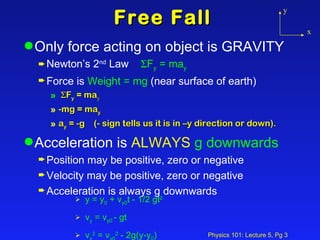
Free Fall Only force acting on object is GRAVITY Newton’s 2 nd  Law   F y  = ma y Force is  Weight = mg  (near surface of earth)  F y  = ma y   -mg = ma y a y  = -g  (- sign tells us it is in –y direction or down). Acceleration is  ALWAYS   g downwards Position may be positive, zero or negative  Velocity may be positive, zero or negative Acceleration is always g downwards y = y 0  + v y0 t - 1/2 gt 2 v y  = v y0  - gt v y 2  = v y0 2  - 2g(y-y 0 ) y x
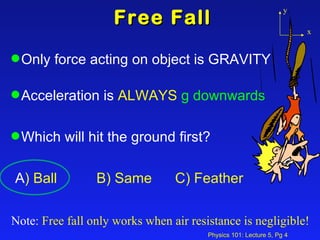
Free Fall Only force acting on object is GRAVITY Acceleration is  ALWAYS   g downwards Which will hit the ground first? A ) Ball  B) Same  C) Feather Note : Free fall only works when air resistance is negligible! y x
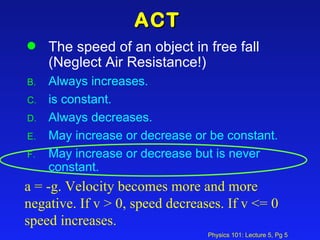
ACT The speed of an object in free fall (Neglect Air Resistance!) Always increases. is constant. Always decreases. May increase or decrease or be constant. May increase or decrease but is never constant. a = -g. Velocity becomes more and more negative. If v > 0, speed decreases. If v <= 0 speed increases.
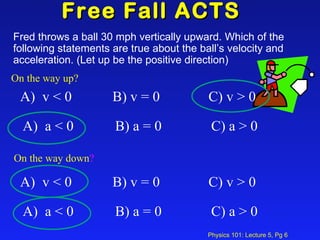
Free Fall ACTS  Fred throws a ball 30 mph vertically upward. Which of the following statements are true about the ball’s velocity and acceleration. (Let up be the positive direction)  On the way up?   On the way down ? A)  v < 0  B) v = 0 C) v > 0 A)  a < 0  B) a = 0  C) a > 0 A)  v < 0  B) v = 0 C) v > 0 A)  a < 0  B) a = 0  C) a > 0
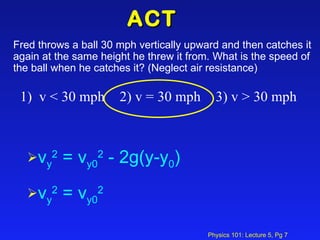
ACT  Fred throws a ball 30 mph vertically upward and then catches it again at the same height he threw it from. What is the speed of the ball when he catches it? (Neglect air resistance) 1)  v < 30 mph    2) v = 30 mph    3) v > 30 mph v y 2  = v y0 2  - 2g(y-y 0 ) v y 2  = v y0 2
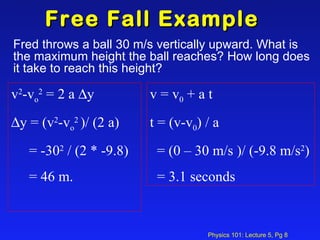
Free Fall Example  Fred throws a ball 30 m/s vertically upward. What is the maximum height the ball reaches? How long does it take to reach this height?  v 2 -v o 2  = 2 a   y  y = (v 2 -v o 2  )/ (2 a) = -30 2  / (2 * -9.8) = 46 m. v = v 0  + a t t = (v-v 0 ) / a = (0 – 30 m/s )/ (-9.8 m/s 2 ) = 3.1 seconds
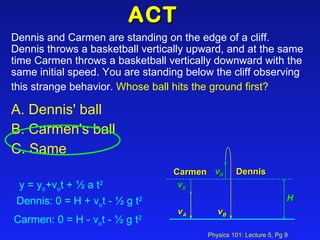
Dennis and Carmen are standing on the edge of a cliff. Dennis throws a basketball vertically upward, and at the same time Carmen throws a basketball vertically downward with the same initial speed. You are standing below the cliff observing this strange behavior.  Whose ball hits the ground first?   A. Dennis' ball  B. Carmen's ball  C. Same ACT  y = y o +v o t + ½ a t 2 Dennis: 0 = H + v o t - ½ g t 2 Carmen: 0 = H - v o t - ½ g t 2 v 0 v 0 Dennis Carmen H v A v B
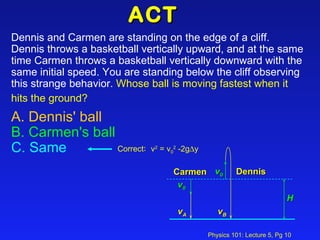
Dennis and Carmen are standing on the edge of a cliff. Dennis throws a basketball vertically upward, and at the same time Carmen throws a basketball vertically downward with the same initial speed. You are standing below the cliff observing this strange behavior.  Whose ball is moving fastest when it hits the ground?   A. Dennis' ball   B. Carmen's ball   C. Same ACT  v 0 v 0 Dennis Carmen H v A v B Correct :  v 2  = v 0 2  -2g  y
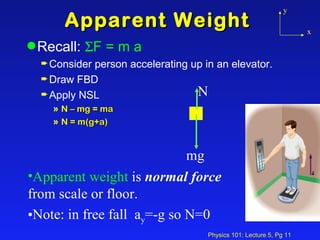
Apparent Weight Recall:   F = m a Consider person accelerating up in an elevator. Draw FBD Apply NSL N – mg = ma N = m(g+a) Apparent weight  is  normal force  from scale or floor. Note: in free fall  a y =-g so N=0 mg N y x
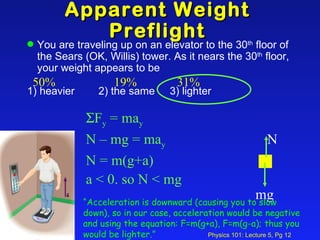
Apparent Weight Preflight You are traveling up on an elevator to the 30 th  floor of the Sears (OK, Willis) tower. As it nears the 30 th  floor, your weight appears to be 1) heavier  2) the same  3) lighter  F y  = ma y N – mg = ma y N = m(g+a) a < 0. so N < mg 50%   19%  31% “ Acceleration is downward (causing you to slow down), so in our case, acceleration would be negative and using the equation: F=m(g+a), F=m(g-a); thus you would be lighter.” mg N
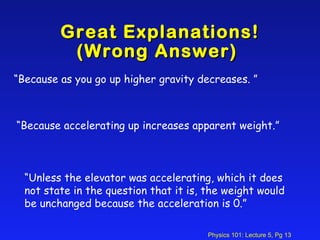
Great Explanations! (Wrong Answer)  “ Because as you go up higher gravity decreases. ” “ Unless the elevator was accelerating, which it does not state in the question that it is, the weight would be unchanged because the acceleration is 0.” “ Because accelerating up increases apparent weight.”
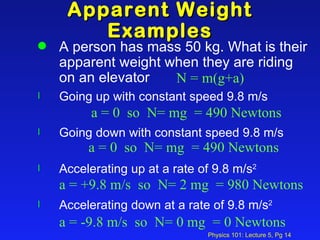
Apparent Weight Examples A person has mass 50 kg. What is their apparent weight when they are riding on an elevator Going up with constant speed 9.8 m/s Going down with constant speed 9.8 m/s Accelerating up at a rate of 9.8 m/s 2 Accelerating down at a rate of 9.8 m/s 2 N = m(g+a) a = 0  so  N= mg  = 490 Newtons a = 0  so  N= mg  = 490 Newtons a = +9.8 m/s  so  N= 2 mg  = 980 Newtons a = -9.8 m/s  so  N= 0 mg  = 0 Newtons
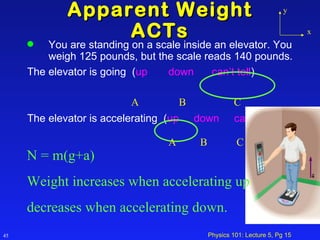
Apparent Weight ACTs You are standing on a scale inside an elevator. You weigh 125 pounds, but the scale reads 140 pounds. The elevator is going  ( up  down  can’t tell ) The elevator is accelerating  ( up  down  can’t tell ) 45 N = m(g+a) Weight increases when accelerating up decreases when accelerating down. A  B  C A  B  C y x
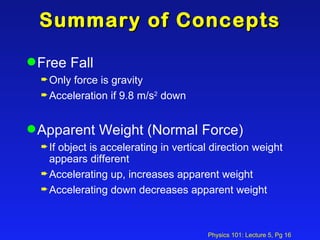
Summary of Concepts Free Fall Only force is gravity Acceleration if 9.8 m/s 2  down Apparent Weight (Normal Force) If object is accelerating in vertical direction weight appears different  Accelerating up, increases apparent weight Accelerating down decreases apparent weight

Lecture05

  • 1.
    Free Fall andApparent Weight Today’s lecture will cover Textbook Sections 4.3,4.5 Check iclicker scores! James scholar paper topics due Fri Sept 24 Exam 1 is Sept 27 Office hours staffed throughout week Physics 101: Lecture 05 Exam I
  • 2.
    Review from Lecture4 Constant Acceleration Equations of Motion x = x 0 + v 0 t + 1/2 at 2 v = v 0 + at v 2 = v 0 2 + 2a(x-x 0 )  F = m a Draw Free Body Diagram Write down equations (which variables do you know, which don’t you know?) Solve Today: look at Gravity as force
  • 3.
    Free Fall Onlyforce acting on object is GRAVITY Newton’s 2 nd Law  F y = ma y Force is Weight = mg (near surface of earth)  F y = ma y -mg = ma y a y = -g (- sign tells us it is in –y direction or down). Acceleration is ALWAYS g downwards Position may be positive, zero or negative Velocity may be positive, zero or negative Acceleration is always g downwards y = y 0 + v y0 t - 1/2 gt 2 v y = v y0 - gt v y 2 = v y0 2 - 2g(y-y 0 ) y x
  • 4.
    Free Fall Onlyforce acting on object is GRAVITY Acceleration is ALWAYS g downwards Which will hit the ground first? A ) Ball B) Same C) Feather Note : Free fall only works when air resistance is negligible! y x
  • 5.
    ACT The speedof an object in free fall (Neglect Air Resistance!) Always increases. is constant. Always decreases. May increase or decrease or be constant. May increase or decrease but is never constant. a = -g. Velocity becomes more and more negative. If v > 0, speed decreases. If v <= 0 speed increases.
  • 6.
    Free Fall ACTS Fred throws a ball 30 mph vertically upward. Which of the following statements are true about the ball’s velocity and acceleration. (Let up be the positive direction) On the way up? On the way down ? A) v < 0 B) v = 0 C) v > 0 A) a < 0 B) a = 0 C) a > 0 A) v < 0 B) v = 0 C) v > 0 A) a < 0 B) a = 0 C) a > 0
  • 7.
    ACT Fredthrows a ball 30 mph vertically upward and then catches it again at the same height he threw it from. What is the speed of the ball when he catches it? (Neglect air resistance) 1) v < 30 mph 2) v = 30 mph 3) v > 30 mph v y 2 = v y0 2 - 2g(y-y 0 ) v y 2 = v y0 2
  • 8.
    Free Fall Example Fred throws a ball 30 m/s vertically upward. What is the maximum height the ball reaches? How long does it take to reach this height? v 2 -v o 2 = 2 a  y  y = (v 2 -v o 2 )/ (2 a) = -30 2 / (2 * -9.8) = 46 m. v = v 0 + a t t = (v-v 0 ) / a = (0 – 30 m/s )/ (-9.8 m/s 2 ) = 3.1 seconds
  • 9.
    Dennis and Carmenare standing on the edge of a cliff. Dennis throws a basketball vertically upward, and at the same time Carmen throws a basketball vertically downward with the same initial speed. You are standing below the cliff observing this strange behavior. Whose ball hits the ground first? A. Dennis' ball B. Carmen's ball C. Same ACT y = y o +v o t + ½ a t 2 Dennis: 0 = H + v o t - ½ g t 2 Carmen: 0 = H - v o t - ½ g t 2 v 0 v 0 Dennis Carmen H v A v B
  • 10.
    Dennis and Carmenare standing on the edge of a cliff. Dennis throws a basketball vertically upward, and at the same time Carmen throws a basketball vertically downward with the same initial speed. You are standing below the cliff observing this strange behavior. Whose ball is moving fastest when it hits the ground? A. Dennis' ball B. Carmen's ball C. Same ACT v 0 v 0 Dennis Carmen H v A v B Correct : v 2 = v 0 2 -2g  y
  • 11.
    Apparent Weight Recall:  F = m a Consider person accelerating up in an elevator. Draw FBD Apply NSL N – mg = ma N = m(g+a) Apparent weight is normal force from scale or floor. Note: in free fall a y =-g so N=0 mg N y x
  • 12.
    Apparent Weight PreflightYou are traveling up on an elevator to the 30 th floor of the Sears (OK, Willis) tower. As it nears the 30 th floor, your weight appears to be 1) heavier 2) the same 3) lighter  F y = ma y N – mg = ma y N = m(g+a) a < 0. so N < mg 50% 19% 31% “ Acceleration is downward (causing you to slow down), so in our case, acceleration would be negative and using the equation: F=m(g+a), F=m(g-a); thus you would be lighter.” mg N
  • 13.
    Great Explanations! (WrongAnswer) “ Because as you go up higher gravity decreases. ” “ Unless the elevator was accelerating, which it does not state in the question that it is, the weight would be unchanged because the acceleration is 0.” “ Because accelerating up increases apparent weight.”
  • 14.
    Apparent Weight ExamplesA person has mass 50 kg. What is their apparent weight when they are riding on an elevator Going up with constant speed 9.8 m/s Going down with constant speed 9.8 m/s Accelerating up at a rate of 9.8 m/s 2 Accelerating down at a rate of 9.8 m/s 2 N = m(g+a) a = 0 so N= mg = 490 Newtons a = 0 so N= mg = 490 Newtons a = +9.8 m/s so N= 2 mg = 980 Newtons a = -9.8 m/s so N= 0 mg = 0 Newtons
  • 15.
    Apparent Weight ACTsYou are standing on a scale inside an elevator. You weigh 125 pounds, but the scale reads 140 pounds. The elevator is going ( up down can’t tell ) The elevator is accelerating ( up down can’t tell ) 45 N = m(g+a) Weight increases when accelerating up decreases when accelerating down. A B C A B C y x
  • 16.
    Summary of ConceptsFree Fall Only force is gravity Acceleration if 9.8 m/s 2 down Apparent Weight (Normal Force) If object is accelerating in vertical direction weight appears different Accelerating up, increases apparent weight Accelerating down decreases apparent weight

Editor's Notes

  • #4 Demos penny and feather. First with air resistance, then without.
  • #5 Demos penny and feather. First with air resistance, then without.
  • #9 Have students make plot?