Change in VelocityChange in Velocity
 Each time you take a step youEach time you take a step you
are changing the velocity ofare changing the velocity of
your body.your body.
 You are probably most familiarYou are probably most familiar
with the velocity changes of awith the velocity changes of a
moving bus or car.moving bus or car.
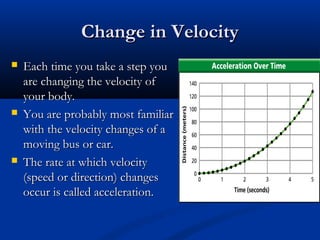
 The rate at which velocityThe rate at which velocity
(speed or direction) changes(speed or direction) changes
occur is called acceleration.occur is called acceleration.
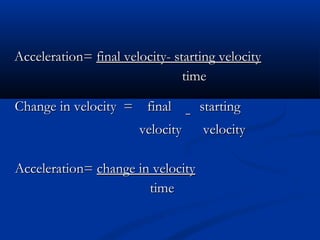
Acceleration=Acceleration= final velocity- starting velocityfinal velocity- starting velocity
timetime
Change in velocity = finalChange in velocity = final
–– startingstarting
velocity velocityvelocity velocity
Acceleration=Acceleration= change in velocitychange in velocity
timetime
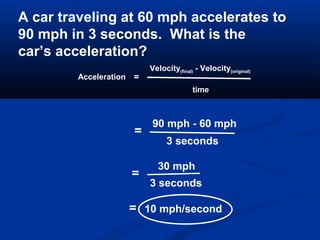
Acceleration =
Velocity(final) - Velocity(original)
time
A car traveling at 60 mph accelerates to
90 mph in 3 seconds. What is the
car’s acceleration?
=
90 mph - 60 mph
3 seconds
=
30 mph
3 seconds
= 10 mph/second
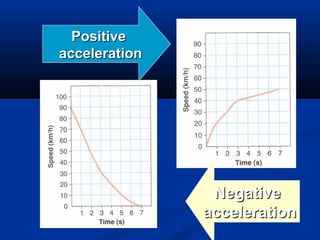
PositivePositive
accelerationacceleration
NegativeNegative
accelerationacceleration
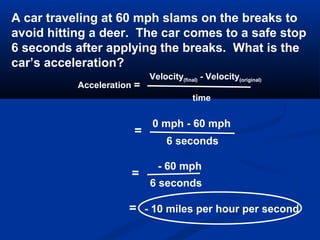
Acceleration =
Velocity(final) - Velocity(original)
time
A car traveling at 60 mph slams on the breaks to
avoid hitting a deer. The car comes to a safe stop
6 seconds after applying the breaks. What is the
car’s acceleration?
=
0 mph - 60 mph
6 seconds
=
- 60 mph
6 seconds
= - 10 miles per hour per second
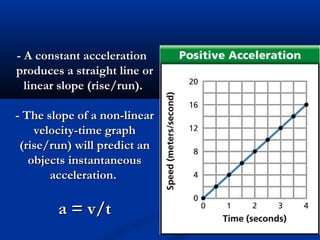
- A constant acceleration- A constant acceleration
produces a straight line orproduces a straight line or
linear slope (rise/run).linear slope (rise/run).
- The slope of a non-linear- The slope of a non-linear
velocity-time graphvelocity-time graph
(rise/run) will predict an(rise/run) will predict an
objects instantaneousobjects instantaneous
acceleration.acceleration.
a = v/ta = v/t
Free fallFree fall
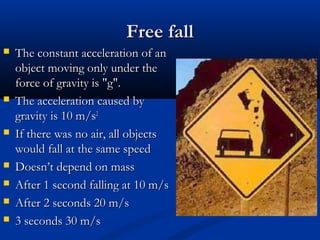
 The constant acceleration of anThe constant acceleration of an
object moving only under theobject moving only under the
force of gravity is "g".force of gravity is "g".
 The acceleration caused byThe acceleration caused by
gravity is 10 m/sgravity is 10 m/s22
 If there was no air, all objectsIf there was no air, all objects
would fall at the same speedwould fall at the same speed
 Doesn’t depend on massDoesn’t depend on mass
 After 1 second falling at 10 m/sAfter 1 second falling at 10 m/s
 After 2 seconds 20 m/sAfter 2 seconds 20 m/s
 3 seconds 30 m/s3 seconds 30 m/s
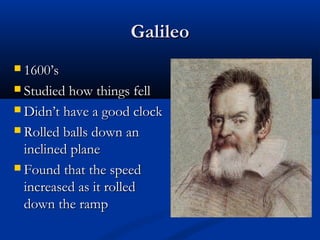
GalileoGalileo
 1600’s1600’s
 Studied how things fellStudied how things fell
 Didn’t have a good clockDidn’t have a good clock
 Rolled balls down anRolled balls down an
inclined planeinclined plane
 Found that the speedFound that the speed
increased as it rolledincreased as it rolled
down the rampdown the ramp
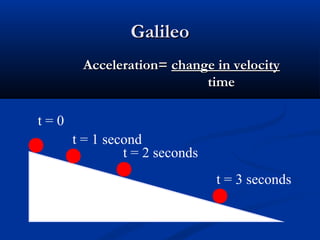
GalileoGalileo
t = 0
t = 1 second
t = 2 seconds
t = 3 seconds
Acceleration=Acceleration= change in velocitychange in velocity
timetime
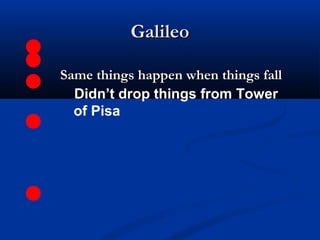
GalileoGalileo
Same things happen when things fallSame things happen when things fall
Didn’t drop things from Tower
of Pisa
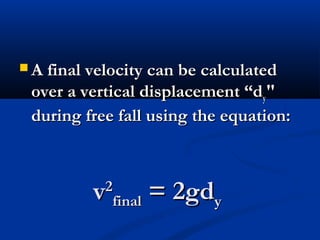
vv22
finalfinal = 2gd= 2gdyy
 A final velocity can be calculatedA final velocity can be calculated
over a vertical displacement “dover a vertical displacement “dyy""
during free fall using the equation:during free fall using the equation:
ddyy = 1/2 gt= 1/2 gt22
 The vertical displacement “dThe vertical displacement “dyy" that" that
occurs during a specific time of free falloccurs during a specific time of free fall
can be determined using the equation:can be determined using the equation:
 Or a time interval can also beOr a time interval can also be
determined over a specified distancedetermined over a specified distance
of freefall using the equation:of freefall using the equation:
tt22
= 2d= 2dyy /g/g
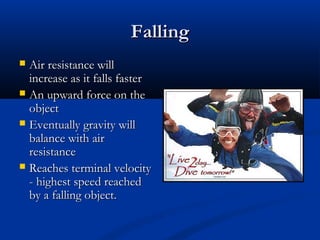
FallingFalling
 Air resistance willAir resistance will
increase as it falls fasterincrease as it falls faster
 An upward force on theAn upward force on the
objectobject
 Eventually gravity willEventually gravity will
balance with airbalance with air
resistanceresistance
 Reaches terminal velocityReaches terminal velocity
- highest speed reached- highest speed reached
by a falling object.by a falling object.
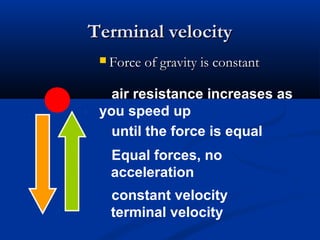
Terminal velocityTerminal velocity
 Force of gravity is constantForce of gravity is constant
air resistance increases as
you speed up
until the force is equal
Equal forces, no
acceleration
constant velocity
terminal velocity

Acceleration

  • 2.
    Change in VelocityChangein Velocity  Each time you take a step youEach time you take a step you are changing the velocity ofare changing the velocity of your body.your body.  You are probably most familiarYou are probably most familiar with the velocity changes of awith the velocity changes of a moving bus or car.moving bus or car.  The rate at which velocityThe rate at which velocity (speed or direction) changes(speed or direction) changes occur is called acceleration.occur is called acceleration.
  • 3.
    Acceleration=Acceleration= final velocity-starting velocityfinal velocity- starting velocity timetime Change in velocity = finalChange in velocity = final –– startingstarting velocity velocityvelocity velocity Acceleration=Acceleration= change in velocitychange in velocity timetime
  • 4.
    Acceleration = Velocity(final) -Velocity(original) time A car traveling at 60 mph accelerates to 90 mph in 3 seconds. What is the car’s acceleration? = 90 mph - 60 mph 3 seconds = 30 mph 3 seconds = 10 mph/second
  • 5.
  • 6.
    Acceleration = Velocity(final) -Velocity(original) time A car traveling at 60 mph slams on the breaks to avoid hitting a deer. The car comes to a safe stop 6 seconds after applying the breaks. What is the car’s acceleration? = 0 mph - 60 mph 6 seconds = - 60 mph 6 seconds = - 10 miles per hour per second
  • 7.
    - A constantacceleration- A constant acceleration produces a straight line orproduces a straight line or linear slope (rise/run).linear slope (rise/run). - The slope of a non-linear- The slope of a non-linear velocity-time graphvelocity-time graph (rise/run) will predict an(rise/run) will predict an objects instantaneousobjects instantaneous acceleration.acceleration. a = v/ta = v/t
  • 8.
    Free fallFree fall The constant acceleration of anThe constant acceleration of an object moving only under theobject moving only under the force of gravity is "g".force of gravity is "g".  The acceleration caused byThe acceleration caused by gravity is 10 m/sgravity is 10 m/s22  If there was no air, all objectsIf there was no air, all objects would fall at the same speedwould fall at the same speed  Doesn’t depend on massDoesn’t depend on mass  After 1 second falling at 10 m/sAfter 1 second falling at 10 m/s  After 2 seconds 20 m/sAfter 2 seconds 20 m/s  3 seconds 30 m/s3 seconds 30 m/s
  • 9.
    GalileoGalileo  1600’s1600’s  Studiedhow things fellStudied how things fell  Didn’t have a good clockDidn’t have a good clock  Rolled balls down anRolled balls down an inclined planeinclined plane  Found that the speedFound that the speed increased as it rolledincreased as it rolled down the rampdown the ramp
  • 10.
    GalileoGalileo t = 0 t= 1 second t = 2 seconds t = 3 seconds Acceleration=Acceleration= change in velocitychange in velocity timetime
  • 11.
    GalileoGalileo Same things happenwhen things fallSame things happen when things fall Didn’t drop things from Tower of Pisa
  • 12.
    vv22 finalfinal = 2gd=2gdyy  A final velocity can be calculatedA final velocity can be calculated over a vertical displacement “dover a vertical displacement “dyy"" during free fall using the equation:during free fall using the equation:
  • 13.
    ddyy = 1/2gt= 1/2 gt22  The vertical displacement “dThe vertical displacement “dyy" that" that occurs during a specific time of free falloccurs during a specific time of free fall can be determined using the equation:can be determined using the equation:  Or a time interval can also beOr a time interval can also be determined over a specified distancedetermined over a specified distance of freefall using the equation:of freefall using the equation: tt22 = 2d= 2dyy /g/g
  • 14.
    FallingFalling  Air resistancewillAir resistance will increase as it falls fasterincrease as it falls faster  An upward force on theAn upward force on the objectobject  Eventually gravity willEventually gravity will balance with airbalance with air resistanceresistance  Reaches terminal velocityReaches terminal velocity - highest speed reached- highest speed reached by a falling object.by a falling object.
  • 15.
    Terminal velocityTerminal velocity Force of gravity is constantForce of gravity is constant air resistance increases as you speed up until the force is equal Equal forces, no acceleration constant velocity terminal velocity