Motion under
constant
Acceleration
Edit by: Muhammad Faheem
Roll no /21CH057/
ENGINEERING
MECHANICS
Presentation Conduct By: Dr Fahad abro
2
Motion with constant acceleration in 1D
Kinematic equations
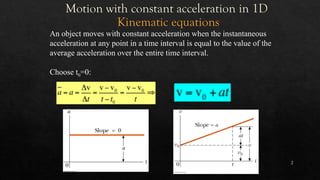
An object moves with constant acceleration when the instantaneous
acceleration at any point in a time interval is equal to the value of the
average acceleration over the entire time interval.
Choose t0=0:
08/11/2024 3
Motion with constant acceleration in 1D
Kinematic equations (II)
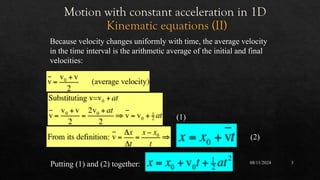
Because velocity changes uniformly with time, the average velocity
in the time interval is the arithmetic average of the initial and final
velocities:
(1)
(2)
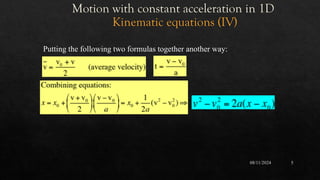
Putting (1) and (2) together:
08/11/2024 4
Motion with constant acceleration in 1D
Kinematic equations (III)
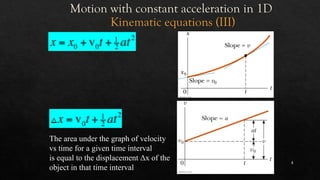
The area under the graph of velocity
vs time for a given time interval
is equal to the displacement Δx of the
object in that time interval
08/11/2024 5
Motion with constant acceleration in 1D
Kinematic equations (IV)
Putting the following two formulas together another way:
08/11/2024 6
Motion with constant acceleration
in 1D
Kinematic equations (V)
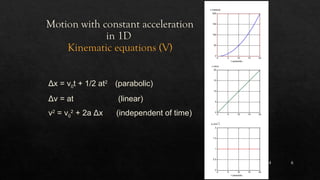
Δx = v0t + 1/2 at2
(parabolic)
Δv = at (linear)
v2
= v0
2
+ 2a Δx (independent of time) 0
5
10
15
20
0 5 10 15 20
v (m/s)
t (seconds)
0
50
100
150
200
0 5 10 15 20
x (meters)
t (seconds)
0
0.5
1
1.5
2
0 5 10 15 20
a (m/s
2
)
t (seconds)
08/11/2024 7
Use of Kinematic Equations
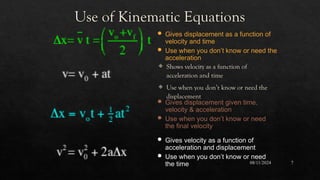
 Shows velocity as a function of
acceleration and time
 Use when you don’t know or need the
displacement
 Gives displacement as a function of
velocity and time
 Use when you don’t know or need the
acceleration
 Gives displacement given time,
velocity & acceleration
 Use when you don’t know or need
the final velocity
 Gives velocity as a function of
acceleration and displacement
 Use when you don’t know or need
the time
Example for motion with a=const in 1D:
Free fall
08/11/2024 8
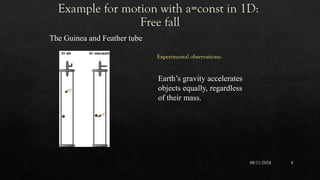
The Guinea and Feather tube
Earth’s gravity accelerates
objects equally, regardless
of their mass.
Experimental observations:
08/11/2024 9
Free Fall Principles
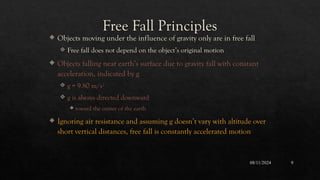
 Objects moving under the influence of gravity only are in free fall
 Free fall does not depend on the object’s original motion
 Objects falling near earth’s surface due to gravity fall with constant
acceleration, indicated by g
 g = 9.80 m/s2
 g is always directed downward
 toward the center of the earth
 Ignoring air resistance and assuming g doesn’t vary with altitude over
short vertical distances, free fall is constantly accelerated motion
08/11/2024 10
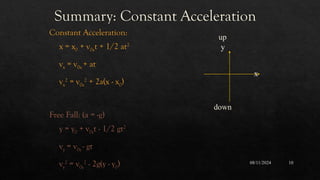
Summary: Constant Acceleration
Constant Acceleration:
x = x0 + v0xt + 1/2 at2
vx = v0x + at
vx
2
= v0x
2
+ 2a(x - x0)
Free Fall: (a = -g)
y = y0 + v0yt - 1/2 gt2
vy = v0y - gt
vy
2
= v0y
2
- 2g(y - y0)
x
y
up
down
08/11/2024 11
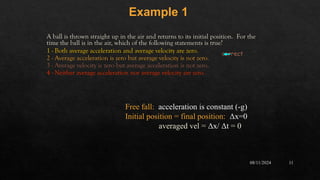
A ball is thrown straight up in the air and returns to its initial position. For the
time the ball is in the air, which of the following statements is true?
1 - Both average acceleration and average velocity are zero.
2 - Average acceleration is zero but average velocity is not zero.
3 - Average velocity is zero but average acceleration is not zero.
4 - Neither average acceleration nor average velocity are zero.
Example 1
correct
Free fall: acceleration is constant (-g)
Initial position = final position: Δx=0
averaged vel = Δx/ Δt = 0
08/11/2024 12
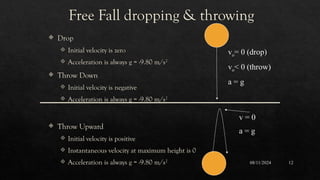
Free Fall dropping & throwing
 Drop
 Initial velocity is zero
 Acceleration is always g = -9.80 m/s2
 Throw Down
 Initial velocity is negative
 Acceleration is always g = -9.80 m/s2
 Throw Upward
 Initial velocity is positive
 Instantaneous velocity at maximum height is 0
 Acceleration is always g = -9.80 m/s2
vo= 0 (drop)
vo< 0 (throw)
a = g
v = 0
a = g
08/11/2024 13
A ball is thrown downward (not dropped) from the top of a
tower. After being released, its downward acceleration will
be:
1. greater than g
2. exactly g
3. smaller than g
Throwing Down Question
08/11/2024 14
Example 2
A ball is thrown vertically upward. At the very top of its trajectory, which of the
following statements is true:
1. velocity is zero and acceleration is zero
2. velocity is not zero and acceleration is zero
3. velocity is zero and acceleration is not zero
4. velocity is not zero and acceleration is not zero correct
Acceleration is the change in velocity. Just because the
velocity is zero does not mean that it is not changing.
At the top of the path, the velocity of the ball is zero,
but the acceleration is not zero. The velocity at the top
is changing, and the acceleration is the rate at which
velocity changes.
Acceleration is not zero since it is due to gravity
and is always a downward-pointing vector.
08/11/2024 15
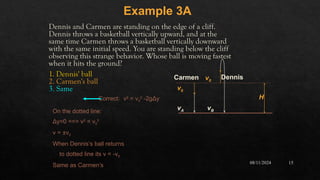
Dennis and Carmen are standing on the edge of a cliff.
Dennis throws a basketball vertically upward, and at the
same time Carmen throws a basketball vertically downward
with the same initial speed. You are standing below the cliff
observing this strange behavior. Whose ball is moving fastest
when it hits the ground?
1. Dennis' ball
2. Carmen's ball
3. Same
v0
v0
Dennis
Carmen
H
vA vB
Example 3A
Correct: v2
= v0
2
-2gΔy
On the dotted line:
Δy=0 ==> v2
= v0
2
v = ±v0
When Dennis’s ball returns
to dotted line its v = -v0
Same as Carmen’s
08/11/2024 16
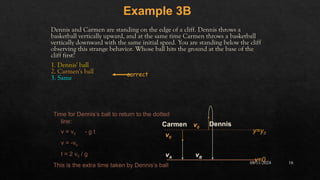
Dennis and Carmen are standing on the edge of a cliff. Dennis throws a
basketball vertically upward, and at the same time Carmen throws a basketball
vertically downward with the same initial speed. You are standing below the cliff
observing this strange behavior. Whose ball hits the ground at the base of the
cliff first?
1. Dennis' ball
2. Carmen's ball
3. Same
Example 3B
correct
v0
v0
Dennis
Carmen
y=y0
vA vB
y=0
Time for Dennis’s ball to return to the dotted
line:
v = v0 - g t
v = -v0
t = 2 v0 / g
This is the extra time taken by Dennis’s ball
08/11/2024 17
Example 4
An object is dropped from rest. If it falls a distance D in time t then
how far will if fall in a time 2t ?
1. D/4
2. D/2
3. D
4. 2D
5. 4D Correct x=1/2 at2
Follow-up question: If the object has speed v at
time t then what is the speed at time 2t ?
1. v/4
2. v/2
3. v
4. 2v
5. 4v
Correct v=at
08/11/2024 18
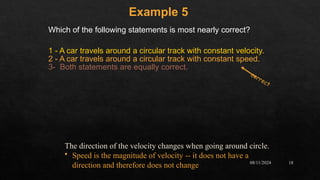
Which of the following statements is most nearly correct?
1 - A car travels around a circular track with constant velocity.
2 - A car travels around a circular track with constant speed.
3- Both statements are equally correct.
Example 5
correct
The direction of the velocity changes when going around circle.
• Speed is the magnitude of velocity -- it does not have a
direction and therefore does not change

fimee presentation motion under constant EM.pptx

  • 1.
    Motion under constant Acceleration Edit by:Muhammad Faheem Roll no /21CH057/ ENGINEERING MECHANICS Presentation Conduct By: Dr Fahad abro
  • 2.
    2 Motion with constantacceleration in 1D Kinematic equations An object moves with constant acceleration when the instantaneous acceleration at any point in a time interval is equal to the value of the average acceleration over the entire time interval. Choose t0=0:
  • 3.
    08/11/2024 3 Motion withconstant acceleration in 1D Kinematic equations (II) Because velocity changes uniformly with time, the average velocity in the time interval is the arithmetic average of the initial and final velocities: (1) (2) Putting (1) and (2) together:
  • 4.
    08/11/2024 4 Motion withconstant acceleration in 1D Kinematic equations (III) The area under the graph of velocity vs time for a given time interval is equal to the displacement Δx of the object in that time interval
  • 5.
    08/11/2024 5 Motion withconstant acceleration in 1D Kinematic equations (IV) Putting the following two formulas together another way:
  • 6.
    08/11/2024 6 Motion withconstant acceleration in 1D Kinematic equations (V) Δx = v0t + 1/2 at2 (parabolic) Δv = at (linear) v2 = v0 2 + 2a Δx (independent of time) 0 5 10 15 20 0 5 10 15 20 v (m/s) t (seconds) 0 50 100 150 200 0 5 10 15 20 x (meters) t (seconds) 0 0.5 1 1.5 2 0 5 10 15 20 a (m/s 2 ) t (seconds)
  • 7.
    08/11/2024 7 Use ofKinematic Equations  Shows velocity as a function of acceleration and time  Use when you don’t know or need the displacement  Gives displacement as a function of velocity and time  Use when you don’t know or need the acceleration  Gives displacement given time, velocity & acceleration  Use when you don’t know or need the final velocity  Gives velocity as a function of acceleration and displacement  Use when you don’t know or need the time
  • 8.
    Example for motionwith a=const in 1D: Free fall 08/11/2024 8 The Guinea and Feather tube Earth’s gravity accelerates objects equally, regardless of their mass. Experimental observations:
  • 9.
    08/11/2024 9 Free FallPrinciples  Objects moving under the influence of gravity only are in free fall  Free fall does not depend on the object’s original motion  Objects falling near earth’s surface due to gravity fall with constant acceleration, indicated by g  g = 9.80 m/s2  g is always directed downward  toward the center of the earth  Ignoring air resistance and assuming g doesn’t vary with altitude over short vertical distances, free fall is constantly accelerated motion
  • 10.
    08/11/2024 10 Summary: ConstantAcceleration Constant Acceleration: x = x0 + v0xt + 1/2 at2 vx = v0x + at vx 2 = v0x 2 + 2a(x - x0) Free Fall: (a = -g) y = y0 + v0yt - 1/2 gt2 vy = v0y - gt vy 2 = v0y 2 - 2g(y - y0) x y up down
  • 11.
    08/11/2024 11 A ballis thrown straight up in the air and returns to its initial position. For the time the ball is in the air, which of the following statements is true? 1 - Both average acceleration and average velocity are zero. 2 - Average acceleration is zero but average velocity is not zero. 3 - Average velocity is zero but average acceleration is not zero. 4 - Neither average acceleration nor average velocity are zero. Example 1 correct Free fall: acceleration is constant (-g) Initial position = final position: Δx=0 averaged vel = Δx/ Δt = 0
  • 12.
    08/11/2024 12 Free Falldropping & throwing  Drop  Initial velocity is zero  Acceleration is always g = -9.80 m/s2  Throw Down  Initial velocity is negative  Acceleration is always g = -9.80 m/s2  Throw Upward  Initial velocity is positive  Instantaneous velocity at maximum height is 0  Acceleration is always g = -9.80 m/s2 vo= 0 (drop) vo< 0 (throw) a = g v = 0 a = g
  • 13.
    08/11/2024 13 A ballis thrown downward (not dropped) from the top of a tower. After being released, its downward acceleration will be: 1. greater than g 2. exactly g 3. smaller than g Throwing Down Question
  • 14.
    08/11/2024 14 Example 2 Aball is thrown vertically upward. At the very top of its trajectory, which of the following statements is true: 1. velocity is zero and acceleration is zero 2. velocity is not zero and acceleration is zero 3. velocity is zero and acceleration is not zero 4. velocity is not zero and acceleration is not zero correct Acceleration is the change in velocity. Just because the velocity is zero does not mean that it is not changing. At the top of the path, the velocity of the ball is zero, but the acceleration is not zero. The velocity at the top is changing, and the acceleration is the rate at which velocity changes. Acceleration is not zero since it is due to gravity and is always a downward-pointing vector.
  • 15.
    08/11/2024 15 Dennis andCarmen are standing on the edge of a cliff. Dennis throws a basketball vertically upward, and at the same time Carmen throws a basketball vertically downward with the same initial speed. You are standing below the cliff observing this strange behavior. Whose ball is moving fastest when it hits the ground? 1. Dennis' ball 2. Carmen's ball 3. Same v0 v0 Dennis Carmen H vA vB Example 3A Correct: v2 = v0 2 -2gΔy On the dotted line: Δy=0 ==> v2 = v0 2 v = ±v0 When Dennis’s ball returns to dotted line its v = -v0 Same as Carmen’s
  • 16.
    08/11/2024 16 Dennis andCarmen are standing on the edge of a cliff. Dennis throws a basketball vertically upward, and at the same time Carmen throws a basketball vertically downward with the same initial speed. You are standing below the cliff observing this strange behavior. Whose ball hits the ground at the base of the cliff first? 1. Dennis' ball 2. Carmen's ball 3. Same Example 3B correct v0 v0 Dennis Carmen y=y0 vA vB y=0 Time for Dennis’s ball to return to the dotted line: v = v0 - g t v = -v0 t = 2 v0 / g This is the extra time taken by Dennis’s ball
  • 17.
    08/11/2024 17 Example 4 Anobject is dropped from rest. If it falls a distance D in time t then how far will if fall in a time 2t ? 1. D/4 2. D/2 3. D 4. 2D 5. 4D Correct x=1/2 at2 Follow-up question: If the object has speed v at time t then what is the speed at time 2t ? 1. v/4 2. v/2 3. v 4. 2v 5. 4v Correct v=at
  • 18.
    08/11/2024 18 Which ofthe following statements is most nearly correct? 1 - A car travels around a circular track with constant velocity. 2 - A car travels around a circular track with constant speed. 3- Both statements are equally correct. Example 5 correct The direction of the velocity changes when going around circle. • Speed is the magnitude of velocity -- it does not have a direction and therefore does not change

Editor's Notes

  • #10 Braking distance: When braking from 100 km/h to 0 km/h, one needs distance x. When braking from 200 km/h to 0 km/h, one needs 4x ! Because if one assumes that deceleration is constant, a, than the time it needs to get the velocity from 100 to zero is t and the time for 200 to 0 is 2 times t (linear dependence on t) while distance depends quadratically on t.