TEACHER ORIENTED METHOD:
LECTURE METHOD
Bincy Varghese
Physical Science
Mount Tabor Training College, Pathanapuram
INTRODUCTION
• Different methods and techniques available for use in the classroom
• Selection of suitable method depends on the
(i) objectives of the lesson
(ii) need of the learner
(iii) nature of the content
• The teacher should know the advantages and disadvantages with respect to other methods
• Lecture method is the most commonly used method of teaching science
METHODS OF TEACHING PHYSICAL SCIENCE
• It is defined as the manner in which teachers impart knowledge and skills while teaching,
and students acquire this knowledge and skill in the process of learning.
• Zurev classified the teaching methods into:
oral observation practical
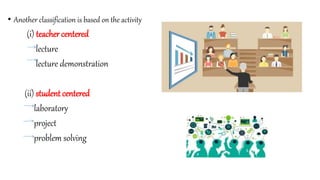
• Another classification is based on the activity
(i) teachercentered
lecture
lecture demonstration
(ii) student centered
laboratory
project
problem solving
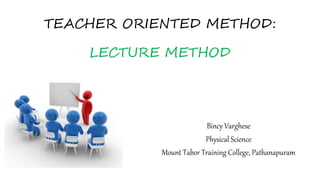
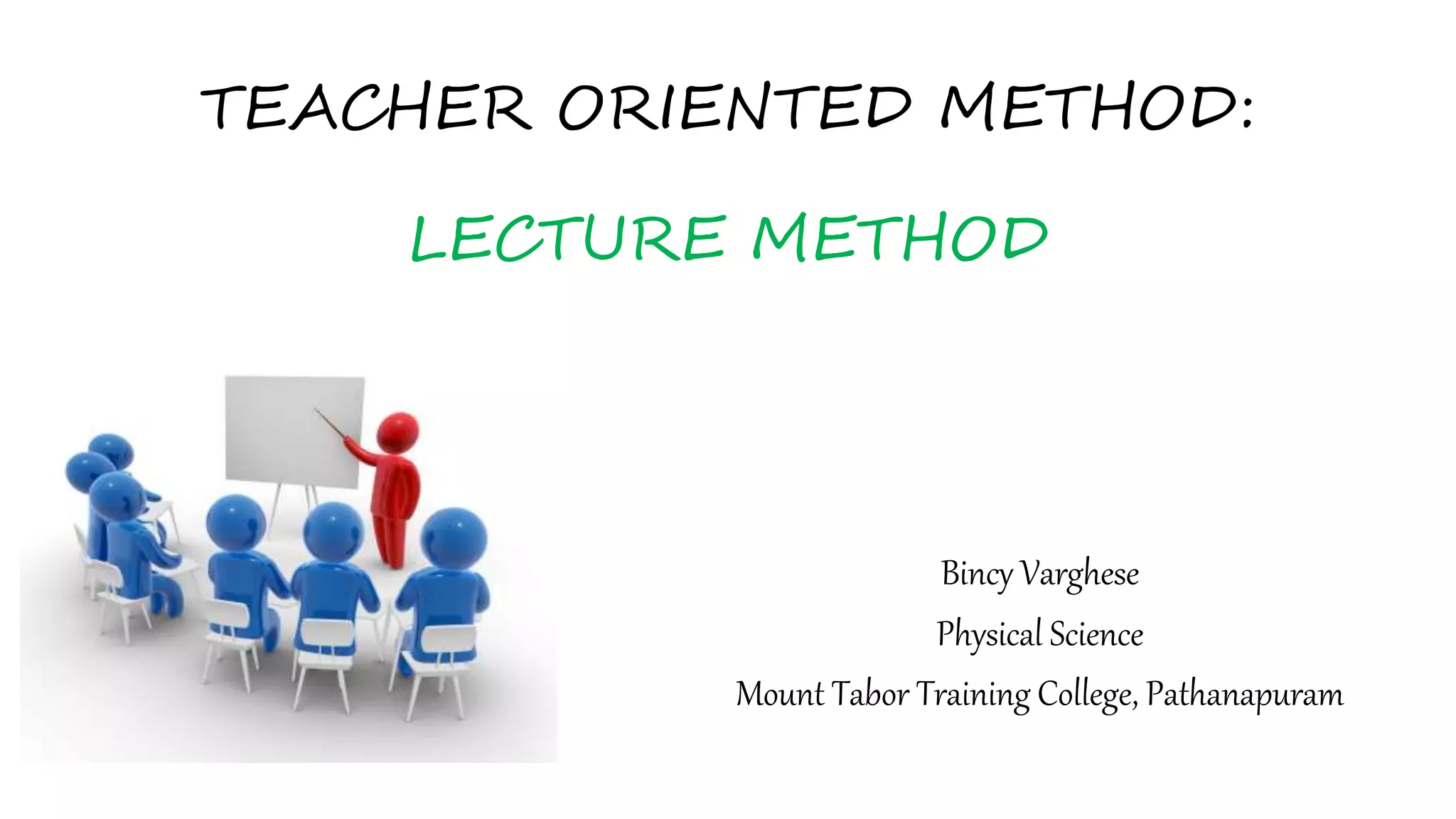
LECTURE METHOD
• Latin word - ‘ lectus ’ : to read
• oldest and most basic teaching method
• teacher centeredmethod / teacher structured / teacher
initiated
• teacher teaches orally to a group
• students are just passive listeners
• commonly used in schools and colleges
• “ Lecture is a pedagogical method whereby the teacher formally delivers
a carefully planned expository address on some particular topic ”-
JAMES MICHAEL LEE
• Wasley, Edgar B, Wronski, Stanley P suggested that lecture method
serves four basic purposes :-
- to motivate
- to clarify
- to review
- to expand
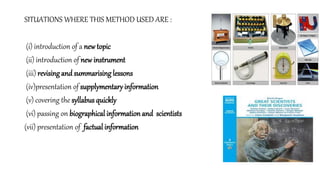
SITUATIONS WHERE THIS METHOD USED ARE :
(i) introduction of a newtopic
(ii) introduction of new instrument
(iii) revising and summarising lessons
(iv)presentation of supplymentary information
(v) covering the syllabus quickly
(vi) passing on biographical information and scientists
(vii) presentation of factual information
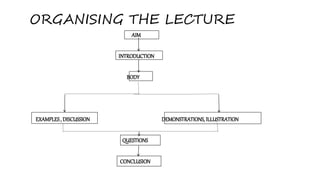
ORGANISING THE LECTURE
AIM
INTRODUCTION
BODY
EXAMPLES, DISCUSSION DEMONSTRATIONS, ILLUSTRATION
QUESTIONS
CONCLUSION
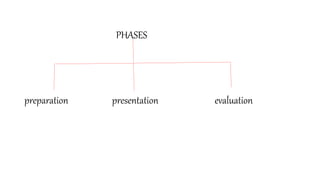
PHASES
preparation presentation evaluation
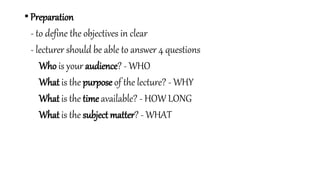
• Preparation
- to define the objectives in clear
- lecturer should be able to answer 4 questions
Who is your audience? - WHO
What is the purpose of the lecture? - WHY
What is the time available? - HOW LONG
What is the subject matter? - WHAT
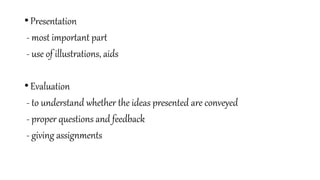
• Presentation
- most important part
- use of illustrations, aids
• Evaluation
- to understand whether the ideas presented are conveyed
- proper questions and feedback
- giving assignments
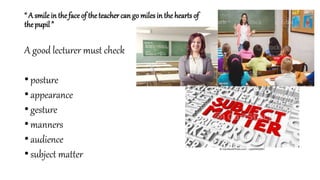
“ A smile in the face of theteacher can go miles in the hearts of
the pupil ”
A good lecturer must check
• posture
• appearance
• gesture
• manners
• audience
• subject matter
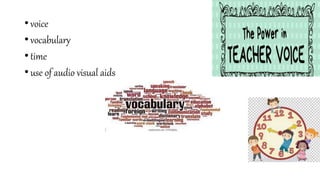
• voice
• vocabulary
• time
• use of audio visual aids
ADVANTAGES
• economical method
• knowledge can be imparted quickly
• attractive and easy to follow
• simplifies the task of teacher
• teacher can develop her own style of
teaching
• easy to impart factual information
and historical anecdotes
• plan the lecture in advance
• good lectures motivate, instigate,
inspire students
DISADVANTAGES
• student participation is negligible -
passive recipents
• teacher is not sure about whether the
students are concentrating and
understanding
• knowledge is imparted so rapidly
• no place for ‘ learning by doing’
• previous knowledge is not taken into
consideration
• doesnot inculcate scientific attitude and training
• doesnot cater to the individual needs and differences
• undemocratic and authoritarian method
• not successful in imparting attitudes and skills
• not able to fix attention more than 40 minutes
CONCLUSION
• suitable for teaching in higher classes - to cover the
prescribed syllabus quickly
--> for imparting factual knowledge
--> introducing new and difficult topic
--> revision of lessons already learnt
• help students who intend to join college
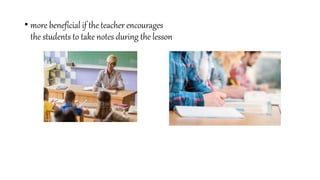
• more beneficial if the teacher encourages
the students to take notes during the lesson
How to make a lecture interesting ????
REFERENCES
• Innovative science teaching for physical science teachers - Radha Mohan
• Teaching of physical science - Amit Kumar
• Instructional strategies and techniques in science education -
Dr. Mariamma Mathew
lecture METHOD.pptx

lecture METHOD.pptx

  • 1.
    TEACHER ORIENTED METHOD: LECTUREMETHOD Bincy Varghese Physical Science Mount Tabor Training College, Pathanapuram
  • 2.
    INTRODUCTION • Different methodsand techniques available for use in the classroom • Selection of suitable method depends on the (i) objectives of the lesson (ii) need of the learner (iii) nature of the content • The teacher should know the advantages and disadvantages with respect to other methods • Lecture method is the most commonly used method of teaching science
  • 3.
    METHODS OF TEACHINGPHYSICAL SCIENCE • It is defined as the manner in which teachers impart knowledge and skills while teaching, and students acquire this knowledge and skill in the process of learning. • Zurev classified the teaching methods into: oral observation practical
  • 4.
    • Another classificationis based on the activity (i) teachercentered lecture lecture demonstration (ii) student centered laboratory project problem solving
  • 5.
    LECTURE METHOD • Latinword - ‘ lectus ’ : to read • oldest and most basic teaching method • teacher centeredmethod / teacher structured / teacher initiated • teacher teaches orally to a group • students are just passive listeners • commonly used in schools and colleges
  • 6.
    • “ Lectureis a pedagogical method whereby the teacher formally delivers a carefully planned expository address on some particular topic ”- JAMES MICHAEL LEE • Wasley, Edgar B, Wronski, Stanley P suggested that lecture method serves four basic purposes :- - to motivate - to clarify - to review - to expand
  • 7.
    SITUATIONS WHERE THISMETHOD USED ARE : (i) introduction of a newtopic (ii) introduction of new instrument (iii) revising and summarising lessons (iv)presentation of supplymentary information (v) covering the syllabus quickly (vi) passing on biographical information and scientists (vii) presentation of factual information
  • 8.
    ORGANISING THE LECTURE AIM INTRODUCTION BODY EXAMPLES,DISCUSSION DEMONSTRATIONS, ILLUSTRATION QUESTIONS CONCLUSION
  • 9.
  • 10.
    • Preparation - todefine the objectives in clear - lecturer should be able to answer 4 questions Who is your audience? - WHO What is the purpose of the lecture? - WHY What is the time available? - HOW LONG What is the subject matter? - WHAT
  • 11.
    • Presentation - mostimportant part - use of illustrations, aids • Evaluation - to understand whether the ideas presented are conveyed - proper questions and feedback - giving assignments
  • 12.
    “ A smilein the face of theteacher can go miles in the hearts of the pupil ” A good lecturer must check • posture • appearance • gesture • manners • audience • subject matter
  • 13.
    • voice • vocabulary •time • use of audio visual aids
  • 14.
    ADVANTAGES • economical method •knowledge can be imparted quickly • attractive and easy to follow • simplifies the task of teacher
  • 15.
    • teacher candevelop her own style of teaching • easy to impart factual information and historical anecdotes • plan the lecture in advance • good lectures motivate, instigate, inspire students
  • 16.
    DISADVANTAGES • student participationis negligible - passive recipents • teacher is not sure about whether the students are concentrating and understanding • knowledge is imparted so rapidly • no place for ‘ learning by doing’ • previous knowledge is not taken into consideration
  • 17.
    • doesnot inculcatescientific attitude and training • doesnot cater to the individual needs and differences • undemocratic and authoritarian method • not successful in imparting attitudes and skills • not able to fix attention more than 40 minutes
  • 18.
    CONCLUSION • suitable forteaching in higher classes - to cover the prescribed syllabus quickly --> for imparting factual knowledge --> introducing new and difficult topic --> revision of lessons already learnt • help students who intend to join college
  • 19.
    • more beneficialif the teacher encourages the students to take notes during the lesson
  • 20.
    How to makea lecture interesting ????
  • 21.
    REFERENCES • Innovative scienceteaching for physical science teachers - Radha Mohan • Teaching of physical science - Amit Kumar • Instructional strategies and techniques in science education - Dr. Mariamma Mathew